Hyperfine versus exchange interaction in the spin dynamics of spatially indirect excitons in CsPbI₃ perovskite nanocrystals
Pith reviewed 2026-06-26 13:19 UTC · model grok-4.3
The pith
For the smallest exchange splittings, hyperfine interaction with nuclear spins dominates the fine structure of indirect excitons in CsPbI3 nanocrystals.
A machine-rendered reading of the paper's core claim, the machinery that carries it, and where it could break.
Core claim
We develop a theory of the polarized photoluminescence of triplet excitons, taking into account the interplay between the electron-hole exchange interaction, their Zeeman effect, and their hyperfine interaction with the nuclei. This model reveals that for the excitons with the smallest exchange splitting we reach the regime, where the exciton fine structure becomes dominated by the hyperfine interaction with the random nuclear spin fluctuations in the NCs.
What carries the argument
The theoretical model for polarized photoluminescence of triplet excitons incorporating electron-hole exchange, Zeeman effect, and hyperfine interaction with nuclei.
Load-bearing premise
The low-energy photoluminescence arises from emission by indirect excitons with electrons and holes spatially separated at the nanocrystal-glass interface.
What would settle it
A measurement showing that the spin dynamics and polarized photoluminescence remain governed by exchange interaction even for the smallest observed exchange splittings would contradict the model.
Figures



read the original abstract
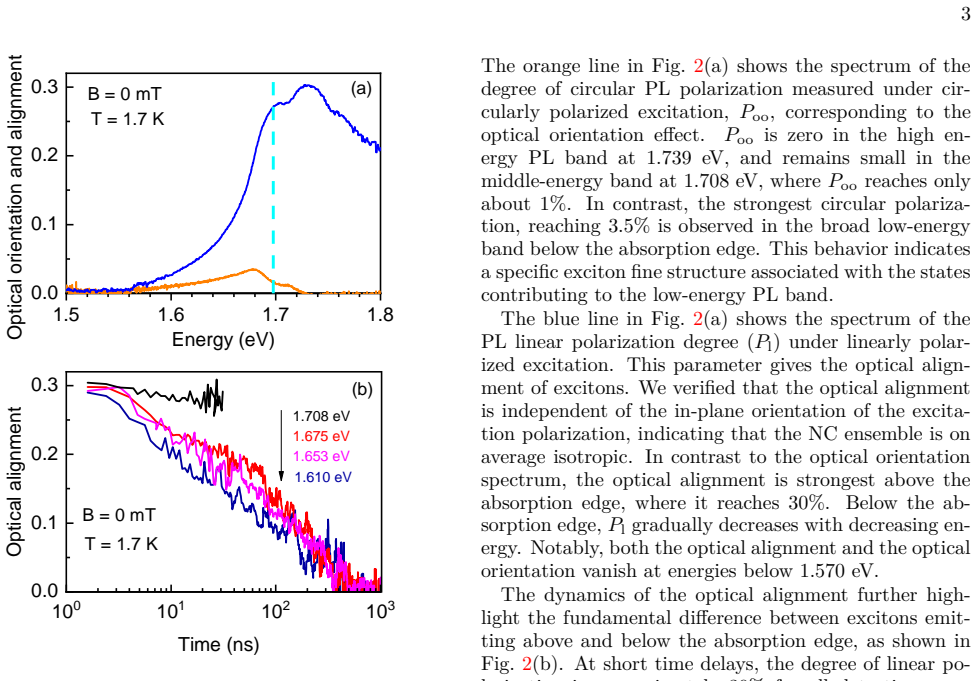
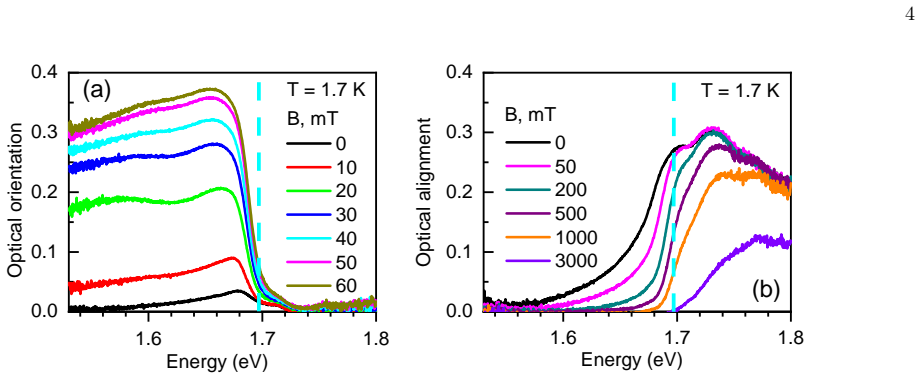
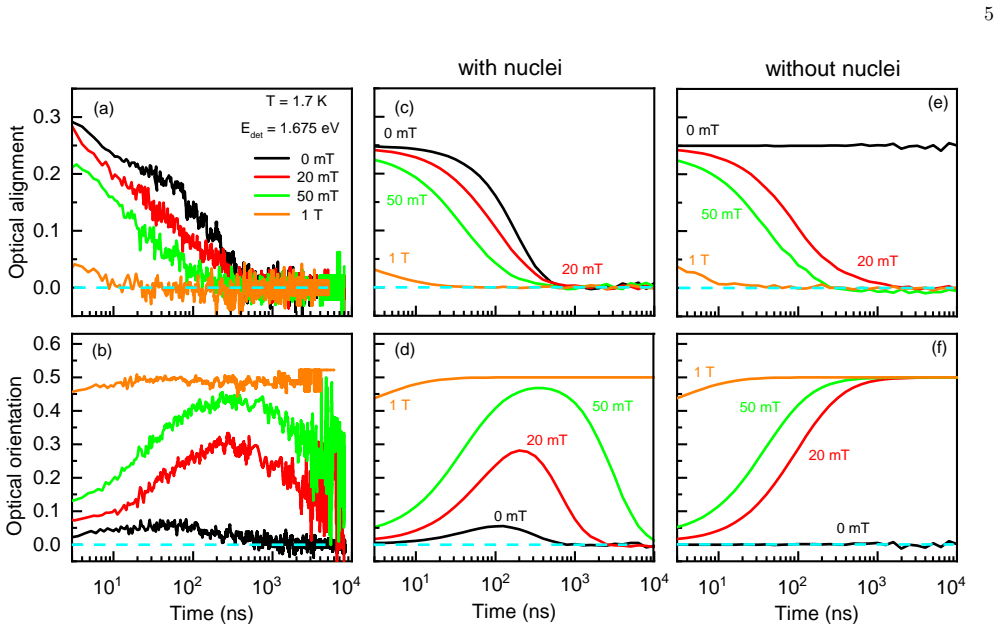
We study the dynamics of recombination, optical orientation, and optical alignment of excitons in ensembles of CsPbI$_{3}$ nanocrystals (NCs), synthesized in a glass matrix. In large NCs with size exceeding 16 nm, the low-energy photoluminescence is contributed by the emission of indirect in real space excitons formed by spatially separated electrons and holes, which are localized at the NC/glass interface. The recombination dynamics of an ensemble of such excitons extends from tens of nanoseconds to microseconds and exhibits a power-law dependence. Their optical alignment and optical orientation reveal a peculiar spin dynamics caused by excitons influenced by the exchange interaction, varying by orders of magnitude. We develop a theory of the polarized photoluminescence of triplet excitons, taking into account the interplay between the electron-hole exchange interaction, their Zeeman effect, and their hyperfine interaction with the nuclei. This model reveals that for the excitons with the smallest exchange splitting we reach the regime, where the exciton fine structure becomes dominated by the hyperfine interaction with the random nuclear spin fluctuations in the NCs.
Editorial analysis
A structured set of objections, weighed in public.
Referee Report
Summary. The paper examines recombination dynamics, optical orientation, and optical alignment of excitons in CsPbI₃ nanocrystals in a glass matrix. It attributes low-energy photoluminescence in NCs larger than 16 nm to emission from spatially indirect (real-space) triplet excitons formed by electrons and holes localized at the NC/glass interface, which exhibit power-law recombination over tens of ns to μs. A theory is developed for the polarized photoluminescence accounting for the interplay of electron-hole exchange interaction (varying over orders of magnitude), Zeeman effect, and hyperfine coupling to nuclear spins; the model concludes that the exciton fine structure enters a hyperfine-dominated regime for those excitons possessing the smallest exchange splittings.
Significance. If the identification of the emitting states holds, the work supplies a concrete theoretical framework linking the distribution of exchange splittings to the crossover into nuclear-fluctuation-dominated spin dynamics. This could explain the observed power-law kinetics and spin relaxation in these systems and offers testable predictions for how optical alignment/orientation depend on magnetic field and NC size.
major comments (2)
- [Abstract and theory section] Abstract and theory section: The central claim that hyperfine interaction dominates the fine structure for the smallest-exchange excitons is load-bearing on the premise that the low-energy PL arises exclusively from spatially indirect excitons whose exchange splitting falls below the nuclear fluctuation scale. No quantitative estimate of the exchange distribution or direct experimental signature (e.g., size-dependent localization or interface-specific Stark shift) is supplied to establish that the observed states actually occupy this regime rather than direct excitons or states with larger exchange.
- [Theory and comparison with experiment] Spin-dynamics modeling: The theory incorporates standard exchange, Zeeman, and hyperfine terms, yet the manuscript does not show explicit numerical solutions or analytic limits (e.g., the condition δ_ex ≪ A_hf) compared against the measured polarization decay curves; without such comparison it remains unclear whether the hyperfine-dominated regime is required to fit the data or whether other parameter choices suffice.
minor comments (2)
- [Theory section] Define the ensemble distribution of exchange splittings explicitly and state the numerical range assumed for hyperfine coupling constants in the NCs.
- [Recombination dynamics] Clarify whether the power-law recombination is derived from the model or introduced phenomenologically.
Simulated Author's Rebuttal
We thank the referee for the careful reading of our manuscript and the constructive comments. We address each major comment below and will revise the manuscript to incorporate additional material where needed.
read point-by-point responses
-
Referee: [Abstract and theory section] Abstract and theory section: The central claim that hyperfine interaction dominates the fine structure for the smallest-exchange excitons is load-bearing on the premise that the low-energy PL arises exclusively from spatially indirect excitons whose exchange splitting falls below the nuclear fluctuation scale. No quantitative estimate of the exchange distribution or direct experimental signature (e.g., size-dependent localization or interface-specific Stark shift) is supplied to establish that the observed states actually occupy this regime rather than direct excitons or states with larger exchange.
Authors: We agree that a quantitative estimate of the exchange splitting distribution would strengthen the identification of the hyperfine-dominated regime. In the revised manuscript we will add such an estimate based on the observed NC size threshold (>16 nm) and the expected variation in interface localization. The power-law recombination extending to microseconds and the abrupt appearance of the low-energy PL band for larger NCs already provide experimental support for the indirect-exciton assignment; we will expand the discussion to include possible interface-specific Stark shifts as additional signatures. The theory section already derives the analytic condition δ_ex ≪ A_hf under which hyperfine fluctuations dominate the fine structure, and the ensemble character of the PL naturally implies a broad distribution that includes the small-δ_ex tail. revision: yes
-
Referee: [Theory and comparison with experiment] Spin-dynamics modeling: The theory incorporates standard exchange, Zeeman, and hyperfine terms, yet the manuscript does not show explicit numerical solutions or analytic limits (e.g., the condition δ_ex ≪ A_hf) compared against the measured polarization decay curves; without such comparison it remains unclear whether the hyperfine-dominated regime is required to fit the data or whether other parameter choices suffice.
Authors: We acknowledge that direct numerical solutions of the spin-dynamics model and explicit comparisons to the measured polarization decay curves would make the necessity of the hyperfine regime clearer. In the revision we will add figures presenting both analytic limits (including δ_ex ≪ A_hf) and numerical solutions of the density-matrix evolution for representative exchange values, Zeeman fields, and hyperfine strengths, overlaid on the experimental optical-orientation and optical-alignment data. These additions will demonstrate that only the hyperfine-dominated regime reproduces the observed slow polarization decay and its magnetic-field dependence. revision: yes
Circularity Check
No circularity: standard Hamiltonian applied to posited indirect-exciton states
full rationale
The derivation applies the conventional triplet-exciton Hamiltonian (electron-hole exchange + Zeeman + hyperfine) to the ensemble of spatially indirect excitons whose existence is stated as an input in the abstract and theory section. No equation reduces a fitted parameter to a 'prediction' by construction, no uniqueness theorem is imported from self-citation, and the hyperfine-dominated regime is obtained only for the subset of states whose exchange splitting is smaller than the nuclear fluctuation scale—an outcome that follows directly from the standard terms once the indirect-exciton premise is granted. The paper therefore remains self-contained against external benchmarks.
Axiom & Free-Parameter Ledger
free parameters (1)
- exchange interaction strength
axioms (1)
- domain assumption Excitons are triplet states whose polarized photoluminescence is governed by exchange, Zeeman, and hyperfine interactions
Reference graph
Works this paper leans on
-
[1]
The corre- sponding typical field of the nuclear spin fluctuations is ∆ B =ℏ/( √ 2T∗ 2gµB). We take into account the nuclear spin dynamics by the Markov switching between all the values in the distribution (7) with the correlation time τc [74–76], which is much longer thanT∗
-
[2]
For the SIE this is not the case
Note that the same Hamiltonian (6) is also relevant for the spatially direct excitons, but the hyperfine interaction for them is much smaller than the exchange interaction, so the sec- ond term can be omitted. For the SIE this is not the case. The optical alignment can be described similarly to Eq. (4a) by solving the Schrödinger equation with the Hamilto...
2021
-
[3]
M. V. Kovalenko, L. Protesescu, M. I. Bondarchuk, Prop- erties and potential optoelectronic applications of lead halide perovskite nanocrystals.Science2017, 358, 745– 750
-
[4]
C. M. Sutter-Fella, Y. Li, M. Amani, J. W. Ager, F. M. Toma, E. Yablonovitch, I. D. Sharp and A. Javey, High photoluminescence quantum yield in band gap tunable bromide containing mixed halide perovskites,Nano Lett., 2016,16, 800–806
2016
-
[5]
W. Ning, J. Bao, Y. Puttisong, F. Moro, L. Kobera, S. Shimono, L. Wang, F. Ji, M. Cuartero, S. Kawaguchi, S. Abbrent, H. Ishibashi, R. De Marco, I. A. Bouianova, G. A. Crespo, Y. Kubota, J. Brus, D. Y. Chung, L. Sun, W. M. Chen, M. G Kanatzidis, F. Gao, Magnetizing lead free halide double perovskites.Science Advances2020, 6, eabb5381
-
[6]
J. Wang, C. Zhang, H. Liu, R. McLaughlin, Y. Zhai, S. R. Vardeny, X. Liu, S. McGill, D. Semenov, H. Guo, R. Tsuchikawa, V. V. Deshpande, D. Sun, Z.V. Vardeny, Spin-optoelectronic devices based on hybrid organic-inorganic trihalide perovskites.Nat. Commun. 2019, 10, 129
2019
-
[7]
Y.-H. Kim, Y. Zhai, H. Lu, X. Pan, C. Xiao, E. A. Gaulding, S. P. Harvey, J. J. Berry, Z. V. Vardeny, J. M. Luther, M. C. Beard, Chiral-induced spin selectiv- ityenablesaroom-temperaturespinlight-emittingdiode. Science2021, 371, 1129
-
[8]
Protesescu, S
L. Protesescu, S. Yakunin, M. I. Bodnarchuk, F. Krieg, R. Caputo, C. H. Hendon, R. X. Yang, A. Walsh, M. V. Kovalenko, Nanocrystals of cesium lead halide per- ovskites (CsPbX3, X = Cl, Br, and I): Novel optoelec- tronic materials showing bright emission with wide color gamut.Nano Lett.2015, 15, 3692–3696
2015
-
[9]
M. A. Becker, R. Vaxenburg, G. Nedelcu, P. C. Sercel, A. Shabaev, M. J. Mehl, J. G. Michopoulos, S. G. Lam- brakos, N. Bernstein, J. L. Lyons, Th. Stöferle, R. F. Mahrt, M. V. Kovalenko, D. J. Norris, G. Rainó, Al. L. Efros. Bright triplet excitons in caesium lead halide per- 11 ovskites.Nature2018,553, 189–193
-
[10]
C. Yin, L. Chen, N. Song, Y. Lv, F. Hu, C. Sun, W. W. Yu, C. Zhang, X. Wang, Y. Zhang, and M. Xiao, Bright-exciton fine-structure splittings in sin- gle perovskite nanocrystals,Phys. Rev. Lett., 2017,119, 026401
2017
-
[11]
M. Fu, Ph. Tamarat, H. Huang, J. Even, A. L. Ro- gach, B. Lounis. Neutral and charged exciton fine struc- ture in single lead halide perovskite nanocrystals revealed by magneto-optical spectroscopy.Nano. Lett.2017, 17, 2895-2901
2017
-
[12]
Y. Han, W. Liang, X. Lin, Y. Li, F. Sun, F. Zhang, P.S. Sercel, K. Wu, Lattice distortion inducing exciton split- ting and coherent quantum beating in CsPbI3 perovskite quantum dots.Nat. Materials2022, 21, 1282
-
[13]
K. Gao, Y. Li, Y. Yang, Y. Liu, M. Liu, W. Liang, B. Zhang, L. Wang, J. Zhu, K. Wu. Manipulating coherent exciton dynamics in CsPbI3 perovskite quantum dots us- ing magnetic field.Adv. Materials2024, 36, 2309420
-
[14]
S. R. Meliakov, E. A. Zhukov, V. V. Belykh, M. O. Nestoklon, E.V.Kolobkova, M.S.Kuznetsova, M.Bayer, and D. R. Yakovlev, Landég-factors of electrons and holes strongly confined in CsPbI3 perovskite nanocrys- tals in glass.Nanoscale2025, 17, 6522
-
[15]
M. O. Nestoklon, E. Kirstein, D. R. Yakovlev, E. A. Zhukov, M. M. Glazov, M. A. Semina, E. L. Ivchenko, E. V. Kolobkova, M. S. Kuznetsova, and M. Bayer, Tailor- ing the electron and hole Landé factors in lead halide per- ovskite nanocrystals by quantum confinement and halide exchange.Nano Lett.2023, 23, 8218–8224
2023
-
[16]
S. R. Meliakov, E. A. Zhukov, V. V. Belykh, M. O. Nestoklon, E.V.Kolobkova, M.S.Kuznetsova, M.Bayer, and D. R. Yakovlev, Temperature dependence of the elec- tron and hole Landég-factors in CsPbI 3 nanocrystals embedded in a glass matrix.Nanoscale2024, 16, 21496
-
[17]
Ph. S. Grigoryev, V. V. Belykh, D. R. Yakovlev, E. Lhuillier, M. Bayer. Coherent spin dynamics of electrons and holes in CsPbBr3 Colloidal Nanocrystals.Nano Lett. 2021, 21, 8481 – 8487
2021
-
[18]
Kirstein and N
E. Kirstein and N. E. Kopteva and D. R. Yakovlev and E. A. Zhukov and E. V. Kolobkova and M. S. Kuznetsova andV.V.BelykhandI.A.YugovaandM.M.Glazovand M. Bayer and A. Greilich, Mode locking of hole spin co- herences in CsPb(Cl,Br)3 perovskite nanocrystals,Nat. Commun., 2023,14, 699
2023
-
[19]
V. O. Kozlov, I.A. Smirnov, M.S. Kuznetsova, E.V. Kolobkova, G.G. Kozlov, V.S. Zapasskii, D.S. Smirnov, I.I. Ryzhov. Spin noise reveals spin dynamics and recharging of lead halide perovskite nanocrystals.Applied Materials Today2025, 45, 102820
-
[20]
Quantum beats of exciton-polarons in CsPbI3 perovskite nanocrystals
A.V.Trifonov, M.O.Nestoklon, M.-A.Hollberg, S.Gris- ard, D. Kudlacik, E. V. Kolobkova, M. S. Kuznetsova, S. V. Goupalov, J. M. Kaspari, D. E. Reiter, D. R. Yakovlev, M. Bayer, I. A. Akimov. Quantum beats of exciton-polarons in CsPbI3 perovskite nanocrystals. cond-mat2025, arXiv:2510.14695
work page internal anchor Pith review Pith/arXiv arXiv
-
[21]
Ch. Zhu, L. G. Feld, M. Svyrydenko, I. Cherniukh, D. N. Dirin, M. I. Bodnarchuk, V. Wood, N. Yazdani, S. C. Boehme, M. V. Kovalenko, G. Rainó. Quantifying the size-dependent exciton-phonon coupling strength in single lead-halide perovskite quantum dots.Adv. Optical Mater.2024, 12, 2301534
2024
-
[22]
M. N. Bataev, M.S. Kuznetsova, D.V. Pankin, M.B. Smirnov, S.Yu. Verbin, I. V. Ignatiev, I. A. Eliseyev, V. Yu. Davydov, A. N. Smirnov, E. V. Kolobkova, Electron- phonon interaction in perovskite nanocrystals in fluo- rophosphate glass matrix.Semiconductors2024, 58, 103- 109
-
[23]
Harkort, I
C. Harkort, I. V. Kalitukha, N. E. Kopteva, M. O. Nestoklon, S. V. Goupalov, L. Saviot, D. Kudlacik, D. R. Yakovlev, E. V. Kolobkova, M. S. Kuznetsova, M. Bayer. Confined acoustic phonons in CsPbI3 nanocrys- tals explored by resonant Raman scattering on excitons. Nano Lett.2025, 25, 12754 – 12761
2025
-
[24]
Y. Lv, C. Yin, C. Zhang, X. Wang, Z.-G. Yu, M. Xiao, Exciton-acoustic phonon coupling revealed by resonant excitation of single perovskite nanocrystals.Nature Com- mun.2021, 12, 2192
2021
-
[25]
Ch. He, Z. Li, H. Jiang, S. Luo, W. Zhang, X. Qin. Po- larized luminescence in halide perovskite nanomaterials. Adv. Materials2025,e07400
-
[26]
P. C. Sercel, J. L. Lyons, D. Wickramaratne, R. Vaxen- burg, N. Bernstein, Al. L. Efros. Exciton fine structure in perovskite nanocrystals.Nano Lett.2019,19, 4068– 4077
2019
-
[27]
L. Hou, Ph. Tamarat, B. Lounis. Revealing the exci- ton fine structure in lead halide perovskite nanocrystals. Nanomaterials2021, 11, 1058
-
[28]
Tamarat, L
Ph. Tamarat, L. Hou, J.-B. Trebbia, A. Swarnkar, L. Bi- adala, Y. Louyer, M. I. Bodnarchuk, M. V. Kovalenko, J. Even, B. Lounis. The dark exciton ground state promotes photon-pair emission in individual perovskite nanocrys- tals.Nat. Comm.2020, 11, 6001
2020
-
[29]
Tamarat, M
Ph. Tamarat, M. I. Bodnarchuk, J.-B. Trebbia, R. Erni, M. V. Kovalenko, J. Even, B. Lounis. The ground ex- citon state of formamidinium lead bromide perovskite nanocrystals is a singlet dark state.Nat. Materials2019, 18, 717-724
-
[30]
V. V. Belykh, M. L. Skorikov, E. V. Kulebyakina, E. V. Kolobkova, M. S. Kuznetsova, M. M. Glazov, D. R. Yakovlev, Submillisecond spin relaxation in CsPb(Cl,Br)3 perovskite nanocrystals in a glass matrix. Nano Lett.2022, 22, 4583–4588
2022
-
[31]
H. Shi, X. Zhang, X. Sun, R. Chen, and X. Zhang, Di- rect and indirect recombination and thermal kinetics of excitons in colloidal all-inorganic lead halide perovskite nanocrystals,J. Phys. Chem. C, 2019,123, 19844-19850
2019
-
[32]
L. Liu, F. Pevere, F. Zhang, H. Zhong, and I. Sy- chugov, Cation effect on excitons in perovskite nanocrys- tals from single-dot photoluminescence of CH3NH3PbI3, Phys. Rev. B, 2019,100, 19430
2019
-
[33]
V. S. Chirvony, K. S. Sekerbayev, H. P. Adl, I. Suárez, Y. T. Taurbayev, A. F. Gualdrón-Reyes, I. Mora-Seró, J. P. Martínez-Pastor, Interpretation of the photolumines- cence decay kinetics in metal halide perovskite nanocrys- tals and thin polycrystalline films,Journal of Lumines- cence, 2020,221, 117092
2020
-
[34]
M. A. Becker, C. Bernasconi, M. I. Bodnarchuk, G. Rainó, M. V. Kovalenko, D. J. Norris, R. F. Mahrt, Th. Stöferle, Unraveling the origin of the long fluores- cence decay component of cesium lead halide perovskite nanocrystals,ACS Nano, 2020,14, 14939-14946
2020
-
[35]
D. S. Smirnov and E. L. Ivchenko, Theory of polarized photoluminescence of indirect band gap excitons in type- I quantum dots,Phys. Rev. B, 2023,108, 195432
2023
-
[36]
Kudlacik, N
D. Kudlacik, N. E. Kopteva, M. Kotur, D. R. Yakovlev, K. V. Kavokin, C. Harkort, M. Karzel, E. A. Zhukov, E. Evers, V. V. Belykh, and M. Bayer, Optical spin ori- 12 entation of localized electrons and holes interacting with nuclei in a FA0.9Cs0.1PbI2.8Br0.2perovskite crystal,ACS Photonics, 2024,11, 2757
2024
-
[37]
Kirstein, D
E. Kirstein, D. R. Yakovlev, M. M. Glazov, E. Evers, E. A. Zhukov, V. V. Belykh, N. E. Kopteva, D. Kud- lacik, O. Nazarenko, D. N. Dirin, M. V. Kovalenko, and M. Bayer, Lead-dominated hyperfine interaction impact- ing the carrier spin dynamics in halide perovskites,Adv. Mater., 2022,34, 2105263
2022
-
[38]
Kotur, P
M. Kotur, P. S. Bazhin, K. V. Kavokin, N. E. Kopteva, D. R. Yakovlev, D. Kudlacik, and M. Bayer, Dynamic polarization of nuclear spins by optically-oriented elec- trons and holes in lead halide perovskite semiconductors, Phys. Rev. B113, 085204 (2026)
2026
-
[39]
M. Kotur, N. E. Kopteva, D. R. Yakovlev, B. Turedi, M. V. Kovalenko, and M. Bayer, Hyperfine interaction of electrons and holes with nuclei probed by optical orien- tation in MAPbI3 perovskite crystals, arXiv:2602.07691 (2026)
work page internal anchor Pith review arXiv 2026
-
[40]
E.Kirstein, D.S.Smirnov, E.A.Zhukov, D.R.Yakovlev, N. E. Kopteva, D. N. Dirin, O. Hordiichuk, M. V. Ko- valenko, and M. Bayer, Evidencing the squeezed dark nuclear spin state in lead halide perovskites, Nat. Com- mun.14, 6683 (2023)
2023
-
[41]
S. R. Meliakov, E. A. Zhukov, V. V. Belykh, K.V. Ka- vokin, V. O. Nestoklon, E. V. Kulebyakina, M. L. Sko- rikov E. V. Kolobkova, M. S. Kuznetsova, M. Bayer, and D. R. Yakovlev, Hyperfine interaction of electrons con- fined in CsPbI3 nanocrystals with nuclear spin fluctua- tions,Phys. Rev. B, 2026,113, 035304
2026
-
[42]
Protesescu, S
L. Protesescu, S. Yakunin, M. I. Bodnarchuk, F. Krieg, R. Caputo, C. H. Hendon, R. X. Yang and A. Walsh, and M. V. Kovalenko, Nanocrystals of cesium lead halide perovskites (CsPbX3, X = Cl, Br, and I): novel optoelec- tronic materials showing bright emission with wide color gamut,Nano Lett., 2015,15, 3692–3696
2015
-
[43]
L. Hou, P. Tamarat, and B. Lounis, Revealing the exci- ton fine structure in lead halide perovskite nanocrystals, Nanomaterials, 2021,11, 1058
2021
-
[44]
E. V. Kulebyakina, M. L. Skorikov, E. V. Kolobkova, M. S. Kuznetsova, M. N. Bataev, D. R. Yakovlev, and V. V. Belykh, Temperature-dependent photolumines- cence dynamics of CsPbBr3 and CsPb(Cl,Br)3 perovskite nanocrystals in a glass matrix,Phys. Rev. B, 2024,109, 235301
2024
-
[45]
Canneson, E
D. Canneson, E. V. Shornikova, D. R. Yakovlev, T. Rogge, A. A. Mitioglu, M. V. Ballottin, P. C. M. Chris- tianen, E. Lhuillier, M. Bayer, and L. Biadala, Nega- tively charged and dark excitons in CsPbBr3 perovskite nanocrystals revealed by high magnetic fields,Nano Lett., 2017,17, 6177–6183
2017
-
[46]
Q. Liu, Y. Wang, N. Sui, Y. Wang, X. Chi, Q. Wang, Y. Chen, W. Ji, L. Zou,H. Zhang, Exciton relaxation dy- namics in photo-excited CsPbI3 perovskite nanocrystals, Scientific Reports, 2016,6, 29442
2016
-
[47]
T. S. Shamirzaev, J. Debus, D. S. Abramkin, D. Dunker, D.R.YakovlevandD.V.Dmitriev, A.K.Gutakovskii, L. S. Braginsky, K. S. Zhuravlev, and M. Bayer, Exciton re- combination dynamics in an ensemble of (In,Al)As/AlAs quantum dots with indirect band-gap and type-I band alignment,Phys. Rev. B, 2011,85, 155318
2011
-
[48]
M. O. Nestoklon, S. V. Goupalov, R. I. Dzhioev, O. S. Ken, V. L. Korenev, Yu. G. Kusrayev, V. F. Sapega, C. de Weerd, L. Gomez, T. Gregorkiewicz, J. Lin, K. Suenaga, Y. Fujiwara, L. B. Matyushkin, and I. N. Yassievich, Optical orientation and alignment of excitons in ensembles of inorganic perovskite nanocrystals,Phys. Rev. B, 2018,97, 235304. [49]Optical...
2018
-
[49]
R. I. Dzhioev, H. M. Gibbs, E. L. Ivchenko, G. Khitrova, V. L. Korenev, M. N. Tkachuk, and B. P. Zakharchenya, Determination of interface preference by observation of linear-to-circular polarization conversion under optical orientation of excitons in type-II GaAs/AlAs superlat- tices,Phys. Rev. B, 1997,56, 13405
1997
-
[50]
G. V. Astakhov, T. Kiessling, A. V. Platonov, T. Slobod- skyy, S. Mahapatra, W. Ossau, G. Schmidt, K. Brunner, and L. W. Molenkamp, Circular-to-linear and linear-to- circular conversion of optical polarization by semiconduc- tor quantum dots,Phys. Rev. Lett., 2006,96, 027402. [53]Optical Spectroscopy of Semiconductor Nanostructures, E. L. Ivchenko, Alpha ...
2006
-
[51]
V. V. Belykh, M. M. Glazov, S. R. Meliakov, D. R. Yakovlev, E. V. Kulebyakina, M. L. Skorikov, M. V. Kochiev, M. S. Kuznetsova, E. V. Kolobkova, and M. Bayer, Millisecond-long electron spin lifetime in CsPbI3 perovskite nanocrystals revealed by optically detected magnetic resonance,ArXive CondMat, 2026, http://arxiv.org/abs/2603.03038
-
[52]
Kirstein, D
E. Kirstein, D. R. Yakovlev, M. M. Glazov and E. A. Zhukov, D. Kudlacik, I. V. Kalitukha, V. F. Sapega, G. S. Dimitriev, M. A. Semina, M. O. Nestoklon, E. L. Ivchenko, N. E. Kopteva, D. N. Dirin, O. Nazarenko, M. V. Kovalenko, A. Baumann, J. Höcker, V. Dyakonov, and M. Bayer, The Landé factors of electrons and holes in lead halide perovskites: universal d...
2022
-
[53]
V. L. Zhiliakov, N. E. Kopteva, I. A. Yugova, D. R. Yakovlev, I. A. Akimov, and M. Bayer, Exciton spin structure in lead halide perovskite semiconductors ex- plored via spin dynamics in a magnetic field,Phys. Rev. B, 2026,113, 155206
2026
-
[54]
E. M. Gamarts, E. L. Ivchenko, G. E. Pikus, B. S. Razbirin, V. I. Safarov, and A. N. Starukhin, Magnetic- field-induced orientation-alignment transition on bound excitons in GaSe crystals,Sov. Phys. Solid State, 1982, 24, 1320
1982
-
[55]
E. M. Gamarts, E. L. Ivchenko, M. I. Karaman, V. P. Mushinski, G. E. Pikus, B. S. Razbirin, and A. N. Starukhin, Optical orientation and alignment of free ex- citons in GaSe during resonance excitation. Experiment, Sov. Phys. JETP, 1977,46, 590
1977
-
[56]
L Ivchenko, G
E. L Ivchenko, G. E. Pikus, B. S. Razbirin, and A. N. Starukhin, Optical orientation and alignment of free ex- citons in GaSe during resonant excitation - Theory,Sov. Phys. JETP, 1977,45, 1172
1977
-
[57]
Miyajima, Y
K. Miyajima, Y. Umemura, K. Katayama, M. Ashida, and T. Itoh, Magnetic-field induced mixing of singlet and triplet excitons confined in CuCl quantum dots,Phys. Stat. Sol. (c), 2009,6, 53
2009
-
[58]
Nomura, K
S. Nomura, K. Misawa, Y. Segawa, and T. Kobayashi, Largegvalue in CuCl semiconductor microcrystallites, Phys. Rev. B, 1993,47, 16024–16027
1993
-
[59]
Kudlacik, A
D. Kudlacik, A. E. Zhukov, D. R. Yakovlev, G. Qiang, M. A. Semina, A. A. Golovatenko, A. V. Rodina, A. L. 13 Efros, A. I. Ekimov, and M. Bayer, Landégfactors and spin dynamics of charge carriers in CuCl nanocrystals in a glass matrix,Phys. Rev. B, 2025,111, 085423
2025
-
[60]
M. Fu, P. Tamarat, H. Huang, J. Even, A. L. Rogach, and B. Lounis, Neutral and charged exciton fine struc- ture in single lead halide perovskite nanocrystals revealed by magneto-optical spectroscopy,Nano Lett., 2017,17, 2895
2017
-
[61]
Tamarat, M
P. Tamarat, M. I. Bodnarchuk, J.-B. Trebbia, R. Erni, M. V. Kovalenko, J. Even, and B. Lounis, Ground ex- citon state of formamidinium lead bromide perovskite nanocrystals is a singlet dark state,Nat. Mater., 2019, 18, 717–724
2019
-
[62]
Tamarat, E
P. Tamarat, E. Prin, Y. Berezovska, A. Moskalenko, Thi Phuc Tan Nguyen, Chenghui Xia, Lei Hou, J.-B. Treb- bia, M. Zacharias, L. Pedesseau, C. Katan, M. I. Bodnar- chuk, M.V.Kovalenko, J.Even, andB.Lounis, Universal scaling laws for charge-carrier interactions with quantum confinement in lead-halide perovskites,Nat. Commun., 2023,14, 229
2023
-
[63]
C. Yin, Y. Lv, X. Zhang, Y. Zhang, W. W. Yu, C. Zhang, Z.-G.Yu, X.Wang, andM.Xiao, Transitionfromdoublet to triplet excitons in single perovskite nanocrystals,J. Phys. Chem. Lett., 2020,11, 5750–5755
2020
-
[64]
D. S. Smirnov and E. L. Ivchenko, Random fine structure and polarized luminescenceof triplet excitons in semicon- ductor nanocrystals,arXiv2603.28552, 2026. [68]Random matrices, Madan Lal Mehta,142, Elsevier, 2004. [69]Symmetry and Strain-Induced Effects in Semiconductors, G. L. Bir and G. E. Pikus, Halsted Press, New York, 1974
-
[65]
S. Zhao, Z. Li, Z. A. Iakovlev, P. Ji, T. Jiang, F. Lin, X. Huang, K. Watanabe, T. Taniguchi, M. M. Glazov, A. S. Baimuratov, and A. Högele, Strain-controlled atomic re- construction and quasi-1D excitons in moiré heterostruc- tures,Phys. Rev. Lett., 2026,136, 176201
2026
-
[66]
V. V. Belykh, D. R. Yakovlev, M. M. Glazov, Ph. S. Grigoryev, M. Hussain, J. Rautert, D. N. Dirin, M. V. Kovalenko, and M. Bayer, Coherent spin dynamics of electrons and holes in CsPbBr3 perovskite crystals,Nat. Commun., 2019,10, 673. [72]Electron & Nuclear Spin Dynamics in Semiconductor Nanostructures, M.M. Glazov, Oxford University Press, 2018
2019
-
[67]
Nedelea, N
V. Nedelea, N. V. Leppenen, E. Evers, D. S. Smirnov, M. Bayer, and A. Greilich, Tuning the nuclei-induced spin relaxation of localized electrons by the quantum Zeno and anti-Zeno effects,Phys. Rev. Res., 2023,5, L032032
2023
-
[68]
M. M. Glazov, Spin noise of localized electrons: Interplay of hopping and hyperfine interaction,Phys. Rev. B, 2019, 91, 195301
2019
-
[69]
Bayer, and A
D.S.Smirnov, E.A.Zhukov, D.R.Yakovlev, E.Kirstein, M. Bayer, and A. Greilich, Spin polarization recovery and Hanle effect for charge carriers interacting with nu- clear spins in semiconductors,Phys. Rev. B, 2020,102, 235413
2020
-
[70]
Kotur, P
M. Kotur, P. S. Bazhin, K. V. Kavokin, N. E. Kopteva, D. R. Yakovlev, D. Kudlacik, and M. Bayer, Dynamic polarization of nuclear spins by optically-oriented elec- trons and holes in lead halide perovskite semiconductors, Phys. Rev. B, 2026,113, 085204
2026
-
[71]
T. S. Shamirzaev, J. Rautert, D. R. Yakovlev, J. De- bus, A. Yu. Gornov, M. M. Glazov, E. L. Ivchenko, and M. Bayer, Spin dynamics and magnetic field induced po- larization of excitons in ultrathin GaAs/AlAs quantum wells with indirect band gap and type-II band alignment, Phys. Rev. B, 2017,96, 035302
2017
-
[72]
Annapurna and S
K. Annapurna and S. Buddhudu, Characterization of flu- orophosphate optical glasses,J. Sol. St. Chem., 1991,93, 454–460
1991
-
[73]
D. R. Yakovlev, S. A. Crooker, M. A. Semina, J. Rautert, J. Mund, D. N. Dirin, and M. V. Kovalenko, and M. Bayer, Exciton polaritons in CsPbBr3 crystals revealed by optical reflectivity in high magnetic fields and two- photon spectroscopy,Phys. Stat. Sol. (RRL), 2024,18, 2300407
2024
-
[74]
E.V.Kolobkova, M.S.Kuznetsova, andN.V.Nikonorov, Perovskite CsPbX3 (X = Cl, Br, I) nanocrystals in flu- orophosphate glasses,J. Non-Cryst. Solids, 2021,563, 20811. S1 Supplementary Information: Hyperfine versus exchange interaction in spin dynamics of spatially indirect excitons in CsPbI3 perovskite nanocrystals Timur S. Shamirzaev, Nataliia E. Kopteva, D...
discussion (0)
Sign in with ORCID, Apple, or X to comment. Anyone can read and Pith papers without signing in.