Are Cosmological Data Excluding Sterile Neutrinos or Only the Fully Thermalized Limit?
Pith reviewed 2026-06-26 13:35 UTC · model grok-4.3
The pith
Current cosmological data pressure fully thermalized sterile neutrinos but allow partially populated cases depending on production history.
A machine-rendered reading of the paper's core claim, the machinery that carries it, and where it could break.
Core claim
Current observations do not generically exclude sterile neutrinos, but rather place strong pressure on fully thermalized or highly populated scenarios, highlighting the importance of production history and phase-space distribution when interpreting cosmological constraints.
What carries the argument
Three realizations of sterile neutrinos: fully thermalized (FTS), temperature-suppressed thermal relic (DTS), and Dodelson-Widrow-like (DW) with reduced phase-space normalization.
If this is right
- Without a local H0 prior the fully thermalized case is strongly disfavored in both LambdaCDM and CPL models.
- Adding the local H0 prior lets the fully thermalized case accommodate higher H0 values but keeps the sterile mass consistent with zero.
- The Dodelson-Widrow-like and temperature-suppressed cases remain compatible with current data.
- Constraints tighten on the effective sterile abundance while remaining weaker on the physical sterile mass.
- Phase-space distribution and production history must be accounted for to interpret limits correctly.
Where Pith is reading between the lines
- If partial sterile neutrinos are realized, their impact on structure growth could differ from fully thermalized expectations in ways future weak-lensing surveys might detect.
- The viability of suppressed cases suggests that joint analyses with laboratory neutrino searches could test specific production mechanisms.
- Extending the same logic to other beyond-Standard-Model relics would require similar case-by-case production modeling.
Load-bearing premise
The three chosen realizations cover the main early-universe production mechanisms without overlooking effects on other observables.
What would settle it
Future data showing a sterile neutrino mass near 1 eV in the fully thermalized state that fits all Planck, DESI, and supernova combinations without tension would challenge the claimed pressure on the FTS case.
Figures


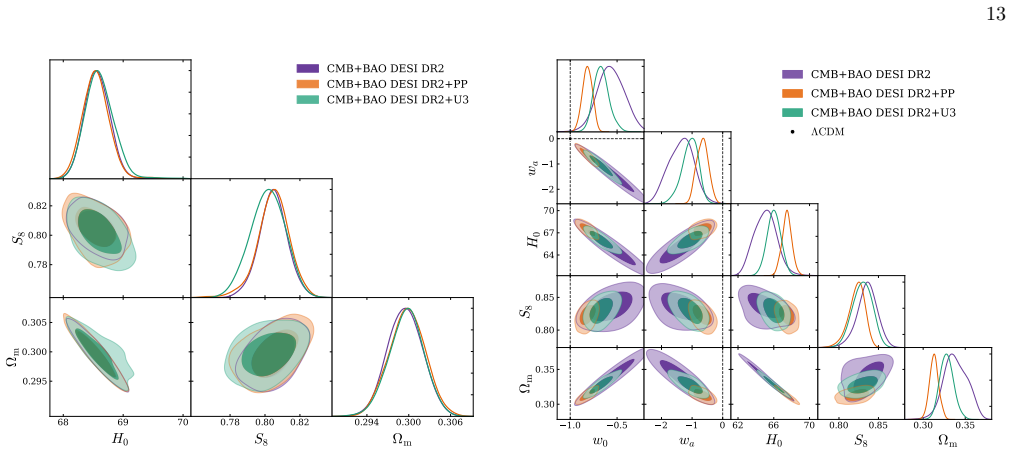


read the original abstract
We present a cosmological reassessment of light sterile-neutrino scenarios, examining whether current observations exclude sterile neutrinos as a class or primarily constrain the fully thermalized case. We consider three distinct realizations: (i) a fully thermalized sterile species (FTS), (ii) a thermal relic with a suppressed temperature relative to the active neutrino background (DTS), and (iii) a Dodelson-Widrow-like (DW) sterile neutrino with reduced phase-space normalization. Constraints are derived within both LambdaCDM and the CPL dynamical dark-energy framework using combinations of Planck CMB data, DESI DR2 BAO measurements, and the PantheonPlus and Union3 Type Ia supernova samples. For baseline data combinations without a local H0 prior, the FTS scenario is strongly disfavored in both cosmological models. Adding the local H0^DN prior allows LambdaCDM+FTS to accommodate the high local H0 value and become statistically competitive with standard LambdaCDM once SNIa data are included, although the sterile-neutrino mass remains consistent with zero. By contrast, partially populated sterile-neutrino scenarios remain viable: the DW realization is broadly compatible with current observations, while the DTS scenario yields the weakest cosmological pressure among the cases considered. Overall, cosmological data mainly require a strongly suppressed effective sterile abundance, leading to tight constraints on m_eff^sterile while allowing substantially weaker bounds on the physical sterile mass. We conclude that current observations do not generically exclude sterile neutrinos, but rather place strong pressure on fully thermalized or highly populated scenarios, highlighting the importance of production history and phase-space distribution when interpreting cosmological constraints.
Editorial analysis
A structured set of objections, weighed in public.
Referee Report
Summary. The paper claims that cosmological data (Planck CMB, DESI DR2 BAO, PantheonPlus/Union3 SNIa) do not generically exclude light sterile neutrinos but instead strongly constrain only the fully thermalized case (FTS). It examines three realizations—FTS, temperature-suppressed thermal relic (DTS), and Dodelson-Widrow-like (DW) with reduced phase-space normalization—within both flat LambdaCDM and CPL dynamical dark energy, with and without a local H0 prior. FTS is disfavored without the H0 prior but becomes competitive with it once SNIa are added (though m_s remains consistent with zero); DW is broadly compatible and DTS experiences the weakest pressure. The central conclusion is that data require strongly suppressed effective sterile abundance (tight bounds on m_eff^sterile) while allowing weaker bounds on physical mass, underscoring the role of production history and phase-space distribution.
Significance. If the central claim holds, the result is significant for the field: it demonstrates that standard thermalized assumptions overstate the exclusion power of current data and that non-thermal or suppressed distributions reopen viable parameter space for sterile neutrinos. This has direct implications for interpreting tensions with short-baseline anomalies and for forecasts with future surveys. The explicit comparison across production mechanisms and the use of both LambdaCDM and CPL frameworks provide a useful template, though the strength depends on whether the three chosen realizations are representative.
major comments (2)
- [Model realizations / abstract] The central claim that data 'do not generically exclude sterile neutrinos' but only the fully thermalized limit rests on the assertion that FTS, DTS, and DW realizations adequately span relevant early-universe production mechanisms. Other channels (resonant production, scalar decay) can produce non-thermal distributions that alter free-streaming length and small-scale power suppression at fixed m_eff^sterile, potentially changing fits to Planck lensing and DESI BAO beyond what is captured here. This assumption is load-bearing and requires explicit justification or additional tests.
- [Results / abstract] The statement that 'the DW realization is broadly compatible with current observations' while FTS is 'strongly disfavored' needs to be supported by quantitative posterior constraints or Delta-chi^2 values for each data combination (Planck+DESI, Planck+DESI+SNIa, with/without H0 prior). Without these numbers, the differential viability across the three cases cannot be assessed for robustness against prior volume or parameter degeneracies.
minor comments (2)
- [Methodology] Clarify the exact parameterization of the DW phase-space normalization and the temperature ratio in DTS (e.g., explicit relation to Delta N_eff or m_eff^sterile) to allow direct comparison with other literature.
- [Data and priors] The abstract mentions 'baseline data combinations without a local H0 prior' and then 'adding the local H0^DN prior'; specify the exact H0 value and uncertainty adopted for the prior.
Simulated Author's Rebuttal
We thank the referee for their constructive and detailed report. We address each major comment below and have revised the manuscript to strengthen the presentation of our results and the justification for our model choices.
read point-by-point responses
-
Referee: [Model realizations / abstract] The central claim that data 'do not generically exclude sterile neutrinos' but only the fully thermalized limit rests on the assertion that FTS, DTS, and DW realizations adequately span relevant early-universe production mechanisms. Other channels (resonant production, scalar decay) can produce non-thermal distributions that alter free-streaming length and small-scale power suppression at fixed m_eff^sterile, potentially changing fits to Planck lensing and DESI BAO beyond what is captured here. This assumption is load-bearing and requires explicit justification or additional tests.
Authors: We agree that resonant production and scalar-decay channels can generate phase-space distributions that differ from the three cases we consider. Our choice of FTS, DTS, and DW is intended to sample the principal phenomenological regimes (fully thermalized, temperature-suppressed thermal, and non-thermal with reduced normalization) that control the effective abundance and free-streaming scale. We will add a dedicated paragraph in Section 2 that explicitly justifies this selection, notes the existence of other mechanisms, and clarifies that the goal is to demonstrate that cosmological constraints are sensitive to production history rather than to exhaustively map every possible distribution. No new numerical realizations are added, but the revised text makes the scope of the claim transparent. revision: partial
-
Referee: [Results / abstract] The statement that 'the DW realization is broadly compatible with current observations' while FTS is 'strongly disfavored' needs to be supported by quantitative posterior constraints or Delta-chi^2 values for each data combination (Planck+DESI, Planck+DESI+SNIa, with/without H0 prior). Without these numbers, the differential viability across the three cases cannot be assessed for robustness against prior volume or parameter degeneracies.
Authors: We accept that explicit quantitative measures improve clarity. The manuscript already reports full posterior constraints in Figures 3–6 and Tables 2–4. To make the differential viability immediately accessible, we will insert a new summary table in Section 4 that lists, for every data combination, the best-fit Δχ^{2} relative to the baseline ΛCDM (or CPL) model together with the corresponding sterile-neutrino parameter values. This addition directly addresses the request for numerical support of the statements in the abstract and results. revision: yes
Circularity Check
No circularity; constraints from independent external data
full rationale
The paper conducts standard cosmological parameter fitting of sterile-neutrino mass and abundance parameters (in FTS, DTS, and DW realizations) against independent external datasets (Planck CMB, DESI DR2 BAO, PantheonPlus/Union3 SNIa) within LambdaCDM and CPL frameworks. No derivation step reduces a reported prediction or viability statement to a fitted input by construction, nor invokes self-citations as load-bearing uniqueness theorems. The central claim that data pressure only fully thermalized cases follows from direct likelihood comparisons on those datasets, making the analysis self-contained against external benchmarks.
Axiom & Free-Parameter Ledger
free parameters (2)
- sterile neutrino mass m_s
- sterile abundance or temperature ratio parameter
axioms (2)
- domain assumption LambdaCDM or CPL parametrization provides an adequate background cosmology for deriving sterile-neutrino constraints
- ad hoc to paper The FTS, DTS, and DW realizations adequately represent the relevant range of sterile-neutrino production histories
Reference graph
Works this paper leans on
-
[1]
For this purpose, we impose the Gaus- sian prior HDN 0 = 73.5±0.81 km s −1 Mpc−1,(38) motivated by the recent Local Distance Network deter- mination [75]
Impact of the LocalH DN 0 Measurement on the ΛCDM+FTS Scenario We now assess how the FTS scenario responds to the explicit inclusion of a high local determination of the 11 Hubble constant. For this purpose, we impose the Gaus- sian prior HDN 0 = 73.5±0.81 km s −1 Mpc−1,(38) motivated by the recent Local Distance Network deter- mination [75]. This informa...
2014
-
[2]
For CMB+BAO DESI DR2 alone, DTS remains disfavored, although much less severely than FTS and generally less than DW
-
[3]
Once supernova data are included, the Bayesian ev- idence becomes statistically inconclusive or mildly favorable, depending on the cosmological back- ground and SNe compilation
-
[4]
For the PantheonPlus combination, DTS is mildly favored in CPL but remains nearly neutral, though slightly negative, in ΛCDM. For the Union3 combi- nation, DTS becomes mildly favored in both CPL and ΛCDM. These results indicate that, when the sterile abundance is sufficiently suppressed through a reduced thermal tem- perature, current cosmological observa...
-
[5]
J. Lesgourgues and S. Pastor, New J. Phys.16, 065002 (2014), arXiv:1404.1740 [hep-ph]
Pith/arXiv arXiv 2014
-
[6]
A. D. Dolgov, Phys. Rept.370, 333 (2002), arXiv:hep- ph/0202122
arXiv 2002
-
[7]
K. N. Abazajian, PoSTASI2020, 001 (2021), arXiv:2102.10183 [hep-ph]
arXiv 2021
-
[8]
S. Hagstotz, P. F. de Salas, S. Gariazzo, M. Gerbino, M. Lattanzi, S. Vagnozzi, K. Freese, and S. Pastor, Phys. Rev. D104, 123524 (2021), arXiv:2003.02289 [astro- ph.CO]
arXiv 2021
-
[9]
E. Di Valentino, S. Gariazzo, and O. Mena, (2024), arXiv:2404.19322 [astro-ph.CO]
arXiv 2024
-
[10]
H. G. Escudero and K. N. Abazajian, Phys. Rev. D111, 043520 (2025), arXiv:2412.05451 [astro-ph.CO]
arXiv 2025
-
[11]
M. A. Sabogal, R. C. Nunes, F. Avila, and A. Bernui, Eur. Phys. J. C86, 314 (2026), arXiv:2510.16141 [astro- ph.CO]
arXiv 2026
- [12]
-
[13]
E. Di Valentino, S. Gariazzo, and O. Mena, Phys. Rev. D104, 083504 (2021), arXiv:2106.15267 [astro-ph.CO]
arXiv 2021
-
[14]
M. M. Ivanov, J. M. Sullivan, S.-F. Chen, A. Chu- daykin, M. Maus, and O. H. E. Philcox, (2026), arXiv:2601.16165 [astro-ph.CO]
arXiv 2026
-
[15]
A. Chudaykin, M. M. Ivanov, and O. H. E. Philcox, Phys. Rev. D113, 123506 (2026), arXiv:2511.20757 [astro-ph.CO]
Pith/arXiv arXiv 2026
-
[16]
H. E. Noriega, J. De-Santiago, G. Garcia-Arroyo, J. Ven- zor, and A. P´ erez-Lorenzana, Phys. Rev. D112, 063509 (2025), arXiv:2506.07994 [astro-ph.CO]
arXiv 2025
- [17]
-
[18]
I. Tanseri, S. Hagstotz, S. Vagnozzi, E. Giusarma, and K. Freese, JHEAp36, 1 (2022), arXiv:2207.01913 [astro- ph.CO]
arXiv 2022
- [19]
-
[20]
S. Roy Choudhury, Astrophys. J. Lett.986, L31 (2025), [Erratum: Astrophys.J.Lett. 1001, L25 (2026), Erratum: Astrophys.J. 1001, L25 (2026)], arXiv:2504.15340 [astro- ph.CO]
arXiv 2025
-
[21]
S. Roy Choudhury and T. Okumura, Astrophys. J. Lett. 976, L11 (2024), arXiv:2409.13022 [astro-ph.CO]
Pith/arXiv arXiv 2024
-
[22]
H. Li, G.-H. Du, T.-N. Li, H.-L. Li, L. Feng, J.-F. Zhang, and X. Zhang, (2026), arXiv:2606.05005 [astro-ph.CO]
Pith/arXiv arXiv 2026
-
[23]
Akeret al.(KATRIN), Science388, adq9592 (2025), arXiv:2406.13516 [nucl-ex]
M. Akeret al.(KATRIN), Science388, adq9592 (2025), arXiv:2406.13516 [nucl-ex]
arXiv 2025
-
[24]
Acharyaet al.(KATRIN), Nature648, 70 (2025), arXiv:2503.18667 [hep-ex]
H. Acharyaet al.(KATRIN), Nature648, 70 (2025), arXiv:2503.18667 [hep-ex]
arXiv 2025
-
[25]
Abratenkoet al.(MicroBooNE), Nature648, 64 (2025), arXiv:2512.07159 [hep-ex]
P. Abratenkoet al.(MicroBooNE), Nature648, 64 (2025), arXiv:2512.07159 [hep-ex]
arXiv 2025
-
[26]
F. A. Alrahmanet al.(ICARUS), (2026), arXiv:2603.22557 [hep-ex]
arXiv 2026
-
[27]
Abed Abudet al.(DUNE), (2025), arXiv:2503.23291 [hep-ex]
A. Abed Abudet al.(DUNE), (2025), arXiv:2503.23291 [hep-ex]
arXiv 2025
-
[28]
K. N. Abazajian, Phys. Rept.711-712, 1 (2017), arXiv:1705.01837 [hep-ph]
Pith/arXiv arXiv 2017
-
[29]
M. A. Aceroet al., J. Phys. G51, 120501 (2024), arXiv:2203.07323 [hep-ex]
arXiv 2024
-
[30]
S. Gariazzo, C. Giunti, M. Laveder, Y. F. Li, and E. M. Zavanin, J. Phys. G43, 033001 (2016), arXiv:1507.08204 [hep-ph]
Pith/arXiv arXiv 2016
-
[31]
B. Dasgupta and J. Kopp, Phys. Rept.928, 1 (2021), arXiv:2106.05913 [hep-ph]
arXiv 2021
-
[32]
M. Archidiacono and S. Gariazzo, Universe8, 175 (2022), arXiv:2201.10319 [hep-ph]
arXiv 2022
-
[33]
A. Boyarsky, O. Ruchayskiy, and M. Shaposhnikov, Ann. Rev. Nucl. Part. Sci.59, 191 (2009), arXiv:0901.0011 [hep-ph]
Pith/arXiv arXiv 2009
-
[34]
L. Feng, T.-N. Li, G.-H. Du, J.-F. Zhang, and X. Zhang, Phys. Dark Univ.48, 101935 (2025), arXiv:2503.10423 [astro-ph.CO]
arXiv 2025
- [35]
- [36]
-
[37]
E. Di Valentino, S. Gariazzo, C. Giunti, O. Mena, S. Pan, and W. Yang, Phys. Rev. D105, 103511 (2022), arXiv:2110.03990 [astro-ph.CO]
arXiv 2022
-
[38]
L. Feng, R.-Y. Guo, J.-F. Zhang, and X. Zhang, Phys. Lett. B827, 136940 (2022), arXiv:2109.06111 [astro- ph.CO]
arXiv 2022
-
[39]
A. Ladeira, R. C. Nunes, S. Pan, and W. Yang, Phys. Rev. D113, 083503 (2026), arXiv:2601.02077 [astro- ph.CO]
Pith/arXiv arXiv 2026
-
[40]
L. Feng, J.-F. Zhang, and X. Zhang, Eur. Phys. J. C77, 418 (2017), arXiv:1703.04884 [astro-ph.CO]
Pith/arXiv arXiv 2017
-
[41]
S. Pan, O. Seto, T. Takahashi, and Y. Toda, Phys. Rev. D110, 083524 (2024), arXiv:2312.15435 [astro-ph.CO]
arXiv 2024
-
[42]
G. B. Gelmini, M. Kawasaki, A. Kusenko, K. Murai, and V. Takhistov, JCAP09, 051 (2020), arXiv:2005.06721 [hep-ph]
arXiv 2020
-
[43]
A. Cuoco, J. Lesgourgues, G. Mangano, and S. Pastor, Phys. Rev. D71, 123501 (2005), arXiv:astro-ph/0502465
Pith/arXiv arXiv 2005
-
[44]
M. A. Acero and J. Lesgourgues, Phys. Rev. D79, 045026 (2009), arXiv:0812.2249 [astro-ph]
Pith/arXiv arXiv 2009
-
[45]
S. Das, A. Maharana, V. Poulin, and R. K. Sharma, Phys. Rev. D105, 103503 (2022), arXiv:2104.03329 [astro-ph.CO]
arXiv 2022
-
[46]
R. Foot and R. R. Volkas, Phys. Rev. D52, 6595 (1995), arXiv:hep-ph/9505359
Pith/arXiv arXiv 1995
-
[47]
Z. G. Berezhiani and R. N. Mohapatra, Phys. Rev. D52, 6607 (1995), arXiv:hep-ph/9505385
Pith/arXiv arXiv 1995
-
[48]
J. L. Feng and J. Kumar, Phys. Rev. Lett.101, 231301 (2008), arXiv:0803.4196 [hep-ph]
Pith/arXiv arXiv 2008
-
[49]
S. Das and K. Sigurdson, Phys. Rev. D85, 063510 (2012), 22 arXiv:1012.4458 [astro-ph.CO]
Pith/arXiv arXiv 2012
-
[50]
A. Berlin, D. Hooper, and G. Krnjaic, Phys. Lett. B 760, 106 (2016), arXiv:1602.08490 [hep-ph]
Pith/arXiv arXiv 2016
-
[51]
T. Bringmann, P. F. Depta, M. Hufnagel, and K. Schmidt-Hoberg, Phys. Lett. B817, 136341 (2021), arXiv:2007.03696 [hep-ph]
arXiv 2021
- [52]
-
[53]
S. Dodelson and L. M. Widrow, Phys. Rev. Lett.72, 17 (1994), arXiv:hep-ph/9303287
Pith/arXiv arXiv 1994
-
[54]
S. Gariazzo, P. F. de Salas, and S. Pastor, JCAP07, 014 (2019), arXiv:1905.11290 [astro-ph.CO]
Pith/arXiv arXiv 2019
-
[55]
W. Yang, R. C. Nunes, S. Pan, and D. F. Mota, Phys. Rev. D95, 103522 (2017), arXiv:1703.02556 [astro- ph.CO]
Pith/arXiv arXiv 2017
-
[56]
W. Yang, E. Di Valentino, S. Pan, and O. Mena, Phys. Dark Univ.31, 100762 (2021), arXiv:2007.02927 [astro- ph.CO]
arXiv 2021
- [57]
- [58]
-
[59]
J. Froustey, C. Pitrou, and M. C. Volpe, JCAP12, 015 (2020), arXiv:2008.01074 [hep-ph]
arXiv 2020
-
[60]
J. J. Bennett, G. Buldgen, P. F. De Salas, M. Drewes, S. Gariazzo, S. Pastor, and Y. Y. Y. Wong, JCAP04, 073 (2021), arXiv:2012.02726 [hep-ph]
arXiv 2021
-
[61]
M. Chevallier and D. Polarski, Int. J. Mod. Phys. D10, 213 (2001), arXiv:gr-qc/0009008
Pith/arXiv arXiv 2001
-
[62]
E. V. Linder, Phys. Rev. Lett.90, 091301 (2003), arXiv:astro-ph/0208512
Pith/arXiv arXiv 2003
-
[63]
N. Aghanimet al.(Planck), Astron. Astrophys.641, A6 (2020), [Erratum: Astron.Astrophys. 652, C4 (2021)], arXiv:1807.06209 [astro-ph.CO]
Pith/arXiv arXiv 2020
-
[64]
N. Aghanimet al.(Planck), Astron. Astrophys.641, A5 (2020), arXiv:1907.12875 [astro-ph.CO]
Pith/arXiv arXiv 2020
-
[65]
N. Aghanimet al.(Planck), Astron. Astrophys.641, A8 (2020), arXiv:1807.06210 [astro-ph.CO]
arXiv 2020
-
[66]
M. Abdul Karimet al.(DESI), Phys. Rev. D112, 083515 (2025), arXiv:2503.14738 [astro-ph.CO]
Pith/arXiv arXiv 2025
-
[67]
M. Abdul Karimet al.(DESI), Phys. Rev. D112, 083514 (2025), arXiv:2503.14739 [astro-ph.CO]
Pith/arXiv arXiv 2025
-
[68]
D. Broutet al., Astrophys. J.938, 110 (2022), arXiv:2202.04077 [astro-ph.CO]
Pith/arXiv arXiv 2022
-
[69]
D. Rubinet al., Astrophys. J.986, 231 (2025), arXiv:2311.12098 [astro-ph.CO]
Pith/arXiv arXiv 2025
-
[70]
D. Blas, J. Lesgourgues, and T. Tram, JCAP07, 034 (2011), arXiv:1104.2933 [astro-ph.CO]
Pith/arXiv arXiv 2011
-
[71]
B. Audren, J. Lesgourgues, K. Benabed, and S. Prunet, JCAP02, 001 (2013), arXiv:1210.7183 [astro-ph.CO]
Pith/arXiv arXiv 2013
-
[72]
T. Brinckmann and J. Lesgourgues, Phys. Dark Univ. 24, 100260 (2019), arXiv:1804.07261 [astro-ph.CO]
Pith/arXiv arXiv 2019
-
[73]
Gelman and D
A. Gelman and D. B. Rubin, Statist. Sci.7, 457 (1992)
1992
-
[74]
Akaike, IEEE Trans
H. Akaike, IEEE Trans. Automatic Control19, 716 (1974)
1974
-
[75]
Jeffreys,Theory of Probability, 3rd ed
H. Jeffreys,Theory of Probability, 3rd ed. (Oxford Uni- versity Press, Oxford, 1961)
1961
-
[76]
R. E. Kass and A. E. Raftery, J. Am. Statist. Assoc.90, 773 (1995)
1995
-
[77]
A. Heavens, Y. Fantaye, A. Mootoovaloo, H. Eggers, Z. Hosenie, S. Kroon, and E. Sellentin, (2017), arXiv:1704.03472 [stat.CO]
Pith/arXiv arXiv 2017
-
[78]
MCEvidence: A python package im- plementing the Marginal Likelihoods from Monte Carlo Markov Chains algorithm,
Y. Fantaye, “MCEvidence: A python package im- plementing the Marginal Likelihoods from Monte Carlo Markov Chains algorithm,”https://github.com/ yabebalFantaye/MCEvidence(2026), gitHub repository, accessed 2026
2026
-
[79]
S. Casertanoet al.(H0DN), Astron. Astrophys.708, A166 (2026), arXiv:2510.23823 [astro-ph.CO]
Pith/arXiv arXiv 2026
-
[80]
E. ¨Oz¨ ulker, E. Di Valentino, and W. Giar` e, (2025), arXiv:2506.19053 [astro-ph.CO]
arXiv 2025
discussion (0)
Sign in with ORCID, Apple, or X to comment. Anyone can read and Pith papers without signing in.