Near-horizon modifications in finite N holography
Pith reviewed 2026-06-26 13:26 UTC · model grok-4.3
The pith
Bulk reconstructions in near-horizon modified AdS₂ and BTZ recover the non-locality estimates expected from finite N holography.
A machine-rendered reading of the paper's core claim, the machinery that carries it, and where it could break.
Core claim
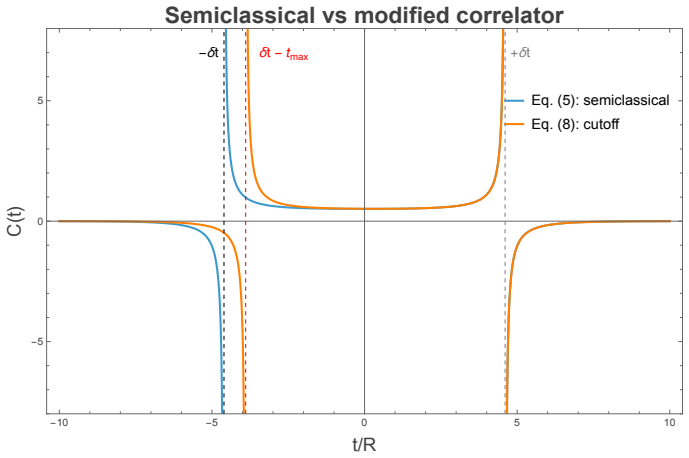
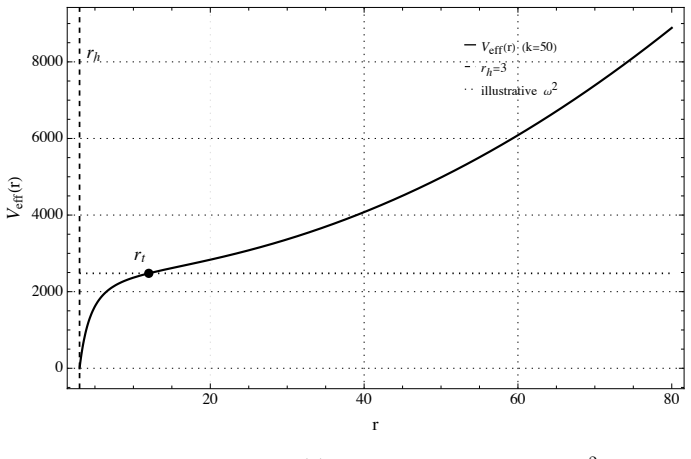
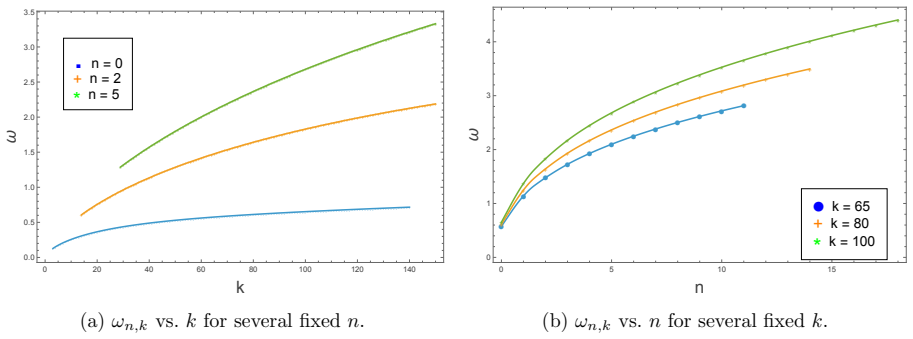
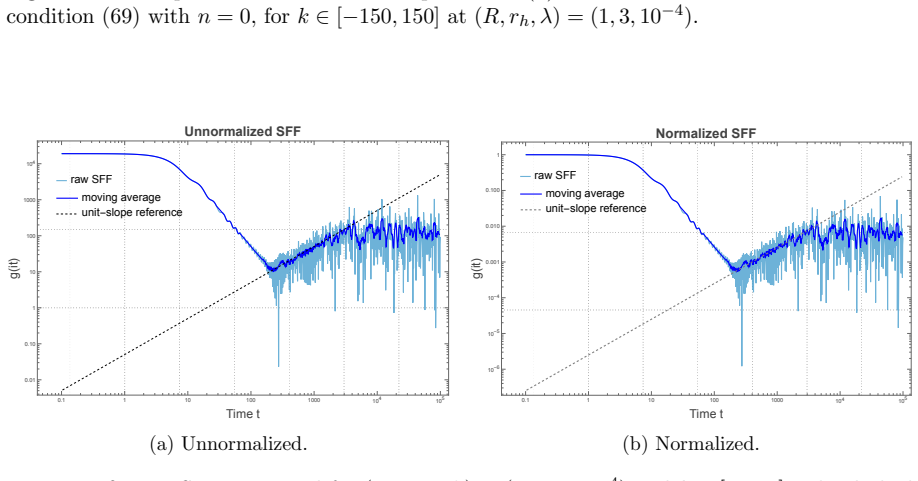
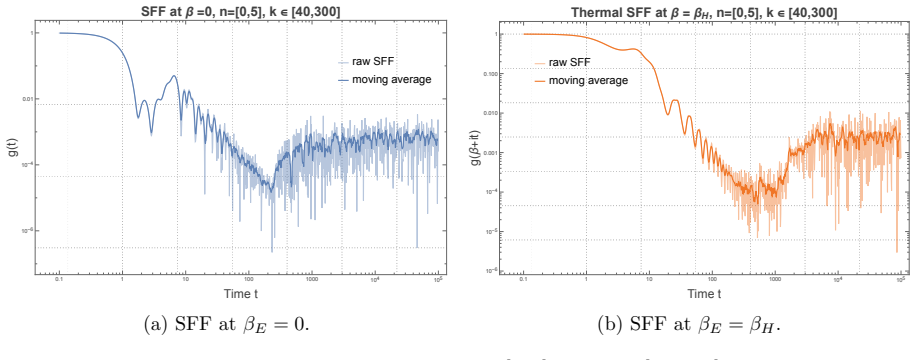
By performing explicit bulk reconstructions in the backgrounds of near-horizon modified AdS₂ and BTZ black holes, the same non-locality estimates are recovered as those obtained from late boundary time cut-offs and HKLL smearing. The near-horizon modification is controlled by a throat parameter which sets the scale of this non-locality. In three bulk dimensions, probe dynamics exhibits a dip-ramp-plateau structure in their spectral form factor when averaged over the throat parameter, a structure also found in backgrounds with a stretched horizon or a brick wall.
What carries the argument
The near-horizon modification controlled by a throat parameter, which implements finite-N violations of the extrapolate dictionary in the bulk geometry.
If this is right
- The non-locality estimates match those from previous methods using time cut-offs and operator smearing.
- The throat parameter directly sets the scale of the non-locality in these modified black hole backgrounds.
- Probe dynamics in three dimensions show a dip-ramp-plateau structure in the spectral form factor averaged over the throat parameter.
- This structure is shared with stretched horizon and brick wall models of black hole mimickers.
Where Pith is reading between the lines
- The throat parameter approach may provide a uniform geometric implementation of finite N effects across different black hole backgrounds without needing explicit boundary cutoffs.
- Similar non-locality could appear in higher dimensional near-horizon modified geometries if the reconstruction procedure generalizes.
- Averaging over the throat parameter might correspond to an ensemble average over different finite N corrections.
Load-bearing premise
The near-horizon modification controlled by a throat parameter faithfully implements the expected finite-N violations of the extrapolate dictionary without additional assumptions about operator smearing or time cut-offs.
What would settle it
A calculation of non-locality estimates from explicit bulk reconstructions in the modified backgrounds that differs from the estimates obtained with a late boundary time cut-off and HKLL smearing would falsify the recovery claim.
Figures





read the original abstract
If one extends the AdS/CFT extrapolate dictionary to large but finite $N$, we are expected to obtain non-perturbative violations of bulk micro-causality. Previously this was achieved by implementing a late boundary time cut-off, while smearing the boundary operator via the HKLL kernel. By performing explicit bulk reconstructions in the backgrounds of near-horizon modified AdS$_2$ and BTZ black holes, we recover the same non-locality estimates as above. For these black hole mimickers, the near-horizon modification is controlled by a throat parameter which sets the scale of this non-locality. In three bulk dimensions, probe dynamics also exhibits a dip-ramp-plateau structure in their spectral form factor when averaged over the throat parameter. Such structure has also been found recently in the background with a stretched horizon or a brick wall.
Editorial analysis
A structured set of objections, weighed in public.
Referee Report
Summary. The paper proposes modeling finite-N violations of bulk micro-causality in AdS/CFT by introducing near-horizon modifications to AdS₂ and BTZ geometries, controlled by a single throat parameter. Explicit bulk reconstructions (via HKLL-type kernels) in these modified backgrounds are claimed to recover the same non-locality length scales previously obtained from late-time boundary cut-offs plus smearing. In three bulk dimensions, averaging the spectral form factor of probe fields over the throat parameter is shown to produce a dip-ramp-plateau structure, analogous to results with stretched horizons or brick walls.
Significance. If the throat parameter can be shown to emerge from a controlled 1/N expansion rather than being introduced by hand, the construction would supply a geometric realization of finite-N non-locality that is independent of explicit cut-offs. The reported match between reconstruction-based non-locality estimates and the earlier cut-off results, together with the SFF structure in 3D, would then constitute a concrete link between modified near-horizon geometry and non-perturbative holographic effects.
major comments (3)
- [§2] §2 (near-horizon modification): the throat parameter is introduced to set the non-locality scale and is subsequently used both to define the modified metric and to perform the averaging that yields the dip-ramp-plateau; no derivation from the extrapolate dictionary or from the 1/N expansion is supplied, so the claimed recovery of the same non-locality estimates risks being circular.
- [§3.2] §3.2 (bulk reconstruction): the statement that the reconstructions 'recover the same non-locality estimates' is presented without an explicit side-by-side comparison (e.g., a table or plot) of the length scales obtained from the throat-modified geometry versus those from the late-time cut-off + HKLL procedure; without this quantitative match it is unclear whether the agreement is robust or parameter-tuned.
- [§4] §4 (spectral form factor): the averaging measure over the throat parameter is not derived from any ensemble or from finite-N statistics; the resulting dip-ramp-plateau therefore depends on an auxiliary choice whose range and weighting are not independently calibrated against any external benchmark.
minor comments (2)
- Notation for the throat parameter is introduced without a clear symbol definition in the abstract and is used interchangeably with 'non-locality scale'; a single consistent symbol and a brief reminder of its dimensions would improve readability.
- Figure captions for the SFF plots do not state the precise range and sampling of the throat parameter used in the average; this information belongs in the caption or in a dedicated methods paragraph.
Simulated Author's Rebuttal
We thank the referee for the careful reading and constructive comments. We address each major point below. We agree that the throat parameter is introduced phenomenologically and will revise the manuscript to clarify its status and provide additional quantitative details where appropriate.
read point-by-point responses
-
Referee: [§2] §2 (near-horizon modification): the throat parameter is introduced to set the non-locality scale and is subsequently used both to define the modified metric and to perform the averaging that yields the dip-ramp-plateau; no derivation from the extrapolate dictionary or from the 1/N expansion is supplied, so the claimed recovery of the same non-locality estimates risks being circular.
Authors: We agree that the throat parameter is introduced phenomenologically to model finite-N non-locality rather than derived from the 1/N expansion or extrapolate dictionary. The construction explores the consequences of such modifications, and the recovery of prior estimates provides a consistency check with cut-off methods. We will revise §2 to explicitly state the phenomenological nature of the parameter and to frame the results as exploratory rather than derived, thereby addressing the circularity concern. revision: yes
-
Referee: [§3.2] §3.2 (bulk reconstruction): the statement that the reconstructions 'recover the same non-locality estimates' is presented without an explicit side-by-side comparison (e.g., a table or plot) of the length scales obtained from the throat-modified geometry versus those from the late-time cut-off + HKLL procedure; without this quantitative match it is unclear whether the agreement is robust or parameter-tuned.
Authors: We acknowledge that an explicit side-by-side comparison is absent. The agreement follows from matching analytic expressions for the non-locality length scales when the throat parameter is identified with the cut-off scale. We will add a table in the revised manuscript comparing the length scales for representative parameter values to make the quantitative match explicit and demonstrate robustness. revision: yes
-
Referee: [§4] §4 (spectral form factor): the averaging measure over the throat parameter is not derived from any ensemble or from finite-N statistics; the resulting dip-ramp-plateau therefore depends on an auxiliary choice whose range and weighting are not independently calibrated against any external benchmark.
Authors: The averaging serves as an illustrative toy model to exhibit the dip-ramp-plateau structure, analogous to stretched-horizon results, using a uniform measure over a range of throat parameters corresponding to relevant non-locality scales. We will revise §4 to clarify that the measure is an auxiliary choice without derivation from finite-N ensembles and to note the illustrative purpose, while acknowledging that calibration against external benchmarks remains open. revision: partial
- Derivation of the throat parameter from a controlled 1/N expansion or the extrapolate dictionary
Circularity Check
Throat parameter introduced to set non-locality scale makes recovery of estimates tautological by construction
specific steps
-
self definitional
[Abstract]
"By performing explicit bulk reconstructions in the backgrounds of near-horizon modified AdS₂ and BTZ black holes, we recover the same non-locality estimates as above. For these black hole mimickers, the near-horizon modification is controlled by a throat parameter which sets the scale of this non-locality."
The throat parameter is introduced as the control that sets the non-locality scale; the reconstructions are then carried out in geometries defined by that parameter, so the recovered estimates are equivalent to the input choice of the parameter by construction rather than independently obtained.
-
fitted input called prediction
[Abstract]
"In three bulk dimensions, probe dynamics also exhibits a dip-ramp-plateau structure in their spectral form factor when averaged over the throat parameter."
The reported dip-ramp-plateau structure is produced by averaging over the throat parameter (the input that defines the modification), rendering the structure a direct output of the averaging procedure on the fitted input rather than a derived prediction.
full rationale
The paper defines the near-horizon modification via a throat parameter that explicitly sets the non-locality scale, then performs bulk reconstructions inside those backgrounds to recover non-locality estimates controlled by the same parameter. This reduces the central claim to a self-definitional exercise rather than an independent derivation from the extrapolate dictionary or 1/N expansion. The spectral form factor structure is likewise obtained by averaging over the same input parameter. No external benchmark or derivation of the parameter from finite-N effects is shown in the provided text; the modification functions as an ansatz whose output matches its input definition. This warrants a moderate circularity score but does not reach 8-10 because the paper still performs explicit reconstructions and notes consistency with other models.
Axiom & Free-Parameter Ledger
free parameters (1)
- throat parameter
axioms (1)
- domain assumption Extension of the AdS/CFT extrapolate dictionary to large but finite N produces non-perturbative violations of bulk micro-causality.
Reference graph
Works this paper leans on
-
[1]
The Large N limit of superconformal field theories and supergravity,
J. M. Maldacena, “The Large N limit of superconformal field theories and supergravity,” Int. J. Theor. Phys.38(1999) 1113–1133,arXiv:hep-th/9711200. 33
Pith/arXiv arXiv 1999
-
[2]
Gauge theory correlators from noncritical string theory,
S. Gubser, I. R. Klebanov, and A. M. Polyakov, “Gauge theory correlators from noncritical string theory,”Phys. Lett. B428(1998) 105–114,arXiv:hep-th/9802109
Pith/arXiv arXiv 1998
-
[3]
Anti-de Sitter space and holography,
E. Witten, “Anti-de Sitter space and holography,”Adv. Theor. Math. Phys.2(1998) 253–291,arXiv:hep-th/9802150
Pith/arXiv arXiv 1998
-
[4]
Lectures on entanglement, von Neumann algebras, and emergence of spacetime,
H. Liu, “Lectures on entanglement, von Neumann algebras, and emergence of spacetime,” inTheoretical Advanced Study Institute in Elementary Particle Physics 2023: Aspects of Symmetry. 10, 2025.arXiv:2510.07017 [hep-th]
arXiv 2023
-
[5]
Very long time scales and black hole thermal equilibrium,
J. L. F. Barbon and E. Rabinovici, “Very long time scales and black hole thermal equilibrium,”JHEP11(2003) 047,arXiv:hep-th/0308063
Pith/arXiv arXiv 2003
-
[6]
J. L. F. Barbon and E. Rabinovici, “Geometry And Quantum Noise,”Fortsch. Phys.62 (2014) 626–646,arXiv:1404.7085 [hep-th]
Pith/arXiv arXiv 2014
-
[7]
Is there really a de Sitter/CFT duality?,
L. Dyson, J. Lindesay, and L. Susskind, “Is there really a de Sitter/CFT duality?,”JHEP 08(2002) 045,arXiv:hep-th/0202163
Pith/arXiv arXiv 2002
-
[8]
Eternal black holes in anti-de Sitter,
J. M. Maldacena, “Eternal black holes in anti-de Sitter,”JHEP04(2003) 021, arXiv:hep-th/0106112
Pith/arXiv arXiv 2003
-
[9]
Local bulk operators in AdS/CFT: A Boundary view of horizons and locality,
A. Hamilton, D. N. Kabat, G. Lifschytz, and D. A. Lowe, “Local bulk operators in AdS/CFT: A Boundary view of horizons and locality,”Phys. Rev. D73(2006) 086003, arXiv:hep-th/0506118
Pith/arXiv arXiv 2006
-
[10]
Holographic representation of local bulk operators,
A. Hamilton, D. N. Kabat, G. Lifschytz, and D. A. Lowe, “Holographic representation of local bulk operators,”Phys. Rev. D74(2006) 066009,arXiv:hep-th/0606141
Pith/arXiv arXiv 2006
-
[11]
Local bulk operators in AdS/CFT: A Holographic description of the black hole interior,
A. Hamilton, D. N. Kabat, G. Lifschytz, and D. A. Lowe, “Local bulk operators in AdS/CFT: A Holographic description of the black hole interior,”Phys. Rev. D75(2007) 106001,arXiv:hep-th/0612053. [Erratum: Phys.Rev.D 75, 129902 (2007)]
Pith/arXiv arXiv 2007
-
[12]
Local bulk operators in AdS/CFT and the fate of the BTZ singularity,
A. Hamilton, D. N. Kabat, G. Lifschytz, and D. A. Lowe, “Local bulk operators in AdS/CFT and the fate of the BTZ singularity,”AMS/IP Stud. Adv. Math.44(2008) 85–100,arXiv:0710.4334 [hep-th]
Pith/arXiv arXiv 2008
-
[13]
Finite N and the failure of bulk locality: Black holes in AdS/CFT,
D. Kabat and G. Lifschytz, “Finite N and the failure of bulk locality: Black holes in AdS/CFT,”JHEP09(2014) 077,arXiv:1405.6394 [hep-th]
Pith/arXiv arXiv 2014
-
[14]
Wormholes as black hole foils,
T. Damour and S. N. Solodukhin, “Wormholes as black hole foils,”Phys. Rev. D76 (2007) 024016,arXiv:0704.2667 [gr-qc]
Pith/arXiv arXiv 2007
-
[15]
Hybrid quantum states in 2D dilaton gravity,
Y. Potaux, D. Sarkar, and S. N. Solodukhin, “Hybrid quantum states in 2D dilaton gravity,”Phys. Rev. D108no. 12, (2023) 125012,arXiv:2310.18745 [hep-th]. 34
arXiv 2023
-
[16]
Can black hole relax unitarily?,
S. N. Solodukhin, “Can black hole relax unitarily?,” in1st Balkan Workshop on Mathematical, Theoretical and Phenomenological Challenges Beyond the Standard Model: Perspectives of Balkans Collaboration, pp. 109–121. 6, 2004.arXiv:hep-th/0406130
Pith/arXiv arXiv 2004
-
[17]
Restoring unitarity in BTZ black hole,
S. N. Solodukhin, “Restoring unitarity in BTZ black hole,”Phys. Rev. D71(2005) 064006,arXiv:hep-th/0501053
Pith/arXiv arXiv 2005
-
[18]
The fate of black hole horizons in semiclassical gravity,
C. Berthiere, D. Sarkar, and S. N. Solodukhin, “The fate of black hole horizons in semiclassical gravity,”Phys. Lett. B786(2018) 21–27,arXiv:1712.09914 [hep-th]
Pith/arXiv arXiv 2018
-
[19]
Quantum states and their back-reacted geometries in 2D dilaton gravity,
Y. Potaux, D. Sarkar, and S. N. Solodukhin, “Quantum states and their back-reacted geometries in 2D dilaton gravity,”Phys. Rev. D105no. 2, (2022) 025015, arXiv:2112.03855 [hep-th]
arXiv 2022
-
[20]
Firewalls as artefacts of inconsistent truncations of quantum geometries,
C. Germani and D. Sarkar, “Firewalls as artefacts of inconsistent truncations of quantum geometries,”Fortsch. Phys.64(2016) 131–143,arXiv:1502.03129 [hep-th]
Pith/arXiv arXiv 2016
-
[21]
Singularity resolution in spherically reduced 2D semiclassical gravity with negative central charge,
A. del R´ ıo, F. J. Mara˜ n´ on-Gonz´ alez, and J. Navarro-Salas, “Singularity resolution in spherically reduced 2D semiclassical gravity with negative central charge,”Phys. Rev. D 111no. 4, (2025) 045025,arXiv:2411.10523 [gr-qc]
arXiv 2025
-
[22]
F. J. Mara˜ n´ on-Gonz´ alez, A. del R´ ıo, and J. Navarro-Salas, “Singularity resolution in the backreacted Schwarzschild geometry from 2D matter with negative central charge,”J. Phys. Conf. Ser.3177no. 1, (2026) 012142,arXiv:2510.02447 [gr-qc]
arXiv 2026
-
[23]
Defining entanglement without tensor factoring: A Euclidean hourglass prescription,
T. Anegawa, N. Iizuka, and D. Kabat, “Defining entanglement without tensor factoring: A Euclidean hourglass prescription,”Phys. Rev. D105no. 8, (2022) 085003, arXiv:2111.03886 [hep-th]
arXiv 2022
-
[24]
Extractable entanglement from a Euclidean hourglass,
T. Anegawa, N. Iizuka, and D. Kabat, “Extractable entanglement from a Euclidean hourglass,”Phys. Rev. D106no. 8, (2022) 085010,arXiv:2205.01137 [hep-th]
arXiv 2022
-
[25]
(A)dS holography with a cutoff,
D. Sarkar, “(A)dS holography with a cutoff,”Phys. Rev. D90no. 8, (2014) 086005, arXiv:1408.0415 [hep-th]
Pith/arXiv arXiv 2014
-
[26]
The Black hole in three-dimensional space-time,
M. Banados, C. Teitelboim, and J. Zanelli, “The Black hole in three-dimensional space-time,”Phys. Rev. Lett.69(1992) 1849–1851,arXiv:hep-th/9204099
Pith/arXiv arXiv 1992
-
[27]
Synthetic fuzzballs: a linear ramp from black hole normal modes,
S. Das, C. Krishnan, A. Kumar, and A. Kundu, “Synthetic fuzzballs: a linear ramp from black hole normal modes,”JHEP01(2023) 153,arXiv:2208.14744 [hep-th]
arXiv 2023
-
[28]
Brickwall in rotating BTZ: a dip-ramp-plateau story,
S. Das and A. Kundu, “Brickwall in rotating BTZ: a dip-ramp-plateau story,”JHEP02 (2024) 049,arXiv:2310.06438 [hep-th]
arXiv 2024
-
[29]
What is the simplest linear ramp?,
S. Das, C. Krishnan, and A. Kundu, “What is the simplest linear ramp?,”JHEP01 (2024) 172,arXiv:2308.11704 [hep-th]. 35
arXiv 2024
-
[30]
Fuzzballs and random matrices,
S. Das, S. K. Garg, C. Krishnan, and A. Kundu, “Fuzzballs and random matrices,”JHEP 10(2023) 031,arXiv:2301.11780 [hep-th]
arXiv 2023
-
[31]
Normal modes of the stretched horizon: a bulk mechanism for black hole microstate level spacing,
C. Krishnan and P. Pathak, “Normal modes of the stretched horizon: a bulk mechanism for black hole microstate level spacing,”JHEP03(2024) 162,arXiv:2312.14109 [hep-th]
arXiv 2024
-
[32]
Black Holes and Random Matrices,
J. S. Cotler, G. Gur-Ari, M. Hanada, J. Polchinski, P. Saad, S. H. Shenker, D. Stanford, A. Streicher, and M. Tezuka, “Black Holes and Random Matrices,”JHEP05(2017) 118, arXiv:1611.04650 [hep-th]
Pith/arXiv arXiv 2017
-
[33]
Conformal symmetry and its breaking in two dimensional Nearly Anti-de-Sitter space,
J. Maldacena, D. Stanford, and Z. Yang, “Conformal symmetry and its breaking in two dimensional Nearly Anti-de-Sitter space,”PTEP2016no. 12, (2016) 12C104, arXiv:1606.01857 [hep-th]
Pith/arXiv arXiv 2016
-
[34]
JT gravity as a matrix integral,
P. Saad, S. H. Shenker, and D. Stanford, “JT gravity as a matrix integral,” arXiv:1903.11115 [hep-th]
Pith/arXiv arXiv 1903
-
[35]
JT gravity and the ensembles of random matrix theory,
D. Stanford and E. Witten, “JT gravity and the ensembles of random matrix theory,” Adv. Theor. Math. Phys.24no. 6, (2020) 1475–1680,arXiv:1907.03363 [hep-th]
arXiv 2020
-
[36]
On the quantum structure of a black hole,
G. ’t Hooft, “On the quantum structure of a black hole,”Nucl. Phys. B256(1985) 727–745
1985
-
[37]
Finite N Black Holes through the Brick Wall,
S. Terashima, “Finite N Black Holes through the Brick Wall,”arXiv:2606.06613 [hep-th]. 36
discussion (0)
Sign in with ORCID, Apple, or X to comment. Anyone can read and Pith papers without signing in.