Binary Black Hole Coalescence and the Dynamics of Scalar Hair in Einstein-Maxwell-Scalar Theory
Pith reviewed 2026-06-26 13:24 UTC · model grok-4.3
The pith
Nonminimal coupling triggers scalar hair growth on merging charged black holes even when none existed initially.
A machine-rendered reading of the paper's core claim, the machinery that carries it, and where it could break.
Core claim
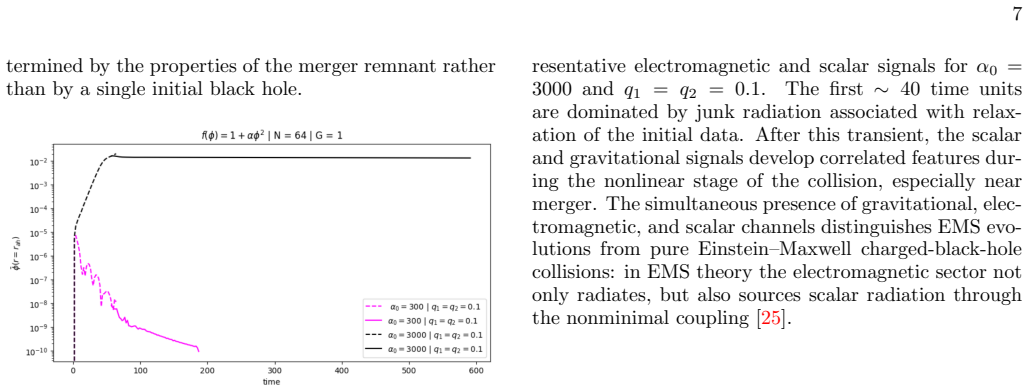
The nonminimal electromagnetic-scalar coupling can dynamically trigger the growth of scalar hair even when the individual black holes are initially scalar-free. The subsequent evolution depends on the coupling strength and on the charge retained by the remnant. For weak coupling, or when charge cancellation suppresses the electromagnetic source after merger, the scalar field is radiated away or absorbed by the final horizon and the system dynamically descalarizes. For sufficiently strong coupling and nonzero remnant charge, the scalar field remains finite and the final black hole approaches a scalarized configuration. The coalescence also excites scalar radiation whose time profile is qualit
What carries the argument
The nonminimal electromagnetic-scalar coupling term, which sources scalar field growth from the electromagnetic invariant when the coupling parameter exceeds a threshold value.
Load-bearing premise
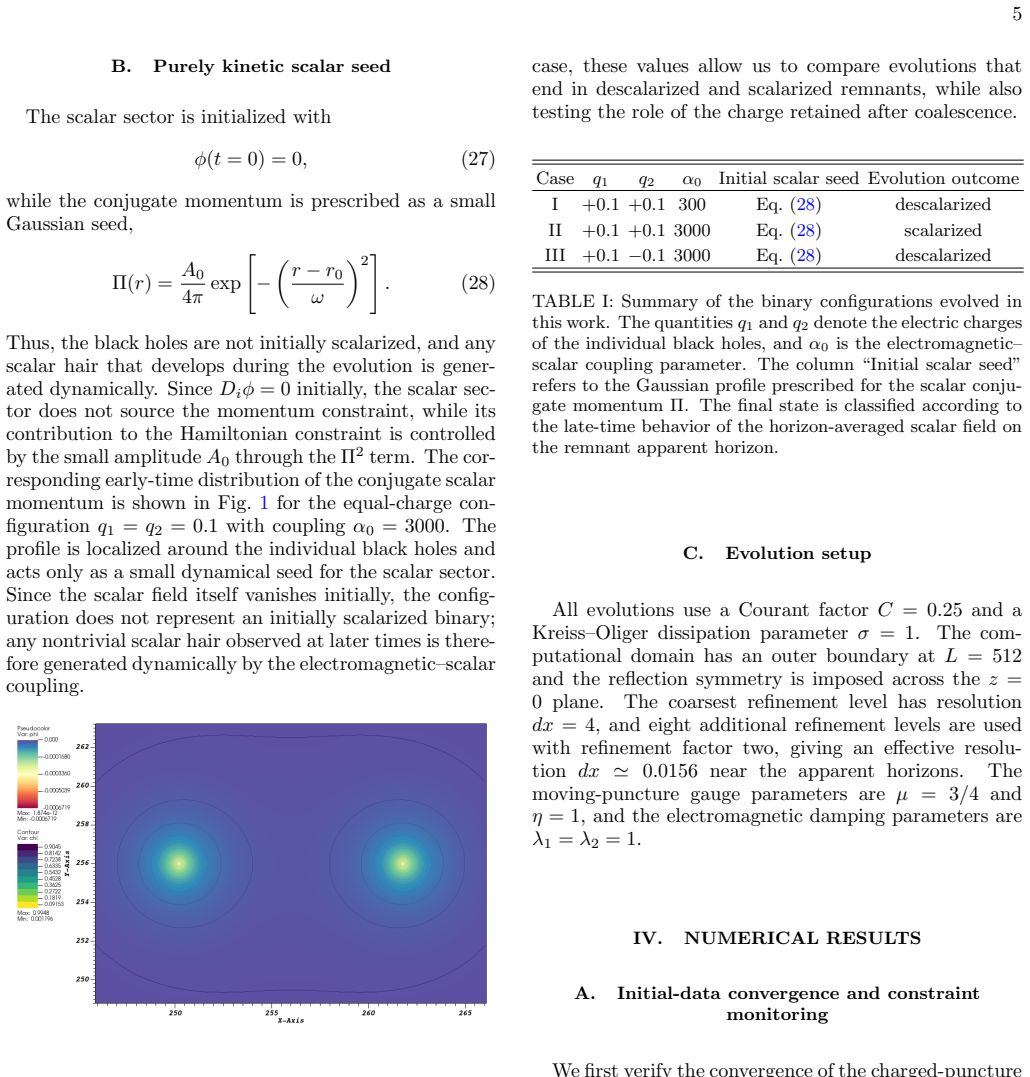
The initial data represent two Reissner-Nordström black holes with a small kinetic scalar perturbation where the scalar field itself starts at exactly zero.
What would settle it
A numerical run with coupling strength above threshold and retained remnant charge in which the scalar field value on the final apparent horizon grows and stabilizes at a nonzero constant rather than decaying to zero.
Figures

read the original abstract
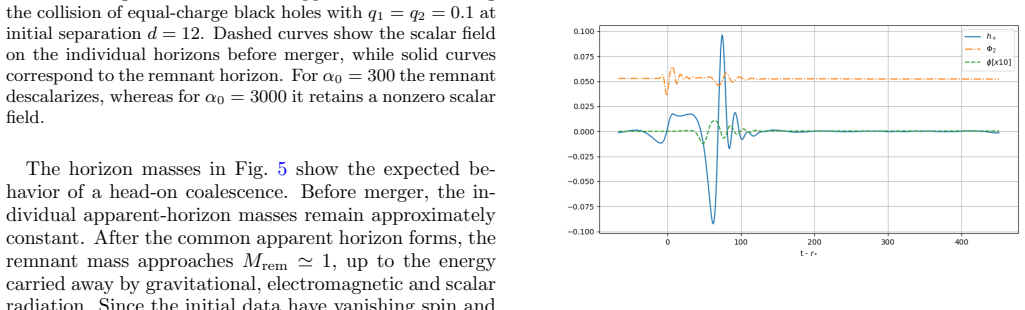
We investigate the head-on coalescence of charged binary black holes in Einstein-Maxwell-Scalar (EMS) theory using numerical relativity. The binaries are built from charged puncture initial data representing two Reissner-Nordstr\"om black holes immersed in a purely kinetic scalar perturbation: the scalar field initially vanishes, while its conjugate momentum provides a small seed for the instability. We evolve the coupled gravitational, electromagnetic, and scalar sectors and monitor the apparent horizons, the emitted radiation, and the scalar field on the horizons. Our simulations show that the nonminimal electromagnetic-scalar coupling can dynamically trigger the growth of scalar hair even when the individual black holes are initially scalar-free. The subsequent evolution depends on the coupling strength and on the charge retained by the remnant. For weak coupling, or when charge cancellation suppresses the electromagnetic source after merger, the scalar field is radiated away or absorbed by the final horizon and the system dynamically descalarizes. For sufficiently strong coupling and nonzero remnant charge, the scalar field remains finite and the final black hole approaches a scalarized configuration. The coalescence also excites scalar radiation whose time profile is qualitatively correlated with the dominant gravitational-wave mode during the nonlinear stage of the collision. These results provide a binary realization of scalarization/descalarization transitions in EMS theory and show that the fate of scalar hair is controlled by the interplay between the scalar coupling and the charge content of the remnant.
Editorial analysis
A structured set of objections, weighed in public.
Referee Report
Summary. The paper investigates the head-on coalescence of charged binary black holes in Einstein-Maxwell-Scalar (EMS) theory using numerical relativity. Binaries are constructed from charged puncture initial data for two Reissner-Nordström black holes with a purely kinetic scalar perturbation (phi=0, nonzero Pi as a seed). Simulations show that the nonminimal electromagnetic-scalar coupling dynamically triggers scalar hair growth even on initially scalar-free black holes; the outcome (scalarization or descalarization) depends on coupling strength and remnant charge, with scalar radiation correlated to the dominant gravitational-wave mode during merger.
Significance. If the results are free of initial-data artifacts, this provides the first numerical-relativity realization of binary scalarization/descalarization transitions in EMS theory, extending single-black-hole studies to mergers and demonstrating that remnant charge controls the fate of scalar hair. It also reports a qualitative correlation between scalar and gravitational radiation during the nonlinear phase.
major comments (2)
- [Initial data construction] Initial data construction (abstract and the section describing the charged puncture data): the setup superposes two RN solutions (which satisfy the EMS constraints only for phi=Pi=0) with phi=0 but nonzero Pi. The nonminimal f(phi)F^2 term modifies the Hamiltonian and momentum constraints, so simply adding the scalar momentum without re-solving the full constraint system can introduce O(1) violations. The subsequent relaxation of these violations could source apparent scalar growth, undermining the claim that the hair is triggered dynamically by the coupling during evolution rather than by initial-data relaxation. The manuscript gives no indication that the constraints were re-solved with the scalar sector active.
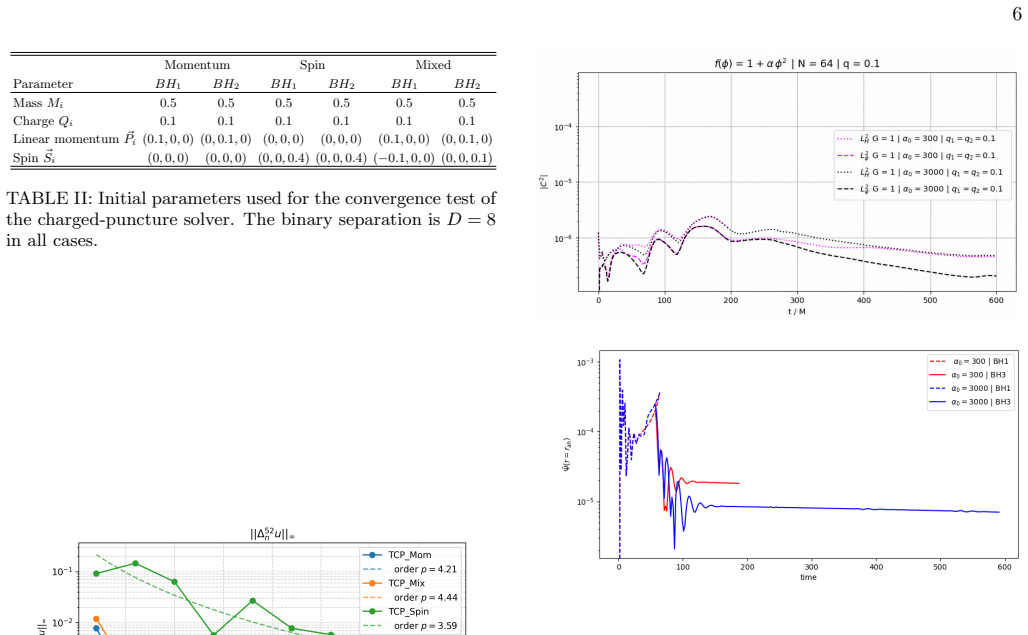
- [Numerical methods and results] Numerical methods and results sections: the abstract (and by extension the methods description) provides no information on grid resolution, convergence tests, or error estimates for the reported scalar-field growth on the horizons. Without these, it is impossible to determine whether the observed behaviors are physical or numerical artifacts, which is load-bearing for the central claim that the coupling triggers scalar hair.
minor comments (1)
- [Abstract] The abstract states that 'the scalar field initially vanishes, while its conjugate momentum provides a small seed for the instability' but does not quantify the amplitude of Pi or demonstrate that it remains a small perturbation after the nonminimal coupling is included.
Simulated Author's Rebuttal
We thank the referee for the thorough review and constructive feedback on our manuscript. We address each major comment below and will revise the paper accordingly to improve clarity and rigor.
read point-by-point responses
-
Referee: [Initial data construction] Initial data construction (abstract and the section describing the charged puncture data): the setup superposes two RN solutions (which satisfy the EMS constraints only for phi=Pi=0) with phi=0 but nonzero Pi. The nonminimal f(phi)F^2 term modifies the Hamiltonian and momentum constraints, so simply adding the scalar momentum without re-solving the full constraint system can introduce O(1) violations. The subsequent relaxation of these violations could source apparent scalar growth, undermining the claim that the hair is triggered dynamically by the coupling during evolution rather than by initial-data relaxation. The manuscript gives no indication that the constraints were re-solved with the scalar sector active.
Authors: We acknowledge the validity of this concern. The initial data was constructed via superposition of RN solutions with an added scalar momentum perturbation without explicitly re-solving the full EMS constraint system including the nonminimal coupling. This omission means that constraint violations may have been present and could have contributed to the early scalar evolution. In the revised manuscript we will add an explicit discussion of the initial constraint violations (including their magnitude and subsequent decay), and we will perform and report additional simulations that solve the constraints with the scalar sector active to confirm that the reported scalar hair growth is not an artifact of initial-data relaxation. revision: yes
-
Referee: [Numerical methods and results] Numerical methods and results sections: the abstract (and by extension the methods description) provides no information on grid resolution, convergence tests, or error estimates for the reported scalar-field growth on the horizons. Without these, it is impossible to determine whether the observed behaviors are physical or numerical artifacts, which is load-bearing for the central claim that the coupling triggers scalar hair.
Authors: We agree that quantitative information on resolution and convergence is required to support the central claims. The original submission omitted these details. In the revised version we will expand the numerical methods section to specify the grid resolutions employed, the convergence order observed, and the results of convergence tests specifically for the scalar field evaluated on the apparent horizons. We will also include error estimates for the reported scalar hair growth and radiation quantities. revision: yes
Circularity Check
No circularity: results from direct numerical evolution of EMS field equations
full rationale
The paper reports outcomes of numerical relativity simulations evolving the coupled gravitational, electromagnetic, and scalar sectors from charged puncture initial data. The central claim (dynamical triggering of scalar hair via nonminimal coupling) follows from integrating the field equations forward in time; no step reduces by construction to a fitted parameter, self-definition, or self-citation chain. No equations or sections exhibit the enumerated circular patterns. The work is self-contained as a dynamical simulation whose outputs are not forced by the inputs.
Axiom & Free-Parameter Ledger
free parameters (1)
- coupling strength
axioms (1)
- domain assumption The initial data setup with puncture method for charged black holes is valid for the evolution.
Reference graph
Works this paper leans on
-
[1]
Ob- servation of Gravitational Waves from a Binary Black Hole Merger,
B. P. Abbottet al.[LIGO Scientific and Virgo], “Ob- servation of Gravitational Waves from a Binary Black Hole Merger,” Phys. Rev. Lett.116(2016) no.6, 061102 [arXiv:1602.03837 [gr-qc]]
Pith/arXiv arXiv 2016
-
[2]
Dark matter from primor- dial black holes would hold charge,
I. J. Araya, N. D. Padilla, M. E. Rubio, J. Sureda, J. Maga˜ na and L. Osorio, “Dark matter from primor- dial black holes would hold charge,” JCAP02(2023), 030 [arXiv:2207.05829 [astro-ph.CO]]
arXiv 2023
-
[3]
C. Moreno, J. C. Degollado, D. N´ u˜ nez and C. Rodr´ ıguez- Leal, “Gravitational and Electromagnetic Perturbations of a Charged Black Hole in a General Gauge Condition,” Particles4(2021) no.2, 106-128 [arXiv:2104.11742 [gr- qc]]
arXiv 2021
-
[4]
C. Palenzuela, L. Lehner and S. Yoshida, “Understand- ing possible electromagnetic counterparts to loud gravi- tational wave events: Binary black hole effects on elec- tromagnetic fields,” Phys. Rev. D81(2010), 084007 [arXiv:0911.3889 [gr-qc]]
Pith/arXiv arXiv 2010
-
[5]
Einstein-Maxwell-scalar black holes: classes of solu- tions, dyons and extremality,
D. Astefanesei, C. Herdeiro, A. Pombo and E. Radu, “Einstein-Maxwell-scalar black holes: classes of solu- tions, dyons and extremality,” JHEP10(2019), 078 [arXiv:1905.08304 [hep-th]]
arXiv 2019
-
[6]
Black Hole Dynamics in Einstein- Maxwell-Dilaton Theory,
E. W. Hirschmann, L. Lehner, S. L. Liebling and C. Palenzuela, “Black Hole Dynamics in Einstein- Maxwell-Dilaton Theory,” Phys. Rev. D97(2018) no.6, 064032 [arXiv:1706.09875 [gr-qc]]
Pith/arXiv arXiv 2018
-
[7]
E. E. Flanagan and S. A. Hughes, “Measuring grav- itational waves from binary black hole coalescences:
-
[8]
Signal-to-noise for inspiral, merger, and ringdown,” Phys. Rev. D57(1998), 4535-4565 [arXiv:gr-qc/9701039 [gr-qc]]
Pith/arXiv arXiv 1998
-
[9]
Quantum Grav
Benjamin Aylott et al 2009, ”Testing gravitational-wave searches with numerical relativity waveforms: results from the first Numerical INJection Analysis (NINJA) project” Class. Quantum Grav. 26 165008
2009
-
[10]
Post-Newtonian Theory for Gravitational 10 Waves,
L. Blanchet, “Post-Newtonian Theory for Gravitational 10 Waves,” Living Rev. Rel.17(2014), 2 [arXiv:1310.1528 [gr-qc]]
Pith/arXiv arXiv 2014
-
[11]
Introduction to 3+1 Numerical Rel- ativity
Miguel Alcubierre. Introduction to 3+1 Numerical Rel- ativity. Oxford University Press, Apr. 2008. isbn: 9780199205677
2008
-
[12]
3+1 formalism and bases of numerical relativity,
E. Gourgoulhon, “3+1 formalism and bases of numerical relativity,” [arXiv:gr-qc/0703035 [gr-qc]]
-
[13]
Solv- ing the Constraint Equations
”Thomas W. Baumgarte and Stuart L. Shapiro. “Solv- ing the Constraint Equations”. In: Numerical Relativ- ity: Starting from Scratch”, Cambridge University Press, 2021, pp. 87–105
2021
-
[14]
The Dy- namics of general relativity,
R. L. Arnowitt, S. Deser and C. W. Misner, “The Dy- namics of general relativity,” Gen. Rel. Grav.40(2008), 1997-2027 [arXiv:gr-qc/0405109 [gr-qc]]
Pith/arXiv arXiv 2008
-
[15]
A New generalized harmonic evolu- tion system,
L. Lindblom, M. A. Scheel, L. E. Kidder, R. Owen and O. Rinne, “A New generalized harmonic evolu- tion system,” Class. Quant. Grav.23(2006), S447-S462 [arXiv:gr-qc/0512093 [gr-qc]]
Pith/arXiv arXiv 2006
-
[16]
The Einstein-Maxwell system in 3+1 form and initial data for multiple charged black holes,
M. Alcubierre, J. C. Degollado and M. Salgado, “The Einstein-Maxwell system in 3+1 form and initial data for multiple charged black holes,” Phys. Rev. D80(2009), 104022 [arXiv:0907.1151 [gr-qc]]
Pith/arXiv arXiv 2009
-
[17]
Evolution of binary black hole space- times,
F. Pretorius, “Evolution of binary black hole space- times,” Phys. Rev. Lett.95(2005), 121101 [arXiv:gr- qc/0507014 [gr-qc]]
arXiv 2005
-
[18]
Binary black hole metric approximation from inspiral to merger,
L. Combi and S. M. Ressler, “Binary black hole metric approximation from inspiral to merger,” Phys. Rev. D 113(2026) no.4, 044023 [arXiv:2403.13308 [gr-qc]]
arXiv 2026
-
[19]
Ultralight boson constraints from grav- itational wave observations of spinning binary black holes,
P. S. Aswathi, W. E. East, N. Siemonsen, L. Sun and D. Jones, “Ultralight boson constraints from grav- itational wave observations of spinning binary black holes,” Phys. Rev. D112(2025) no.12, 123048 [arXiv:2507.20979 [gr-qc]]
arXiv 2025
-
[20]
S. Gliorio, M. Della Rocca, S. Barsanti, L. Gualtieri, A. Maselli and T. P. Sotiriou, “Adiabatic evolution of asymmetric binaries on generic orbits with new funda- mental fields I: characterization of gravitational wave fluxes,” [arXiv:2603.10116 [gr-qc]]
-
[21]
J. F. Acevedo and A. Ritz, “Binary-boosted Dark Mat- ter,” [arXiv:2603.08781 [hep-ph]]
-
[22]
Deep Learning Search for Gravitational Waves from Compact Binary Coalescence,
L. Mobilia, T. Dal Canton and G. M. Guidi, “Deep Learning Search for Gravitational Waves from Compact Binary Coalescence,” [arXiv:2603.09386 [gr-qc]]
-
[23]
Late Inspiral and Merger of Bi- nary Black Holes in Scalar-Tensor Theories of Gravity,
J. Healy, T. Bode, R. Haas, E. Pazos, P. Laguna, D. Shoe- maker and N. Yunes, “Late Inspiral and Merger of Bi- nary Black Holes in Scalar-Tensor Theories of Gravity,” Class. Quant. Grav.29(2012), 232002 [arXiv:1112.3928 [gr-qc]]
Pith/arXiv arXiv 2012
-
[24]
Dynami- cal Descalarization in Binary Black Hole Mergers,
H. O. Silva, H. Witek, M. Elley and N. Yunes, “Dynami- cal Descalarization in Binary Black Hole Mergers,” Phys. Rev. Lett.127(2021) no.3, 031101 [arXiv:2012.10436 [gr- qc]]
arXiv 2021
-
[25]
M. Elley, H. O. Silva, H. Witek and N. Yunes, “Spin- induced dynamical scalarization, descalarization, and stealthness in scalar-Gauss-Bonnet gravity during a black hole coalescence,” Phys. Rev. D106(2022) no.4, 044018 [arXiv:2205.06240 [gr-qc]]
arXiv 2022
-
[26]
Collisions of charged black holes,
M. Zilhao, V. Cardoso, C. Herdeiro, L. Lehner and U. Sperhake, “Collisions of charged black holes,” Phys. Rev. D85(2012), 124062 [arXiv:1205.1063 [gr-qc]]
Pith/arXiv arXiv 2012
-
[27]
Binary neutron star merg- ers in Einstein-scalar-Gauss-Bonnet gravity,
W. E. East and F. Pretorius, “Binary neutron star merg- ers in Einstein-scalar-Gauss-Bonnet gravity,” Phys. Rev. D106(2022) no.10, 104055 [arXiv:2208.09488 [gr-qc]]
arXiv 2022
-
[28]
Black hole binaries in cu- bic Horndeski theories,
P. Figueras and T. Fran¸ ca, “Black hole binaries in cu- bic Horndeski theories,” Phys. Rev. D105(2022) no.12, 124004 [arXiv:2112.15529 [gr-qc]]
arXiv 2022
-
[29]
Spontaneous Scalarization of Charged Black Holes,
C. A. R. Herdeiro, E. Radu, N. Sanchis-Gual and J. A. Font, “Spontaneous Scalarization of Charged Black Holes,” Phys. Rev. Lett.121(2018) no.10, 101102 [arXiv:1806.05190 [gr-qc]]
Pith/arXiv arXiv 2018
-
[30]
Scalarized black holes in teleparallel gravity,
S. Bahamonde, L. Ducobu and C. Pfeifer, “Scalarized black holes in teleparallel gravity,” JCAP04(2022) no.04, 018 [arXiv:2201.11445 [gr-qc]]
arXiv 2022
-
[31]
Spontaneous scalarization of black holes in Gauss-Bonnet teleparallel gravity,
S. Bahamonde, D. D. Doneva, L. Ducobu, C. Pfeifer and S. S. Yazadjiev, “Spontaneous scalarization of black holes in Gauss-Bonnet teleparallel gravity,” Phys. Rev. D107 (2023) no.10, 104013 [arXiv:2212.07653 [gr-qc]]
arXiv 2023
-
[32]
Nonlinear scalarization of Schwarzschild black holes in scalar-torsion teleparal- lel gravity,
P. A. Gonz´ alez, E. Papantonopoulos, J. Rob- ledo and Y. V´ asquez, “Nonlinear scalarization of Schwarzschild black holes in scalar-torsion teleparal- lel gravity,” Phys. Rev. D111(2025) no.4, 044064 doi:10.1103/PhysRevD.111.044064 [arXiv:2407.13557 [gr-qc]]
-
[33]
A. De Felice and S. Tsujikawa, “Light rings, gravita- tional lensing, and ISCOs of exotic compact objects in Einstein-scalar-Maxwell theories,” JCAP06(2026), 002 [arXiv:2602.23657 [gr-qc]]
Pith/arXiv arXiv 2026
-
[34]
Dynamical spontaneous scalarization in Einstein-Maxwell-scalar theory *,
W. Xiong, P. Liu, C. Niu, C. Y. Zhang and B. Wang, “Dynamical spontaneous scalarization in Einstein-Maxwell-scalar theory *,” Chin. Phys. C46 (2022) no.9, 095103 [arXiv:2205.07538 [gr-qc]]
arXiv 2022
-
[35]
Dynamical descalarization in Einstein-Maxwell-scalar theory,
C. Niu, W. Xiong, P. Liu, C. Y. Zhang and B. Wang, “Dynamical descalarization in Einstein-Maxwell-scalar theory,” [arXiv:2209.12117 [gr-qc]]
-
[36]
Type I critical dynami- cal scalarization and descalarization in Einstein-Maxwell- scalar theory,
J. Y. Jiang, Q. Chen, Y. Liu, Y. Tian, W. Xiong, C. Y. Zhang and B. Wang, “Type I critical dynami- cal scalarization and descalarization in Einstein-Maxwell- scalar theory,” Sci. China Phys. Mech. Astron.67(2024) no.2, 220411 [arXiv:2306.10371 [gr-qc]]
arXiv 2024
-
[37]
GRChombo: An adaptable nu- merical relativity code for fundamental physics,
T. Andrade, L. Areste Salo, J. C. Aurrekoetxea, J. Bam- ber, K. Clough, R. Croft, E. de Jong, A. Drew, A. Duran and P. G. Ferreira,et al.“GRChombo: An adaptable nu- merical relativity code for fundamental physics,” J. Open Source Softw.6(2021) no.68, 3703 [arXiv:2201.03458 [gr- qc]]
arXiv 2021
-
[38]
Zum Unit¨ atsproblem der Physik,
T. Kaluza, “Zum Unit¨ atsproblem der Physik,” Sitzungs- ber. Preuss. Akad. Wiss. Berlin (Math. Phys. )1921 (1921), 966-972 [arXiv:1803.08616 [physics.hist-ph]]
Pith/arXiv arXiv 1921
-
[39]
Spontaneous Scalari- sation of Charged Black Holes: Coupling Dependence and Dynamical Features,
P. G. S. Fernandes, C. A. R. Herdeiro, A. M. Pombo, E. Radu and N. Sanchis-Gual, “Spontaneous Scalari- sation of Charged Black Holes: Coupling Dependence and Dynamical Features,” Class. Quant. Grav.36(2019) no.13, 134002 [erratum: Class. Quant. Grav.37(2020) no.4, 049501] [arXiv:1902.05079 [gr-qc]]
arXiv 2019
-
[40]
The Cauchy problem on space-times that are not globally hyperbolic,
J. L. Friedman, “The Cauchy problem on space-times that are not globally hyperbolic,” [arXiv:gr-qc/0401004 [gr-qc]]
-
[41]
On the numerical integration of Einstein’s field equations,
T. W. Baumgarte and S. L. Shapiro, “On the numerical integration of Einstein’s field equations,” Phys. Rev. D 59(1998), 024007 [arXiv:gr-qc/9810065 [gr-qc]]
Pith/arXiv arXiv 1998
-
[42]
Evolution of three- dimensional gravitational waves: Harmonic slicing case,
M. Shibata and T. Nakamura, “Evolution of three- dimensional gravitational waves: Harmonic slicing case,” Phys. Rev. D52(1995), 5428-5444
1995
-
[43]
S. Bernuzzi and D. Hilditch, “Constraint violation in free evolution schemes: Comparing BSSNOK with a con- formal decomposition of Z4,” Phys. Rev. D81(2010), 084003 [arXiv:0912.2920 [gr-qc]]
Pith/arXiv arXiv 2010
-
[44]
Conformal and covariant formulation of the Z4 system with constraint-violation damping,
D. Alic, C. Bona-Casas, C. Bona, L. Rezzolla and 11 C. Palenzuela, “Conformal and covariant formulation of the Z4 system with constraint-violation damping,” Phys. Rev. D85(2012), 064040 [arXiv:1106.2254 [gr-qc]]
Pith/arXiv arXiv 2012
-
[45]
A New formal- ism for numerical relativity,
C. Bona, J. Masso, E. Seidel and J. Stela, “A New formal- ism for numerical relativity,” Phys. Rev. Lett.75(1995), 600-603 [arXiv:gr-qc/9412071 [gr-qc]]
Pith/arXiv arXiv 1995
-
[46]
Gauge condi- tions for long term numerical black hole evolutions with- out excision,
M. Alcubierre, B. Bruegmann, P. Diener, M. Koppitz, D. Pollney, E. Seidel and R. Takahashi, “Gauge condi- tions for long term numerical black hole evolutions with- out excision,” Phys. Rev. D67(2003), 084023 [arXiv:gr- qc/0206072 [gr-qc]]
arXiv 2003
-
[47]
Berger, P
M.J. Berger, P. Colella, Local adaptive mesh refine- ment for shock hydrodynamics, Journal of Computa- tional Physics, Volume 82, Issue 1, 1989, Pages 64-84, ISSN 0021-9991
1989
-
[48]
Methods for the approximate solution of time dependent problems,
Heinz-Otto Kreiss, “Methods for the approximate solution of time dependent problems,” 1973. url: https://api.semanticscholar.org/CorpusID:118627871
1973
-
[49]
Binary Black Holes in Modified Gravity,
T. Fran¸ ca, “Binary Black Holes in Modified Gravity,” [arXiv:2308.12037 [gr-qc]]
-
[50]
Introduction to isolated horizons in numerical rel- ativity,
O. Dreyer, B. Krishnan, D. Shoemaker and E. Schnet- ter, “Introduction to isolated horizons in numerical rel- ativity,” Phys. Rev. D67(2003), 024018 [arXiv:gr- qc/0206008 [gr-qc]]
arXiv 2003
-
[51]
The Lazarus project: A Pragmatic approach to binary black hole evolutions,
J. G. Baker, M. Campanelli and C. O. Lousto, “The Lazarus project: A Pragmatic approach to binary black hole evolutions,” Phys. Rev. D65(2002), 044001 [arXiv:gr-qc/0104063 [gr-qc]]
Pith/arXiv arXiv 2002
-
[52]
A Single- domain spectral method for black hole puncture data,
M. Ansorg, B. Bruegmann and W. Tichy, “A Single- domain spectral method for black hole puncture data,” Phys. Rev. D70(2004), 064011 [arXiv:gr-qc/0404056 [gr-qc]]
Pith/arXiv arXiv 2004
-
[53]
G. Bozzola and V. Paschalidis, “Initial data for general relativistic simulations of multiple electrically charged black holes with linear and angular momenta,” Phys. Rev. D99(2019) no.10, 104044 [arXiv:1903.01036 [gr- qc]]
Pith/arXiv arXiv 2019
-
[54]
Estabrook, H
F. Estabrook, H. Wahlquist, S. Christensen, B. DeWitt, L. Smarr and E. Tsiang, Phys. Rev. D7(1973), 2814- 2817
1973
-
[55]
Conformatlly invariant orthogonal de- composition of symmetric tensors on Riemannian mani- folds and the initial value problem of general relativity,
J. W. York, Jr., “Conformatlly invariant orthogonal de- composition of symmetric tensors on Riemannian mani- folds and the initial value problem of general relativity,” J. Math. Phys.14(1973), 456-464
1973
-
[56]
Time asymmetric ini- tial data for black holes and black hole collisions,
J. M. Bowen and J. W. York, Jr., “Time asymmetric ini- tial data for black holes and black hole collisions,” Phys. Rev. D21(1980), 2047-2056
1980
-
[57]
W. Tichy, B. Bruegmann and P. Laguna, “Gauge condi- tions for binary black hole puncture data based on an approximate helical Killing vector,” Phys. Rev. D68 (2003), 064008 [arXiv:gr-qc/0306020 [gr-qc]]
Pith/arXiv arXiv 2003
-
[58]
Collisions of oppositely charged black holes,
M. Zilh˜ ao, V. Cardoso, C. Herdeiro, L. Lehner and U. Sperhake, “Collisions of oppositely charged black holes,” Phys. Rev. D89(2014) no.4, 044008 [arXiv:1311.6483 [gr-qc]]
Pith/arXiv arXiv 2014
discussion (0)
Sign in with ORCID, Apple, or X to comment. Anyone can read and Pith papers without signing in.