Digital Beam Pattern Optimisation for the GRAO 32-m Telescope: A Comparative Analysis of FIR Filter Design Methods
Pith reviewed 2026-06-26 12:54 UTC · model grok-4.3
The pith
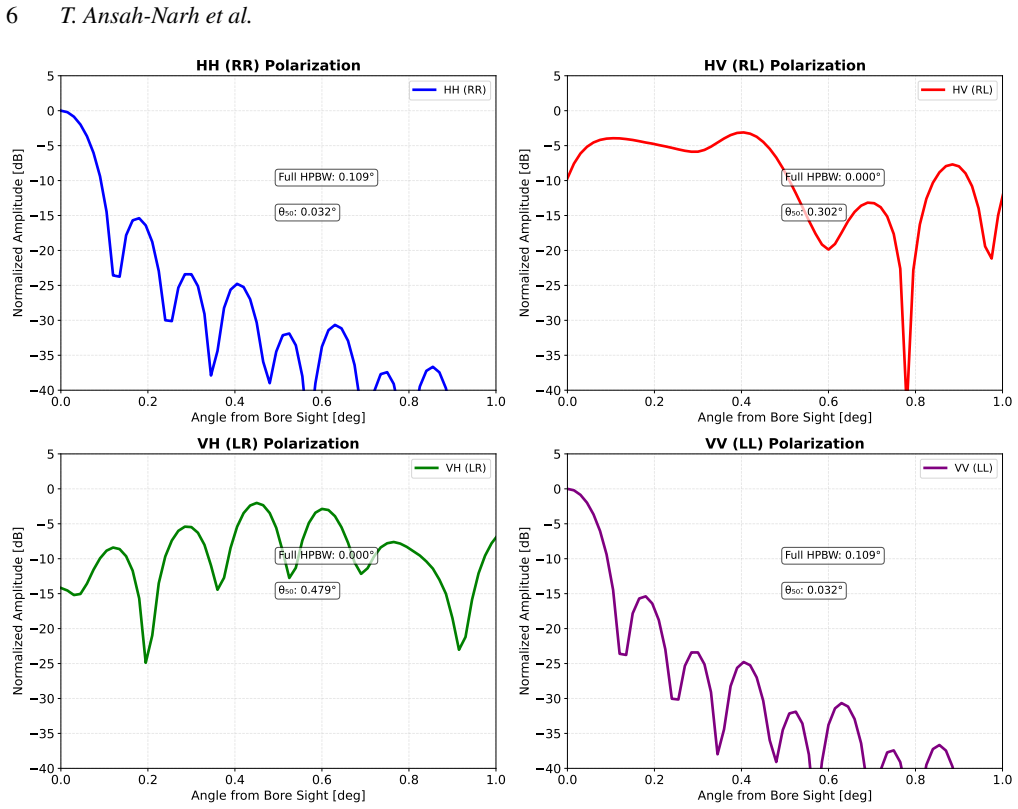
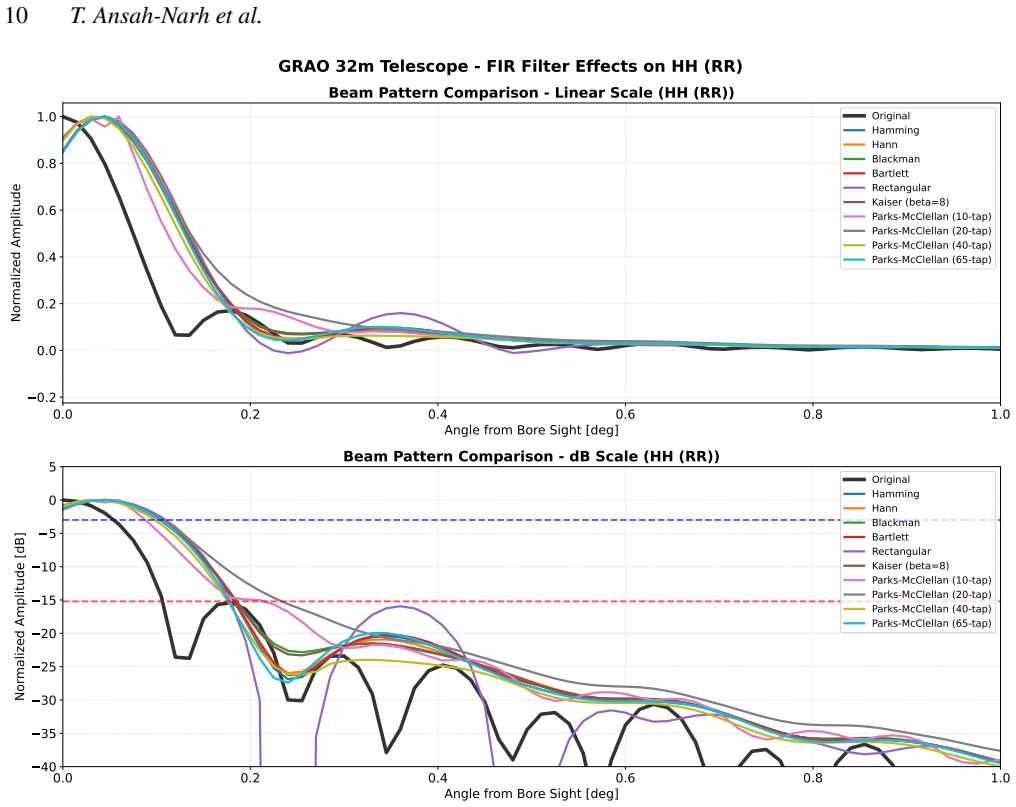
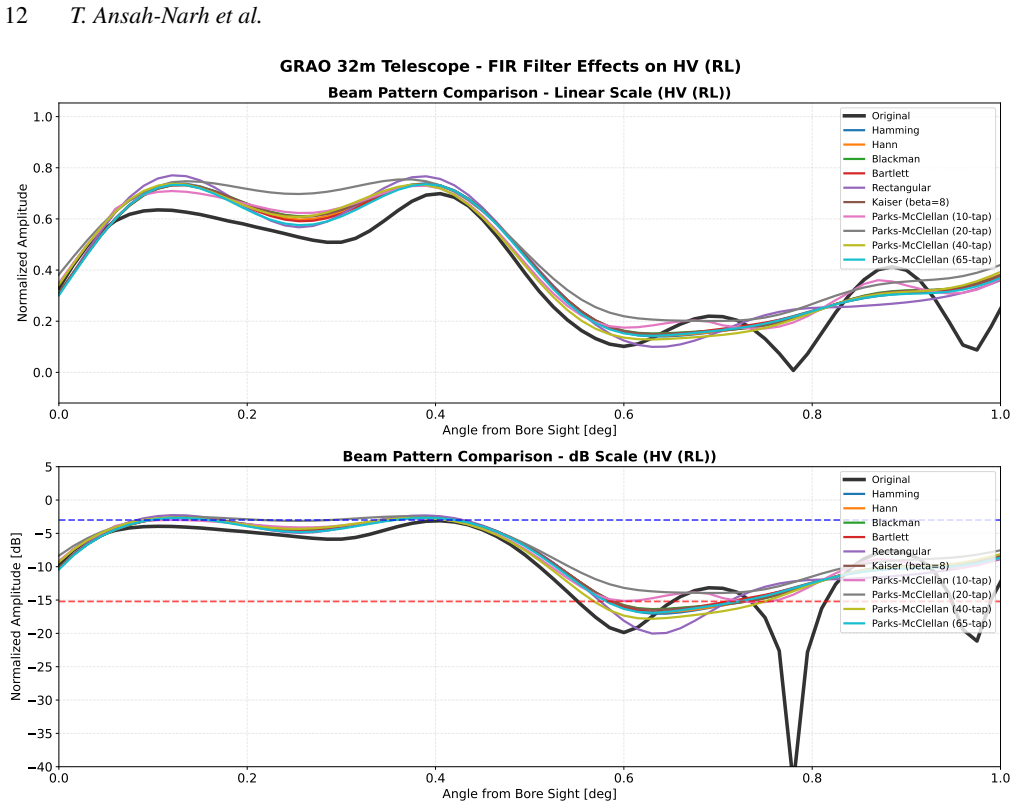
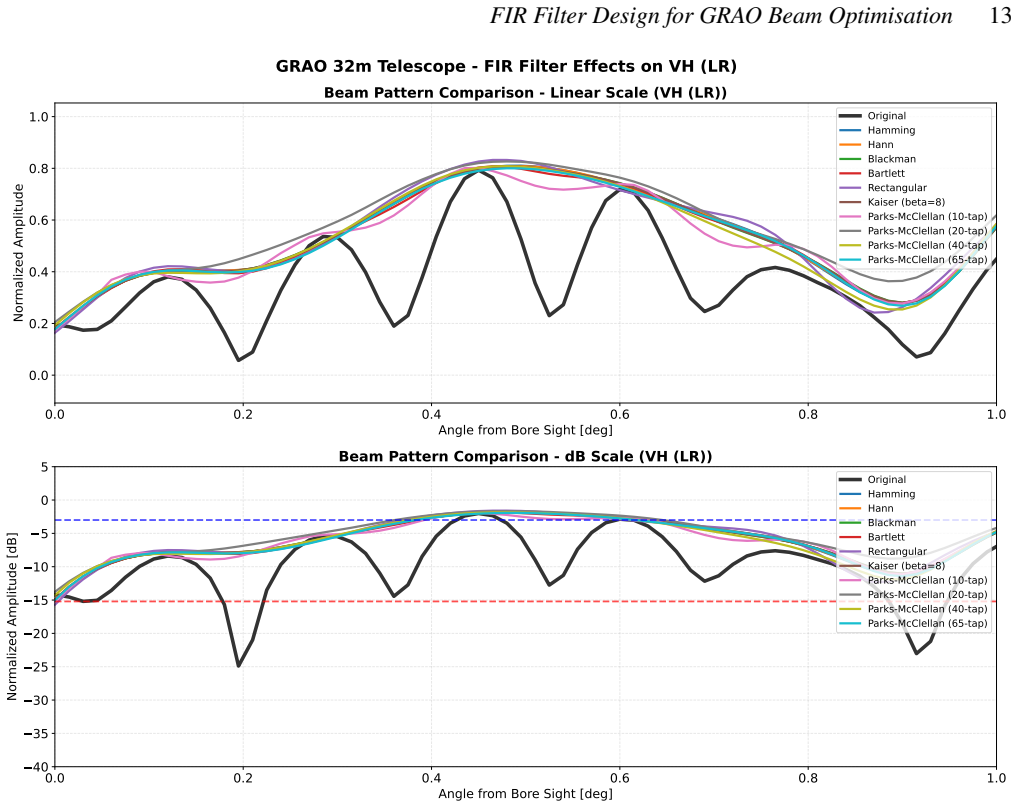
FIR spatial filtering of GRAO telescope beam simulations reduces near-in sidelobes and cross-polar leakage below -30 dB at boresight.
A machine-rendered reading of the paper's core claim, the machinery that carries it, and where it could break.
Core claim
Reformulating beam pattern control as a classical FIR filter design problem on simulated Jones fields allows deliberate attenuation of high spatial-frequency components responsible for residual sidelobes and cross-polar leakage in the GRAO 32-m antenna at 5 GHz, yielding smoother beams, reduced ripple, and leakage below -30 dB at boresight while preserving diffraction-limited resolution.
What carries the argument
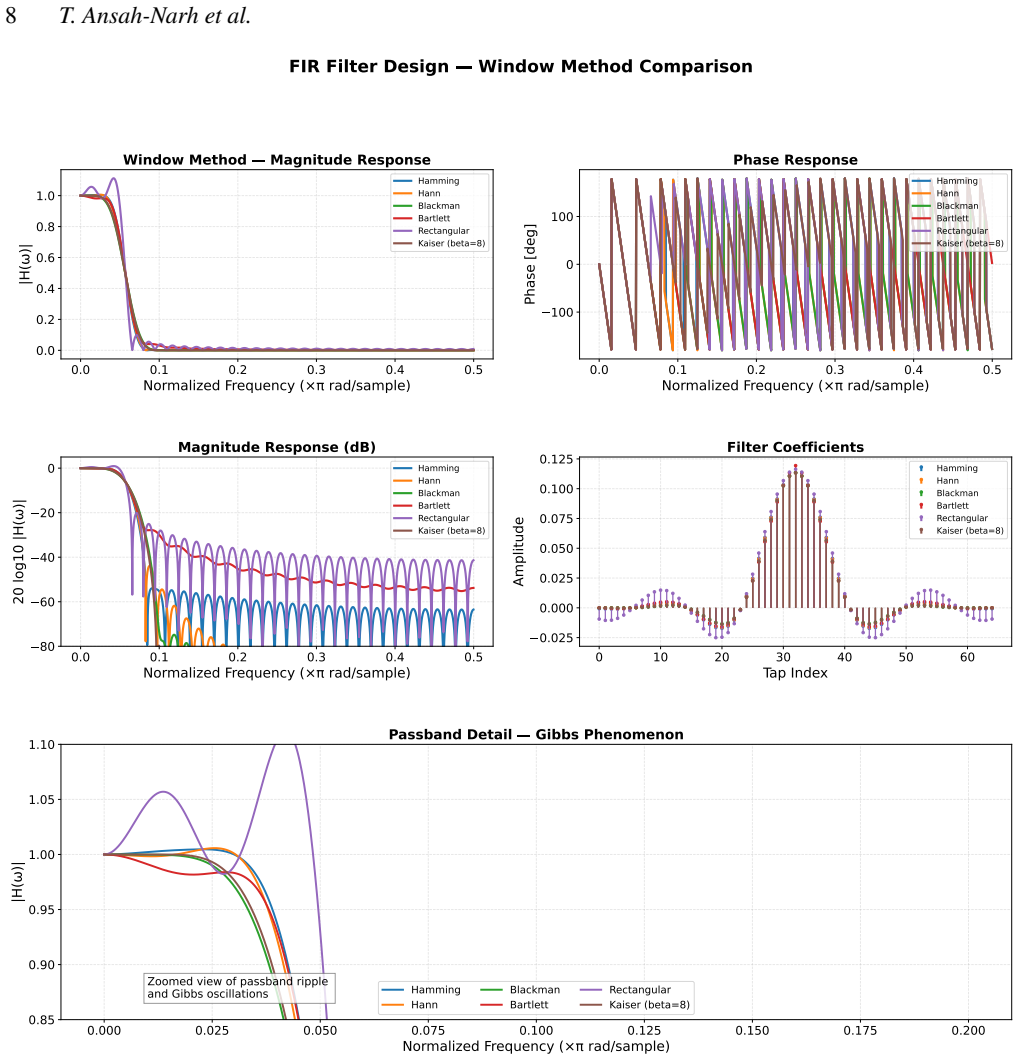
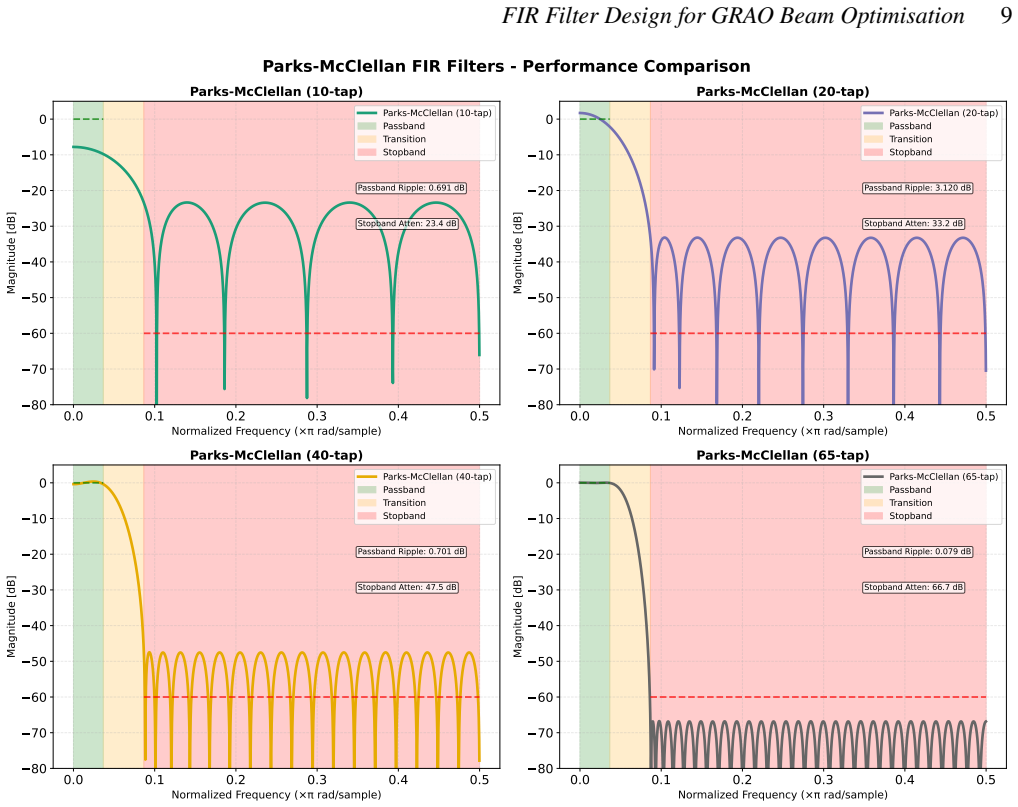
The FIR spatial filtering framework that maps angular displacement to spatial frequency and applies window or Parks-McClellan design directly to the simulated Jones vector fields.
If this is right
- Improved calibration stability for VLBI observations with the GRAO antenna.
- Higher polarimetric precision for spectral-line surveys and pulsar timing.
- A computationally efficient, non-invasive complement to mechanical or optical beam optimisation.
- Direct applicability of the same FIR approach to other single-dish and phased-array telescopes.
Where Pith is reading between the lines
- The method could be validated by feeding the filtered beam models into existing calibration pipelines and comparing residual errors against unfiltered cases.
- Real-time digital correction using pre-computed FIR coefficients might be feasible if the telescope's pointing and frequency are stable enough.
- Extension to wide-band or multi-frequency observations would require checking whether a single set of filter coefficients remains effective across the band.
Load-bearing premise
The electromagnetic simulations of the Jones fields already capture the telescope's real residual sidelobes, structural diffraction, and cross-polar leakage, so that filtering performed in simulation will produce corresponding gains on the sky.
What would settle it
On-sky 5 GHz beam maps of the GRAO telescope taken before and after applying the FIR coefficients, checked to see whether measured cross-polar leakage at boresight falls below -30 dB and near-in ripple decreases as predicted.
Figures


read the original abstract
The scientific utility of large single-dish radio telescopes depends critically on the stability and fidelity of their beam patterns, which govern angular resolution, sensitivity, and polarimetric accuracy. For the 32-m Ghana Radio Astronomy Observatory (GRAO) antenna, electromagnetic simulations reveal residual sidelobes, structural diffraction, and cross-polar leakage that limit performance in high-dynamic-range and polarisation-sensitive observations. To address these limitations, we develop a finite-impulse-response (FIR) spatial filtering framework that reformulates beam optimisation as a digital signal processing problem. By exploiting the equivalence between angular displacement and spatial frequency, classical FIR design methods, window-based and Parks-McClellan algorithms are adapted to operate directly on simulated Jones fields. This approach enables controlled suppression of high spatial frequency artefacts responsible for sidelobes and polarisation mixing, while preserving the telescope's diffraction-limited resolution. Applied to the GRAO 5 GHz beam model, the method achieves substantial reductions in near-in sidelobe ripple, improves beam smoothness, and lowers cross-polar leakage below -30 dB at boresight. These improvements translate into enhanced calibration stability and polarimetric precision, strengthening the telescope's capacity for Very Long Baseline Interferometry, spectral-line surveys, and pulsar timing. Beyond GRAO, the method provides a generalisable, non-invasive, and computationally efficient pathway for beam control applicable to other single-dish and phased-array instruments. The results establish digital spatial filtering as a practical complement to conventional optical or mechanical optimisation, advancing the integration of electromagnetic modelling and signal processing in next-generation radio astronomical instrumentation.
Editorial analysis
A structured set of objections, weighed in public.
Referee Report
Summary. The manuscript reformulates beam pattern optimization for the GRAO 32-m telescope as a digital FIR filtering problem applied to simulated Jones fields at 5 GHz. It adapts classical window-based and Parks-McClellan FIR design methods to suppress high-spatial-frequency artefacts in the simulated beams, reporting quantitative gains in sidelobe ripple reduction, beam smoothness, and cross-polar leakage below -30 dB at boresight, with claimed benefits for VLBI, spectral-line surveys, and pulsar timing. The approach is presented as a generalisable, non-invasive complement to optical or mechanical optimisation.
Significance. If the simulation-to-reality translation holds, the work demonstrates a computationally lightweight DSP-based pathway for mitigating residual sidelobes and polarisation leakage in single-dish antennas, potentially improving calibration stability without hardware changes. The explicit comparison of two standard FIR methods on the same simulated Jones fields provides a concrete benchmark that could be adopted by other facilities.
major comments (2)
- [Results / Discussion (implied by abstract claims)] The central quantitative claims (sidelobe ripple reduction, smoothness improvement, cross-polar leakage < -30 dB) rest entirely on post-filtering of the electromagnetic simulation; no section compares either the input simulated beam or the filtered output against measured on-sky maps, holography, or residual errors from actual GRAO observations. This leaves the translation to enhanced calibration stability and polarimetric precision dependent on an untested fidelity assumption about the model.
- [Abstract and concluding paragraphs] The manuscript states that the filtered beams 'translate into enhanced calibration stability and polarimetric precision' without providing error propagation, sensitivity analysis, or even a forward-model test showing how the reported leakage reduction would affect, e.g., Stokes parameter leakage in a typical observation.
minor comments (2)
- [Methods] Notation for the Jones vector components and the spatial-frequency mapping should be defined once in a dedicated subsection rather than introduced inline.
- [Figures] Figure captions should explicitly state whether the displayed beams are the raw simulation, the filtered result, or the difference, and include the filter order and cutoff values used.
Simulated Author's Rebuttal
We thank the referee for the constructive comments on our simulation-based study. We address each major point below and will revise the manuscript accordingly to better qualify the scope and limitations.
read point-by-point responses
-
Referee: [Results / Discussion (implied by abstract claims)] The central quantitative claims (sidelobe ripple reduction, smoothness improvement, cross-polar leakage < -30 dB) rest entirely on post-filtering of the electromagnetic simulation; no section compares either the input simulated beam or the filtered output against measured on-sky maps, holography, or residual errors from actual GRAO observations. This leaves the translation to enhanced calibration stability and polarimetric precision dependent on an untested fidelity assumption about the model.
Authors: We agree that all quantitative results derive from the electromagnetic simulation of the GRAO 5 GHz Jones fields and that no on-sky, holography, or observational comparison is included. The work is presented as a DSP-based optimisation method applied to simulated fields. In revision we will explicitly state in the abstract, results, and discussion that the reported reductions are achieved within the simulated model, note the dependence on simulation fidelity, and add a forward-looking statement on the desirability of future validation against measured beams. revision: partial
-
Referee: [Abstract and concluding paragraphs] The manuscript states that the filtered beams 'translate into enhanced calibration stability and polarimetric precision' without providing error propagation, sensitivity analysis, or even a forward-model test showing how the reported leakage reduction would affect, e.g., Stokes parameter leakage in a typical observation.
Authors: The phrasing was intended to indicate expected downstream benefits from the demonstrated leakage reduction. We accept that no error propagation, sensitivity analysis, or forward-model test of Stokes leakage is provided. We will revise the abstract and concluding paragraphs to replace definitive statements with qualified language such as 'are expected to translate' and will insert a short paragraph noting that a full propagation study lies outside the present methods paper while the leakage reduction itself is quantified in the simulation. revision: yes
Circularity Check
No significant circularity; standard DSP applied to external EM simulations
full rationale
The paper applies classical window-based and Parks-McClellan FIR design methods to pre-existing simulated Jones fields from electromagnetic modeling of the GRAO telescope. Reported improvements (sidelobe ripple reduction, beam smoothness, cross-polar leakage < -30 dB) are computed directly within that simulation and do not reduce to any fitted parameter renamed as a prediction, self-definitional equivalence, or load-bearing self-citation chain. The derivation chain is self-contained against the external simulation benchmark; the translation to on-sky performance is an untested assumption but does not constitute circularity under the specified patterns.
Axiom & Free-Parameter Ledger
free parameters (1)
- FIR filter order and cutoff frequencies
axioms (1)
- domain assumption Equivalence between angular displacement in the beam and spatial frequency for DSP filtering
Reference graph
Works this paper leans on
-
[1]
Journal of Astronomical Telescopes, Instruments, and Systems , keywords =
Ghana radio astronomy observatory. Journal of Astronomical Telescopes, Instruments, and Systems , keywords =. doi:10.1117/1.JATIS.12.1.017001 , archivePrefix =. 2601.10784 , primaryClass =
-
[2]
2005 , publisher=
Large antennas of the deep space network , author=. 2005 , publisher=
2005
-
[3]
1982 , publisher=
The handbook of antenna design , author=. 1982 , publisher=
1982
-
[4]
Proceedings of the IEEE , volume=
Quasi-optical techniques , author=. Proceedings of the IEEE , volume=. 2002 , publisher=
2002
-
[5]
IEEE signal processing magazine , volume=
A personal history of the Parks-McClellan algorithm , author=. IEEE signal processing magazine , volume=. 2005 , publisher=
2005
-
[6]
IEEE Transactions on circuit theory , volume=
Chebyshev approximation for nonrecursive digital filters with linear phase , author=. IEEE Transactions on circuit theory , volume=. 1972 , publisher=
1972
-
[7]
Proceedings of the IEEE , volume=
On the use of windows for harmonic analysis with the discrete Fourier transform , author=. Proceedings of the IEEE , volume=. 2005 , publisher=
2005
-
[8]
1999 , publisher=
Discrete-time signal processing , author=. 1999 , publisher=
1999
-
[9]
2025 , publisher=
Discrete-Time Signals and Systems: A MATLAB Integrated Approach , author=. 2025 , publisher=
2025
-
[10]
, title =
Garakoui, S. , title =. 2023 , school =
2023
-
[11]
Chichester, West Sussex, UK, 2010, includes bibliographical references , pages=
Wideband beamforming , author=. Chichester, West Sussex, UK, 2010, includes bibliographical references , pages=. 2010 , publisher=
2010
-
[12]
Dual-Band Dual-Beam Shared-Aperture Reflector Antenna Design with FSS Subreflector , volume =
Wang, Qunbiao and Li, Peng and Tan, Guodong and Zhang, Yiqun and Yan, Yuanxin and Xu, Wanye and Rocca, Paolo , year =. Dual-Band Dual-Beam Shared-Aperture Reflector Antenna Design with FSS Subreflector , volume =. Sensors , publisher =. doi:10.3390/s25092934 , number =
-
[13]
2007 , publisher=
The paraboloidal reflector antenna in radio astronomy and communication , author=. 2007 , publisher=
2007
-
[14]
Smirnov, O. M. , year =. Revisiting the radio interferometer measurement equation: II. Calibration and direction-dependent effects , volume =. doi:10.1051/0004-6361/201116434 , journal =
-
[15]
Understanding radio polarimetry. I. Mathematical foundations , author=. Astronomy and Astrophysics Supplement Series , volume=. 1996 , publisher=
1996
-
[16]
Antenna Handbook: Theory, Applications, and Design , pages=
Reflector antennas , author=. Antenna Handbook: Theory, Applications, and Design , pages=. 1988 , publisher=
1988
-
[17]
IEEE transactions on magnetics , volume=
A novel fast algorithm for physical optics analysis of single and dual reflector antennas , author=. IEEE transactions on magnetics , volume=. 2002 , publisher=
2002
-
[18]
Hoare, Melvin G. , year =. UK aid for African radio astronomy , volume =. Nature Astronomy , publisher =. doi:10.1038/s41550-018-0515-z , number =
-
[19]
Atemkeng, Marcellin and Okouma, Patrice and Maina, Eric and Ianjamasimanana, Roger and Zambou, Serges , year =. Radio Astronomical Antennas in the Central African Region to Improve the Sampling Function of the VLBI Network in the SKA Era? , volume =. Sensors , publisher =. doi:10.3390/s22218466 , number =
-
[20]
The WSPC Handbook of Astronomical Instrumentation: Volume 1: Radio Astronomical Instrumentation , pages=
Spectrometers and polyphase filterbanks in radio astronomy , author=. The WSPC Handbook of Astronomical Instrumentation: Volume 1: Radio Astronomical Instrumentation , pages=. 2021 , publisher=
2021
-
[21]
Lecture Note, pfister
Discrete-time signal processing , author=. Lecture Note, pfister. ee. duke. edu/courses/ece485/dtsp. pdf , year=
-
[22]
Remote sensing of environment , volume=
Improved finite impulse response filters for enhanced destriping of geostationary satellite data , author=. Remote sensing of environment , volume=. 1998 , publisher=
1998
-
[23]
Digital Signal Processing , volume=
Realization of reduced-delay finite impulse response filters for audio applications , author=. Digital Signal Processing , volume=. 2010 , publisher=
2010
-
[24]
International Journal of Science and Research (IJSR) , volume=
A review of digital FIR filter design in communication systems , author=. International Journal of Science and Research (IJSR) , volume=
-
[25]
The Astrophysical Journal , volume=
Optimized beam sculpting with generalized fringe-rate filters , author=. The Astrophysical Journal , volume=. 2016 , publisher=
2016
-
[26]
Sparse array design for multiple switched beams using iterative antenna selection method , volume =
Wang, Xiangrong and Aboutanios, Elias , year =. Sparse array design for multiple switched beams using iterative antenna selection method , volume =. doi:10.1016/j.dsp.2020.102684 , journal =
-
[27]
IEEE Transactions on Antennas and Propagation , volume=
Polarimetry with phased array antennas: Sensitivity and polarimetric performance using unpolarized sources for calibration , author=. IEEE Transactions on Antennas and Propagation , volume=. 2012 , publisher=
2012
-
[28]
Warnick, Karl F. and Ivashina, Marianna V. and Wijnholds, Stefan J. and Maaskant, Rob , year =. Polarimetry With Phased Array Antennas: Theoretical Framework and Definitions , volume =. IEEE Transactions on Antennas and Propagation , publisher =. doi:10.1109/tap.2011.2167926 , number =
-
[29]
2017 , publisher=
Interferometry and synthesis in radio astronomy , author=. 2017 , publisher=
2017
-
[30]
Experimental Astronomy , volume=
Array signal processing for radio astronomy , author=. Experimental Astronomy , volume=. 2004 , publisher=
2004
-
[31]
2023 , type =
GRAO 32-m Telescope: Technical Specifications and Performance Parameters , institution =. 2023 , type =
2023
-
[32]
American Astronomical Society Meeting Abstracts\# 225 , volume=
The African VLBI network project , author=. American Astronomical Society Meeting Abstracts\# 225 , volume=
-
[33]
arXiv preprint arXiv:1405.7214 , year=
An African VLBI Network of radio telescopes , author=. arXiv preprint arXiv:1405.7214 , year=
-
[34]
ApJ , fjournal=
Fournier, Paul , title=. ApJ , fjournal=
-
[35]
An important paper , journal=
-
[36]
Another Unreal Paper , journal=
-
[37]
A Last Unreal Paper , journal=
discussion (0)
Sign in with ORCID, Apple, or X to comment. Anyone can read and Pith papers without signing in.