Radiatively Controlled Thermal Stability of High-Altitude Clouds in Exoplanetary Atmospheres
Pith reviewed 2026-06-26 12:57 UTC · model grok-4.3
The pith
Silicate condensates remain thermally stable for cloud formation in exoplanet upper atmospheres across wide conditions, whereas sulfide condensates heat to sublimation even around temperate planets.
A machine-rendered reading of the paper's core claim, the machinery that carries it, and where it could break.
Core claim
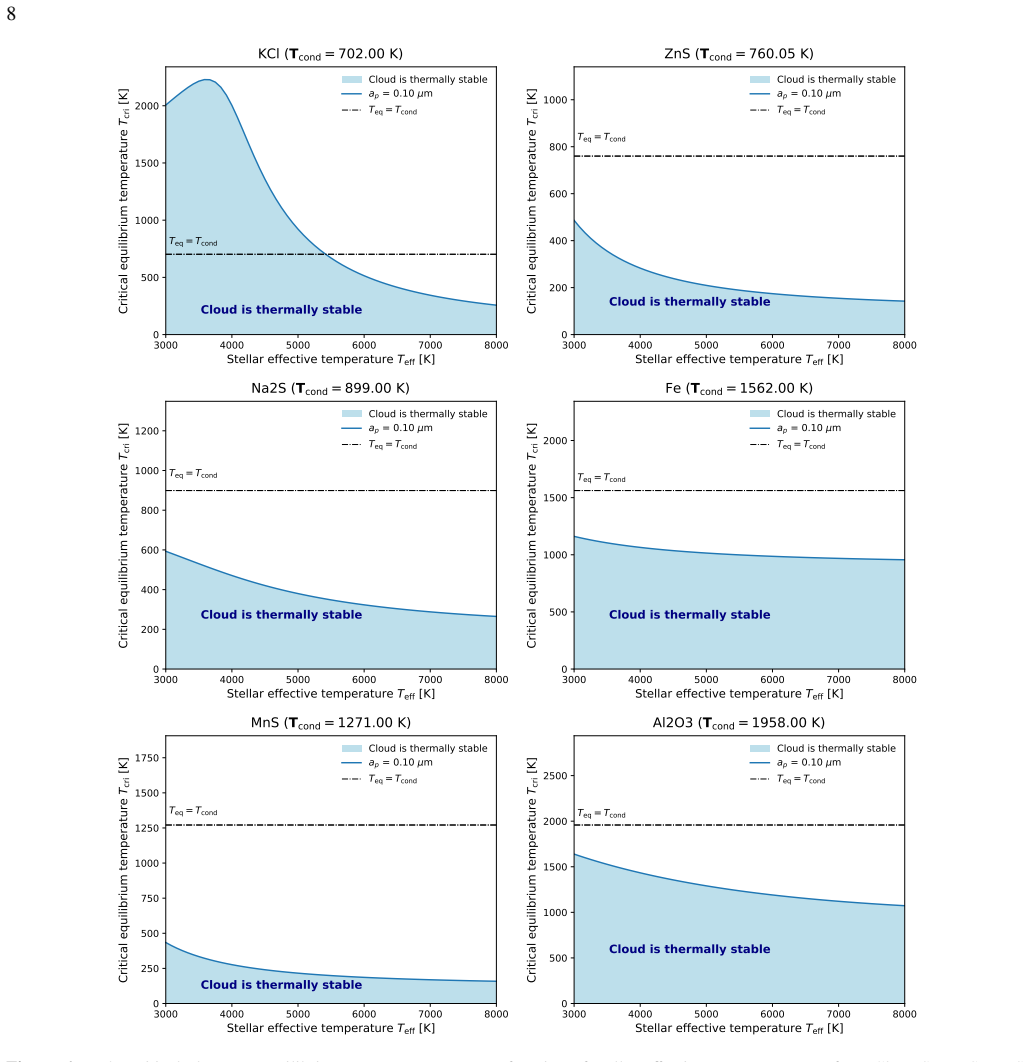
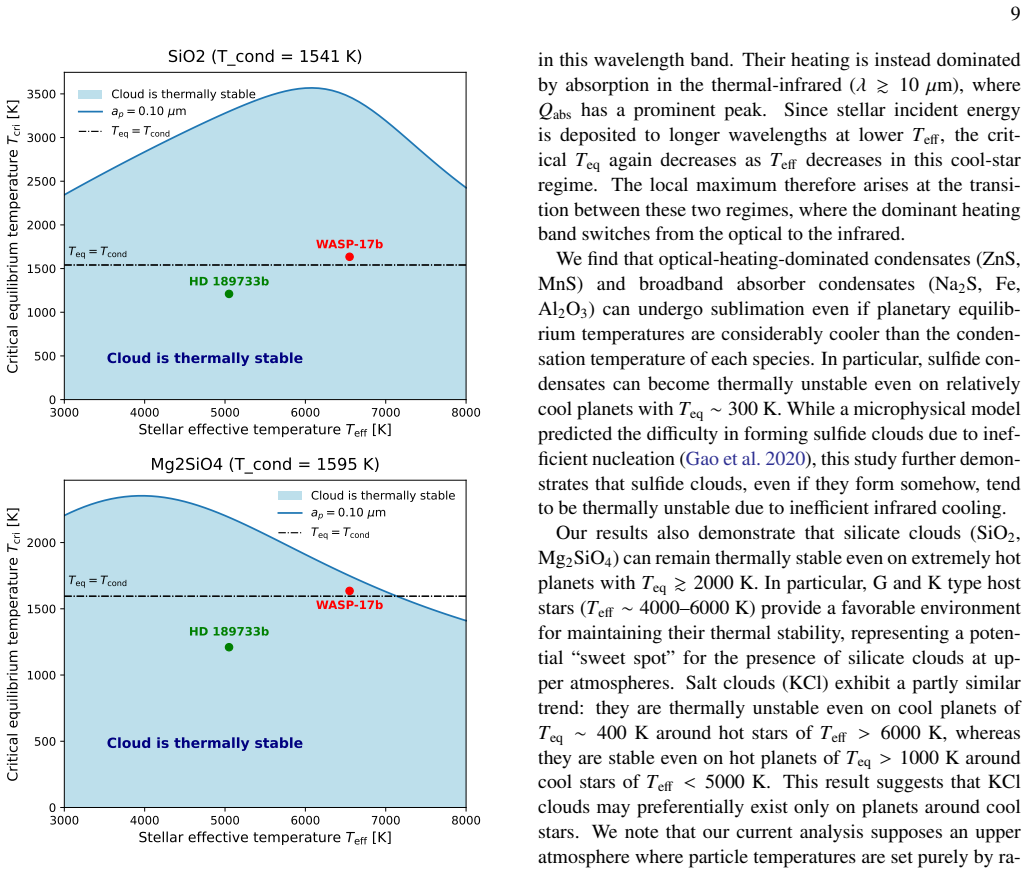
By solving the radiative energy balance for eight cloud condensates, the authors show that particle temperatures fall into composition-dependent groups. Silicate condensates maintain temperatures below their condensation points in a wide range of stellar and planetary conditions, while sulfide condensates reach sublimation temperatures even on temperate planets. Specific planets like WASP-17b and HD 189733b are in the stable regime for SiO2 clouds.
What carries the argument
Radiative equilibrium temperature for cloud particles, obtained by balancing absorbed stellar radiation against emitted infrared radiation and compared to each material's condensation temperature.
If this is right
- SiO2 clouds are possible on the daysides of WASP-17b and HD 189733b.
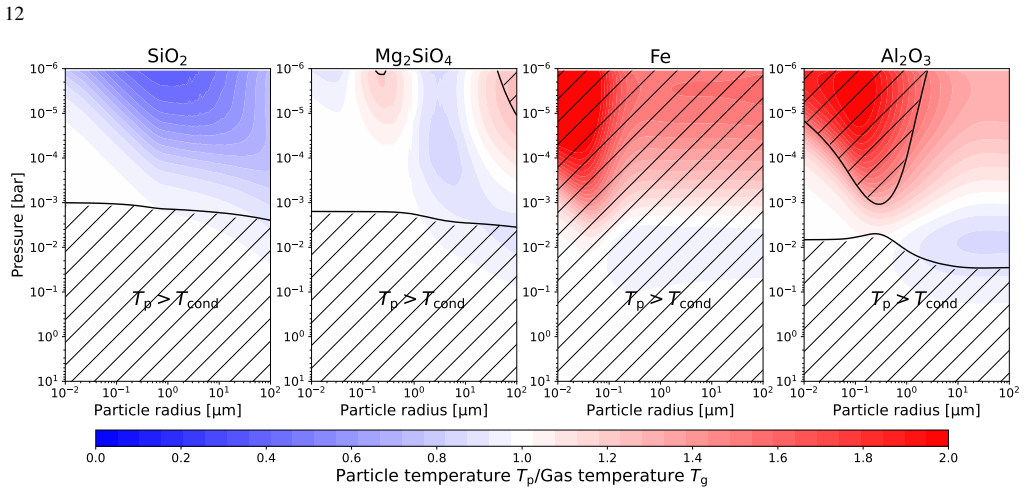
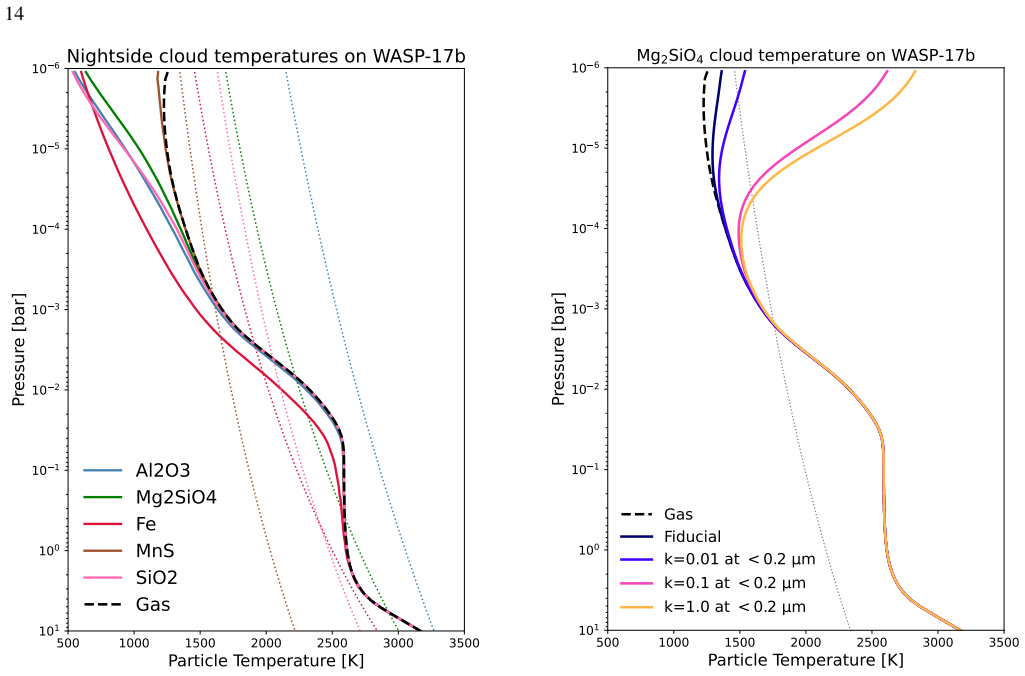
- Fe clouds are ruled out on the dayside of WASP-17b despite gas temperatures allowing formation.
- Al2O3 clouds exist only in a narrow vertical region on WASP-17b.
- Sulfide clouds are unlikely at high altitudes on most exoplanets examined.
Where Pith is reading between the lines
- Cloud composition inferences from spectra may need revision if particle temperatures differ from gas temperatures.
- Future observations could map which condensates appear at which pressures to test the radiative control.
- Similar calculations might apply to clouds on cooler planets or in different wavelength regimes.
Load-bearing premise
Cloud particle temperatures are controlled only by radiative heating from the star and infrared cooling, with gas collisions and latent heat playing negligible roles at low pressures.
What would settle it
Detection of sulfide clouds at pressures low enough that the model predicts they should have sublimated, or direct spectroscopic measurement showing particle temperatures matching gas temperatures instead.
Figures




read the original abstract
One of the most striking findings of exoplanetary science is the ubiquity of clouds. A conventional approach to infer the cloud compositions is to utilize the thermochemical equilibrium model assuming the same temperature shared with clouds and ambient gases; however, this assumption is actually not always valid, especially in the tenuous upper atmospheres where particle-gas collisions are infrequent. In this study, we investigate the radiative equilibrium temperatures of exoplanetary clouds to assess the thermal stability of aerosols in the low atmospheric pressure limit. For eight cloud-forming condensates (KCl, ZnS, Na$_2$S, MnS, SiO$_2$, Mg$_2$SiO$_4$, Fe, and Al$_2$O$_3$), we solve the energy balance between stellar radiative heating and infrared cooling to calculate the particle temperature, which is then compared with their condensation temperatures. We find three composition-dependent groups in the particle-temperature behavior, and show that silicate condensates (SiO$_2$ and Mg$_2$SiO$_4$) maintain a cool enough temperature in a wide range of stellar and planetary conditions. Conversely, sulfide condensates (ZnS, Na$_2$S, and MnS) are readily heated to their sublimation temperatures even on temperate planets. WASP-17b and HD 189733b fall within the thermodynamically stable regime for SiO$_2$ clouds, consistent with recent JWST observations. We also examine the vertical profiles of cloud temperatures on WASP-17b, showing that Fe clouds cannot exist on the dayside, and Al$_2$O$_3$ clouds can exist only in a confined region, even though atmospheric temperature appears to allow the formation of these clouds. This study provides novel insights on cloud compositions in upper exoplanetary atmospheres, testable by upcoming atmospheric surveys of JWST and Ariel.
Editorial analysis
A structured set of objections, weighed in public.
Referee Report
Summary. The manuscript calculates radiative equilibrium temperatures for eight cloud condensates (KCl, ZnS, Na2S, MnS, SiO2, Mg2SiO4, Fe, Al2O3) by balancing stellar absorption against infrared emission, then compares these particle temperatures to condensation/sublimation temperatures. It reports three composition-dependent behavioral groups, concluding that silicates remain thermally stable across wide stellar/planetary conditions while sulfides heat to sublimation even on temperate planets; specific applications are made to WASP-17b, HD 189733b, and vertical profiles on WASP-17b.
Significance. If the central results hold, the work supplies a first-principles radiative-equilibrium alternative to thermochemical-equilibrium assumptions for high-altitude cloud stability, directly linking optical properties to observable cloud compositions and offering testable predictions for JWST and Ariel. The explicit energy-balance calculations and application to observed planets constitute clear strengths.
major comments (3)
- [Abstract / §2] Abstract and §2 (Methods): The claim that particle-gas collisions and latent-heat exchange are negligible (justifying the pure radiative-equilibrium treatment) is load-bearing for the stability conclusions, yet no quantitative comparison of collision frequency (kinetic-theory mean free path or rate) versus radiative timescale is provided for the modeled pressures or the WASP-17b dayside profile.
- [Results] Results section (grouping into three classes): The partition of condensates into stable (silicates), unstable (sulfides), and intermediate groups is presented without explicit quantitative criteria, thresholds, or sensitivity metrics; the separation therefore appears post-hoc and its robustness to uncertainties in optical constants is untested.
- [§4] §4 (WASP-17b vertical profiles): The statements that Fe clouds cannot exist on the dayside and Al2O3 clouds are confined to a narrow region rest on the same unquantified radiative-equilibrium assumption; without the collision-timescale validation, these specific non-existence claims cannot be evaluated.
minor comments (2)
- No error bars, Monte-Carlo realizations, or sensitivity tests on the adopted optical constants or condensation temperatures are reported, limiting assessment of robustness.
- [Abstract] The abstract states consistency with JWST observations for WASP-17b and HD 189733b but provides no direct quantitative comparison (e.g., retrieved cloud altitudes or temperatures).
Simulated Author's Rebuttal
We thank the referee for their thoughtful comments, which have helped us improve the clarity and rigor of our manuscript. We provide point-by-point responses to the major comments below.
read point-by-point responses
-
Referee: [Abstract / §2] Abstract and §2 (Methods): The claim that particle-gas collisions and latent-heat exchange are negligible (justifying the pure radiative-equilibrium treatment) is load-bearing for the stability conclusions, yet no quantitative comparison of collision frequency (kinetic-theory mean free path or rate) versus radiative timescale is provided for the modeled pressures or the WASP-17b dayside profile.
Authors: We agree that a quantitative validation of the negligible collision assumption would strengthen the paper. In the revised manuscript, we have included a new subsection in §2 with estimates of the mean free path and collision rates using kinetic theory at pressures from 10^{-6} to 10^{-3} bar, compared to the radiative cooling timescale calculated from the particle's emissivity and temperature. This shows that radiative timescales are orders of magnitude shorter than collision times in the upper atmosphere, justifying the pure radiative equilibrium approach for the conditions considered. revision: yes
-
Referee: [Results] Results section (grouping into three classes): The partition of condensates into stable (silicates), unstable (sulfides), and intermediate groups is presented without explicit quantitative criteria, thresholds, or sensitivity metrics; the separation therefore appears post-hoc and its robustness to uncertainties in optical constants is untested.
Authors: We acknowledge that the grouping would benefit from explicit criteria. We have revised the Results section to define quantitative thresholds based on the temperature difference between the particle equilibrium temperature and the condensation temperature: 'stable' if ΔT < -200 K across the explored parameter space, 'unstable' if ΔT > 100 K, and 'intermediate' otherwise. We have also added a sensitivity test varying the optical constants by ±20% (within typical uncertainties for these materials) and confirmed that the group assignments remain unchanged. revision: yes
-
Referee: [§4] §4 (WASP-17b vertical profiles): The statements that Fe clouds cannot exist on the dayside and Al2O3 clouds are confined to a narrow region rest on the same unquantified radiative-equilibrium assumption; without the collision-timescale validation, these specific non-existence claims cannot be evaluated.
Authors: These statements rely on the radiative equilibrium model. With the addition of the collision timescale analysis in the revised §2, the assumption is now quantitatively supported for the relevant pressures. We have updated §4 to reference this validation and note that the conclusions apply specifically in the low-density limit where particle-gas collisions are infrequent. revision: yes
Circularity Check
No significant circularity; derivation uses external inputs
full rationale
The paper derives particle temperatures by solving the radiative energy balance equation using optical properties and condensation temperatures taken from prior literature. No parameters are fitted to the stability conclusions, no self-citation chain supports the central partition into stable/unstable groups, and the derivation does not reduce to a renaming or self-definition. The assumption of negligible collisions is an explicit modeling choice whose validity is a separate question from circularity.
Axiom & Free-Parameter Ledger
axioms (1)
- domain assumption Particle temperature is determined solely by radiative equilibrium (stellar heating = IR cooling) with negligible gas-particle heat exchange at low pressure.
Reference graph
Works this paper leans on
-
[1]
Adams, D., Gao, P., de Pater, I., & Morley, C. V . 2019, ApJ, 874, 61
2019
-
[2]
J., Wittenmyer, R
Addison, B., Wright, D. J., Wittenmyer, R. A., et al. 2019, PASP, 131, 115003
2019
-
[3]
R., Hellier, C., Gillon, M., et al
Anderson, D. R., Hellier, C., Gillon, M., et al. 2010, ApJ, 709, 159
2010
-
[4]
E., Rooney, C
Batalha, N. E., Rooney, C. M., Visscher, C., et al. 2026, AJ, 171, 98
2026
-
[5]
A., Lothringer, J., et al
Benneke, B., Knutson, H. A., Lothringer, J., et al. 2019, Nature Astronomy, 3, 813
2019
-
[6]
2025, Nature Astronomy, 9, 1300
Bertrand, T., Lellouch, E., Holler, B., et al. 2025, Nature Astronomy, 9, 1300
2025
-
[7]
S., Desidera, S., Benatti, S., et al
Bonomo, A. S., Desidera, S., Benatti, S., et al. 2017, A&A, 602, A107
2017
-
[8]
Brande, J., Crossfield, I. J. M., Kreidberg, L., et al. 2024, ApJL, 961, L23
2024
-
[9]
& Sharp, C
Burrows, A. & Sharp, C. M. 1999, ApJ, 512, 843
1999
-
[10]
2015, ApJL, 813, L1
Charnay, B., Meadows, V ., Misra, A., Leconte, J., & Arney, G. 2015, ApJL, 813, L1
2015
-
[11]
A., Mayne, N
Christie, D. A., Mayne, N. J., Gillard, R. M., et al. 2022, MNRAS, 517, 1407
2022
-
[12]
2025, Nature Astronomy, 9, 512
Coulombe, L.-P., Radica, M., Benneke, B., et al. 2025, Nature Astronomy, 9, 512
2025
-
[13]
Crossfield, I. J. M. & Kreidberg, L. 2017, AJ, 154, 261
2017
-
[14]
Draine, B. T. 2011, Physics of the Interstellar and Intergalactic Medium
2011
-
[15]
H., Yu, X., Ohno, K., et al
Dymont, A. H., Yu, X., Ohno, K., et al. 2022, ApJ, 937, 90 18
2022
-
[16]
E., Kirk, J., et al
Espinoza, N., Steinrueck, M. E., Kirk, J., et al. 2024, Nature, 632, 1017
2024
-
[17]
D., Radica, M., Welbanks, L., et al
Feinstein, A. D., Radica, M., Welbanks, L., et al. 2023, Nature, 614, 670
2023
-
[18]
1975, Journal of Atmospheric and Terrestrial Physics, 37, 1327
Fiocco, G., Grams, G., & Visconti, G. 1975, Journal of Atmospheric and Terrestrial Physics, 37, 1327
1975
-
[19]
1976, Journal of the Atmospheric Sciences, 33, 2415
Fiocco, G., Mugnai, A., & Grams, G. 1976, Journal of the Atmospheric Sciences, 33, 2415
1976
-
[20]
2017, ApJL, 847, L22
Fu, G., Deming, D., Knutson, H., et al. 2017, ApJL, 847, L22
2017
-
[21]
Fu, G., Stevenson, K. B., Sing, D. K., et al. 2025b, arXiv e-prints, arXiv:2501.02081
-
[22]
& Benneke, B
Gao, P. & Benneke, B. 2018, ApJ, 863, 165
2018
-
[23]
Gao, P., Piette, A. A. A., Steinrueck, M. E., et al. 2023, ApJ, 951, 96
2023
-
[24]
P., Lee, E
Gao, P., Thorngren, D. P., Lee, E. K. H., et al. 2020, Nature Astronomy, 4, 951
2020
-
[25]
R., Moran, S
Gao, P., Wakeford, H. R., Moran, S. E., & Parmentier, V . 2021, Journal of Geophysical Research (Planets), 126, e06655
2021
-
[26]
2008, Geophys
Goldenson, N., Desch, S., & Christensen, P. 2008, Geophys. Res. Lett., 35, L08813
2008
-
[27]
A., Batalha, N
Gordon, T. A., Batalha, N. M., Batalha, N. E., et al. 2026, AJ, 171, 178
2026
-
[28]
K., Wakeford, H
Grant, D., Lewis, N. K., Wakeford, H. R., et al. 2023, ApJL, 956, L32
2023
-
[29]
M., Kahre, M
Haberle, R. M., Kahre, M. A., Bertrand, T., & Wolff, M. J. 2025, Icarus, 429, 116452
2025
-
[30]
D., Johnson, A
Hamill, C. D., Johnson, A. V ., & Gao, P. 2024, PSJ, 5, 186
2024
-
[31]
D., Johnson, A
Hamill, C. D., Johnson, A. V ., Lodge, M., et al. 2025, ApJ, 987, 176
2025
-
[32]
2006, A&A, 451, L9
Helling, C., Thi, W.-F., Woitke, P., & Fridlund, M. 2006, A&A, 451, L9
2006
-
[33]
Heng, K., Hayek, W., Pont, F., & Sing, D. K. 2012, MNRAS, 420, 20
2012
-
[34]
W., & Min, M
Huang, H., Ormel, C. W., & Min, M. 2024, A&A, 691, A291
2024
-
[35]
E., Lewis, N
Inglis, J., Batalha, N. E., Lewis, N. K., et al. 2024, ApJL, 973, L41
2024
-
[36]
Jones, A. P. 2022, A&A, 665, A21
2022
-
[37]
A., Blecic, J., Ashtari, R., et al
Kahle, K. A., Blecic, J., Ashtari, R., et al. 2025, A&A, 701, A184
2025
-
[38]
2014, A&A, 568, A42
Kataoka, A., Okuzumi, S., Tanaka, H., & Nomura, H. 2014, A&A, 568, A42
2014
-
[39]
& Ikoma, M
Kawashima, Y . & Ikoma, M. 2018, ApJ, 853, 7
2018
-
[40]
Kempton, E. M. R., Zhang, M., Bean, J. L., et al. 2023, arXiv e-prints, arXiv:2305.06240
arXiv 2023
-
[41]
V ., & Rowland, M
Kiefer, S., Morley, C. V ., & Rowland, M. J. 2026, ApJ, 1001, 98
2026
-
[42]
& Heng, K
Kitzmann, D. & Heng, K. 2018, MNRAS, 475, 94
2018
-
[43]
A., Benneke, B., Deming, D., & Homeier, D
Knutson, H. A., Benneke, B., Deming, D., & Homeier, D. 2014, Nature, 505, 66
2014
-
[44]
2006, A&A, 449, 583
Koike, C., Mutschke, H., Suto, H., et al. 2006, A&A, 449, 583
2006
-
[45]
& Arfaux, A
Lavvas, P. & Arfaux, A. 2021, MNRAS, 502, 5643
2021
-
[46]
Showman, A. P. 2019, ApJ, 878, 118
2019
-
[47]
2024, arXiv e-prints, arXiv:2410.09981
Lavvas, P., Paraskevaidou, S., & Arfaux, A. 2024, arXiv e-prints, arXiv:2410.09981
arXiv 2024
-
[48]
2016, A&A, 594, A48
Lee, E., Dobbs-Dixon, I., Helling, C., Bognar, K., & Woitke, P. 2016, A&A, 594, A48
2016
-
[49]
Lee, E. K. H. 2023, MNRAS, 524, 2918
2023
-
[50]
Lee, E. K. H. & Ohno, K. 2025, A&A, 695, A111
2025
-
[51]
Lee, E. K. H., Werlen, A., & Dorn, C. 2025, ApJL, 990, L43
2025
- [52]
-
[53]
J., Boutle, I
Lines, S., Mayne, N. J., Boutle, I. A., et al. 2018, A&A, 615, A97
2018
-
[54]
Marley, M. S. 2025, arXiv e-prints, arXiv:2512.04186
arXiv 2025
-
[55]
G., Wakeford, H
Lodge, M. G., Wakeford, H. R., & Leinhardt, Z. M. 2024, MNRAS, 527, 11113
2024
-
[56]
R., Mullens, E., Alderson, L., et al
Louie, D. R., Mullens, E., Alderson, L., et al. 2025, AJ, 169, 86
2025
-
[57]
S., Eastman, J
Mahajan, A. S., Eastman, J. D., & Kirk, J. 2024, ApJL, 963, L37
2024
-
[58]
2025, AJ, 169, 221
Malsky, I., Rauscher, E., Stevenson, K., et al. 2025, AJ, 169, 221
2025
-
[59]
& Kempton, E
Mbarek, R. & Kempton, E. M. R. 2016, ApJ, 827, 121
2016
-
[60]
2025, arXiv e-prints, arXiv:2509.23406 Miller-Ricci Kempton, E., Zahnle, K., & Fortney, J
Mehta, N., Parmentier, V ., Tan, X., et al. 2025, arXiv e-prints, arXiv:2509.23406 Miller-Ricci Kempton, E., Zahnle, K., & Fortney, J. J. 2012, ApJ, 745, 3
arXiv 2025
-
[61]
2020, ApJ, 899, 53
Molaverdikhani, K., Henning, T., & Molli`ere, P. 2020, ApJ, 899, 53
2020
-
[62]
E., Lodge, M
Moran, S. E., Lodge, M. G., Batalha, N. E., et al. 2025, ApJ, 994, 116
2025
-
[63]
E., Marley, M
Moran, S. E., Marley, M. S., & Crossley, S. D. 2024, ApJL, 973, L3
2024
-
[64]
V ., Fortney, J
Morley, C. V ., Fortney, J. J., Marley, M. S., et al. 2012, ApJ, 756, 172
2012
-
[65]
V ., Fortney, J
Morley, C. V ., Fortney, J. J., Marley, M. S., et al. 2015, ApJ, 815, 110
2015
-
[66]
M., Heng, K., & Kitzmann, D
Morris, B. M., Heng, K., & Kitzmann, D. 2024, A&A, 685, A104
2024
-
[67]
Mukherjee, S., Sing, D. K., Fu, G., et al. 2025, arXiv e-prints, arXiv:2505.10910
Pith/arXiv arXiv 2025
-
[68]
M., Beatty, T
Murphy, M. M., Beatty, T. G., Schlawin, E., et al. 2024, Nature Astronomy, 8, 1562
2024
-
[69]
M., Beatty, T
Murphy, M. M., Beatty, T. G., Schlawin, E., et al. 2025, AJ, 170, 61
2025
-
[70]
& Okuzumi, S
Ohno, K. & Okuzumi, S. 2018, ApJ, 859, 34
2018
-
[71]
2020, ApJ, 891, 131
Ohno, K., Okuzumi, S., & Tazaki, R. 2020, ApJ, 891, 131
2020
-
[72]
J., et al
Ohno, K., Schlawin, E., Bell, T. J., et al. 2025, ApJL, 979, L7 19
2025
-
[73]
2016, MNRAS, 457, 3420
Oreshenko, M., Heng, K., & Demory, B.-O. 2016, MNRAS, 457, 3420
2016
-
[74]
Ormel, C. W. & Min, M. 2019, A&A, 622, A121
2019
-
[75]
A., Henry, T
Paredes, L. A., Henry, T. J., Quinn, S. N., et al. 2021, AJ, 162, 176
2021
-
[76]
Marley, M. S. 2016, ApJ, 828, 22
2016
-
[77]
& Zhang, X
Powell, D. & Zhang, X. 2024, ApJ, 969, 5
2024
-
[78]
2018, ApJ, 860, 18
Powell, D., Zhang, X., Gao, P., & Parmentier, V . 2018, ApJ, 860, 18
2018
-
[79]
2026, miepython: A Python library for Mie scattering calculations
Prahl, S. 2026, miepython: A Python library for Mie scattering calculations
2026
-
[80]
& Rauscher, E
Roman, M. & Rauscher, E. 2019, ApJ, 872, 1
2019
discussion (0)
Sign in with ORCID, Apple, or X to comment. Anyone can read and Pith papers without signing in.