The impedance of a charged flat-plate electric double-layer capacitor
Pith reviewed 2026-06-26 11:10 UTC · model grok-4.3
The pith
Slanted lines in Nyquist plots of biased or asymmetrically diffusing EDL capacitors originate from ambipolar salt diffusion and are described by Warburg circuit elements.
A machine-rendered reading of the paper's core claim, the machinery that carries it, and where it could break.
Core claim
The impedance spectra of biased or asymmetrically diffusing flat-plate EDL capacitors exhibit a slanted line at intermediate frequencies caused by ambipolar salt diffusion. Symmetric salt perturbations from nonzero bias are modeled by a Warburg open element while antisymmetric perturbations from unequal diffusion coefficients are modeled by a Warburg short element. The resulting circuit analysis supplies explicit relations connecting the Warburg prefactors to the ambipolar diffusion coefficient, the chemical capacitance of the bulk electrolyte, and the differential charge efficiency of the EDLs.
What carries the argument
Warburg short and open circuit elements that capture ambipolar salt diffusion in the equivalent-circuit models for the two cases of bias and unequal diffusion coefficients.
If this is right
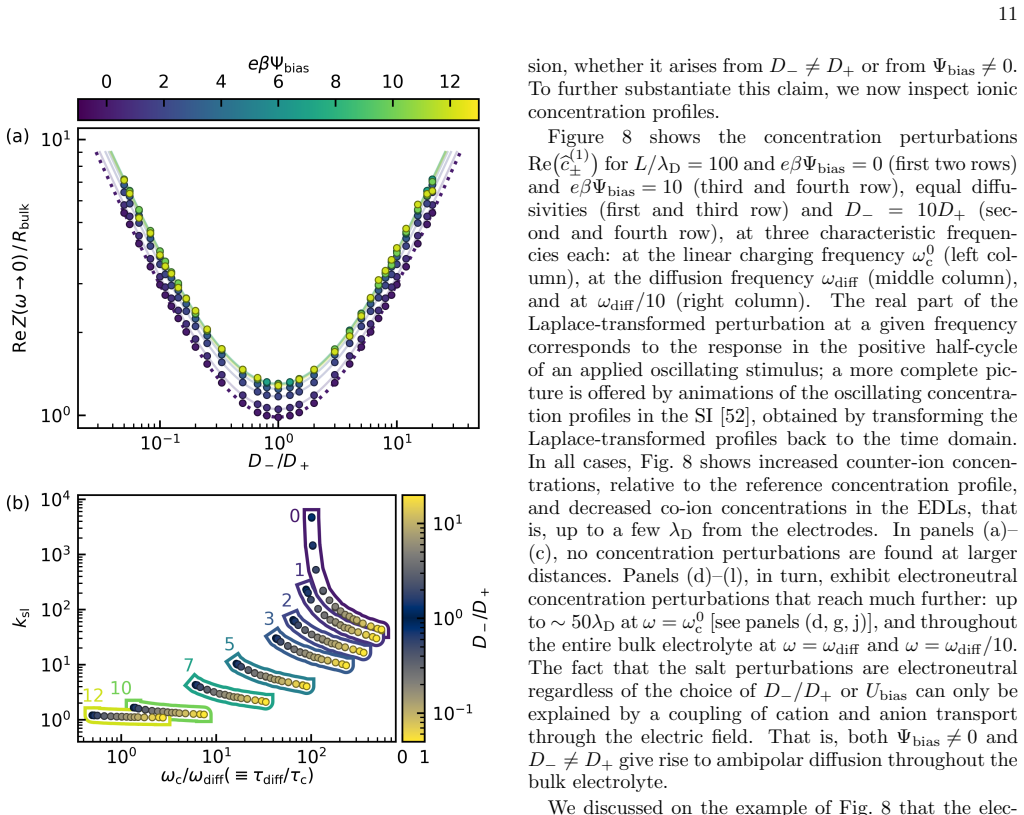
- The width of the slanted-line region saturates at large bias voltages.
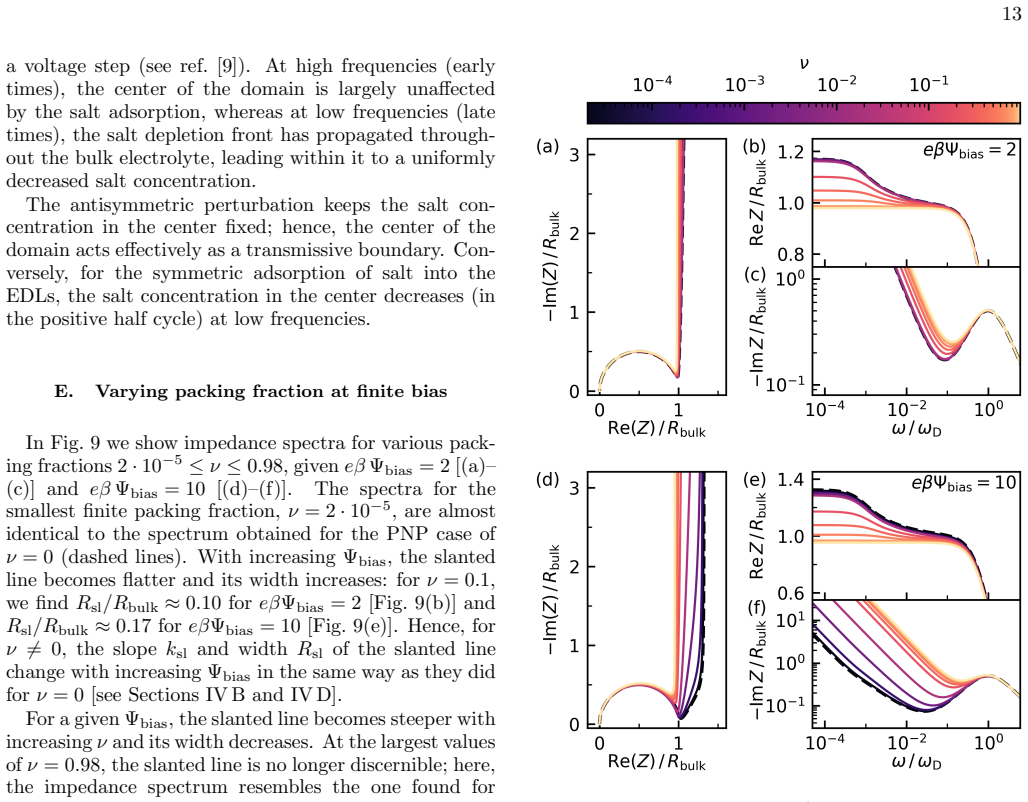
- The width of the slanted-line region vanishes for large ion packing fractions.
- The overall capacitance of the closed system is limited by the finite total number of ions.
- The Warburg prefactors are quantitatively linked to the ambipolar diffusion coefficient, bulk chemical capacitance, and EDL differential charge efficiency.
Where Pith is reading between the lines
- The symmetric versus antisymmetric distinction in salt perturbations may generalize to impedance analysis of other confined electrochemical cells.
- Varying bulk ion concentration while holding bias fixed could test the predicted dependence of the Warburg prefactor on chemical capacitance.
- The finite-ion limitation identified here suggests that closed-system corrections become essential for modeling small-volume or low-concentration EDL devices.
Load-bearing premise
The modified Poisson-Nernst-Planck continuum equations with the chosen boundary conditions and discretization faithfully represent the ion transport and electrostatics without additional microscopic effects.
What would settle it
Direct observation of the spatial and temporal form of salt concentration perturbations at the frequencies where the slanted line appears, checking whether they match the predicted symmetric or antisymmetric ambipolar diffusion patterns.
Figures



read the original abstract
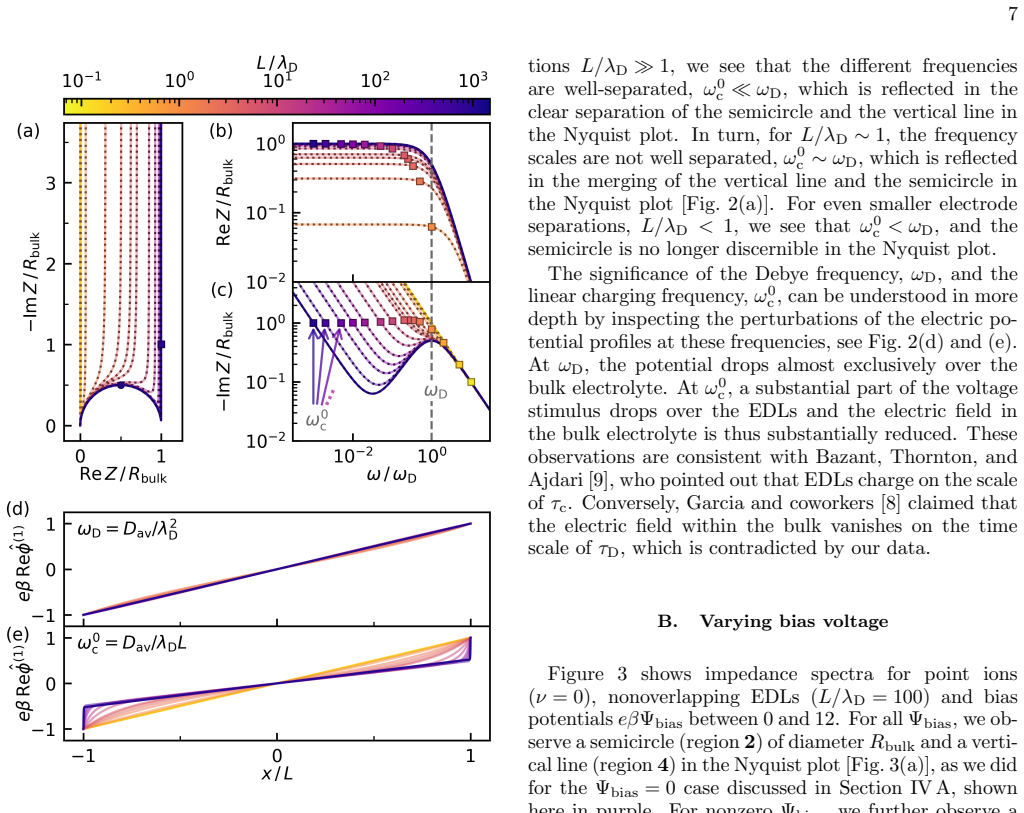
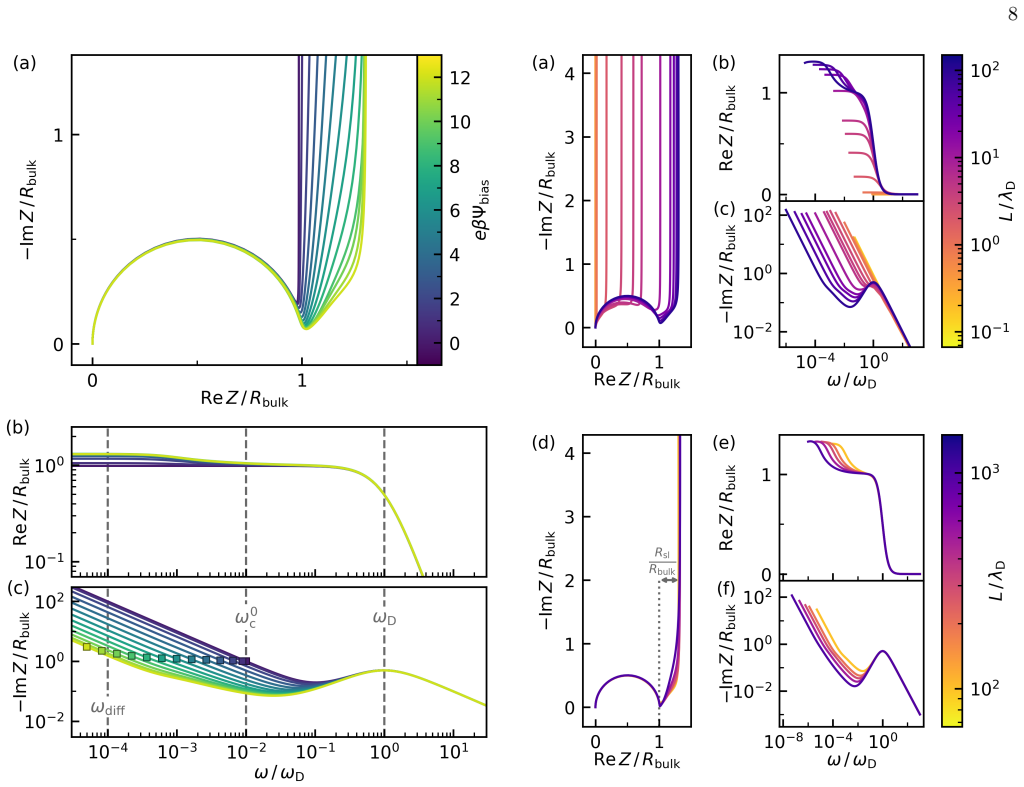
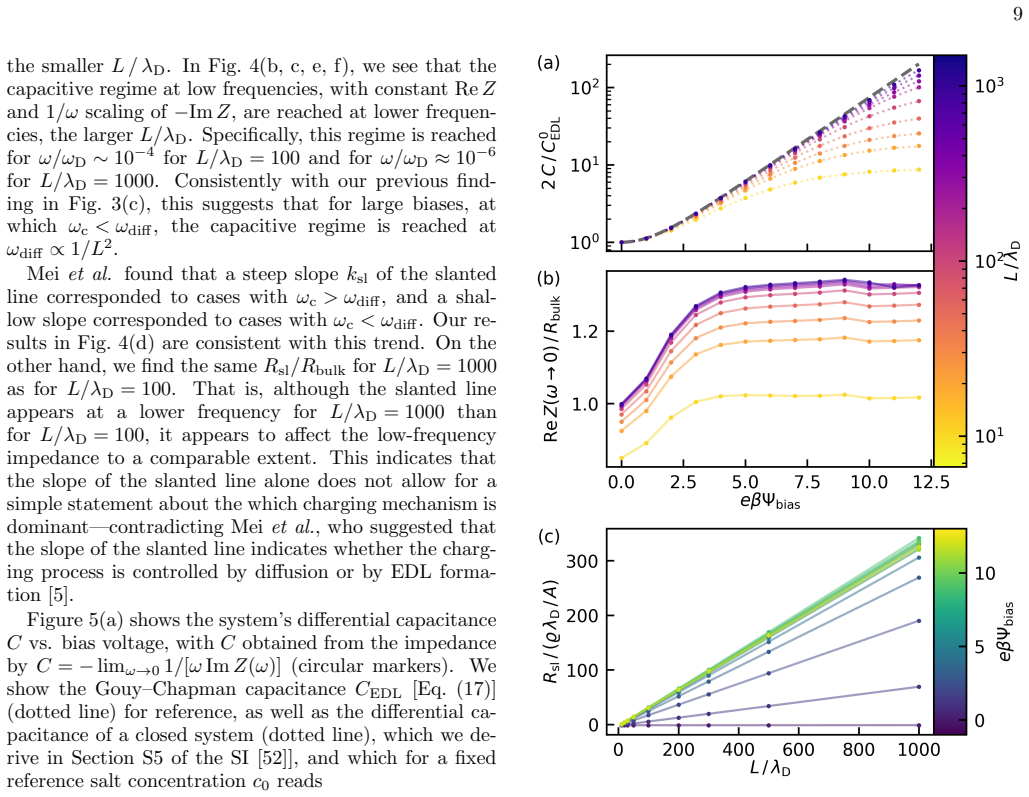
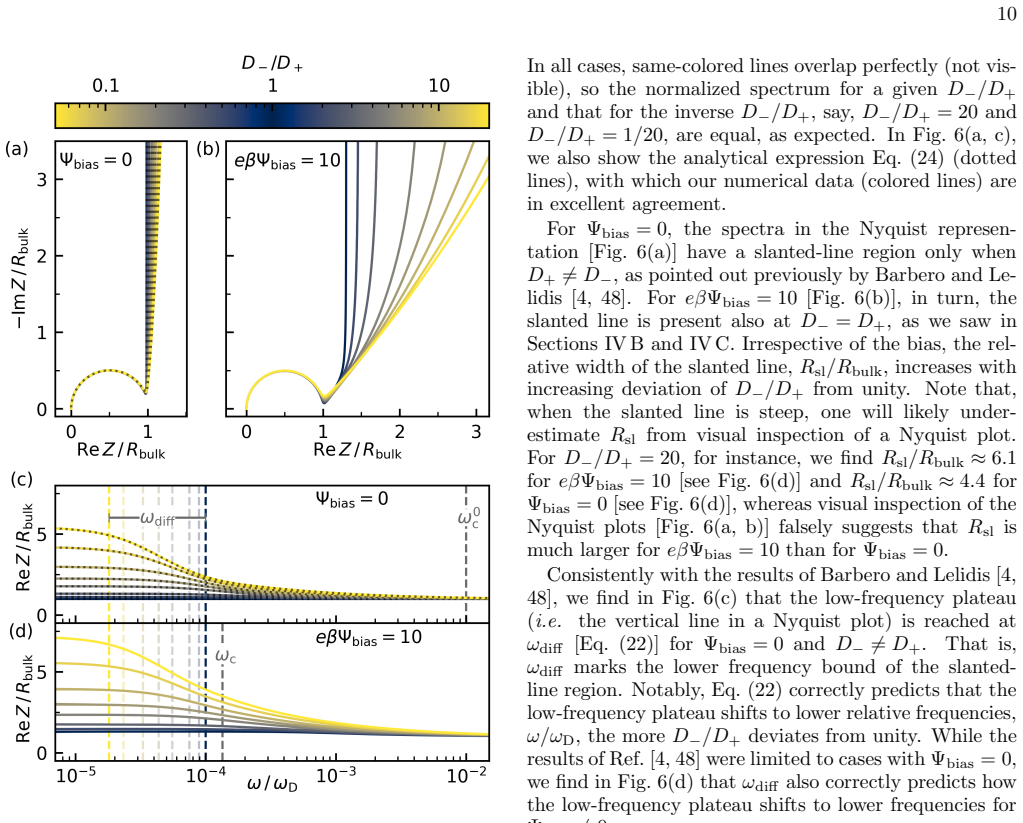
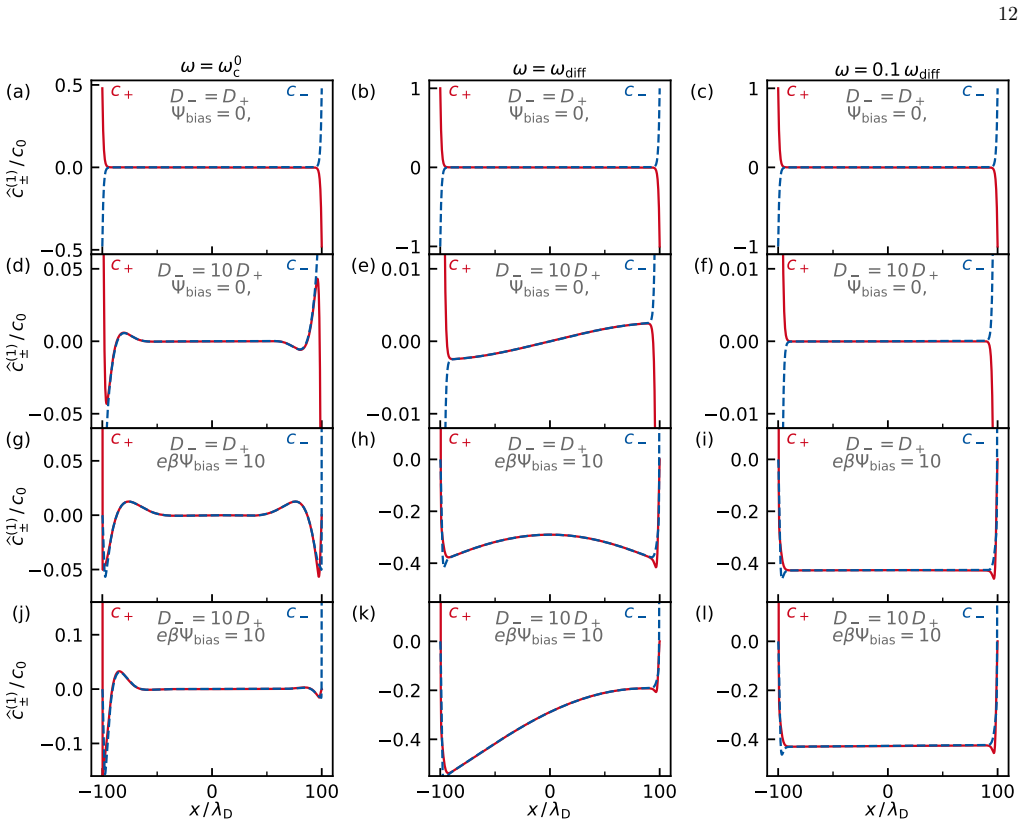
We calculate the impedance of a flat-plate electric double-layer (EDL) capacitor by means of Finite Element Method simulations of modified Poisson--Nernst--Planck equations. In Nyquist representation, the impedance spectra show a slanted line at intermediate frequencies if the capacitor is biased by a voltage, $U_\mathrm{bias}\neq 0$, or if the cation and anion diffusion coefficients differ, $D_-\neq D_+$. By inspecting the concentration perturbations in the relevant frequency range, we confirm that the slanted line is in both cases related to ambipolar salt diffusion. On the basis of our impedance data, we disprove two previously made claims: 1) that the width $R_\mathrm{sl}$ of the slanted-line region represents an EDL resistance; and 2) that the slope $k_\mathrm{sl}$ of the slanted line is a measure of the ratio of the diffusion and charging time scales, $\tau_\mathrm{diff}/\tau_\mathrm{c}$. For the quantitative analysis of flat-electrode EDL capacitor impedance, we propose instead two equivalent circuits, for the cases $D_-\neq D_+$ and $U_\mathrm{bias}\neq 0$. These two cases give rise to antisymmetric and symmetric salt perturbations, which are best described by a Warburg short and Warburg open element, respectively. From our circuit analysis, we obtain quantitative relations that link the Warburg prefactors to the ambipolar diffusion coefficient, the chemical capacitance of the bulk electrolyte, and the differential charge efficiency of the EDLs. We thus provide a theoretical framework that explains why the width of the slanted line saturates at large biases, why it vanishes for large ion packing fractions, and how the system's overall capacitance is limited by the finite amount of ions in a closed system.
Editorial analysis
A structured set of objections, weighed in public.
Referee Report
Summary. The manuscript uses finite-element simulations of modified Poisson-Nernst-Planck equations to compute the impedance spectra of a flat-plate electric double-layer capacitor. It shows that a slanted line appears in Nyquist plots at intermediate frequencies when a bias voltage is applied or when cation and anion diffusivities differ, attributes this feature to ambipolar salt diffusion via concentration-perturbation analysis, disproves two prior interpretations of the slanted-line width and slope, and proposes equivalent-circuit models employing Warburg short and open elements whose prefactors are quantitatively linked to the ambipolar diffusion coefficient, bulk chemical capacitance, and differential charge efficiency of the EDLs. The framework is used to explain saturation of the slanted-line width at large bias, its disappearance at high packing fractions, and the ion-number limitation on total capacitance.
Significance. If the central results hold, the work supplies a concrete, falsifiable mapping between observable impedance features and microscopic transport parameters that is directly testable by experiment. The combination of perturbation diagnostics, circuit fitting, and explicit relations to independently defined quantities (ambipolar diffusivity, chemical capacitance) constitutes a clear advance over purely phenomenological descriptions. The explanation of bias saturation and packing-fraction dependence supplies mechanistic insight that can guide device modeling.
major comments (2)
- [§3] §3 (model section): the precise functional form of the 'modified' PNP equations (steric corrections, boundary conditions at the electrodes) is not reproduced in the main text; because the ambipolar-diffusion mechanism and the resulting Warburg prefactors depend on these modifications, an explicit statement of the governing equations and the chosen mesh-convergence criteria is required to allow independent reproduction.
- [§5.2] §5.2 (circuit analysis): the quantitative relations that map Warburg prefactors onto ambipolar diffusivity, chemical capacitance, and differential charge efficiency are obtained by fitting the same simulation data used to generate the spectra; an independent, a-priori calculation of these three quantities from the steady-state profiles (without re-fitting) would remove any residual concern about circularity.
minor comments (3)
- [Figure 4] Figure 4: the Nyquist plots for the two cases (bias vs. diffusivity asymmetry) use different line styles that are not explained in the caption; adding a legend or explicit labels would improve readability.
- Notation: the symbol for differential charge efficiency is introduced only in the abstract and the final paragraph; an explicit definition (e.g., as a derivative of surface charge with respect to bulk concentration) should appear in the methods or results section.
- The manuscript cites prior claims that are being disproved but does not provide the exact references or the numerical values those works reported for R_sl and k_sl; adding these citations and a short comparison table would strengthen the disproof section.
Simulated Author's Rebuttal
We thank the referee for the positive evaluation and the recommendation of minor revision. The comments are constructive and we address each one below.
read point-by-point responses
-
Referee: [§3] §3 (model section): the precise functional form of the 'modified' PNP equations (steric corrections, boundary conditions at the electrodes) is not reproduced in the main text; because the ambipolar-diffusion mechanism and the resulting Warburg prefactors depend on these modifications, an explicit statement of the governing equations and the chosen mesh-convergence criteria is required to allow independent reproduction.
Authors: We agree that explicit reproduction of the modified Poisson-Nernst-Planck equations (including steric corrections) and the electrode boundary conditions is necessary for independent verification, given their direct role in the ambipolar-diffusion analysis. In the revised manuscript we will insert the complete set of governing equations into the main text of §3 together with the mesh-convergence criteria used for the finite-element calculations. revision: yes
-
Referee: [§5.2] §5.2 (circuit analysis): the quantitative relations that map Warburg prefactors onto ambipolar diffusivity, chemical capacitance, and differential charge efficiency are obtained by fitting the same simulation data used to generate the spectra; an independent, a-priori calculation of these three quantities from the steady-state profiles (without re-fitting) would remove any residual concern about circularity.
Authors: We accept the referee’s point that an independent verification would eliminate any appearance of circularity. In the revision we will add a direct, a-priori evaluation of the ambipolar diffusivity, bulk chemical capacitance and differential charge efficiency computed solely from the steady-state concentration and potential profiles; these values will then be compared with the Warburg-prefactor results to confirm consistency without re-fitting the impedance spectra. revision: yes
Circularity Check
No significant circularity identified
full rationale
The derivation proceeds from FEM solutions of the modified PNP equations, direct inspection of symmetric/antisymmetric concentration perturbations to attribute the slanted Nyquist line to ambipolar diffusion, and standard Warburg-element circuit fitting whose prefactor mappings are obtained by algebraic rearrangement of independently defined quantities (ambipolar D, bulk chemical capacitance, differential charge efficiency). No step reduces a claimed prediction to a fitted parameter by construction, no load-bearing premise rests on self-citation, and the quantitative relations follow from the circuit topology rather than tautological re-labeling of simulation outputs.
Axiom & Free-Parameter Ledger
axioms (2)
- domain assumption Modified Poisson-Nernst-Planck equations govern the coupled ion transport and electrostatic potential inside the electrolyte domain.
- domain assumption The capacitor is a closed finite-volume system containing a fixed total number of ions.
Reference graph
Works this paper leans on
-
[1]
B. E. Conway,Electrochemical supercapacitors: scientific fundamentals and technological applications(Springer Science & Business Media, 2013)
2013
-
[2]
J. R. Macdonald, Phys. Rev.92, 4 (1953)
1953
-
[3]
D. R. Franceschetti and J. R. Macdonald, J. Electroanal. Chem. Interf. Electrochem.100, 583 (1979)
1979
-
[4]
Barbero and I
G. Barbero and I. Lelidis, Phys. Rev. E76, 051501 (2007)
2007
-
[5]
B.-A. Mei, O. Munteshari, J. Lau, B. Dunn, and L. Pilon, J. Phys. Chem. C122, 194 (2018)
2018
-
[6]
Barbero, A
G. Barbero, A. S. Gliozzi, M. Scalerandi, and A. M. Scar- fone, J. Mol. Liq.272, 565 (2018)
2018
-
[7]
J. J. L´ opez-Garc´ ıa, J. Horno, and C. Grosse, Microma- chines14, 368 (2023)
2023
-
[8]
J. J. L´ opez-Garc´ ıa, J. Horno, and C. Grosse, J. Phys. Chem. C129, 12561 (2025)
2025
-
[9]
M. Z. Bazant, K. Thornton, and A. Ajdari, Phys. Rev. E 70, 021506 (2004)
2004
-
[10]
M. S. Kilic, M. Z. Bazant, and A. Ajdari, Phys. Rev. E 75, 021503 (2007)
2007
-
[11]
Janssen and M
M. Janssen and M. Bier, Phys. Rev. E97, 052616 (2018)
2018
-
[12]
R. F. Stout and A. S. Khair, Phys. Rev. E92, 032305 (2015)
2015
-
[13]
Balu and A
B. Balu and A. S. Khair, Soft Matter14, 8267 (2018)
2018
-
[14]
Babel, M
S. Babel, M. Eikerling, and H. L¨ owen, J. Phys. Chem. C 122, 21724 (2018)
2018
-
[15]
K. Ma, M. Janssen, C. Lian, and R. van Roij, J. Chem. Phys.156, 084101 (2022)
2022
-
[16]
Pireddu and B
G. Pireddu and B. Rotenberg, Phys. Rev. Lett.130, 098001 (2023)
2023
-
[17]
Pireddu, C
G. Pireddu, C. J. Fairchild, S. P. Niblett, S. J. Cox, and B. Rotenberg, Proc. Natl. Acad. Sci.121, e2318157121 (2024)
2024
-
[18]
Barnaveli and R
A. Barnaveli and R. van Roij, Soft Matter20, 704 (2024)
2024
-
[19]
Palaia, A
I. Palaia, A. J. Asta, M. Dutta, P. B. Warren, B. Roten- berg, and E. Trizac, Phys. Rev. Lett.135, 148002 (2025)
2025
-
[20]
Palaia, A
I. Palaia, A. J. Asta, M. Dutta, P. B. Warren, B. Roten- berg, and E. Trizac, Phys. Rev. E112, 035417 (2025)
2025
-
[21]
Beunis, F
F. Beunis, F. Strubbe, M. Marescaux, K. Neyts, and A. R. M. Verschueren, Appl. Phys. Lett.91, 182911 (2007)
2007
-
[22]
Beunis, F
F. Beunis, F. Strubbe, M. Marescaux, J. Beeckman, K. Neyts, and A. R. M. Verschueren, Phys. Rev. E78, 011502 (2008)
2008
-
[23]
Marzantowicz, J
M. Marzantowicz, J. R. Dygas, and F. Krok, Electrochim. Acta53, 7417 (2008)
2008
-
[24]
Nakamura, H
M. Nakamura, H. Kaminaga, O. Endo, H. Tajiri, O. Sakata, and N. Hoshi, J. Phys. Chem. C118, 22136 (2014)
2014
-
[25]
R. J. Kortschot, A. P. Philipse, and B. H. Ern´ e, J. Phys. Chem. C118, 11584 (2014)
2014
-
[26]
Schuster, Curr
R. Schuster, Curr. Opin. Electrochem.1, 88 (2017)
2017
-
[27]
Schalenbach, Y
M. Schalenbach, Y. E. Durmus, H. Tempel, H. Kungl, and R.-A. Eichel, Phys. Chem. Chem. Phys.23, 21097 (2021)
2021
-
[28]
C. Zhao, T. Yang, S. Jin, and B. Wu, J. Phys. Chem. C 128, 5964 (2024)
2024
-
[29]
Kutbay, B
E. Kutbay, B. Ulgut, C. Kocabas, and S. Suzer, J. Phys. Chem. Lett.16, 8778 (2025)
2025
-
[30]
Barsoukov and J
E. Barsoukov and J. R. Macdonald,Impedance spec- troscopy: theory, experiment, and applications(John Wi- ley & Sons, 2018)
2018
-
[31]
M. E. Orazem and B. Tribollet,Electrochemical Impedance Spectroscopy, 2nd ed. (John Wiley & Sons, 2017)
2017
-
[32]
Lasia,Electrochemical Impedance Spectroscopy and its Applications(Springer, 2014)
A. Lasia,Electrochemical Impedance Spectroscopy and its Applications(Springer, 2014)
2014
-
[33]
Levie, Adv
D. Levie, Adv. Electrochem. and Electrochem. Eng6, 329 (1967)
1967
-
[34]
C. Ho, I. D. Raistrick, and R. A. Huggins, J. Electrochem. Soc.127, 343 (1980)
1980
-
[35]
E. Lust, G. Nurk, A. J¨ anes, M. Arulepp, P. Nigu, P. M¨ oller, S. Kallip, and V. Sammelselg, J. Solid State Electrochem.7, 91 (2003)
2003
-
[36]
E. Lust, A. J¨ anes, and M. Arulepp, J. Electroanal. Chem. 562, 33 (2004)
2004
-
[37]
E. Lust, A. J¨ anes, T. P¨ arn, and P. Nigu, J. Solid State Electrochem.8, 224 (2004)
2004
-
[38]
Jurczakowski, C
R. Jurczakowski, C. Hitz, and A. Lasia, J. Electroanal. Chem.572, 355 (2004)
2004
-
[39]
Segalini, B
J. Segalini, B. Daffos, P. L. Taberna, Y. Gogotsi, and P. Simon, Electrochimica Acta55, 7489 (2010)
2010
-
[40]
Jokar, A
E. Jokar, A. I. Zad, and S. Shahrokhian, J. Solid State Electrochem.19, 269 (2015)
2015
-
[41]
Liu, Z.-Z
H. Liu, Z.-Z. Pan, A. Aziz, R. Tang, W. Lv, and H. Nishi- hara, Adv. Funct. Mater.33, 2303730 (2023)
2023
-
[42]
Zeng, B.-A
Z. Zeng, B.-A. Mei, G. Song, M. Hamza, Z. Yan, Q. Wei, H. Feng, Z. Zuo, B. Jia, and R. Xiong, J. Energy Storage 102, 114021 (2024). 21
2024
-
[43]
Hallemans, D
N. Hallemans, D. Howey, A. Battistel, N. F. Saniee, F. Scarpioni, B. Wouters, F. La Mantia, A. Hubin, W. D. Widanage, and J. Lataire, Electrochimica Acta 466, 142939 (2023)
2023
-
[44]
Li and J
C. Li and J. Huang, Advanced Science , e75601 (2026)
2026
-
[45]
Paasch, K
G. Paasch, K. Micka, and P. Gersdorf, Electrochim. Acta 38, 2653 (1993)
1993
-
[46]
Huang, Electrochim
J. Huang, Electrochim. Acta281, 170 (2018)
2018
-
[47]
Pedersen, T
C. Pedersen, T. Aslyamov, and M. Janssen, PRX Energy 2, 043006 (2023)
2023
-
[48]
Lelidis and G
I. Lelidis and G. Barbero, Phys. Lett. A343, 440 (2005)
2005
-
[49]
Gunning, D
J. Gunning, D. Y. C. Chan, and L. R. White, J. Colloid Interface Sci.170, 522 (1995)
1995
-
[50]
E. H. B. DeLacey and L. R. White, J. Chem. Soc. Lond. Faraday Trans. 278, 457 (1982)
1982
-
[51]
A. D. Ratschow, A. J. Wagner, M. Janssen, and S. Hardt, Proc. Natl. Acad. Sci.122, e2504322122 (2025)
2025
-
[52]
See the Supplemental Material
-
[53]
Borukhov, D
I. Borukhov, D. Andelman, and H. Orland, Phys. Rev. Lett.79, 435 (1997)
1997
-
[54]
A. A. Kornyshev, The Journal of Physical Chemistry B 111, 5545 (2007)
2007
-
[55]
M. S. Kilic, M. Z. Bazant, and A. Ajdari, Phys. Rev. E 75, 021502 (2007)
2007
-
[56]
J. Song, E. Khoo, and M. Z. Bazant, Phys. Rev. E100, 042204 (2019)
2019
-
[57]
A. A. Pilla, J. Electrochem. Soc.117, 467 (1970)
1970
-
[58]
S. C. Creason, J. W. Hayes, and D. E. Smith, J. Elec- troanal. Chem. Interfacial Electrochem.47, 9 (1973)
1973
-
[59]
G. S. Popkirov and R. N. Schindler, Rev. Sci. Instrum. 63, 5366 (1992)
1992
-
[60]
Barsoukov, S
E. Barsoukov, S. H. Ryu, and H. Lee, J. Electroanal. Chem.536, 109 (2002)
2002
-
[61]
J. Sihvo, N. Hallemans, A. H. Tan, D. A. Howey, S. R. Duncan, and T. Roinila, IEEE Trans. Transp. Electrif. 10.1109/TTE.2026.3659482 (2026)
-
[62]
H. P. Van Leeuwen, D. J. Kooijman, M. Sluyters- Rehbach, and J. H. Sluyters, J. Electroanal. Chem. In- terfacial Electrochem.23, 475 (1969)
1969
-
[63]
Logg, K.-A
A. Logg, K.-A. Mardal, and G. Wells,Automated solu- tion of differential equations by the finite element method: The FEniCS book, Vol. 84 (Springer Science & Business Media, 2012)
2012
-
[64]
A. Logg and G. N. Wells, ACM Trans. Math. Softw.37, 10.1145/1731022.1731030 (2010)
-
[65]
M. S. Alnæs, A. Logg, K. B. Ølgaard, M. E. Rognes, and G. N. Wells, ACM Trans. Math. Softw.40, 1 (2014)
2014
-
[66]
R. C. Kirby and A. Logg, ACM Trans. Math. Softw.32, 10.1145/1163641.1163644 (2006)
-
[67]
P. M. Biesheuvel and M. Z. Bazant, Phys. Rev. E81, 031502 (2010)
2010
-
[68]
Jamnik and J
J. Jamnik and J. Maier, Phys. Chem. Chem. Phys.3, 1668 (2001)
2001
-
[69]
Barbero, Phys
G. Barbero, Phys. Chem. Chem. Phys.19, 32575 (2017)
2017
-
[70]
T. R. Brumlev and R. P. Buck, J. Electroanal. Chem. Interf. Electrochem.126, 73 (1981)
1981
-
[71]
Jamnik and J
J. Jamnik and J. Maier, J. Electrochem. Soc.146, 4183 (1999)
1999
-
[72]
Van Soestbergen, P
M. Van Soestbergen, P. M. Biesheuvel, and M. Z. Bazant, Phys. Rev. E81, 021503 (2010)
2010
-
[73]
Mirzadeh, F
M. Mirzadeh, F. Gibou, and T. M. Squires, Phys. Rev. Lett.113, 097701 (2014)
2014
-
[74]
Tsch¨ ope, E
A. Tsch¨ ope, E. Sommer, and R. Birringer, Solid State Ion.139, 255 (2001)
2001
-
[75]
Tsch¨ ope, Solid State Ion.139, 267 (2001)
A. Tsch¨ ope, Solid State Ion.139, 267 (2001)
2001
-
[76]
M. J. Verkerk, B. J. Middelhuis, and A. J. Burggraaf, Solid State Ion.6, 159 (1982)
1982
-
[77]
Vollman and R
M. Vollman and R. Waser, J. Am. Ceram. Soc.77, 235 (1994)
1994
-
[78]
X. Guo, W. Sigle, J. Fleig, and J. Maier, Solid State Ion. 154, 555 (2002)
2002
-
[79]
X. Guo, W. Sigle, and J. Maier, J. Am. Ceram. Soc.86, 77 (2003)
2003
-
[80]
Shirpour, R
M. Shirpour, R. Merkle, and J. Maier, Solid State Ion. 225, 304 (2012)
2012
discussion (0)
Sign in with ORCID, Apple, or X to comment. Anyone can read and Pith papers without signing in.