Keldysh field theory of spin- and valley-distinguished polariton nonlinearities in transition-metal dichalcogenide monolayers
Pith reviewed 2026-06-26 11:11 UTC · model grok-4.3
The pith
A Keldysh field theory identifies sixteen nonlinear contributions in TMD polariton systems, with spin-dark excitons dominating the blueshift.
A machine-rendered reading of the paper's core claim, the machinery that carries it, and where it could break.
Core claim
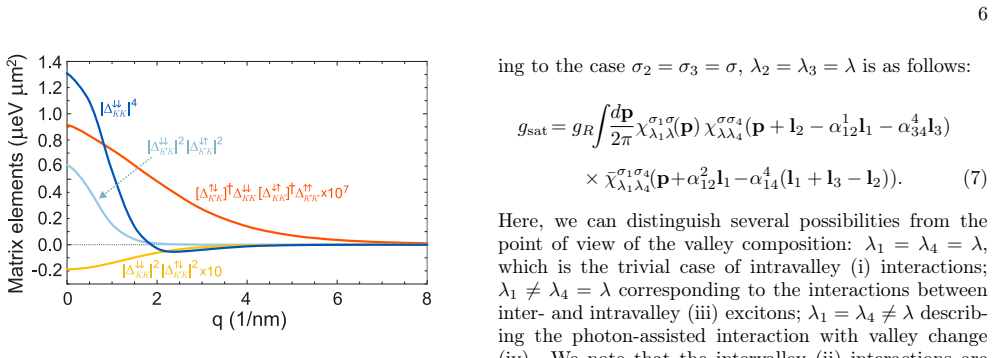
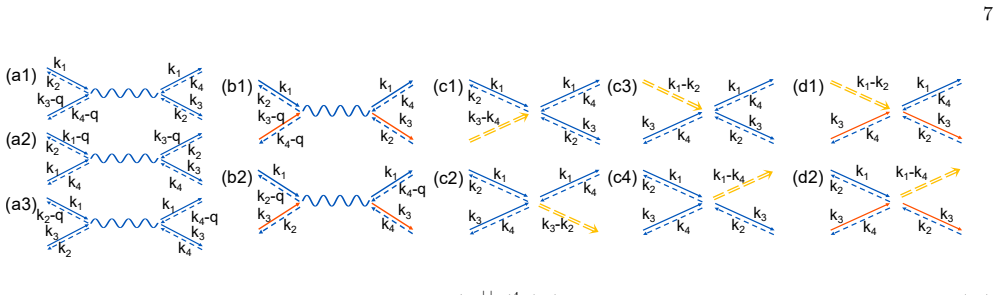
When all the bright and dark exciton species are considered, the TMD monolayer-based polariton systems feature sixteen different nonlinear contributions due to interactions and even more saturation-related terms. Strikingly, while the interactions of excitons within one valley are overall dominant, the contribution to the blueshift from spin-dark excitons is much higher than that from bright intravalley excitons.
What carries the argument
The Keldysh nonequilibrium field theory in path-integral formalism that distinguishes all spin and valley combinations of excitons.
If this is right
- Sixteen separate nonlinear interaction channels must be included in any complete description of TMD polaritons.
- Saturation effects generate additional terms beyond the interaction contributions.
- Blueshift values increase when the spin-dark exciton channel is properly accounted for.
- Valley and spin degrees of freedom dictate which nonlinear processes are allowed or suppressed.
Where Pith is reading between the lines
- Design of nonlinear photonic devices based on TMDs may benefit from selective population of dark exciton states.
- The same formalism could be applied to related layered materials that possess internal spin and valley degrees of freedom.
- Pump-probe experiments with spin- and valley-resolved detection could measure the relative strength of each of the sixteen channels.
- Prior numerical estimates of polariton interaction strengths in these systems probably need revision to include the dark-exciton contributions.
Load-bearing premise
Existing descriptions of bosonization and polariton interactions in TMD-based systems are incomplete because they overlook the valley degree of freedom and the various spin combinations.
What would settle it
A microscopic calculation or experiment that finds the blueshift contribution from spin-dark excitons to be smaller than or equal to that from bright intravalley excitons would falsify the reported dominance.
Figures

read the original abstract
Electrons in transition-metal dichalcogenides (TMDs) possess valley and spin degrees of freedom, which leads to rich exciton and exciton-polariton physics with nontrivial scattering dynamics and enhanced nonlinearities, presenting a key mechanism for photonic devices. Yet, existing descriptions of bosonization and polariton interactions in TMD-based systems overlook the valley degree of freedom as well as the various particles' spins combinations. In this work, we derive a nonequilibrium field-theory approach in the path integral formalism that allows to track all the polariton nonlinearities in the strong coupling regime. We demonstrate that, when all the bright and dark exciton species are considered, the TMD monolayer-based polariton systems feature sixteen different nonlinear contributions due to interactions and even more saturation-related terms. Strikingly, while the interactions of excitons within one valley are overall dominant, we show that the contribution to the blueshift from spin-dark excitons is much higher than that from bright intravalley excitons.
Editorial analysis
A structured set of objections, weighed in public.
Referee Report
Summary. The manuscript derives a nonequilibrium Keldysh field theory in the path-integral formalism to describe spin- and valley-distinguished polariton nonlinearities in TMD monolayers. It claims that including all bright and dark exciton species yields sixteen distinct nonlinear interaction contributions plus additional saturation terms, with intravalley interactions dominant overall but spin-dark excitons providing a substantially larger contribution to the blueshift than bright intravalley excitons.
Significance. If the central derivation holds, the work supplies a systematic nonequilibrium framework that incorporates the full set of valley and spin degrees of freedom, addressing an acknowledged gap in prior bosonization treatments of TMD polaritons. This could enable more accurate modeling of strong-coupling nonlinearities relevant to photonic devices. The path-integral construction itself is a methodological strength when it produces explicit, countable channels rather than fitted parameters.
minor comments (2)
- The abstract states the count of sixteen interaction channels and the blueshift ordering but does not reference the specific equations or table that enumerates them; adding a forward reference to the relevant section or table would improve readability.
- Saturation-related terms are mentioned as 'even more' than the sixteen interaction terms; a brief explicit count or classification of these terms (e.g., in a dedicated subsection) would clarify their relative weight.
Simulated Author's Rebuttal
We thank the referee for their positive evaluation of our work and the recommendation of minor revision. No specific major comments were provided in the report, so we have no individual points requiring response or revision at this stage.
Circularity Check
No significant circularity; derivation self-contained
full rationale
The paper derives a Keldysh nonequilibrium field theory from the path-integral formalism to incorporate valley and spin degrees of freedom for TMD polaritons. The central result (sixteen interaction nonlinearities plus saturation terms, with spin-dark excitons dominating blueshift) follows directly from enumerating all bright/dark exciton species in the extended basis; this enumeration is a definitional consequence of the chosen Hilbert space rather than a fitted parameter or self-citation reduction. No load-bearing self-citations, ansatzes smuggled via prior work, or predictions that collapse to inputs are present in the abstract or described derivation chain. The approach is independent of external benchmarks and does not rename known empirical patterns.
Axiom & Free-Parameter Ledger
axioms (1)
- standard math Path integral formalism applies to nonequilibrium polariton systems in the strong-coupling regime
Reference graph
Works this paper leans on
-
[1]
classical
For the fermionic fields, the fields on the forward and backward branches are independent, so we define the “classical” and “quantum” component using the Larkin-Ovchinnikov rotation:\Psi 1,2 = (\Psi f \pm \Psi b)/ \surd 2, \Psi 1,2 = ( \Psi f \mp \Psi b)/ \surd
-
[2]
pure excitonic
According to the procedure described in Refs. [53, 54], the integration over the bath degree of freedom, in the case of constant density of states, results in coupling constants\Gamma being frequency independent, so that the contribution to the system’s action reads \Delta \scrS s = +\infty \int - \infty d\omega 2\pi \int d\bfr \Biggl[ \sum \sigma [ \^\Ps...
-
[3]
Carusotto and C
I. Carusotto and C. Ciuti,Quantum fluids of light, Rev. Mod. Phys.85, 299 (2013)
2013
-
[4]
K´ ena-Cohen and S
S. K´ ena-Cohen and S. Forrest,Room-temperature polari- ton lasing in an organic single-crystal microcavity, Na- ture Photon.4, 371 (2010)
2010
-
[5]
Lidzey, D
D. Lidzey, D. Bradley, M. Skolnick, T. Virgili, S. Walker, and D. M. Whittaker,Strong exciton–photon coupling in an organic semiconductor microcavity, Nature395, 53 (1998)
1998
-
[6]
Brehier, R
A. Brehier, R. Parashkov, J. S. Lauret, and E. Deleporte, Strong exciton-photon coupling in a microcavity contain- ing layered perovskite semiconductors, Appl. Phys. Lett. 14 89, 171110 (2006)
2006
-
[7]
R. Su, C. Diederichs, J. Wang, T. C. H. Liew, J. Zhao, S. Liu, W. Xu, Zh. Chen, and Q. Xiong,Room- Temperature Polariton Lasing in All-Inorganic Per- ovskite Nanoplatelets, Nano Letters17, 3982 (2017)
2017
-
[8]
X. Liu, T. Galfsky, Zh. Sun, F. Xia, E. Lin, Y.-H. Lee, S. K´ ena-Cohen, and V. M. MenonStrong light–matter cou- pling in two-dimensional atomic crystals, Nature Photon. 9, 30 (2015)
2015
-
[9]
Y. Luo, J. Zhao, A. Fieramosca, et al,Strong light-matter coupling in van der Waals materials, Light Sci. Appl.13, 203 (2024)
2024
-
[10]
Sanvitto, S
D. Sanvitto, S. K´ ena-Cohen,The road towards polari- tonic devices, Nature Mater.15, 1061 (2016)
2016
-
[11]
Kasprzak, M
J. Kasprzak, M. Richard, S. Kundermann, A. Baas, P. Jeambrun, J. M. J. Keeling, F. M. Marchetti, M. H. Szyma´ nska, R. Andr´ e, J. L. Staehli, V. Savona, P. B. Littlewood, B. Deveaud, and Le Si Dang,Bose–Einstein condensation of exciton polaritons, Nature443, 409 (2006)
2006
-
[12]
A. Amo, J. Lefr` ere, S. Pigeon, C. Adrados, C. Ciuti, I. Carusotto, R.Houdr´ e, E.Giacobino, andA.Bramati,Su- perfluidity of polaritons in semiconductor microcavities, Nature Phys.5, 805–810 (2009)
2009
-
[13]
Lerario, A
G. Lerario, A. Fieramosca, F. Barachati, D. Ballarini, K. S. Daskalakis, L. Dominici, M. De Giorgi, S. A. Maier, G. Gigli, S. K´ ena-Cohen, and D. Sanvitto,Room- temperature superfluidity in a polariton condensate, Na- ture Phys.13, 837 (2017)
2017
-
[14]
K. G. Lagoudakis, M. Wouters, M. Richard, A. Baas, I. Carusotto, R. Andr´ e, Le Si Dang, and B. Deveaud- Pl´ edran ,Quantized vortices in an exciton–polariton con- densate, Nature Phys.4, 706 (2008)
2008
-
[15]
K. G. Lagoudakis, B. Pietka, M. Wouters, R. Andr´ e, and B. Deveaud-Pl´ edran,Coherent oscillations in an exciton-polariton Josephson junction, Phys. Rev. Lett. 105, 120403 (2010)
2010
-
[16]
Abbarchi, A
M. Abbarchi, A. Amo, V. Sala, D. Solnyshkov, H. Flayac, L. Ferrier, I. Sagnes, E. Galopin, A. Lemaˆ ıtre, and G. Malpuech,Macroscopic quantum self-trapping and Josephson oscillations of exciton polaritons, Nature Phys.9, 275 (2013)
2013
-
[17]
Verger, C
A. Verger, C. Ciuti, and I. Carusotto,Polariton quantum blockade in a photonic dot, Phys. Rev. B73, 193306 (2006)
2006
-
[18]
T. C. H. Liew,The future of quantum in polariton sys- tems: opinion, Opt. Mater. Express13, 1938 (2023)
1938
-
[19]
M. Kira, F. Jahnke, S. W. Koch, J. D. Berger, D. V. Wick, T. R. Nelson, Jr., G. Khitrova, and H. M. Gibbs, Quantum Theory of Nonlinear Semiconductor Microcav- ity Luminescence Explaining “Boser” Experiments, Phys. Rev. Lett.79, 5170 (1997)
1997
-
[20]
Combescot, O
M. Combescot, O. Betbeder-Matibet, and F. Dubin,The many-body physics of composite bosons, Phys. Rep.463, 215 (2008)
2008
-
[21]
Tassone and Y
F. Tassone and Y. Yamamoto,Exciton-exciton scattering dynamics in a semiconductor microcavity and stimulated scattering into polaritons, Phys. Rev. B59, 10830 (1999)
1999
-
[22]
Rochat, C
G. Rochat, C. Ciuti, V. Savona, C. Piermarocchi, A. Quattropani, and P. Schwendimann,Excitonic Bloch equations for a two-dimensional system of interacting ex- citons, Phys. Rev. B61, 13856 (2000)
2000
-
[23]
Takayama, N.H
R. Takayama, N.H. Kwong, I. Rumyantsev, M. Kuwata- Gonokami, and R. Binder,T-matrix analysis of biexci- tonic correlations in the nonlinear optical response of semiconductor quantum wells, Eur. Phys. J. B25, 445 (2002)
2002
-
[24]
M. M. Glazov, H. Ouerdane, L. Pilozzi, G. Malpuech, A. V. Kavokin, and A. D’Andrea,Polariton-polariton scat- tering in microcavities: A microscopic theory, Phys. Rev. B80, 155306 (2009)
2009
-
[25]
Grudinina and N
A. Grudinina and N. Voronova,Path integral approach to bosonization and nonlinearities in exciton-polariton sys- tems, Phys. Rev. B110, 115304 (2024)
2024
-
[26]
Schmitt-Rink, D.S
S. Schmitt-Rink, D.S. Chemla, and D. A. B. Miller,The- ory of transient excitonic optical nonlinearities in semi- conductor quantum-well structures, Phys. Rev. B32, 6601 (1985)
1985
-
[27]
J.K. K¨ onig, J. M. Fitzgerald, D. Erkensten, and E. Malic, Exciton Polariton–Polariton Interactions in Transition- Metal Dichalcogenides, arXiv:2603.28409
-
[28]
Fr´ erot, A
I. Fr´ erot, A. Vashisht, M. Morassi, A. Lemaˆ ıtre, S. Ravets, J. Bloch, A. Minguzzi, and M. Richard,Bogoli- ubov excitations driven by thermal lattice phonons in a quantum fluid of light, Phys. Rev. X13, 041058 (2023)
2023
-
[29]
Richard, I
M. Richard, I. Fr´ erot, S. Ravets, et al.,Exci- tonic oscillator-strength saturation dominates polariton- polariton interactions, Phys. Rev. Research8, L012039 (2026)
2026
-
[30]
J. Gu, V. Walther, L. Waldecker, D. Rhodes, A. Raja, J. C. Hone, T. F. Heinz, S. K´ ena-Cohen, T. Pohl, and V. M. Menon,Enhanced nonlinear interaction of polaritons via excitonic Rydberg states in monolayer WSe2, Nat. Commun.12, 2269 (2021)
2021
-
[31]
G. Wang, A. Chernikov, M. M. Glazov, T. F. Heinz, X. Marie, T. Amand, and B. Urbaszek,Colloquium: Exci- tons in atomically thin transition metal dichalcogenides, Rev. Mod. Phys.90, 021001 (2018)
2018
-
[32]
K. Mak, J. Shan,Photonics and optoelectronics of 2D semiconductor transition metal dichalcogenides, Nature Photon.10, 216 (2016)
2016
-
[33]
Shahnazaryan, I
V. Shahnazaryan, I. Iorsh, I. A. Shelykh, and O. Kyri- ienko,Exciton-exciton interaction in transition-metal dichalcogenide monolayers, Phys. Rev. B96, 115409 (2017)
2017
-
[34]
Stepanov, A
P. Stepanov, A. Vashisht, M. Klaas, N. Lundt, S. Tongay, M. Blei, S. H¨ ofling, T. Volz, A. Minguzzi, J. Renard, C. Schneider, and M. Richard,Exciton-exciton interaction beyond the hydrogenic picture in a MoSe2 monolayer in the strong light-matter coupling regime, Phys. Rev. Lett. 126, 167401 (2021)
2021
-
[35]
L. V. Keldysh,Coulomb interaction in thin semiconduc- tor and semimetal films, JETP Lett.29, 658 (1979)
1979
-
[36]
O. Bleu, G. Li, J. Levinsen, and M. M. Parish,Polariton interactions in microcavities with atomically thin semi- conductor layers, Phys. Rev. Research2, 043185 (2020)
2020
-
[37]
Zhang, F
L. Zhang, F. Wu, Sh. Hou, Zh. Zhang, Y.-H. Chou, K. Watanabe, T. Taniguchi, S. R. Forrest, and H. Deng,Van der Waals heterostructure polaritons with moir´ e-induced nonlinearity, Nature591, 61 (2021)
2021
-
[38]
J. Zhao, A. Fieramosca, K. Dini, R. Bao, W. Du, R. Su, Y. Luo, W. Zhao, D. Sanvitto, T. C. H. Liew, and Q. Xiong,Exciton polariton interactions in Van der Waals superlattices at room temperature, Nat. Commun.14, 1512 (2023)
2023
-
[39]
Y. Zeng, V. Cr´ epel, and A. J. Millis,Keldysh Field The- ory of Dynamical Exciton Condensation Transitions in Nonequilibrium Electron-Hole Bilayers, Phys. Rev. Lett. 15 132, 266001 (2024)
2024
-
[40]
Polimeno, F
L. Polimeno, F. Todisco, R. Mastria, M. De Giorgi, A. Fieramosca, M. Pugliese, D. Ballarini, A. Grudinina, N. Voronova, and D. Sanvitto,Enhanced Polariton Inter- actions in Suspended WS2 Monolayer Microcavity, Adv. Mater.37, 2418612 (2025)
2025
-
[41]
Y. Luo, Q. Guo, X. Deng, S. Ghosh, Q. Zhang, H. Xu, and Q. Xiong,Manipulating nonlinear exciton polaritons in an atomically-thin semiconductor with artificial poten- tial landscapes, Light Sci. Appl.12, 220 (2023)
2023
-
[42]
J. Zhao, A. Fieramosca, K. Dini, Q. Shang, R. Bao, Yu. Luo, K. Shen, Y. Zhao, R. Su, J. Z´ u˜ niga-P´ erez, W. Gao, V. Ardizzone, D. Sanvitto, Q. Xiong, and T. C. H. Liew, Room-temperature spin-layer locking of exciton–polariton nonlinearities in a WS2 microcavity. Nature Photon.19, 1353 (2025)
2025
-
[43]
Yu, G.-B
H. Yu, G.-B. Liu, P. Gong, X. Xu, and W. Yao,Dirac cones and Dirac saddle points of bright excitons in mono- layer transition metal dichalcogenides, Nat. Commun.5, 3876 (2014)
2014
-
[44]
chemical potential
Since the number of excitations in the system is con- served, i.e.,[ \^H, N\mathrm{t}\mathrm{o}\mathrm{t}] = 0, whereN \mathrm{t}\mathrm{o}\mathrm{t}=N \mathrm{p}\mathrm{h}+ 1 2 \bigl( Nc - Nv \bigr) , one can redefine the Hamiltonian of the system: H - \mu N\mathrm{t}\mathrm{o}\mathrm{t}\rightarrow Hwhere the introduced parameter\mu works as the “chemica...
-
[45]
E. Paik, L. Zhang, K. Fai Mak, J. Shan, and H. Deng,Ex- citons and polaritons in two-dimensional transition metal dichalcogenides: a tutorial, Adv. Opt. Photon.16, 1064 (2024)
2024
-
[46]
Korm´ anyos, G
A. Korm´ anyos, G. Burkard, M. Gmitra, J. Fabian, V. Z´ olyomi, N. D. Drummond, and V. Fal’ko,k·p the- ory for two-dimensional transition metal dichalcogenide semiconductors, 2D Mater.2, 022001 (2015)
2015
-
[47]
Ramasubramaniam,Large excitonic effects in mono- layers of molybdenum and tungsten dichalcogenides, Phys
A. Ramasubramaniam,Large excitonic effects in mono- layers of molybdenum and tungsten dichalcogenides, Phys. Rev. B86, 115409 (2012)
2012
-
[48]
Chernikov, T
A. Chernikov, T. C. Berkelbach, H. M. Hill, A. Rigosi, Y. Li, B. Aslan, D. R. Reichman, M. S. Hybertsen, and T. F. Heinz,Exciton Binding Energy and Nonhydrogenic Rydberg Series in Monolayer WS2 Phys. Rev. Lett.113, 076802 (2014)
2014
-
[49]
Erkensten, S
D. Erkensten, S. Brem, and E. Malic,Exciton-exciton interaction in transition metal dichalcogenide monolayers and van der Waals heterostructures, Phys. Rev. B103, 045426 (2021)
2021
-
[50]
Such a compositions are characteristic for WX2 materi- als; for MoX2, one needs to replaceK\updownarrow K\prime
-
[51]
T. C. Berkelbach, M. S. Hybertsen, and D. R. Reich- man,Theory of neutral and charged excitons in mono- layer transition metal dichalcogenides, Phys. Rev. B88, 045318 (2013)
2013
-
[52]
P. A. Noordman, L. Maisel Licer´ an, and H. T. C. Stoof, Variational and field-theoretical approach to exciton- exciton interactions and biexcitons in semiconductors, arXiv:2510.05242
-
[53]
C.R.Zhu, K.Zhang, M.Glazov, B.Urbaszek, T.Amand, Z. W. Ji, B. L. Liu, and X. Marie,Exciton valley dynam- ics probed by Kerr rotation in WSe2 monolayers, Phys. Rev. B90, 161302(R) (2014)
2014
-
[54]
Dufferwiel, T
S. Dufferwiel, T. P. Lyons, D. D. Solnyshkov, A. A. P. Trichet, A. Catanzaro, F. Withers, G. Malpuech, J. M. Smith, K. S. Novoselov, M. S. Skolnick, D. N. Krizhanovskii, and A. I. Tartakovskii,Valley coherent exciton-polaritons in a monolayer semiconductor, Nat. Commun.9, 4797 (2018)
2018
-
[55]
Kamenev,Field Theory of Non-Equilibrium Systems, 2nd ed
A. Kamenev,Field Theory of Non-Equilibrium Systems, 2nd ed. Cambridge: Cambridge University Press (2023)
2023
-
[56]
M. H. Szyma´ nska, J. Keeling, and P. B. Littlewood, Mean-field theory and fluctuation spectrum of a pumped decaying Bose-Fermi system across the quantum conden- sation transition, Phys. Rev. B75, 195331 (2007)
2007
- [57]
-
[58]
Yamaguchi, R
M. Yamaguchi, R. Nii, K. Kamide, T. Ogawa, and Y. Yamamoto,Generating functional approach for sponta- neous coherence in semiconductor electron-hole-photon systems, Phys. Rev. B91, 115129 (2015)
2015
-
[59]
Hanai, P
R. Hanai, P. B. Littlewood, and Y. Ohashi,Photo- luminescence and gain/absorption spectra of a driven- dissipative electron-hole-photon condensate, Phys. Rev. B97, 245302 (2018)
2018
-
[60]
[37] but for the bilayer system with tunneling between layers, with the focus on indirect exctions
Similar problem was considered in Ref. [37] but for the bilayer system with tunneling between layers, with the focus on indirect exctions
-
[61]
Steinhoff, E
A. Steinhoff, E. Wietek, M. Florian, T. Schulz, T. Taniguchi, K.Watanabe, Sh.Zhao, A.H¨ ogele, F.Jahnke, and A. ChernikovExciton-exciton interactions in van der Waals heterobilayers, Phys. Rev. X14, 031025 (2024)
2024
discussion (0)
Sign in with ORCID, Apple, or X to comment. Anyone can read and Pith papers without signing in.