Autonomous Orbit Determination Analysis of a Conceptual Cislunar Navigation Constellation based on Inter-Satellite Range Measurement
Pith reviewed 2026-06-26 10:08 UTC · model grok-4.3
The pith
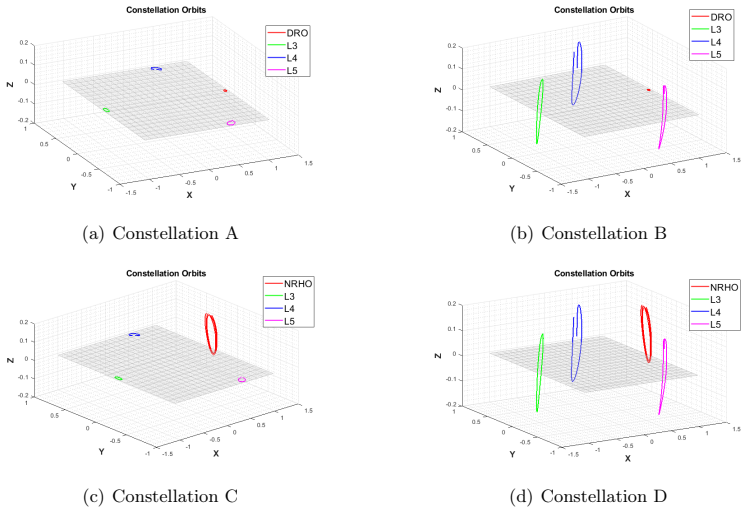
Out-of-plane parameters control autonomous orbit determination accuracy in a four-satellite cislunar constellation using inter-satellite ranges.
A machine-rendered reading of the paper's core claim, the machinery that carries it, and where it could break.
Core claim
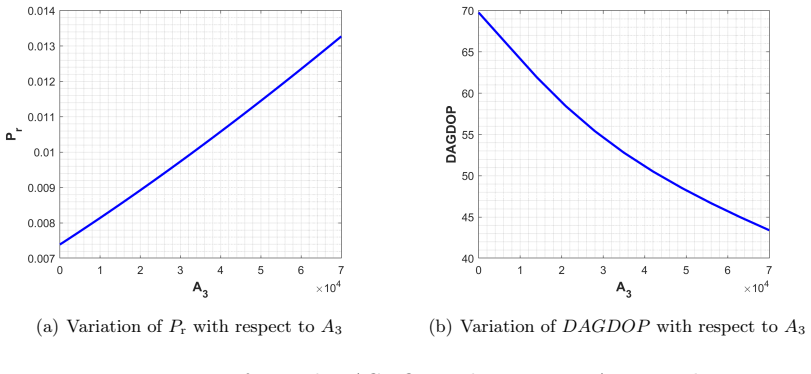
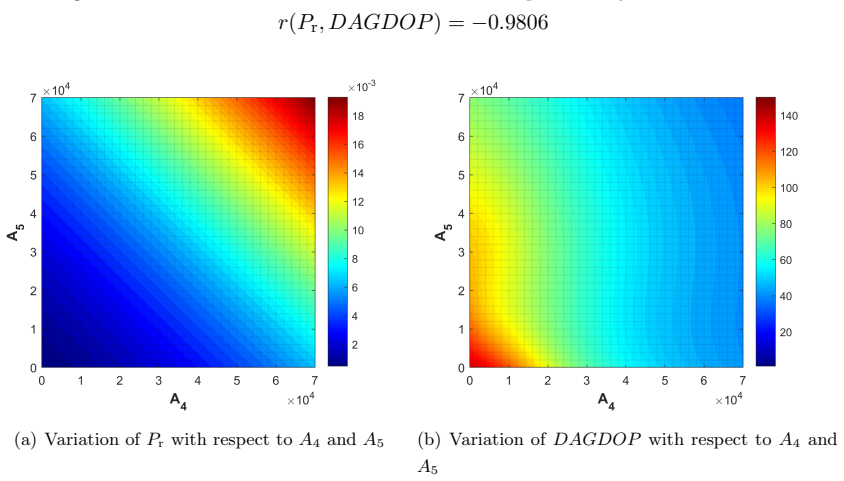
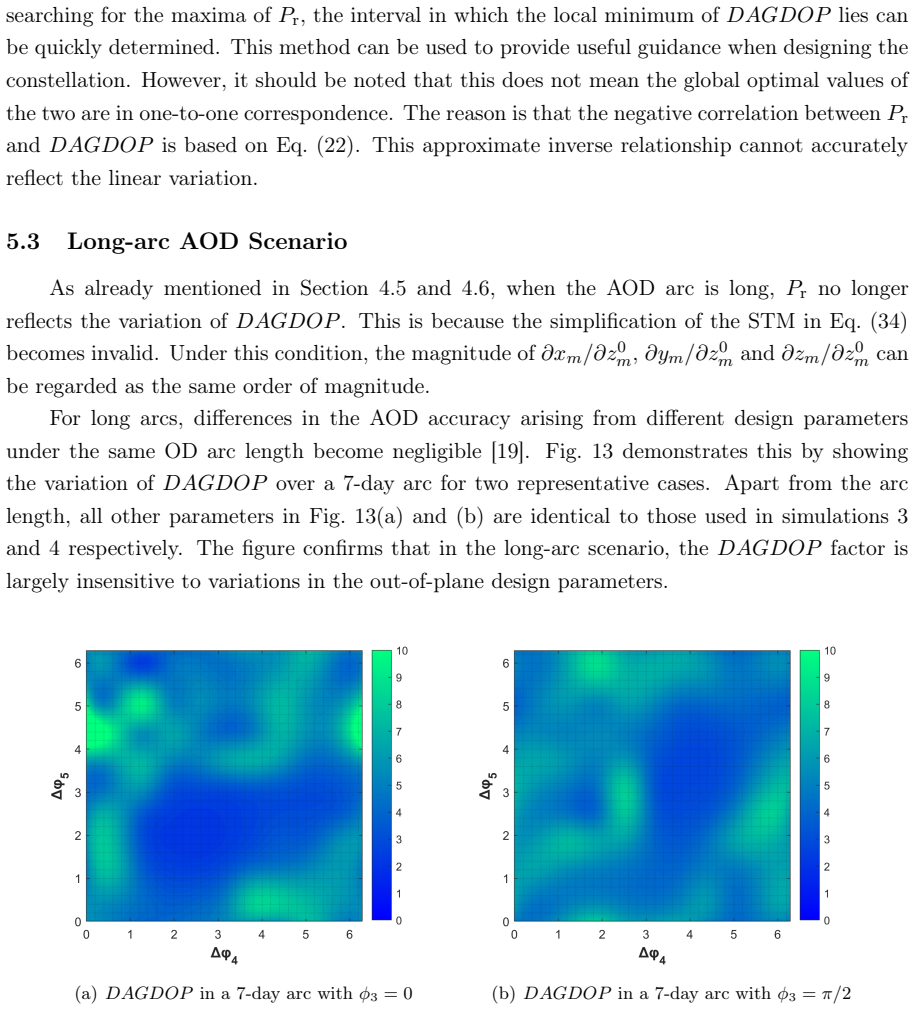
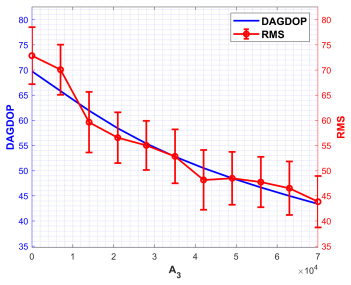
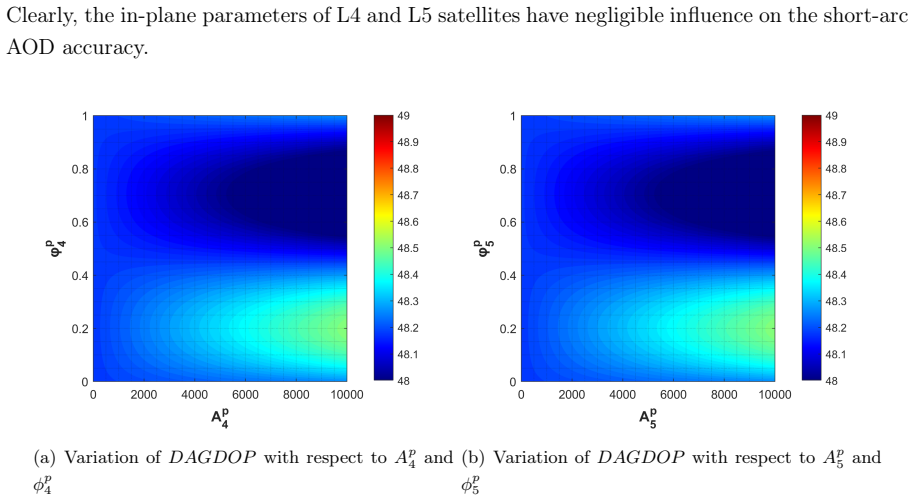
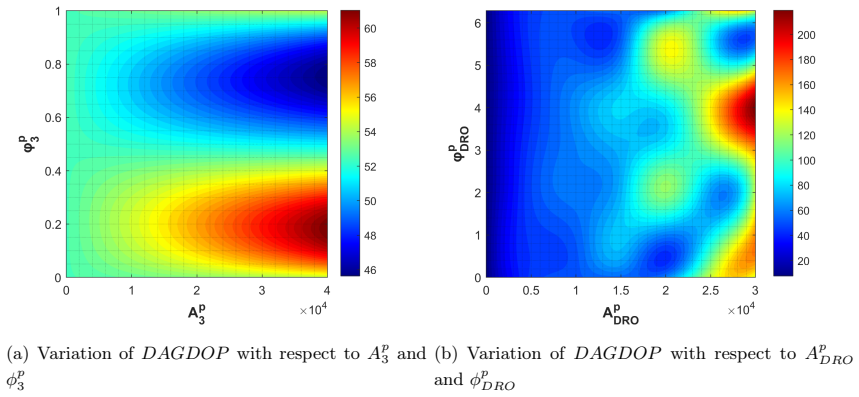
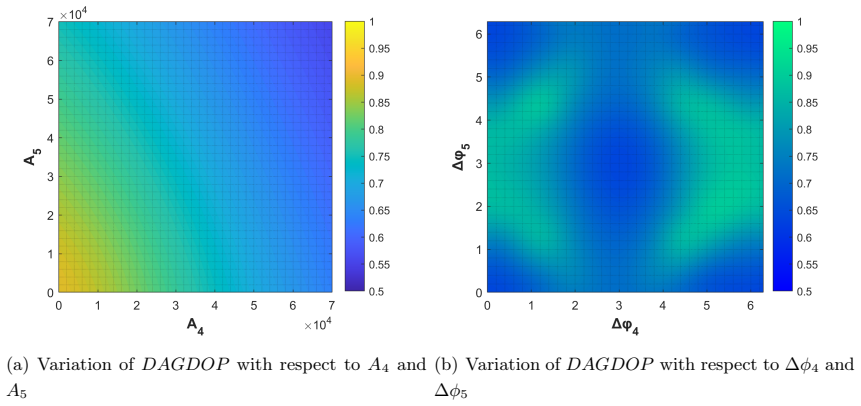
With a model of autonomous orbit determination based on inter-satellite range measurements alone, the out-of-plane design parameters are identified as the main parameters influencing the AOD accuracy. For short arcs, increasing out-of-plane amplitude improves accuracy while initial phases exert more complex effects. The relative planarity factor Pr, which correlates negatively with AOD accuracy, is introduced to quantify how coplanarity of the constellation reduces determination performance. For long-arc AOD the influence of design parameters becomes insignificant.
What carries the argument
The relative planarity factor Pr, a metric proposed to evaluate how constellation coplanarity affects range-only autonomous orbit determination accuracy.
If this is right
- Increasing out-of-plane amplitude improves short-arc AOD accuracy.
- Coplanarity of the four orbits, as quantified by Pr, significantly reduces AOD accuracy.
- Initial out-of-plane phases exert a complex influence on short-arc accuracy.
- Long-arc AOD accuracy shows little dependence on the examined design parameters.
- Out-of-plane parameters are the primary drivers of overall AOD performance in this model.
Where Pith is reading between the lines
- Constellation designers would need to enforce sufficient out-of-plane separation to preserve navigation observability.
- The Pr metric could be tested against real perturbed trajectories to check whether its correlation holds beyond the ideal case examined.
- Similar planarity analysis might apply to range-only determination in other restricted three-body regimes.
Load-bearing premise
Inter-satellite range measurements are the only data source and contain no unmodeled biases or external perturbations that would invalidate the solutions.
What would settle it
A set of range-only simulations in which AOD error covariances remain unchanged when out-of-plane amplitudes are varied would falsify the claim that those parameters dominate accuracy.
Figures


read the original abstract
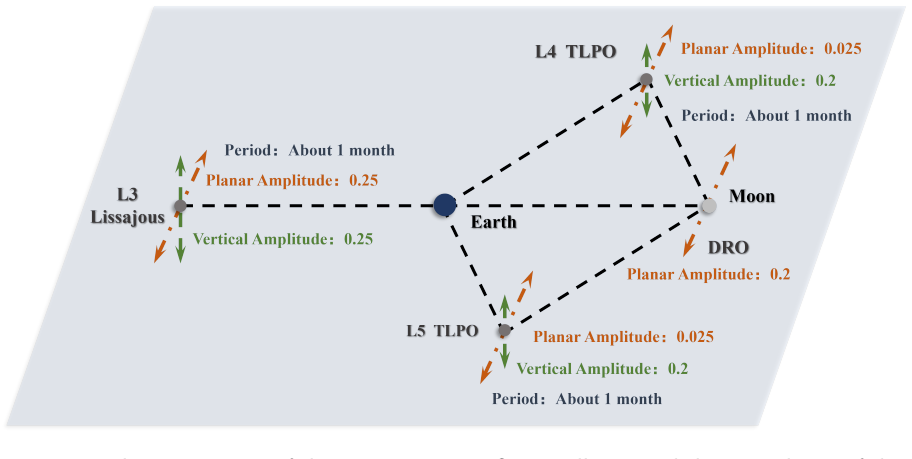
With the community's increasing interest in the cislunar space, building a navigation constellation servicing the whole cislunar space has become a pressing need. Previous studies mainly focus on constellations using orbits close to the Moon, which limits the servicing volume of the constellation. In this work, a four-satellite constellation using one L3 orbit, one L4 orbit, one L5 orbit and an orbit close to the Moon is proposed. The orbit determination accuracy is an important factor to be considered when designing parameters of the constellation. In this study, the mode of autonomous orbit determination (AOD) based on inter-satellite range data is considered. With such a model, the out-of-plane design parameters are identified as the main parameters influencing the AOD accuracy. For the AOD based on short arcs, we find that the increase of the out-of-plane amplitude can improve the AOD accuracy, and the out-of-plane initial phases have a more complex influence. A novel relative planarity factor (RPF) $P_\text{r}$, which has negative correlation with the AOD accuracy, is proposed as the metric to evaluate the variation of AOD performance. Using $P_\text{r}$, we demonstrate that the coplanarity of the constellation can significantly reduce the AOD accuracy. For the long arc AOD, the influence of different parameters is insignificant.
Editorial analysis
A structured set of objections, weighed in public.
Referee Report
Summary. The manuscript proposes a four-satellite cislunar navigation constellation using one L3 orbit, one L4 orbit, one L5 orbit, and one orbit close to the Moon. It analyzes autonomous orbit determination (AOD) accuracy based solely on inter-satellite range measurements, identifying out-of-plane design parameters (amplitude and initial phase) as the dominant influences. For short-arc AOD, larger out-of-plane amplitudes improve accuracy while phases have complex effects; a novel relative planarity factor Pr is introduced with negative correlation to AOD accuracy, showing that coplanarity degrades performance. Long-arc AOD exhibits insignificant parameter sensitivity.
Significance. If the simulation results hold under realistic conditions, the work provides a timely geometric design metric (Pr) for cislunar constellations that could simplify optimization of AOD performance, addressing a pressing need for navigation infrastructure beyond lunar orbits. The identification of out-of-plane parameters as primary drivers offers a concrete, falsifiable guideline for constellation geometry.
major comments (2)
- [AOD model description] Section describing the AOD model and measurement assumptions: the central claims on out-of-plane parameter dominance and the negative correlation of Pr with AOD accuracy rest on the assumption that inter-satellite ranges are the sole observable and are free of unmodeled biases, clock errors, or dynamical perturbations (SRP, third-body gravity, lunar gravity errors). No evidence is provided that these effects were injected into the simulations or that the observability analysis accounts for them; if present at realistic levels, the reported sensitivities and utility of Pr as a design metric could change substantially.
- [Short-arc AOD results] Short-arc AOD simulation results (results section): the reported improvement with out-of-plane amplitude, complex phase effects, and the demonstration that coplanarity reduces accuracy via Pr are derived from idealized bias-free measurements. Without additional runs that include perturbations, these findings are load-bearing for the design recommendations but lack the validation needed to confirm they are not artifacts of the noise-free model.
minor comments (3)
- [Abstract and introduction] The abstract and introduction should explicitly state the orbit propagator fidelity, measurement noise model (e.g., white noise standard deviation), and arc lengths used in the simulations to allow reproducibility.
- [Definition of Pr] Clarify the exact mathematical definition of the relative planarity factor Pr (including how it is computed from the four orbital planes) in the main text rather than relying on the abstract description.
- [Figures] Figure captions for any constellation geometry or error plots should include the specific parameter values (amplitudes, phases) corresponding to each curve to aid interpretation of the Pr correlation.
Simulated Author's Rebuttal
We thank the referee for the constructive review and for recognizing the potential utility of the relative planarity factor Pr. We address the two major comments point by point below, proposing targeted revisions to clarify assumptions while preserving the scope of this conceptual study.
read point-by-point responses
-
Referee: [AOD model description] Section describing the AOD model and measurement assumptions: the central claims on out-of-plane parameter dominance and the negative correlation of Pr with AOD accuracy rest on the assumption that inter-satellite ranges are the sole observable and are free of unmodeled biases, clock errors, or dynamical perturbations (SRP, third-body gravity, lunar gravity errors). No evidence is provided that these effects were injected into the simulations or that the observability analysis accounts for them; if present at realistic levels, the reported sensitivities and utility of Pr as a design metric could change substantially.
Authors: We agree that the analysis is performed under idealized assumptions with bias-free inter-satellite ranges and a simplified dynamical model. The manuscript is a conceptual numerical study focused on geometric observability effects rather than end-to-end realism. We will revise the AOD model section to explicitly list the measurement assumptions, add a dedicated limitations paragraph, and state that the reported sensitivities and Pr correlation apply to this noise-free case. The identification of out-of-plane dominance remains a valid geometric insight within the modeled conditions, but we will not claim direct applicability to perturbed scenarios. revision: partial
-
Referee: [Short-arc AOD results] Short-arc AOD simulation results (results section): the reported improvement with out-of-plane amplitude, complex phase effects, and the demonstration that coplanarity reduces accuracy via Pr are derived from idealized bias-free measurements. Without additional runs that include perturbations, these findings are load-bearing for the design recommendations but lack the validation needed to confirm they are not artifacts of the noise-free model.
Authors: The short-arc results are generated from the idealized model described in the methods. We will expand the results and conclusions sections to stress that the amplitude, phase, and Pr findings are specific to bias-free measurements and to recommend that the Pr metric be validated with realistic perturbations in subsequent studies. No new perturbed simulations are available for this revision; the current work is positioned as providing baseline geometric guidance rather than validated operational recommendations. revision: partial
Circularity Check
No significant circularity; derivation relies on independent simulation and geometric definition
full rationale
The paper defines a four-satellite cislunar constellation, performs AOD simulations using inter-satellite range measurements as the sole observable, identifies out-of-plane parameters as dominant via those simulations, and introduces a geometrically defined RPF Pr that is then shown to correlate negatively with the simulated AOD accuracy. No quoted step reduces a claimed prediction or result to an input by construction (e.g., no fitted parameter renamed as prediction, no self-definitional loop, no load-bearing self-citation chain). The central claims rest on external simulation outputs rather than tautological re-expression of the model inputs, making the derivation self-contained against the paper's own benchmarks.
Axiom & Free-Parameter Ledger
free parameters (2)
- out-of-plane amplitude
- out-of-plane initial phase
axioms (1)
- domain assumption Cislunar orbital motion can be propagated accurately enough for AOD studies using standard restricted three-body or ephemeris models.
invented entities (1)
-
Relative planarity factor Pr
no independent evidence
Reference graph
Works this paper leans on
-
[1]
The control and use of libration-point satellites
R. W Farquhar. “The control and use of libration-point satellites”. In:phd thesis stanford university(1970)
1970
-
[2]
Numerical determination of Lissajous trajectories in the restricted three-body problem
K. C. Howell and H. J. Pernicka. “Numerical determination of Lissajous trajectories in the restricted three-body problem”. In:Celestial Mechanics41.1 (1987), pp. 107–124.issn: 1572-9478.doi:10.1007/BF01238756.url:https://doi.org/10.1007/BF01238756
work page doi:10.1007/bf01238756.url:https://doi.org/10.1007/bf01238756 1987
-
[3]
Regions in the Complex Plane Containing the Eigenvalues of a Matrix
Richard A. Brualdi and Stephen Mellendorf. “Regions in the Complex Plane Containing the Eigenvalues of a Matrix”. In:The American Mathematical Monthly101.10 (1994), pp. 975–985.issn: 00029890, 19300972.url:http://www.jstor.org/stable/2975164. 36
arXiv 1994
-
[4]
Solar force modeling of block IIR global positioning system satellites
H. F. Fliegel and T. E. Gallini. “Solar force modeling of block IIR global positioning system satellites”. In:Journal of Spacecraft and Rockets33.6 (1996), pp. 863–866.doi: 10.2514/3.26851
-
[5]
Quasihalo Orbits Associated with Libration Points
G. Gómez, J. Masdemont, and C. Simó. “Quasihalo Orbits Associated with Libration Points”. In:The Journal of the Astronautical Sciences46.2 (1998), pp. 135–176.issn: 2195-0571.doi:10.1007/BF03546241.url:https://doi.org/10.1007/BF03546241
work page doi:10.1007/bf03546241.url:https://doi.org/10.1007/bf03546241 1998
-
[6]
Dynamics in the center manifold of the collinear points of the restricted three body problem
Àngel Jorba and Josep Masdemont. “Dynamics in the center manifold of the collinear points of the restricted three body problem”. In:Physica D: Nonlinear Phenomena132.1 (1999), pp. 189–213.issn: 0167-2789.doi:https://doi.org/10.1016/S0167-2789(99) 00042-1
-
[7]
THEORY OF VIBRATION | Substructuring
M. Sunar. “THEORY OF VIBRATION | Substructuring”. In:Encyclopedia of Vibration. Ed. by S. Braun. Oxford: Elsevier, 2001, pp. 1332–1335.isbn: 978-0-12-227085-7.doi: https://doi.org/10.1006/rwvb.2001.0117.url:https://www.sciencedirect.com/ science/article/pii/B012227085100117X
work page doi:10.1006/rwvb.2001.0117.url:https://www.sciencedirect.com/ 2001
-
[8]
Geocentric Space-Fixed Position, Velocity, and Acceleration Vectors of Tracking Station
Theodore D. Moyer. “Geocentric Space-Fixed Position, Velocity, and Acceleration Vectors of Tracking Station”. In:Formulation for Observed and Computed Values of Deep Space Network Data Types for Navigation. 2003. Chap. 5, pp. 103–182.doi:https://doi.org/ 10.1002/0471728470.ch5
-
[9]
Spacecraft Ephemeris and Partials File
Theodore D. Moyer. “Spacecraft Ephemeris and Partials File”. In:Formulation for Ob- served and Computed Values of Deep Space Network Data Types for Navigation. 2003. Chap. 4, pp. 55–101.doi:https://doi.org/10.1002/0471728470.ch4
-
[10]
Developing Architectures and Technologies for an Evolvable NASA Space Communication Infrastructure
Kul Bhasin and Jeffrey L. Hayden. “Developing Architectures and Technologies for an Evolvable NASA Space Communication Infrastructure”. In:Space Communication Infras- tructure," AIAA ICSSC(2004)
2004
-
[11]
Libration Point Navigation Concepts Supporting the Vision for Space Exploration
J. Russell Carpenter et al. “Libration Point Navigation Concepts Supporting the Vision for Space Exploration”. In:AIAA/AAS Astrodynamics Specialist Conference and Exhibit. 2004
2004
-
[12]
Schutz, B
B. Schutz, B. Tapley, and G. H. Born.Statistical orbit determination. Elsevier, 2004
2004
-
[13]
On quasi-periodic motions around the triangular libration points of the real Earth–Moon system
X. Y. Hou and L. Liu. “On quasi-periodic motions around the triangular libration points of the real Earth–Moon system”. In:Celestial Mechanics and Dynamical Astronomy108 (2010), pp. 301–313.doi:10.1007/s10569-010-9305-3
-
[14]
IERS conventions (2010)
G. Petit, B. Luzum, et al. “IERS conventions (2010)”. In: (2010)
2010
-
[15]
On quasi-periodic motions around the collinear libration points in the real Earth–Moon system
X. Y. Hou and L. Liu. “On quasi-periodic motions around the collinear libration points in the real Earth–Moon system”. In:Celestial Mechanics and Dynamical Astronomy(2011)
2011
-
[16]
Linked Autonomous Interplanetary Satellite Orbit Navigation (LiAISON) between Geosynchronous and Lunar Halo Orbits
Jeffrey S. Parker et al. “Linked Autonomous Interplanetary Satellite Orbit Navigation (LiAISON) between Geosynchronous and Lunar Halo Orbits”. In: (2012)
2012
-
[17]
The development and evaluation of the Earth Gravitational Model 2008 (EGM2008)
Nikolaos K. Pavlis et al. “The development and evaluation of the Earth Gravitational Model 2008 (EGM2008)”. In:Journal of Geophysical Research: Solid Earth117.B4 (2012). doi:https://doi.org/10.1029/2011JB008916. 37
-
[18]
A New Constellation Configuration Scheme for Communicating Architec- ture in Cislunar Space
Ming Xu et al. “A New Constellation Configuration Scheme for Communicating Architec- ture in Cislunar Space”. In:Mathematical Problems in Engineering,2013,(2013-2-14)2013 (2013), pp. 130–137
2013
-
[19]
Application of two special orbits in the orbit determination of lunar satellites
Peng Liu et al. “Application of two special orbits in the orbit determination of lunar satellites”. In:Research in Astronomy and Astrophysics14 (2014), pp. 1307 –1328.url: https://api.semanticscholar.org/CorpusID:55820946
2014
-
[20]
Long term evolution of distant retrograde orbits in the Earth-Moon system
Collin Bezrouk and Jeffrey S. Parker. “Long term evolution of distant retrograde orbits in the Earth-Moon system”. In:Astrophysics and Space Science362.9 (2017), p. 176.doi: 10.1007/s10509-017-3158-0.url:https://doi.org/10.1007/s10509-017-3158-0
work page doi:10.1007/s10509-017-3158-0.url:https://doi.org/10.1007/s10509-017-3158-0 2017
-
[21]
NEAR RECTILINEAR HALO OR- BITS AND THEIR APPLICATION IN CIS-LUNAR SPACE
Emily Spreen, Kathleen Howell, and Diane Davis. “NEAR RECTILINEAR HALO OR- BITS AND THEIR APPLICATION IN CIS-LUNAR SPACE”. In: May 2017.url:https: //api.semanticscholar.org/CorpusID:150371373
2017
-
[22]
Wenbin Wang et al. “Joint navigation performance of distant retrograde orbits and cislunar orbits via LiAISON considering dynamic and clock model errors”. In:Navigation66 (Dec. 2019).doi:10.1002/navi.340
-
[23]
Autonomous orbit determination of satellite constellations in the earth-moon system and a proposed VLBI constellation
Liu Bin. “Autonomous orbit determination of satellite constellations in the earth-moon system and a proposed VLBI constellation”. MA thesis. Nanjing University, 2020
2020
-
[24]
Zhaoyang Gao and Xiyun Hou. “Coverage Analysis of Lunar Communication/Navigation Constellations Based on Halo Orbits and Distant Retrograde Orbits”. In:Journal of Nav- igation73 (Mar. 2020), pp. 1–21.doi:10.1017/S0373463320000065
-
[25]
Satellite Constellation Pattern Optimization for Complex Regional Coverage
Hang Woon Lee et al. “Satellite Constellation Pattern Optimization for Complex Regional Coverage”. In:Journal of Spacecraft and Rockets57.6 (2020), pp. 1309–1327.doi:https: //doi.org/10.2514/1.A34657
-
[26]
E. M. Zimovan-Spreen, K. C. Howell, and D. C. Davis. “Near rectilinear halo orbits and nearby higher-period dynamical structures: orbital stability and resonance properties”. In: Celestial Mechanics and Dynamical Astronomy132.5 (2020), p. 28.doi:10.1007/s10569- 020-09968-2
-
[27]
Ryan S. Park et al. “The JPL Planetary and Lunar Ephemerides DE440 and DE441”. In: The Astronomical Journal161.3 (2021), p. 105.doi:10.3847/1538-3881/abd414
-
[28]
Zhaoyang Gao and Xiyun Hou. “Comparison of Autonomous Orbit Determination for Satellite Pairs in Lunar Halo and Distant Retrograde Orbits”. In:NA VIGATION: Journal of the Institute of Navigation69 (June 2022), navi.522.doi:10.33012/navi.522
-
[29]
Forced hovering orbit above the primary in the bi- nary asteroid system
Wang Hai-Shuo and Hou Xi-Yun. “Forced hovering orbit above the primary in the bi- nary asteroid system”. In:Celestial Mechanics and Dynamical Astronomy134.5 (2022). Received: 27 March 2022; Revised: 16 July 2022; Accepted: 19 August 2022; Published: 18 October 2022, p. 50.issn: 1572-9478.doi:10 . 1007 / s10569 - 022 - 10098 - 0.url: https://doi.org/10.100...
-
[30]
Gravity aspects from recent gravity field model GRGM1200A of the Moon and analysis of magnetic data
Jaroslav Klokočník et al. “Gravity aspects from recent gravity field model GRGM1200A of the Moon and analysis of magnetic data”. In:Icarus384 (2022), p. 115086.issn: 0019- 1035.doi:https://doi.org/10.1016/j.icarus.2022.115086.url:https://www. sciencedirect.com/science/article/pii/S0019103522001956
work page doi:10.1016/j.icarus.2022.115086.url:https://www 2022
-
[31]
Station-keeping around triangular libration points in the Earth-Moon system
Yun-Fei Li and Xi-Yun Hou. “Station-keeping around triangular libration points in the Earth-Moon system”. In:Advances in Space Research70.11 (2022), pp. 3373–3392.issn: 0273-1177.doi:https://doi.org/10.1016/j.asr.2022.08.044
-
[32]
Eberhard Gill Erdem Turan Stefano Speretta. “Performance analysis of crosslink radio- metric measurement based autonomous orbit determination for cislunar small satellite formations”. In:Advances in Space Research72.7 (2023). Space Environment Manage- ment and Space Sustainability, pp. 2710–2732.issn: 0273-1177.doi:https://doi.org/ 10.1016/j.asr.2022.11.032
-
[33]
A comprehensive review on Cislunar expansion and space domain awareness
Brian Baker-McEvilly et al. “A comprehensive review on Cislunar expansion and space domain awareness”. In:Progress in Aerospace Sciences147 (2024), p. 101019.issn: 0376- 0421.doi:https://doi.org/10.1016/j.paerosci.2024.101019
-
[34]
Dynamics around the 9:2 NRHO in the Sun-Earth-Moon System: Staging, Phasing, and Transitioning
G. M. Brown et al. “Dynamics around the 9:2 NRHO in the Sun-Earth-Moon System: Staging, Phasing, and Transitioning”. In: (2024).doi:10.52202/078368-0072
-
[35]
Design of a Cislunar space navigation constellation based on special long-period orbits
Youtao Gao et al. “Design of a Cislunar space navigation constellation based on special long-period orbits”. In:Advances in Space Research74.7 (2024), pp. 3137–3156.issn: 0273- 1177.doi:https://doi.org/10.1016/j.asr.2024.06.020
-
[36]
A frequency tracking algorithm for quasi-periodic orbits near the Earth-Moon triangular libration points
M. Liu and X. Hou. “A frequency tracking algorithm for quasi-periodic orbits near the Earth-Moon triangular libration points”. Submitted toCelestial Mechanics and Dynamical Astronomy. 2024
2024
-
[37]
Stability of spatial orbits around Earth–Moon triangular libration points
M. L. Liu et al. “Stability of spatial orbits around Earth–Moon triangular libration points”. In:Monthly Notices of the Royal Astronomical Society535.3 (2024), pp. 2619–2632.doi: 10.1093/mnras/stae2399
-
[38]
Cislunar Satellite Constellation Design via Integer Linear Program- ming
Patel Malav et al. “Cislunar Satellite Constellation Design via Integer Linear Program- ming”. In:The Journal of the Astronautical Sciences3 (2024), p. 71.doi:doi.org/10. 1007/s40295-024-00445-8
2024
-
[39]
Y. Sun, M. Wang, and H. Zhang. “Distant retrograde orbit baseline generation considering solar eclipse mitigation”. In:Acta Astronautica223 (2024), pp. 221–233.doi:10.1016/j. actaastro.2024.06.038
work page doi:10.1016/j 2024
-
[40]
Zheyu Xu et al. “Orbit determination of Earth-Moon libration point navigation constella- tion based on Inter-satellite links”. In:Advances in Space Research74.2 (2024), pp. 937– 948.issn: 0273-1177.doi:https://doi.org/10.1016/j.asr.2024.04.002
-
[41]
Design of Cislunar Navigation Constellation via Orbits with a Resonant Period
Jiaxin He et al. “Design of Cislunar Navigation Constellation via Orbits with a Resonant Period”. In:Applied Sciences (2076-3417)15.9 (2025). 39
2076
-
[42]
Luciano Iess et al. “A Novel Orbit Determination and Time Synchronization Architec- ture for a Radio Navigation Satellite Constellation in the Cislunar Environment”. In: NA VIGATION: Journal of the Institute of Navigation72.3 (2025).issn: 0028-1522.doi: 10.33012/navi.713.url:https://navi.ion.org/content/72/3/navi.713
work page doi:10.33012/navi.713.url:https://navi.ion.org/content/72/3/navi.713 2025
-
[43]
Pasquale Tartaglia et al. “Semi-autonomous navigation of a lunar constellation via inter- satellite Doppler and terrestrial GNSS measurements”. In:Acta Astronautica236 (2025), pp. 946–955.issn: 0094-5765.doi:https://doi.org/10.1016/j.actaastro.2025.06. 046
-
[44]
Yuehao Teng et al. “Autonomous orbit determination, timekeeping and service perfor- mance analysis of the cislunar space navigation system based on special long-period or- bits”. In:Measurement255 (2025), p. 118005.issn: 0263-2241.doi:https://doi.org/ 10.1016/j.measurement.2025.118005
-
[45]
A new solar radiation pressure model for some orbit types in the cislunar space
Haohan Li et al. “A new solar radiation pressure model for some orbit types in the cislunar space”. In:Advances in Space Research77.12 (2026), pp. 12184–12201.issn: 0273-1177. doi:https://doi.org/10.1016/j.asr.2026.04.006
-
[46]
Shuanglin Li et al. “Simultaneous Estimation of Lunar Ephemeris and Satellite Orbits Using a DRO-Based LiAISON Method in Cislunar Space”. In:NA VIGATION: Journal of the Institute of Navigation73.1 (2026).issn: 0028-1522.doi:10.33012/navi.766.url: https://navi.ion.org/content/73/1/navi.766. 40
discussion (0)
Sign in with ORCID, Apple, or X to comment. Anyone can read and Pith papers without signing in.