VMM3a/SRS readout for the HYDRA time projection chamber at R³B
Pith reviewed 2026-06-26 09:30 UTC · model grok-4.3
The pith
The SRS-VMM3a readout has been adapted with custom boards and shown to deliver reliable timing and DAQ compatibility for the HYDRA TPC at R3B.
A machine-rendered reading of the paper's core claim, the machinery that carries it, and where it could break.
Core claim
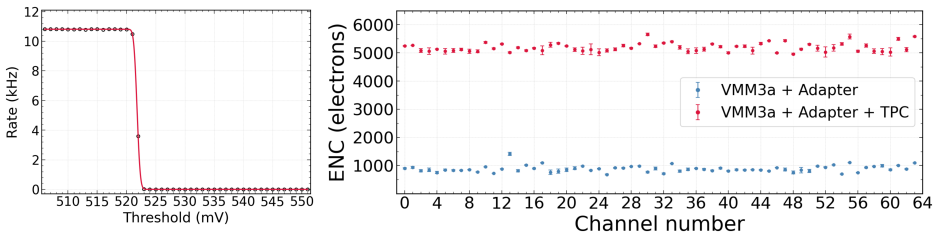
After adaptation of the SRS-VMM3a front-end to the HYDRA-TPC pad plane, laboratory and integration tests confirm reliable operation, precise timing performance, and full compatibility with the R3B data acquisition framework, establishing the system as a suitable readout solution for the detector.
What carries the argument
The VMM3a ASIC inside the Scalable Readout System (SRS), connected through custom adapter boards to the TPC pad plane and synchronized with the R3B DAQ.
If this is right
- The readout supports the high-rate capability and precise charge-timing measurements needed for pion tracking in hypernuclei decays.
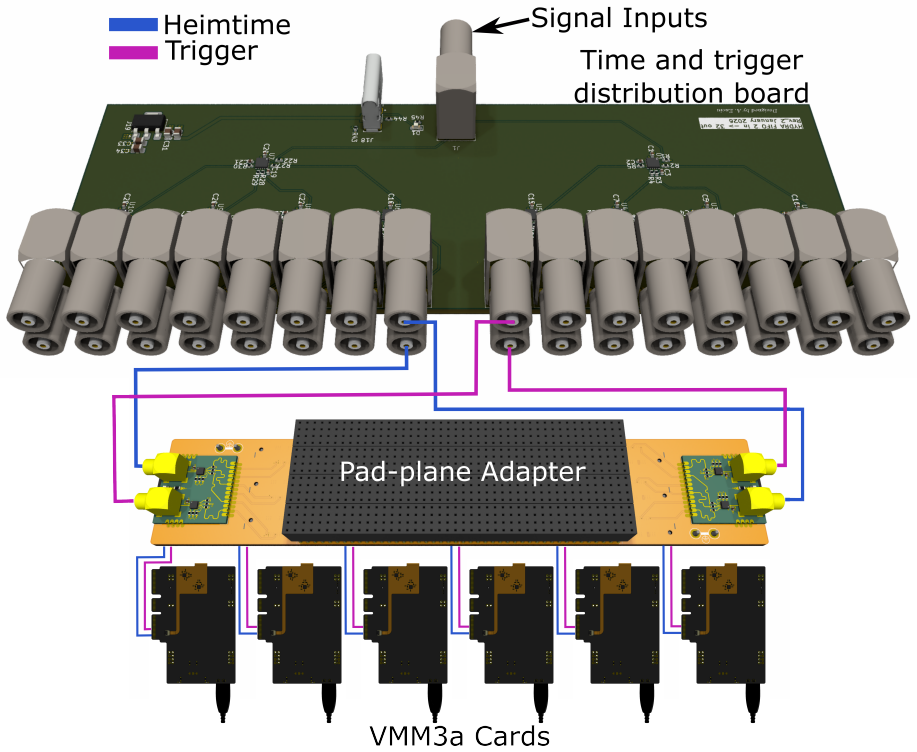
- The system integrates directly into the R3B data acquisition without requiring separate synchronization hardware.
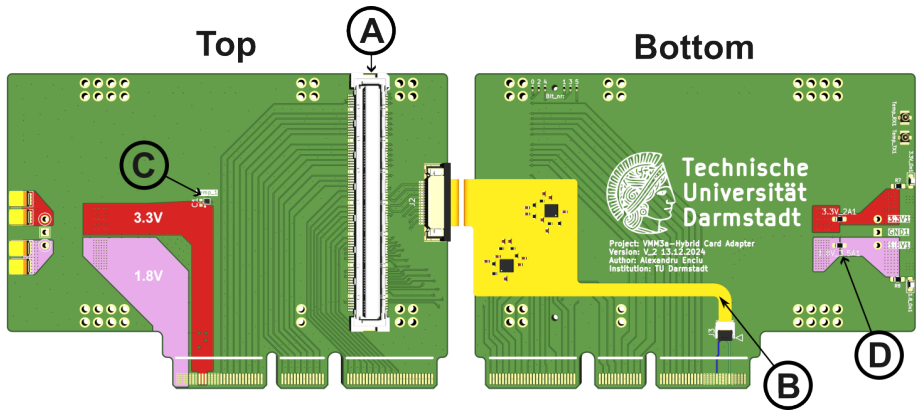
- Custom adapter boards and power distribution enable the VMM3a to match the geometry and channel count of the HYDRA pad plane.
Where Pith is reading between the lines
- If the timing precision holds under beam, the TPC can deliver the spatial resolution required to reconstruct hypernuclear decay vertices.
- The same SRS-VMM3a architecture could be ported to other gaseous trackers planned for the FAIR facility with only board redesign.
- A next step would be to quantify the exact timing jitter and efficiency at the highest expected pion rates in R3B runs.
Load-bearing premise
Laboratory and integration tests are representative of performance under actual beam conditions and full experimental rates at R3B.
What would settle it
High-rate beam data at R3B showing timing resolution worse than a few nanoseconds or frequent data loss that exceeds the laboratory measurements.
Figures
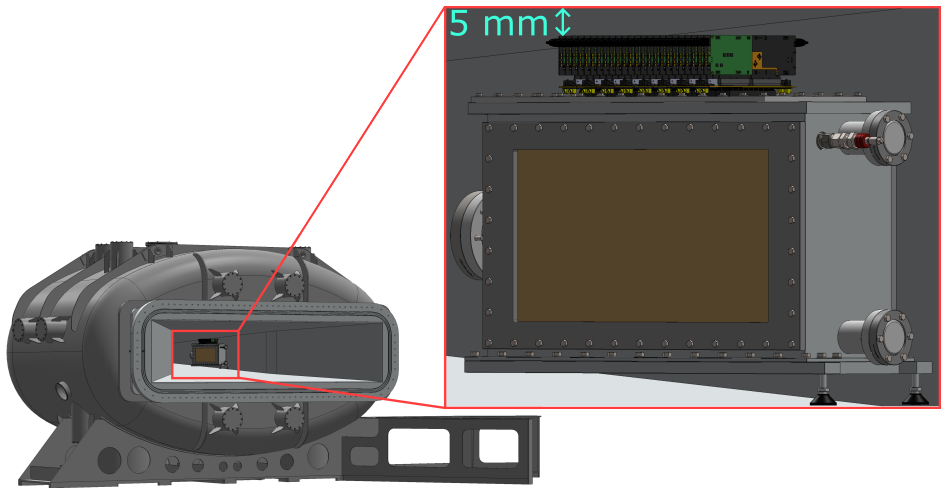
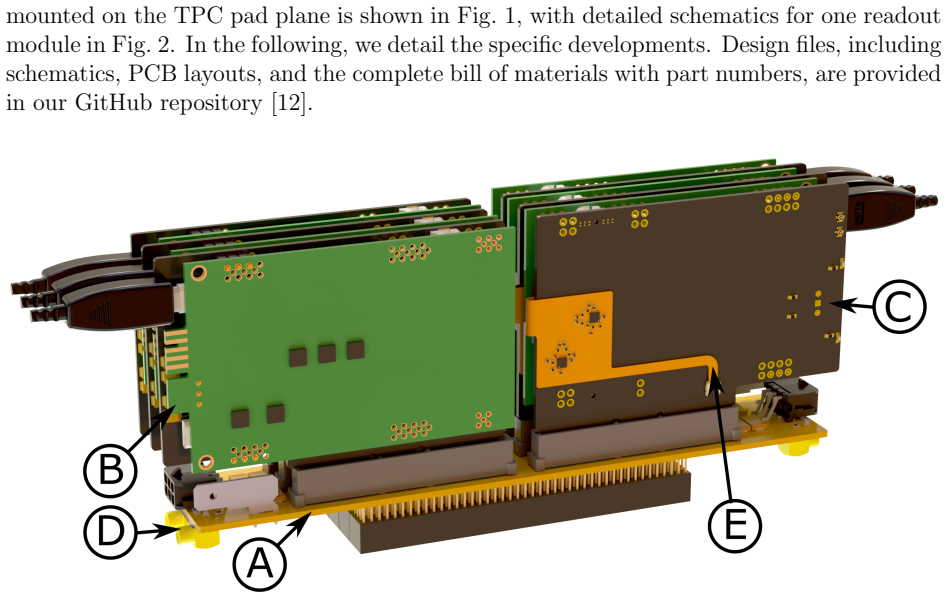
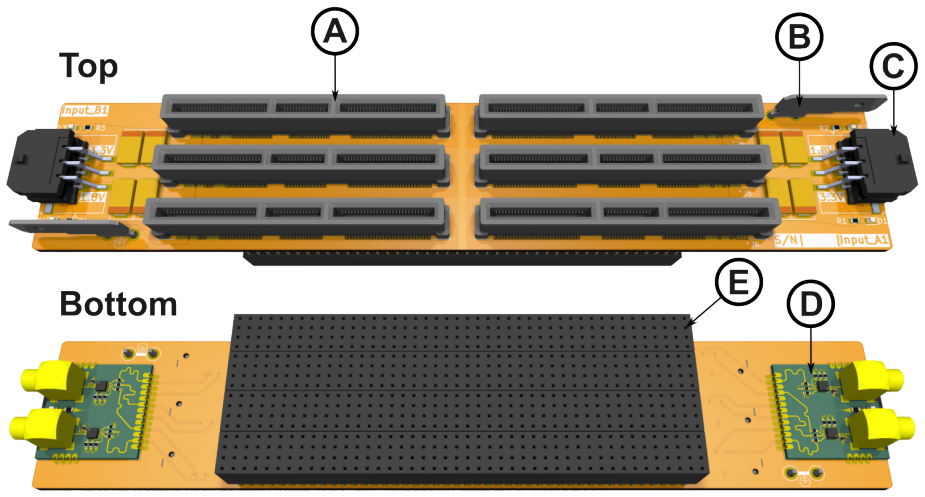
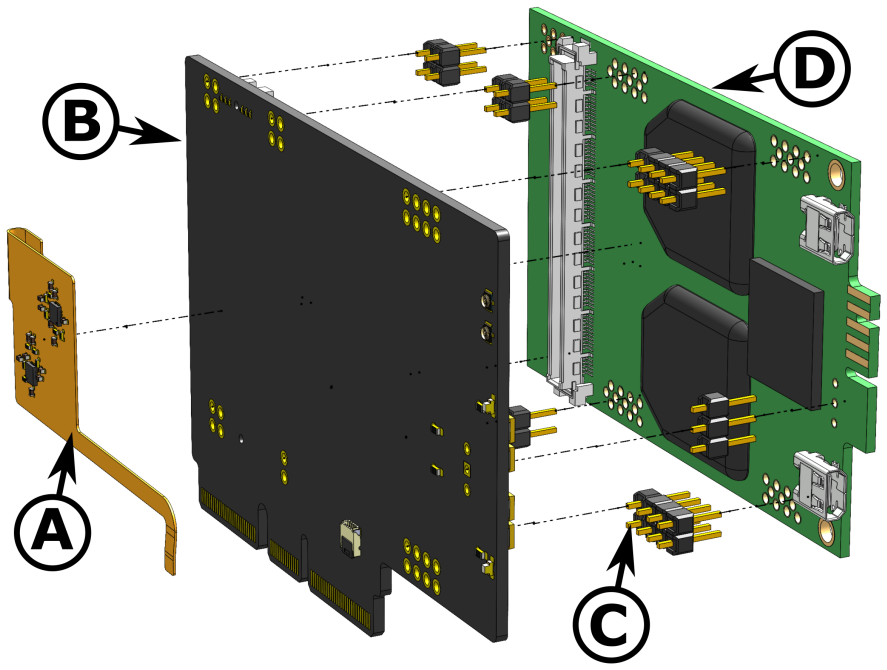
read the original abstract
The VMM3a Application-Specific Integrated Circuit (ASIC), integrated into the Scalable Readout System (SRS), provides high-rate capability together with precise charge and timing measurements for gaseous detectors. In this work, the SRS-VMM3a readout architecture has been implemented for the HYDRA (HYpernuclei Decay at R$^3$B Apparatus) Time Projection Chamber (TPC), a dedicated pion tracker developed to study hypernuclei within the R$^3$B experiment at GSI/FAIR. We present the adaptation of the VMM3a-based front-end electronics to the HYDRA-TPC pad plane, including the design of custom adapter boards, power distribution, and synchronization with the R$^3$B data acquisition system. The performance of the readout chain was evaluated through a series of laboratory and integration tests. The results demonstrate reliable operation, precise timing performance, and compatibility with the R$^3$B data acquisition framework, establishing the SRS-VMM3a system as a suitable readout solution for the HYDRA-TPC.
Editorial analysis
A structured set of objections, weighed in public.
Referee Report
Summary. The manuscript describes the adaptation of the VMM3a ASIC in the SRS readout system to the HYDRA TPC pad plane for the R³B experiment. It covers custom adapter boards, power distribution, and DAQ synchronization, then reports performance from laboratory and integration tests, concluding that the system demonstrates reliable operation, precise timing, and compatibility, establishing it as suitable for HYDRA-TPC.
Significance. If the performance claims hold under experimental conditions, the work supplies a concrete, high-rate readout implementation for a dedicated pion tracker in hypernuclei studies at FAIR. It shows practical integration of an existing ASIC platform into a specific gaseous detector, which could be useful for similar TPCs. The absence of quantitative metrics or beam data, however, confines the significance to a technical description rather than a validated performance benchmark.
major comments (2)
- [Abstract] Abstract: The claims that the tests 'demonstrate reliable operation, precise timing performance, and compatibility' are unsupported by any numerical results, resolutions, efficiencies, or error bars. This is load-bearing for the central suitability conclusion because the abstract provides no data against which to judge whether the system meets R³B requirements.
- [Abstract] Abstract / Results description: Suitability for the R³B experiment is asserted after 'laboratory and integration tests' only, with no in-beam data, rate scaling, or occupancy studies referenced. The extrapolation from these tests to beam conditions (ionization, event rates, track topologies) is therefore unvalidated and directly undermines the final claim.
Simulated Author's Rebuttal
We thank the referee for the careful review and the specific comments on the abstract. We address each point below and indicate the revisions we will make.
read point-by-point responses
-
Referee: [Abstract] Abstract: The claims that the tests 'demonstrate reliable operation, precise timing performance, and compatibility' are unsupported by any numerical results, resolutions, efficiencies, or error bars. This is load-bearing for the central suitability conclusion because the abstract provides no data against which to judge whether the system meets R³B requirements.
Authors: We agree that the abstract would be strengthened by explicit numerical support. The body of the manuscript reports concrete laboratory results including timing resolution values, channel-to-channel uniformity, and observed error rates during integration. We will revise the abstract to quote the key measured figures (e.g., timing precision and operational stability metrics) so that the suitability statement is directly tied to data. revision: yes
-
Referee: [Abstract] Abstract / Results description: Suitability for the R³B experiment is asserted after 'laboratory and integration tests' only, with no in-beam data, rate scaling, or occupancy studies referenced. The extrapolation from these tests to beam conditions (ionization, event rates, track topologies) is therefore unvalidated and directly undermines the final claim.
Authors: The manuscript scope is the hardware adaptation and its verification under laboratory and integration conditions that replicate the pad-plane geometry, power, and DAQ interface required by R³B. These tests confirm basic functionality and timing performance at the relevant signal levels. We accept that the abstract and conclusion overstate the reach of the present data. We will revise both to state that the system has been shown to be compatible and functional in the tested regime and is therefore ready for beam commissioning, without claiming validated performance under full experimental conditions. revision: yes
Circularity Check
No circularity: pure experimental implementation report with no derivations
full rationale
This is an experimental hardware paper describing the adaptation of VMM3a/SRS readout to the HYDRA-TPC, including adapter boards, power, synchronization, and lab/integration tests. No equations, models, fitted parameters, or first-principles derivations appear. The central claim rests on direct empirical test results rather than any prediction that reduces to its inputs by construction. No self-citations, uniqueness theorems, or ansatzes are invoked in a load-bearing manner. The paper is self-contained as a technical report; any concerns about extrapolation to beam conditions are validity issues, not circularity.
Axiom & Free-Parameter Ledger
Reference graph
Works this paper leans on
-
[1]
Alme et al
J. Alme et al. The ALICE TPC, a large 3-dimensional tracking device with fast readout for ultra-high multiplicity events.Nucl. Instrum. Meth. A, 622:316–367, 2010
2010
-
[2]
Bradt et al
J. Bradt et al. Commissioning of the Active-Target Time Projection Chamber.Nucl. Instrum. Methods Phys. Res. A, 875:65–79, 2017
2017
-
[3]
F. Sauli. GEM: A new concept for electron amplification in gas detectors.Nucl. Instrum. Methods A, 386:531–534, 1997
1997
-
[4]
Giomataris, Ph
Y. Giomataris, Ph. Rebourgeard, J.P. Robert, and G. Charpak. MICROMEGAS: a high-granularity position-sensitive gaseous detector for high particle-flux environments. Nucl. Instrum. Methods A, 376:29–35, 1996
1996
-
[5]
Ji et al
L.-C. Ji et al. The HYDRA pion-tracker for hypernuclei studies at R 3B.Nucl. Inst. Meth. A, 1082:170999, 2026
2026
-
[6]
Velardita et al
S. Velardita et al. Method to evidence hypernuclear halos from a two-target interaction cross section measurement.Eur. Phys. J. A, 59:139, 2023
2023
-
[7]
Gastineau et al
B. Gastineau et al. Design status of the R 3B-GLAD magnet: Large acceptance super- conducting dipole with active shielding, graded coils, large forces and indirect cooling by thermosiphon.IEEE Trans. Appl. Supercond., 18:407–410, 2008
2008
-
[8]
de Geronimo et al
G. de Geronimo et al. The VMM3a ASIC.IEEE Transactions on Nuclear Science, 69:976–985, 2022. 15
2022
-
[9]
Lupberger et al
M. Lupberger et al. Implementation of the VMM ASIC in the Scalable Readout System. Nucl. Inst. Meth. A, 903:91–98, 2018
2018
-
[10]
Martoiu, H
S. Martoiu, H. Muller, A. Tarazona, and J. Toledo. Development of the scalable readout system for micro-pattern gas detectors and other applications.J. Inst., 8:C03015, 2013
2013
-
[11]
Pfeiffer et al
D. Pfeiffer et al. Rate-capability of the VMM3a front-end in the RD51 Scalable Readout System.Nucl. Inst. Meth. A, 1031:166548, 2022. [12]https://github.com/AlexEnciu/HYDRA_VMM3_Adapter
2022
-
[12]
Beck et al
D. Beck et al. The New White Rabbit Based Timing System for the FAIR Facility. Proc. of PCaPAC2012, page 242, 2012
2012
-
[13]
Johansson
H˚ akan T. Johansson. TRLO II - description.https://fy.chalmers.se/ ~f96hajo/ trloii/vulom4_trlo/descr_defs_frame.html
-
[14]
VULOM.https://www.gsi.de/work/forschung/experimentelektronik/ digitalelektronik/digitalelektronik-/module/vme/vulom
-
[15]
Analog Devices, Inc., 2024
Analog Devices.LTspice Simulator. Analog Devices, Inc., 2024
2024
-
[16]
Welch and W
J. Welch and W. B. Kuhn. Single sided coplanar waveguide. pages 131–133, 2018
2018
-
[17]
Artech House, 1991
Brian C Wadell.Transmission Line Design Handbook. Artech House, 1991
1991
-
[18]
Bogatin.Signal and Power Integrity - Simplified
E. Bogatin.Signal and Power Integrity - Simplified. Prentice Hall, 2nd edition, 2010
2010
-
[19]
Cheng, Z
K. Cheng, Z. Luo, X. Xiong, and X. Wei. Two optimization ways of ddr3 transmission line equal-length wiring based on signal integrity.International Journal of Electronics and Telecommunications, pages 385–394, 09 2021
2021
-
[20]
H. W. Johnson and M. Graham.High-Speed Digital Design: A Handbook of Black Magic. Prentice Hall, 1993
1993
-
[21]
Zhang and R
W. Zhang and R. Chang. Equivalent pi-network model of lossy and dispersive coupled transmission lines.Tsinghua Science and Technology, 17(1):84–93, 2012
2012
-
[22]
Mudavath, B
R. Mudavath, B. R. Naik, and B. Gugulothu. Analysis of crosstalk noise for coupled microstrip interconnect models in high-speed pcb design. pages 1–5, 2019
2019
-
[23]
E. Terzimpasoglou. Investigations on asic for triple-gem detectors. Master’s thesis, Rheinische Friedrich-Wilhelms-Universit¨ at Bonn, 2021. Available on arXiv: 2206.09968
arXiv 2021
-
[24]
L. S. Scharenberg.Next-Generation Electronics for the Read-Out of Micro-Pattern Gaseous Detectors. Phd thesis, Rheinische Friedrich-Wilhelms-Universit¨ at Bonn, 2023
2023
-
[25]
Kolanoski and N
H. Kolanoski and N. Wermes.Particle Detectors: Fundamentals and Applications. Oxford University Press, Oxford, 2020. 16
2020
discussion (0)
Sign in with ORCID, Apple, or X to comment. Anyone can read and Pith papers without signing in.