REVIEW 2 major objections 2 minor 129 references
The Origins of Stochasticity: Comprehensive Investigations on Uncertainty Quantification for Large Language Models
T0 review · 2 major / 2 minor · reviewed 2026-06-26 · grok-4.3
Pith's one-line read Consensus-based uncertainty quantification methods outperform other approaches for large language models, with larger models showing lower uncertainty.
desk verdict The four-source taxonomy and 21-method comparison are the actual contribution, but the 'consensus-based win' claim rests on an unshown disjoint partition. read the letter →
The pith
A machine-rendered reading of the paper's core claim, the machinery that carries it, and where it could break.
The reading
What carries the argument
The four-source uncertainty taxonomy (input, parameter, token, decoding-process) that supports categorizing and evaluating UQ methods.
What would settle it
An observation that the uncertainty sources overlap significantly or that consensus-based methods fail to outperform on new tasks would falsify the main results.
Extended reading notes
Core claim
The paper claims that its four-source uncertainty taxonomy allows for a systematic categorization of UQ methods, and that experiments demonstrate consensus-based methods outperform others while larger model scales correlate with lower uncertainty estimates, suggesting an empirical scaling law.
Load-bearing premise
The proposed four-source taxonomy systematically and non-overlappingly attributes uncertainty sources in LLM generation.
Editorial extensions
If this is right
- Effectiveness of UQ methods is sensitive to task types and generation settings.
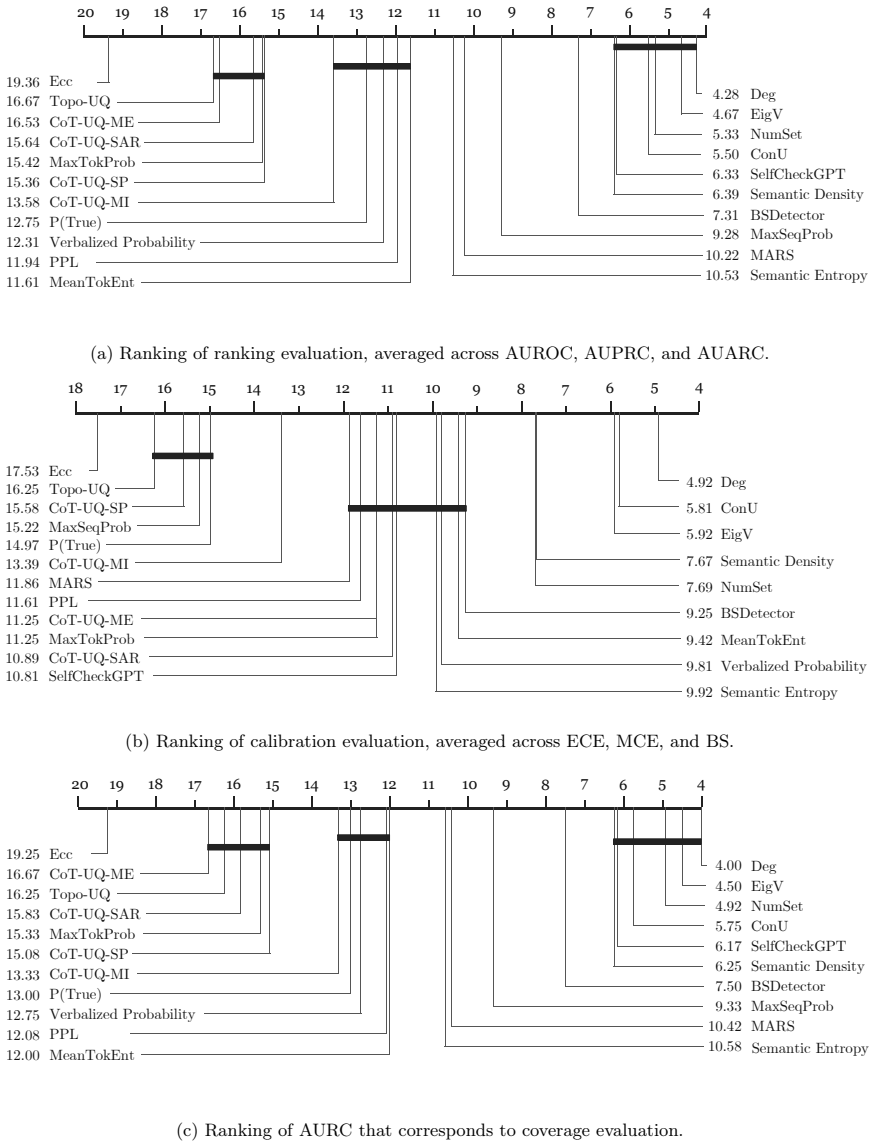
- Consensus-based methods like Deg and EigV consistently outperform other UQ approaches.
- Larger model scales correlate with lower uncertainty estimates.
- This indicates an empirical scaling law for LLM uncertainty.
Reading between the lines
- The taxonomy might enable targeted improvements in UQ by addressing specific sources separately.
- The scaling observation could imply that uncertainty issues diminish naturally with model advancement.
- Consensus methods may be preferred in applications where reliability is critical.
Signed reviews
Editorial analysis
A structured set of objections, weighed in public.
Referee Report
Summary. The paper proposes a four-source taxonomy for uncertainty in LLMs (input-level, parameter-level, token-level, decoding-process sources) and correspondingly categorizes 21 UQ methods into Bayesian, ensemble, consensus-based, and single-pass approaches. It presents an evaluation framework and reports empirical results on Qwen3, Llama 3.2, and DeepSeek-V3 across TriviaQA, GSM8K, and HumanEval, claiming that (i) UQ effectiveness is sensitive to task type and generation settings, (ii) consensus-based methods (Deg, EigV) consistently outperform the other categories, and (iii) larger model scales correlate with lower uncertainty estimates, suggesting an empirical scaling law.
Significance. If the taxonomy can be shown to provide a non-overlapping partition and the empirical comparisons are placed on a statistically sound footing, the work would supply a structured diagnostic lens for LLM uncertainty that could guide method selection and connect theoretical sources to practical UQ performance. The reported scaling observation would also be of interest if replicated.
major comments (2)
- [Abstract and taxonomy section] Abstract and taxonomy section: the claim that the four sources 'systematically attribute' uncertainty without overlap is load-bearing for the subsequent categorization of the 21 methods and for the interpretation that consensus-based methods outperform because they target a distinct source; no formal disjointness argument, exhaustive mapping, or check for re-interpretability (e.g., a single-pass method also being parameter-level) is supplied.
- [Experimental results section] Experimental results section: the statement that Deg and EigV 'consistently outperform' other approaches requires, at minimum, per-benchmark tables with means, standard deviations or error bars, and a statistical test across the three model families; the abstract supplies none of these, leaving open whether observed gaps are significant or artifacts of implementation details within each category.
minor comments (2)
- [Notation and tables] Ensure every abbreviation (Deg, EigV, etc.) is defined on first use and that the exact assignment of each of the 21 methods to one of the four categories is tabulated for reproducibility.
- [Evaluation framework] Clarify the precise generation settings (temperature, top-p, etc.) and the exact metrics used for each benchmark so that the sensitivity claim in (i) can be verified.
Simulated Author's Rebuttal
We thank the referee for the constructive comments, which help clarify the presentation of our taxonomy and strengthen the empirical claims. We address each major comment below.
read point-by-point responses
-
Referee: [Abstract and taxonomy section] Abstract and taxonomy section: the claim that the four sources 'systematically attribute' uncertainty without overlap is load-bearing for the subsequent categorization of the 21 methods and for the interpretation that consensus-based methods outperform because they target a distinct source; no formal disjointness argument, exhaustive mapping, or check for re-interpretability (e.g., a single-pass method also being parameter-level) is supplied.
Authors: We agree that the manuscript does not supply a formal proof of disjointness or an exhaustive re-interpretability check. The taxonomy is motivated by the sequential stages of LLM generation (input encoding, parameter sampling during inference, per-token distribution, and decoding strategy), which we treat as primary attribution sources. While conceptual overlaps are possible in edge cases, the categorization of the 21 methods follows these primary attributions. We will add a dedicated subsection in the taxonomy section that discusses potential overlaps, provides an explicit mapping table, and acknowledges limitations in strict disjointness. revision: yes
-
Referee: [Experimental results section] Experimental results section: the statement that Deg and EigV 'consistently outperform' other approaches requires, at minimum, per-benchmark tables with means, standard deviations or error bars, and a statistical test across the three model families; the abstract supplies none of these, leaving open whether observed gaps are significant or artifacts of implementation details within each category.
Authors: We acknowledge that the current presentation of results does not include the requested statistical rigor in the reported tables or abstract. The full experimental section contains per-benchmark scores, but we will revise it to include (i) expanded tables with means and standard deviations computed over multiple runs, (ii) error bars in figures, and (iii) paired statistical tests (e.g., Wilcoxon signed-rank) across the three model families to assess whether performance gaps are significant. These additions will be reflected in both the results section and a revised abstract. revision: yes
Circularity Check
No significant circularity; empirical claims rest on external benchmarks and standard models
full rationale
The paper proposes a four-source taxonomy and corresponding four-way categorization of UQ methods, then reports empirical performance on public benchmarks (TriviaQA, GSM8K, HumanEval) and standard model families (Qwen3, Llama 3.2, DeepSeek-V3). No equations, fitted parameters, or self-citations are shown to reduce the central claims (consensus-based methods outperform; scaling law) to the taxonomy by construction. The taxonomy is presented as a proposed attribution scheme rather than a self-definitional mapping, and the evaluation framework uses independent data and metrics. This satisfies the default expectation of a self-contained empirical study against external references.
Assumptions & free parameters
assumptions (1)
- domain assumption LLM generation involves distinct and attributable uncertainty sources at input, parameter, token, and decoding stages
Cite this review
Pith. "Pith review of The Origins of Stochasticity: Comprehensive Investigations on Uncertainty Quantification for Large Language Models." pith.science (2026). https://pith.science/paper/PXMELEJA
@misc{pith2026260622792,
  author       = {Pith},
  title        = {Pith review of: The Origins of Stochasticity: Comprehensive Investigations on Uncertainty Quantification for Large Language Models},
  year         = {2026},
  howpublished = {\url{https://pith.science/paper/PXMELEJA}},
  note         = {Machine review of arXiv:2606.22792}
}
read the original abstract
Recent advancements in Large Language Models (LLMs) have enabled sophisticated reasoning and content generation, yet their inherent stochasticity poses significant challenges for ensuring predictive credibility. While traditional uncertainty taxonomy paradigms, such as the dichotomy of aleatoric and epistemic uncertainties, provide conceptual foundations, they often fail to capture the multi-component and multi-stage nature of LLM generation and struggle to evaluate the effectiveness of various Uncertainty Quantification (UQ) methods. In this paper, we propose a granular uncertainty taxonomy that systematically attributes LLM uncertainty into input-level, parameter-level, token-level, and decoding-process sources. Correspondingly, we categorize existing UQ methods into Bayesian, ensemble, consensus-based, and single-pass approaches. Furthermore, we introduce a comprehensive evaluation framework covering diverse generation settings and metrics. We empirically evaluate 21 typical UQ methods across three prominent LLM families, including Qwen3, Llama 3.2, and DeepSeek-V3, on benchmarks such as TriviaQA, GSM8K, and HumanEval. Our experimental results demonstrate that (i) the effectiveness of UQ methods is sensitive to task types and generation settings; (ii) consensus-based methods, typed Deg and EigV, consistently outperform other UQ approaches; and (iii) larger model scales correlate with lower uncertainty estimates, suggesting an empirical scaling law for LLM uncertainty. This work bridges the gap between theoretical origins and practical deployment, providing a versatile diagnostic tool for systematically quantifying uncertainty in LLM applications.
Figures


Figures from the paper (4 more)


Reference graph
Works this paper leans on
-
[1]
Abbasi-Yadkori, Y., Kuzborskij, I., György, A., and Szepesvári, C. (2024). To believe or not to believe your LLM: Iterative prompting for estimating epistemic uncertainty. InAdvances in Neural Information Processing Systems 37, pages 58077–58117
2024
-
[2]
K., Pleiss, G., Zemel, R
Abe, T., Buchanan, E. K., Pleiss, G., Zemel, R. S., and Cunningham, J. P. (2022). Deep ensembles work, but are they necessary? InAdvances in Neural Information Processing Systems 35, pages 33646–33660
2022
- [3]
- [4]
-
[5]
F., Kang, S., Huang, Z., Yaldiz, D
Bakman, Y. F., Kang, S., Huang, Z., Yaldiz, D. N., Belém, C. G., Zhu, C., Kumar, A., Samuel, A., Avestimehr, S., Liu, D., and Karimireddy, S. P. (2025). Uncertainty as feature gaps: Epistemic uncertainty quantification of LLMs in contextual question-answering.arXiv preprint arXiv:2510.02671
-
[6]
F., Yaldiz, D
Bakman, Y. F., Yaldiz, D. N., Buyukates, B., Tao, C., Dimitriadis, D., and Avestimehr, S. (2024). MARS: Meaning-aware response scoring for uncertainty estimation in generative LLMs. InProceed- ings of the 20th Conference of the North American Chapter of the Association for Computational Linguistics: Human Language Technologies, pages 7752–7767
2024
-
[7]
Balabanov, O. and Linander, H. (2024). Uncertainty quantification in fine-tuned LLMs using LoRA ensembles.arXiv preprint arXiv:2402.12264
-
[8]
Band, N., Li, X., Ma, T., and Hashimoto, T. (2024). Linguistic calibration of long-form generations. InProceedings of the 41st International Conference on Machine Learning, pages 2732–2778
2024
Show all 129 references
-
[9]
and Soatto, S
Becker, E. and Soatto, S. (2024). Cycles of thought: Measuring LLM confidence through stable explanations.arXiv preprint arXiv:2406.03441
2024
-
[10]
Blundell, C., Cornebise, J., Kavukcuoglu, K., and Wierstra, D. (2015). Weight uncertainty in neural network. InProceedings of the 32nd International Conference on Machine Learning, pages 1613–1622
2015
-
[11]
Brier, W. G. (1950). Verification of forecasts expressed in terms of probability.Monthly weather review, 78(1):1–3
1950
-
[12]
Brown, T. B., Mann, B., Ryder, N., Subbiah, M., Kaplan, J., Dhariwal, P., Neelakantan, A., Shyam, P., Sastry, G., Askell, A., Agarwal, S., Herbert-Voss, A., Krueger, G., Henighan, T., Child, 40 R., Ramesh, A., Ziegler, D. M., Wu, J., Winter, C., Hesse, C., Chen, M., Sigler, E....
2020
-
[13]
Chen, C., Liu, K., Chen, Z., Gu, Y., Wu, Y., Tao, M., Fu, Z., and Ye, J. (2024). INSIDE: LLMs’ internal states retain the power of hallucination detection. InProceedings of the 12th International Conference on Learning Representations
2024
-
[14]
and Mueller, J
Chen, J. and Mueller, J. (2024). Quantifying uncertainty in answers from any language model and enhancing their trustworthiness. InProceedings of the 62nd Annual Meeting of the Association for Computational Linguistics, pages 5186–5200
2024
-
[15]
Chen, M., Tworek, J., Jun, H., Yuan, Q., de Oliveira Pinto, H. P., Kaplan, J., Edwards, H., Burda, Y., Joseph, N., Brockman, G., Ray, A., Puri, R., Krueger, G., Petrov, M., Khlaaf, H., Sastry, G., Mishkin, P., Chan, B., Gray, S., Ryder, N., Pavlov, M., Power, A., Kaiser, L., B...
2021 arXiv
-
[16]
Chen, Q., Qin, L., Liu, J., Peng, D., Guan, J., Wang, P., Hu, M., Zhou, Y., Gao, T., and Che, W. (2025a). Towards reasoning era: A survey of long chain-of-thought for reasoning large language models.arXiv preprint arXiv:2503.09567
-
[17]
Chen, T., Liu, X., Da, L., Chen, J., Papalexakis, V., and Wei, H. (2025b). Uncertainty quantification of large language models through multi-dimensional responses.arXiv preprint arXiv:2502.16820
-
[18]
and Li, Y
Chen, W. and Li, Y. (2023). Calibrating transformers via sparse gaussian processes. InProceedings of the 11th International Conference on Learning Representations
2023
-
[19]
J., Gibbs, I., and Candès, E
Cherian, J. J., Gibbs, I., and Candès, E. J. (2024). Large language model validity via enhanced conformal prediction methods. InAdvances in Neural Information Processing Systems 37, pages 114812–114842
2024
-
[20]
Cobbe, K., Kosaraju, V., Bavarian, M., Chen, M., Jun, H., Kaiser, L., Plappert, M., Tworek, J., Hilton, J., Nakano, R., Hesse, C., and Schulman, J. (2021). Training verifiers to solve math word problems.arXiv preprint arXiv:2110.14168. 41
2021 arXiv
-
[21]
Da, L., Chen, T., Cheng, L., and Wei, H. (2024). LLM uncertainty quantification through directional entailment graph and claim level response augmentation.arXiv preprint arXiv:2407.00994
2024
-
[22]
Da, L., Liu, X., Dai, J., Cheng, L., Wang, Y., and Wei, H. (2025). Understanding the uncertainty of LLM explanations: A perspective based on reasoning topology. InProceedings of the 2nd Conference on Language Modeling
2025
-
[23]
CanlinearprobesmeasureLLMuncertainty? arXiv preprint arXiv:2510.04108
Dakhmouche, R., Letellier, A., andGorji, M.H.(2025). CanlinearprobesmeasureLLMuncertainty? arXiv preprint arXiv:2510.04108
2025
-
[24]
Darrin, M., Piantanida, P., and Colombo, P. (2023). RainProof: An umbrella to shield text generator from out-of-distribution data. InProceedings of the 28th Conference on Empirical Methods in Natural Language Processing, pages 5831–5857
2023
-
[25]
and Goadrich, M
Davis, J. and Goadrich, M. H. (2006). The relationship between precision-recall and ROC curves. InProceedings of the 23rd International Conference on Machine Learning, pages 233–240
2006
-
[26]
DeepSeek-V3 technical report.arXiv preprint arXiv:2412.19437
DeepSeek-AI (2024). DeepSeek-V3 technical report.arXiv preprint arXiv:2412.19437
2024 arXiv
-
[27]
Dinh, T. A. and Niehues, J. (2025). Are generative models underconfident? better quality estimation with boosted model probability. InProceedings of the 30th Conference on Empirical Methods in Natural Language Processing, pages 3364–3382
2025
-
[28]
Du, X., Xiao, C., and Li, S. (2024). HaloScope: Harnessing unlabeled LLM generations for hallucination detection. InAdvances in Neural Information Processing Systems 37, pages 102948– 102972
2024
-
[29]
Duan, J., Cheng, H., Wang, S., Zavalny, A., Wang, C., Xu, R., Kailkhura, B., and Xu, K. (2024). Shifting attention to relevance: Towards the predictive uncertainty quantification of free-form large language models. InProceedings of the 62nd Annual Meeting of the Association fo...
2024
-
[30]
Fadeeva, E., Rubashevskii, A., Shelmanov, A., Petrakov, S., Li, H., Mubarak, H., Tsymbalov, E., Kuzmin, G., Panchenko, A., Baldwin, T., Nakov, P., and Panov, M. (2024). Fact-checking the output of large language models via token-level uncertainty quantification. InProceedings ...
2024
-
[31]
Fan, A., Lewis, M., and Dauphin, Y. N. (2018). Hierarchical neural story generation. InProceedings of the 56th Annual Meeting of the Association for Computational Linguistics, pages 889–898
2018
-
[32]
Farquhar, S., Kossen, J., Kuhn, L., and Gal, Y. (2024). Detecting hallucinations in large language models using semantic entropy.Nature, 630(8017):625–630. 42
2024
-
[33]
Unsupervisedqualityestimationforneuralmachinetranslation.Transactions of the Association for Computational Linguistics, 8:539–555
Fomicheva, M., Sun, S., Yankovskaya, L., Blain, F., Guzmán, F., Fishel, M., Aletras, N., Chaudhary, V., andSpecia, L.(2020). Unsupervisedqualityestimationforneuralmachinetranslation.Transactions of the Association for Computational Linguistics, 8:539–555
2020
-
[34]
and Ghahramani, Z
Gal, Y. and Ghahramani, Z. (2016). Dropout as a bayesian approximation: Representing model uncertainty in deep learning. InProceedings of The 33rd International Conference on Machine Learning, pages 1050–1059
2016
-
[35]
Gao, X., Zhang, J., Mouatadid, L., and Das, K. (2024). SPUQ: Perturbation-based uncertainty quantification for large language models. InProceedings of the 18th Conference of the European Chapter of the Association for Computational Linguistics, pages 2336–2346
2024
-
[36]
Geifman, Y., Uziel, G., and El-Yaniv, R. (2019). Bias-reduced uncertainty estimation for deep neural classifiers. InProceedings of the 7th International Conference on Learning Representations
2019
-
[37]
Guo, C., Pleiss, G., Sun, Y., and Weinberger, K. Q. (2017). On calibration of modern neural networks. InProceedings of the 34th International Conference on Machine Learning, pages 1321–1330
2017
-
[38]
He, J., Gong, Y., Chen, K., Lin, Z., Wei, C., and Zhao, Y. (2023). LLM factoscope: Uncovering LLMs’ factual discernment through inner states analysis.arXiv preprint arXiv:2312.16374
2023
-
[39]
He, P., Liu, X., Gao, J., and Chen, W. (2021). DeBERTa: Decoding-enhanced BERT with disen- tangled attention. InProceedings of the 9th International Conference on Learning Representations
2021
-
[40]
Holtzman, A., Buys, J., Du, L., Forbes, M., and Choi, Y. (2020). The curious case of neural text degeneration. InProceedings of the 8th International Conference on Learning Representations
2020
-
[41]
Hou, B., Liu, Y., Qian, K., Andreas, J., Chang, S., and Zhang, Y. (2024). Decomposing uncer- tainty for large language models through input clarification ensembling. InProceedings of the 35th International Conference on Machine Learning, pages 19023–19042
2024
-
[42]
and Waegeman, W
Hüllermeier, E. and Waegeman, W. (2021). Aleatoric and epistemic uncertainty in machine learning: An introduction to concepts and methods.Machine Learning, 110(3):457–506
2021
-
[43]
S., and Zettlemoyer, L
Joshi, M., Choi, E., Weld, D. S., and Zettlemoyer, L. (2017). TriviaQA: A large scale distantly supervised challenge dataset for reading comprehension. InProceedings of the 55th Annual Meeting of the Association for Computational Linguistics, pages 1601–1611
2017
-
[44]
V., Laga, H., Boussaïd, F., Buntine, W
Jospin, L. V., Laga, H., Boussaïd, F., Buntine, W. L., and Bennamoun, M. (2022). Hands-on bayesian neural networks - A tutorial for deep learning users.IEEE Computational Intelligence Magazine, 17(2):29–48. 43
2022
-
[45]
and Yuki, A
Junya, T. and Yuki, A. (2019). Relevant and informative response generation using pointwise mutual information. InProceedings of the 1st Workshop on NLP for Conversational AI, pages 133–138
2019
-
[46]
Kadavath, S., Conerly, T., Askell, A., Henighan, T., Drain, D., Perez, E., Schiefer, N., Hatfield- Dodds, Z., DasSarma, N., Tran-Johnson, E., Johnston, S., Showk, S. E., Jones, A., Elhage, N., Hume, T., Chen, A., Bai, Y., Bowman, S., Fort, S., Ganguli, D., Hernandez, D., Jacob...
2022 arXiv
-
[47]
B., Chess, B., Child, R., Gray, S., Radford, A., Wu, J., and Amodei, D
Kaplan, J., McCandlish, S., Henighan, T., Brown, T. B., Chess, B., Child, R., Gray, S., Radford, A., Wu, J., and Amodei, D. (2020). Scaling laws for neural language models.arXiv preprint arXiv:2001.08361
2020 arXiv
-
[48]
and Gal, Y
Kendall, A. and Gal, Y. (2017). What uncertainties do we need in bayesian deep learning for computer vision? InAdvances in Neural Information Processing Systems 30, pages 5574–5584
2017
-
[49]
and Chandorkar, A
Kharbanda, A. and Chandorkar, A. (2024). Divergent ensemble networks: Enhancing uncertainty estimation with shared representations and independent branching.arXiv preprint arXiv:2412.01193
2024
-
[50]
A., and Gal, Y
Kossen, J., Han, J., Razzak, M., Schut, L., Malik, S. A., and Gal, Y. (2024). Semantic entropy probes: Robust and cheap hallucination detection in LLMs.arXiv preprint arXiv:2406.15927
2024 arXiv
-
[51]
R., Raskar, R., and Beam, A
Kumar, B., Lu, C., Gupta, G., Palepu, A., Bellamy, D. R., Raskar, R., and Beam, A. (2023). Conformal prediction with large language models for multi-choice question answering.arXiv preprint arXiv:2305.18404
2023
-
[52]
Lakshminarayanan, B., Pritzel, A., and Blundell, C. (2017). Simple and scalable predictive uncertainty estimation using deep ensembles. InAdvances in Neural Information Processing Systems 30, pages 6402–6413
2017
-
[53]
Laurent, O., Lafage, A., Tartaglione, E., Daniel, G., Martinez, J., Bursuc, A., and Franchi, G. (2023). Packed ensembles for efficient uncertainty estimation. InProceedings of the 11th International Conference on Learning Representations
2023
-
[54]
Lee, K., Lee, K., Lee, H., and Shin, J. (2018). A simple unified framework for detecting out-of- distribution samples and adversarial attacks. InAdvances in Neural Information Processing Systems 31, pages 7167–7177
2018
-
[55]
Lewis, P., Perez, E., Piktus, A., Petroni, F., Karpukhin, V., Goyal, N., Küttler, H., Lewis, M., Yih, W., Rocktäschel, T., Riedel, S., and Kiela, D. (2020). Retrieval-augmented generation for 44 knowledge-intensive NLP tasks. InAdvances in Neural Information Processing Systems...
2020
-
[56]
Li, Y., Qiang, R., Moukheiber, L., and Zhang, C. (2025). Language model uncertainty quantification with attention chain.arXiv preprint arXiv:2503.19168
2025
-
[57]
Liang, S., Lu, X., Liu, Z., Wang, M., Lyu, Y., and Zhang, S. (2026). On the impact of weight quantization on deep neural network uncertainty. InProceedings of the 40th AAAI Conference on Artificial Intelligence, pages 23425–23432
2026
-
[58]
Lin, S., Hilton, J., and Evans, O. (2022). Teaching models to express their uncertainty in words. Transactions on Machine Learning Research
2022
-
[59]
Lin, Z., Trivedi, S., and Sun, J. (2024a). Contextualized sequence likelihood: Enhanced confidence scores for natural language generation. InProceedings of the 29th Conference on Empirical Methods in Natural Language Processing, pages 10351–10368
-
[60]
Lin, Z., Trivedi, S., and Sun, J. (2024b). Generating with confidence: Uncertainty quantification for black-box large language models.Transactions on Machine Learning Research
-
[61]
Ling, C., Zhao, X., Zhang, X., Cheng, W., Liu, Y., Sun, Y., Oishi, M., Osaki, T., Matsuda, K., Ji, J., Bai, G., Zhao, L., and Chen, H. (2024). Uncertainty quantification for in-context learning of large language models. InProceedings of the 20th Conference of the North America...
2024
-
[62]
Liu, L., Pan, Y., Li, X., and Chen, G. (2024a). Uncertainty estimation and quantification for LLMs: A simple supervised approach.arXiv preprint arXiv:2404.15993
-
[63]
F., Chao, L
Liu, S., Li, Z., Liu, X., Zhan, R., Wong, D. F., Chao, L. S., and Zhang, M. (2024b). Can LLMs learn uncertainty on their own? expressing uncertainty effectively in a self-training manner. In Proceedings of the 29th Conference on Empirical Methods in Natural Language Processing...
-
[64]
Liu, X., Chen, T., Da, L., Chen, C., Lin, Z., and Wei, H. (2025). Uncertainty quantification and confidence calibration in large language models: A survey. InProceedings of the 31st ACM SIGKDD Conference on Knowledge Discovery and Data Mining V.2, pages 6107–6117
2025
-
[65]
Liu, Y., Ott, M., Goyal, N., Du, J., Joshi, M., Chen, D., Levy, O., Lewis, M., Zettlemoyer, L., and Stoyanov, V. (2019). Roberta: A robustly optimized bert pretraining approach.arXiv preprint arXiv:1907.11692
2019 arXiv
-
[66]
The Llama 3 herd of models.arXiv preprint arXiv:2407.21783
Llama (2024). The Llama 3 herd of models.arXiv preprint arXiv:2407.21783. 45
2024 arXiv
-
[67]
T., Yamada, Y., Hu, S., Foerster, J., Ha, D., and Clune, J
Lu, C., Lu, C., Lange, R. T., Yamada, Y., Hu, S., Foerster, J., Ha, D., and Clune, J. (2026). Towards end-to-end automation of AI research.Nature, 651(8107):914–919
2026
-
[68]
J., Izmailov, P., Garipov, T., Vetrov, D
Maddox, W. J., Izmailov, P., Garipov, T., Vetrov, D. P., and Wilson, A. G. (2019). A simple baseline for bayesian uncertainty in deep learning. InAdvances in Neural Information Processing Systems 32, pages 13132–13143
2019
-
[69]
and Gales, M
Malinin, A. and Gales, M. J. F. (2021). Uncertainty estimation in autoregressive structured prediction. InProceedings of the 9th International Conference on Learning Representations
2021
-
[70]
Manakul, P., Liusie, A., and Gales, M. J. F. (2023). SelfCheckGPT: Zero-resource black-box hallucination detection for generative large language models. InProceedings of the 28th Conference on Empirical Methods in Natural Language Processing, pages 9004–9017
2023
-
[71]
Michelmore, R., Kwiatkowska, M., and Gal, Y. (2018). Evaluating uncertainty quantification in end-to-end autonomous driving control.arXiv preprint arXiv:1811.06817
2018 arXiv
-
[72]
Min, S., Michael, J., Hajishirzi, H., and Zettlemoyer, L. (2020). AmbigQA: Answering ambiguous open-domain questions. InProceedings of the 25th Conference on Empirical Methods in Natural Language Processing, pages 5783–5797
2020
-
[73]
and Xin, M
Mo, S. and Xin, M. (2024). Tree of uncertain thoughts reasoning for large language models. In Proceedings of the 51st International Conference on Acoustics, Speech, and Signal Processing, pages 12742–12746
2024
-
[74]
Nadeem, M. S. A., Zucker, J.-D., and Hanczar, B. (2009). Accuracy-rejection curves (ARCs) for comparing classification methods with a reject option. InProceedings of the 3rd International Workshop on Machine Learning in Systems Biology, pages 65–81
2009
-
[75]
Nemani, V., Biggio, L., Huan, X., Hu, Z., Fink, O., Tran, A., Wang, Y., Zhang, X., and Hu, C. (2023). Uncertainty quantification in machine learning for engineering design and health prognostics: A tutorial.Mechanical Systems and Signal Processing, 205:110796
2023
-
[76]
Nikitin, A., Kossen, J., Gal, Y., and Marttinen, P. (2024). Kernel language entropy: Fine-grained uncertainty quantification for LLMs from semantic similarities. InAdvances in Neural Information Processing Systems 37, pages 8901–8929
2024
-
[77]
Gpt-4 technical report.arXiv preprint arXiv:2303.08774
OpenAI (2023). Gpt-4 technical report.arXiv preprint arXiv:2303.08774
2023 arXiv
-
[78]
Piray, P. (2026). Not all uncertainty is alike: volatility, stochasticity, and exploration.arXiv preprint arXiv:2605.19215. 46
2026 arXiv
-
[79]
Semanticdensity: Uncertaintyquantificationforlargelanguage models through confidence measurement in semantic space
Qiu, X.andMiikkulainen, R.(2024). Semanticdensity: Uncertaintyquantificationforlargelanguage models through confidence measurement in semantic space. InAdvances in Neural Information Processing Systems 37, pages 134507–134533
2024
-
[80]
H., Jaakkola, T
Quach, V., Fisch, A., Schuster, T., Yala, A., Sohn, J. H., Jaakkola, T. S., and Barzilay, R. (2024). Conformal language modeling. InProceedings of the 12th International Conference on Learning Representations
2024
-
[81]
Qwen3 technical report.arXiv preprint arXiv:2505.09388
Qwen (2025). Qwen3 technical report.arXiv preprint arXiv:2505.09388
2025 arXiv
-
[82]
Ren, J., Luo, J., Zhao, Y., Krishna, K., Saleh, M., Lakshminarayanan, B., and Liu, P. J. (2023). Out-of-distribution detection and selective generation for conditional language models. InProceedings of the 11th International Conference on Learning Representations
2023
-
[83]
Ritter, H., Botev, A., and Barber, D. (2018). A scalable laplace approximation for neural networks. InProceedings of the 6th International Conference on Learning Representations
2018
-
[84]
Sclar, M., Choi, Y., Tsvetkov, Y., and Suhr, A. (2024). Quantifying language models’ sensitivity to spurious features in prompt design or: How I learned to start worrying about prompt formatting. In Proceedings of the 12th International Conference on Learning Representations
2024
-
[85]
S., Taglicht, N., Shabtay, T., Ambus, A., Alon, N., Oron, S., Gordon-Tapiero, A., Kaplan, Y., Shwartz, V., Shaham, T
Shapira, N., Wendler, C., Yen, A., Sarti, G., Pal, K., Floody, O., Belfki, A., Loftus, A., Jannali, A.R., Prakash, N., Cui, J., Rogers, G., Brinkmann, J., Rager, C., Zur, A., Ripa, M., Sankaranarayanan, A., Atkinson, D., Gandikota, R., Fiotto-Kaufman, J., Hwang, E., Orgad, H.,...
2026 arXiv
-
[86]
Shi, H., Wang, Y., Han, L., Zhang, H., and Wang, H. (2025). Training-free bayesianization for low-rank adapters of large language models. InAdvances in Neural Information Processing Systems 38, pages 41663–41700
2025
-
[87]
Shin, M., Cho, H., Min, H., and Lim, S. (2021). Neural bootstrapper. InAdvances in Neural Information Processing Systems 34, pages 16596–16609
2021
-
[88]
Z., and Majumdar, A
Shorinwa, O., Mei, Z., Lidard, J., Ren, A. Z., and Majumdar, A. (2026). A survey on uncertainty quantification of large language models: Taxonomy, open research challenges, and future directions. ACM Computing Surveys, 58(3):63:1–63:38
2026
-
[89]
S., Saha, S., Kattakinda, P., and Feizi, S
Sriramanan, G., Bharti, S., Sadasivan, V. S., Saha, S., Kattakinda, P., and Feizi, S. (2024). LLM-Check: Investigating detection of hallucinations in large language models. InAdvances in Neural Information Processing Systems 37, pages 34188–34216. 47
2024
-
[90]
Stengel-Eskin, E., Hase, P., and Bansal, M. (2024). LACIE: Listener-aware finetuning for confidence calibration in large language models.arXiv preprint arXiv:2405.21028
2024
-
[91]
Su, J., Luo, J., Wang, H., and Cheng, L. (2024). API is enough: Conformal prediction for large language models without logit-access. InProceedings of the 29th Conference on Empirical Methods in Natural Language Processing, pages 979–995
2024
-
[92]
Sun, S., Zhang, G., Shi, J., and Grosse, R. B. (2019). Functional variational bayesian neural networks. InProceedings of the 7th International Conference on Learning Representations
2019
-
[93]
and Lopez-Paz, D
Tagasovska, N. and Lopez-Paz, D. (2019). Single-model uncertainties for deep learning. InAdvances in Neural Information Processing Systems 32, pages 6414–6425
2019
-
[94]
Tian, K., Mitchell, E., Zhou, A., Sharma, A., Rafailov, R., Yao, H., Finn, C., and Manning, C. D. (2023). Just ask for calibration: Strategies for eliciting calibrated confidence scores from language models fine-tuned with human feedback. InProceedings of the 28th Conference o...
2023
-
[95]
Tonolini, F., Aletras, N., Massiah, J., and Kazai, G. (2024). Bayesian prompt ensembles: Model uncertainty estimation for black-box large language models. InProceedings of the 62nd Annual Meeting of the Association for Computational Linguistics, pages 12229–12272
2024
-
[96]
Valiant, L. G. (1984). A theory of the learnable.Communications of the ACM, 27(11):1134–1142
1984
-
[97]
van der Poel, L., Cotterell, R., and Meister, C. (2022). Mutual information alleviates hallucinations in abstractive summarization. InProceedings of the 27th Conference on Empirical Methods in Natural Language Processing, pages 5956–5965
2022
-
[98]
B., Grishchenkov, K., Panchenko, A., Baldwin, T., Nakov, P., Panov, M., and Shelmanov, A
Vashurin, R., Fadeeva, E., Vazhentsev, A., Rvanova, L., Vasilev, D., Tsvigun, A., Petrakov, S., Xing, R., Sadallah, A. B., Grishchenkov, K., Panchenko, A., Baldwin, T., Nakov, P., Panov, M., and Shelmanov, A. (2025a). Benchmarking uncertainty quantification methods for large l...
-
[99]
Vashurin, R., Goloburda, M., Ilina, A., Rubashevskii, A., Nakov, P., Shelmanov, A., and Panov, M. (2025b). CoCoA: A minimum bayes risk framework bridging confidence and consistency for uncertainty quantification in LLMs. InAdvances in Neural Information Processing Systems 38, ...
-
[100]
Vazhentsev, A., Kuzmin, G., Tsvigun, A., Panchenko, A., Panov, M., Burtsev, M., and Shelmanov, A. (2023). Hybrid uncertainty quantification for selective text classification in ambiguous tasks. In Proceedings of the 61st Annual Meeting of the Association for Computational Ling...
2023
-
[101]
Vazhentsev, A., Rvanova, L., Kuzmin, G., Fadeeva, E., Lazichny, I., Panchenko, A., Panov, M., Baldwin, T., Sachan, M., Nakov, P., and Shelmanov, A. (2025a). Uncertainty-aware attention heads: Efficient unsupervised uncertainty quantification for LLMs.arXiv preprint arXiv:2505.20045
-
[102]
Vazhentsev, A., Rvanova, L., Lazichny, I., Panchenko, A., Panov, M., Baldwin, T., and Shelmanov, A. (2025b). Token-level density-based uncertainty quantification methods for eliciting truthfulness of large language models. InProceedings of the 21st Conference of the North Amer...
-
[103]
(2005).Algorithmic learning in a random world
Vovk, V., Gammerman, A., and Shafer, G. (2005).Algorithmic learning in a random world. Springer
2005
-
[104]
K., Shariatmadar, K., Moens, D., and Hallez, H
Wang, K., Cuzzolin, F., Manchingal, S. K., Shariatmadar, K., Moens, D., and Hallez, H. (2024a). Credal deep ensembles for uncertainty quantification. InAdvances in Neural Information Processing Systems 37, pages 79540–79572
-
[105]
Wang, K., Cuzzolin, F., Moens, D., and Hallez, H. (2026). Credal ensemble distillation for uncertainty quantification. InProceedings of the 40th AAAI Conference on Artificial Intelligence, pages 26319–26327
2026
-
[106]
Wang, X., Aitchison, L., and Rudolph, M. (2023). LoRA ensembles for large language model fine-tuning.arXiv preprint arXiv:2310.00035
2023
-
[107]
N., and Wang, H
Wang, Y., Shi, H., Han, L., Metaxas, D. N., and Wang, H. (2024b). BLoB: Bayesian low-rank adaptation by backpropagation for large language models. InAdvances in Neural Information Processing Systems 37, pages 67758–67794
-
[108]
T., and Zhu, X
Wang, Z., Duan, J., Cheng, L., Zhang, Y., Wang, Q., Shi, X., Xu, K., Shen, H. T., and Zhu, X. (2024c). ConU: Conformal uncertainty in large language models with correctness coverage guarantees. InProceedings of the 29th Conference on Empirical Methods in Natural Language Proce...
-
[109]
H., Le, Q
Wei, J., Wang, X., Schuurmans, D., Bosma, M., Ichter, B., Xia, F., Chi, E. H., Le, Q. V., and Zhou, D. (2022). Chain-of-thought prompting elicits reasoning in large language models. InAdvances in Neural Information Processing Systems 35, pages 24824–24837
2022
-
[110]
Williams, A., Nangia, N., and Bowman, S. R. (2018). A broad-coverage challenge corpus for sentence understanding through inference. InProceedings of the 16th Conference of the North American Chapter of the Association for Computational Linguistics: Human Language Technologies,...
2018
-
[111]
E., Hernández-Lobato, J
Wu, A., Nowozin, S., Meeds, E., Turner, R. E., Hernández-Lobato, J. M., and Gaunt, A. L. (2019). Deterministic variational inference for robust bayesian neural networks. InProceedings of the 7th International Conference on Learning Representations
2019
-
[112]
and Wang, W
Xiao, Y. and Wang, W. Y. (2021). On hallucination and predictive uncertainty in conditional language generation. InProceedings of the 16th Conference of the European Chapter of the Association for Computational Linguistics, pages 2734–2744
2021
-
[113]
Xu, T., Wu, S., Diao, S., Liu, X., Wang, X., Chen, Y., and Gao, J. (2024). SaySelf: Teaching LLMs to express confidence with self-reflective rationales. InProceedings of the 29th Conference on Empirical Methods in Natural Language Processing, pages 5985–5998
2024
-
[114]
N., Bakman, Y
Yaldiz, D. N., Bakman, Y. F., Buyukates, B., Tao, C., Ramakrishna, A., Dimitriadis, D., Zhao, J., and Avestimehr, S. (2025). Do not design, learn: A trainable scoring function for uncertainty estimation in generative LLMs. InProceedings of the 21st Conference of the North Amer...
2025
-
[115]
X., Robeyns, M., Wang, X., and Aitchison, L
Yang, A. X., Robeyns, M., Wang, X., and Aitchison, L. (2024a). Bayesian low-rank adapta- tion for large language models. InProceedings of the 12th International Conference on Learning Representations
-
[116]
E., Wettig, A., Lieret, K., Yao, S., Narasimhan, K., and Press, O
Yang, J., Jimenez, C. E., Wettig, A., Lieret, K., Yao, S., Narasimhan, K., and Press, O. (2024b). SWE-agent: Agent-computer interfaces enable automated software engineering. InAdvances in Neural Information Processing Systems 38, pages 50528–50652
-
[117]
Yao, S., Yu, D., Zhao, J., Shafran, I., Griffiths, T., Cao, Y., and Narasimhan, K. (2023). Tree of thoughts: Deliberate problem solving with large language models.Advances in Neural Information Processing Systems 36, pages 11809–11822
2023
-
[118]
F., Yilmaz, E., Shi, S., and Tu, Z
Ye, F., Yang, M., Pang, J., Wang, L., Wong, D. F., Yilmaz, E., Shi, S., and Tu, Z. (2024). Benchmarking LLMs via uncertainty quantification.Advances in Neural Information Processing Systems 37, pages 15356–15385
2024
-
[119]
C., Kaddar, Y., Blunsom, P., Staton, S., and Gal, Y
Ye, Z., Melo, L. C., Kaddar, Y., Blunsom, P., Staton, S., and Gal, Y. (2025). Uncertainty-aware step-wise verification with generative reward models.arXiv preprint arXiv:2502.11250
2025
-
[120]
Yu, X., Xu, C., Zhang, G., He, Y., Chen, Z., Xue, Z., Zhang, J., Liao, Y., Hu, X., Jiang, Y.-G., and Yan, S. (2026). Visual Multi-Agent system: Mitigating hallucination snowballing via visual flow. InProceedings of the 14th International Conference on Learning Representations
2026
-
[121]
C., Hutter, F., and Teh, Y
Zaidi, S., Zela, A., Elsken, T., Holmes, C. C., Hutter, F., and Teh, Y. W. (2021). Neural ensemble search for uncertainty estimation and dataset shift. InAdvances in Neural Information Processing Systems 34, pages 7898–7911. 50
2021
-
[122]
and Zhang, R
Zhang, B. and Zhang, R. (2025). CoT-UQ: Improving response-wise uncertainty quantification in LLMs with chain-of-thought. InProceedings of the 63rd Annual Meeting of the Association for Computational Linguistics, pages 26114–26133
2025
-
[123]
Zhang, C., Liu, F., Basaldella, M., and Collier, N. (2024). LUQ: Long-text uncertainty quantifica- tion for LLMs. InProceedings of the 29th Conference on Empirical Methods in Natural Language Processing, pages 5244–5262
2024
-
[124]
A., and Sricharan, K
Zhang, J., Li, Z., Das, K., Malin, B. A., and Sricharan, K. (2023a). SAC3: Reliable hallucination detection in black-box language models via semantic-aware cross-check consistency. InProceedings of the 28th Conference on Empirical Methods in Natural Language Processing, pages ...
-
[125]
and Wang, D.-B
Zhang, M.-L. and Wang, D.-B. (2026). Uncertainty calibration in deep learning: Methods, emerging challenges, and LLM frontiers.Journal of Computer Science and Technology, pages 1–23
2026
-
[126]
Zhang, T., Qiu, L., Guo, Q., Deng, C., Zhang, Y., Zhang, Z., Zhou, C., Wang, X., and Fu, L. (2023b). Enhancing uncertainty-based hallucination detection with stronger focus. InProceedings of the 28th Conference on Empirical Methods in Natural Language Processing, pages 915–932
-
[127]
Zhao, Y., Yan, L., Sun, W., Xing, G., Meng, C., Wang, S., Cheng, Z., Ren, Z., and Yin, D. (2024). Knowing what LLMs DO NOT know: A simple yet effective self-detection method. InProceedings of the 20th Conference of the North American Chapter of the Association for Computationa...
2024
-
[128]
Zhou, Z.-H. (2021). Why over-parameterization of deep neural networks does not overfit?Science China. Information Sciences, 64(1):116101
2021
-
[129]
(2025).Ensemble Methods: Foundations and Algorithms
Zhou, Z.-H. (2025).Ensemble Methods: Foundations and Algorithms. Chapman and Hall/CRC. 51
2025
Reviewed June 26, 2026 · model on record in the stance chip above.
Discussion (0). Continue with ORCID to comment.