Learning-Augmented Algorithms for Online Vertex Cover
Pith reviewed 2026-06-26 06:39 UTC · model grok-4.3
The pith
Online weighted vertex cover with advice achieves the same robustness-consistency tradeoffs as ski rental.
A machine-rendered reading of the paper's core claim, the machinery that carries it, and where it could break.
Core claim
This paper studies learning-augmented online weighted vertex cover with advice and a parameter λ ∈ (0,1). We consider two graph cases: bipartite graphs and general graphs. In both settings, the online algorithm must maintain a feasible vertex cover under irrevocable decisions. We show that these problems admit the same robustness--consistency tradeoffs as learning-augmented ski rental. For the bipartite graph model, we give a randomized algorithm that is 1/(1-e^{-λ})-robust and λ/(1-e^{-λ})-consistent. For the general graph model, we give a deterministic algorithm that is (1+1/λ)-robust and (1+λ)-consistent. We prove that the tradeoffs above are optimal in both settings. We also validate the
What carries the argument
A parameter λ that represents the quality of the machine-learned prediction, used to achieve robustness-consistency tradeoffs identical to those in ski rental.
If this is right
- Bipartite graphs admit a randomized algorithm with the stated optimal tradeoff.
- General graphs admit a deterministic algorithm with the stated optimal tradeoff.
- The tradeoffs are proven to be optimal in both cases.
- The results extend learning-augmented techniques to online vertex cover.
Where Pith is reading between the lines
- The pattern may generalize to other online covering problems.
- Estimating λ from data could enable practical use of these algorithms.
- Connections to other online problems like ski rental suggest a unified theory for learning-augmented online algorithms.
Load-bearing premise
The advice is a single scalar λ that correctly parameterizes the quality of the prediction of the optimal cover.
What would settle it
Finding an input sequence where the algorithm's performance ratio exceeds the claimed bound for the given λ would disprove the guarantee.
Figures

read the original abstract
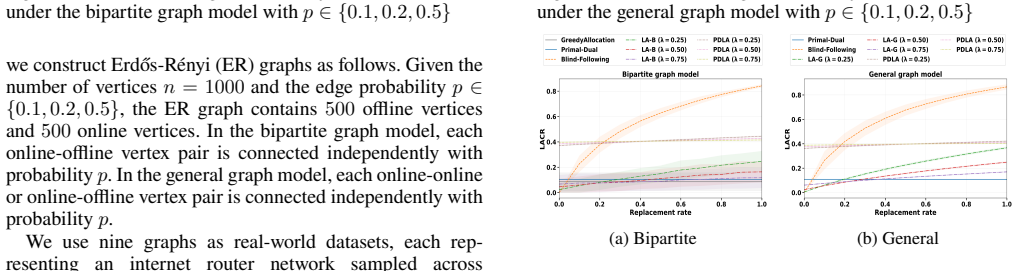
This paper studies learning-augmented online weighted vertex cover with advice and a parameter $\lambda \in (0,1)$. We consider two graph cases: bipartite graphs and general graphs. In both settings, the online algorithm must maintain a feasible vertex cover under irrevocable decisions. We show that these problems admit the same robustness--consistency tradeoffs as learning-augmented ski rental. For the bipartite graph model, we give a randomized algorithm that is $\frac{1}{1-e^{-\lambda}}$-robust and $\frac{\lambda}{1-e^{-\lambda}}$-consistent. For the general graph model, we give a deterministic algorithm that is $(1+\frac{1}{\lambda})$-robust and $(1+\lambda)$-consistent. We prove that the tradeoffs above are optimal in both settings. We also validate the proposed algorithms through experiments on synthetic and real-world datasets.
Editorial analysis
A structured set of objections, weighed in public.
Referee Report
Summary. The paper studies learning-augmented online weighted vertex cover with advice parameterized by λ ∈ (0,1). For bipartite graphs it gives a randomized algorithm that is 1/(1-e^{-λ})-robust and λ/(1-e^{-λ})-consistent; for general graphs it gives a deterministic algorithm that is (1+1/λ)-robust and (1+λ)-consistent. Both tradeoffs are proved optimal via reductions to ski-rental, and the algorithms are validated experimentally on synthetic and real-world data.
Significance. If the results hold, the work shows that online vertex cover admits the same optimal robustness-consistency tradeoffs as ski-rental under this advice model, with explicit algorithms, matching lower bounds, and empirical support. This strengthens the learning-augmented online-algorithms literature by extending it to a canonical graph problem while preserving the clean parameterized guarantees.
major comments (1)
- [Abstract and §1–2] Abstract and §1–2: the robustness and consistency bounds, as well as the optimality claims, are derived under an advice model in which the learner supplies precisely a scalar λ ∈ (0,1) that correctly parameterizes the quality of a machine-learned prediction of the optimum cover. The manuscript must state explicitly (in the model section) how λ is obtained from an actual predictor; the stated guarantees cease to apply for arbitrary or adversarially chosen advice.
minor comments (1)
- [Experiments] The experimental section should report how λ is estimated or tuned from the underlying ML predictor on the real-world instances, to make the validation directly comparable to the theoretical model.
Simulated Author's Rebuttal
We thank the referee for the careful reading and the constructive comment regarding the advice model. We address the point below and will revise the manuscript accordingly.
read point-by-point responses
-
Referee: [Abstract and §1–2] Abstract and §1–2: the robustness and consistency bounds, as well as the optimality claims, are derived under an advice model in which the learner supplies precisely a scalar λ ∈ (0,1) that correctly parameterizes the quality of a machine-learned prediction of the optimum cover. The manuscript must state explicitly (in the model section) how λ is obtained from an actual predictor; the stated guarantees cease to apply for arbitrary or adversarially chosen advice.
Authors: We agree that the model section should make this explicit. In the revised manuscript we will add a paragraph to §2 (Preliminaries) stating that the machine-learned predictor outputs an estimate of the optimum vertex cover, from which λ ∈ (0,1) is derived as a direct measure of the predictor’s accuracy (e.g., via a monotone function of the relative error between the predicted and true optimum). The algorithm receives this scalar λ as advice, and the robustness/consistency bounds are proved under the assumption that the supplied λ correctly reflects the prediction quality. We will also add a remark clarifying that the stated guarantees do not hold for arbitrary or adversarially chosen λ, which is the standard modeling assumption in the learning-augmented algorithms literature. revision: yes
Circularity Check
No circularity: tradeoffs derived from competitive analysis and reductions to ski-rental, independent of fitted data or self-referential definitions.
full rationale
The paper derives robustness-consistency bounds for online vertex cover by explicit reduction to the known learning-augmented ski-rental problem and standard competitive-analysis arguments, then proves matching optimality via lower-bound constructions. The parameter λ is an explicit modeling assumption on advice quality rather than a fitted quantity renamed as a prediction; no step equates an output ratio to an input by definition, and no load-bearing claim rests on an unverified self-citation chain. Experiments are presented only for validation, not for deriving the stated ratios. This is the normal non-circular case for a reduction-based competitive-analysis paper.
Axiom & Free-Parameter Ledger
free parameters (1)
- λ
axioms (2)
- domain assumption Standard online competitive analysis model with irrevocable decisions and worst-case input sequences.
- domain assumption The advice can be summarized by a single scalar λ that correctly parameterizes prediction accuracy.
Reference graph
Works this paper leans on
-
[1]
Computer Networks , volume=
Breadth-first search tree integrated vertex cover algorithms for link monitoring and routing in wireless sensor networks , author=. Computer Networks , volume=. 2021 , publisher=
2021
-
[2]
Algorithmica , volume=
Vertex cover meets scheduling , author=. Algorithmica , volume=. 2016 , publisher=
2016
-
[3]
Journal of the ACM (JACM) , volume=
Competitive caching with machine learned advice , author=. Journal of the ACM (JACM) , volume=. 2021 , publisher=
2021
-
[4]
Advances in Neural Information Processing Systems , volume=
The primal-dual method for learning augmented algorithms , author=. Advances in Neural Information Processing Systems , volume=
-
[5]
Advances in Neural Information Processing Systems , volume=
Learning-augmented algorithms for online linear and semidefinite programming , author=. Advances in Neural Information Processing Systems , volume=
-
[6]
Advances in Neural Information Processing Systems , volume=
Improving online algorithms via ML predictions , author=. Advances in Neural Information Processing Systems , volume=
-
[7]
Advances in Neural Information Processing Systems , volume=
Online algorithms for multi-shop ski rental with machine learned advice , author=. Advances in Neural Information Processing Systems , volume=
-
[8]
Improved learning-augmented algorithms for the multi-option ski rental problem via best-possible competitive analysis , author=. Proc. ICML , pages=. 2023 , organization=
2023
-
[9]
Advances in Neural Information Processing Systems , volume=
Learning-augmented streaming algorithms for correlation clustering , author=. Advances in Neural Information Processing Systems , volume=
-
[10]
Learning-augmented hierarchical clustering , author =. Proc. ICML , pages =. 2025 , volume =
2025
-
[11]
Learning-augmented k -means clustering , author=. Proc. ICLR , year=
-
[12]
Online scheduling via learned weights , author=. Proc. SODA , pages=. 2020 , organization=
2020
-
[13]
Flow time scheduling with uncertain processing time , author=. Proc. STOC , pages=
-
[14]
ACM Transactions on Parallel Computing , volume=
Non-clairvoyant scheduling with predictions , author=. ACM Transactions on Parallel Computing , volume=. 2023 , publisher=
2023
-
[15]
Non-clairvoyant scheduling with partial predictions , author=. Proc. ICML , pages=
-
[16]
Improved bounds for online facility location with predictions , author=. Proc. AAAI , volume=
-
[17]
Advances in Neural Information Processing Systems , volume=
Learning-augmented algorithms for k -median via online learning , author=. Advances in Neural Information Processing Systems , volume=
-
[18]
Advances in Neural Information Processing Systems , volume=
Online knapsack with frequency predictions , author=. Advances in Neural Information Processing Systems , volume=
-
[19]
Smart predict-and-optimize for hard combinatorial optimization problems , author=. Proc. AAAI , volume=
-
[20]
Communications of the ACM , volume=
Algorithms with predictions , author=. Communications of the ACM , volume=. 2022 , publisher=
2022
-
[21]
Online algorithms for rent-or-buy with expert advice , author=. Proc. ICML , pages=. 2019 , organization=
2019
-
[22]
Learning-augmented online algorithm for two-level ski-rental problem , author=. Proc. AAAI , volume=
-
[23]
Theoretical Computer Science , volume=
On-line vertex-covering , author=. Theoretical Computer Science , volume=. 2005 , publisher=
2005
-
[24]
Information Processing Letters , volume=
Mean analysis of an online algorithm for the vertex cover problem , author=. Information Processing Letters , volume=. 2009 , publisher=
2009
-
[25]
Theory of Computing Systems , volume=
Algorithm for online 3-path vertex cover , author=. Theory of Computing Systems , volume=. 2020 , publisher=
2020
-
[26]
Matroid online bipartite matching and vertex cover , author=. Proc. EC , pages=
-
[27]
Two-sided online bipartite matching and vertex cover: Beating the greedy algorithm , author=. Proc. ICALP , pages=. 2015 , organization=
2015
-
[28]
Algorithmica , volume=
Competitive randomized algorithms for nonuniform problems , author=. Algorithmica , volume=. 1994 , publisher=
1994
-
[29]
Advances in Neural Information Processing Systems , volume=
Optimal robustness-consistency trade-offs for learning-augmented online algorithms , author=. Advances in Neural Information Processing Systems , volume=
-
[30]
ACM Transactions on Algorithms (TALG) , volume=
Online algorithms for weighted paging with predictions , author=. ACM Transactions on Algorithms (TALG) , volume=. 2022 , publisher=
2022
-
[31]
Parsimonious learning-augmented caching , author=. Proc. ICML , pages=. 2022 , organization=
2022
-
[32]
Learning-augmented weighted paging , author=. Proc. SODA , pages=. 2022 , organization=
2022
-
[33]
Advances in Neural Information Processing Systems , volume=
Secretary and online matching problems with machine learned advice , author=. Advances in Neural Information Processing Systems , volume=
-
[34]
Advances in Neural Information Processing Systems , volume=
Learning-augmented online bipartite fractional matching , author=. Advances in Neural Information Processing Systems , volume=
-
[35]
Learning-augmented online bipartite matching in the random arrival order model , author=. Proc. ICCSET , pages=. 2026 , organization=
2026
-
[36]
Omega , volume=
The vertex cover game: Application to transport networks , author=. Omega , volume=. 2020 , publisher=
2020
-
[37]
International journal of Computer Networks & Communications , volume=
Distributed vertex cover algorithms for wireless sensor networks , author=. International journal of Computer Networks & Communications , volume=. 2014 , publisher=
2014
-
[38]
, author=
Online stochastic optimization without distributions. , author=. Proc. ICAPS , volume=
-
[39]
Algorithmica , volume=
Relaxing the irrevocability requirement for online graph algorithms , author=. Algorithmica , volume=. 2022 , publisher=
2022
-
[40]
Advances in Neural Information Processing Systems , volume=
Online bipartite matching with advice: Tight robustness-consistency tradeoffs for the two-stage model , author=. Advances in Neural Information Processing Systems , volume=
-
[41]
ACM Transactions on Intelligent Systems and Technology , volume=
Snap: A general-purpose network analysis and graph-mining library , author=. ACM Transactions on Intelligent Systems and Technology , volume=. 2016 , publisher=
2016
-
[42]
On the discrete generalizations of Gronwall’s inequality , author=. J. Indian Math. Soc , volume=
-
[43]
Graphs over time: densification laws, shrinking diameters and possible explanations , author=. Proc. SIGKDD , pages=
-
[44]
Mathematics of Operations Research , volume=
Online primal-dual algorithms for covering and packing , author=. Mathematics of Operations Research , volume=. 2009 , publisher=
2009
-
[45]
Advances in Neural Information Processing Systems , volume=
Online ad allocation with predictions , author=. Advances in Neural Information Processing Systems , volume=
-
[46]
Learning-augmented algorithms for online concave packing and convex covering problems , author =. Proc. AISTATS , pages =. 2025 , volume =
2025
-
[47]
2025 , eprint=
Learning-Augmented Online Covering Problems , author=. 2025 , eprint=
2025
-
[48]
Online covering with multiple experts , author=. Proc. ALT , year=
-
[49]
Computer Networks , volume=
Breadth-first search tree integrated vertex cover algorithms for link monitoring and routing in wireless sensor networks , author=. Computer Networks , volume=
-
[50]
Algorithmica , volume=
Vertex cover meets scheduling , author=. Algorithmica , volume=
-
[51]
Journal of the ACM , volume=
Competitive caching with machine learned advice , author=. Journal of the ACM , volume=
-
[52]
The primal-dual method for learning augmented algorithms , author=. Proc. NeurIPS , pages=
-
[53]
Learning-augmented algorithms for online linear and semidefinite programming , author=. Proc. NeurIPS , pages=
-
[54]
Improving online algorithms via
Purohit, Manish and Svitkina, Zoya and Kumar, Ravi , booktitle=. Improving online algorithms via
-
[55]
Online algorithms for multi-shop ski rental with machine learned advice , author=. Proc. NeurIPS , pages=
-
[56]
Improved learning-augmented algorithms for the multi-option ski rental problem via best-possible competitive analysis , author=. Proc. ICML , pages=
-
[57]
Learning-augmented streaming algorithms for correlation clustering , author=. Proc. NeurIPS , pages=
-
[58]
Learning-augmented hierarchical clustering , author =. Proc. ICML , pages =
-
[59]
Improved bounds for online facility location with predictions , author=. Proc. AAAI , pages=
-
[60]
Learning-augmented algorithms for k -median via online learning , author=. Proc. NeurIPS , pages=
-
[61]
Online knapsack with frequency predictions , author=. Proc. NeurIPS , pages=
-
[62]
Smart predict-and-optimize for hard combinatorial optimization problems , author=. Proc. AAAI , pages=
-
[63]
Communications of the ACM , volume=
Algorithms with predictions , author=. Communications of the ACM , volume=
-
[64]
Online algorithms for rent-or-buy with expert advice , author=. Proc. ICML , pages=
-
[65]
Learning-augmented online algorithm for two-level ski-rental problem , author=. Proc. AAAI , pages=
-
[66]
Theoretical Computer Science , volume=
On-line vertex-covering , author=. Theoretical Computer Science , volume=
-
[67]
Information Processing Letters , volume=
Mean analysis of an online algorithm for the vertex cover problem , author=. Information Processing Letters , volume=
-
[68]
Theory of Computing Systems , volume=
Algorithm for online 3-path vertex cover , author=. Theory of Computing Systems , volume=
-
[69]
Two-sided online bipartite matching and vertex cover: Beating the greedy algorithm , author=. Proc. ICALP , pages=
-
[70]
Algorithmica , volume=
Competitive randomized algorithms for nonuniform problems , author=. Algorithmica , volume=
-
[71]
Optimal robustness-consistency trade-offs for learning-augmented online algorithms , author=. Proc. NeurIPS , pages=
-
[72]
ACM Transactions on Algorithms (TALG) , volume=
Online algorithms for weighted paging with predictions , author=. ACM Transactions on Algorithms (TALG) , volume=
-
[73]
Parsimonious learning-augmented caching , author=. Proc. ICML , pages=
-
[74]
Learning-augmented weighted paging , author=. Proc. SODA , pages=
-
[75]
Secretary and online matching problems with machine learned advice , author=. Proc. NeurIPS , pages=
-
[76]
Learning-augmented online bipartite fractional matching , author=. Proc. NeurIPS , pages=
-
[77]
Learning-augmented online bipartite matching in the random arrival order model , author=. Proc. ICCSET , pages=
-
[78]
Omega , volume=
The vertex cover game: Application to transport networks , author=. Omega , volume=
-
[79]
International journal of Computer Networks & Communications , volume=
Distributed vertex cover algorithms for wireless sensor networks , author=. International journal of Computer Networks & Communications , volume=
-
[80]
Online stochastic optimization without distributions , author=. Proc. ICAPS , pages=
discussion (0)
Sign in with ORCID, Apple, or X to comment. Anyone can read and Pith papers without signing in.