Characterising transiting exoplanets at long orbital period: lessons learned for PLATO from 10 years of monitoring the HIP41378 system
Pith reviewed 2026-06-26 07:50 UTC · model grok-4.3
The pith
Ten years monitoring the HIP41378 system yields lessons for characterizing long-period transiting exoplanets with PLATO.
A machine-rendered reading of the paper's core claim, the machinery that carries it, and where it could break.
Core claim
By monitoring the HIP41378 multi-planetary system over one decade via both radial-velocity and transit observations, the authors have identified key lessons for characterizing transiting exoplanets at long orbital periods. These lessons are important for the follow-up strategy of PLATO transiting exoplanets.
What carries the argument
The HIP41378 multi-planetary system monitored for ten years through combined radial-velocity and transit observations, used as a case study for long-period planet characterization.
If this is right
- PLATO follow-up programs will need to allocate resources for extended radial-velocity campaigns to measure planetary masses.
- Multi-year transit monitoring will be required to confirm periods and detect additional planets in long-period systems.
- Coordination between space photometry and ground-based spectroscopy will be essential for bright southern targets.
Where Pith is reading between the lines
- Archival long-baseline data on systems like HIP41378 may serve as templates for interpreting PLATO light curves of similar planets.
- The emphasis on southern-sky accessibility suggests that ESO facilities will play a central role in realizing the full potential of the PLATO sample.
Load-bearing premise
The specific challenges and solutions encountered with the HIP41378 system are representative of the broader population of long-period transiting planets PLATO will discover.
What would settle it
A sample of PLATO-discovered long-period transiting exoplanets that require substantially shorter monitoring campaigns or different techniques than those applied to HIP41378 would show the lessons are not broadly representative.
Figures

read the original abstract
The upcoming launch of the PLATO mission will open a new area of exoplanetary research by probing transiting exoplanets at long orbital periods around bright stars. These planets will be amenable to follow-up observations, especially with the ESO telescopes as the first PLATO field is in the southern sky. In this paper we listed the lessons we learned by monitoring the bright HIP41378 multi-planetary system over one decade via both radial-velocity and transit observations. These lessons are important for the follow-up strategy of PLATO transiting exoplanets.
Editorial analysis
A structured set of objections, weighed in public.
Referee Report
Summary. The manuscript presents a case study of 10 years of radial-velocity and transit monitoring of the bright multi-planet HIP41378 system and extracts observational lessons (long-period challenges, multi-planet interactions, RV precision limits on F-stars, TTVs) that the authors argue are important for the follow-up strategy of long-period transiting planets that PLATO will discover around bright stars.
Significance. If the encountered challenges prove representative of the PLATO long-period population, the practical lessons on scheduling, instrument choice, and handling dynamical complexity could usefully inform ESO follow-up planning. The work supplies concrete observational experience rather than simulations, which is a strength when the lessons are shown to generalize.
major comments (2)
- [Abstract and §5] Abstract and §5 (Conclusions): the central claim that the listed lessons 'are important for the follow-up strategy of PLATO transiting exoplanets' is load-bearing yet unsupported by any quantitative test of representativeness; the manuscript offers no comparison to PLATO yield simulations, to the known sample of other bright long-period transitors, or to selection biases affecting F-star systems.
- [§4] §4 (Lessons learned): the generalization from this single F-star multi-planet system to the broader PLATO long-period population is asserted without discussion of how typical the observed TTV amplitudes, RV semi-amplitude limits, or transit-timing precision requirements are expected to be; this leaves the applicability of each lesson untested.
minor comments (2)
- The manuscript would benefit from an explicit table or subsection listing each lesson alongside the specific HIP41378 data (epoch range, number of RV points, transit coverage) that motivated it.
- A short paragraph on how the southern PLATO field overlaps with ESO facilities would strengthen the motivation without altering the core argument.
Simulated Author's Rebuttal
We thank the referee for the constructive report. The manuscript is a case study based on one decade of observations of a single system, and we will revise the abstract and §5 to frame the lessons more explicitly as illustrative of potential challenges rather than claiming broad representativeness. We address each major comment below.
read point-by-point responses
-
Referee: [Abstract and §5] Abstract and §5 (Conclusions): the central claim that the listed lessons 'are important for the follow-up strategy of PLATO transiting exoplanets' is load-bearing yet unsupported by any quantitative test of representativeness; the manuscript offers no comparison to PLATO yield simulations, to the known sample of other bright long-period transitors, or to selection biases affecting F-star systems.
Authors: We agree that the manuscript provides no quantitative test of how representative the HIP41378 system is of the PLATO long-period population. The work is observational and draws lessons from real data on this F-star multi-planet system. We will revise the abstract and §5 to remove the load-bearing claim of direct importance and instead state that the experience highlights practical issues (such as long-term scheduling and dynamical complexity) that merit consideration in PLATO follow-up planning. A short limitations paragraph will be added noting the absence of comparisons to yield simulations or other systems. revision: partial
-
Referee: [§4] §4 (Lessons learned): the generalization from this single F-star multi-planet system to the broader PLATO long-period population is asserted without discussion of how typical the observed TTV amplitudes, RV semi-amplitude limits, or transit-timing precision requirements are expected to be; this leaves the applicability of each lesson untested.
Authors: We accept that §4 asserts applicability without quantifying typicality. In revision we will expand the section to discuss the specific characteristics of HIP41378 (F-type host, multi-planet architecture, observed TTV and RV properties) and explicitly caution that other PLATO targets may exhibit different amplitudes or precision needs. We will reference existing population studies for context but cannot add new simulations or statistical comparisons within the scope of this observational paper. revision: partial
Circularity Check
No circularity: observational case study with no derivations or fitted predictions
full rationale
The paper is a qualitative report of lessons from 10 years of RV and transit monitoring of the single HIP41378 system. No equations, parameters, or predictions appear in the provided text. The central claim (lessons are important for PLATO) is a forward-looking recommendation, not a derivation that reduces to its own inputs by construction, self-citation, or renaming. Generalization concerns are about representativeness, not circularity.
Axiom & Free-Parameter Ledger
Reference graph
Works this paper leans on
-
[1]
Alam, M. K. et al 2022, ApJ Letters, 927, 1, L5 Becker, J. C. et al. 2019, AJ, 702, A211 Berardo, D. et al. 2019, AJ, 157, 5, 185 Bryant, E. M. et al. 2021, MNRAS, 504, 1, L45 García-Mejía, J. et al. 2026, AJ, 171, 4, 245 Gaudi, B. S. & Winn, J. N. 2007, ApJ, 655, 1, 550 Grouffal, S. et al. 2022, A&A, 668, A172 Grouffal, S. et al. 2025, A&A, 701, A173 Gro...
arXiv 2022
-
[2]
b The signal from the planet candidate HIP41378 h could have been detected during the 5th observation year, but no data were collected that year due to the COVID pandemic. c The PLATO targets have a much better visibility along the year from the ESO observatories than HIP41378 so a given event can be much better covered than in the campaign reported in Gr...
2025
-
[3]
The star was nightly observed whenever possible, except in 2020 during the COVID pandemic
The nine year RV monitoring of HIP41378 with HARPS, HARPS-N, HIRES, and ESPRESSO spectrographs. The star was nightly observed whenever possible, except in 2020 during the COVID pandemic. The high-frequency signals (planets b, c, g, and the stellar rotation) have been removed from the data and model to highlight the long-period signals. Adopted from Grouff...
2020
-
[4]
their TTV is longer than one night of 7h, when scheduling a follow-up observation with, e.g
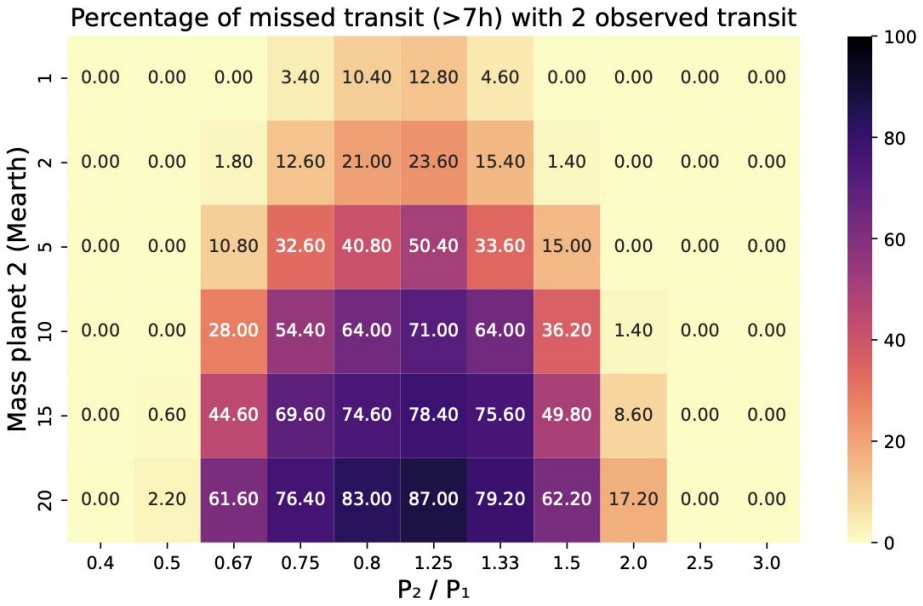
Assuming an Earth analog (1M e, P=365d) seen twice in transit by PLATO in 2027 and 2028, this is the ratio of transits that would be missed, i.e. their TTV is longer than one night of 7h, when scheduling a follow-up observation with, e.g. ANDES/ELT, in
2027
-
[5]
In the most extreme scenarios, more than 80% of the transiting planets observed only twice by PLATO could not be re-observed a few years later
This ratio depends on the mass and period of the (unseen in transit) perturber. In the most extreme scenarios, more than 80% of the transiting planets observed only twice by PLATO could not be re-observed a few years later. Figure from Grouffal (2025). Figure
2025
-
[6]
The visibility constraints from JWST and CHEOPS are displayed in yellow and red (respectively)
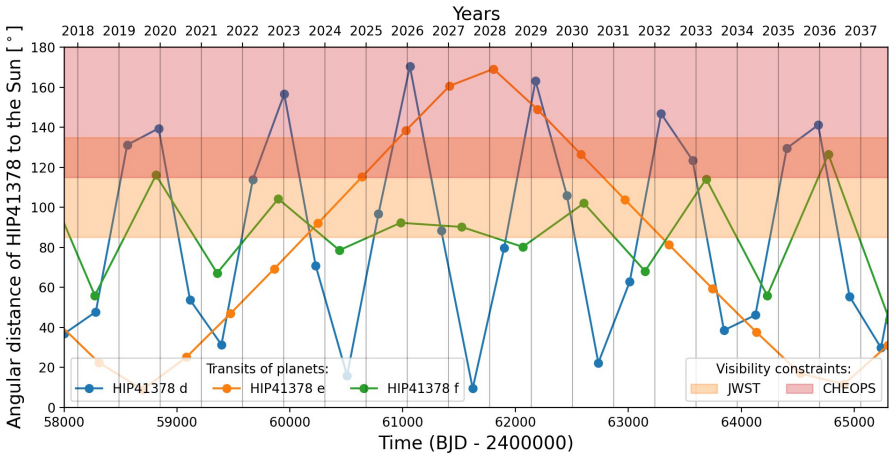
Angular distance of the star HIP41378 to the Sun, as seen from the Earth, at the expected times of transit (dots) of the planets d (blue), e (orange) and f (green). The visibility constraints from JWST and CHEOPS are displayed in yellow and red (respectively). The period covers 20 years of time, from the K2’s campaign C18, to the first light of ELT/ANDES ...
2032
discussion (0)
Sign in with ORCID, Apple, or X to comment. Anyone can read and Pith papers without signing in.