Integrating Sensing into Covert Communications: Opportunities and Challenges
Pith reviewed 2026-06-26 07:15 UTC · model grok-4.3
The pith
Sensing shifts covert communications from passive concealment to state-aware control using adversary and environmental data.
A machine-rendered reading of the paper's core claim, the machinery that carries it, and where it could break.
Core claim
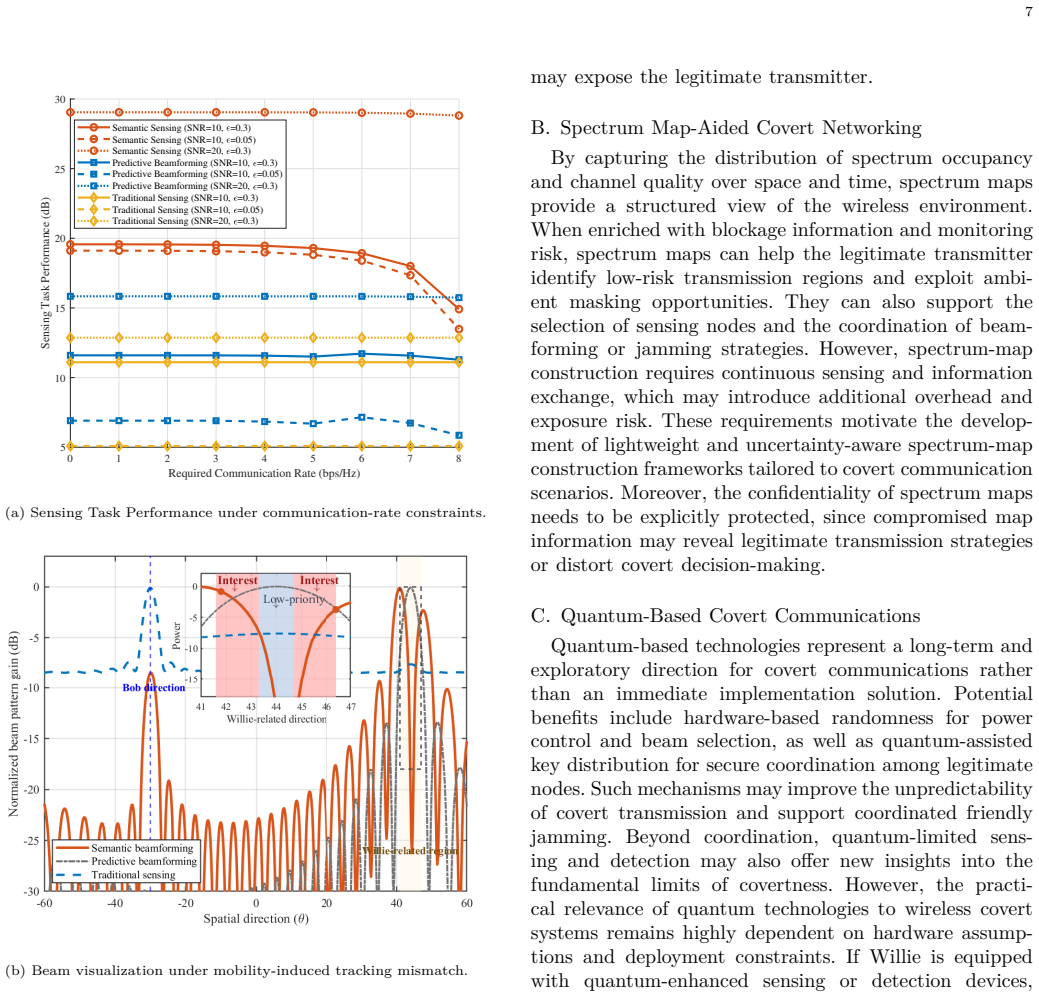
Sensing-empowered covert communications use adversary and environmental information to guide transmission and jamming control, changing system design from passive concealment to state-aware decision-making while creating challenges in exposure and resource use. Several intelligent sensing paradigms are discussed that extract relevant information through limited active probing. A case study demonstrates that sensing-assisted beamforming enhances spatial resource utilization and covert data delivery reliability in time-varying channels.
What carries the argument
Sensing-assisted beamforming that extracts task-relevant adversary and environmental information to enable state-aware transmission and jamming decisions.
If this is right
- Sensing improves spatial resource utilization and reliability of covert data delivery in time-varying channels.
- Intelligent sensing paradigms can extract task-relevant information using only limited active probing.
- Covert system design must now account for exposure and resource consumption introduced by the sensing process.
- Open issues remain in building more adaptive covert wireless systems that balance sensing benefits against its risks.
Where Pith is reading between the lines
- The same sensing data could potentially be reused across multiple covert links in a shared network to reduce overall probing overhead.
- In multi-user settings the exposure risks from sensing might compound if one user's probes reveal information usable against others.
- Testing whether sensing-assisted control maintains covertness under mobility models not covered in the low-altitude case study would clarify general applicability.
Load-bearing premise
Information gathered by sensing about adversaries and the environment can direct transmission and jamming without the sensing activity itself revealing the system or creating excessive exposure risks.
What would settle it
A measurement in which active sensing transmissions are detected by the target adversary at a rate that raises the overall exposure probability above the level achieved by conventional blind covert methods.
Figures
read the original abstract
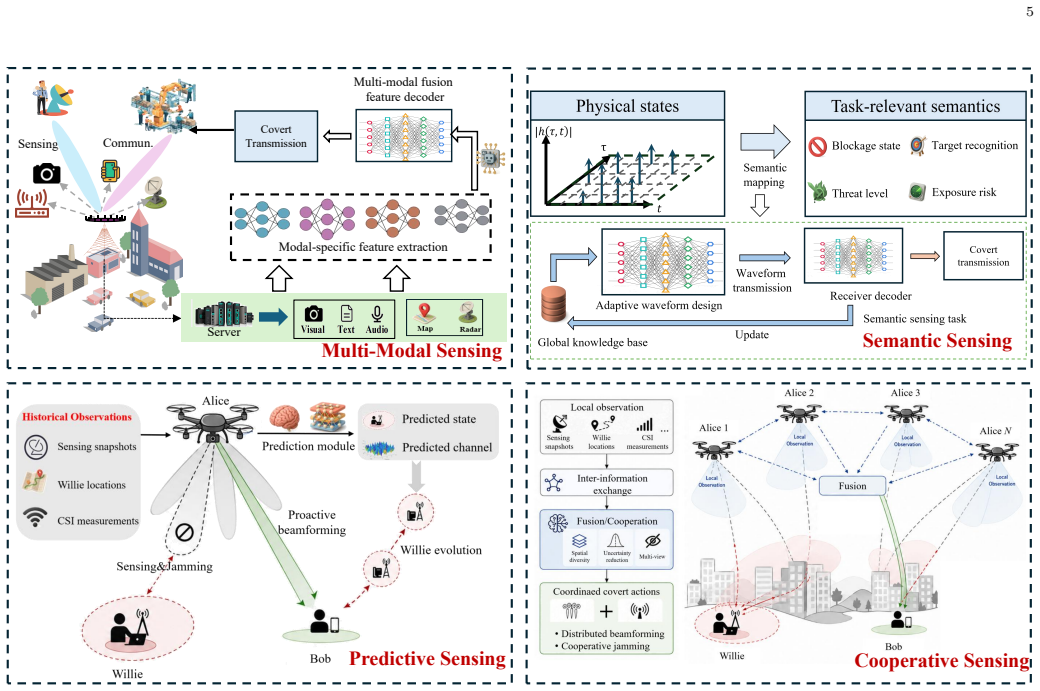
Covert communications aim to hide the existence of wireless transmissions from unauthorized adversaries. However, conventional designs based on blind interference or passive uncertainty can be ineffective in dynamic propagation environments. This article investigates sensing-empowered covert communications, where adversary and environmental information are used to guide transmission and jamming control. We show how sensing changes covert system design from passive concealment to state-aware decision-making, while also introducing new challenges related to exposure and resource consumption. We further discuss several intelligent sensing paradigms that extract task-relevant information with limited active probing. A case study in low-altitude wireless networks illustrates that sensing-assisted beamforming can improve spatial resource utilization and the reliability of covert data delivery in time-varying channels. Finally, several open issues are discussed to support more adaptive covert wireless systems.
Editorial analysis
A structured set of objections, weighed in public.
Referee Report
Summary. The manuscript is a perspective article arguing that integrating sensing into covert communications shifts system design from passive concealment (based on blind interference or uncertainty) to state-aware decision-making, where adversary and environmental information guides transmission and jamming control. It identifies resulting challenges in exposure and resource consumption, discusses intelligent sensing paradigms that extract task-relevant information via limited active probing, presents an illustrative case study on sensing-assisted beamforming in low-altitude wireless networks for improved spatial resource use and covert delivery reliability in time-varying channels, and outlines open issues for more adaptive covert systems.
Significance. As a conceptual overview, the work usefully frames how sensing can enable adaptive covert designs while surfacing self-exposure risks, which could help direct research toward practical sensing-assisted covert systems in dynamic environments such as low-altitude networks. The explicit discussion of limited-probing paradigms as a mitigation strategy strengthens the perspective by addressing a key tension in the central claim.
minor comments (1)
- The case study is described only at a high level as an illustration; if the full manuscript contains any specific performance metrics or comparisons, a brief quantitative summary in the main text would improve concreteness without altering the perspective nature of the article.
Simulated Author's Rebuttal
We thank the referee for the positive evaluation of our perspective article and the recommendation to accept. The summary accurately captures the manuscript's focus on shifting covert communications toward state-aware designs via sensing while surfacing exposure and resource challenges.
Circularity Check
No significant circularity in conceptual perspective article
full rationale
This manuscript is an overview/perspective piece with no new theorems, equations, derivations, fitted parameters, or quantitative models. Its central claim—that sensing shifts covert design toward state-aware control while surfacing exposure risks—is presented as a conceptual reframing rather than a reduction of any output to its own inputs by construction. No self-citation chains, ansatzes, or uniqueness theorems are invoked as load-bearing premises. The case study is explicitly labeled illustrative only. The derivation chain is therefore self-contained at the level of discussion and does not exhibit any of the enumerated circularity patterns.
Axiom & Free-Parameter Ledger
Reference graph
Works this paper leans on
-
[1]
Covert communications: A comprehensive survey,
X. Chen, J. An, Z. Xiong, C. Xing, N. Zhao, F. R. Yu, and A. Nallanathan, “Covert communications: A comprehensive survey,” IEEE Commun. Surveys Tuts., vol. 25, no. 2, pp. 1173– 1198, 2023
2023
-
[2]
Intelligent covert communications: Hiding transmission via learning,
F. Yang, N. Deng, Q. Shi, C. Xing, N. Zhao, and D. Niyato, “Intelligent covert communications: Hiding transmission via learning,” IEEE Commun. Mag., vol. 64, no. 4, pp. 142–148, 2026
2026
-
[3]
Integrating sensing and communications in 6g? not until it is secure to do so,
N. Su, F. Liu, J. Zou, C. Masouros, G. C. Alexandropoulos, A. Mourad, J. L. Hernando, Q. Zhang, and T.-T. Chan, “Integrating sensing and communications in 6g? not until it is secure to do so,” arXiv preprint arXiv:2503.15243, 2025
-
[4]
On covert communi- cation with noise uncertainty,
B. He, S. Yan, X. Zhou, and V. K. Lau, “On covert communi- cation with noise uncertainty,” IEEE Commun. Lett., vol. 21, no. 4, pp. 941–944, 2017
2017
-
[5]
Covert communication in the presence of an uninformed jam- mer,
T. V. Sobers, B. A. Bash, S. Guha, D. Towsley, and D. Goeckel, “Covert communication in the presence of an uninformed jam- mer,” IEEE Trans. Wireless Commun., vol. 16, no. 9, pp. 6193– 6206, 2017
2017
-
[6]
Aerial-networked ISAC-empowered collaborative energy-efficient covert communications,
J. Wu et al., “Aerial-networked ISAC-empowered collaborative energy-efficient covert communications,” Chinese J. Aeron., p. 103451, 2025
2025
-
[7]
Sensing-aided covert communications: Turning interference into allies,
X. Wang, Z. Fei, P. Liu, J. A. Zhang, Q. Wu, and N. Wu, “Sensing-aided covert communications: Turning interference into allies,” IEEE Trans. Wireless Commun., vol. 23, no. 9, pp. 10726–10739, 2024
2024
-
[8]
Collaborative secret and covert communications for multi-user multi-antenna uplink UA V systems: Design and optimization,
J. Xu, L. Bai, X. Xie, and L. Zhou, “Collaborative secret and covert communications for multi-user multi-antenna uplink UA V systems: Design and optimization,” IEEE Trans. Wireless Commun., vol. 24, no. 7, pp. 6020–6035, 2025
2025
-
[9]
Joint power allocation and rate control for rate splitting multiple access networks with covert communica- tions,
N. Q. Hieu, D. T. Hoang, D. Niyato, D. N. Nguyen, D. I. Kim, and A. Jamalipour, “Joint power allocation and rate control for rate splitting multiple access networks with covert communica- tions,” IEEE Trans. Commun., vol. 71, no. 4, pp. 2274–2287, 2023
2023
-
[10]
Achieving covert wireless communications using a full-duplex receiver,
K. Shahzad, X. Zhou, S. Yan, J. Hu, F. Shu, and J. Li, “Achieving covert wireless communications using a full-duplex receiver,” IEEE Trans. Wireless Commun., vol. 17, no. 12, pp. 8517–8530, 2018
2018
-
[11]
Intelligent covert communication: Recent advances and future research trends,
Z. Li, J. Shi, J. Si, L. Lv, L. Guan, B. Hao, Z. Tie, D. Wang, C. Xing, and T. Q. Quek, “Intelligent covert communication: Recent advances and future research trends,” Engineering, vol. 44, pp. 101–111, 2025
2025
-
[12]
Covert communications with simultaneous multi-modal transmission,
R. Aggarwal, J. S. Kong, T. J. Moore, J. Choi, P. Spasojevic, and F. T. Dagefu, “Covert communications with simultaneous multi-modal transmission,” in Proceedings of the 17th ACM Conference on Security and Privacy in Wireless and Mobile Networks, pp. 1–7, 2024
2024
-
[13]
Semantic sensing: A task-oriented paradigm,
X. Zhang, J. A. Zhang, C. Liu, W. Yuan, G. Y. Li, and M. G. Amin, “Semantic sensing: A task-oriented paradigm,” arXiv preprint arXiv:2603.29102, 2026
-
[14]
Low-altitude wireless networks: A comprehensive survey,
J. Wu et al., “Low-altitude wireless networks: A comprehensive survey,” China Commun., vol. 23, no. 3, pp. 99–141, 2026
2026
-
[15]
Predictive precoder design for otfs-enabled urllc: A deep learning ap- proach,
C. Liu, S. Li, W. Yuan, X. Liu, and D. W. K. Ng, “Predictive precoder design for otfs-enabled urllc: A deep learning ap- proach,” IEEE J. Sel. Areas Commun., vol. 41, no. 7, pp. 2245– 2260, 2023
2023
discussion (0)
Sign in with ORCID, Apple, or X to comment. Anyone can read and Pith papers without signing in.