Thermal and rotational effects of giant impacts during terrestrial planet accretion
Pith reviewed 2026-06-26 07:42 UTC · model grok-4.3
The pith
Giant impacts lower post-impact core-mantle boundary pressures through thermal and rotational effects.
A machine-rendered reading of the paper's core claim, the machinery that carries it, and where it could break.
Core claim
Post-impact CMB pressures are generally lower than previously assumed, due to both thermal and rotational effects. Full mantle melting is common and a substantial fraction of mantle material is heated above the Fe-MgO solvus closure temperature for impacts with modified specific energies Q_S > 10^6 J/kg, implying that a miscible layer could form close to the CMB for many giant impacts. The comparatively low internal pressures and large regions of metal-silicate miscibility after giant impacts have significant effects on the processes of core formation, and metal-silicate equilibration would occur near the CMB during later post-impact cooling, consistent with Earth's geochemistry.
What carries the argument
Scaling laws for impact heating efficiency, mantle-core heat partitioning, and CMB pressures and temperatures, derived from SWIFT hydrocode runs combined with HERCULES structure calculations.
If this is right
- Post-impact CMB pressures are lower than earlier assumptions.
- Full mantle melting occurs after most giant impacts.
- For impacts above Q_S of 10^6 J/kg a miscible metal-silicate layer can form near the CMB.
- Metal-silicate equilibration takes place near the CMB during subsequent cooling.
- These pressure and mixing conditions change the expected outcomes of core formation.
Where Pith is reading between the lines
- The lower pressures and near-CMB mixing may help account for the observed abundances of siderophile elements in Earth's mantle.
- Accretion models that omit these rotational and thermal effects may overestimate final core pressures on other terrestrial planets.
- Direct seismic or geochemical constraints on early Earth CMB conditions could test the predicted pressure reduction.
- Extending the same simulation approach to different mass ratios or velocities would show how sensitive the scaling laws are to the impact parameter distribution.
Load-bearing premise
The chosen suite of collisions between Moon- to super-Earth-mass bodies is representative of the giant impacts that actually occurred during terrestrial planet accretion.
What would settle it
A measurement or independent model of post-impact CMB pressure in a terrestrial planet that equals or exceeds the higher values assumed in prior work rather than the lower values obtained here.
Figures

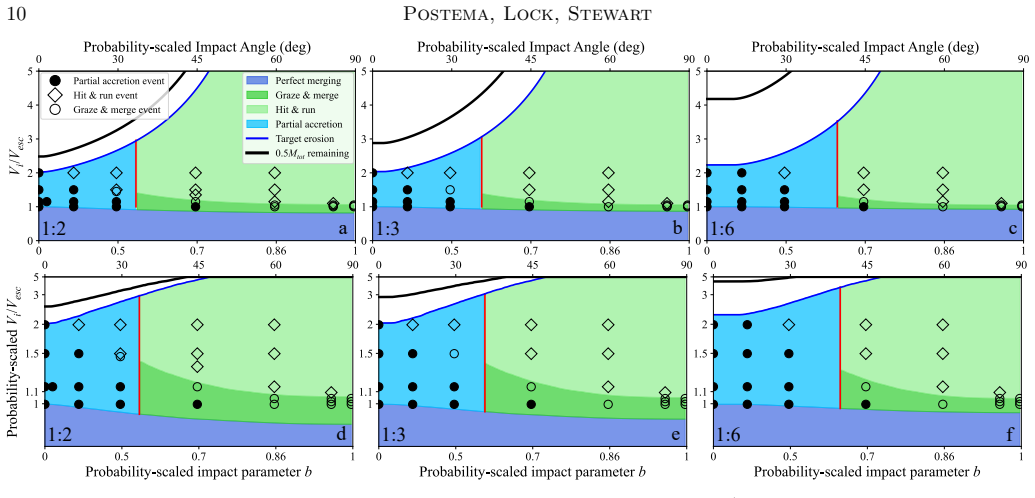


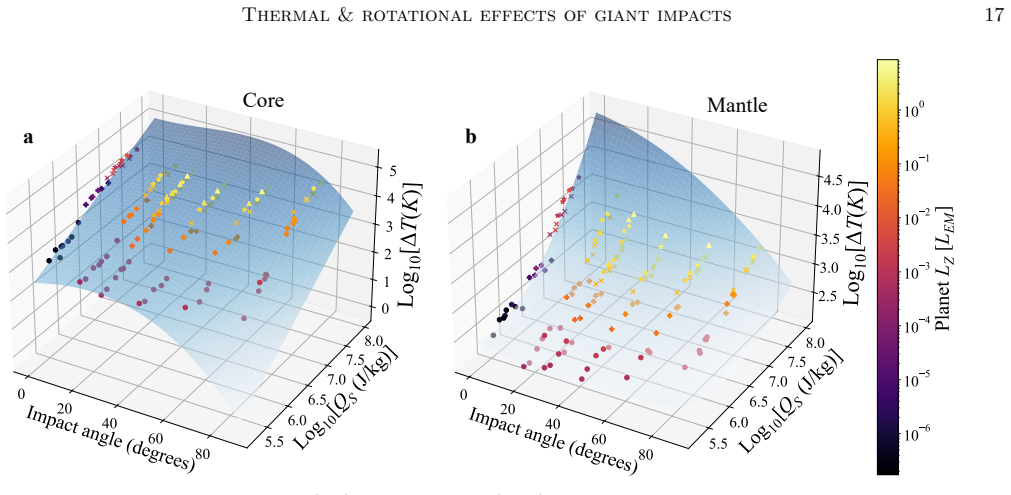


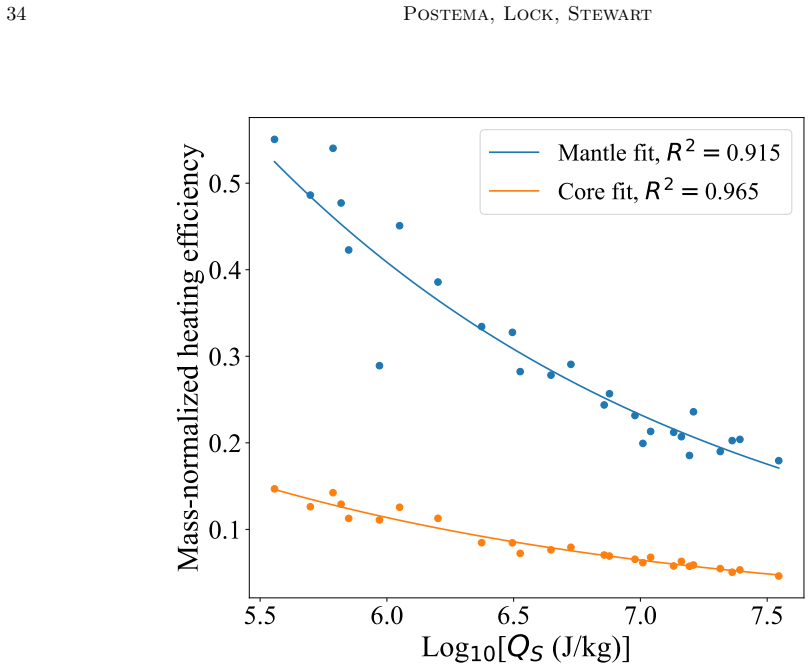


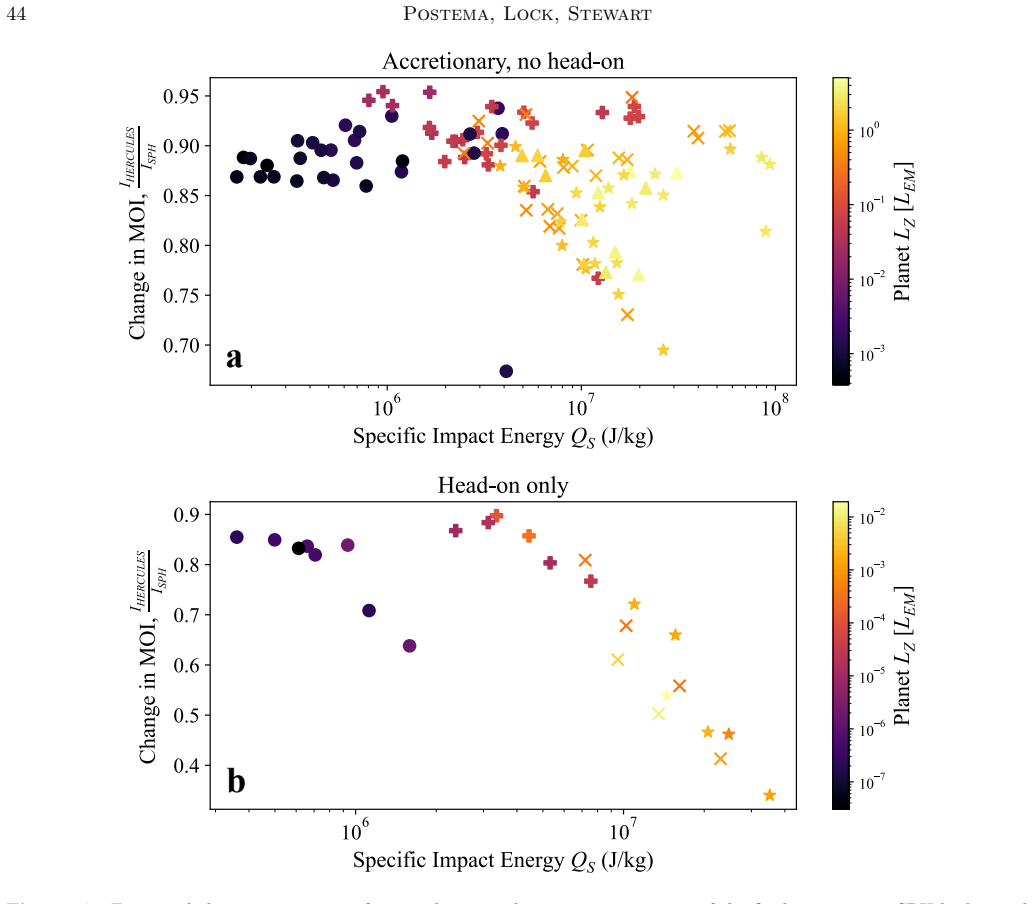

read the original abstract
Terrestrial planets likely experienced one or more giant impacts during their formation that inflicted large thermal, chemical, and rotational perturbations. The early states of terrestrial planets are expected to be dominated by the thermal and rotational outcomes of giant impacts, but critical parameters that control internal processes, such as the pressures and temperatures of core formation, are not fully understood. Here we present the results from a representative suite of collisions between Moon- to super-Earth-mass bodies using the SWIFT hydrocode and updated ANEOS equations of state, allowing more robust temperature calculations. Using these results and the HERCULES planetary structure code, we calculated the contributions from thermal energy, gravitational potential energy, and post-impact rotation on the pressure-temperature conditions of the core-mantle boundary (CMB). We derived scaling laws for the efficiency of impact heating, mantle-core heat partitioning, and CMB pressures and temperatures. We find that post-impact CMB pressures are generally lower than previously assumed, due to both thermal and rotational effects. Full mantle melting is common and a substantial fraction of mantle material is heated above the Fe-MgO solvus closure temperature for impacts with modified specific energies $Q_S>10^6$ J/kg, implying that a miscible layer could form close to the CMB for many giant impacts. The comparatively low internal pressures and large regions of metal-silicate miscibility after giant impacts have significant effects on the processes of core formation, and our work indicates that metal-silicate equilibration would occur near the CMB during later post-impact cooling, consistent with Earth's geochemistry.
Editorial analysis
A structured set of objections, weighed in public.
Referee Report
Summary. The manuscript presents results from a suite of giant impact simulations between Moon- to super-Earth-mass bodies using the SWIFT hydrocode with ANEOS equations of state. Post-processing with the HERCULES code is used to calculate post-impact core-mantle boundary (CMB) pressures and temperatures, incorporating thermal, gravitational potential, and rotational effects. Scaling laws are derived for impact heating efficiency, mantle-core heat partitioning, and CMB conditions. The key findings are that post-impact CMB pressures are lower than previously assumed due to thermal and rotational effects, full mantle melting is common, and for impacts with Q_S > 10^6 J/kg a substantial fraction of mantle material exceeds the Fe-MgO solvus temperature, suggesting possible miscible layer formation near the CMB with implications for core formation and metal-silicate equilibration.
Significance. If the results hold, this work would provide important revisions to models of terrestrial planet formation by showing lower CMB pressures and conditions favoring metal-silicate equilibration near the CMB. The computational approach combining hydrodynamics with structure calculations is a positive aspect, and the derived scaling laws could be useful for broader modeling if validated.
major comments (2)
- [Abstract] Abstract: the central claim that post-impact CMB pressures are 'generally lower' and that a miscible layer forms 'for many giant impacts' rests on the assertion of a 'representative suite'; however, the abstract provides no information on how the chosen mass ratios, velocities, angles, and resulting Q_S values were selected to match the statistical distribution from N-body accretion models, making representativeness load-bearing for the generalization.
- [Abstract] Abstract (workflow description): the manuscript describes the SWIFT + ANEOS + HERCULES workflow and states derived scaling laws but provides no details on numerical resolution, convergence tests, or validation against known benchmarks; without these the quantitative support for the reported CMB pressures, temperatures, and scaling laws cannot be evaluated.
minor comments (1)
- [Abstract] The modified specific energy Q_S is used in the abstract without an explicit definition or reference to its formula; this should be clarified on first use.
Simulated Author's Rebuttal
We thank the referee for their constructive comments, which identify opportunities to strengthen the abstract. We respond to each major comment below and have revised the abstract to address the concerns raised.
read point-by-point responses
-
Referee: [Abstract] Abstract: the central claim that post-impact CMB pressures are 'generally lower' and that a miscible layer forms 'for many giant impacts' rests on the assertion of a 'representative suite'; however, the abstract provides no information on how the chosen mass ratios, velocities, angles, and resulting Q_S values were selected to match the statistical distribution from N-body accretion models, making representativeness load-bearing for the generalization.
Authors: We agree that the abstract would benefit from explicit context on parameter selection. In the revised manuscript we will update the abstract to state that the impact parameters were chosen to span the distributions of mass ratios, velocities, and angles reported in N-body accretion studies (with the specific selection criteria and resulting Q_S range detailed in Section 2). This makes the basis for the 'representative suite' and the generalizations clear while preserving the original findings. revision: yes
-
Referee: [Abstract] Abstract (workflow description): the manuscript describes the SWIFT + ANEOS + HERCULES workflow and states derived scaling laws but provides no details on numerical resolution, convergence tests, or validation against known benchmarks; without these the quantitative support for the reported CMB pressures, temperatures, and scaling laws cannot be evaluated.
Authors: The full manuscript includes a Methods section that reports the numerical resolution employed in the SWIFT runs, presents convergence tests, and describes validation of the ANEOS equations of state and HERCULES structure calculations against benchmarks. To improve accessibility from the abstract, we will add a concise clause referencing the numerical methods and validation procedures (with a pointer to the Methods section). This directly addresses the concern about evaluability of the quantitative results. revision: yes
Circularity Check
Derivation from new hydrocode simulations is self-contained
full rationale
The paper obtains its CMB pressure, temperature, melting, and scaling-law results directly from a new suite of SWIFT hydrocode runs (with updated ANEOS) followed by independent HERCULES structure calculations. Scaling laws are stated as empirical fits to those simulation outputs; no equation reduces a reported quantity to a parameter fitted from the same data set, and no load-bearing premise rests on a self-citation chain. The representativeness assumption is an external modeling choice, not a definitional or fitted-input circularity. The derivation chain is therefore self-contained against external benchmarks.
Axiom & Free-Parameter Ledger
axioms (2)
- domain assumption The ANEOS equations of state provide sufficiently accurate temperatures for the post-impact states examined.
- domain assumption The HERCULES planetary structure code correctly incorporates thermal energy, gravitational potential, and rotation to compute CMB pressure and temperature.
Reference graph
Works this paper leans on
-
[1]
Nature , volume=
Geophysical evidence for an enriched molten silicate layer above Mars’s core , author=. Nature , volume=. 2023 , publisher=
2023
-
[2]
Nature , volume=
Evidence for a liquid silicate layer atop the Martian core , author=. Nature , volume=. 2023 , publisher=
2023
-
[3]
Super-Earths and Earth-like exoplanets , volume=
Lichtenberg, Tim and Miguel, Yamila , year=. Super-Earths and Earth-like exoplanets , volume=. Treatise on Geochemistry (Third Edition) , publisher=. doi:10.1016/B978-0-323-99762-1.00122-4 , abstractNote=
-
[4]
Journal of Geophysical Research: Planets , author=
The Pressure and Temperature Limits of Likely Rocky Exoplanets , volume=. Journal of Geophysical Research: Planets , author=. 2019 , pages=. doi:10.1029/2018JE005844 , abstractNote=
-
[5]
2019", month =
Collapsing Impact Vapor Plume Model for Chondrule and Chondrite Formation. Lunar and Planetary Science Conference, 50 , year = "2019", month = "Mar", eid =
2019
-
[6]
Lunar and Planetary Science Conference , year = "2019", series =
High Collision Velocities Between Planetesimals During Planet Growth and Migration. Lunar and Planetary Science Conference , year = "2019", series =
2019
-
[7]
Lunar and Planetary Science Conference , year = "2019", series =
Collapsing Impact Vapor Plumes: A New Planetesimal Formation Environment. Lunar and Planetary Science Conference , year = "2019", series =
2019
-
[8]
2019", month =
Impact Vaporization Criteria During Planet Formation. Lunar and Planetary Science Conference, 50 , year = "2019", month = "Mar", eid =
2019
-
[9]
Wahl and Burkhard Militzer , doi =
Sean M. Wahl and Burkhard Militzer , doi =. High-temperature miscibility of iron and rock during terrestrial planet formation , volume =. Earth and Planetary Science Letters , month =
-
[10]
2019", month =
Size Distribution of Chondrules Set by Droplet Breakup and Coupling During Vaporizing Collisions in the Nebula. Lunar and Planetary Science Conference, 50 , year = "2019", month = "Mar", eid =
2019
-
[11]
Impact disruption of gravity-dominated bodies: New simulation data and scaling. , keywords =. 2016. doi:10.1016/j.icarus.2016.04.018 , adsurl =
-
[12]
Gasoline2: a modern smoothed particle hydrodynamics code. , keywords =. doi:10.1093/mnras/stx1643 , adsurl =
-
[13]
doi:10.2138/gsrmg.55.1.197 , Journal =
-
[14]
Growth of asteroids, planetary embryos and Kuiper belt objects by chondrule accretion
doi:10.1126/sciadv.1500109 , Eid =. arXiv , Author =:1503.07347 , Journal =
work page internal anchor Pith review Pith/arXiv arXiv doi:10.1126/sciadv.1500109
-
[15]
doi:10.1038/nature12908 , Eprint =
, Month = jan, Pages =. doi:10.1038/nature12908 , Eprint =
-
[16]
doi:10.1016/j.gca.2016.06.023 , Journal =
-
[17]
doi:10.1016/j.gca.2004.01.008 , Journal =
-
[18]
doi:10.1126/science.1168221 , Journal =
-
[19]
Titanium isotopes and the radial heterogeneity of the solar system , Url =
Ingo Leya and Maria Sch. Titanium isotopes and the radial heterogeneity of the solar system , Url =. Earth and Planetary Science Letters , Keywords =. 2008 , Bdsk-Url-1 =. doi:https://doi.org/10.1016/j.epsl.2007.10.017 , Issn =
-
[20]
doi:10.1007/978-3-319-60609-5_7 , Editor =
Astrophysics and Space Science Library , Date-Added =. doi:10.1007/978-3-319-60609-5_7 , Editor =
-
[21]
and Davies, Erik and Lemke, Raymond W and Bliss, David E
Root, Seth and Townsend, Joshua P. and Davies, Erik and Lemke, Raymond W and Bliss, David E. and Fratanduono, Dayne E. and Kraus, Richard G. and Millot, Marius and Spaulding, Dylan K. and Shulenburger, Luke and Stewart, Sarah T. and Jacobsen, Stein B. , Date-Added =. The. Geophysical Research Letters , Keywords =. doi:10.1029/2017GL076931 , Eprint =
-
[22]
, Keywords =. doi:10.1086/338850 , Eprint =
-
[23]
, Keywords =. doi:10.1086/318019 , Eprint =
-
[24]
doi:10.3847/1538-4357/aaa5a5 , Eid =
, Keywords =. doi:10.3847/1538-4357/aaa5a5 , Eid =
-
[25]
Disk evolution in the solar neighborhood. I Disk frequencies from 1 to 100 Myr
doi:10.1051/0004-6361/201322597 , Eid =. arXiv , Author =:1312.0609 , Journal =
work page internal anchor Pith review Pith/arXiv arXiv doi:10.1051/0004-6361/201322597
-
[26]
doi:10.1111/j.1945-5100.1998.tb01611.x , Journal =
-
[27]
doi:10.1111/maps.12292 , Journal =
-
[29]
doi:10.1006/icar.2002.6895 , Journal =
-
[30]
doi:10.1038/nature10077 , Journal =
-
[31]
doi:10.1016/j.icarus.2018.04.008 , Eprint =
, Keywords =. doi:10.1016/j.icarus.2018.04.008 , Eprint =
-
[32]
Meteorites and the Early Solar System II , Date-Added =
-
[33]
doi:10.1038/nature03676 , Journal =
-
[34]
Johnson, Brandon C. and Walsh, Kevin J. and Minton, David A. and Krot, Alexander N. and Levison, Harold F. , Date-Added =. Timing of the formation and migration of giant planets as constrained by. Science Advances , Number =. 2016 , Bdsk-Url-1 =. doi:10.1126/sciadv.1601658 , Eprint =
-
[35]
doi:10.1038/nature14105 , Journal =
-
[36]
doi:10.1016/j.epsl.2015.09.049 , Journal =
-
[37]
doi:10.1126/science.1226919 , Journal =
-
[38]
Lunar and Planetary Science Conference , Date-Added =
-
[39]
doi:10.1016/j.epsl.2016.09.020 , Journal =
-
[40]
doi:10.3847/2041-8213/aa72a2 , Eid =. arXiv , Author =:1705.03676 , Journal =
work page internal anchor Pith review Pith/arXiv arXiv doi:10.3847/2041-8213/aa72a2 2041
-
[41]
doi:10.1088/0004-637X/691/2/L133 , Journal =
-
[42]
doi:10.1006/icar.2002.6909 , Journal =
-
[43]
doi:10.1086/589806 , Eid =. arXiv , Author =:0712.1019 , Journal =
work page internal anchor Pith review Pith/arXiv arXiv doi:10.1086/589806
-
[44]
doi:10.1088/0067-0049/215/2/21 , Eid =. arXiv , Author =:1411.4010 , Journal =
work page internal anchor Pith review Pith/arXiv arXiv doi:10.1088/0067-0049/215/2/21
-
[45]
doi:10.1086/192204 , Journal =
-
[46]
The Frequency of Giant impacts on Earth-like Worlds
The frequency of giant impacts on Earth-like worlds , Volume = 821, Year = 2016, Bdsk-Url-1 =. doi:10.3847/0004-637X/821/2/126 , Eid =. arXiv , Author =:1511.03663 , Journal =
work page internal anchor Pith review Pith/arXiv arXiv doi:10.3847/0004-637x/821/2/126 2016
-
[47]
doi:10.1006/icar.1998.6007 , Journal =
-
[48]
doi:10.1006/icar.2001.6639 , Journal =
-
[49]
doi:10.1006/icar.2000.6526 , Journal =
-
[50]
doi:10.1029/92JE02726 , Journal =
-
[51]
doi:10.1016/j.epsl.2015.06.023 , Eprint =
Earth and Planetary Science Letters , Keywords =. doi:10.1016/j.epsl.2015.06.023 , Eprint =
-
[52]
doi:10.1007/s11214-007-9284-1 , Journal =
-
[53]
doi:10.1038/nature23899 , Journal =
-
[54]
Disruption of bound clusters by photoionization
, Keywords =. doi:10.1111/j.1365-2966.2012.21546.x , Eprint =
-
[55]
doi:10.1016/j.icarus.2011.11.020 , Journal =
-
[56]
doi:10.1016/j.icarus.2013.10.022 , Journal =
-
[57]
Origin of the Earth , Date-Added =
-
[58]
doi:10.1007/s11214-016-0248-1 , Eprint =
, Keywords =. doi:10.1007/s11214-016-0248-1 , Eprint =
-
[59]
doi:10.1016/j.icarus.2017.06.030 , Eprint =
, Keywords =. doi:10.1016/j.icarus.2017.06.030 , Eprint =
-
[60]
doi:10.1029/JB087iB08p06668 , Journal =
-
[61]
, Month = aug, Pages =
-
[62]
Robin M. Canup , keywords =. Simulations of a late lunar-forming impact , journal =. 2004 , issn =. doi:https://doi.org/10.1016/j.icarus.2003.09.028 , url =
-
[63]
doi:10.1126/science.1226073 , Journal =
-
[64]
R.M. Canup and A.C. Barr and D.A. Crawford , keywords =. Lunar-forming impacts: High-resolution SPH and AMR-CTH simulations , journal =. 2013 , issn =. doi:https://doi.org/10.1016/j.icarus.2012.10.011 , url =
-
[65]
Journal of Geophysical Research (1896-1977) , author =
Dynamic compression of enstatite , volume =. Journal of Geophysical Research (1896-1977) , author =. doi:https://doi.org/10.1029/JB076i023p05504 , url =. https://agupubs.onlinelibrary.wiley.com/doi/pdf/10.1029/JB076i023p05504 , year =
-
[66]
Raikes, Susan A. and Ahrens, Thomas J. , title = ". Geophysical Journal International , volume =. 1979 , month =. doi:10.1111/j.1365-246X.1979.tb04804.x , url =
-
[67]
Sarah T. Stewart , title =. doi:10.5281/zenodo.3866507 , url =
-
[68]
Sarah T. Stewart , title =. doi:10.5281/zenodo.3866550 , url =
-
[69]
Equation of state model
Stewart, S and Davies, E and Duncan, M and Lock, S and Root, S and Townsend, J and Jacobsen, S , journal=. Equation of state model
-
[70]
Thompson, S. L. and Lauson, H. S. and Melosh, H. J. and Collins, G. S. and Stewart, S. T. , title =. doi:10.5281/zenodo.3525030 , url =
-
[71]
The composition of the Earth , journal =. 1995 , note =. doi:https://doi.org/10.1016/0009-2541(94)00140-4 , url =
-
[72]
John E. Chambers , keywords =. Planetary accretion in the inner Solar System , journal =. 2004 , issn =. doi:https://doi.org/10.1016/j.epsl.2004.04.031 , url =
-
[73]
Geophysical Research Letters , volume =
Piet, Hélène and Badro, James and Gillet, Philippe , title =. Geophysical Research Letters , volume =. doi:https://doi.org/10.1002/2017GL075225 , url =. https://agupubs.onlinelibrary.wiley.com/doi/pdf/10.1002/2017GL075225 , abstract =
-
[74]
Watt, J. Peter and Ahrens, Thomas J. , title =. Journal of Geophysical Research: Solid Earth , volume =. doi:https://doi.org/10.1029/JB091iB07p07495 , url =. https://agupubs.onlinelibrary.wiley.com/doi/pdf/10.1029/JB091iB07p07495 , abstract =
-
[75]
David C. Rubie and Daniel J. Frost and Ute Mann and Yuki Asahara and Francis Nimmo and Kyusei Tsuno and Philip Kegler and Astrid Holzheid and Herbert Palme , keywords =. Heterogeneous accretion, composition and core–mantle differentiation of the Earth , journal =. 2011 , issn =. doi:https://doi.org/10.1016/j.epsl.2010.11.030 , url =
-
[76]
Fischer and Yoichi Nakajima and Andrew J
Rebecca A. Fischer and Yoichi Nakajima and Andrew J. Campbell and Daniel J. Frost and Dennis Harries and Falko Langenhorst and Nobuyoshi Miyajima and Kilian Pollok and David C. Rubie , abstract =. High pressure metal–silicate partitioning of Ni, Co, V, Cr, Si, and O , journal =. 2015 , issn =. doi:https://doi.org/10.1016/j.gca.2015.06.026 , url =
-
[77]
Alexandre Emsenhuber and Erik Asphaug and Saverio Cambioni and Travis S. J. Gabriel and Stephen R. Schwartz , doi =. The Planetary Science Journal , month =
-
[78]
Stewart,S. T. and Kennedy,G. B. and Senft,L. E. and Furlanetto,M. R. and Obst,A. W. and Payton,J. R. and Seifter,A. , title =. AIP Conference Proceedings , volume =. 2006 , doi =
2006
-
[79]
Kraus, R. G. and Stewart, S. T. and Swift, D. C. and Bolme, C. A. and Smith, R. F. and Hamel, S. and Hammel, B. D. and Spaulding, D. K. and Hicks, D. G. and Eggert, J. H. and Collins, G. W. , title =. Journal of Geophysical Research: Planets , volume =. doi:https://doi.org/10.1029/2012JE004082 , url =. https://agupubs.onlinelibrary.wiley.com/doi/pdf/10.10...
-
[80]
Kraus and Seth Root and Raymond W
Richard G. Kraus and Seth Root and Raymond W. Lemke and Sarah T. Stewart and Stein B. Jacobsen and Thomas R. Mattsson , doi =. Impact vaporization of planetesimal cores in the late stages of planet formation , volume =. Nature Geoscience , month =
-
[81]
and Seifter, Achim and Obst, Andrew W
Stewart, Sarah T. and Seifter, Achim and Obst, Andrew W. , title =. Geophysical Research Letters , volume =. doi:https://doi.org/10.1029/2008GL035947 , url =. https://agupubs.onlinelibrary.wiley.com/doi/pdf/10.1029/2008GL035947 , abstract =
discussion (0)
Sign in with ORCID, Apple, or X to comment. Anyone can read and Pith papers without signing in.