Phase Uniformity Detector for GRSMReceivers in mmWave and Sub-THz Bands
Pith reviewed 2026-06-26 07:03 UTC · model grok-4.3
The pith
A phase uniformity detector provides robust spatial detection for GRSM receivers under local oscillator phase noise.
A machine-rendered reading of the paper's core claim, the machinery that carries it, and where it could break.
Core claim
The central discovery is that by modeling the phases of directly RF-sampled signals via directional statistics, the GLRT for detecting spatial modulation signals simplifies to a Rayleigh uniformity test. This test admits a closed-form threshold that does not depend on the noise variance, enabling reliable detection performance that remains stable in the presence of independent local oscillator phase noise.
What carries the argument
Phase Uniformity Detector derived from directional statistics modeling of signal phases, reducing to a Rayleigh uniformity test.
If this is right
- The detector's performance stays consistent regardless of noise variance.
- Spatial detection succeeds even with independent local oscillator phase noise.
- No energy fluctuation sensitivity affects the decision threshold.
- Phase-coherence-aware combining mitigates ILO-PN without needing estimation.
Where Pith is reading between the lines
- This phase-based approach may prove useful in other high-frequency wireless systems facing similar oscillator issues.
- It highlights potential benefits of shifting from energy-based to phase-based detection in uncertain noise environments.
Load-bearing premise
Received signal phases follow a directional statistics model that permits the generalized likelihood ratio test to simplify into a Rayleigh uniformity test with a closed-form threshold independent of noise variance.
What would settle it
A measurement campaign in a mmWave GRSM testbed that varies the independent local oscillator phase noise strength and checks whether the false alarm and detection probabilities match the theoretical predictions from the Rayleigh test.
Figures

read the original abstract
This paper introduces a phase-domain statistical detector, the Phase Uniformity Detector (PUD), for binary hypothesis testing in Generalized Receive Spatial Modulation (GRSM) systems. The PUD uses direct RF sampling to obtain received signal samples, their phases are modeled via Directional Statistics (DS). A Generalized Likelihood Ratio Test (GLRT) is derived and reduced to a Rayleigh uniformity test with a closed-form, noise-variance-independent threshold. Unlike conventional Energy Detection (ED), the PUD offers robust spatial detection under Independent Local Oscillator Phase Noise (ILO-PN), remaining insensitive to energy fluctuations and noise uncertainty. Additionally, a phase-coherence-aware combining scheme mitigates ILO-PN without requiring estimation.
Editorial analysis
A structured set of objections, weighed in public.
Referee Report
Summary. The paper introduces the Phase Uniformity Detector (PUD) for binary hypothesis testing in Generalized Receive Spatial Modulation (GRSM) systems in mmWave and sub-THz bands. It models received signal phases via directional statistics, derives a GLRT that reduces to a Rayleigh uniformity test possessing a closed-form threshold independent of noise variance, and claims robustness to independent local oscillator phase noise (ILO-PN) without estimation, along with a phase-coherence-aware combining scheme that outperforms conventional energy detection under energy fluctuations and noise uncertainty.
Significance. If the claimed reduction from GLRT to a noise-variance-independent Rayleigh test holds with the stated assumptions, the PUD would address a practical limitation of energy detectors in high-frequency bands by providing spatial detection that is insensitive to ILO-PN and noise uncertainty; this could enable more reliable GRSM operation where phase noise is prominent.
major comments (1)
- [Abstract/derivation] Abstract (and any derivation section): the central claim that the GLRT reduces to a Rayleigh uniformity test with closed-form, noise-variance-independent threshold is asserted without supplying the directional statistics model, the explicit GLRT formulation, the reduction steps, or the assumptions under which the threshold becomes independent of noise variance; this prevents verification of the reduction and the claimed robustness.
Simulated Author's Rebuttal
We thank the referee for their review and for highlighting the need for explicit derivation details. We address the major comment below.
read point-by-point responses
-
Referee: [Abstract/derivation] Abstract (and any derivation section): the central claim that the GLRT reduces to a Rayleigh uniformity test with closed-form, noise-variance-independent threshold is asserted without supplying the directional statistics model, the explicit GLRT formulation, the reduction steps, or the assumptions under which the threshold becomes independent of noise variance; this prevents verification of the reduction and the claimed robustness.
Authors: We agree that the current manuscript presentation asserts the GLRT reduction without providing the supporting directional statistics model, explicit GLRT steps, or assumptions for noise-variance independence. This limits verifiability. In the revision we will add a dedicated derivation subsection that (i) states the von Mises or wrapped-normal phase model under each hypothesis, (ii) writes the full GLRT expression, (iii) shows the algebraic reduction to the Rayleigh uniformity statistic, and (iv) identifies the modeling assumptions (circularly symmetric noise, independent ILO-PN) that render the threshold independent of noise variance. These additions will directly enable verification of the robustness claims. revision: yes
Circularity Check
No significant circularity detected
full rationale
The provided abstract and context describe a derivation from directional statistics modeling of phases to a GLRT that reduces to a Rayleigh uniformity test with a closed-form threshold. No equations, self-citations, fitted parameters renamed as predictions, or load-bearing uniqueness theorems are quoted that would reduce the claimed result to its inputs by construction. The independence from noise variance is presented as a derived property. With no identifiable circular steps in the given material and the derivation appearing self-contained against external benchmarks, the score is 0.
Axiom & Free-Parameter Ledger
axioms (1)
- domain assumption Phases of received samples follow a directional statistics model suitable for GLRT derivation
Reference graph
Works this paper leans on
-
[1]
Error probability and capacity of precoding-aided spatial modulation,
R. Zhanget al., “Error probability and capacity of precoding-aided spatial modulation,”IEEE Trans. Wireless Commun., 2012
2012
-
[2]
Receive spatial modulation for LOS mmWave with TX beamforming,
N. S. Perovi ´cet al., “Receive spatial modulation for LOS mmWave with TX beamforming,”IEEE Trans. Commun., 2019
2019
-
[3]
Precoding-aided spatial modulation,
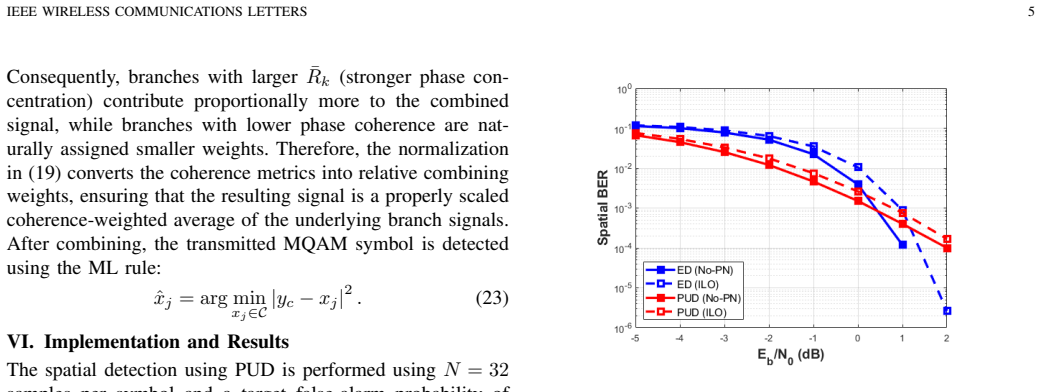
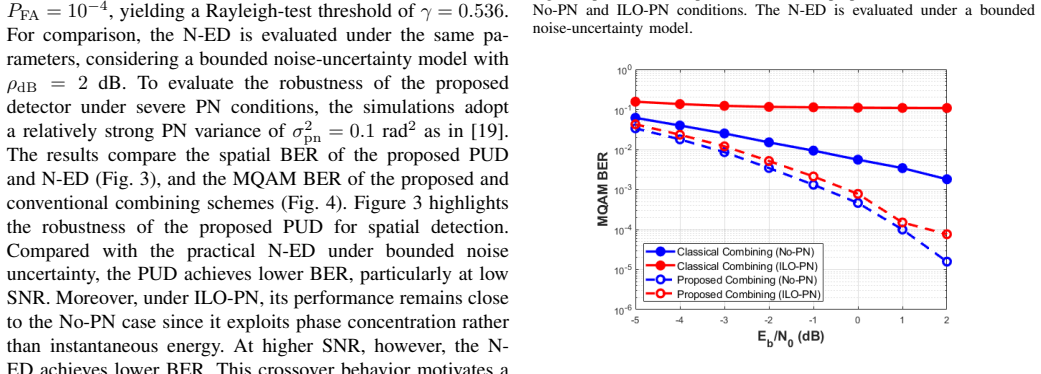
R. Zhanget al., “Precoding-aided spatial modulation,”IEEE Trans. Wireless Commun., 2012. Fig. 3. Spatial BER comparison between the proposed PUD and N-ED under No-PN and ILO-PN conditions. The N-ED is evaluated under a bounded noise-uncertainty model. Fig. 4. MQAM BER of the proposed PUD using the classical/ proposed combining schemes under No-PN and ILO-...
2012
-
[4]
Receive spatial modulation for massive MIMO,
A. Raafatet al., “Receive spatial modulation for massive MIMO,” in Proc. IEEE GLOBECOM, 2017
2017
-
[5]
Inverted BER trends for energy-detected GRSM- MQAM massive MIMO,
O. Daoudet al., “Inverted BER trends for energy-detected GRSM- MQAM massive MIMO,” inProc. WiMob, 2025
2025
-
[6]
GRSM-MQAM massive MIMO under phase noise for mmWave,
O. Daoudet al., “GRSM-MQAM massive MIMO under phase noise for mmWave,”URSI GASS, 2026
2026
-
[7]
Noise uncertainty in energy detection,
S. Bahamou and A. Nafkha, “Noise uncertainty in energy detection,” in Proc. EUSIPCO, 2013
2013
-
[8]
K. V . Mardia and P. E. Jupp,Directional Statistics. Wiley, 2009
2009
-
[9]
Uniformity tests in circular statistics,
A. M. R. Mora, “Uniformity tests in circular statistics,” M.S. thesis, Texas A&M Univ.-Corpus Christi, 2018
2018
-
[10]
Blind identification using directional statistics,
M.-J. Liet al., “Blind identification using directional statistics,” inProc. ICAIT, 2008
2008
-
[11]
Spectrum sensing via directional statistics,
C. Guoet al., “Spectrum sensing via directional statistics,”IEEE J. Sel. Areas Commun., 2013
2013
-
[12]
Spatially sparse precoding in mmWave MIMO,
O. El Ayachet al., “Spatially sparse precoding in mmWave MIMO,” IEEE Trans. Wireless Commun., 2014
2014
-
[13]
Massive MU-MIMO-OFDM uplink with 1-bit ADCs,
S. Jacobssonet al., “Massive MU-MIMO-OFDM uplink with 1-bit ADCs,” inProc. IEEE GC Wkshps, 2019
2019
-
[14]
Atapattuet al.,Energy Detection for Spectrum Sensing
S. Atapattuet al.,Energy Detection for Spectrum Sensing. Springer, 2014
2014
-
[15]
Toward direct RF sampling: Implica- tions for digital communications,
D. Siafarikas and J. L. V olakis, “Toward direct RF sampling: Implica- tions for digital communications,”IEEE Microw. Mag., vol. 21, no. 9, pp. 43–52, Sep. 2020
2020
-
[16]
Large-sample distribution of likelihood ratio,
S. S. Wilks, “Large-sample distribution of likelihood ratio,”Ann. Math. Stat., 1938
1938
-
[17]
When is the GLRT optimal?,
O. Zeitouniet al., “When is the GLRT optimal?,”IEEE Trans. Inf. Theory, 2002
2002
-
[18]
Statistical signal processing,
R. Nowak, “Statistical signal processing,” Univ. Wisconsin lecture notes, 2015
2015
-
[19]
Phase noise model selection for sub-THz communications,
B. Bicais, S. M. Dore, and J.-B. Dore, “Phase noise model selection for sub-THz communications,” inProc. IEEE Global Commun. Conf. (GLOBECOM), Waikoloa, HI, USA, Dec. 2019, pp. 1–6
2019
discussion (0)
Sign in with ORCID, Apple, or X to comment. Anyone can read and Pith papers without signing in.