The Barnard's Star Planetary System: Stability, Composition, and Evolution of Four Sub-Earth Exoplanets
Pith reviewed 2026-06-26 07:33 UTC · model grok-4.3
The pith
Barnard's Star's four sub-Earth planets likely have ferropericlase-rich mantles with less than half Earth's water capacity and radiogenic heating.
A machine-rendered reading of the paper's core claim, the machinery that carries it, and where it could break.
Core claim
Barnard's Star's abnormally high Mg/Si ratio and low Th/Mg ratio imply planetary mantles which are rich in (Mg,Fe)O ferropericlase, have less than half the water capacity as Earth, generate about half of the radiogenic heating as Earth, and are cool and unlikely to have outgassed secondary atmospheres. All four planets have masses between 0.19 and 0.84 Earth masses, are likely tidally locked, a 4:3 mean-motion resonance chain for the inner three cannot be ruled out, and extant primary atmospheres are highly unlikely on any of them.
What carries the argument
Inheritance of the star's refractory elemental abundance ratios to model planetary mantle mineralogy and thermal evolution.
If this is right
- The four planets have masses between 0.19 and 0.84 Earth masses and are likely tidally locked.
- A 4:3 mean-motion resonance chain among the inner three planets cannot be ruled out.
- Extant primary atmospheres are highly unlikely on any of the planets.
- The mantles are rich in ferropericlase, hold less than half Earth's water, and produce half the radiogenic heat, yielding cooler interiors.
Where Pith is reading between the lines
- The same stellar-abundance method can be applied to other nearby stars to forecast interior properties of their sub-Earth planets before direct measurements exist.
- Lower water storage and radiogenic heating together reduce the likelihood of sustained geological cycling or outgassing on these worlds compared with Earth.
- Cooler mantles may suppress magnetic-field generation, altering long-term atmospheric retention even if secondary atmospheres formed.
Load-bearing premise
The planets inherited bulk elemental abundance ratios similar to those measured in the star for refractory elements.
What would settle it
A measured planetary density or mantle mineralogy that deviates from the ferropericlase-rich, low-water prediction based on the star's Mg/Si and Th/Mg ratios.
Figures



read the original abstract
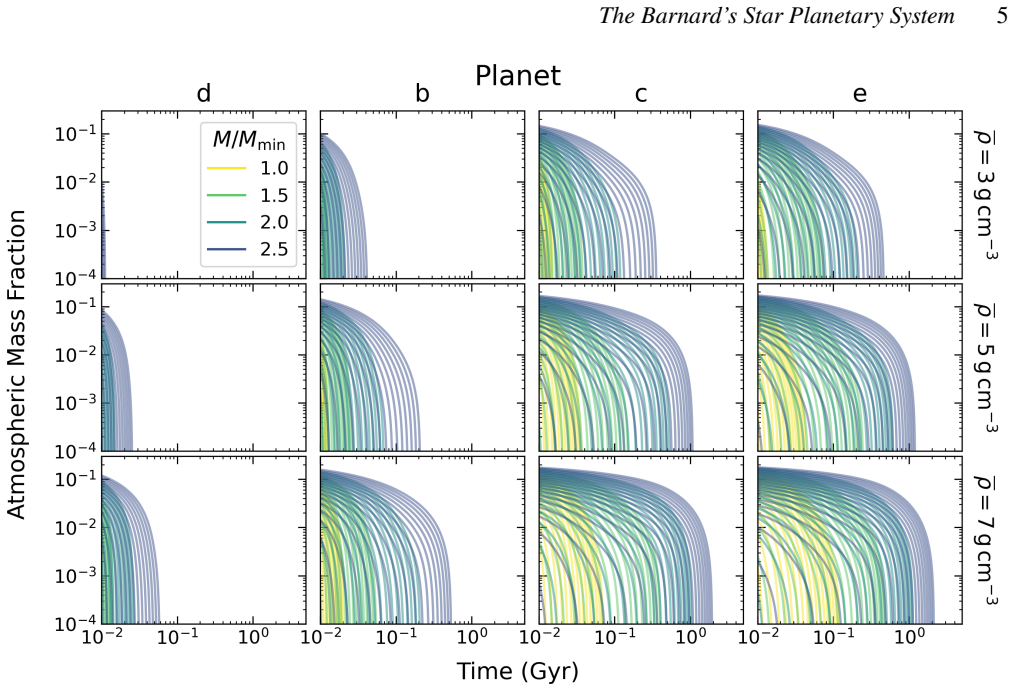
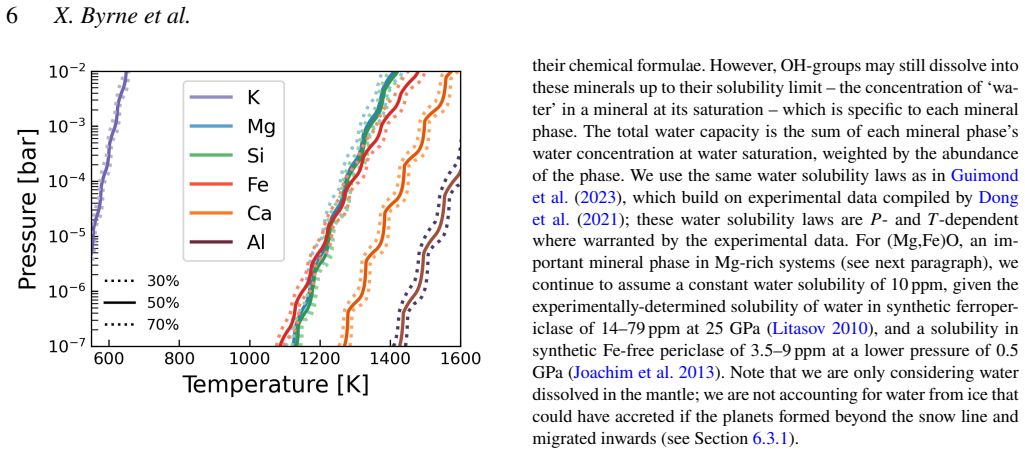
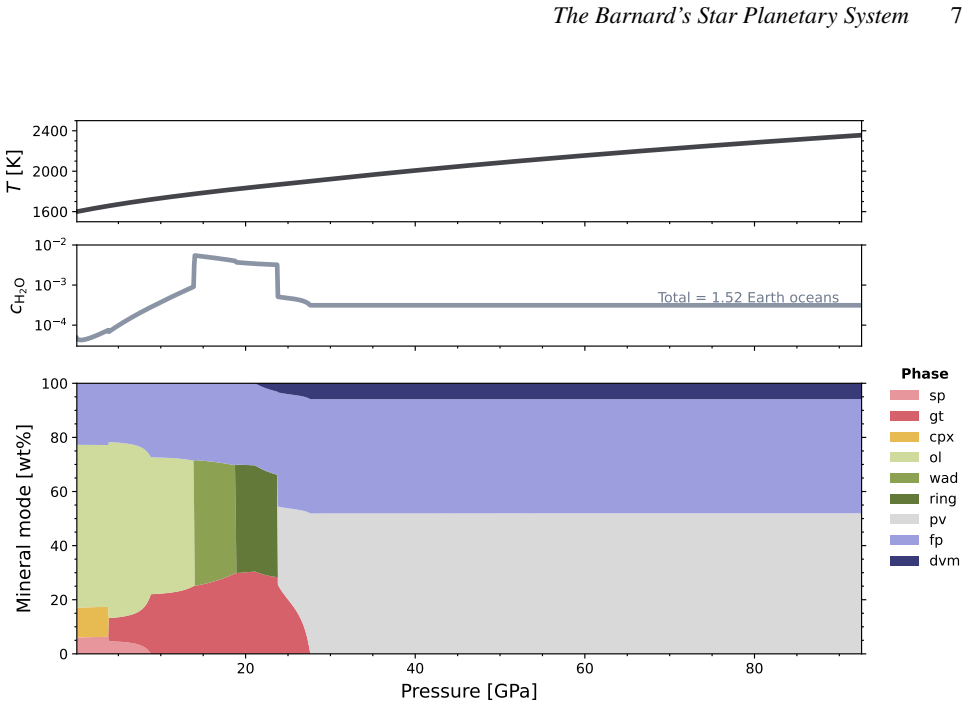
Barnard's Star is the nearest single star to the Sun (1.8 pc), and hosts four recently-discovered planets. The star also has well-characterized stellar abundances of important rock-forming elements, including Fe, Mg, and Si. For refractory elements like these, the planets have likely inherited similar bulk elemental abundance ratios to the star, facilitating modelling of their interior structures. We present here an analysis of the Barnard's Star planetary system on several fronts. We perform a detailed stability analysis of the system, ascertaining that all four planets likely have masses between 0.19 and 0.84 $M_{\oplus}$, and are likely tidally locked, whereas a 4:3 mean-motion resonance chain for the inner three planets cannot be ruled out. Using atmospheric evolution models, we show that the prospect of extant primary atmospheres is highly unlikely on any of the planets. Barnard's Star's abnormally high Mg/Si ratio and low Th/Mg ratio imply planetary mantles which (a) are rich in (Mg,Fe)O ferropericlase; (b) have less than half the water capacity as Earth; (c) generate about half of the radiogenic heating as Earth; and (d) are cool and unlikely to have outgassed secondary atmospheres. Our analysis of this system presents an accessible set of first steps for the study of other nearby exoplanetary systems, as well as sub-Earth planets which will be increasingly discovered over the coming years.
Editorial analysis
A structured set of objections, weighed in public.
Referee Report
Summary. The manuscript analyzes the four-planet system around Barnard's Star. A stability analysis concludes that the planets have masses in the range 0.19–0.84 M_⊕, are likely tidally locked, and that a 4:3 MMR chain among the inner three planets cannot be ruled out. Atmospheric evolution modeling indicates that extant primary atmospheres are unlikely. Stellar abundance ratios (elevated Mg/Si and depressed Th/Mg) are used to infer that the planetary mantles are ferropericlase-rich, possess less than half Earth's water storage capacity, produce roughly half Earth's radiogenic heat, and are cool enough that secondary atmospheres are unlikely to have outgassed.
Significance. If the bulk-composition inheritance assumption is valid, the work supplies a concrete template for linking high-precision stellar abundances to interior structure and thermal evolution of sub-Earth planets, a class that will become increasingly accessible. The stability and atmospheric-evolution components are presented as independent of the composition modeling and could stand alone.
major comments (2)
- [Abstract and mantle-composition section] Abstract and § on mantle modeling: the quantitative claims that the mantles have “less than half the water capacity as Earth,” generate “about half of the radiogenic heating,” and are “cool and unlikely to have outgassed secondary atmospheres” rest on the premise that the planets inherited the star’s Mg/Si and Th/Mg ratios to the precision needed for those statements. No formation-model reference, condensation-sequence calculation, or sensitivity test for sub-Earth masses is supplied to show that disk fractionation, pebble accretion, or giant impacts would preserve the ratios at the required level.
- [Stability analysis] Stability-analysis section: the reported mass bounds (0.19–0.84 M_⊕) and the statement that a 4:3 MMR chain “cannot be ruled out” are presented without the accompanying N-body integration details, initial-condition sampling, or resonance-width metrics that would allow an independent reader to reproduce the stability conclusion.
minor comments (2)
- [Abstract] The abstract states conclusions from stability and atmospheric models but does not indicate the numerical methods, data sources, or validation steps used; these details appear only later in the text.
- [Introduction / methods] Notation for the four planets is introduced without an explicit table of orbital elements or periods, making cross-references between the stability and composition sections harder to follow.
Simulated Author's Rebuttal
We thank the referee for their constructive and detailed review. We address each major comment below and agree that targeted revisions will improve clarity and reproducibility.
read point-by-point responses
-
Referee: [Abstract and mantle-composition section] Abstract and § on mantle modeling: the quantitative claims that the mantles have “less than half the water capacity as Earth,” generate “about half of the radiogenic heating,” and are “cool and unlikely to have outgassed secondary atmospheres” rest on the premise that the planets inherited the star’s Mg/Si and Th/Mg ratios to the precision needed for those statements. No formation-model reference, condensation-sequence calculation, or sensitivity test for sub-Earth masses is supplied to show that disk fractionation, pebble accretion, or giant impacts would preserve the ratios at the required level.
Authors: We agree that the quantitative statements on water capacity, radiogenic heating, and outgassing rest on the inheritance assumption for refractory ratios. While this assumption is standard for refractory elements, the manuscript does not supply the requested formation-model references or sensitivity tests for sub-Earth masses. In revision we will add a concise discussion paragraph citing relevant work on refractory-element preservation during pebble accretion and giant impacts, together with a brief note on the assumption's applicability to low-mass planets. The core results remain unchanged. revision: yes
-
Referee: [Stability analysis] Stability-analysis section: the reported mass bounds (0.19–0.84 M_⊕) and the statement that a 4:3 MMR chain “cannot be ruled out” are presented without the accompanying N-body integration details, initial-condition sampling, or resonance-width metrics that would allow an independent reader to reproduce the stability conclusion.
Authors: The stability conclusions derive from N-body integrations performed for the study, yet we acknowledge that the manuscript as submitted does not include sufficient methodological detail for independent reproduction. We will expand the stability section to describe the integrator, timestep, initial-condition sampling strategy, and resonance-width assessment metrics. These additions will support the existing mass bounds and MMR statement without altering them. revision: yes
Circularity Check
No significant circularity detected
full rationale
The paper states an explicit assumption that refractory elemental ratios (Mg/Si, Th/Mg) are inherited from the star to the planets, then uses independent stellar abundance data to infer mantle properties. No derivation step reduces a claimed prediction or result to a fitted parameter, self-citation chain, or definitional equivalence within the paper's own equations. Stability analysis, tidal locking conclusions, and atmospheric evolution modeling are presented as independent calculations. The central claims therefore remain self-contained against external benchmarks (stellar spectroscopy) rather than internally forced.
Axiom & Free-Parameter Ledger
free parameters (1)
- planet mass bounds
axioms (1)
- domain assumption planets inherited similar bulk elemental abundance ratios to the star for refractory elements
Reference graph
Works this paper leans on
-
[1]
Four Sub-Earth Planets Orbiting Barnard's Star from MAROON-X and ESPRESSO. , keywords =. doi:10.3847/2041-8213/adb8d5 , archivePrefix =. 2503.08095 , primaryClass =
-
[2]
Comprehensive High-resolution Chemical Spectroscopy of Barnard's Star with SPIRou. , keywords =. doi:10.3847/1538-4357/ad3063 , archivePrefix =. 2310.12125 , primaryClass =
-
[3]
Proceedings of the National Academy of Science , keywords =
Predicting the long-term stability of compact multiplanet systems. Proceedings of the National Academy of Science , keywords =. doi:10.1073/pnas.2001258117 , archivePrefix =. 2007.06521 , primaryClass =
-
[4]
Spectro-Thermometry of M dwarfs and their candidate planets: too hot, too cool, or just right?
Spectro-thermometry of M Dwarfs and Their Candidate Planets: Too Hot, Too Cool, or Just Right?. , keywords =. doi:10.1088/0004-637X/779/2/188 , archivePrefix =. 1311.0003 , primaryClass =
work page internal anchor Pith review Pith/arXiv arXiv doi:10.1088/0004-637x/779/2/188
-
[5]
Summary of the content and survey properties
Gaia Data Release 3. Summary of the content and survey properties. , keywords =. doi:10.1051/0004-6361/202243940 , archivePrefix =. 2208.00211 , primaryClass =
-
[6]
Geochemistry, Geophysics, Geosystems , volume=
Radioactive heat production of six geologically important nuclides , author=. Geochemistry, Geophysics, Geosystems , volume=. 2017 , publisher=
2017
-
[7]
Solar System Abundances and Condensation Temperatures of the Elements. , keywords =. doi:10.1086/375492 , adsurl =
-
[8]
, year = 2005, month = jun, volume =
The U/Th production ratio and the age of the Milky Way from meteorites and Galactic halo stars. , year = 2005, month = jun, volume =. doi:10.1038/nature03645 , adsurl =
-
[9]
Nature Geoscience , year = 2011, month = sep, volume =
Partial radiogenic heat model for Earth revealed by geoneutrino measurements. Nature Geoscience , year = 2011, month = sep, volume =. doi:10.1038/ngeo1205 , adsurl =
-
[10]
Earth and Planetary Science Letters , volume=
The K/U ratio of the silicate Earth: Insights into mantle composition, structure and thermal evolution , author=. Earth and Planetary Science Letters , volume=. 2009 , publisher=
2009
-
[11]
Borexino Results on Neutrinos from the Sun and Earth. Universe , keywords =. doi:10.3390/universe7070231 , archivePrefix =. 2105.13858 , primaryClass =
-
[12]
Comprehensive geoneutrino analysis with Borexino. , keywords =. doi:10.1103/PhysRevD.101.012009 , archivePrefix =. 1909.02257 , primaryClass =
-
[13]
Geo-neutrinos and the Radioactive Power of the Earth
Geoneutrinos and the radioactive power of the Earth. Reviews of Geophysics , keywords =. doi:10.1029/2012RG000400 , archivePrefix =. 1111.6099 , primaryClass =
work page internal anchor Pith review Pith/arXiv arXiv doi:10.1029/2012rg000400
-
[14]
Foley and David Bercovici and William Landuyt , keywords =
Bradford J. Foley and David Bercovici and William Landuyt , keywords =. The conditions for plate tectonics on super-Earths: Inferences from convection models with damage , journal =. 2012 , issn =. doi:https://doi.org/10.1016/j.epsl.2012.03.028 , url =
-
[15]
A radiogenic heating evolution model for cosmochemically Earth-like exoplanets. , keywords =. doi:10.1016/j.icarus.2014.08.031 , adsurl =
-
[16]
Evolution of the Earth , year = 2007, editor =
Plate Tectonics through Time. Evolution of the Earth , year = 2007, editor =. doi:10.1016/B978-044452748-6.00143-7 , adsurl =
-
[17]
Radiogenic Heating and Its Influence on Rocky Planet Dynamos and Habitability. , keywords =. doi:10.3847/2041-8213/abc251 , archivePrefix =. 2011.04791 , primaryClass =
-
[18]
Galactic Chemical Evolution and solar s-process abundances: dependence on the 13C-pocket structure
Galactic Chemical Evolution and Solar s-process Abundances: Dependence on the ^ 13 C-pocket Structure. , keywords =. doi:10.1088/0004-637X/787/1/10 , archivePrefix =. 1403.1764 , primaryClass =
work page internal anchor Pith review Pith/arXiv arXiv doi:10.1088/0004-637x/787/1/10
-
[19]
Spectroscopic determination of Eu abundances in Centauri AB
Europium as a lodestar: diagnosis of radiogenic heat production in terrestrial exoplanets. Spectroscopic determination of Eu abundances in Centauri AB. , keywords =. doi:10.1051/0004-6361/202038386 , adsurl =
-
[20]
Evolutionary Phenomena in Galaxies , year = 1989, editor =
The G-Dwarf Problem and Radio-Active Cosmochronology. Evolutionary Phenomena in Galaxies , year = 1989, editor =
1989
-
[21]
, year = 2008, month = sep, volume =
Neutron-capture elements in the early galaxy. , year = 2008, month = sep, volume =. doi:10.1146/annurev.astro.46.060407.145207 , adsurl =
-
[22]
Is Mercury a volatile-rich planet?. , keywords =. doi:10.1029/2012GL051711 , adsurl =
-
[23]
Handbook of Isotopes in the Cosmos
-
[24]
s-Process Nucleosynthesis in Advanced Burning Phases of Massive Stars
s-Process Nucleosynthesis in Advanced Burning Phases of Massive Stars. , keywords =. doi:10.1086/509753 , archivePrefix =. astro-ph/0609788 , primaryClass =
work page internal anchor Pith review Pith/arXiv arXiv doi:10.1086/509753
-
[25]
Chemie der Erde / Geochemistry , year = 2021, month = sep, volume =
Geochemistry and cosmochemistry of potassium stable isotopes. Chemie der Erde / Geochemistry , year = 2021, month = sep, volume =. doi:10.1016/j.chemer.2021.125786 , adsurl =
-
[26]
Constraints on the substellar companions in wide orbits around the Barnard's Star from CanariCam mid-infrared imaging. , keywords =. doi:10.1093/mnras/stv1350 , archivePrefix =. 1507.01254 , primaryClass =
work page internal anchor Pith review Pith/arXiv arXiv doi:10.1093/mnras/stv1350
-
[27]
The chemical make-up of the Sun: A 2020 vision
The chemical make-up of the Sun: A 2020 vision. , keywords =. doi:10.1051/0004-6361/202140445 , archivePrefix =. 2105.01661 , primaryClass =
work page internal anchor Pith review Pith/arXiv arXiv doi:10.1051/0004-6361/202140445 2020
-
[28]
Condon and Noah McLean and Stephen R
Daniel J. Condon and Noah McLean and Stephen R. Noble and Samuel A. Bowring , abstract =. Isotopic composition (238U/235U) of some commonly used uranium reference materials , journal =. 2010 , issn =. doi:https://doi.org/10.1016/j.gca.2010.09.019 , url =
-
[29]
Measurement of stellar age from uranium decay
Measurement of stellar age from uranium decay. , keywords =. doi:10.1038/35055507 , archivePrefix =. astro-ph/0104357 , primaryClass =
work page internal anchor Pith review Pith/arXiv arXiv doi:10.1038/35055507
-
[30]
The Chemical Composition and Age of the Metal-Poor Halo Star BD +17^\circ 3248
The Chemical Composition and Age of the Metal-poor Halo Star BD +17 3248. , keywords =. doi:10.1086/340347 , archivePrefix =. astro-ph/0202429 , primaryClass =
work page internal anchor Pith review Pith/arXiv arXiv doi:10.1086/340347
-
[31]
Discovery of HE 1523-0901, a Strongly r-Process Enhanced Metal-Poor Star with Detected Uranium
Discovery of HE 1523-0901, a Strongly r-Process-enhanced Metal-poor Star with Detected Uranium. , keywords =. doi:10.1086/518122 , archivePrefix =. astro-ph/0703414 , primaryClass =
work page internal anchor Pith review Pith/arXiv arXiv doi:10.1086/518122
-
[32]
Lunar and Planetary Science Conference , year = 1993, series =
Th and U Abundances in Chondritic Meteorites. Lunar and Planetary Science Conference , year = 1993, series =
1993
-
[33]
Abundances of Uranium and Thorium Elements in Earth Estimated by Geoneutrino Spectroscopy. , keywords =. doi:10.1029/2022GL099566 , archivePrefix =. 2205.14934 , primaryClass =
-
[34]
Abundances of the elements in the solar system
Abundances of the Elements in the Solar System. Landolt B. doi:10.1007/978-3-540-88055-4_34 , archivePrefix =. 0901.1149 , primaryClass =
work page internal anchor Pith review Pith/arXiv arXiv doi:10.1007/978-3-540-88055-4_34
-
[35]
Earth and Planetary Science Letters , year = 2005, month = feb, volume =
Major and trace element composition of the depleted MORB mantle (DMM). Earth and Planetary Science Letters , year = 2005, month = feb, volume =. doi:10.1016/j.epsl.2004.12.005 , adsurl =
-
[36]
The composition of the Earth. Chemical Geology , year = 1995, month = jan, volume =. doi:10.1016/0009-2541(94)00140-4 , adsurl =
-
[37]
Journal of Physical and Chemical Reference Data , volume=
Isotopic compositions of the elements 1997 , author=. Journal of Physical and Chemical Reference Data , volume=. 1998 , publisher=
1997
-
[38]
Chinese Physics C , keywords =
Hunting potassium geoneutrinos with liquid scintillator Cherenkov neutrino detectors. Chinese Physics C , keywords =. doi:10.1088/1674-1137/44/3/033001 , adsurl =
-
[39]
Physics of the Earth and Planetary Interiors , keywords =
Thermal evolution of the core with a high thermal conductivity. Physics of the Earth and Planetary Interiors , keywords =. doi:10.1016/j.pepi.2015.02.002 , adsurl =
-
[40]
Journal of Geophysical Research (Planets) , keywords =
Super-Earth Internal Structures and Initial Thermal States. Journal of Geophysical Research (Planets) , keywords =. doi:10.1029/2019JE006124 , adsurl =
-
[41]
Galactic Chemical Evolution of Radioactive Isotopes. , keywords =. doi:10.3847/1538-4357/ab21d1 , archivePrefix =. 1905.07828 , primaryClass =
-
[42]
On the Distribution and Variation of Radioactive Heat Producing Elements Within Meteorites, the Earth, and Planets. , keywords =. doi:10.1007/s11214-020-00656-z , adsurl =
-
[43]
The Solar Neighborhood. I. Standard Spectral Types (K5-M8) for Northern Dwarfs Within Eight Parsecs. , keywords =. doi:10.1086/117167 , adsurl =
-
[44]
Theory of Low-Mass Stars and Substellar Objects
Theory of Low-Mass Stars and Substellar Objects. , keywords =. doi:10.1146/annurev.astro.38.1.337 , archivePrefix =. astro-ph/0006383 , primaryClass =
work page internal anchor Pith review Pith/arXiv arXiv doi:10.1146/annurev.astro.38.1.337
-
[45]
The Occurrence of Potentially Habitable Planets Orbiting M Dwarfs Estimated from the Full Kepler Dataset and an Empirical Measurement of the Detection Sensitivity. , keywords =. doi:10.1088/0004-637X/807/1/45 , archivePrefix =. 1501.01623 , primaryClass =
work page internal anchor Pith review Pith/arXiv arXiv doi:10.1088/0004-637x/807/1/45
-
[46]
A Revised Estimate of the Occurrence Rate of Terrestrial Planets in the Habitable Zones around Kepler M-dwarfs. , keywords =. doi:10.1088/2041-8205/767/1/L8 , archivePrefix =. 1303.2649 , primaryClass =
work page internal anchor Pith review Pith/arXiv arXiv doi:10.1088/2041-8205/767/1/l8 2041
-
[47]
, year = 1963, month = sep, volume =
Astrometric study of Barnard's star from plates taken with the 24-inch Sproul refractor. , year = 1963, month = sep, volume =. doi:10.1086/109001 , adsurl =
-
[48]
, year = 1973, month = oct, volume =
An unsuccessful search for a planetary companion of Barnard's star BD +4 3561. , year = 1973, month = oct, volume =. doi:10.1086/111480 , adsurl =
-
[49]
A Study of the Astrometric Motion of Barnard's Star. , keywords =. doi:10.1007/BF00989158 , adsurl =
-
[50]
A candidate super-Earth planet orbiting near the snow line of Barnard's star
A candidate super-Earth planet orbiting near the snow line of Barnard's star. , keywords =. doi:10.1038/s41586-018-0677-y , archivePrefix =. 1811.05955 , primaryClass =
work page internal anchor Pith review Pith/arXiv arXiv doi:10.1038/s41586-018-0677-y
-
[51]
Stellar Activity Manifesting at a One-year Alias Explains Barnard b as a False Positive. , keywords =. doi:10.3847/1538-3881/ac0057 , adsurl =
-
[52]
A sub-Earth-mass planet orbiting Barnard's star. , keywords =. doi:10.1051/0004-6361/202451311 , archivePrefix =. 2410.00569 , primaryClass =
-
[53]
Habitable Zones Around Main-Sequence Stars: New Estimates
Habitable Zones around Main-sequence Stars: New Estimates. , keywords =. doi:10.1088/0004-637X/765/2/131 , archivePrefix =. 1301.6674 , primaryClass =
work page internal anchor Pith review Pith/arXiv arXiv doi:10.1088/0004-637x/765/2/131
-
[54]
Habitable Zones Around Main-Sequence Stars: Dependence on Planetary Mass
Habitable Zones around Main-sequence Stars: Dependence on Planetary Mass. , keywords =. doi:10.1088/2041-8205/787/2/L29 , archivePrefix =. 1404.5292 , primaryClass =
work page internal anchor Pith review Pith/arXiv arXiv doi:10.1088/2041-8205/787/2/l29 2041
-
[55]
The Origin of RNA Precursors on Exoplanets
The origin of RNA precursors on exoplanets. Science Advances , keywords =. doi:10.1126/sciadv.aar3302 , archivePrefix =. 1808.02718 , primaryClass =
work page internal anchor Pith review Pith/arXiv arXiv doi:10.1126/sciadv.aar3302
-
[56]
A planetary system around the millisecond pulsar PSR1257 + 12. , keywords =. doi:10.1038/355145a0 , adsurl =
-
[57]
, year = 1995, month = nov, volume =
A Jupiter-mass companion to a solar-type star. , year = 1995, month = nov, volume =. doi:10.1038/378355a0 , adsurl =
-
[58]
Unveiling the planet population at birth. , keywords =. doi:10.1093/mnras/stab529 , archivePrefix =. 2007.11006 , primaryClass =
-
[59]
Testing exoplanet evaporation with multitransiting systems. , keywords =. doi:10.1093/mnras/stz3435 , archivePrefix =. 1912.01609 , primaryClass =
-
[60]
Elemental ratios in stars vs planets
Elemental ratios in stars vs planets. , keywords =. doi:10.1051/0004-6361/201525963 , archivePrefix =. 1507.01343 , primaryClass =
work page internal anchor Pith review Pith/arXiv arXiv doi:10.1051/0004-6361/201525963
-
[61]
A Stellar Magnesium to Silicon ratio in the atmosphere of an exoplanet. arXiv e-prints , keywords =. doi:10.48550/arXiv.2512.10904 , archivePrefix =. 2512.10904 , primaryClass =
-
[62]
Earth and Planetary Science Letters , year = 2010, month = may, volume =
The chemical composition of the Earth: Enstatite chondrite models. Earth and Planetary Science Letters , year = 2010, month = may, volume =. doi:10.1016/j.epsl.2010.02.033 , adsurl =
-
[63]
Journal of Geophysical Research (Planets) , keywords =
Constraining the composition and thermal state of Mars from inversion of geophysical data. Journal of Geophysical Research (Planets) , keywords =. doi:10.1029/2007JE002996 , adsurl =
-
[64]
Scaling the Earth: A Sensitivity Analysis of Terrestrial Exoplanetary Interior Models
Scaling the Earth: A Sensitivity Analysis of Terrestrial Exoplanetary Interior Models. , keywords =. doi:10.3847/0004-637X/819/1/32 , archivePrefix =. 1510.07582 , primaryClass =
work page internal anchor Pith review Pith/arXiv arXiv doi:10.3847/0004-637x/819/1/32
-
[65]
The Origin of Mercury. , keywords =. doi:10.1007/s11214-007-9284-1 , adsurl =
-
[66]
Earth and Planetary Science Letters , year = 1972, month = jul, volume =
Metal/silicate fractionation in the Solar System. Earth and Planetary Science Letters , year = 1972, month = jul, volume =. doi:10.1016/0012-821X(72)90174-4 , adsurl =
-
[67]
SPIRou: NIR velocimetry and spectropolarimetry at the CFHT. , keywords =. doi:10.1093/mnras/staa2569 , archivePrefix =. 2008.08949 , primaryClass =
-
[68]
, year = 2020, month = dec, volume =
The effect of galactic chemical evolution on terrestrial exoplanet composition and tectonics. , year = 2020, month = dec, volume =. doi:10.1016/j.icarus.2020.114025 , adsurl =
-
[69]
What makes a planet habitable?. , keywords =. doi:10.1007/s00159-009-0019-z , adsurl =
-
[70]
The chemical composition of $\alpha$ Cen AB revisited
The chemical composition of Centauri AB revisited. , keywords =. doi:10.1051/0004-6361/201833125 , archivePrefix =. 1805.00929 , primaryClass =
work page internal anchor Pith review Pith/arXiv arXiv doi:10.1051/0004-6361/201833125
-
[71]
A Model Earth-sized Planet in the Habitable Zone of Centauri A/B. , keywords =. doi:10.3847/1538-4357/ac4e8c , archivePrefix =. 2110.12565 , primaryClass =
-
[72]
Bayesian analysis of interiors of HD 219134b, Kepler-10b, Kepler-93b, CoRoT-7b, 55 Cnc e, and HD 97658b using stellar abundance proxies. , keywords =. doi:10.1051/0004-6361/201628749 , archivePrefix =. 1609.03909 , primaryClass =
work page internal anchor Pith review Pith/arXiv arXiv doi:10.1051/0004-6361/201628749
-
[73]
Seven temperate terrestrial planets around the nearby ultracool dwarf star TRAPPIST-1
Seven temperate terrestrial planets around the nearby ultracool dwarf star TRAPPIST-1. , keywords =. doi:10.1038/nature21360 , archivePrefix =. 1703.01424 , primaryClass =
work page internal anchor Pith review Pith/arXiv arXiv doi:10.1038/nature21360
-
[74]
The nature of the TRAPPIST-1 exoplanets
The nature of the TRAPPIST-1 exoplanets. , keywords =. doi:10.1051/0004-6361/201732233 , archivePrefix =. 1802.01377 , primaryClass =
work page internal anchor Pith review Pith/arXiv arXiv doi:10.1051/0004-6361/201732233
-
[75]
An ancient extrasolar system with five sub-Earth-size planets
An Ancient Extrasolar System with Five Sub-Earth-size Planets. , keywords =. doi:10.1088/0004-637X/799/2/170 , archivePrefix =. 1501.06227 , primaryClass =
work page internal anchor Pith review Pith/arXiv arXiv doi:10.1088/0004-637x/799/2/170
-
[76]
Early 2017 observations of TRAPPIST-1 with $\textit{Spitzer}$
Early 2017 observations of TRAPPIST-1 with Spitzer. , keywords =. doi:10.1093/mnras/sty051 , archivePrefix =. 1801.02554 , primaryClass =
work page internal anchor Pith review Pith/arXiv arXiv doi:10.1093/mnras/sty051 2017
-
[77]
The Planet-Metallicity Correlation. , keywords =. doi:10.1086/428383 , adsurl =
-
[78]
Spectroscopic stellar parameters for 582 FGK stars in the HARPS volume-limited sample. Revising the metallicity-planet correlation. , keywords =. doi:10.1051/0004-6361/201117699 , archivePrefix =. 1108.5279 , primaryClass =
work page internal anchor Pith review Pith/arXiv arXiv doi:10.1051/0004-6361/201117699
-
[79]
, year = 2012, month = jun, volume =
An abundance of small exoplanets around stars with a wide range of metallicities. , year = 2012, month = jun, volume =. doi:10.1038/nature11121 , adsurl =
-
[80]
Orbital Architectures of Planet-hosting Binaries. I. Forming Five Small Planets in the Truncated Disk of Kepler-444A. , keywords =. doi:10.3847/0004-637X/817/1/80 , archivePrefix =. 1512.03428 , primaryClass =
work page internal anchor Pith review Pith/arXiv arXiv doi:10.3847/0004-637x/817/1/80
discussion (0)
Sign in with ORCID, Apple, or X to comment. Anyone can read and Pith papers without signing in.