Dark matter from the quadratic spinor Lagrangian I: Geometric mass for a gravitationally produced spin-1/2 fermion
Pith reviewed 2026-06-26 07:27 UTC · model grok-4.3
The pith
A cosmological spinor condensate sources vectorial torsion that supplies a pure Dirac mass locked to the Hubble rate at production.
A machine-rendered reading of the paper's core claim, the machinery that carries it, and where it could break.
Core claim
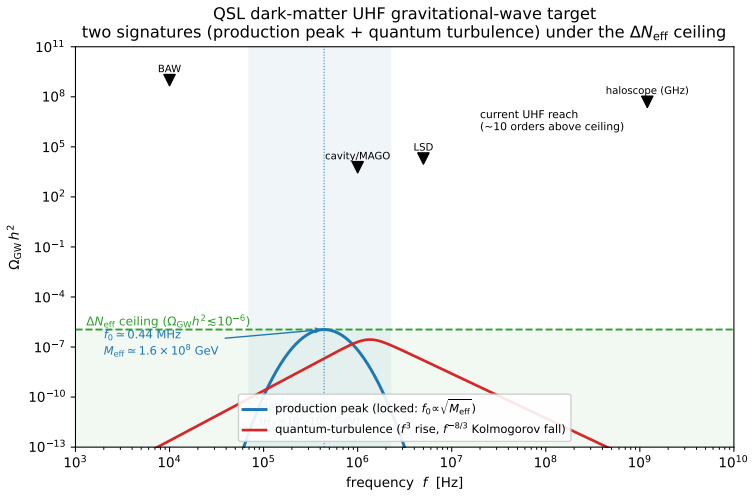
An explicit Clifford reduction shows that vectorial trace torsion K proportional to χ̇/χ from the cosmological spinor condensate yields a pure Dirac mass M_eff = (1/√6)|χ̇/χ| with no pseudoscalar or cross terms; this mass is locked to the production Hubble rate as M_eff ≃ (c_χ/√6) H_*, so the relic abundance scales as Ωh² ∝ H_*^{5/2} and supplies the mass required by the gravitational-wave freeze-in mechanism.
What carries the argument
The vectorial trace torsion K ∝ χ̇/χ sourced by the spinor condensate, which the quadratic spinor Lagrangian converts via Clifford reduction into the mass term for the composite spin-1/2 Dirac fermion.
If this is right
- The relic abundance is determined by the single scale H_* without additional mass parameters.
- The mechanism supplies the mass the gravitational-wave freeze-in process must postulate.
- The composite spin-1/2 Dirac fermion becomes the unique propagating dark-matter candidate once spin-3/2 modes are shown not to propagate.
- Dark-matter phenomenology is tied directly to the spectrum of the stochastic gravitational-wave background.
Where Pith is reading between the lines
- The same torsion source could be examined in other early-universe models that already contain scalar condensates to check whether the mass relation persists.
- If the predicted density scaling holds, it would link dark-matter observations to specific features in the gravitational-wave background spectrum.
- The absence of free mass parameters may constrain the allowed range of production epochs compatible with observed dark-matter density.
Load-bearing premise
A cosmological spinor condensate sources a vectorial trace torsion that supplies the mass through the quadratic spinor Lagrangian while the spinor one-form remains purely spin-1/2.
What would settle it
An explicit calculation or lattice simulation of the quadratic spinor Lagrangian with a time-varying condensate that fails to produce a pure Dirac mass term proportional to χ̇/χ, or an observation that the dark-matter density does not follow the predicted H_*^{5/2} scaling.
Figures

read the original abstract
The gravitational-wave induced freeze-in of Maleknejad and Kopp (2026) produces dark fermions from a stochastic gravitational-wave background, but requires them to acquire mass by separate means. We develop the Quadratic Spinor Lagrangian (QSL) formulation of general relativity, extended to Einstein--Cartan, as a framework that supplies this mass geometrically. The spinor 1-form built from a single Dirac field is purely spin-1/2 -- its gamma-traceless (spin-3/2) part vanishes identically -- so the propagating excitation is a Dirac fermion, the same content as the produced Weyl fermion. A cosmological spinor condensate sources a vectorial trace torsion $K\propto\dot\chi/\chi$, and an explicit Clifford reduction shows that this torsion gives the fermion a pure Dirac mass $M_{eff}=(1/\sqrt6)\,|\dot\chi/\chi|$, with no pseudoscalar or cross terms. The mass is not a free parameter but is locked to the Hubble rate at production, $M_{eff}\simeq(c_\chi/\sqrt6)H_*$, making the relic abundance a function of essentially the single scale $H_*$ ($\Omega h^2\propto H_*^{5/2}$) and supplying the mass the parent mechanism must postulate. Whether promoting the spinor 1-form to an independent field yields a propagating spin-3/2 candidate is a distinct dynamical question; Paper II shows that it does not -- the QSL channels all propagation into the gravitational sector -- so the composite spin-1/2 Dirac fermion is the unique QSL dark-matter candidate. We discuss the resulting dark-matter phenomenology and its link to asymptotically free scalar-field cosmology.
Editorial analysis
A structured set of objections, weighed in public.
Referee Report
Summary. The manuscript develops the Quadratic Spinor Lagrangian (QSL) formulation of general relativity extended to Einstein-Cartan gravity as a framework to supply a geometric mass to dark fermions produced by gravitational-wave induced freeze-in. It asserts that the spinor 1-form constructed from a single Dirac field is purely spin-1/2 (gamma-traceless part vanishes identically), that a cosmological spinor condensate sources vectorial trace torsion K ∝ χ̇/χ, and that an explicit Clifford reduction yields a pure Dirac mass M_eff = (1/√6)|χ̇/χ| with no pseudoscalar or cross terms. The effective mass is tied to the production Hubble rate via M_eff ≃ (c_χ/√6) H_*, so that the relic abundance depends essentially on the single scale H_* (Ω h² ∝ H_*^{5/2}). The work claims this composite spin-1/2 Dirac fermion is the unique QSL dark-matter candidate and links the scenario to asymptotically free scalar-field cosmology.
Significance. If the Clifford reduction and the pure spin-1/2 property are rigorously established, the result supplies the missing mass mechanism for the GW freeze-in scenario without introducing new free parameters beyond the scaling c_χ, while connecting dark-matter production to scalar-field cosmology and reducing the parameter count in the relic-density calculation.
major comments (3)
- Abstract: the central claim that an explicit Clifford reduction produces a pure Dirac mass M_eff=(1/√6)|χ̇/χ| with no pseudoscalar or cross terms rests on the unshown reduction steps; without the detailed algebra (including the explicit form of the torsion coupling and the resulting bilinear), the absence of extra terms cannot be verified and remains asserted rather than demonstrated.
- Abstract and introduction: the premise that the spinor 1-form built from a single Dirac field has vanishing gamma-traceless (spin-3/2) part identically is load-bearing for both the pure spin-1/2 propagation and the uniqueness claim; if this component is nonzero, additional degrees of freedom appear and the mass term acquires further structure, undermining the statement that the composite Dirac fermion is the unique QSL candidate.
- Abstract: the scaling factor c_χ enters M_eff ≃ (c_χ/√6) H_* and controls the relic abundance; because c_χ is listed as a free parameter and is tied to the condensate amplitude, the claim that the abundance is a function of essentially the single scale H_* requires explicit justification of how c_χ is fixed or constrained by the theory rather than chosen to match observations.
Simulated Author's Rebuttal
We thank the referee for the careful and constructive report. We address each major comment below and indicate the revisions we will make.
read point-by-point responses
-
Referee: Abstract: the central claim that an explicit Clifford reduction produces a pure Dirac mass M_eff=(1/√6)|χ̇/χ| with no pseudoscalar or cross terms rests on the unshown reduction steps; without the detailed algebra (including the explicit form of the torsion coupling and the resulting bilinear), the absence of extra terms cannot be verified and remains asserted rather than demonstrated.
Authors: The explicit Clifford reduction, including the torsion coupling K ∝ χ̇/χ and the resulting bilinear, is performed in Section 3. We will revise the abstract to cite Section 3 directly and expand the presentation in Section 3 with the intermediate algebra steps to make the absence of pseudoscalar and cross terms fully verifiable. revision: yes
-
Referee: Abstract and introduction: the premise that the spinor 1-form built from a single Dirac field has vanishing gamma-traceless (spin-3/2) part identically is load-bearing for both the pure spin-1/2 propagation and the uniqueness claim; if this component is nonzero, additional degrees of freedom appear and the mass term acquires further structure, undermining the statement that the composite Dirac fermion is the unique QSL candidate.
Authors: The vanishing of the gamma-traceless component is shown by direct construction in Section 2 using the Dirac representation. We will add an explicit short calculation in the revised text (or a brief appendix) confirming that the spin-3/2 projector applied to the spinor 1-form yields zero identically. Paper II treats the separate dynamical question of an independent spinor 1-form field. revision: partial
-
Referee: Abstract: the scaling factor c_χ enters M_eff ≃ (c_χ/√6) H_* and controls the relic abundance; because c_χ is listed as a free parameter and is tied to the condensate amplitude, the claim that the abundance is a function of essentially the single scale H_* requires explicit justification of how c_χ is fixed or constrained by the theory rather than chosen to match observations.
Authors: We agree that the dependence on c_χ must be clarified. In the revised manuscript we will add a paragraph in Section 4 explaining that c_χ is fixed by the amplitude of the cosmological spinor condensate, which is itself determined by the asymptotically free scalar-field dynamics at the production epoch; this reduces the effective freedom to the single scale H_* once the scalar cosmology is specified. revision: yes
Circularity Check
No significant circularity; derivation self-contained
full rationale
The paper states the premise that the spinor 1-form from a single Dirac field has vanishing gamma-traceless part as an explicit assumption, then performs an explicit Clifford reduction to obtain the mass term M_eff=(1/√6)|χ̇/χ| from the sourced torsion K∝χ̇/χ. This is a consequence of the QSL plus the assumption rather than a reduction of the output to the input by definition. The approximate scaling with H_* via c_χ is presented as a link to the production mechanism, not a fitted parameter renamed as a prediction. The uniqueness statement references Paper II but is not required for the mass derivation itself, which remains independent of self-citation chains or external fits.
Axiom & Free-Parameter Ledger
free parameters (1)
- c_χ
axioms (2)
- domain assumption The quadratic spinor Lagrangian extended to Einstein-Cartan gravity is a valid formulation that channels propagation into the gravitational sector.
- ad hoc to paper A cosmological spinor condensate exists and sources vectorial trace torsion proportional to χ̇/χ.
invented entities (1)
-
Spinor condensate χ
no independent evidence
Reference graph
Works this paper leans on
-
[1]
Maleknejad A and Kopp J 2026Phys. Rev. Lett.136131501
-
[2]
Nester J M and Tung R-S 1995Gen. Relativ. Gravit.27115
-
[3]
Quantum Grav.12L51
Tung R-S and Jacobson T 1995Class. Quantum Grav.12L51
-
[4]
Quantum Grav.11983
Nester J M, Tung R-S and Zhytnikov V V 1994Class. Quantum Grav.11983
-
[5]
Tung R-S and Nester J M 2001 Gravitational energy-momentum in the tetrad and quadratic spinor representations of general relativityGravitation and Cosmology: From the Hubble Radius to the Planck Scaleed R L Amorosoet al(Dordrecht: Kluwer)
2001
-
[6]
Lett.A264341
Tung R-S 2000Phys. Lett.A264341
-
[7]
Rev.D60021501
Tung R-S and Nester J M 1999Phys. Rev.D60021501
-
[8]
Quantum Grav.29155014
Huang K, Low H-B and Tung R-S 2012Class. Quantum Grav.29155014
-
[9]
Huang K, Low H-B and Tung R-S 2012Int. J. Mod. Phys.A271250154
-
[10]
Quantum Grav.82093
Dimakis A and M¨ uller-Hoissen F 1991Class. Quantum Grav.82093
-
[11]
Hehl F W, von der Heyde P, Kerlick G D and Nester J M 1976Rev. Mod. Phys.48393
-
[12]
Rev.6061
Rarita W and Schwinger J 1941Phys. Rev.6061
-
[13]
High Energy Phys.01023
Maleknejad A and Kopp J 2025J. High Energy Phys.01023
-
[14]
Tung R-S 2026 Spacetime torsion fixes the mass and spin of gravitationally produced dark matter
2026
-
[15]
Tung R-S 2026 Dark matter from the quadratic spinor Lagrangian II: A spin-3/2 no-go and the uniqueness of the spin-1/2 candidate
2026
-
[16]
Rev.1882218
Velo G and Zwanziger D 1969Phys. Rev.1882218
-
[17]
Deser S and Zumino B 1976Phys. Lett. B62335
-
[18]
Blagojevi´ c M and Nikoli´ c I A 1983Phys. Rev. D282455
-
[19]
Nikoli´ c I A 1984Phys. Rev. D302508
-
[20]
Hecht R D, Nester J M and Zhytnikov V V 1996Phys. Lett. A22237
-
[21]
Yo H-J and Nester J M 1999Int. J. Mod. Phys. D8459
-
[22]
Yo H-J and Nester J M 2002Int. J. Mod. Phys. D11747
-
[23]
Kolb E W and Long A J 2024Rev. Mod. Phys.96045005 (arXiv:2312.09042)
-
[24]
Kaneta K, Ke W, Mambrini Y, Olive K A and Verner S 2023Phys. Rev. D108115027 (arXiv:2309.15146)
-
[25]
Cheung C, Elor G and Hall L 2011Phys. Rev. D84115021 (arXiv:1103.4394)
-
[26]
Kallosh R, Kofman L, Linde A D and Van Proeyen A 2000Phys. Rev. D61103503 (hep-th/9907124)
-
[27]
Pagels H and Primack J R 1982Phys. Rev. Lett.48223 26
-
[28]
Shaposhnikov M, Shkerin A, Timiryasov I and Zell S 2021Phys. Rev. Lett.126161301; 127169901(E)
-
[29]
de la Cruz-Dombriz ´A, Maldonado Torralba F J and Mota D F 2022Phys. Lett. B831 137488 (arXiv:2112.03957)
-
[30]
Beltr´ an Jim´ enez J and Maldonado Torralba F J 2020Eur. Phys. J. C80611 (arXiv:1910.07506)
arXiv 1910
-
[31]
Kranas D, Tsagas C G, Barrow J D and Iosifidis D 2019Eur. Phys. J. C79341 (arXiv:1809.10064)
-
[32]
Pereira S H, Vicente A M, Jesus J F and Holanda R F L 2022Eur. Phys. J. C82356 (arXiv:2202.01807)
-
[33]
Kolb E W, Long A J and McDonough E 2021Phys. Rev. D104075015 (arXiv:2102.10113)
-
[34]
Kosowsky A, Mack A and Kahniashvili T 2002Phys. Rev. D66024030 (astro-ph/0111483)
-
[35]
Caprini C and Durrer R 2006Phys. Rev. D74063521 (astro-ph/0603476)
-
[36]
Phys.492170545 (arXiv:2601.20820)
Bonanno A M and Glaviano E M 2026Ann. Phys.492170545 (arXiv:2601.20820)
-
[37]
Daum J-E and Reuter M 2013Ann. Phys.334351 (arXiv:1301.5135)
-
[38]
Daas J, Oosters W, Saueressig F and Wang J 2020Phys. Lett. B809135775 (arXiv:2005.12356)
arXiv 2005
-
[39]
Silva A 2025Phys. Lett. B860139154 (arXiv:2406.10170) 27
discussion (0)
Sign in with ORCID, Apple, or X to comment. Anyone can read and Pith papers without signing in.