A dipolar Bose-Bose mixture of Dysprosium isotopes with controllable interspecies interactions
Pith reviewed 2026-06-26 05:56 UTC · model grok-4.3
The pith
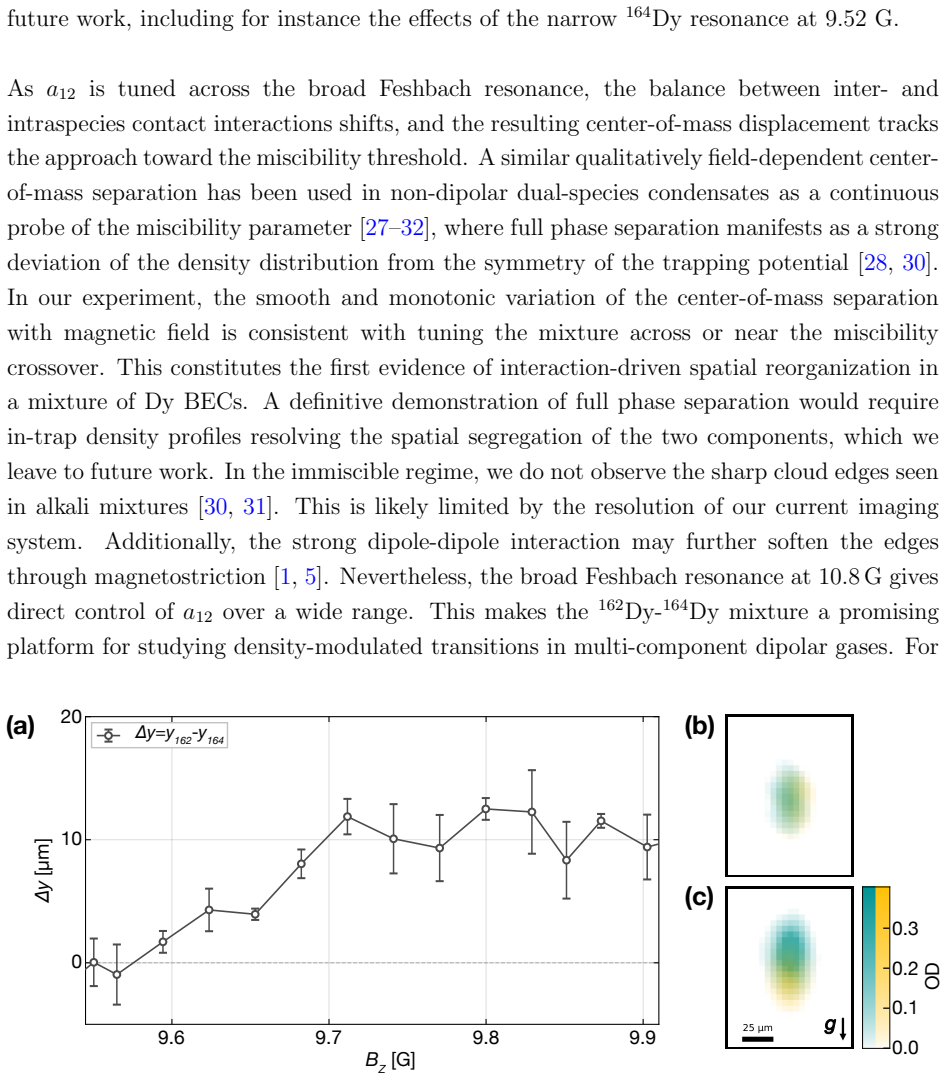
A mixture of two dysprosium Bose-Einstein condensates is tuned between miscible and immiscible phases via a broad interspecies Feshbach resonance.
A machine-rendered reading of the paper's core claim, the machinery that carries it, and where it could break.
Core claim
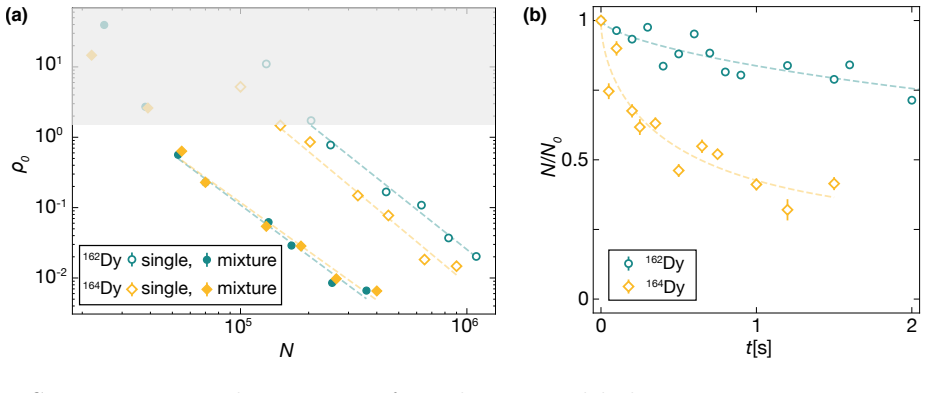
We report on the realization of a quantum-degenerate Bose-Bose mixture of 162Dy and 164Dy. Owing to the near-identical mass and polarizability of the two isotopes, the mixture thermalizes efficiently, with evaporation trajectories closely following those of the single-isotope case. Using a broad interspecies Feshbach resonance, we explore a miscible-immiscible transition between the two Bose-Einstein condensates. The tunability of the interspecies interaction, combined with the large magnetic dipole moment of Dy, makes this platform well suited for exploring dipolar effects in ultracold mixtures, including multi-component supersolidity.
What carries the argument
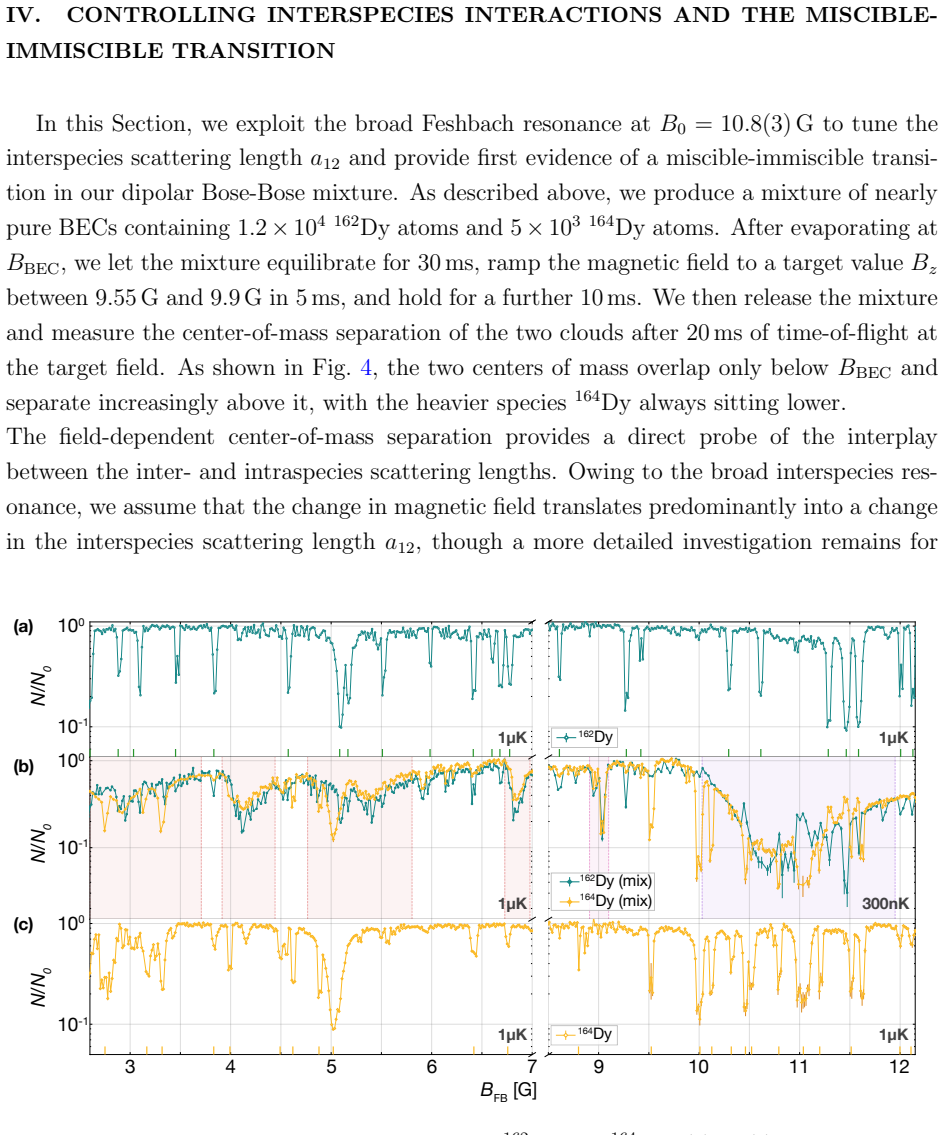
Broad interspecies Feshbach resonance that tunes the scattering length between the two dysprosium isotopes while both species remain quantum degenerate.
If this is right
- The mixture remains stable and quantum degenerate while the interspecies interaction is tuned across the miscible-immiscible boundary.
- The large magnetic dipole moments of both species remain available for dipolar physics once the contact interaction is adjusted.
- The same evaporation sequence used for single-species dysprosium works for the mixture without additional optimization.
Where Pith is reading between the lines
- Independent tuning of intra-species and inter-species dipolar strengths could become possible by combining the Feshbach resonance with magnetic-field orientation control.
- Phase-separation dynamics near the transition could be studied with high spatial resolution to test predictions for dipolar binary condensates.
- Extension to three-component mixtures or to mixtures with different dysprosium isotopes might reveal additional supersolid phases.
Load-bearing premise
The two isotopes have sufficiently similar mass and polarizability that the mixture thermalizes efficiently and follows single-species evaporation trajectories.
What would settle it
No observable change in spatial overlap or density profiles between the two condensates when the magnetic field is swept across the reported interspecies Feshbach resonance.
Figures

read the original abstract
We report on the realization of a quantum-degenerate Bose-Bose mixture of 162Dy and 164Dy. Owing to the near-identical mass and polarizability of the two isotopes, the mixture thermalizes efficiently, with evaporation trajectories closely following those of the single-isotope case. Using a broad interspecies Feshbach resonance, we explore a miscible-immiscible transition between the two Bose-Einstein condensates. The tunability of the interspecies interaction, combined with the large magnetic dipole moment of Dy, makes this platform well suited for exploring dipolar effects in ultracold mixtures, including multi-component supersolidity.
Editorial analysis
A structured set of objections, weighed in public.
Referee Report
Summary. The manuscript reports the experimental realization of a quantum-degenerate Bose-Bose mixture of 162Dy and 164Dy. Owing to the near-identical mass and polarizability of the isotopes, the mixture thermalizes efficiently during evaporation. A broad interspecies Feshbach resonance is used to tune the interspecies interaction and observe the miscible-immiscible transition between the two condensates. The work positions the platform for future studies of dipolar effects in mixtures, including multi-component supersolidity.
Significance. If the experimental claims hold, the result establishes a new tunable dipolar Bose mixture with efficient thermalization, which is a practical advantage for reaching degeneracy. This could enable controlled studies of dipolar multi-component physics that are difficult in other systems.
minor comments (2)
- [Abstract] Abstract: the statement that evaporation trajectories 'closely follow' the single-isotope case is presented without quantitative comparison (e.g., atom number or temperature vs. time); adding a brief metric or reference to a figure would strengthen the claim.
- [Abstract] The manuscript does not specify the magnetic-field location or width of the interspecies Feshbach resonance in the abstract or early sections; providing these values (or a citation to the resonance characterization) would clarify the accessible interaction range.
Simulated Author's Rebuttal
We thank the referee for the positive assessment of our work and the recommendation for minor revision. No major comments were provided in the report.
Circularity Check
No significant circularity: purely experimental report
full rationale
The manuscript is an experimental realization paper reporting the production of a quantum-degenerate 162Dy-164Dy Bose-Bose mixture, observation of a tunable miscible-immiscible transition via an interspecies Feshbach resonance, and positioning the system for future dipolar studies. No derivation chain, fitted parameters, predictions, or self-referential equations appear in the abstract or described content. The statement that evaporation trajectories follow the single-isotope case is presented as a direct consequence of the isotopes' near-identical mass and polarizability—an external physical fact, not an internal fit or self-definition. No load-bearing self-citations, ansatzes, or uniqueness theorems are invoked. The work is self-contained against external benchmarks and receives the default non-circularity finding.
Axiom & Free-Parameter Ledger
Reference graph
Works this paper leans on
-
[1]
Chomaz, I
L. Chomaz, I. Ferrier-Barbut, F. Ferlaino, B. Laburthe-Tolra, B. L. Lev, and T. Pfau. Dipolar physics: A review of experiments with magnetic quantum gases.Reports on Progress in Physics, 86(2):026401, dec 2022
2022
-
[2]
Tanzi, E
L. Tanzi, E. Lucioni, F. Fam` a, J. Catani, A. Fioretti, C. Gabbanini, R. N. Bisset, L. Santos, and G. Modugno. Observation of a dipolar quantum gas with metastable supersolid properties. Phys. Rev. Lett., 122:130405, apr 2019
2019
-
[3]
B¨ ottcher, J.-N
F. B¨ ottcher, J.-N. Schmidt, M. Wenzel, J. Hertkorn, M. Guo, T. Langen, and T. Pfau. Tran- sient supersolid properties in an array of dipolar quantum droplets.Phys. Rev. X, 9:011051, mar 2019
2019
-
[4]
Chomaz, D
L. Chomaz, D. Petter, P. Ilzh¨ ofer, G. Natale, A. Trautmann, C. Politi, G. Durastante, R. M. W. van Bijnen, A. Patscheider, M. Sohmen, M. J. Mark, and F. Ferlaino. Long- lived and transient supersolid behaviors in dipolar quantum gases.Phys. Rev. X, 9:021012, apr 2019. 9
2019
-
[5]
Trautmann, P
A. Trautmann, P. Ilzh¨ ofer, G. Durastante, C. Politi, M. Sohmen, M. J. Mark, and F. Ferlaino. Dipolar quantum mixtures of erbium and dysprosium atoms.Phys. Rev. Lett., 121:213601, nov 2018
2018
-
[6]
Bland, E
T. Bland, E. Poli, L. A. Pe˜ na Ardila, L. Santos, F. Ferlaino, and R. N. Bisset. Alternating- domain supersolids in binary dipolar condensates.Physical Review A, 106(5):053322, nov 2022
2022
-
[7]
R. N. Bisset, L. A. Pe˜ na Ardila, and L. Santos. Quantum droplets of dipolar mixtures.Phys. Rev. Lett., 126:025301, jan 2021
2021
-
[8]
Scheiermann, L
D. Scheiermann, L. A. Pe˜ na Ardila, T. Bland, R. N. Bisset, and L. Santos. Catalyzation of supersolidity in binary dipolar condensates.Phys. Rev. A, 107:L021302, feb 2023
2023
-
[9]
Arazo, A
M. Arazo, A. Gallem´ ı, M. Guilleumas, R. Mayol, and L. Santos. Self-bound crystals of antiparallel dipolar mixtures.Phys. Rev. Res., 5:043038, oct 2023
2023
-
[10]
A.-C. Lee, D. Baillie, and P. B. Blakie. Stability of a flattened dipolar binary condensate: Emergence of the spin roton.Phys. Rev. Res., 4:033153, aug 2022
2022
-
[11]
N. Q. Burdick, K. Baumann, Y. Tang, M. Lu, and B. L. Lev. Fermionic suppression of dipolar relaxation.Phys. Rev. Lett., 114:023201, jan 2015
2015
- [12]
-
[13]
Lecomte, A
M. Lecomte, A. Journeaux, J. Veschambre, J. Dalibard, and R. Lopes. Production and stabilization of a spin mixture of ultracold dipolar bose gases.Phys. Rev. Lett., 134:013402, jan 2025
2025
-
[14]
Duerbeck, L
M. Duerbeck, L. Reihs, J. Seifert, B. Choudhari, J. P. Marulanda-Serna, N. Werum, M. De Pas, G. Meijer, and G. Valtolina. Dual-isotope narrow-line MOT of dysprosium by phase modula- tion.Submitted, 2026
2026
-
[15]
Dreon, L
D. Dreon, L. A. Sidorenkov, C. Bouazza, W. Maineult, J. Dalibard, and S. Nascimbene. Optical cooling and trapping of highly magnetic atoms: the benefits of a spontaneous spin polarization.Journal of Physics B: Atomic, Molecular and Optical Physics, 50(6):065005, mar 2017
2017
-
[16]
Maier, H
T. Maier, H. Kadau, M. Schmitt, A. Griesmaier, and T. Pfau. Narrow-line magneto-optical trap for dysprosium atoms.Opt. Lett., 39(11):3138–3141, jun 2014
2014
-
[17]
Krstaji´ c, P
M. Krstaji´ c, P. Juh´ asz, J. Kuˇ cera, L. R. Hofer, G. Lamb, A. L. Marchant, and R. P. Smith. Characterization of three-body loss in 166Er and optimized production of large bose-einstein condensates.Phys. Rev. A, 108:063301, dec 2023
2023
-
[18]
Modugno, G
G. Modugno, G. Ferrari, G. Roati, R. J. Brecha, A. Simoni, and M. Inguscio. Bose-einstein condensation of potassium atoms by sympathetic cooling.Science, 294(5545):1320–1322, 2001. 10
2001
-
[19]
De Marco, G
L. De Marco, G. Valtolina, K. Matsuda, W. G. Tobias, J. P. Covey, and J. Ye. A degenerate fermi gas of polar molecules.Science, 363(6429):853–856, 2019
2019
-
[20]
Baroni, G
C. Baroni, G. Lamporesi, and M. Zaccanti. Quantum mixtures of ultracold gases of neutral atoms.Nature Reviews Physics, 6(12):736–752, nov 2024
2024
-
[21]
A. G. Volosniev, G. Bighin, L. Santos, and L. A. Pe˜ na Ardila. Non-equilibrium dynamics of dipolar polarons.SciPost Phys., 15:232, 2023
2023
-
[22]
Chomaz et al
L. Chomaz et al. Dipolar physics: A review of experiments with magnetic quantum gases. Reports on Progress in Physics, 86(2):026401, dec 2022
2022
-
[23]
Maier, H
T. Maier, H. Kadau, M. Schmitt, M. Wenzel, I. Ferrier-Barbut, T. Pfau, A. Frisch, S. Baier, K. Aikawa, L. Chomaz, M. J. Mark, F. Ferlaino, C. Makrides, E. Tiesinga, A. Petrov, and S. Kotochigova. Emergence of chaotic scattering in ultracold er and dy.Phys. Rev. X, 5:041029, nov 2015
2015
-
[24]
Durastante, C
G. Durastante, C. Politi, M. Sohmen, P. Ilzh¨ ofer, M. J. Mark, M. A. Norcia, and F. Ferlaino. Feshbach resonances in an erbium-dysprosium dipolar mixture.Phys. Rev. A, 102:033330, sep 2020
2020
-
[25]
Frisch, M
A. Frisch, M. Mark, K. Aikawa, F. Ferlaino, J. L. Bohn, C. Makrides, A. Petrov, and S. Kotochigova. Quantum chaos in ultracold collisions of gas-phase erbium atoms.Nature, 507(7493):475–479, 2014
2014
-
[26]
Scazza, G
F. Scazza, G. Del Pace, L. Pieri, R. Concas, W. J. Kwon, and G. Roati. A low-impedance radio-frequency circuit for fast spin manipulations in cold alkali atoms.Review of Scientific Instruments, 96(10):104713, oct 2025
2025
-
[27]
D. S. Hall, M. R. Matthews, J. R. Ensher, C. E. Wieman, and E. A. Cornell. Dynamics of component separation in a binary mixture of bose-einstein condensates.Phys. Rev. Lett., 81:1539–1542, aug 1998
1998
-
[28]
S. B. Papp, J. M. Pino, and C. E. Wieman. Tunable miscibility in a dual-species bose-einstein condensate.Phys. Rev. Lett., 101:040402, jul 2008
2008
-
[29]
D. J. McCarron, H. W. Cho, D. L. Jenkin, M. P. K¨ oppinger, and S. L. Cornish. Dual-species bose-einstein condensate of 87Rb and 133Cs.Phys. Rev. A, 84:011603(R), jul 2011
2011
-
[30]
Wacker, N
L. Wacker, N. B. Jørgensen, D. Birkmose, R. Horchani, W. Ertmer, C. Klempt, N. Winter, J. Sherson, and J. J. Arlt. Tunable dual-species bose-einstein condensates of 39K and 87Rb. Phys. Rev. A, 92:053602, nov 2015
2015
-
[31]
Burchianti, C
A. Burchianti, C. D’Errico, S. Rosi, A. Simoni, M. Modugno, C. Fort, and F. Minardi. Dual- species bose-einstein condensate of 41K and 87Rb in a hybrid trap.Phys. Rev. A, 98:063616, dec 2018
2018
-
[32]
Politi, A
C. Politi, A. Trautmann, P. Ilzh¨ ofer, G. Durastante, M. J. Mark, M. Modugno, and F. Ferlaino. Interspecies interactions in an ultracold dipolar mixture.Phys. Rev. A, 105:023304, feb 2022. 11
2022
-
[33]
R. K. Kumar, P. Muruganandam, L. Tomio, and A. Gammal. Miscibility in coupled dipolar and non-dipolar bose–einstein condensates.Journal of Physics Communications, 1(3):035012, nov 2017
2017
-
[34]
A.-C. Lee, D. Baillie, P. B. Blakie, and R. N. Bisset. Miscibility and stability of dipolar bosonic mixtures.Phys. Rev. A, 103:063301, jun 2021
2021
-
[35]
Kirkby, A.-C
W. Kirkby, A.-C. Lee, D. Baillie, T. Bland, F. Ferlaino, P. B. Blakie, and R. N. Bisset. Excitations of a binary dipolar supersolid.Phys. Rev. Lett., 133:103401, sep 2024
2024
-
[36]
N. Masalaeva, W. Kirkby, F. Ferlaino, and R. N. Bisset. Quantum vortex channels as josephson junctions. arXiv:2602.01889, 2026. 12
arXiv 2026
discussion (0)
Sign in with ORCID, Apple, or X to comment. Anyone can read and Pith papers without signing in.