Physics-Informed Path-Parametric Learning for Efficient and Lightweight CSI Feedback
Pith reviewed 2026-06-26 11:48 UTC · model grok-4.3
The pith
HS-PINNnet reformulates CSI reconstruction as multipath parameter estimation to reduce feedback overhead and computation.
A machine-rendered reading of the paper's core claim, the machinery that carries it, and where it could break.
Core claim
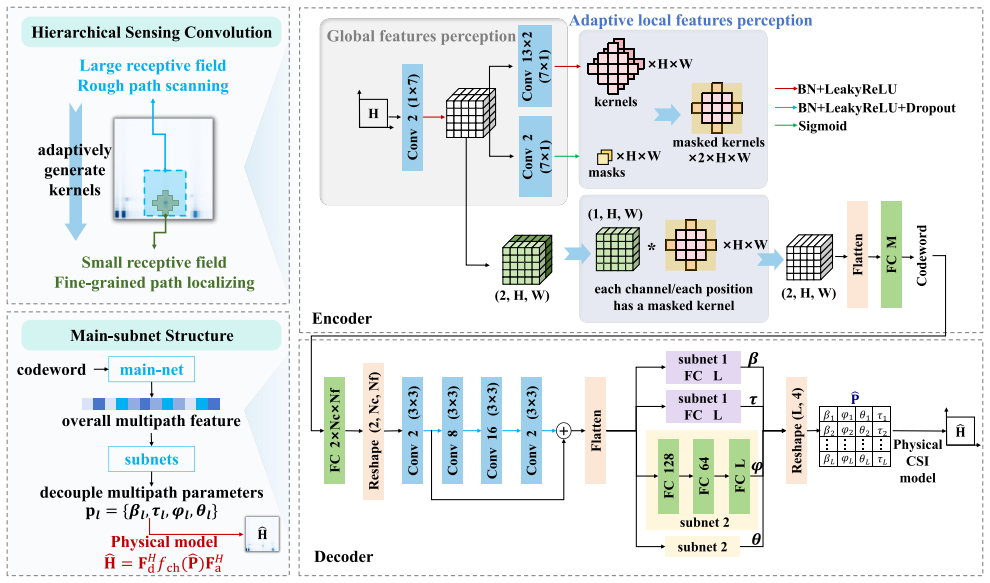
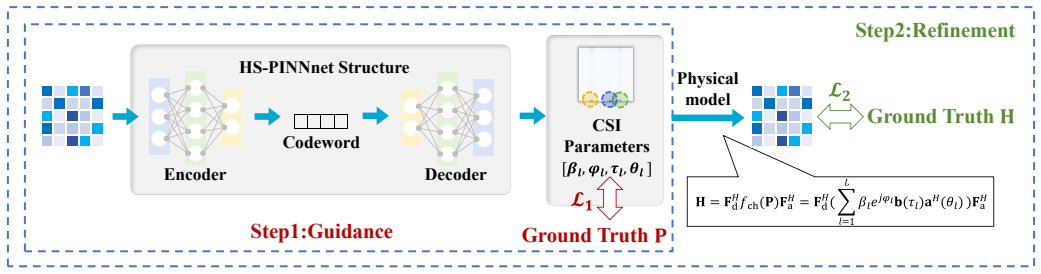
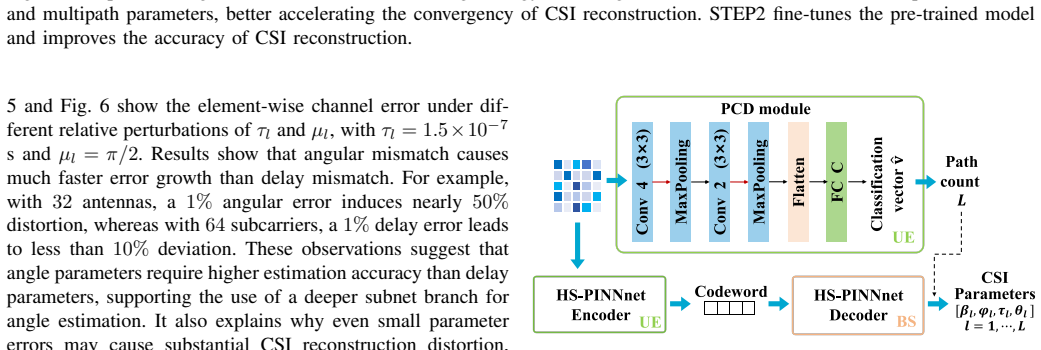
HS-PINNnet integrates a multipath channel model into the network, reformulating high-dimensional CSI reconstruction as low-dimensional multipath parameter estimation. It features a hierarchical sensing encoder to produce a compact multipath representation, and a heterogeneous decoder for parameter-specific CSI reconstruction with dedicated branches to estimate different parameters. A PCD module adaptively estimates the number of dominant paths in each CSI sample, and a subchannel-wise shared encoding and parallel decoding strategy decomposes high-dimensional CSI processing into low-dimensional subchannel tasks.
What carries the argument
HS-PINNnet, which embeds a multipath channel model into a hierarchical sensing physics-informed neural network to convert CSI reconstruction into multipath parameter estimation.
If this is right
- HS-PINNnet achieves a 92.8 percent reduction in FLOPs compared with state-of-the-art CSI feedback methods.
- The design exhibits two orders of magnitude lower FPGA simulation latency.
- The PCD module improves generalization across different channel environments.
- Subchannel-wise processing makes the method scalable to XL-MIMO systems.
Where Pith is reading between the lines
- The parameter-based approach could allow direct fusion with ray-tracing or geometry-based channel models in future network simulators.
- Lower computational cost may enable real-time CSI feedback on resource-constrained devices such as IoT sensors.
- The interpretability gain might simplify regulatory or standardization discussions around learned CSI codecs.
Load-bearing premise
Reformulating CSI reconstruction as multipath parameter estimation will produce outputs consistent with multipath propagation principles in diverse real-world environments.
What would settle it
Measured CSI from a real propagation environment where HS-PINNnet's reconstructed values deviate from the actual multipath components by more than the error margin of conventional methods.
Figures



read the original abstract
Channel State Information (CSI) feedback is vital for high spectral efficiency in wireless systems, yet high-dimensional CSI introduce significant feedback overhead. Recent deep learning (DL) approaches alleviate this issue by treating CSI as a visual image, but such "black-box" designs often lack interpretability, producing CSI that is not consistent with multipath propagation principles. To address these limitations, this paper proposes HS-PINNnet, a Hierarchical Sensing mechanism assisted Physics-Informed Neural Network for CSI Feedback. Unlike vision-inspired methods, HS-PINNnet integrates a multipath channel model into the network, reformulating high-dimensional CSI reconstruction as low-dimensional multipath parameter estimation (e.g., amplitude, angle). HS-PINNnet features a hierarchical sensing encoder to produce a compact multipath representation, and a heterogeneous decoder for parameter-specific CSI reconstruction, with dedicated branches to estimate different parameters. Moreover, a PCD module adaptively estimates the number of dominant paths in each CSI sample to enhance generalization across diverse environments. A subchannel-wise shared encoding and parallel decoding strategy is further designed to decompose high-dimensional CSI processing into low-dimensional subchannel tasks, reducing training difficulty and improving scalability of HS-PINNnet for future extremely large-scale multiple-input multiple-output (XL-MIMO) systems. Simulation results show that HS-PINNnet outperforms the state-of-the-art under different configurations, achieving a 92.8% reduction in FLOPs and exhibiting two orders of magnitude lower FPGA simulation latency.
Editorial analysis
A structured set of objections, weighed in public.
Referee Report
Summary. The paper proposes HS-PINNnet, a hierarchical sensing physics-informed neural network for CSI feedback. It integrates a multipath channel model to reformulate high-dimensional CSI reconstruction as low-dimensional multipath parameter estimation (amplitude, angle, etc.), using a hierarchical encoder, heterogeneous decoder with parameter-specific branches, a PCD module for adaptive estimation of dominant paths per sample, and subchannel-wise shared encoding/parallel decoding for scalability in XL-MIMO. Simulations claim outperformance over SOTA with 92.8% FLOPs reduction and two orders of magnitude lower FPGA latency.
Significance. If the simulation results hold under the reported conditions, the work provides a more interpretable alternative to black-box vision-inspired DL methods for CSI feedback by grounding the architecture in multipath propagation principles, with potential efficiency benefits for high-dimensional systems.
minor comments (3)
- The abstract states that HS-PINNnet 'outperforms the state-of-the-art under different configurations' but does not name the specific baselines or configurations; this should be clarified with explicit references to prior methods and parameter settings.
- The claim of consistency with multipath propagation principles is central but rests on simulation results; the manuscript should include a dedicated section or figure quantifying how closely the reconstructed CSI matches independent multipath model predictions (e.g., via path parameter error metrics) beyond aggregate NMSE.
- The PCD module's adaptive path-number estimation is described as enhancing generalization, but the training procedure for this module and any associated loss terms are not detailed in the provided abstract; add explicit description of the loss formulation and training schedule.
Simulated Author's Rebuttal
We thank the referee for the positive review, recognition of the interpretability benefits of grounding the architecture in multipath propagation, and the recommendation for minor revision. No specific major comments were listed in the report.
Circularity Check
No significant circularity detected
full rationale
The paper's core contribution is an architectural design (hierarchical encoder, heterogeneous decoder, PCD module, subchannel-wise processing) that explicitly incorporates a multipath channel model as an external domain-knowledge constraint to reformulate CSI feedback as parameter estimation. Performance claims rest on simulation benchmarks comparing against baselines, with no equations or derivations shown that reduce a claimed prediction or uniqueness result back to a fitted parameter or self-citation by construction. The multipath integration is a modeling choice whose validity is tested externally via those simulations rather than assumed tautologically. No load-bearing self-citations, ansatz smuggling, or renaming of known results appear in the abstract or described structure.
Axiom & Free-Parameter Ledger
free parameters (1)
- Estimated multipath parameters (amplitude, angle, etc.)
axioms (1)
- domain assumption Wireless channels follow a multipath propagation model that can be parameterized by amplitude, angle, and similar quantities.
Reference graph
Works this paper leans on
-
[1]
Physics-Informed Neural Networks for Wireless CSI Feedback,
C. Linget al., “Physics-Informed Neural Networks for Wireless CSI Feedback,”Proc. IEEE ICC, pp. 1–6, 2026
2026
-
[2]
5G-Advanced Toward 6G: Past, Present, and Future,
W. Chenet al., “5G-Advanced Toward 6G: Past, Present, and Future,” IEEE J. Sel. Areas Commun., vol. 41, no. 6, pp. 1592–1619, 2023
2023
-
[3]
A Speculative Study on 6G,
F. Tariq, M. R. A. Khandaker, K.-K. Wong, M. A. Imran, M. Bennis, and M. Debbah, “A Speculative Study on 6G,”IEEE Wireless Commun., vol. 27, no. 4, pp. 118–125, 2020
2020
-
[4]
Overview of Deep Learning- Based CSI Feedback in Massive MIMO Systems,
J. Guo, C.-K. Wen, S. Jin, and G. Y . Li, “Overview of Deep Learning- Based CSI Feedback in Massive MIMO Systems,”IEEE Trans. Com- mun., vol. 70, no. 12, pp. 8017–8045, 2022
2022
-
[5]
Physical Layer Procedures for Data (Release 17),
3GPP, “Physical Layer Procedures for Data (Release 17),” 3rd Generation Partnership Project (3GPP), Technical Specification (TS) 38.214, 2022, Version 17.3.0. [Online]. Available: https://www.3gpp.org
2022
-
[6]
Sparse Representation for Wireless Communications: A Compressive Sensing Approach,
Z. Qin, J. Fan, Y . Liu, Y . Gao, and G. Y . Li, “Sparse Representation for Wireless Communications: A Compressive Sensing Approach,”IEEE Signal Process. Mag., vol. 35, no. 3, pp. 40–58, 2018
2018
-
[7]
Remote State Estimation of Nonlinear Systems Over Fading Channels via Recurrent Neural Networks,
S. Cai and V . K. N. Lau, “Remote State Estimation of Nonlinear Systems Over Fading Channels via Recurrent Neural Networks,”IEEE Trans. Neural Netw. Learn. Syst., vol. 33, no. 8, pp. 3908–3922, 2022
2022
-
[8]
Graph Neural Networks for Wireless Communications: From Theory to Practice,
Y . Shen, J. Zhang, S. H. Song, and K. B. Letaief, “Graph Neural Networks for Wireless Communications: From Theory to Practice,” IEEE Trans. Wireless Commun., vol. 22, no. 5, pp. 3554–3569, 2023
2023
-
[9]
Deep Learning- Based Design of Uplink Integrated Sensing and Communication,
Q. Qi, X. Chen, C. Zhong, C. Yuen, and Z. Zhang, “Deep Learning- Based Design of Uplink Integrated Sensing and Communication,”IEEE Trans. Wireless Commun., vol. 23, no. 9, pp. 10 639–10 652, 2024
2024
-
[10]
Graph Neural Network-Based Node Deployment for Throughput Enhancement,
Y . Yang, D. Zou, and X. He, “Graph Neural Network-Based Node Deployment for Throughput Enhancement,”IEEE Trans. Neural Netw. Learn. Syst., vol. 35, no. 10, pp. 14 810–14 824, 2024
2024
-
[11]
Prompt-Enabled Large AI Models for CSI Feedback,
J. Guo, Y . Cui, C.-K. Wen, and S. Jin, “Prompt-Enabled Large AI Models for CSI Feedback,”IEEE J. Sel. Areas Commun., vol. 44, pp. 2654–2668, 2026
2026
-
[12]
Towards CSI Acquisition in 6G: A 3GPP Perspective,
Y . Cui, C. Jiang, C. Ling, J. Liu, J. Guo, C.-K. Wen, and S. Jin, “Towards CSI Acquisition in 6G: A 3GPP Perspective,” 2026, dOI: 10.13140/RG.2.2.12766.19527. [On- line]. Available: https://www.researchgate.net/publication/405232078 Towards CSI Acquisition in 6G A 3GPP Perspective
-
[13]
Deep Learning for Massive MIMO CSI Feedback,
C.-K. Wen, W.-T. Shih, and S. Jin, “Deep Learning for Massive MIMO CSI Feedback,”IEEE Wireless Commun. Lett., vol. 7, no. 5, pp. 748– 751, 2018
2018
-
[14]
Convolutional Neural Network- Based Multiple-Rate Compressive Sensing for Massive MIMO CSI Feedback: Design, Simulation, and Analysis,
J. Guo, C.-K. Wen, S. Jin, and G. Y . Li, “Convolutional Neural Network- Based Multiple-Rate Compressive Sensing for Massive MIMO CSI Feedback: Design, Simulation, and Analysis,”IEEE Trans. Wireless Commun., vol. 19, no. 4, pp. 2827–2840, 2020
2020
-
[15]
Multi-resolution CSI Feedback with Deep Learning in Massive MIMO System,
Z. Lu, J. Wang, and J. Song, “Multi-resolution CSI Feedback with Deep Learning in Massive MIMO System,” inProc. IEEE ICC, 2020, pp. 1–6
2020
-
[16]
Going Deeper With Convolutions,
C. Szegedyet al., “Going Deeper With Convolutions,” inProc. IEEE/CVF CVPR, 2015, pp. 1–9
2015
-
[17]
DualConv: Dual Convolutional Kernels for Lightweight Deep Neural Networks,
J. Zhong, J. Chen, and A. Mian, “DualConv: Dual Convolutional Kernels for Lightweight Deep Neural Networks,”IEEE Trans. Neural Netw. Learn. Syst., vol. 34, no. 11, pp. 9528–9535, 2023
2023
-
[18]
Rethinking the Inception Architecture for Computer Vision,
C. Szegedy, V . Vanhoucke, S. Ioffe, J. Shlens, and Z. Wojna, “Rethinking the Inception Architecture for Computer Vision,” inProc. IEEE/CVF CVPR, 2016, pp. 2818–2826
2016
-
[19]
Transformer Empowered CSI Feed- back for Massive MIMO Systems,
Y . Xu, M. Yuan, and M.-O. Pun, “Transformer Empowered CSI Feed- back for Massive MIMO Systems,” inProc. IEEE WOCC, 2021, pp. 157–161
2021
-
[20]
A Novel Approach Using Convolu- tional Transformer for Massive MIMO CSI Feedback,
X. Bi, S. Li, C. Yu, and Y . Zhang, “A Novel Approach Using Convolu- tional Transformer for Massive MIMO CSI Feedback,”IEEE Wireless Commun. Lett., vol. 11, no. 5, pp. 1017–1021, 2022
2022
-
[21]
TransNet: Full Attention Network for CSI Feedback in FDD Massive MIMO System,
Y . Cui, A. Guo, and C. Song, “TransNet: Full Attention Network for CSI Feedback in FDD Massive MIMO System,”IEEE Wireless Commun. Lett., vol. 11, no. 5, pp. 903–907, 2022
2022
-
[22]
A Spatially Separable Attention Mechanism for Massive MIMO CSI Feedback,
S. Mourya, S. Amuru, and K. K. Kuchi, “A Spatially Separable Attention Mechanism for Massive MIMO CSI Feedback,”IEEE Wireless Commun. Lett., vol. 12, no. 1, pp. 40–44, 2023
2023
-
[23]
Attention is All you Need,
A. Vaswaniet al., “Attention is All you Need,” inProc. NeurIPS, vol. 30, 2017
2017
-
[24]
A Survey of Visual Transformers,
Y . Liuet al., “A Survey of Visual Transformers,”IEEE Trans. Neural Netw. Learn. Syst., vol. 35, no. 6, pp. 7478–7498, 2024
2024
-
[25]
Deep Learning-Based CSI Feedback Approach for Time-Varying Massive MIMO Channels,
T. Wang, C.-K. Wen, S. Jin, and G. Y . Li, “Deep Learning-Based CSI Feedback Approach for Time-Varying Massive MIMO Channels,”IEEE Wireless Commun. Lett., vol. 8, no. 2, pp. 416–419, 2019
2019
-
[26]
Compressive Sampled CSI Feedback Method Based on Deep Learning for FDD Massive MIMO Systems,
J. Wang, G. Gui, T. Ohtsuki, B. Adebisi, H. Gacanin, and H. Sari, “Compressive Sampled CSI Feedback Method Based on Deep Learning for FDD Massive MIMO Systems,”IEEE Trans. Commun., vol. 69, no. 9, pp. 5873–5885, 2021
2021
-
[27]
Learning How to Transfer From Uplink to Downlink via Hyper-Recurrent Neural Network for FDD Massive MIMO,
Y . Liu and O. Simeone, “Learning How to Transfer From Uplink to Downlink via Hyper-Recurrent Neural Network for FDD Massive MIMO,”IEEE Trans. Wireless Commun., vol. 21, no. 10, pp. 7975– 7989, 2022
2022
-
[28]
Physics-Inspired Deep Learning Anti-Aliasing Framework in Efficient Channel State Feedback,
Y . Lin, Y . Xin, T. Lee, C. Zhang, and Z. Ding, “Physics-Inspired Deep Learning Anti-Aliasing Framework in Efficient Channel State Feedback,”IEEE Trans. Wireless Commun., vol. 24, no. 2, pp. 1117– 1131, 2024
2024
-
[29]
Physics-Informed Data Augmentation for CSI Data-Limited Deep Learning-Driven Communication Tasks,
M. Yuan, L. Lian, and S. Ji, “Physics-Informed Data Augmentation for CSI Data-Limited Deep Learning-Driven Communication Tasks,” in Proc. IEEE ICC Workshops, 2025, pp. 1634–1639
2025
-
[30]
Deep Learning- Based CSI Feedback for RIS-Assisted Multi-User Systems,
J. Guo, X. Yang, C.-K. Wen, S. Jin, and G. Ye Li, “Deep Learning- Based CSI Feedback for RIS-Assisted Multi-User Systems,”IEEE Trans. Commun., vol. 73, no. 7, pp. 4974–4989, 2025
2025
-
[31]
MuSAC: Mutualistic Sensing and Communication for Mobile Crowdsensing,
S. Ji, L. Lian, Y . Zheng, and C. Wu, “MuSAC: Mutualistic Sensing and Communication for Mobile Crowdsensing,” inProc. IEEE ICDCS, 2024, pp. 243–254
2024
-
[32]
CSI-StripeFormer: Exploiting Stripe Features for CSI Compression in Massive MIMO System,
Q. Hu, H. Kang, H. Chen, Q. Huang, Q. Zhang, and M. Cheng, “CSI-StripeFormer: Exploiting Stripe Features for CSI Compression in Massive MIMO System,” inProc. IEEE INFOCOM, 2023, pp. 1–10
2023
-
[33]
Newtonized Or- thogonal Matching Pursuit: Frequency Estimation Over the Continuum,
B. Mamandipoor, D. Ramasamy, and U. Madhow, “Newtonized Or- thogonal Matching Pursuit: Frequency Estimation Over the Continuum,” IEEE Trans. Signal Process., vol. 64, no. 19, p. 5066–5081, 2016
2016
-
[34]
Transformer-Assisted Parametric CSI Feedback for mmWave Massive MIMO Systems,
H. Ju, S. Jeong, S. Kim, B. Lee, and B. Shim, “Transformer-Assisted Parametric CSI Feedback for mmWave Massive MIMO Systems,”IEEE Trans. Wireless Commun., vol. 23, no. 12, pp. 18 774–18 787, 2024
2024
-
[35]
Foundation Models for Wireless Communications: From PHY Intelligence to Network Autonomy,
L. Lianget al., “Foundation Models for Wireless Communications: From PHY Intelligence to Network Autonomy,”arXiv:2606.06239, 2026
Pith/arXiv arXiv 2026
-
[36]
Deformable Convolutional Networks,
J. Dai, H. Qi, Y . Xiong, Y . Li, G. Zhang, H. Hu, and Y . Wei, “Deformable Convolutional Networks,” inProc. IEEE ICCV, 2017, pp. 764–773
2017
-
[37]
Large Kernel Matters — Improve Semantic Segmen- tation by Global Convolutional Network,
C. Penget al., “Large Kernel Matters — Improve Semantic Segmen- tation by Global Convolutional Network,” inProc. IEEE/CVF CVPR, 2017, pp. 1743–1751
2017
-
[38]
Receptive Fields as Experts in Convolu- tional Neural Architectures,
D. Lian, W. Yu, and X. Wang, “Receptive Fields as Experts in Convolu- tional Neural Architectures,” inProc. ICML, 2024, pp. 29 531–29 544
2024
-
[39]
LSNet: See Large, Focus Small,
A. Wang, H. Chen, Z. Lin, J. Han, and G. Ding, “LSNet: See Large, Focus Small,” inProc. IEEE/CVF CVPR, 2025, pp. 9718–9729
2025
-
[40]
A Survey of Convolutional Neural Networks: Analysis, Applications, and Prospects,
Z. Li, F. Liu, W. Yang, S. Peng, and J. Zhou, “A Survey of Convolutional Neural Networks: Analysis, Applications, and Prospects,”IEEE Trans. Neural Netw. Learn. Syst., vol. 33, no. 12, pp. 6999–7019, 2022
2022
-
[41]
Batch Normalization: Accelerating Deep Network Training by Reducing Internal Covariate Shift,
S. Ioffe and C. Szegedy, “Batch Normalization: Accelerating Deep Network Training by Reducing Internal Covariate Shift,” inProc. ICML, vol. 37, 2015, pp. 448–456
2015
-
[42]
Deep Residual Learning for Image Recognition,
K. He, X. Zhang, S. Ren, and J. Sun, “Deep Residual Learning for Image Recognition,” inProc. IEEE/CVF CVPR, 2016, pp. 770–778
2016
-
[43]
DeepMIMO: A Generic Deep Learning Dataset for Millimeter Wave and Massive MIMO Applications,
A. Alkhateeb, “DeepMIMO: A Generic Deep Learning Dataset for Millimeter Wave and Massive MIMO Applications,” inProc. IEEE ITA, 2019, pp. 1–8
2019
-
[44]
Custom Hardware Architectures for Deep Learning on Portable Devices: A Review,
K. S. Zamanet al., “Custom Hardware Architectures for Deep Learning on Portable Devices: A Review,”IEEE Trans. Neural Netw. Learn. Syst., vol. 33, no. 11, pp. 6068–6088, 2022
2022
discussion (0)
Sign in with ORCID, Apple, or X to comment. Anyone can read and Pith papers without signing in.