Black Hole Ringdown Nonlinearities in the Large-D Limit
Pith reviewed 2026-06-26 07:16 UTC · model grok-4.3
The pith
Including nonlinear effects up to cubic order improves black hole ringdown modelling accuracy by several orders of magnitude.
A machine-rendered reading of the paper's core claim, the machinery that carries it, and where it could break.
Core claim
In the large-D limit the quasinormal-mode spectrum remains analytically tractable even after including nonlinear corrections; explicit third-order response functions for a driven static black hole, when used to model head-on collisions, improve the fit to the ringdown phase by several orders of magnitude relative to linear quasinormal-mode sums, with the size of the nonlinear corrections increasing at higher velocities.
What carries the argument
The large-D effective theory of black hole dynamics, which renders the full nonlinear quasinormal-mode spectrum analytically tractable.
If this is right
- Nonlinear effects grow stronger with increasing collision velocity across the studied range.
- The third-order truncation already accounts for the leading nonlinear contributions in these head-on cases.
- The framework permits clean, controlled extraction of the ringdown signal from inexpensive numerical simulations.
- The same analytic response functions can be applied to other initial data within the large-D setting.
Where Pith is reading between the lines
- The method could be extended to spinning or off-axis collisions to check whether similar nonlinear corrections appear in more generic mergers.
- If the large-D results translate to four dimensions, standard linear quasinormal-mode template banks used in gravitational-wave analysis may require systematic nonlinear corrections at high signal-to-noise ratios.
- The computational cheapness of large-D simulations offers a route to explore even higher-order nonlinearities that remain inaccessible in full four-dimensional numerical relativity.
Load-bearing premise
The large-D effective theory remains a faithful approximation to the nonlinear ringdown dynamics of four-dimensional black holes, and the third-order truncation captures the dominant nonlinear contributions.
What would settle it
A side-by-side comparison of the large-D nonlinear ringdown waveforms against four-dimensional numerical-relativity simulations of identical head-on collisions at the same velocities and mass ratios would test whether the reported accuracy gain holds.
Figures


read the original abstract
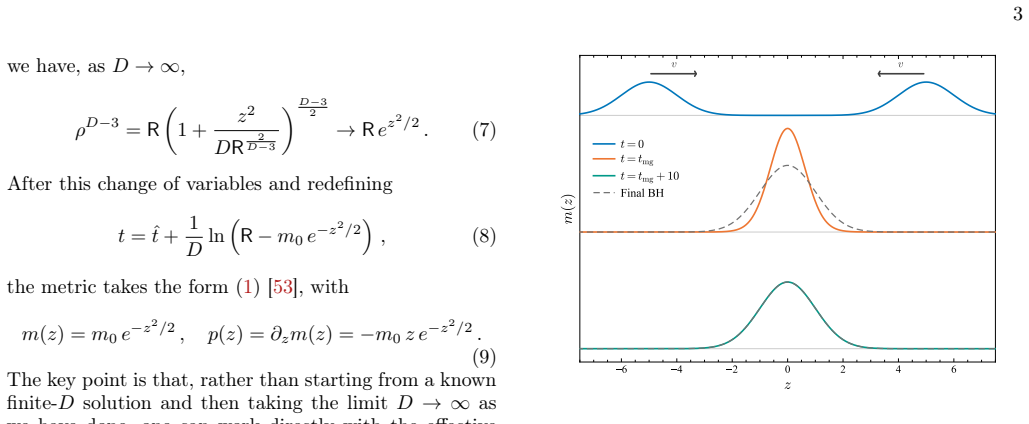
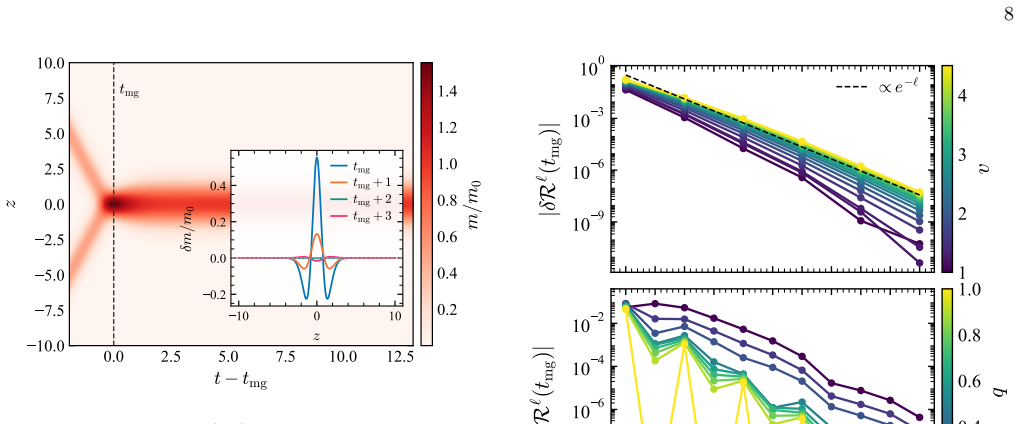
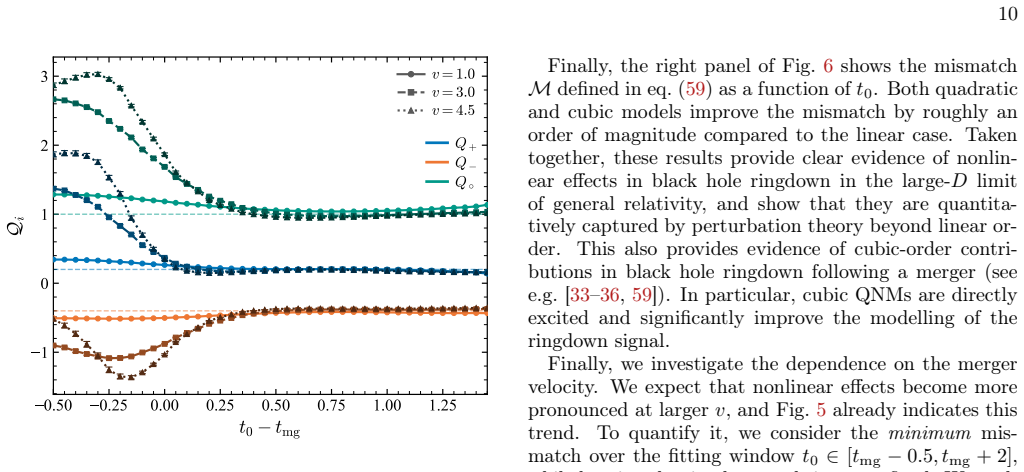
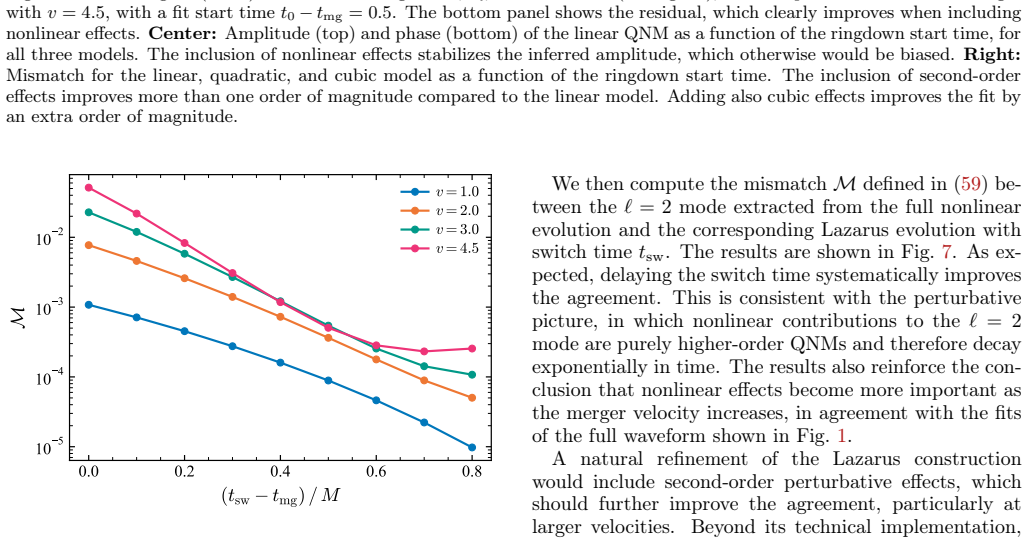
We initiate the study of nonlinear effects in the ringdown phase of black hole mergers using the effective theory of black hole dynamics in the large-D limit. This framework offers several advantages: the quasinormal mode spectrum, including nonlinear corrections, is analytically tractable; numerical simulations of collisions are computationally inexpensive; and the extraction and analysis of the ringdown signal are clean and controlled. As a proof of concept, we derive analytic expressions for the third-order response of a static black hole driven by a single quasinormal mode, and apply them to study the ringdown following head-on collisions of non-spinning black holes across a range of velocities and mass ratios. We find that including nonlinear effects, up to quadratic and cubic order, improves the accuracy of quasinormal-mode modelling of black hole relaxation by several orders of magnitude. The results also show a clear growth in the strength of nonlinear effects as the collision velocity increases.
Editorial analysis
A structured set of objections, weighed in public.
Referee Report
Summary. The paper initiates the study of nonlinear ringdown effects in black hole mergers within the large-D effective theory. It derives analytic expressions for the third-order response of a static black hole to a single quasinormal mode and applies these to head-on collisions of non-spinning black holes, demonstrating that quadratic and cubic nonlinear corrections reduce the residual between the simulated ringdown and linear QNM modeling by several orders of magnitude, with nonlinear strength increasing with collision velocity. The work is framed as a proof-of-concept in this controlled setting.
Significance. If the central results hold, the manuscript provides a valuable controlled framework for analytic and numerical exploration of nonlinear ringdown, leveraging the tractability of the large-D limit for both derivations and inexpensive simulations. Explicit credit is due for the analytic third-order response functions and the direct comparison to independent numerical collision runs, which enable clean extraction of the improvement without post-hoc fitting.
major comments (2)
- [§4] §4 (results on head-on collisions): the reported improvement by 'several orders of magnitude' is load-bearing for the central claim, yet the manuscript does not specify the precise residual norms (e.g., L2 or pointwise) or the time window over which they are computed; without these, it is unclear whether the quoted gain is uniform or dominated by early/late times.
- [§3.2] §3.2 (third-order response derivation): the truncation at cubic order is presented as capturing the dominant nonlinearities, but no explicit estimate or bound is given on the size of omitted higher-order terms relative to the quadratic/cubic contributions for the velocity range studied; this affects the justification that the improvement is due to the included nonlinearities rather than truncation artifacts.
minor comments (2)
- The notation for the response functions (e.g., the kernels or coefficients in the third-order expressions) should be cross-referenced consistently between the analytic derivation and the numerical application sections to aid readability.
- Figure captions for the residual plots should explicitly state the mass ratios and velocities used, as well as the fitting procedure for the linear QNM baseline, to make the comparison self-contained.
Simulated Author's Rebuttal
We thank the referee for the positive assessment and the recommendation for minor revision. The two major comments identify areas where additional clarity will strengthen the presentation. We address each point below and indicate the revisions we will make.
read point-by-point responses
-
Referee: [§4] §4 (results on head-on collisions): the reported improvement by 'several orders of magnitude' is load-bearing for the central claim, yet the manuscript does not specify the precise residual norms (e.g., L2 or pointwise) or the time window over which they are computed; without these, it is unclear whether the quoted gain is uniform or dominated by early/late times.
Authors: We agree that explicit specification of the residual norm and time window is necessary to make the quantitative claim unambiguous. In the revised manuscript we will define the precise norm (L2 over the waveform amplitude, normalized by the peak value) and state the time intervals used for the comparison (from the onset of ringdown to a fixed number of e-folds after the peak). We will also add a supplementary figure showing the residual as a function of time for both linear and nonlinear models, confirming that the reported improvement holds across the window rather than being localized to early or late times. revision: yes
-
Referee: [§3.2] §3.2 (third-order response derivation): the truncation at cubic order is presented as capturing the dominant nonlinearities, but no explicit estimate or bound is given on the size of omitted higher-order terms relative to the quadratic/cubic contributions for the velocity range studied; this affects the justification that the improvement is due to the included nonlinearities rather than truncation artifacts.
Authors: The large-D effective theory provides parametric control: each additional order in the nonlinearity is accompanied by an extra factor of 1/D. For the D values used in the simulations this suppression is numerically small, and the independent numerical collision data show that adding the analytically derived quadratic and cubic terms reduces the residual by the reported amount. Nevertheless, we acknowledge that an explicit numerical bound on the quartic remainder for the highest velocities would further strengthen the argument. In the revision we will add a short paragraph estimating the expected size of the next-order term from the 1/D scaling and from the observed convergence of the nonlinear model; if a fully rigorous a-priori bound proves impractical without additional computation we will state this limitation explicitly. revision: partial
Circularity Check
No significant circularity detected
full rationale
The paper constructs analytic third-order response functions from the large-D effective theory equations and validates the resulting improvement in ringdown modeling against independent numerical simulations of head-on collisions. No derivation step reduces by construction to a fitted input, self-citation, or renamed ansatz; the central claim concerns internal consistency within the controlled large-D truncation and is externally benchmarked by the simulations. The work is presented explicitly as a proof-of-concept study, with no load-bearing uniqueness theorems or self-referential definitions invoked.
Axiom & Free-Parameter Ledger
axioms (1)
- domain assumption The large-D limit provides a controlled and faithful approximation to the nonlinear ringdown of four-dimensional black holes.
Reference graph
Works this paper leans on
-
[1]
These solutions correspond to genuine quasinormal modes forℓ≥2, whereasℓ= 1is a translational zero mode
Re- quiring bounded, finite polynomial solutions forces h+ =ℓ∈Z + .(21) The frequencies are then quantized as ωℓ =± √ ℓ−1−i(ℓ−1),(22) with corresponding wavefunctions δR=H ℓ z/ √ 2 .(23) The solution forδpfollows directly from (14). These solutions correspond to genuine quasinormal modes forℓ≥2, whereasℓ= 1is a translational zero mode. The integerℓcan be ...
-
[2]
angular level
= (h− −ℓ)(h + −ℓ)H ℓ(z/ √ 2).(37) It follows immediately that δN Rk = X ℓ sℓ N,k (h− −ℓ)(h + −ℓ) Hℓ(z/ √ 2).(38) From this expression,δ N mk(z)follows directly, while δN pk(z)is obtained from the second equation in (30) using the first equation, which yields (σN,k −2i)δ N pk(z) = 2iz(1 +iσ N,k)δN mk(z) +i(1 +z 2 +iσ N,k)δN mk,z(z) + 2iz δN mk,zz(z) +i δ N...
-
[3]
Second-order Solutions Assuming a single linear QNM withℓ= 2(and there- fore frequencyω=±1−i), of amplitude and phaseA andϕ, one finds that at second order the response splits into an oscillatory and a purely damped channel, with σ2,1 = 2−2i , σ 2,◦ =−2i .(43) The corresponding amplitudes are A2 2,1 =A 2 −1 5 + i 10 e−2iϕ , A 4 2,1 =A 2 1 8 e−2iϕ , A2 2,◦...
-
[4]
Box 1”, same as Fig. 2),L x/r0 = 20.51,L y/r0 = 82.04 (or “Box 2
Third-order Solutions Extending the self-coupling of a singleℓ= 2QNM to third order and using the second-order solution (45), we find two oscillatory channels and no purely damped contribution, σ3,1 = 1−3i , σ 3,2 = 3−3i .(46) The corresponding amplitudes are A2 3,1 =A 3 − 3 20 + 19i 20 e−iϕ , A 4 3,1 =A 3 2 5 + i 20 e−iϕ , A6 3,1 =A 3 e−iϕ 16 , A 2 3,2 =...
-
[5]
Modeling ringdown: Beyond the fundamental quasinor- mal modes,
Lionel London, Deirdre Shoemaker, and James Healy, “Modeling ringdown: Beyond the fundamental quasinor- mal modes,” Phys. Rev. D90, 124032 (2014), [Erratum: Phys.Rev.D 94, 069902 (2016)], arXiv:1404.3197 [gr-qc]
Pith/arXiv arXiv 2014
-
[6]
Nonlinear Effects in Black Hole Ringdown,
Mark Ho-Yeuk Cheunget al., “Nonlinear Effects in Black Hole Ringdown,” Phys. Rev. Lett.130, 081401 (2023), arXiv:2208.07374 [gr-qc]
arXiv 2023
-
[7]
Nonlinearities in Black Hole Ringdowns,
Keefe Mitmanet al., “Nonlinearities in Black Hole Ringdowns,” Phys. Rev. Lett.130, 081402 (2023), arXiv:2208.07380 [gr-qc]
arXiv 2023
-
[8]
Mode coupling in the nonlinear response of black holes,
Yosef Zlochower, Roberto Gomez, Sascha Husa, Luis Lehner, and Jeffrey Winicour, “Mode coupling in the nonlinear response of black holes,” Phys. Rev. D68, 084014 (2003), arXiv:gr-qc/0306098
Pith/arXiv arXiv 2003
-
[9]
Nonlinear quasinormal mode detectability with next-generation gravitational wave detectors,
Sophia Yi, Adrien Kuntz, Enrico Barausse, Emanuele Berti, Mark Ho-Yeuk Cheung, Konstantinos Kri- tos, and Andrea Maselli, “Nonlinear quasinormal mode detectability with next-generation gravitational wave detectors,” Phys. Rev. D109, 124029 (2024), arXiv:2403.09767 [gr-qc]
arXiv 2024
-
[10]
Black hole spectroscopy with nonlinearquasinormalmodes,
Macarena Lagos, Tomás Andrade, Jordi Rafecas- Ventosa, and Lam Hui, “Black hole spectroscopy with nonlinearquasinormalmodes,” Phys.Rev.D111,024018 (2025), arXiv:2411.02264 [gr-qc]
arXiv 2025
-
[11]
A nonlinear voice from GW250114 ringdown,
Yi-Fan Wang, Sizheng Ma, Neev Khera, and Huan Yang, “A nonlinear voice from GW250114 ringdown,” (2026), arXiv:2601.05734 [gr-qc]
arXiv 2026
-
[12]
Second order perturbations of a Schwarzschild black hole,
Reinaldo J. Gleiser, Carlos O. Nicasio, Richard H. Price, and Jorge Pullin, “Second order perturbations of a Schwarzschild black hole,” Class. Quant. Grav.13, L117– L124 (1996), arXiv:gr-qc/9510049
Pith/arXiv arXiv 1996
-
[13]
Colliding black holes: How far can the close approximation go?
Reinaldo J. Gleiser, Carlos O. Nicasio, Richard H. Price, and Jorge Pullin, “Colliding black holes: How far can the close approximation go?” Phys. Rev. Lett.77, 4483–4486 (1996), arXiv:gr-qc/9609022
Pith/arXiv arXiv 1996
-
[14]
Gauge in- variant formalism for second order perturbations of Schwarzschild space-times,
Alcides Garat and Richard H. Price, “Gauge in- variant formalism for second order perturbations of Schwarzschild space-times,” Phys. Rev. D61, 044006 (2000), arXiv:gr-qc/9909005
Pith/arXiv arXiv 2000
-
[15]
Second or- der gauge invariant gravitational perturbations of a Kerr black hole,
Manuela Campanelli and Carlos O. Lousto, “Second or- der gauge invariant gravitational perturbations of a Kerr black hole,” Phys. Rev. D59, 124022 (1999), arXiv:gr- qc/9811019
arXiv 1999
-
[16]
Second and higher- order perturbations of a spherical spacetime,
David Brizuela, Jose M. Martin-Garcia, and Guillermo A. Mena Marugan, “Second and higher- order perturbations of a spherical spacetime,” Phys. Rev. D74, 044039 (2006), arXiv:gr-qc/0607025
Pith/arXiv arXiv 2006
-
[17]
High-order gauge-invariant pertur- 13 bations of a spherical spacetime,
David Brizuela, Jose M. Martin-Garcia, and Guillermo A. Mena Marugan, “High-order gauge-invariant pertur- 13 bations of a spherical spacetime,” Phys. Rev. D76, 024004 (2007), arXiv:gr-qc/0703069
Pith/arXiv arXiv 2007
-
[18]
David Brizuela, Jose M. Martin-Garcia, and Manuel Tiglio, “A Complete gauge-invariant formalism for arbi- trarysecond-orderperturbationsofaSchwarzschildblack hole,” Phys. Rev. D80, 024021 (2009), arXiv:0903.1134 [gr-qc]
Pith/arXiv arXiv 2009
-
[19]
Mode coupling of Schwarzschild per- turbations: Ringdown frequencies,
Enrique Pazos, David Brizuela, Jose M. Martin-Garcia, and Manuel Tiglio, “Mode coupling of Schwarzschild per- turbations: Ringdown frequencies,” Phys. Rev. D82, 104028 (2010), arXiv:1009.4665 [gr-qc]
Pith/arXiv arXiv 2010
-
[20]
Second and higher- order quasi-normal modes in binary black hole mergers,
Kunihito Ioka and Hiroyuki Nakano, “Second and higher- order quasi-normal modes in binary black hole mergers,” Phys. Rev. D76, 061503 (2007), arXiv:0704.3467 [astro- ph]
Pith/arXiv arXiv 2007
-
[21]
Second Order Quasi-Normal Mode of the Schwarzschild Black Hole,
Hiroyuki Nakano and Kunihito Ioka, “Second Order Quasi-Normal Mode of the Schwarzschild Black Hole,” Phys. Rev. D76, 084007 (2007), arXiv:0708.0450 [gr-qc]
Pith/arXiv arXiv 2007
-
[22]
Generation and propaga- tion of nonlinear quasinormal modes of a Schwarzschild black hole,
Macarena Lagos and Lam Hui, “Generation and propaga- tion of nonlinear quasinormal modes of a Schwarzschild black hole,” Phys. Rev. D107, 044040 (2023), arXiv:2208.07379 [gr-qc]
arXiv 2023
-
[23]
Nonlinear quasi-normal modes: uniform approximation,
Bruno Bucciotti, Adrien Kuntz, Francesco Serra, and Enrico Trincherini, “Nonlinear quasi-normal modes: uniform approximation,” JHEP12, 048 (2023), arXiv:2309.08501 [hep-th]
arXiv 2023
-
[24]
Nonlinear Ringdown at the Black Hole Horizon,
Neev Khera, Ariadna Ribes Metidieri, Béatrice Bonga, Xisco Jiménez Forteza, Badri Krishnan, Eric Poisson, Daniel Pook-Kolb, Erik Schnetter, and Huan Yang, “Nonlinear Ringdown at the Black Hole Horizon,” Phys. Rev. Lett.131, 231401 (2023), arXiv:2306.11142 [gr-qc]
arXiv 2023
-
[25]
Quadratic Quasi-Normal Modes of a Schwarzschild Black Hole,
Bruno Bucciotti, Leonardo Juliano, Adrien Kuntz, and Enrico Trincherini, “Quadratic Quasi-Normal Modes of a Schwarzschild Black Hole,” (2024), arXiv:2405.06012 [gr-qc]
arXiv 2024
-
[26]
Amplitudes and Polarizations of Quadratic Quasi-Normal Modes for a Schwarzschild Black Hole,
Bruno Bucciotti, Leonardo Juliano, Adrien Kuntz, and Enrico Trincherini, “Amplitudes and Polarizations of Quadratic Quasi-Normal Modes for a Schwarzschild Black Hole,” (2024), arXiv:2406.14611 [hep-th]
arXiv 2024
-
[27]
Quadratic perturbations of the Schwarzschild black hole: the algebraically special sector,
Jibril Ben Achour and Hugo Roussille, “Quadratic perturbations of the Schwarzschild black hole: the algebraically special sector,” JCAP07, 085 (2024), arXiv:2406.08159 [gr-qc]
arXiv 2024
-
[28]
Excitation of quadratic quasinormal modes for Kerr black holes,
Sizheng Ma and Huan Yang, “Excitation of quadratic quasinormal modes for Kerr black holes,” Phys. Rev. D 109, 104070 (2024), arXiv:2401.15516 [gr-qc]
arXiv 2024
-
[29]
Quadratic quasi-normal mode dependence on linear mode parity,
Patrick Bourg, Rodrigo Panosso Macedo, Andrew Spiers, Benjamin Leather, Béatrice Bonga, and Adam Pound, “Quadratic quasi-normal mode dependence on linear mode parity,” (2024), arXiv:2405.10270 [gr-qc]
arXiv 2024
-
[30]
Computing non- linearity ratios using second order black hole perturba- tion theory,
Jasveer Singh and Vardarajan Suneeta, “Computing non- linearity ratios using second order black hole perturba- tion theory,” (2025), arXiv:2512.00943 [gr-qc]
Pith/arXiv arXiv 2025
-
[31]
Spin depen- dence of black hole ringdown nonlinearities,
Jaime Redondo-Yuste, Gregorio Carullo, Justin L. Rip- ley, Emanuele Berti, and Vitor Cardoso, “Spin depen- dence of black hole ringdown nonlinearities,” Phys. Rev. D109, L101503 (2024), arXiv:2308.14796 [gr-qc]
arXiv 2024
-
[32]
Quadratic Mode Couplings in Rotating Black Holes and Their Detectability,
Neev Khera, Sizheng Ma, and Huan Yang, “Quadratic Mode Couplings in Rotating Black Holes and Their Detectability,” Phys. Rev. Lett.134, 211404 (2025), arXiv:2410.14529 [gr-qc]
arXiv 2025
-
[33]
Second-order Teukolsky formalism in Kerr spacetime: Formulation and nonlinear source,
Andrew Spiers, Adam Pound, and Jordan Moxon, “Second-order Teukolsky formalism in Kerr spacetime: Formulation and nonlinear source,” Phys. Rev. D108, 064002 (2023), arXiv:2305.19332 [gr-qc]
arXiv 2023
-
[34]
Andrew Spiers, Adam Pound, and Barry Wardell, “Second-order perturbations of the Schwarzschild spacetime: Practical, covariant, and gauge-invariant formalisms,” Phys. Rev. D110, 064030 (2024), arXiv:2306.17847 [gr-qc]
arXiv 2024
-
[35]
Quadratic quasinormal modes at null infinity on a Schwarzschild spacetime,
Patrick Bourg, Rodrigo Panosso Macedo, Andrew Spiers, Benjamin Leather, Bonga Béatrice, and Adam Pound, “Quadratic quasinormal modes at null infinity on a Schwarzschild spacetime,” Phys. Rev. D112, 044049 (2025), arXiv:2503.07432 [gr-qc]
arXiv 2025
-
[36]
Huan Yang, Aaron Zimmerman, and Luis Lehner, “Tur- bulentBlackHoles,” Phys.Rev.Lett.114,081101(2015), arXiv:1402.4859 [gr-qc]
Pith/arXiv arXiv 2015
-
[37]
Nonlinear effects in the black hole ringdown: Absorption-induced mode excitation,
Laura Sberna, Pablo Bosch, William E. East, Stephen R. Green, and Luis Lehner, “Nonlinear effects in the black hole ringdown: Absorption-induced mode excitation,” Phys. Rev. D105, 064046 (2022), arXiv:2112.11168 [gr- qc]
arXiv 2022
-
[38]
Ringdown of a dynamical spacetime,
JaimeRedondo-Yuste, DavidPereñiguez, andVitorCar- doso, “Ringdown of a dynamical spacetime,” Phys. Rev. D109, 044048 (2024), arXiv:2312.04633 [gr-qc]
arXiv 2024
-
[39]
Imprints of changing mass and spin on black hole ringdown,
Hengrui Zhuet al., “Imprints of changing mass and spin on black hole ringdown,” Phys. Rev. D110, 124028 (2024), arXiv:2404.12424 [gr-qc]
arXiv 2024
-
[40]
Nonlinear effect of absorption on the ringdown of a spinning black hole,
Taillte May, Sizheng Ma, Justin L. Ripley, and William E. East, “Nonlinear effect of absorption on the ringdown of a spinning black hole,” Phys. Rev. D110, 084034 (2024), arXiv:2405.18303 [gr-qc]
arXiv 2024
-
[41]
Waveform modelling for the Laser In- terferometer Space Antenna,
Niayesh Afshordiet al.(LISA Consortium Waveform Working Group), “Waveform modelling for the Laser In- terferometer Space Antenna,” Living Rev. Rel.28, 9 (2025), arXiv:2311.01300 [gr-qc]
Pith/arXiv arXiv 2025
-
[42]
The large D limit of General Relativity,
Roberto Emparan, Ryotaku Suzuki, and Kentaro Tan- abe, “The large D limit of General Relativity,” JHEP06, 009 (2013), arXiv:1302.6382 [hep-th]
Pith/arXiv arXiv 2013
-
[43]
Effective theory of Black Holes in the 1/D expansion,
Roberto Emparan, Tetsuya Shiromizu, Ryotaku Suzuki, Kentaro Tanabe, and Takahiro Tanaka, “Effective theory of Black Holes in the 1/D expansion,” JHEP06, 159 (2015), arXiv:1504.06489 [hep-th]
arXiv 2015
-
[44]
A mem- brane paradigm at large D,
Sayantani Bhattacharyya, Anandita De, Shiraz Min- walla, Ravi Mohan, and Arunabha Saha, “A mem- brane paradigm at large D,” JHEP04, 076 (2016), arXiv:1504.06613 [hep-th]
Pith/arXiv arXiv 2016
-
[45]
A Charged Mem- brane Paradigm at Large D,
Sayantani Bhattacharyya, Mangesh Mandlik, Shiraz Minwalla, and Somyadip Thakur, “A Charged Mem- brane Paradigm at Large D,” JHEP04, 128 (2016), arXiv:1511.03432 [hep-th]
Pith/arXiv arXiv 2016
-
[46]
Large D limit of Einstein’s equations,
Roberto Emparan and Christopher P. Herzog, “Large D limit of Einstein’s equations,” Rev. Mod. Phys.92, 045005 (2020), arXiv:2003.11394 [hep-th]
arXiv 2020
-
[47]
General effectivetheoriesof black holesinthe large D limit,
Roberto Emparan, Jordi Rafecas-Ventosa, and Benson Way, “General effectivetheoriesof black holesinthe large D limit,” JHEP04, 034 (2026), arXiv:2512.14186 [hep- th]
arXiv 2026
-
[48]
Evolution and End Point of the Black String Insta- bility: Large D Solution,
Roberto Emparan, Ryotaku Suzuki, and Kentaro Tan- abe, “Evolution and End Point of the Black String Insta- bility: Large D Solution,” Phys. Rev. Lett.115, 091102 (2015), arXiv:1506.06772 [hep-th]
Pith/arXiv arXiv 2015
-
[49]
Currents and Radiation from the largeDBlack Hole Membrane,
Sayantani Bhattacharyya, Anup Kumar Mandal, Mangesh Mandlik, Umang Mehta, Shiraz Minwalla, Utkarsh Sharma, and Somyadip Thakur, “Currents and Radiation from the largeDBlack Hole Membrane,” JHEP05, 098 (2017), arXiv:1611.09310 [hep-th]. 14
Pith/arXiv arXiv 2017
-
[50]
Decoupling and non-decoupling dynamics of large D black holes,
Roberto Emparan, Ryotaku Suzuki, and Kentaro Tan- abe, “Decoupling and non-decoupling dynamics of large D black holes,” JHEP07, 113 (2014), arXiv:1406.1258 [hep-th]
arXiv 2014
-
[51]
Quasinormal modes of (Anti-)de Sitter black holes in the 1/D expansion,
Roberto Emparan, Ryotaku Suzuki, and Kentaro Tan- abe, “Quasinormal modes of (Anti-)de Sitter black holes in the 1/D expansion,” JHEP04, 085 (2015), arXiv:1502.02820 [hep-th]
arXiv 2015
-
[52]
Phases and Stabil- ity of Non-Uniform Black Strings,
Roberto Emparan, Raimon Luna, Marina Martínez, Ry- otaku Suzuki, and Kentaro Tanabe, “Phases and Stabil- ity of Non-Uniform Black Strings,” JHEP05, 104 (2018), arXiv:1802.08191 [hep-th]
arXiv 2018
-
[53]
Black hole collisions, instabilities, and cosmic censorship violation at largeD,
Tomás Andrade, Roberto Emparan, David Licht, and Raimon Luna, “Black hole collisions, instabilities, and cosmic censorship violation at largeD,” JHEP09, 099 (2019), arXiv:1908.03424 [hep-th]
arXiv 2019
-
[54]
Evidence for violations of Weak Cosmic Censorship in black hole collisions in higher dimensions,
Tomas Andrade, Pau Figueras, and Ulrich Sperhake, “Evidence for violations of Weak Cosmic Censorship in black hole collisions in higher dimensions,” JHEP03, 111 (2022), arXiv:2011.03049 [hep-th]
arXiv 2022
-
[55]
Holographic du- als of evaporating black holes,
Roberto Emparan, Raimon Luna, Ryotaku Suzuki, Mar- ija Tomašević, and Benson Way, “Holographic du- als of evaporating black holes,” JHEP05, 182 (2023), arXiv:2301.02587 [hep-th]
arXiv 2023
-
[56]
Hydro-elastic Com- plementarity in Black Branes at large D,
Roberto Emparan, Keisuke Izumi, Raimon Luna, Ry- otaku Suzuki, and Kentaro Tanabe, “Hydro-elastic Com- plementarity in Black Branes at large D,” JHEP06, 117 (2016), arXiv:1602.05752 [hep-th]
arXiv 2016
-
[57]
Rotating black holes and black bars at large D,
Tomás Andrade, Roberto Emparan, and David Licht, “Rotating black holes and black bars at large D,” JHEP 09, 107 (2018), arXiv:1807.01131 [hep-th]
Pith/arXiv arXiv 2018
-
[58]
Cosmic censorship violation in black hole collisions in higher dimensions,
Tomás Andrade, Roberto Emparan, David Licht, and Raimon Luna, “Cosmic censorship violation in black hole collisions in higher dimensions,” JHEP04, 121 (2019), arXiv:1812.05017 [hep-th]
Pith/arXiv arXiv 2019
-
[59]
Entropypro- duction and entropic attractors in black hole fusion and fission,
Tomas Andrade, Roberto Emparan, Aron Jansen, David Licht, RaimonLuna, andRyotakuSuzuki,“Entropypro- duction and entropic attractors in black hole fusion and fission,” JHEP08, 098 (2020), arXiv:2005.14498 [hep-th]
arXiv 2020
-
[60]
Spectral decomposition of the per- turbation response of the schwarzschild geometry,
Edward W. Leaver, “Spectral decomposition of the per- turbation response of the schwarzschild geometry,” Phys. Rev. D34, 384–408 (1986)
1986
-
[61]
Perturbations of plane waves and quadratic quasinormal modes on the lightring,
Kwinten Fransen, David Pereñiguez, and Jaime Redondo-Yuste, “Perturbations of plane waves and quadratic quasinormal modes on the lightring,” JHEP 12, 148 (2025), arXiv:2509.03598 [gr-qc]
arXiv 2025
-
[62]
Natural polyno- mials for Kerr quasinormal modes,
Lionel London and Michelle Foucoin, “Natural polyno- mials for Kerr quasinormal modes,” Phys. Rev. D113, 044009 (2026), arXiv:2312.17680 [gr-qc]
arXiv 2026
-
[63]
The quasi- normal mode content of binary black hole ringdown,
Richard Dyer and Christopher J. Moore, “The quasi- normal mode content of binary black hole ringdown,” (2025), arXiv:2510.13954 [gr-qc]
Pith/arXiv arXiv 2025
-
[64]
Emanuele Berti, Marco Cavaglia, and Leonardo Gualtieri, “Gravitational energy loss in high-energy par- ticle collisions: Ultrarelativistic plunge into a multidi- mensional black hole,” Phys. Rev. D69, 124011 (2004), arXiv:hep-th/0309203
Pith/arXiv arXiv 2004
-
[65]
Emanuele Berti, Vitor Cardoso, and Barnabas Kipapa, “Up to eleven: radiation from particles with arbitrary energy falling into higher-dimensional black holes,” Phys. Rev. D83, 084018 (2011), arXiv:1010.3874 [gr-qc]
Pith/arXiv arXiv 2011
-
[66]
Scipy 1.0: fundamental algorithms for sci- entific computing in python,
Pauli Virtanen, Ralf Gommers, Travis E Oliphant, Matt Haberland, Tyler Reddy, David Cournapeau, Evgeni Burovski, Pearu Peterson, Warren Weckesser, Jonathan Bright,et al., “Scipy 1.0: fundamental algorithms for sci- entific computing in python,” Nature methods17, 261– 272 (2020)
2020
-
[67]
Gravitational waves from black hole collisions via an eclectic approach,
John G. Baker, Bernd Bruegmann, Manuela Campanelli, and Carlos O. Lousto, “Gravitational waves from black hole collisions via an eclectic approach,” Class. Quant. Grav.17, L149–L156 (2000), arXiv:gr-qc/0003027
Pith/arXiv arXiv 2000
-
[68]
Plunge wave forms from inspiralling binary black holes,
John G. Baker, Bernd Bruegmann, Manuela Campanelli, C. O. Lousto, and R. Takahashi, “Plunge wave forms from inspiralling binary black holes,” Phys. Rev. Lett. 87, 121103 (2001), arXiv:gr-qc/0102037
Pith/arXiv arXiv 2001
-
[69]
The Lazarus project: A Pragmatic approach to binary black hole evolutions,
John G. Baker, Manuela Campanelli, and Carlos O. Lousto, “The Lazarus project: A Pragmatic approach to binary black hole evolutions,” Phys. Rev. D65, 044001 (2002), arXiv:gr-qc/0104063
Pith/arXiv arXiv 2002
-
[70]
The Lazarus project. II. Space-like extraction with the quasi-Kinnersley tetrad,
Manuela Campanelli, Bernard J. Kelly, and Carlos O. Lousto, “The Lazarus project. II. Space-like extraction with the quasi-Kinnersley tetrad,” Phys. Rev. D73, 064005 (2006), arXiv:gr-qc/0510122
Pith/arXiv arXiv 2006
-
[71]
Colliding black holes: The Close limit,
Richard H. Price and Jorge Pullin, “Colliding black holes: The Close limit,” Phys. Rev. Lett.72, 3297–3300 (1994), arXiv:gr-qc/9402039
Pith/arXiv arXiv 1994
-
[72]
Inspiralling black holes: The Close limit,
Gaurav Khanna, John G. Baker, Reinaldo J. Gleiser, Pablo Laguna, Carlos O. Nicasio, Hans-Peter Nollert, Richard Price, and Jorge Pullin, “Inspiralling black holes: The Close limit,” Phys. Rev. Lett.83, 3581–3584 (1999), arXiv:gr-qc/9905081
Pith/arXiv arXiv 1999
-
[73]
Fully relativistic three-dimensional Cauchy-characteristic matching for physical degrees of freedom,
Sizheng Maet al., “Fully relativistic three-dimensional Cauchy-characteristic matching for physical degrees of freedom,” Phys. Rev. D109, 124027 (2024), arXiv:2308.10361 [gr-qc]
arXiv 2024
-
[74]
The SXS collaboration’s third catalog of binary black hole simulations,
Mark A. Scheelet al., “The SXS collaboration’s third catalog of binary black hole simulations,” Class. Quant. Grav.42, 195017 (2025), arXiv:2505.13378 [gr-qc]. Appendix A: Quadratic solution fromℓ= 2andℓ= 3linear modes At second order, we find four oscillatory frequency channels σ2,1 = 2−2i , σ 2,2 = 2 √ 2−4i , σ2,3 = 1 + √ 2−3i , σ 2,4 = 1− √ 2−3i . (A1)...
arXiv 2025
discussion (0)
Sign in with ORCID, Apple, or X to comment. Anyone can read and Pith papers without signing in.