JWST Characterization of Earth Quasi-Satellite (469219) Kamo`oalewa
Pith reviewed 2026-06-26 06:34 UTC · model grok-4.3
The pith
JWST spectra show Kamo`oalewa has neutral colors and high albedo matching enstatite-rich material.
A machine-rendered reading of the paper's core claim, the machinery that carries it, and where it could break.
Core claim
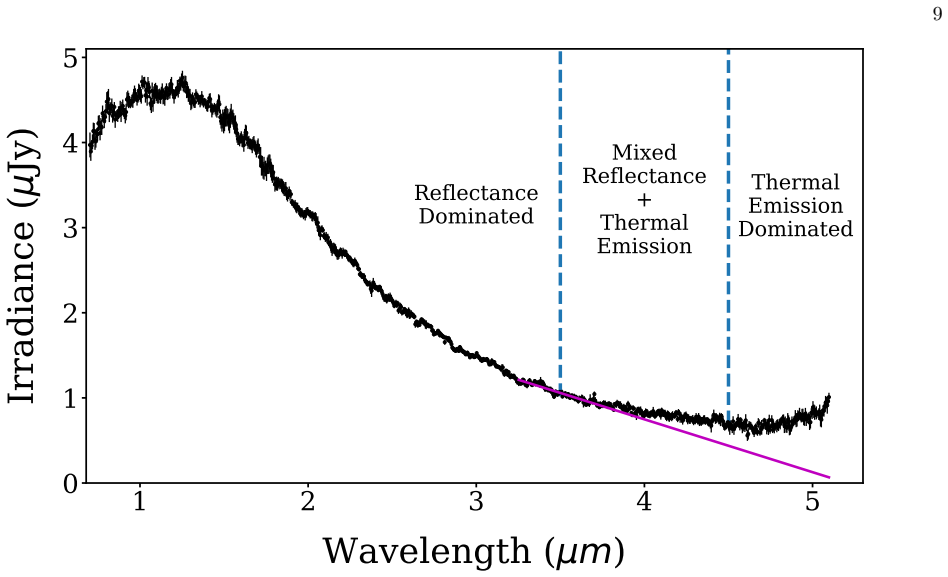
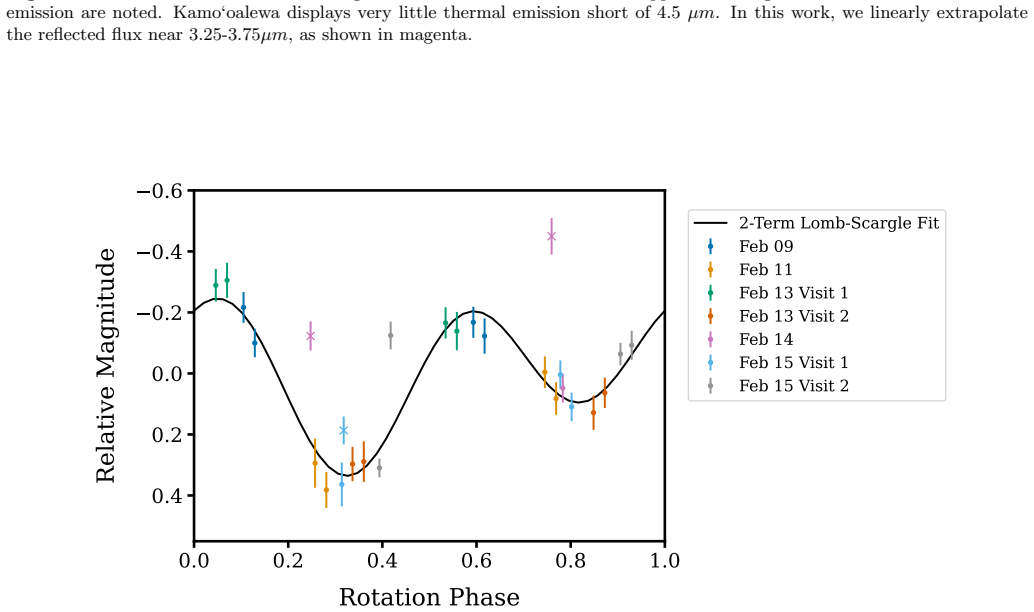
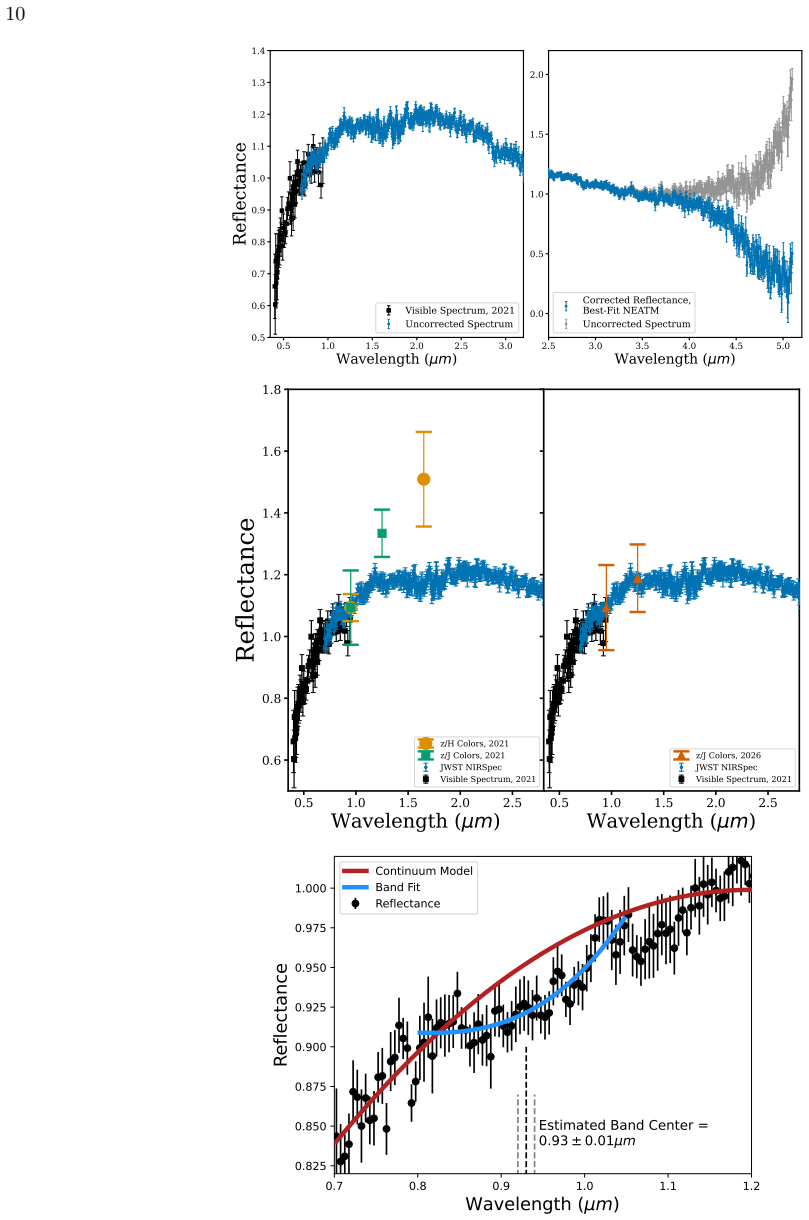
The JWST reflectance spectrum is notably less red from 1.0-2.5 μm than previous ground-based spectrophotometric observations, with infrared colors more similar to S, V, or E-type silicate asteroids. A faint silicate absorption feature is detected at 0.93±0.01 μm but not at 2.0 μm. Models of the faint thermal emission beginning near 4.5 μm find a mean diameter of 18±2 m and best-fit visible albedo p_V = 0.59, with this combination of color, albedo, and absorption bands similar to oldhamite-bearing enstatite-rich compositions. Brightness variations confirm the 27.9-minute rotation period.
What carries the argument
NIRSpec integral field unit reflectance spectroscopy from 0.6-5 μm combined with thermal emission models applied to the long-wavelength data to derive size and albedo.
If this is right
- Kamo`oalewa is consistent with enstatite-rich rather than lunar-like material.
- The diameter is 18 meters and the albedo is approximately 0.59.
- The rotation period of 27.9 minutes is confirmed independently by the JWST brightness changes.
- LBT zJ colors from 2026 agree with the JWST data and differ from the 2021 ground-based results.
Where Pith is reading between the lines
- This revised view could mean other Earth quasi-satellites also have enstatite compositions.
- Mission planning for Tianwen-2 may need to account for a brighter, less weathered surface.
- Neutral spectra in additional small near-Earth objects could point to a larger population of enstatite-rich bodies.
Load-bearing premise
That the neutral spectrum, high albedo, and specific absorption features uniquely identify oldhamite-bearing enstatite-rich material rather than other possible compositions or unaccounted surface effects such as variable emissivity.
What would settle it
A new spectrum or laboratory measurement of a different asteroid composition that reproduces the exact JWST reflectance shape from 0.6 to 5 μm along with the derived albedo and diameter.
Figures

read the original abstract
Near-Earth asteroid (469219) Kamo`oalewa is a uniquely stable quasi-satellite of the Earth and a target of the Tianwen-2 spacecraft mission. Here we report observations taken with JWST's NIRSpec instrument in integral field unit (IFU) mode in February 2026. The JWST reflectance spectrum is notably less red (more neutral) from $1.0-2.5$ $\mu m$ than previous ground-based spectrophotometric observations. New observations made with LBT in April 2026, observed and processed similarly to the 2021 observations, find $zJ$ colors in agreement with JWST. Kamo`oalewa's infrared colors appear more similar to S, V, or E-type silicate asteroids and unlike the reddened, space-weathered lunar-like silicates suggested by previous observations. In agreement with the ground-based spectrum, we detect a faint silicate absorption feature at $0.93\pm 0.01$ $\mu m$. We do not detect a 2.0 $\mu m$ silicate absorption. Models of Kamo`oalewa's faint thermal emission (beginning near 4.5 $\mu m$) find a mean diameter of $D=18\pm2\mathrm{m}$ and best-fit visible albedo $p_V = 0.59^{+0.25}_{-0.17}$, with models as low as $p_V = 0.36$ providing adequate model fits. This combination of color, albedo, and absorption bands is similar to oldhamite-bearing enstatite-rich compositions. Kamo`oalewa's brightness variations over the course of the JWST program provides independent confirmation of its rotation period of 27.9 minutes, with an axis ratio $\sim1.4$ ($D\sim15-21$ m).
Editorial analysis
A structured set of objections, weighed in public.
Referee Report
Summary. The paper presents new JWST NIRSpec IFU observations of the Earth quasi-satellite asteroid (469219) Kamo`oalewa, reporting a neutral (less red) reflectance spectrum from 1.0-2.5 μm compared to prior ground-based data, confirmation of a faint 0.93 μm silicate absorption feature, non-detection of a 2.0 μm feature, and LBT zJ colors consistent with the JWST spectrum. Thermal modeling of faint emission beginning near 4.5 μm yields a mean diameter of 18±2 m and best-fit visible albedo p_V=0.59^{+0.25}_{-0.17} (acceptable fits to p_V=0.36), leading to the conclusion that the color-albedo-band combination resembles oldhamite-bearing enstatite-rich compositions. Brightness variations confirm the 27.9 min rotation period and ~1.4 axis ratio.
Significance. If the thermal modeling and compositional interpretation hold, the result revises the object's classification away from space-weathered lunar-like silicates toward enstatite-rich material, with direct relevance to its origin, dynamical stability as a quasi-satellite, and target selection for the Tianwen-2 mission. The work demonstrates JWST's capability for characterizing small NEAs and combines independent JWST and LBT datasets with standard thermal modeling to produce falsifiable predictions about surface composition.
major comments (1)
- [Thermal modeling section] Thermal modeling section (paragraph beginning 'Models of Kamo`oalewa's faint thermal emission'): the reported acceptable fits at p_V=0.36 rely on standard NEATM-style assumptions (fixed emissivity near 0.9, no explicit roughness); for an ~18 m, 28-min rotator these parameters can alter effective temperature and shift inferred albedo by tens of percent. The manuscript should test sensitivity to emissivity (e.g., 0.8-1.0) or roughness to confirm whether the lower-albedo end still excludes S- or V-type interpretations given the neutral spectrum and 0.93 μm band.
minor comments (2)
- The abstract and thermal-model paragraph should explicitly state the wavelength range over which the thermal component is modeled and the specific thermal model (NEATM or variant) employed, including any fixed parameters.
- Figure captions or text should clarify how the LBT zJ colors were processed to match the 2021 observations, including any aperture or calibration details.
Simulated Author's Rebuttal
We thank the referee for their positive assessment of the manuscript and recommendation for minor revision. We address the single major comment below.
read point-by-point responses
-
Referee: [Thermal modeling section] Thermal modeling section (paragraph beginning 'Models of Kamo`oalewa's faint thermal emission'): the reported acceptable fits at p_V=0.36 rely on standard NEATM-style assumptions (fixed emissivity near 0.9, no explicit roughness); for an ~18 m, 28-min rotator these parameters can alter effective temperature and shift inferred albedo by tens of percent. The manuscript should test sensitivity to emissivity (e.g., 0.8-1.0) or roughness to confirm whether the lower-albedo end still excludes S- or V-type interpretations given the neutral spectrum and 0.93 μm band.
Authors: We agree that the thermal modeling relies on standard NEATM assumptions with fixed emissivity ~0.9 and no explicit roughness, and that for an ~18 m object with a 28-min period these choices can affect the derived albedo at the tens-of-percent level. In the revised manuscript we will add sensitivity tests varying emissivity from 0.8 to 1.0 and incorporating a simple roughness parameter. These runs will be used to re-evaluate the acceptable albedo range and to confirm whether the lower-albedo solutions remain compatible with the observed neutral spectrum and 0.93 μm band when distinguishing enstatite-rich compositions from S- or V-type interpretations. revision: yes
Circularity Check
No significant circularity; claims rest on new data and standard modeling
full rationale
The paper reports new JWST NIRSpec IFU observations from February 2026 and LBT photometry from April 2026. Reflectance spectrum, colors, and a 0.93 μm feature are extracted directly from these data. Thermal emission modeling (onset near 4.5 μm) is applied using standard methods to derive diameter (18±2 m) and albedo (best-fit 0.59, acceptable down to 0.36). Compositional similarity to oldhamite-bearing enstatite is stated as a comparison of the observed color-albedo-band combination to known materials. No equations reduce outputs to inputs by construction, no fitted parameters are relabeled as predictions, and no load-bearing self-citations or uniqueness theorems from prior author work appear in the derivation chain. The analysis is self-contained against external benchmarks.
Axiom & Free-Parameter Ledger
free parameters (2)
- mean diameter D =
18 m
- visible albedo p_V =
0.59
axioms (2)
- domain assumption Standard assumptions in asteroid thermal equilibrium and radiative transfer
- domain assumption The 0.93 μm feature is a silicate absorption and absence of 2.0 μm feature is compositionally diagnostic
Reference graph
Works this paper leans on
-
[1]
Astropy Collaboration, Robitaille, T. P., Tollerud, E. J., et al. 2013, A&A, 558, A33, doi: 10.1051/0004-6361/201322068 Astropy Collaboration, Price-Whelan, A. M., Sip˝ ocz, B. M., et al. 2018, AJ, 156, 123, doi: 10.3847/1538-3881/aabc4f Astropy Collaboration, Price-Whelan, A. M., Lim, P. L., et al. 2022, ApJ, 935, 167, doi: 10.3847/1538-4357/ac7c74
-
[2]
Belskaya, I. N., & Shevchenko, V. G. 2000, Icarus, 147, 94, doi: 10.1006/icar.2000.6410
-
[3]
Bohlin, R. C., Gordon, K. D., & Tremblay, P.-E. 2014, PASP, 126, 711, doi: 10.1086/677655
-
[4]
Bonamico, R., Hanuˇ s, J., & Delbo, M. 2026, arXiv e-prints, arXiv:2604.26734, doi: 10.48550/arXiv.2604.26734
work page internal anchor Pith review Pith/arXiv arXiv doi:10.48550/arxiv.2604.26734 2026
-
[5]
1989, in Asteroids II, ed
Bowell, E., Hapke, B., Domingue, D., et al. 1989, in Asteroids II, ed. R. P. Binzel, T. Gehrels, & M. S. Matthews, 524–556
1989
-
[6]
Burbine, T. H., & Binzel, R. P. 2002, Icarus, 159, 468, doi: 10.1006/icar.2002.6902
-
[7]
doi:10.5281/zenodo.17515973 , version =
Bushouse, H., Eisenhamer, J., Dencheva, N., et al. 2025, JWST Calibration Pipeline, 1.20.2 Zenodo, doi: 10.5281/zenodo.17515973
-
[8]
Cantillo, D. C., Ridenhour, K. I., Battle, A., et al. 2024, PSJ, 5, 138, doi: 10.3847/PSJ/ad4885
-
[9]
D., Malhotra, R., & Rosengren, A
Castro-Cisneros, J. D., Malhotra, R., & Rosengren, A. J. 2023, arXiv e-prints, arXiv:2304.14136, doi: 10.48550/arXiv.2304.14136 7
-
[10]
Dai, W., Moynier, F., & Siebert, J. 2024, GeoCoA, 375, 247, doi: 10.1016/j.gca.2024.04.022 de la Fuente Marcos, C., & de la Fuente Marcos, R. 2016, MNRAS, 462, 3441, doi: 10.1093/mnras/stw1972 Delb´ o, M., & Harris, A. W. 2002, M&PS, 37, 1929, doi: 10.1111/j.1945-5100.2002.tb01174.x Devog` ele, M., Hainaut, O. R., Micheli, M., et al. 2026, Journal of the ...
-
[11]
2021, AJ, 162, 227, doi: 10.3847/1538-3881/ac2902
Fenucci, M., & Novakovi´ c, B. 2021, AJ, 162, 227, doi: 10.3847/1538-3881/ac2902
-
[12]
2026, A&A, 706, A276, doi: 10.1051/0004-6361/202558680
Fenucci, M., Novakovi´ c, B., Granvik, M., & Zhang, P. 2026, A&A, 706, A276, doi: 10.1051/0004-6361/202558680
-
[13]
2006, Science, 312, 1330, doi: 10.1126/science.1125841
Fujiwara, A., Kawaguchi, J., Yeomans, D., et al. 2006, Science, 312, 1330, doi: 10.1126/science.1125841
-
[14]
J., & Kelley, M
Gaffey, M. J., & Kelley, M. S. 2004, in Lunar and Planetary Science Conference, Lunar and Planetary Science Conference, 1812
2004
-
[15]
Gordon, K. D., Bohlin, R., Sloan, G. C., et al. 2022, AJ, 163, 267, doi: 10.3847/1538-3881/ac66dc
-
[16]
Harris, A. W. 1989, in Lunar and Planetary Science
1989
-
[17]
Harris, A. W. 1998, Icarus, 131, 291, doi: 10.1006/icar.1997.5865
-
[18]
Hicks, M. D., Buratti, B. J., Lawrence, K. J., et al. 2014, Icarus, 235, 60, doi: 10.1016/j.icarus.2013.11.011
-
[19]
Hirabayashi, M., & Scheeres, D. J. 2015, The Astrophysical Journal Letters, 798, L8, doi: 10.1088/2041-8205/798/1/L8
-
[20]
2023, AJ, 166, 178, doi: 10.3847/1538-3881/acf8cc
Hu, S., Li, B., Jiang, H., Bao, G., & Ji, J. 2023, AJ, 166, 178, doi: 10.3847/1538-3881/acf8cc
-
[21]
2024, Nature Astronomy, 8, 819, doi: 10.1038/s41550-024-02258-z
Jiao, Y., Cheng, B., Huang, Y., et al. 2024, Nature Astronomy, 8, 819, doi: 10.1038/s41550-024-02258-z
-
[22]
2019, in EPSC-DPS Joint Meeting 2019, Vol
Jin, W., Li, F., Yan, J., et al. 2019, in EPSC-DPS Joint Meeting 2019, Vol. 2019, EPSC–DPS2019–1485
2019
-
[23]
Kareta, T., Fuentes-Mu˜ noz, O., Moskovitz, N., Farnocchia, D., & Sharkey, B. N. L. 2025, ApJL, 979, L8, doi: 10.3847/2041-8213/ad9ea8
-
[24]
A., & Spencer, J
Lebofsky, L. A., & Spencer, J. R. 1989, in Asteroids II, ed. R. P. Binzel, T. Gehrels, & M. S. Matthews, 128–147
1989
-
[26]
2019, Scientia Sinica Physica, Mechanica & Astronomica, 49, 084508, doi: 10.1360/SSPMA-2019-0028
Li, X., Qiao, D., Huang, J., Han, H., & Meng, L. 2019, Scientia Sinica Physica, Mechanica & Astronomica, 49, 084508, doi: 10.1360/SSPMA-2019-0028
-
[27]
M., Pentik¨ ainen, H., Uvarova, E., et al
MacLennan, E. M., Pentik¨ ainen, H., Uvarova, E., et al. 2026, A&A, 707, A131, doi: 10.1051/0004-6361/202556031
-
[28]
Mommert, M., Jedicke, R., & Trilling, D. E. 2018, AJ, 155, 74, doi: 10.3847/1538-3881/aaa23b
-
[29]
2014, in Protostars and Planets VI, ed
Reddy, V., Dunn, T. L., Thomas, C. A., Moskovitz, N. A., & Burbine, T. H. 2015, in Asteroids IV, ed. P. Michel, F. E. DeMeo, & W. F. Bottke, 43–63, doi: 10.2458/azu uapress 9780816532131-ch003
work page doi:10.2458/azu 2015
-
[30]
2017, in AAS/Division for Planetary Sciences Meeting Abstracts, Vol
Reddy, V., Kuhn, O., Thirouin, A., et al. 2017, in AAS/Division for Planetary Sciences Meeting Abstracts, Vol. 49, AAS/Division for Planetary Sciences Meeting Abstracts #49, 204.07
2017
-
[31]
Reddy, V., Le Corre, L., O’Brien, D. P., et al. 2012, Icarus, 221, 544, doi: 10.1016/j.icarus.2012.08.011
-
[32]
S., de Wit, J., Micheli, M., et al
Rivkin, A. S., de Wit, J., Micheli, M., et al. 2026, Research Notes of the AAS, 10, 52, doi: 10.3847/2515-5172/ae4fb4
-
[33]
2025, PSJ, 6, 69, doi: 10.3847/PSJ/adb95d
Battle, A. 2025, PSJ, 6, 69, doi: 10.3847/PSJ/adb95d
-
[34]
A., Thomas, C., Reddy, V., et al
Sanchez, J. A., Thomas, C., Reddy, V., et al. 2020, AJ, 159, 146, doi: 10.3847/1538-3881/ab723f
-
[35]
Scheeres, D. J., & S´ anchez, P. 2018, Progress in Earth and Planetary Science, 5, 25, doi: 10.1186/s40645-018-0182-9
-
[36]
Sharkey, B. N. L., Rivkin, A. S., Cartwright, R. J., et al. 2025, PSJ, 6, 242, doi: 10.3847/PSJ/ae04dd
-
[37]
Sharkey, B. N. L., Reddy, V., Malhotra, R., et al. 2021, Communications Earth and Environment, 2, 231, doi: 10.1038/s43247-021-00303-7
-
[38]
Tholen, D. J. 1989, in Asteroids II, ed. R. P. Binzel, T. Gehrels, & M. S. Matthews, 1139–1150
1989
-
[39]
2016, in AAS/Division for Planetary Sciences Meeting Abstracts, Vol
Micheli, M. 2016, in AAS/Division for Planetary Sciences Meeting Abstracts, Vol. 48, AAS/Division for Planetary Sciences Meeting Abstracts #48, 311.05
2016
-
[40]
Mandell, A. M. 2018, JQSRT, 217, 86, doi: 10.1016/j.jqsrt.2018.05.023
-
[41]
Wong, I., Brown, M. E., Emery, J. P., et al. 2024, PSJ, 5, 87, doi: 10.3847/PSJ/ad2fc3 8 T able 1.Per-dither observational circumstances and reflected irradiances Exposure Mid-Time ∆ (au) r (au) Phase ( ◦) Integrated Irradiance (mJy) 2026-02-09 01:41:01.820 0.17340 1.06615 61.4763 1.766±0.076 2026-02-09 01:54:38.844 0.17340 1.06616 61.4722 1.803±0.096 202...
discussion (0)
Sign in with ORCID, Apple, or X to comment. Anyone can read and Pith papers without signing in.