On-orbit Calibration of the Carruthers GCI: Photon Background Removal
Pith reviewed 2026-06-25 23:23 UTC · model grok-4.3
The pith
Algorithms remove photon backgrounds from Carruthers GeoCoronal Imager data to isolate exospheric hydrogen Lyman-alpha signals with approximately 3% error.
A machine-rendered reading of the paper's core claim, the machinery that carries it, and where it could break.
Core claim
The paper establishes that the photon background removal algorithms, applied within the L1B-to-L1C pipeline, isolate the exospheric H Lyman-alpha radiance from interplanetary hydrogen and limb-dominated oxygen emissions at 1304 and 1356 Angstrom, achieving an expected measurement error of approximately 3 percent as shown by synthetic image validation.
What carries the argument
The photon background removal algorithms combined with the L1B-to-L1C science data processing pipeline that produces absolutely calibrated exospheric measurements.
If this is right
- Exospheric hydrogen radiance can be recovered in physical units after background subtraction.
- Global spatial maps and temporal variability of the exosphere become measurable.
- Response of the exosphere to geomagnetic storms can be observed in the calibrated data.
- Both wide-field and narrow-field Lyman-alpha channels yield usable signals after processing.
Where Pith is reading between the lines
- The same background subtraction steps could apply to other Lyman-alpha imaging instruments viewing planetary atmospheres from space.
- If the synthetic generator proves representative, future missions might rely more on modeled backgrounds than extensive pre-flight tests.
- Accurate removal of the oxygen limb signal may enable studies of weaker exospheric features that were previously masked.
Load-bearing premise
The synthetic image generator accurately represents the actual on-orbit photon backgrounds, including the dominance of oxygen emissions near Earth's limb.
What would settle it
Direct comparison of processed real on-orbit images against independent exospheric radiance measurements from another instrument or model that would confirm or refute the 3 percent error level.
Figures

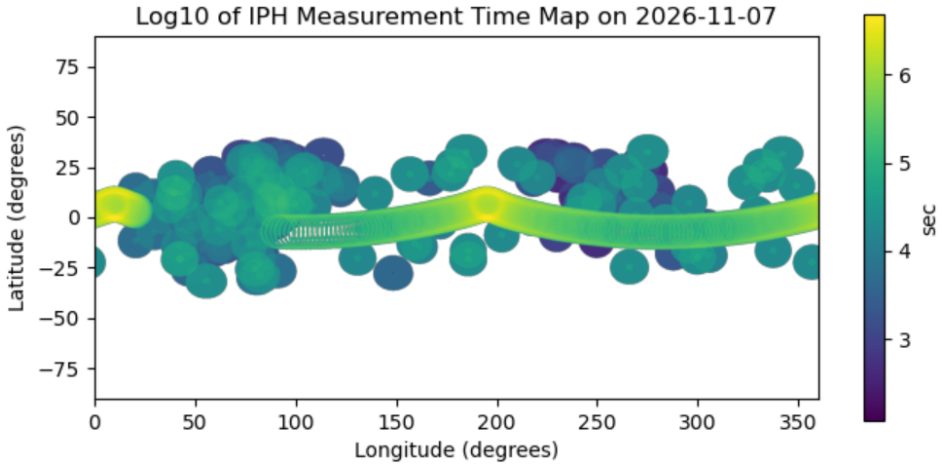
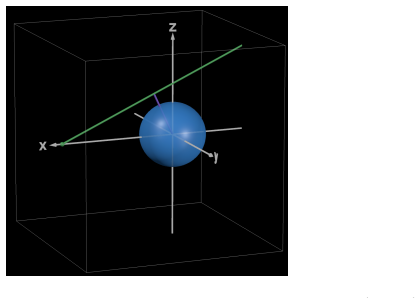
read the original abstract
The Carruthers Geocorona Observatory, launched in September 2025, is NASA's first mission devoted to investigating the fundamental nature of Earth's exosphere from its distant vantage in halo orbit around the Earth-Sun Lagrange 1 (L1) point. Its primary payload, the GeoCoronal Imager, consists of two coaligned photometric imagers that measure ultraviolet Lyman-alpha emission radiance from exospheric hydrogen simultaneously at wide- and narrow- fields of view. These observations will map the exosphere's global spatial structure and observe its temporal variability in response to geomagnetic storms. However, a critical step in that analysis is isolating the in band exospheric H Lyman-alpha signal from any other source of photons, including in-band InterPlanetary Hydrogen photon background and out of band photon backgrounds. The latter is dominated by oxygen emissions at 1304Ang and 1356Ang near Earth's limb. This paper details the algorithms used to retrieve and remove photon backgrounds on-orbit. Finally, the science data processing pipeline that transforms instrument-effect corrected images (L1B science data product) into absolutely-calibrated exospheric H measurements in physical units (L1C science data product) is detailed. Validation using a synthetic image generator demonstrates that the algorithms achieve an expected error of approximately 3% for exospheric radiance measurements.
Editorial analysis
A structured set of objections, weighed in public.
Referee Report
Summary. The paper describes algorithms for removing in-band interplanetary hydrogen and out-of-band oxygen (O I 1304 Å and 1356 Å) photon backgrounds from Carruthers GCI ultraviolet images, details the L1B-to-L1C processing pipeline that produces absolutely calibrated exospheric H Lyman-alpha radiance, and reports validation via a synthetic image generator that yields an expected error of approximately 3% in the retrieved exospheric radiance.
Significance. If the synthetic generator is shown to faithfully reproduce the spatially varying on-orbit background field, the work would supply a practical, end-to-end method for background-corrected exospheric mapping from L1, directly supporting the mission’s science goals of characterizing global exospheric structure and geomagnetic-storm response.
major comments (2)
- [Abstract / Validation section] Abstract and validation section: the headline claim of ~3% error rests entirely on synthetic-image tests, yet the manuscript supplies no quantitative comparison of the generator’s output statistics (limb profiles, count-rate histograms, or spectral leakage fractions) against pre-flight calibration data or any independent on-orbit measurements of the dominant O I 1304/1356 Å limb emission. Without such a fidelity check, the reported error bound cannot be transferred to real flight data.
- [Background-removal algorithm description] Background-removal algorithm description (presumably §3–4): it is not stated whether any free parameters in the background models (e.g., scaling factors for geocoronal O emission or instrument scatter) are determined from the same images used in the synthetic validation or from an independent data set; this leaves open the possibility of circularity in the quoted 3% figure.
minor comments (2)
- [Abstract] The abstract states an “expected error of approximately 3%” but does not specify the metric (RMS, median absolute deviation, etc.) or the exact definition of “exospheric radiance” used in the comparison.
- [Validation figures] Figure captions and axis labels in the validation figures should explicitly state whether the plotted residuals are in physical units (R) or normalized counts.
Simulated Author's Rebuttal
We thank the referee for the constructive comments. We address each major point below and will revise the manuscript to improve clarity on validation and parameter sources.
read point-by-point responses
-
Referee: [Abstract / Validation section] Abstract and validation section: the headline claim of ~3% error rests entirely on synthetic-image tests, yet the manuscript supplies no quantitative comparison of the generator’s output statistics (limb profiles, count-rate histograms, or spectral leakage fractions) against pre-flight calibration data or any independent on-orbit measurements of the dominant O I 1304/1356 Å limb emission. Without such a fidelity check, the reported error bound cannot be transferred to real flight data.
Authors: We acknowledge that the manuscript does not present explicit quantitative comparisons of the synthetic generator outputs (such as limb profiles or count-rate histograms) to pre-flight calibration data. The generator is built from pre-flight models, but we agree that direct fidelity metrics are needed to support transferability of the 3% error to flight data. In revision we will add a dedicated subsection with these comparisons using available pre-flight datasets. On-orbit O I measurements are still being accumulated and will be addressed in subsequent work. revision: yes
-
Referee: [Background-removal algorithm description] Background-removal algorithm description (presumably §3–4): it is not stated whether any free parameters in the background models (e.g., scaling factors for geocoronal O emission or instrument scatter) are determined from the same images used in the synthetic validation or from an independent data set; this leaves open the possibility of circularity in the quoted 3% figure.
Authors: The free parameters are obtained from pre-flight laboratory calibrations and independent on-orbit datasets that are distinct from the synthetic validation images. We will revise §§3–4 to explicitly document these independent sources and thereby remove any ambiguity about circularity. revision: yes
Circularity Check
No significant circularity; validation uses independent synthetic generator with known truth
full rationale
The paper describes photon background removal algorithms and validates performance via a synthetic image generator that supplies known exospheric radiance inputs, yielding an expected ~3% error. No quoted equations, self-citations, or parameter-fitting steps reduce the reported error metric to the inputs by construction. The synthetic generator serves as an external testbed rather than a fitted or self-defined component, and the abstract supplies no indication that background models were tuned on the same realizations used for validation. This is the standard non-circular pattern for algorithm testing on simulated data.
Axiom & Free-Parameter Ledger
Reference graph
Works this paper leans on
-
[1]
Swan/soho lyman-αmapping: The hydrogen geocorona extends well beyond the moon,
I. I. Baliukin, J.-L. Bertaux, E. Qu´ emerais, V. Izmodenov, and W. Schmidt, “Swan/soho lyman-αmapping: The hydrogen geocorona extends well beyond the moon,”Journal of Geo- physical Research: Space Physics, vol. 124, no. 2, pp. 861–885, 2019.doi:https://doi.org/ 10.1029/2018ja026136
-
[2]
Redistribution of h atoms in the upper atmosphere during geomagnetic storms,
J. Qin, L. Waldrop, and J. J. Makela, “Redistribution of h atoms in the upper atmosphere during geomagnetic storms,”Journal of Geophysical Research: Space Physics, vol. 122, no. 10, pp. 10–686, 2017.doi:https://doi.org/10.1002/2017ja024489
-
[3]
At- mospheric escape and evolution of terrestrial planets and satellites,
H. Lammer, J. F. Kasting, E. Chassefi` ere, R. E. Johnson, Y. N. Kulikov, and F. Tian, “At- mospheric escape and evolution of terrestrial planets and satellites,”Space Science Reviews, vol. 139, no. 1, pp. 399–436, 2008.doi:https://doi.org/10.1007/s11214-008-9413-5
-
[4]
Ultraviolet spectroscopy and remote sensing of the upper atmosphere
R. Meier, “Ultraviolet spectroscopy and remote sensing of the upper atmosphere,”Space Science Reviews, vol. 58, no. 2, Dec. 1991.doi:https://doi.org/10.1007/BF01206000
-
[5]
Apollo 16 lyman alpha imagery of the hydrogen geocorona,
G. R. Carruthers, T. Page, and R. R. Meier, “Apollo 16 lyman alpha imagery of the hydrogen geocorona,”Journal of Geophysical Research, vol. 81, no. 10, pp. 1664–1672, 1976.doi:https: //doi.org/10.1029/ja081i010p01664 17
-
[6]
Space science reviews volume on galileo mission overview,
T. V. Johnson, C. Yeates, and R. Young, “Space science reviews volume on galileo mission overview,”Space Science Reviews, vol. 60, no. 1, pp. 3–21, 1992.doi:https://doi.org/10. 1007/bf00216848
1992
-
[7]
Ecliptic north-south symmetry of hydrogen geocorona,
S. Kameda et al., “Ecliptic north-south symmetry of hydrogen geocorona,”Geophysical Research Letters, vol. 44, no. 23, pp. 11–706, 2017.doi:https : / / doi . org / 10 . 1002 / 2017gl075915
2017
-
[8]
J. Bertaux, “Interpretation of ogo-5 line shape measurements of lyman-αemission from ter- restrial exospheric hydrogen,”Planetary and Space Science, vol. 26, no. 5, pp. 431–447, 1978. doi:https://doi.org/10.1016/0032-0633(78)90065-x
-
[9]
On-orbit Calibration of the Carruthers GCI: Instrument Effect Correction,
A. M. Zhang, H. Filippini, L. Waldrop, and J. B. McPhate, “On-orbit Calibration of the Carruthers GCI: Instrument Effect Correction,” 2026, Under review at Space Science Reviews
2026
-
[10]
On-orbit Calibration of the Carruthers GCI: Radiometric Sensitivity,
A. M. Zhang et al., “On-orbit Calibration of the Carruthers GCI: Radiometric Sensitivity,” 2026, Under review at Space Science Reviews
2026
-
[11]
Numerical Model Simulation of the Carruthurs Geocoronal Observatory,
H. Filippini et al., “Numerical Model Simulation of the Carruthurs Geocoronal Observatory,” vol. 99999, no. 99999, pp. 0-0, Feb. 2026.doi:0.0
2026
-
[12]
Design and performance of the carruthers geocoronal imager,
M. M. Sirk et al., “Design and performance of the carruthers geocoronal imager,” Under review at Space Science Reviews, 2026
2026
-
[13]
P. Virtanen et al., “Scipy 1.0: Fundamental algorithms for scientific computing in python,” Nature methods, vol. 17, no. 3, pp. 261–272, 2020.doi:https://doi.org/10.1038/s41592- 019-0686-2
-
[14]
Deceleration of interstellar hydrogen at the heliospheric interface,
R. Lallement, J.-L. Bertaux, and J. T. Clarke, “Deceleration of interstellar hydrogen at the heliospheric interface,”Science, vol. 260, no. 5111, pp. 1095–1098, 1993.doi:https://doi. org/10.1126/science.260.5111.1095
-
[15]
Lyman-αmodels for lro lamp from messenger mascs and soho swan data,
W. R. Pryor et al., “Lyman-αmodels for lro lamp from messenger mascs and soho swan data,” inCross-Calibration of Far UV Spectra of Solar System Objects and the Heliosphere, E. Qu´ emerais, M. Snow, and R.-M. Bonnet, Eds. New York, NY: Springer New York, 2013, pp. 163–175,isbn: 978-1-4614-6384-9.doi:10 . 1007 / 978 - 1 - 4614 - 6384 - 9 _ 5[Online]. Availa...
-
[16]
Improved solar lymanα irradiance modeling from 1947 through 1999 based on uars observations,
T. N. Woods, W. K. Tobiska, G. J. Rottman, and J. R. Worden, “Improved solar lymanα irradiance modeling from 1947 through 1999 based on uars observations,”Journal of Geo- physical Research: Space Physics, vol. 105, no. A12, pp. 27 195–27 215, 2000.doi:https : //doi.org/10.1029/2000ja000051
-
[17]
J. H. Zoennchen, G. Cucho-Padin, L. Waldrop, and H. J. Fahr, “Comparison of terrestrial exospheric hydrogen 3d distributions at solar minimum and maximum using twins lyman-a observations,”Frontiers in Astronomy and Space Sciences, vol. 11, 2024,issn: 2296-987X. doi:10.3389/fspas.2024.1409744[Online]. Available:https://www.frontiersin.org/ journals/astrono...
-
[18]
S. V. Venkatakrishnan, C. A. Bouman, and B. Wohlberg, “Plug-and-play priors for model based reconstruction,” in2013 IEEE Global Conference on Signal and Information Process- ing, 2013, pp. 945–948.doi:10.1109/GlobalSIP.2013.6737048
-
[19]
D. P. Kingma and J. Ba,Adam: A method for stochastic optimization, 2017. arXiv:1412.6980 [cs.LG]. [Online]. Available:https://arxiv.org/abs/1412.6980 18
Pith/arXiv arXiv 2017
-
[20]
Pytorch: An imperative style, high-performance deep learning library,
A. Paszke et al., “Pytorch: An imperative style, high-performance deep learning library,” vol. 32, H. Wallach, H. Larochelle, A. Beygelzimer, F. d’Alch´ e-Buc, E. Fox, and R. Garnett, Eds., 2019. [Online]. Available:https://proceedings.neurips.cc/paper_files/paper/ 2019/file/bdbca288fee7f92f2bfa9f7012727740-Paper.pdf 19
2019
discussion (0)
Sign in with ORCID, Apple, or X to comment. Anyone can read and Pith papers without signing in.