Proximity-Induced Spin Reorientation in Monolayer CrI₃ on Hexagonal WTe₂
Pith reviewed 2026-06-25 23:07 UTC · model grok-4.3
The pith
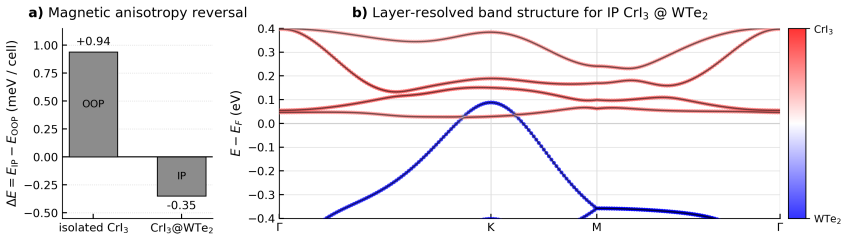
Placing monolayer CrI₃ on WTe₂ reorients its magnetization from out-of-plane to in-plane.
A machine-rendered reading of the paper's core claim, the machinery that carries it, and where it could break.
Core claim
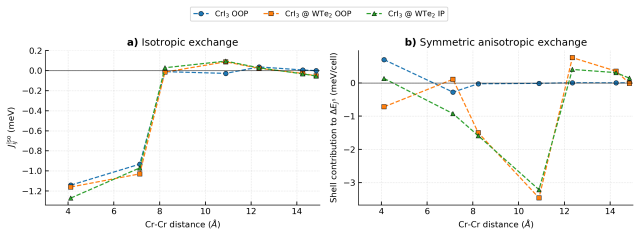
WTe₂ reorients the CrI₃ magnetization from out-of-plane to in-plane and substantially enhances the magnetic ordering scale within the extracted spin models. The reorientation is driven by a substrate-induced change in the balance between symmetric anisotropic exchange and onsite anisotropy, as obtained from relativistic spin-Hamiltonian mapping of first-principles electronic structure calculations.
What carries the argument
Relativistic spin-Hamiltonian mapping that extracts magnetic interactions from first-principles electronic structure calculations and connects them to finite-temperature magnetic behavior.
Load-bearing premise
The relativistic spin-Hamiltonian mapping extracted from first-principles calculations accurately represents the proximity-induced modifications to magnetic interactions without dominant errors from exchange-correlation approximations or finite-size effects.
What would settle it
An experiment that measures the CrI₃/WTe₂ heterostructure and finds the magnetization remains out-of-plane or the ordering temperature stays unchanged would falsify the central claim.
Figures


read the original abstract
Magnetic anisotropy controls the orientation and thermal stability of two-dimensional magnetic order. Predicting proximity-induced changes in anisotropy requires linking the electronic structure to microscopic magnetic interactions and finite-temperature behavior. Here we study monolayer CrI$_3$ on hexagonal WTe$_2$ using a first-principles-to-finite-temperature workflow centered on relativistic spin-Hamiltonian mapping. We find that WTe$_2$ reorients the CrI$_3$ magnetization from out-of-plane to in-plane and substantially enhances the magnetic ordering scale within the extracted spin models. Analysis of the extracted spin Hamiltonians shows that the reorientation is driven by a substrate-induced change in the balance between symmetric anisotropic exchange and onsite anisotropy. We establish a transferable workflow for proximity-controlled magnetism in two-dimensional van der Waals heterostructures.
Editorial analysis
A structured set of objections, weighed in public.
Referee Report
Summary. The manuscript develops a first-principles workflow that maps the electronic structure of monolayer CrI₃ on hexagonal WTe₂ to a relativistic spin Hamiltonian and then analyzes finite-temperature behavior. It reports that the WTe₂ substrate reorients the CrI₃ magnetization from out-of-plane to in-plane while substantially increasing the magnetic ordering scale, with the reorientation arising from a substrate-induced shift in the relative strength of symmetric anisotropic exchange versus onsite anisotropy.
Significance. If the spin-Hamiltonian mapping is reliable, the work supplies a concrete, transferable protocol for predicting proximity-induced anisotropy changes in 2D van der Waals heterostructures. The combination of relativistic first-principles mapping with finite-temperature modeling is a methodological strength that could be applied to other material pairs.
major comments (2)
- [Spin-Hamiltonian mapping section] The central claim that the reorientation is driven by a change in the balance between symmetric anisotropic exchange and onsite anisotropy is load-bearing; the manuscript must therefore tabulate the extracted values of these terms (with uncertainties) for both freestanding CrI₃ and the heterostructure so that the shift can be verified quantitatively.
- [Computational methods] Anisotropy energies are typically only a few meV; the manuscript should therefore include explicit tests of convergence with supercell size and choice of exchange-correlation functional, as these are the dominant sources of uncertainty in the weakest assumption identified for the mapping procedure.
minor comments (1)
- Ensure that all symbols appearing in the extracted Hamiltonian (e.g., the precise definition of the symmetric anisotropic exchange tensor) are defined in a single, early section or table.
Simulated Author's Rebuttal
We thank the referee for the positive assessment and constructive comments. We address each major point below and will revise the manuscript accordingly.
read point-by-point responses
-
Referee: [Spin-Hamiltonian mapping section] The central claim that the reorientation is driven by a change in the balance between symmetric anisotropic exchange and onsite anisotropy is load-bearing; the manuscript must therefore tabulate the extracted values of these terms (with uncertainties) for both freestanding CrI₃ and the heterostructure so that the shift can be verified quantitatively.
Authors: We agree that explicit tabulation strengthens the central claim. The revised manuscript will include a new table (or expanded Table in the Spin-Hamiltonian mapping section) listing the symmetric anisotropic exchange and onsite anisotropy parameters extracted for both freestanding monolayer CrI₃ and the CrI₃/WTe₂ heterostructure, together with the estimated uncertainties arising from the mapping procedure. revision: yes
-
Referee: [Computational methods] Anisotropy energies are typically only a few meV; the manuscript should therefore include explicit tests of convergence with supercell size and choice of exchange-correlation functional, as these are the dominant sources of uncertainty in the weakest assumption identified for the mapping procedure.
Authors: We accept the recommendation. The revised manuscript will add explicit convergence tests with respect to supercell size and exchange-correlation functional choice in the Computational Methods section (or a dedicated supplementary note), quantifying their effect on the extracted anisotropy parameters. revision: yes
Circularity Check
No significant circularity in derivation chain
full rationale
The paper describes a standard first-principles electronic structure calculation mapped to a relativistic spin-Hamiltonian, followed by analysis of anisotropy terms and finite-temperature behavior. No load-bearing step reduces by construction to its own inputs, fitted parameters renamed as predictions, or self-citation chains. The reorientation claim follows directly from comparing extracted onsite anisotropy and symmetric anisotropic exchange terms between isolated CrI3 and the heterostructure, without self-referential definitions or uniqueness theorems imported from prior author work. The workflow is self-contained against external benchmarks.
Axiom & Free-Parameter Ledger
axioms (1)
- domain assumption First-principles electronic structure calculations combined with spin-Hamiltonian mapping accurately capture proximity effects on magnetic anisotropy.
Reference graph
Works this paper leans on
-
[1]
Nature546, 265–269 (2017)
Gong, C.et al.Discoveryofintrinsicferromagnetismintwo-dimensionalvanderwaalscrystals. Nature546, 265–269 (2017)
2017
-
[2]
Huang, B.et al.Layer-dependent ferromagnetism in a van der waals crystal down to the monolayer limit.Nature546, 270–273 (2017)
2017
-
[3]
S., Mandrus, D
Burch, K. S., Mandrus, D. & Park, J.-G. Magnetism in two-dimensional van der waals materials.Nature563, 47–52 (2018)
2018
-
[4]
Gibertini, M., Koperski, M., Morpurgo, A. F. & Novoselov, K. S. Magnetic 2d materials and heterostructures.Nature Nanotechnology14, 408–419 (2019)
2019
-
[5]
Lado, J. L. & Fernández-Rossier, J. On the origin of magnetic anisotropy in two dimensional CrI3.2D Materials4, 035002 (2017)
2017
-
[6]
L., Sorée, B
Tiwari, S., Van de Put, M. L., Sorée, B. & Vandenberghe, W. G. Critical behavior of the ferromagnets CrI3, CrBr3, and CrGeTe3 and the antiferromagnet FeCl2: A detailed first- principles study.Physical Review B103, 014432 (2021)
2021
-
[7]
R., Skovhus, T
Pavizhakumari, V. R., Skovhus, T. & Olsen, T. Beyond the random phase approximation for calculating curie temperatures in ferromagnets: application to Fe, Ni, Co and monolayer CrI3.Journal of Physics: Condensed Matter37, 115806 (2025)
2025
-
[8]
V., Mazurenko, V
Kashin, I. V., Mazurenko, V. V., Katsnelson, M. I. & Rudenko, A. N. Orbitally-resolved ferromagnetism of monolayer CrI3.2D Materials7, 025036 (2020). 18
2020
-
[9]
& Núñez, A
Jaeschke-Ubiergo, R., Suárez Morell, E. & Núñez, A. S. Theory of magnetism in the van der waals magnet CrI3.Physical Review B103, 174410 (2021)
2021
-
[10]
Krindges, A., Vaz de Morais Junior, C. A. & Piotrowski, M. J. Role of electronic correlations on exchange interactions and curie temperature in monolayer CrI3.ACS Omega11(2026). URLhttps://doi.org/10.1021/acsomega.6c02634
-
[11]
& Yan, J.-A
Webster, L. & Yan, J.-A. Strain-tunable magnetic anisotropy in monolayer CrCl3, CrBr3, and CrI3.Physical Review B98, 144411 (2018)
2018
-
[12]
I., Torbatian, Z., Qaiumzadeh, A
Vishkayi, S. I., Torbatian, Z., Qaiumzadeh, A. & Asgari, R. Strain and electric-field control of spin-spin interactions in monolayer CrI3.Physical Review Materials4, 094004 (2020)
2020
-
[13]
& Yuan, S
Wu, Z., Yu, J. & Yuan, S. Strain-tunable magnetic and electronic properties of monolayer CrI3.Physical Chemistry Chemical Physics21, 7750–7755 (2019)
2019
-
[14]
& Yazyev, O
Pizzochero, M. & Yazyev, O. V. Inducing magnetic phase transitions in monolayer CrI3 via lattice deformations.The Journal of Physical Chemistry C124, 7585–7590 (2020)
2020
-
[15]
& Sanyal, B
Wang, D. & Sanyal, B. Systematic study of monolayer to trilayer CrI3: Stacking sequence dependence of electronic structure and magnetism.The Journal of Physical Chemistry C125, 18467–18473 (2021)
2021
-
[16]
Dolui, K.et al.Proximity spin–orbit torque on a two-dimensional magnet within van der waals heterostructure: Current-driven antiferromagnet-to-ferromagnet reversible nonequilib- rium phase transition in bilayer CrI3.Nano Letters20, 2288–2295 (2020)
2020
-
[17]
Zollner, K., Faria Junior, P. E. & Fabian, J. Proximity exchange effects in MoSe2 and WSe2 heterostructures with CrI3: Twist angle, layer, and gate dependence.Physical Review B100, 085128 (2019)
2019
-
[18]
Zollner, K., Faria Junior, P. E. & Fabian, J. Strong manipulation of the valley splitting upon twisting and gating in MoSe2/CrI3 and WSe2/CrI3 van der waals heterostructures.Physical Review B107, 035112 (2023). 19
2023
-
[19]
Zhao, W.et al.Magnetic proximity and nonreciprocal current switching in a monolayer WTe2 helical edge.Nature Materials19, 503–507 (2020)
2020
-
[20]
& Ganesh, P
Staros, D., Rubenstein, B. & Ganesh, P. A first-principles study of bilayer 1t’-WTe2/CrI3: a candidate topological spin filter.npj Spintronics2, 4 (2024)
2024
-
[21]
Zhou, S.et al.Field-free and efficient nanosecond spin–orbit torque switching in optimized WTe2/Fe3GaTe2 heterostructures.Applied Physics Letters128, 192403 (2026)
2026
-
[22]
Zhang, X.et al.Imaging of a van der waals spin-orbit torque system using spin ensembles in hbn.Nature Communications(2026)
2026
-
[23]
Ning, H. L.et al.Efficient spin transfer in WTe 2/Fe3GeTe2 van der Waals heterostructure enabled by direct interlayer p-orbital hybridization (2024).2412.02966
arXiv 2024
-
[24]
Herling, F.et al.Strain-mediated lattice reconstruction enhances ferromagnetism in Cr2Ge2Te6/WTe2 van der Waals heterobilayers.Nano Letters26, 5434–5442 (2026)
2026
-
[25]
Li, J.et al.Proximity-magnetized quantum spin hall insulator: monolayer 1t ′- WTe2/Cr2Ge2Te6.Nature Communications13, 5134 (2022)
2022
-
[26]
Henríquez-Guerra, E.et al.Strain engineering of magnetoresistance and magnetic anisotropy in CrSBr.Advanced Materialse2506695 (2025)
2025
-
[27]
Cheng, G.et al.Emergence of electric-field-tunable interfacial ferromagnetism in 2d antifer- romagnet heterostructures.Nature Communications13, 7348 (2022)
2022
-
[28]
Eom, J.et al.Voltage control of magnetism in Fe3−xGeTe2/In2Se3 van der waals ferromag- netic/ferroelectric heterostructures.Nature Communications14, 5605 (2023)
2023
-
[29]
Bacaksiz, C., Šabani, D., Menezes, R. M. & Milošević, M. V. Distinctive magnetic properties of CrI3 and CrBr3 monolayers caused by spin-orbit coupling.Physical Review B103, 125418 (2021)
2021
-
[30]
& Milošević, M
Šabani, D., Bacaksız, C. & Milošević, M. V. Beyond orbitally resolved magnetic exchange in CrI3 and NiI2.Physical Review Letters135, 036704 (2025). 20
2025
-
[31]
T.et al.grogupy: v0.4.0 (2025)
Pozsár, D. T.et al.grogupy: v0.4.0 (2025). URLhttps://doi.org/10.5281/zenodo. 15449541
doi:10.5281/zenodo 2025
-
[32]
I., Katsnelson, M
Liechtenstein, A. I., Katsnelson, M. I., Antropov, V. P. & Gubanov, V. A. Local spin density functional approach to the theory of exchange interactions in ferromagnetic metals and alloys. Journal of Magnetism and Magnetic Materials67, 65–74 (1987)
1987
-
[33]
Martínez-Carracedo, G.et al.Relativistic magnetic interactions from nonorthogonal basis sets.Physical Review B108, 214418 (2023)
2023
-
[34]
& Heine, T
Ma, Y., Kou, L., Li, X., Dai, Y. & Heine, T. Two-dimensional transition metal dichalcogenides with a hexagonal lattice: Room-temperature quantum spin hall insulators.Physical Review B93, 035442 (2016)
2016
- [35]
-
[36]
& Weinberger, P
Udvardi, L., Szunyogh, L., Palotás, K. & Weinberger, P. First-principles relativistic study of spin waves in thin magnetic films.Physical Review B68, 104436 (2003)
2003
-
[37]
M.et al.The SIESTA method for ab initio order-N materials simulation.Journal of Physics: Condensed Matter14, 2745–2779 (2002)
Soler, J. M.et al.The SIESTA method for ab initio order-N materials simulation.Journal of Physics: Condensed Matter14, 2745–2779 (2002)
2002
-
[38]
García, A.et al.Siesta: Recent developments and applications.The Journal of Chemical Physics152, 204108 (2020)
2020
-
[39]
P., Burke, K
Perdew, J. P., Burke, K. & Ernzerhof, M. Generalized gradient approximation made simple. Physical Review Letters77, 3865–3868 (1996)
1996
-
[40]
Evans, R. F. L.et al.Atomistic spin model simulations of magnetic nanomaterials.Journal of Physics: Condensed Matter26, 103202 (2014). 21
2014
discussion (0)
Sign in with ORCID, Apple, or X to comment. Anyone can read and Pith papers without signing in.