Universal two-zero texture in SO(10): implications of JUNO and realization from non-invertible symmetries
Pith reviewed 2026-06-25 23:29 UTC · model grok-4.3
The pith
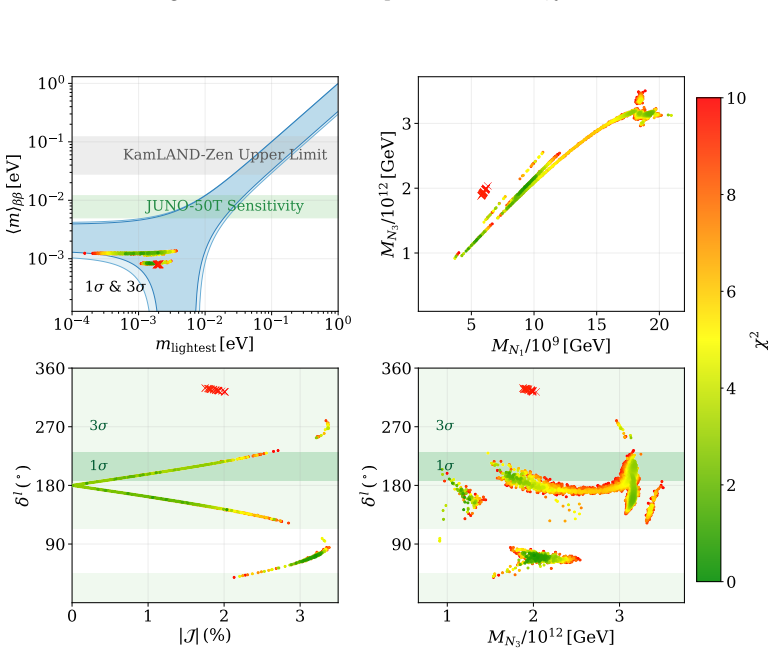
Universal two-zero texture in SO(10) fits nine flavor observables with seven parameters after fixing charged fermion masses.
A machine-rendered reading of the paper's core claim, the machinery that carries it, and where it could break.
Core claim
The universal two-zero texture imposed uniformly on the up-quark, down-quark, charged-lepton and neutrino mass matrices within SO(10) yields a seven-parameter description of nine flavor observables that fits all current data, exhibits an enhanced preference for normal neutrino mass ordering, confines the Dirac phase to two regions, and forecasts a meV-scale m_beta beta; the texture admits a realization from non-invertible selection rules produced by Z_3 gauging of Z_N with minimal N=7.
What carries the argument
Universal two-zero texture (UTZT) applied simultaneously to every quark and lepton mass matrix in the SO(10) framework.
If this is right
- The texture remains fully compatible with all current flavor data.
- It exhibits an enhanced preference for normal neutrino mass ordering.
- The Dirac phase is predicted mainly in two regions, one of which matches existing data.
- A meV-scale m_beta beta is forecasted, below the reach of next-generation neutrinoless double beta decay searches.
- The zero pattern can be realized from non-invertible selection rules of Z_3 gauged Z_N symmetry with minimal N=7.
Where Pith is reading between the lines
- Precision data on the Dirac phase from future oscillation experiments could distinguish or exclude one of the two allowed regions.
- The same non-invertible symmetry mechanism might generate analogous textures inside other grand unified groups without extra light fields.
- The seven-parameter economy provides a concrete target for testing whether zero textures survive in more complete ultraviolet completions.
Load-bearing premise
The universal two-zero texture must hold simultaneously for the up-quark, down-quark, charged-lepton and neutrino mass matrices inside the SO(10) framework.
What would settle it
A measurement of the Dirac CP phase outside both predicted intervals or an effective Majorana mass m_beta beta significantly above the meV range would rule out the construction.
Figures

read the original abstract
We apply the universal two-zero texture (UTZT) to all quark and lepton mass matrices in the SO(10) grand unified framework. With charged fermion masses fixed at their best-fit values, this texture contains only seven free parameters to account for nine flavor observables, rendering it highly predictive. Motivated by the recent JUNO indication in favor of the normal ordering of light neutrino masses, we perform an updated analysis of the UTZT in SO(10). The texture remains fully compatible with all current flavor data and exhibits an enhanced preference for normal ordering. The Dirac phase is predicted mainly in two regions, one of which matches very well with current data. A meV-scale $m_{\beta\beta}$ is predicted, beyond the sensitivity bound of future neutrinoless double beta decay measurement. We further explore the origin of the UTZT from non-invertible symmetries, without introducing additional low-energy degrees of freedom. We show that the UTZT can be realized through non-invertible selection rules arising from the $Z_3$ gauging of $Z_N$, with a minimal realization corresponding to $N=7$.
Editorial analysis
A structured set of objections, weighed in public.
Referee Report
Summary. The manuscript applies a universal two-zero texture (UTZT) simultaneously to all quark and lepton mass matrices (M_u, M_d, M_e, M_νD, M_R) inside an SO(10) GUT. With charged-fermion masses fixed at best-fit values, the texture is stated to involve only seven free parameters for nine flavor observables. An updated numerical analysis, motivated by the JUNO preference for normal ordering, finds full compatibility with current data, an enhanced preference for normal ordering, Dirac-phase predictions concentrated in two regions (one consistent with data), and a meV-scale m_ββ. The texture is further derived from non-invertible selection rules obtained by Z_3 gauging of Z_N (minimal N=7) without additional low-energy degrees of freedom.
Significance. If the UTZT can be consistently realized across all SO(10) sectors while preserving the stated parameter count, the work supplies a compact, predictive framework for flavor observables with direct implications for neutrino mass ordering, CP violation, and neutrinoless double-beta decay. The non-invertible symmetry construction, achieved without extra fields, constitutes a genuine theoretical strength that elevates the model beyond purely phenomenological texture studies.
major comments (2)
- [§3] §3 (texture implementation in SO(10)): the central claim that the UTZT reduces to exactly seven free parameters after fixing charged-fermion masses rests on the assumption that the same zero positions can be imposed on M_u, M_d, M_e, M_νD and M_R simultaneously. Because these matrices are linear combinations of the same Y_{10} and Y_{126} with sector-dependent Clebsch-Gordan coefficients, the alignment of zeros is not automatic and may impose additional relations among the underlying Yukawa entries, altering the effective parameter count. This point is load-bearing for the predictivity and compatibility statements.
- [Numerical results section] Numerical results section (analysis of neutrino observables): the abstract asserts that the seven-parameter fit remains fully compatible and yields specific predictions (enhanced normal ordering, two Dirac-phase regions, meV-scale m_ββ). Explicit tables or figures reporting the χ² values, the ranges of the seven parameters, and the treatment of SO(10) relations under the fit are required to substantiate that the quoted predictions do not reduce to the input fit itself.
minor comments (2)
- [Abstract] Abstract: the phrase 'nine flavor observables' is used without enumeration; listing them explicitly would improve clarity for readers unfamiliar with the precise counting.
- [§5] §5 (non-invertible symmetry): the minimal N=7 realization is stated, but a brief table or diagram showing which matrix entries are forbidden by the selection rules in each sector would aid verification that the texture is reproduced uniformly.
Simulated Author's Rebuttal
We thank the referee for the careful reading and constructive comments. We address the two major comments point by point below.
read point-by-point responses
-
Referee: [§3] §3 (texture implementation in SO(10)): the central claim that the UTZT reduces to exactly seven free parameters after fixing charged-fermion masses rests on the assumption that the same zero positions can be imposed on M_u, M_d, M_e, M_νD and M_R simultaneously. Because these matrices are linear combinations of the same Y_{10} and Y_{126} with sector-dependent Clebsch-Gordan coefficients, the alignment of zeros is not automatic and may impose additional relations among the underlying Yukawa entries, altering the effective parameter count. This point is load-bearing for the predictivity and compatibility statements.
Authors: The UTZT is imposed on the fundamental Yukawa matrices Y_{10} and Y_{126}. The mass matrices are then formed using fixed SO(10) Clebsch-Gordan coefficients, which are representation-theoretic constants and do not generate extra relations among the non-zero entries. The seven parameters are precisely the independent non-zero entries in Y_{10} and Y_{126} once charged-fermion masses are fixed; the neutrino-sector observables follow as predictions. We will add an explicit paragraph in §3 mapping the textured Yukawas through the CG coefficients to confirm no additional constraints arise. revision: partial
-
Referee: Numerical results section (analysis of neutrino observables): the abstract asserts that the seven-parameter fit remains fully compatible and yields specific predictions (enhanced normal ordering, two Dirac-phase regions, meV-scale m_ββ). Explicit tables or figures reporting the χ² values, the ranges of the seven parameters, and the treatment of SO(10) relations under the fit are required to substantiate that the quoted predictions do not reduce to the input fit itself.
Authors: We agree that the numerical section would benefit from greater explicitness. The revised manuscript will include a table with best-fit values, 1σ ranges of the seven parameters, and minimum χ² for normal versus inverted ordering. A new figure will show the predicted Dirac-phase and m_ββ distributions. The SO(10) relations are enforced by deriving all mass matrices from the same seven Yukawa parameters via the fixed CG coefficients; the fit minimizes χ² over these parameters only. revision: yes
Circularity Check
No significant circularity; texture ansatz and parameter reduction are independent inputs analyzed against data.
full rationale
The abstract states the UTZT is applied to all SO(10) matrices with charged-fermion masses fixed at best-fit values, yielding seven parameters for nine observables. This is a standard ansatz whose consequences (compatibility, normal-ordering preference, Dirac-phase regions, m_beta beta prediction) are then compared to external flavor data. The non-invertible symmetry section explores an origin for the texture without equations or claims that reduce any quoted prediction to a prior fit by construction. No self-citation chains, self-definitional loops, or fitted-input-renamed-as-prediction steps appear in the provided text. The central claim therefore remains self-contained and externally falsifiable.
Axiom & Free-Parameter Ledger
free parameters (1)
- seven free parameters of the universal two-zero texture
axioms (2)
- domain assumption The universal two-zero texture applies to all quark and lepton mass matrices in the SO(10) framework
- domain assumption SO(10) grand unified theory provides the underlying gauge structure
invented entities (1)
-
non-invertible symmetries realized by Z_3 gauging of Z_N (minimal N=7)
no independent evidence
Reference graph
Works this paper leans on
-
[1]
H. Fritzsch, Phys. Lett. B70, 436-440 (1977) doi:10.1016/0370-2693(77)90408-7
-
[2]
S. Weinberg, Trans. New York Acad. Sci. 38, 185-201 (1977) doi:10.1111/j.2164- 0947.1977.tb02958.x
-
[3]
F. Wilczek and A. Zee, Phys. Lett. B70, 418 (1977) [erratum: Phys. Lett. B72, 504 (1978)] doi:10.1016/0370-2693(77)90403-8
-
[4]
H. Fritzsch, Phys. Lett. B73, 317-322 (1978) doi:10.1016/0370-2693(78)90524-5
-
[5]
H. Fritzsch, Nucl. Phys. B155, 189-207 (1979) doi:10.1016/0550-3213(79)90362-6
-
[6]
D. s. Du and Z. z. Xing, Phys. Rev. D48, 2349-2352 (1993) doi:10.1103/PhysRevD.48.2349
-
[7]
A Symmetry Pattern of Maximal CP-Violation and a Determination of the Unitarity Triangle
H. Fritzsch and Z. z. Xing, Phys. Lett. B 353, 114-118 (1995) doi:10.1016/0370- 2693(95)00545-V [arXiv:hep-ph/9502297 [hep-ph]]
work page internal anchor Pith review Pith/arXiv arXiv doi:10.1016/0370- 1995
-
[8]
Z. z. Xing, J. Phys. G23, 1563-1578 (1997) doi:10.1088/0954-3899/23/11/006 [arXiv:hep- ph/9609204 [hep-ph]]
-
[9]
Four-Zero Texture of Hermitian Quark Mass Matrices and Current Experimental Tests
H. Fritzsch and Z. z. Xing, Phys. Lett. B 555, 63-70 (2003) doi:10.1016/S0370- 2693(03)00048-0 [arXiv:hep-ph/0212195 [hep-ph]]
work page internal anchor Pith review Pith/arXiv arXiv doi:10.1016/s0370- 2003
-
[10]
Z. z. Xing and H. Zhang, J. Phys. G30, 129-136 (2004) doi:10.1088/0954-3899/30/2/011 [arXiv:hep-ph/0309112 [hep-ph]]
work page internal anchor Pith review Pith/arXiv arXiv doi:10.1088/0954-3899/30/2/011 2004
-
[11]
Z. z. Xing and Z. h. Zhao, Nucl. Phys. B 897, 302-325 (2015) doi:10.1016/j.nuclphysb.2015.05.027 [arXiv:1501.06346 [hep-ph]]
work page internal anchor Pith review Pith/arXiv arXiv doi:10.1016/j.nuclphysb.2015.05.027 2015
-
[12]
H. Fritzsch, Z. z. Xing and D. Zhang, Nucl. Phys. B 974, 115634 (2022) doi:10.1016/j.nuclphysb.2021.115634 [arXiv:2111.06727 [hep-ph]]
-
[13]
P. H. Frampton, S. L. Glashow and D. Marfatia, Phys. Lett. B 536, 79-82 (2002) doi:10.1016/S0370-2693(02)01817-8 [arXiv:hep-ph/0201008 [hep-ph]]
work page internal anchor Pith review Pith/arXiv arXiv doi:10.1016/s0370-2693(02)01817-8 2002
-
[14]
Z. z. Xing, Phys. Lett. B 530, 159-166 (2002) doi:10.1016/S0370-2693(02)01354-0 [arXiv:hep-ph/0201151 [hep-ph]]
work page internal anchor Pith review Pith/arXiv arXiv doi:10.1016/s0370-2693(02)01354-0 2002
-
[15]
Z. z. Xing, Phys. Lett. B539, 85-90 (2002) doi:10.1016/S0370-2693(02)02062-2 [arXiv:hep- ph/0205032 [hep-ph]]. 12
-
[16]
Two-zero Textures of the Majorana Neutrino Mass Matrix and Current Experimental Tests
H. Fritzsch, Z. z. Xing and S. Zhou, JHEP09, 083 (2011) doi:10.1007/JHEP09(2011)083 [arXiv:1108.4534 [hep-ph]]
work page internal anchor Pith review Pith/arXiv arXiv doi:10.1007/jhep09(2011)083 2011
-
[17]
Z.z.XingandH.Zhang, Phys.Lett.B 569, 30-40(2003)doi:10.1016/j.physletb.2003.07.008 [arXiv:hep-ph/0304234 [hep-ph]]
work page internal anchor Pith review Pith/arXiv arXiv doi:10.1016/j.physletb.2003.07.008 2003
-
[18]
Y. L. Zhou, Phys. Rev. D 86, 093011 (2012) doi:10.1103/PhysRevD.86.093011 [arXiv:1205.2303 [hep-ph]]
work page internal anchor Pith review Pith/arXiv arXiv doi:10.1103/physrevd.86.093011 2012
-
[19]
Neutrino mass determination from a four-zero texture mass matrix
J. Barranco, D. Delepine and L. Lopez-Lozano, Phys. Rev. D 86, 053012 (2012) doi:10.1103/PhysRevD.86.053012 [arXiv:1205.0859 [hep-ph]]
work page internal anchor Pith review Pith/arXiv arXiv doi:10.1103/physrevd.86.053012 2012
-
[20]
Neutrino Mixing Angles from Texture Zeros of the Lepton Mass Matrices
H. Fritzsch and S. Zhou, Phys. Lett. B 718, 1457-1464 (2013) doi:10.1016/j.physletb.2012.12.071 [arXiv:1212.0411 [hep-ph]]
work page internal anchor Pith review Pith/arXiv arXiv doi:10.1016/j.physletb.2012.12.071 2013
-
[21]
J. Liao, D. Marfatia and K. Whisnant, Phys. Rev. D 87, 073013 (2013) doi:10.1103/PhysRevD.87.073013 [arXiv:1302.2372 [hep-ph]]
work page internal anchor Pith review Pith/arXiv arXiv doi:10.1103/physrevd.87.073013 2013
-
[22]
M. J. S. Yang, Phys. Lett. B 806, 135483 (2020) doi:10.1016/j.physletb.2020.135483 [arXiv:2002.09152 [hep-ph]]
-
[23]
M. J. S. Yang, PTEP 2022, no.1, 013B12 (2022) doi:10.1093/ptep/ptab162 [arXiv:2104.12063 [hep-ph]]
-
[24]
G. X. Fang and Y. L. Zhou, Chin. Phys. C49, no.10, 103107 (2025) doi:10.1088/1674- 1137/ade6d7 [arXiv:2410.18743 [hep-ph]]
-
[25]
A non Supersymmetric SO(10) Grand Unified Model for All the Physics below $M_{GUT}$
G. Altarelli and D. Meloni, JHEP 08, 021 (2013) doi:10.1007/JHEP08(2013)021 [arXiv:1305.1001 [hep-ph]]
work page internal anchor Pith review Pith/arXiv arXiv doi:10.1007/jhep08(2013)021 2013
-
[26]
K. S. Babu, B. Bajc and S. Saad, JHEP 02, 136 (2017) doi:10.1007/JHEP02(2017)136 [arXiv:1612.04329 [hep-ph]]
work page internal anchor Pith review Pith/arXiv arXiv doi:10.1007/jhep02(2017)136 2017
-
[27]
K. S. Babu, T. Fukuyama, S. Khan and S. Saad, JHEP 06, 045 (2019) doi:10.1007/JHEP06(2019)045 [arXiv:1812.11695 [hep-ph]]
work page internal anchor Pith review Pith/arXiv arXiv doi:10.1007/jhep06(2019)045 2019
-
[28]
T. Ohlsson and M. Pernow, JHEP 06, 085 (2019) doi:10.1007/JHEP06(2019)085 [arXiv:1903.08241 [hep-ph]]
work page internal anchor Pith review Pith/arXiv arXiv doi:10.1007/jhep06(2019)085 2019
-
[29]
V. S. Mummidi and K. M. Patel, JHEP 12, 042 (2021) doi:10.1007/JHEP12(2021)042 [arXiv:2109.04050 [hep-ph]]
-
[30]
B. Fu, S. F. King, L. Marsili, S. Pascoli, J. Turner and Y. L. Zhou, JHEP11, 072 (2022) doi:10.1007/JHEP11(2022)072 [arXiv:2209.00021 [hep-ph]]
-
[31]
B. Fu, S. F. King, L. Marsili, S. Pascoli, J. Turner and Y. L. Zhou, Phys. Rev. D109, no.5, 5 (2024) doi:10.1103/PhysRevD.109.055025 [arXiv:2308.05799 [hep-ph]]
-
[32]
K. S. Babu, C. S. Fong and S. Saad, JHEP11, 151 (2025) doi:10.1007/JHEP11(2025)151 [arXiv:2508.14969 [hep-ph]]
-
[33]
Fits to SO(10) Grand Unified Models
A. Dueck and W. Rodejohann, JHEP 09, 024 (2013) doi:10.1007/JHEP09(2013)024 [arXiv:1306.4468 [hep-ph]]
work page internal anchor Pith review Pith/arXiv arXiv doi:10.1007/jhep09(2013)024 2013
-
[34]
Saad, JHEP04, 058 (2023) doi:10.1007/JHEP04(2023)058 [arXiv:2212.05291 [hep-ph]]
S. Saad, JHEP04, 058 (2023) doi:10.1007/JHEP04(2023)058 [arXiv:2212.05291 [hep-ph]]
-
[35]
K. S. Babu, P. Di Bari, C. S. Fong and S. Saad, JHEP 10, 190 (2024) doi:10.1007/JHEP10(2024)190 [arXiv:2409.03840 [hep-ph]]. 13
- [36]
-
[37]
Z. Q. Chen, G. X. Fang and Y. L. Zhou, Phys. Rev. D 113, no.11, 115024 (2026) doi:10.1103/lwmz-2y6c [arXiv:2511.16196 [hep-ph]]
work page internal anchor Pith review Pith/arXiv arXiv doi:10.1103/lwmz-2y6c 2026
-
[38]
Y. F. Wang,JUNO Experiment, Talk presented in Neutrino 2026, Ivrine, June 2026
2026
-
[39]
Symmetry realization of texture zeros
W. Grimus, A. S. Joshipura, L. Lavoura and M. Tanimoto, Eur. Phys. J. C36, 227-232 (2004) doi:10.1140/epjc/s2004-01896-y [arXiv:hep-ph/0405016 [hep-ph]]
work page internal anchor Pith review Pith/arXiv arXiv doi:10.1140/epjc/s2004-01896-y 2004
-
[40]
The $S_3$ flavour symmetry: Neutrino masses and mixings
F. Gonzalez Canales, A. Mondragon and M. Mondragon, Fortsch. Phys.61, 546-570 (2013) doi:10.1002/prop.201200121 [arXiv:1205.4755 [hep-ph]]
work page internal anchor Pith review Pith/arXiv arXiv doi:10.1002/prop.201200121 2013
-
[41]
P. M. Ferreira, W. Grimus, D. Jurčiukonis and L. Lavoura, Nucl. Phys. B906, 289-320 (2016) doi:10.1016/j.nuclphysb.2016.03.011 [arXiv:1510.02641 [hep-ph]]
work page internal anchor Pith review Pith/arXiv arXiv doi:10.1016/j.nuclphysb.2016.03.011 2016
-
[42]
I. P. Ivanov and L. Lavoura, J. Phys. G 43, no.10, 105005 (2016) doi:10.1088/0954- 3899/43/10/105005 [arXiv:1511.02720 [hep-ph]]
work page internal anchor Pith review Pith/arXiv arXiv doi:10.1088/0954- 2016
-
[43]
T. Ohlsson and M. Pernow, JHEP 09, 111 (2021) doi:10.1007/JHEP09(2021)111 [arXiv:2107.08771 [hep-ph]]
-
[44]
M. Lindestam, T. Ohlsson and M. Pernow, JHEP 01, 009 (2022) doi:10.1007/JHEP01(2022)009 [arXiv:2110.09533 [hep-ph]]
-
[45]
D. Zhang, Nucl. Phys. B 952, 114935 (2020) doi:10.1016/j.nuclphysb.2020.114935 [arXiv:1910.07869 [hep-ph]]
-
[46]
J. N. Lu, X. G. Liu and G. J. Ding, Phys. Rev. D 101, no.11, 115020 (2020) doi:10.1103/PhysRevD.101.115020 [arXiv:1912.07573 [hep-ph]]
-
[47]
Y. Choi, H. T. Lam and S. H. Shao, Phys. Rev. Lett. 129, no.16, 161601 (2022) doi:10.1103/PhysRevLett.129.161601 [arXiv:2205.05086 [hep-th]]
-
[48]
C. Cordova and K. Ohmori, Phys. Rev. X 13, no.1, 011034 (2023) doi:10.1103/PhysRevX.13.011034 [arXiv:2205.06243 [hep-th]]
-
[49]
C. Cordova, S. Hong, S. Koren and K. Ohmori, Phys. Rev. X14, no.3, 031033 (2024) doi:10.1103/PhysRevX.14.031033 [arXiv:2211.07639 [hep-ph]]
-
[50]
C. Cordova, S. Hong and S. Koren, Phys. Rev. X 15, no.3, 031011 (2025) doi:10.1103/PhysRevX.15.031011 [arXiv:2402.12453 [hep-ph]]
-
[51]
T. Kobayashi, H. Otsuka and M. Tanimoto, JHEP 12, 117 (2024) doi:10.1007/JHEP12(2024)117 [arXiv:2409.05270 [hep-ph]]
-
[52]
G. C. Branco, L. Lavoura and F. Mota, Phys. Rev. D 39, 3443 (1989) doi:10.1103/PhysRevD.39.3443
-
[53]
Z. Jiang, B. Y. Qu and G. J. Ding, Phys. Rev. D 112, no.11, 115029 (2025) doi:10.1103/d29s-cw34 [arXiv:2510.07236 [hep-ph]]
-
[54]
T. Kobayashi, H. Otsuka, M. Tanimoto and H. Uchida, JHEP 08, 189 (2025) doi:10.1007/JHEP08(2025)189 [arXiv:2505.07262 [hep-ph]]
-
[55]
T. Kobayashi, H. Otsuka and T. T. Yanagida, Phys. Rev. D113, no.5, 055016 (2026) doi:10.1103/vbd5-5cp3 [arXiv:2508.12287 [hep-ph]]
-
[56]
B. Y. Qu, Z. Jiang and G. J. Ding, [arXiv:2602.24214 [hep-ph]]. 14
-
[57]
Intermediate mass scales in the non-supersymmetric SO(10) grand unification: a reappraisal
S. Bertolini, L. Di Luzio and M. Malinsky, Phys. Rev. D 80, 015013 (2009) doi:10.1103/PhysRevD.80.015013 [arXiv:0903.4049 [hep-ph]]
work page internal anchor Pith review Pith/arXiv arXiv doi:10.1103/physrevd.80.015013 2009
-
[58]
S. F. King, S. Pascoli, J. Turner and Y. L. Zhou, JHEP 10, 225 (2021) doi:10.1007/JHEP10(2021)225 [arXiv:2106.15634 [hep-ph]]
-
[59]
Suppressing Proton Decay in the Minimal SO(10) Model
B. Dutta, Y. Mimura and R. N. Mohapatra, Phys. Rev. Lett. 94, 091804 (2005) doi:10.1103/PhysRevLett.94.091804 [arXiv:hep-ph/0412105 [hep-ph]]
work page internal anchor Pith review Pith/arXiv arXiv doi:10.1103/physrevlett.94.091804 2005
-
[60]
Neutrino Mixing Predictions of a Minimal SO(10) Model with Suppressed Proton Decay
B. Dutta, Y. Mimura and R. N. Mohapatra, Phys. Rev. D 72, 075009 (2005) doi:10.1103/PhysRevD.72.075009 [arXiv:hep-ph/0507319 [hep-ph]]
work page internal anchor Pith review Pith/arXiv arXiv doi:10.1103/physrevd.72.075009 2005
-
[61]
Different SO(10) Paths to Fermion Masses and Mixings
G. Altarelli and G. Blankenburg, JHEP 03, 133 (2011) doi:10.1007/JHEP03(2011)133 [arXiv:1012.2697 [hep-ph]]
work page internal anchor Pith review Pith/arXiv arXiv doi:10.1007/jhep03(2011)133 2011
-
[62]
Origin of Quark-Lepton Flavor in SO(10) with Type II Seesaw
B. Dutta, Y. Mimura and R. N. Mohapatra, Phys. Rev. D 80, 095021 (2009) doi:10.1103/PhysRevD.80.095021 [arXiv:0910.1043 [hep-ph]]
work page internal anchor Pith review Pith/arXiv arXiv doi:10.1103/physrevd.80.095021 2009
-
[63]
NuFit-6.0: Updated global analysis of three-flavor neutrino oscillations
I. Esteban, M. C. Gonzalez-Garcia, M. Maltoni, I. Martinez-Soler, J. P. Pinheiro and T. Schwetz, JHEP 12, 216 (2024) doi:10.1007/JHEP12(2024)216 [arXiv:2410.05380 [hep- ph]]
work page internal anchor Pith review Pith/arXiv arXiv doi:10.1007/jhep12(2024)216 2024
- [64]
discussion (0)
Sign in with ORCID, Apple, or X to comment. Anyone can read and Pith papers without signing in.