Quantum droplets and condensates in an optical lattice coupled to a dissipative cavity: Collective excitations and non-equilibrium dynamics
Pith reviewed 2026-06-25 21:55 UTC · model grok-4.3
The pith
Coupling a lossy cavity to a Bose gas in an optical lattice produces a polariton-like mode whose frequency softens and whose relaxation time diverges at the density-ordering transition.
A machine-rendered reading of the paper's core claim, the machinery that carries it, and where it could break.
Core claim
In this driven-dissipative lattice system the excitation spectrum contains a polariton-like gapped mode whose frequency softens as a precursor of density ordering; the mode’s relaxation time diverges on approach to the critical point, establishing the non-equilibrium character of the transition. Cavity fluctuations can be used to probe the mode through resulting spatio-temporal oscillations of the atomic density. In the droplet regime bound modes appear that reflect the self-bound non-equilibrium character, and solitonic configurations (condensate kinks, double droplets) remain visible in the dynamics beyond the linear instability threshold, analogous to scarring.
What carries the argument
The polariton-like gapped excitation generated by the linear coupling between atomic density fluctuations and the cavity field; its frequency softening and diverging relaxation time are extracted from the classical-field equations of motion.
If this is right
- The polariton-like mode frequency decreases toward zero as the density-ordering transition is approached.
- The relaxation time of the polariton-like mode diverges at the critical point, indicating non-equilibrium critical behavior.
- Cavity-field fluctuations generate observable spatio-temporal oscillations in both condensate and droplet states.
- Bound modes in the droplet regime carry signatures of the non-equilibrium self-bound state.
- Kink and double-droplet solitonic configurations remain visible in the dynamics even after linear instability sets in beyond a critical coupling.
Where Pith is reading between the lines
- Cavity loss supplies an experimentally tunable handle on non-equilibrium critical points without requiring direct atomic dissipation.
- The persistence of unstable solitonic states after a quench may be tested by monitoring the long-time density profile following a sudden change in cavity detuning.
- The same softening-and-divergence signature could be sought in two-dimensional lattices or in cavities with multiple modes to map the dependence on dimensionality and photon number.
- Time-resolved detection of the cavity output field offers a direct route to extract the diverging relaxation time without imaging the atomic cloud.
Load-bearing premise
The classical-field description remains quantitatively reliable for the stationary states and for the softening polariton mode together with its diverging relaxation time right up to the density-ordering critical point.
What would settle it
A measurement of the gapped excitation’s frequency and decay rate while the cavity-atom coupling is ramped toward the density-ordering threshold; the frequency must fall to zero while the relaxation time must increase without bound.
Figures




read the original abstract
Motivated by recent experiments on light-matter interacting systems, we investigate a dilute Bose gas and self-bound quantum droplets in a one-dimensional optical lattice coupled to a lossy cavity mode. Using a classical-field approach, we determine the stationary states and collective excitations of this non-equilibrium system. Apart from the usual Bogoliubov modes, we identify a polariton-like gapped excitation, the frequency of which softens as a precursor of the density ordering transition. Moreover, its relaxation time diverges as the critical point is approached, signaling the non-equilibrium nature of this transition. Dynamically, this polariton-like mode can be probed by inducing cavity field fluctuations, which in turn generates spatio-temporal oscillations of both the condensate and droplet states. In the droplet regime, we also analyze the bound modes which bear the characteristics of such non-equilibrium self-bound state. In addition, we uncover solitonic non-equilibrium states, including condensate with kink-like configuration and double-droplet state, and investigate their robustness following a sudden quench. Remarkably, although these states become unstable beyond a critical coupling, they continue to manifest in the dynamics, akin to the scarring phenomena. Our results demonstrate that dissipative cavity coupling provides a versatile route for exploring rich non-equilibrium dynamics of condensates and quantum droplets within experimentally accessible settings.
Editorial analysis
A structured set of objections, weighed in public.
Referee Report
Summary. The manuscript investigates a dilute Bose gas and self-bound quantum droplets in a one-dimensional optical lattice coupled to a lossy cavity mode. Using a classical-field approach, it determines stationary states and collective excitations, identifying a polariton-like gapped mode whose frequency softens as a precursor to the density-ordering transition with a diverging relaxation time; it further examines bound modes in the droplet regime, solitonic states (kink-like condensates and double-droplet configurations), and their post-quench dynamics, including persistence of unstable states reminiscent of scarring.
Significance. If the central results hold, the work provides a concrete demonstration that dissipative cavity coupling can induce non-equilibrium signatures such as mode softening with critical slowing and persistent unstable configurations in both condensates and quantum droplets, offering experimentally accessible routes for probing light-matter systems beyond equilibrium Bogoliubov theory.
major comments (2)
- [Abstract] Abstract and opening of the methods section: the reported softening of the polariton-like mode and divergence of its relaxation time are obtained within the classical-field treatment, yet the manuscript supplies no explicit justification, fluctuation correction, or benchmark against a quantum method for the validity of this approximation near the density-ordering critical point where cavity loss couples amplitude and phase fluctuations; this is load-bearing for the claim that the divergence signals the non-equilibrium nature of the transition.
- [Dynamical section] Section on dynamical probing and quench dynamics: the persistence of unstable solitonic states after a sudden quench is presented as a scarring-like phenomenon, but without a quantitative assessment of how cavity dissipation modifies the classical equations of motion near criticality, it remains unclear whether the reported spatio-temporal oscillations and robustness are robust to quantum corrections.
minor comments (2)
- [Introduction] Notation for the cavity loss rate and lattice parameters should be defined at first use to improve readability for readers outside the immediate subfield.
- [Figures] Figure captions for the excitation spectra could explicitly state the system parameters used (e.g., atom number, cavity detuning) rather than referring only to the main text.
Simulated Author's Rebuttal
We thank the referee for their detailed review and valuable suggestions. We address each major comment below, providing clarifications and indicating where revisions will be made to the manuscript.
read point-by-point responses
-
Referee: [Abstract] Abstract and opening of the methods section: the reported softening of the polariton-like mode and divergence of its relaxation time are obtained within the classical-field treatment, yet the manuscript supplies no explicit justification, fluctuation correction, or benchmark against a quantum method for the validity of this approximation near the density-ordering critical point where cavity loss couples amplitude and phase fluctuations; this is load-bearing for the claim that the divergence signals the non-equilibrium nature of the transition.
Authors: We acknowledge that the classical-field approach is an approximation and that near the critical point, quantum fluctuations could play a role. The manuscript focuses on the classical limit, which is appropriate for the dilute Bose gas under consideration, as is common in studies of quantum droplets and condensates. We will revise the methods section to include a brief justification for the validity of the classical-field treatment, referencing the parameter regime where mean-field and classical approximations hold, and note that the observed mode softening and diverging relaxation time are features within this framework that highlight non-equilibrium aspects. A full quantum benchmark is beyond the scope of this work but represents an interesting direction for future research. revision: partial
-
Referee: [Dynamical section] Section on dynamical probing and quench dynamics: the persistence of unstable solitonic states after a sudden quench is presented as a scarring-like phenomenon, but without a quantitative assessment of how cavity dissipation modifies the classical equations of motion near criticality, it remains unclear whether the reported spatio-temporal oscillations and robustness are robust to quantum corrections.
Authors: The dynamics are governed by the classical equations including cavity dissipation, which leads to the observed spatio-temporal oscillations and the persistence of the unstable states. We will add a discussion clarifying that these results are obtained within the classical-field model and that the scarring-like behavior is a feature of the dissipative classical dynamics. Quantitative assessment of quantum corrections would require advanced quantum simulation techniques not employed here; we will note this limitation and suggest it as a possible extension. revision: partial
Circularity Check
No significant circularity; derivation self-contained via classical-field model
full rationale
The paper applies a classical-field approach to compute stationary states and excitations from the underlying model equations. No load-bearing step reduces a reported prediction (e.g., mode softening or relaxation-time divergence) to a fitted parameter or self-citation by construction. The polariton-like mode and its properties emerge directly from the non-equilibrium dynamics without evidence of self-definitional loops or renamed inputs. This is the expected outcome for a model-derived analysis that does not invoke fitted observables as predictions.
Axiom & Free-Parameter Ledger
axioms (2)
- domain assumption Classical-field (Gross-Pitaevskii-like) description suffices for stationary states and linear excitations of the cavity-coupled system.
- domain assumption Cavity loss can be treated as a constant rate without back-action on the mode structure beyond the mean-field level.
Reference graph
Works this paper leans on
-
[1]
To analyze the formation of the density-modulated structure arising from the instability of the homogeneous states, we introduce a two sub-lattice ansatz for which the condensate wavefunctions are parametrized by a density imbalance∆ between the even and odd lattice sites, given by, ¯χeven = p n0(1 + ∆),¯χ odd = p n0(1−∆),(13) wheren 0 is the average on-s...
-
[2]
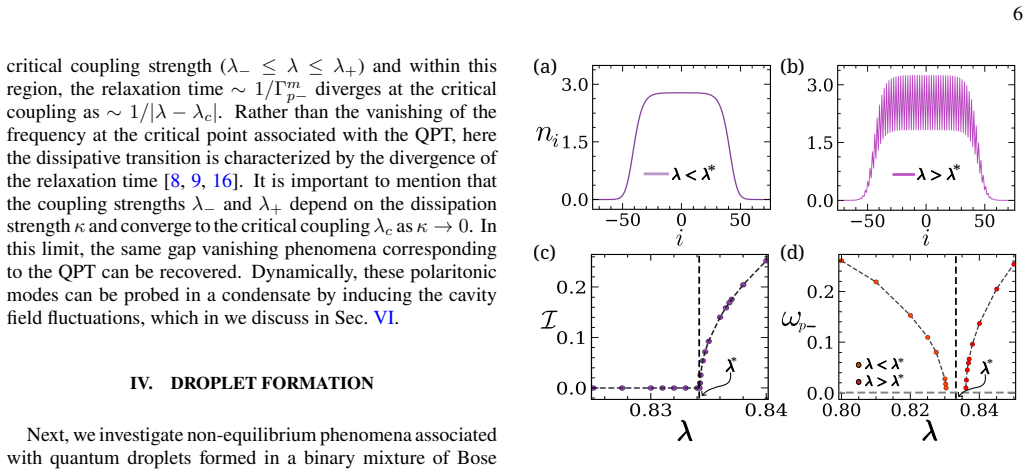
In the presence of dissipation (κ̸= 0), the variation of the frequencyω p− of the lower excitation branch, with the atom-photon couplingλis shown in Fig. 1(d). In the limit ofλ→0,ω p− approaches the frequency of the cavity fieldω 0, whereasω p+ reduces to the Bogoliubov modeω(k=π). As evident from Fig. 1(d), the mode frequencyω p− of the lowest excitation...
-
[3]
Breuer and F
H.-P. Breuer and F. Petruccione,The Theory of Open Quantum Systems(Oxford University Press, Oxford, 2002)
2002
-
[4]
Weiss,Quantum Dissipative Systems(WorldScientific, Sin- gapore, 2008)
U. Weiss,Quantum Dissipative Systems(WorldScientific, Sin- gapore, 2008)
2008
-
[5]
A. J. Daley, Quantum Trajectories and Open Many-Body Quan- tum Systems, Adv. Phys.63, 77 (2014)
2014
-
[6]
Weimer, A
H. Weimer, A. Kshetrimayum, and R. Or´ us, Simulation meth- ods for open quantum many-body systems, Rev. Mod. Phys. 93, 015008 (2021)
2021
-
[7]
Fazio, J
R. Fazio, J. Keeling, L. Mazza, and M. Schir `o, Many-body open quantum systems, SciPost Phys. Lect. Notes99, 1 (2025)
2025
-
[8]
Diehl, A
S. Diehl, A. Micheli, A. Kantian, B. Kraus, H. P. B¨ uchler, and P. Zoller, Quantum States and Phases in Driven Open Quantum Systems with Cold Atoms, Nat. Phys.4, 878 (2008)
2008
-
[9]
Diehl, A
S. Diehl, A. Tomadin, A. Micheli, R. Fazio, and P. Zoller, Dynamical Phase Transitions and Instabilities in Open Atomic Many-Body Systems, Phys. Rev. Lett.105, 015702 (2010)
2010
-
[10]
Dimer, B
F. Dimer, B. Estienne, A. S. Parkins, and H. J. Carmichael, Proposed realization of the Dicke-model quantum phase tran- sition in an optical cavity QED system, Phys. Rev. A75, 013804 (2007)
2007
-
[11]
Morrison and A
S. Morrison and A. S. Parkins, Collective spin systems in dispersive optical cavity QED: Quantum phase transitions and entanglement, Phys. Rev. A77, 043810 (2008)
2008
-
[12]
E. M. Kessler, G. Giedke, A. Imamoglu, S. F. Yelin, M. D. Lukin, and J. I. Cirac, Dissipative phase transition in a central spin system, Phys. Rev. A86, 012116 (2012)
2012
-
[13]
L. M. Sieberer, S. D. Huber, E. Altman, and S. Diehl, Dynam- ical Critical Phenomena in Driven-Dissipative Systems, Phys. Rev. Lett.110, 195301 (2013)
2013
-
[14]
Le Boit ´e, G
A. Le Boit ´e, G. Orso, and C. Ciuti, Steady-State Phases and Tunneling-Induced Instabilities in the Driven Dissipative Bose Hubbard Model, Phys. Rev. Lett.110, 233601 (2013)
2013
-
[15]
Kulkarni, B
M. Kulkarni, B. ¨Oztop, and H. E. T¨ ureci, Cavity-mediated near- critical dissipative dynamics of a driven condensate, Phys. Rev. Lett.111, 220408 (2013)
2013
-
[16]
H. J. Carmichael, Breakdown of Photon Blockade: A Dissi- pative Quantum Phase Transition in Zero Dimensions, Phys. Rev. X5, 031028 (2015)
2015
-
[17]
Fitzpatrick, N
M. Fitzpatrick, N. M. Sundaresan, A. C. Y. Li, J. Koch, and A. A. Houck, Observation of a Dissipative Phase Transition in a One-Dimensional Circuit QED Lattice, Phys. Rev. X7, 011016 (2017)
2017
-
[18]
Casteels, R
W. Casteels, R. Fazio, and C. Ciuti, Critical dynamical prop- erties of a first-order dissipative phase transition, Phys. Rev. A 95, 012128 (2017)
2017
-
[19]
Soriente, T
M. Soriente, T. Donner, R. Chitra, and O. Zilber- berg, Dissipation-induced anomalous multicritical phenom- ena, Phys. Rev. Lett.120, 183603 (2018)
2018
-
[20]
Minganti, A
F. Minganti, A. Biella, N. Bartolo, and C. Ciuti, Spectral theory of Liouvillians for dissipative phase transitions, Phys. Rev. A 98, 042118 (2018)
2018
-
[21]
Hwang, P
M.-J. Hwang, P. Rabl, and M. B. Plenio, Dissipative phase transition in the open quantum Rabi model, Phys. Rev. A97, 013825 (2018)
2018
-
[22]
C. J. Zhu, L. L. Ping, Y. P. Yang, and G. S. Agarwal, Squeezed Light Induced Symmetry Breaking Superradiant Phase Tran- sition, Phys. Rev. Lett.124, 073602 (2020)
2020
-
[23]
M. H. Kalthoff, D. M. Kennes, A. J. Millis, and M. A. Sentef, Nonequilibrium phase transition in a driven-dissipative quan- tum antiferromagnet, Phys. Rev. Res.4, 023115 (2022)
2022
-
[24]
Prasad, H
M. Prasad, H. K. Yadalam, C. Aron, and M. Kulkarni, Dissipa- tive quantum dynamics, phase transitions, and non-Hermitian random matrices, Phys. Rev. A105, L050201 (2022)
2022
-
[25]
Rakovszky, S
T. Rakovszky, S. Gopalakrishnan, and C. von Keyserlingk, Defining stable phases of open quantum systems, Phys. Rev. X 14, 041031 (2024)
2024
-
[26]
Zhu, C.-S
G.-L. Zhu, C.-S. Hu, H. Wang, W. Qin, X.-Y. L¨ u, and F. Nori, Nonreciprocal superradiant phase transitions and multicriti- cality in a cavity QED system, Phys. Rev. Lett.132, 193602 (2024)
2024
-
[27]
Abouelela, M
A. Abouelela, M. Turaev, R. Kramer, M. Janning, M. Kajan, S. Ray, and J. Kroha, Stabilizing open photon condensates by ghost-attractor dynamics, Phys. Rev. Lett.135, 053402 (2025)
2025
-
[28]
L. M. Sieberer, M. Buchhold, J. Marino, and S. Diehl, Uni- versality in driven open quantum matter, Rev. Mod. Phys.97, 025004 (2025)
2025
-
[29]
Iemini, A
F. Iemini, A. Russomanno, J. Keeling, M. Schir `o, M. Dal- monte, and R. Fazio, Boundary time crystals, Phys. Rev. Lett. 121, 035301 (2018)
2018
-
[30]
Keßler, P
H. Keßler, P. Kongkhambut, C. Georges, L. Mathey, J. G. Cosme, and A. Hemmerich, Observation of a dissipative time crystal, Phys. Rev. Lett.127, 043602 (2021)
2021
-
[31]
Kongkhambut, J
P. Kongkhambut, J. Skulte, L. Mathey, J.G. Cosme, A. Hem- merich, and H. Kessle, Observation of a continuous time crys- tal, Science377, 670 (2022)
2022
-
[32]
X. Wu, Z. Wang, F. Yang, R. Gao, C. Liang, M.K. Tey, X. Li, T. Pohl, and L. You, Dissipative time crystal in a strongly interacting Rydberg gas, Nature (London)20, 1389 (2024)
2024
-
[33]
Russo and T
F. Russo and T. Pohl, Quantum dissipative continuous time crystals, Phys. Rev. Lett.135, 110404 (2025)
2025
-
[34]
Grobe, F
R. Grobe, F. Haake, and H.-J. Sommers, Quantum distinction of regular and chaotic dissipative motion, Phys. Rev. Lett.61, 1899 (1988); R. Grobe and F. Haake, Universality of cubic- level repulsion for dissipative quantum chaos,ibid.62, 2893 (1989)
1988
-
[35]
Akemann, M
G. Akemann, M. Kieburg, A. Mielke, and T. Prosen, Univer- sal signature from integrability to chaos in dissipative open quantum systems, Phys. Rev. Lett.123, 254101 (2019)
2019
-
[36]
Denisov, T
S. Denisov, T. Laptyeva, W. Tarnowski, D. Chru´sci´nski, and K. ˙Zyczkowski, Universal spectra of random Lindblad operators, Phys. Rev. Lett.123, 140403 (2019). 13
2019
-
[37]
L. S ´a, P. Ribeiro, and T. Prosen, Complex spacing ratios: A sig- nature of dissipative quantum chaos, Phys. Rev. X10, 021019 (2020)
2020
-
[38]
Piazza and H
F. Piazza and H. Ritsch, Self-ordered limit cycles, chaos, and phase slippage with a superfluid inside an optical resonator, Phys. Rev. Lett.115, 163601 (2015)
2015
-
[39]
S. Ray, A. Vardi, and D. Cohen, Quantum signatures in quench from chaos to superradiance, Phys. Rev. Lett.128, 130604 (2022)
2022
-
[40]
Villase ˜nor, L
D. Villase ˜nor, L. F. Santos, and P. Barberis-Blostein, Break- down of the quantum distinction of regular and chaotic classical dynamics in dissipative systems, Phys. Rev. Lett.133, 240404 (2024)
2024
-
[41]
Vivek, D
G. Vivek, D. Mondal, S. Chakraborty, and S. Sinha, Self trap- ping phenomenon, multistability and chaos in open anisotropic Dicke dimer, Phys. Rev. Lett.134, 113404 (2025)
2025
-
[42]
Ferrari, L
F. Ferrari, L. Gravina, D. Eeltink, P. Scarlino, V. Savona, and F. Minganti, Dissipative quantum chaos unveiled by stochastic quantum trajectories, Phys. Rev. Res.7, 013276 (2025)
2025
-
[43]
Mondal, A
D. Mondal, A. Kolovsky, and S. Sinha, Dissipative chaos and steady state of an open Tavis-Cummings dimer, Phys. Rev. E 111, L052204 (2025)
2025
-
[44]
Villase ˜nor, H
D. Villase ˜nor, H. Yan, M. Orel, and M. Robnik, Correspon- dence principle, dissipation, and Ginibre ensemble, Phys. Rev. E112, L042204 (2025)
2025
-
[45]
Mondal, L
D. Mondal, L. F. Santos, and S. Sinha, Transient and steady state chaos in dissipative quantum systems, Phys. Rev. Lett. 136, 040401 (2026)
2026
-
[46]
Ritsch, P
H. Ritsch, P. Domokos, F. Brennecke, and T. Esslinger, Cold atoms in cavity-generated dynamical optical potentials, Rev. Mod. Phys.85, 553 (2013)
2013
-
[47]
Mivehvar, F
F. Mivehvar, F. Piazza, T. Donner, and H. Ritsch, Cavity QED with quantum gases: New paradigms in many-body physics, Adv. Phys.70, 1 (2021)
2021
-
[48]
V. D. Vaidya, Y. Guo, R. M. Kroeze, K. E. Ballantine, A. J. Koll´ar, J. Keeling, and B. L. Lev, Tunable-Range, Photon Me- diated Atomic Interactions in Multimode Cavity QED, Phys. Rev. X8, 011002 (2018)
2018
-
[49]
Baumann, C
K. Baumann, C. Guerlin, F. Brennecke, and T. Esslinger, Dicke quantum phase transition with a superfluid gas in an optical cavity, Nature (London)464, 1301 (2010)
2010
-
[50]
Klinder, H
J. Klinder, H. Keßler, M. Wolke, L. Mathey, and A. Hem- merich, Dynamical phase transition in the open Dicke model, Proc. Natl. Acad. Sci. U.S.A.112, 3290 (2015)
2015
-
[51]
M. P. Baden, K. J. Arnold, A. L. Grimsmo, S. Parkins, and M. D. Barrett, Realization of the Dicke model using cavity assisted Raman transitions, Phys. Rev. Lett.113, 020408 (2014)
2014
-
[52]
S. J. Masson, M. D. Barrett, and S. Parkins, Cavity QED Engineering of Spin Dynamics and Squeezing in a Spinor Gas, Phys. Rev. Lett.119, 213601 (2017)
2017
-
[53]
Zhiqiang, C
Z. Zhiqiang, C. H. Lee, R. Kumar, K. J. Arnold, S. J. Mas- son, A. S. Parkins, and M. D. Barrett, Nonequilibrium phase transition in a spin-1 Dicke model, Optica4, 424 (2017)
2017
-
[54]
Landig, L
R. Landig, L. Hruby, N. Dogra, M. Landini, R. Mottl, T. Donner, and T. Esslinger, Quantum phases from competing short- and long-range interactions in an optical lattice, Nature (London)532, 476 (2016)
2016
-
[55]
L ´eonard, A
J. L ´eonard, A. Morales, P. Zupancic, T. Esslinger, and T. Donner, Supersolid Formation in a Quantum Gas Breaking a Continuous Translational Symmetry, Nature (London)543, 87 (2017)
2017
-
[56]
S. R. K. Rodriguez, W. Casteels, F. Storme, N. Carlon Zambon, I. Sagnes, L. Le Gratiet, E. Galopin, A. Lemaˆıtre, A. Amo, C. Ciuti, and J. Bloch, Probing a dissipative phase transition via dynamical optical hysteresis, Phys. Rev. Lett.118, 247402 (2017)
2017
-
[57]
Letscher, O
F. Letscher, O. Thomas, T. Niederpr¨ um, M. Fleischhauer, and H. Ott, Bistability versus Metastability in Driven Dissipative Rydberg Gases, Phys. Rev. X7, 021020 (2017)
2017
-
[58]
R. M. Kroeze, Y. Guo, V. D. Vaidya, J. Keeling, and B. L. Lev, Spinor self-ordering of a quantum gas in a cavity, Phys. Rev. Lett.121, 163601 (2018)
2018
-
[59]
Mivehvar, S
F. Mivehvar, S. Ostermann, F. Piazza, and H. Ritsch, Driven- dissipative supersolid in a ring cavity, Phys. Rev. Lett.118, 073602 (2017)
2017
-
[60]
Muniz, D
J. Muniz, D. Barberena, R.J. Lewis-Swan, D.J. Young, J. R. K. Cline, A. M. Rey, and J.K. Thompson, Exploring dynamical phase transitions with cold atoms in an optical cavity, Nature (London)580, 602 (2020)
2020
-
[61]
Ferri, R
F. Ferri, R. Rosa-Medina, F. Finger, N. Dogra, M. Soriente, O. Zilberberg, T. Donner, and T. Esslinger, Emerging dissipative phases in a superradiant quantum gas with tunable decay, Phys. Rev. X11, 041046 (2021)
2021
-
[62]
Bloch, I
J. Bloch, I. Carusotto, and M. Wouters, Non-equilibrium Bose–Einstein condensation in photonic systems, Nat. Rev. Phys.4, 470 (2022)
2022
-
[63]
D. J. Young, A. Chu, E. Y. Song, D. Barberena, D. Wellnitz, Z. Niu, V. M. Sch ¨afer, R. J. Lewis-Swan, A. M. Rey, and J. K. Thompson, Observing dynamical phases of BCS super conductors in a cavity QED simulator, Nature (London)625, 679 (2024)
2024
-
[64]
Bloch, J
I. Bloch, J. Dalibard, and W. Zwerger, Many-Body physics with ultracold gases, Rev. Mod. Phys.80, 885 (2008)
2008
-
[65]
Bloch, Ultracold quantum gases in optical lattices, Nat
I. Bloch, Ultracold quantum gases in optical lattices, Nat. Phys. 1, 23 (2005); I. Bloch, J. Dalibard, and S. Nascimb´ene, Quan- tum simulations with ultracold quantum gases Nat. Phys.8, 267 (2012)
2005
-
[66]
D. S. Petrov, Quantum Mechanical Stabilization of a Collaps- ing Bose-Bose Mixture, Phys. Rev. Lett.115, 155302 (2015)
2015
-
[67]
Schmitt, M
M. Schmitt, M. Wenzel, F. B ¨ottcher, I. Ferrier-Barbut, and T. Pfau, Self-bound droplets of a dilute magnetic quantum liquid, Nature (London)539, 259 (2016)
2016
-
[68]
C. R. Cabrera, L. Tanzi, J. Sanz, B. Naylor, P. Thomas, P. Cheiney, and L. Tarruell, Quantum liquid droplets in a mixture of Bose-Einstein condensates, Science359, 301 (2018)
2018
-
[69]
Semeghini, G
G. Semeghini, G. Ferioli, L. Masi, C. Mazzinghi, L. Wolswijk, F. Minardi, M. Modugno, G. Modugno, M. Inguscio, and M. Fattori, Self-Bound Quantum Droplets of Atomic Mixtures in Free Space, Phys. Rev. Lett.120, 235301 (2018)
2018
-
[70]
Chomaz, S
L. Chomaz, S. Baier, D. Petter, M. J. Mark, F. W¨achtler, L. San- tos, and F. Ferlaino, Quantum-Fluctuation-Driven Crossover from a Dilute Bose-Einstein Condensate to a Macrodroplet in a Dipolar Quantum Fluid, Phys. Rev. X6, 041039 (2016)
2016
-
[71]
B ¨ottcher, J.-N
F. B ¨ottcher, J.-N. Schmidt, J. Hertkorn, K. S. H. Ng, S. D. Graham, M. Guo, T. Langen, and T. Pfau, New states of matter with fine-tuned interactions: Quantum droplets and dipolar supersolids, Rep. Prog. Phys.84, 012403 (2021)
2021
-
[72]
Z. Luo, W. Pang, B. Liu, Y. Li, and B.A. Malomed, A new kind form of liquid matter: Quantum droplets, Front. Phys.16, 32201 (2021)
2021
-
[73]
D. S. Petrov and G. E. Astrakharchik, Ultradilute Low- Dimensional Liquids, Phys. Rev. Lett.117, 100401 (2016)
2016
-
[74]
G. E. Astrakharchik and B. A. Malomed, Dynamics of one- dimensional quantum droplets, Phys. Rev. A98, 013631 (2018)
2018
-
[75]
Tylutki, G
M. Tylutki, G. E. Astrakharchik, B. A. Malomed, and D. S. Petrov, Collective excitations of a one-dimensional quantum droplet, Phys. Rev. A101, 051601(R) (2020). 14
2020
-
[76]
Karpov and F
P. Karpov and F. Piazza, Light-induced quantum droplet phases of lattice bosons in multimode cavities, Phys. Rev. Lett.128, 103201 (2022)
2022
-
[77]
Masalaeva, H
N. Masalaeva, H. Ritsch, and F. Mivehvar, Tuning photon- mediated interactions in a multimode cavity: From supersolid to insulating droplets hosting phononic excitations, Phys. Rev. Lett.131, 173401 (2023)
2023
-
[78]
L. Mixa, M. Radonji ´c, A. Pelster, and M. Thorwart, Engineer- ing quantum droplet formation by cavity-induced long-range interactions, Phys. Rev. Res.7, 023204 (2025)
2025
-
[79]
L. Mixa, M. Radonji ´c, A. Pelster, and M. Thorwart, Cavity- induced quantum droplets, Phys. Rev. Res.7, 033216 (2025)
2025
-
[80]
Caldara, O
M. Caldara, O. Bleu, F. M. Marchetti, J. Levinsen, and M. M. Parish, Quantum droplets of light in semiconductor microcav- ities, Phys. Rev. Lett.136, 116902 (2026)
2026
discussion (0)
Sign in with ORCID, Apple, or X to comment. Anyone can read and Pith papers without signing in.