Universal behavior of the condensation energy of Superconducting BCS Bose gases
Pith reviewed 2026-06-25 20:22 UTC · model grok-4.3
The pith
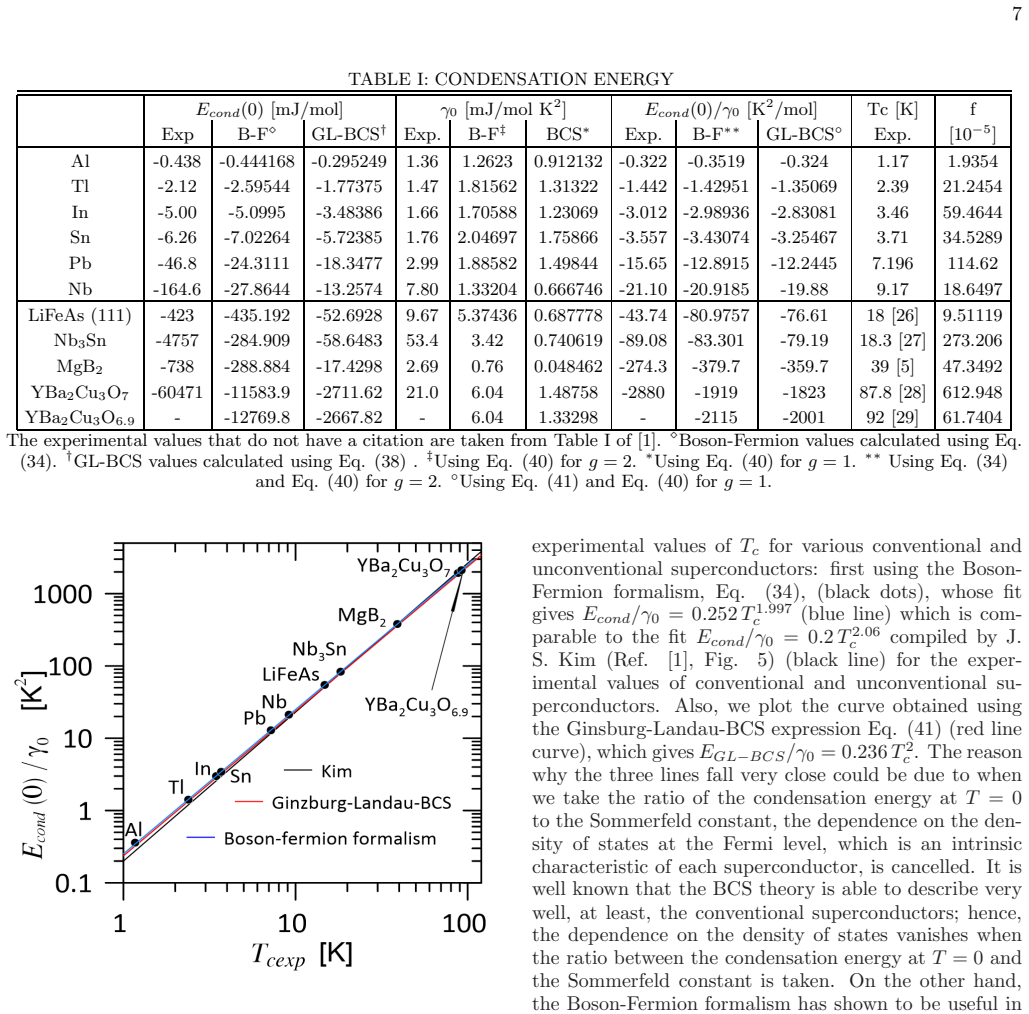
Boson-fermion formalism produces condensation energy scaling E_cond/γ0 = 0.252 T_c^1.997 matching experiments
A machine-rendered reading of the paper's core claim, the machinery that carries it, and where it could break.
Core claim
The central discovery is that both the boson-fermion model and the Ginzburg-Landau-BCS approach predict a universal quadratic-like scaling of the condensation energy with the critical temperature, specifically E_cond/γ0 = 0.252 T_c^{1.997} and 0.236 T_c^2 respectively, in agreement with data from a range of superconductors.
What carries the argument
The boson-fermion formalism in which the condensation energy is the difference between the Helmholtz free energy of the normal attractive electron gas and that of the state with condensed composite bosons from paired electrons plus unpaired electrons.
Load-bearing premise
The superconducting state consists of condensed Cooper pairs as composite bosons from a fraction of electrons in the Debye shell along with unpaired electrons inside and outside the shell, while the normal state is simply an N-particle attractive electron gas.
What would settle it
A precise measurement of condensation energy and the Sommerfeld constant for any superconductor that shows the ratio E_cond/γ0 lying far from 0.25 T_c^2.
Figures
read the original abstract
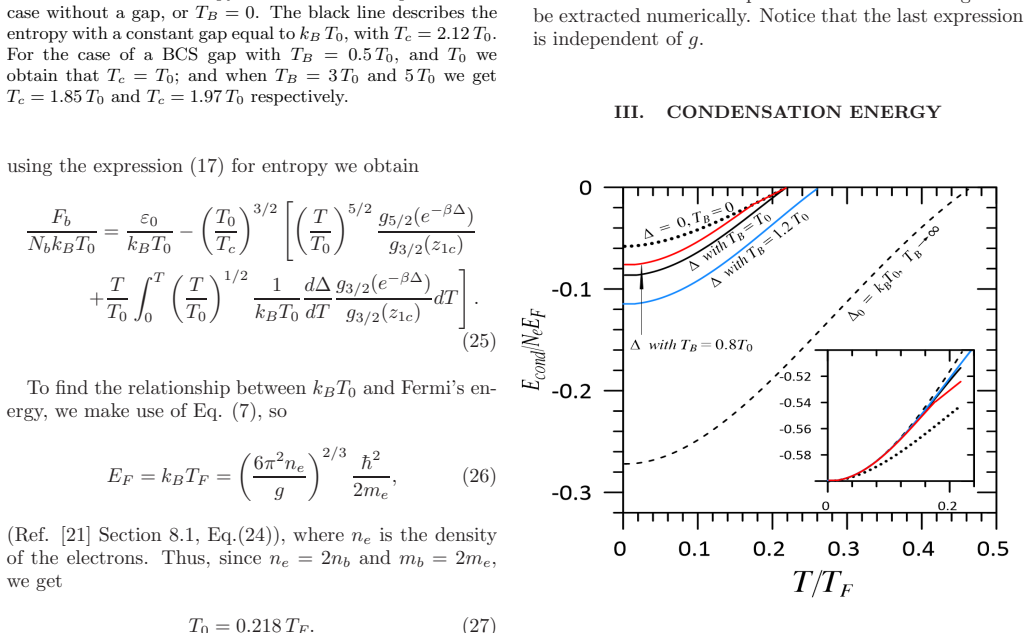
Using the Boson-Fermion formalism of superconductivity we calculate the condensation energy for several superconductors ranging from conventional to unconventional, or high temperature superconductors. It is calculated as the difference between the Helmholtz free energies of the superconducting and the normal state, which is a gas of N attractive electron gas, while the superconducting state is formed by the condensed Cooper pairs taken as composite bosons, coming from a fraction of the electrons inside the Debye shell, plus those electrons inside and outside the Debye shell that are unable to pair. After giving the analytic expressions for the internal energy U and the entropy S we obtain the Helmholtz free energy F = U -TS for both the superconducting and the normal states as functions of temperature. In the search for universalities, we calculate the ratio of the condensation energy at T=0 to the Sommerfeld constant (the normal state electronic specific heat over the temperature when T it's almost zero) using two different methods: the Boson-Fermion formalism developed here, as well as an analytical expression deduced from a combination of the BCS and Ginzburg-Landau theories. We find for the Boson-Fermion formalism $E_{cond}/\gamma_0= 0.252\,T_{c}^{1.997}$, which is the same behavior described by the experimental fit of Kim et al $E_{cond}/\gamma_0= 0.2\,T_{c}^{2.06}$ and by the one recently reported by Tallon et al for overdoped cuprate superconductors; while for the Ginzburg-Landau-BCS we get the expression $E_{cond}/\gamma_0= 0.236\,T_{c}^{2}$, also in very good agreement with the partifirst method.
Editorial analysis
A structured set of objections, weighed in public.
Referee Report
Summary. The manuscript applies a Boson-Fermion formalism to compute the superconducting condensation energy E_cond as the difference F_sc(T) - F_n(T) between Helmholtz free energies. The superconducting state consists of condensed composite bosons formed from a fraction of electrons inside the Debye shell together with unpaired electrons inside and outside the shell; the normal state is an N-particle attractive electron gas with no pairing. Analytic expressions for internal energy U and entropy S are stated to yield F = U - TS for both states. The resulting ratio is reported as E_cond/γ0 = 0.252 T_c^1.997 from the model and E_cond/γ0 = 0.236 T_c^2 from a Ginzburg-Landau-BCS route; both are compared to experimental fits of Kim et al. and Tallon et al.
Significance. A parameter-free derivation of the observed near-quadratic scaling of condensation energy with T_c across conventional and cuprate superconductors would be of interest, particularly if the coefficient emerges directly from the model equations without adjustment. The manuscript does not demonstrate that the reported prefactor 0.252 is fixed independently of the free fraction of paired electrons or that the normal-state reference is consistently defined within the same attractive Hamiltonian.
major comments (3)
- [Abstract (model definition)] The normal state is defined as an N-particle attractive electron gas without pairing while the superconducting state incorporates pairing from the same attractive interaction. Because the Hamiltonian contains attraction, the normal state should exhibit a pairing instability, so F_n is not obviously the correct reference state; this partition directly determines E_cond and is therefore load-bearing for the claimed scaling.
- [Abstract (Boson-Fermion formalism)] The fraction of electrons inside the Debye shell that form pairs is identified as a free parameter. Without an explicit, data-independent prescription for fixing this fraction, the numerical coefficient 0.252 cannot be verified as emerging solely from the model equations rather than from adjustment to match the cited experimental fits (0.2 T_c^2.06).
- [Abstract] No explicit analytic expressions for U or S (hence F) are supplied, nor are any tables of numerical values or fitting procedures shown. It is therefore impossible to confirm whether the quoted coefficient 0.252 is obtained without additional fitting or whether the exponent 1.997 is a numerical artifact.
minor comments (2)
- [Abstract] Typo: 'partifirst method' should read 'particular method'.
- [Abstract] The abstract states that the GL-BCS route 'also in very good agreement with the partifirst method' but provides no quantitative comparison of the two coefficients beyond the quoted values.
Simulated Author's Rebuttal
We thank the referee for the careful reading and constructive comments. We address each major comment below, proposing revisions to clarify the model and improve verifiability.
read point-by-point responses
-
Referee: [Abstract (model definition)] The normal state is defined as an N-particle attractive electron gas without pairing while the superconducting state incorporates pairing from the same attractive interaction. Because the Hamiltonian contains attraction, the normal state should exhibit a pairing instability, so F_n is not obviously the correct reference state; this partition directly determines E_cond and is therefore load-bearing for the claimed scaling.
Authors: In the Boson-Fermion formalism the normal state is the attractive electron gas with no boson condensation (i.e., the unpaired phase), while the superconducting state includes condensed composite bosons formed from the same attractive interaction. This partition is the standard definition of condensation energy within the model and is analogous to the normal-state reference used in BCS theory. We will add an explicit paragraph in the revised manuscript justifying the choice of reference state, its relation to the pairing instability above Tc, and consistency with the Hamiltonian. revision: yes
-
Referee: [Abstract (Boson-Fermion formalism)] The fraction of electrons inside the Debye shell that form pairs is identified as a free parameter. Without an explicit, data-independent prescription for fixing this fraction, the numerical coefficient 0.252 cannot be verified as emerging solely from the model equations rather than from adjustment to match the cited experimental fits (0.2 T_c^2.06).
Authors: The fraction is fixed by the model parameters (Debye-shell volume relative to the Fermi volume and the self-consistent pairing condition set by the interaction strength) and is independent of the experimental condensation-energy data. The quoted coefficient 0.252 follows directly from substituting this fraction into the free-energy expressions. We will supply the explicit, data-independent prescription for the fraction in the revised manuscript so that the origin of the prefactor can be verified. revision: yes
-
Referee: [Abstract] No explicit analytic expressions for U or S (hence F) are supplied, nor are any tables of numerical values or fitting procedures shown. It is therefore impossible to confirm whether the quoted coefficient 0.252 is obtained without additional fitting or whether the exponent 1.997 is a numerical artifact.
Authors: The analytic expressions for U and S (and hence F) are stated in the manuscript after the model definition. To address the concern we will (i) display the expressions prominently, (ii) add a table of numerical values for E_cond/γ0 computed at several Tc, and (iii) describe the fitting procedure used to extract the coefficient and exponent. These additions will confirm that the reported numbers arise from the model equations without further adjustment. revision: yes
Circularity Check
No significant circularity; scaling obtained from explicit free-energy difference in defined model
full rationale
The paper constructs analytic expressions for U and S (hence F) separately for the superconducting state (condensed composite bosons from a fraction of Debye-shell electrons plus unpaired electrons) and the normal state (N-particle attractive electron gas), then defines E_cond strictly as F_sc - F_n. The reported numerical relation E_cond/γ0 = 0.252 T_c^1.997 is stated to follow from evaluating that difference; the GL-BCS route is an independent analytic derivation yielding 0.236 T_c^2. No quoted step shows the coefficient or exponent being fitted to the cited experimental data, nor does any result reduce by construction to an input parameter or self-citation. The modeling partition is an assumption, not a definitional loop that forces the output scaling.
Axiom & Free-Parameter Ledger
free parameters (1)
- fraction of electrons inside Debye shell that form pairs
axioms (2)
- domain assumption Helmholtz free energy difference between the defined superconducting and normal states equals the condensation energy
- domain assumption Cooper pairs can be treated as composite bosons whose condensation contributes to the free energy
Reference graph
Works this paper leans on
-
[1]
218033 TF . (9) Since we are deriving the condensation energy, we first obtain the expressions for the internal energy U (T ), the entropy S(T ), and the corresponding HFE F = U − T S, for both the normal and the condensed states. B. Boson internal energy For this system, the bosonic internal energy Ub(T ) di- vided by T as a function of the temperature is...
-
[2]
1: Normalized entropy
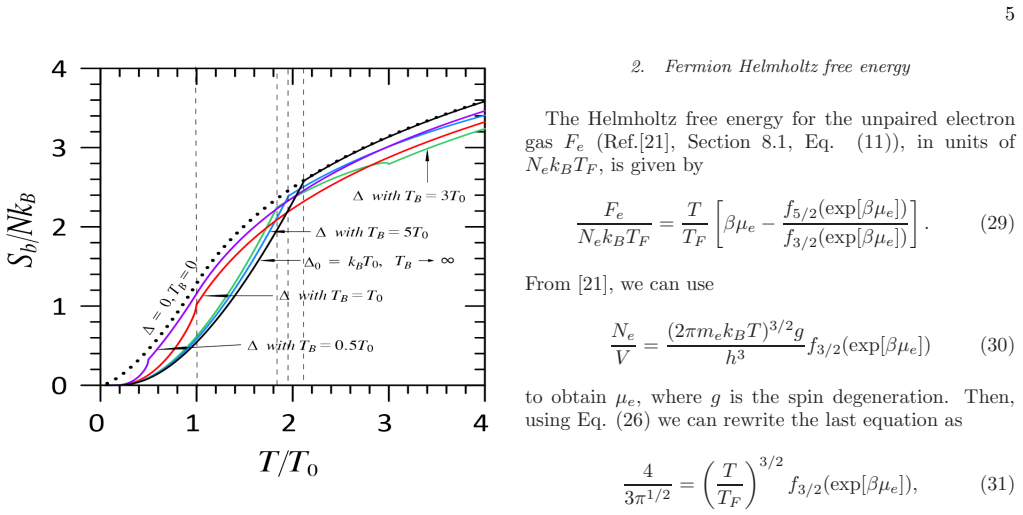
Boson Helmholtz free energy For a boson gas at T ≤ Tc, substituting the form of the internal energy given in (10), with µ = ε0, and after 5 FIG. 1: Normalized entropy. The dotted line represents the case without a gap, or TB = 0. The black line describes the entropy with a constant gap equal to kB T0, with Tc = 2. 12 T0. For the case of a BCS gap with TB ...
-
[3]
102 ζ(3/ 2)g5/ 2(exp[− β (∆ 0)]) + ε0 kBTF . (28)
-
[4]
Ginzburg-Landau-BCS condensation energy
Fermion Helmholtz free energy The Helmholtz free energy for the unpaired electron gas Fe (Ref.[21], Section 8.1, Eq. (11)), in units of NekBTF , is given by Fe NekBTF = T TF [ βµ e − f5/ 2(exp[βµ e]) f3/ 2(exp[βµ e]) ] . (29) From [21], we can use Ne V = (2πm ekBT )3/ 2g h3 f3/ 2(exp[βµ e]) (30) to obtain µ e, where g is the spin degeneration. Then, using...
1919
-
[5]
997 c , while from the Ginsburg-Landau-BCS ex- pression goes like 0
252 T 1. 997 c , while from the Ginsburg-Landau-BCS ex- pression goes like 0 . 236 T 2 c . With both methods the Econd(T = 0) /γ 0 ratio are in agreement with the exper- imental fit reported by Kim [1] for several conventional and non-conventional superconductors, where the ratio is 0.2 T 2. 06 c , as well as with the experimental results recently reported...
-
[6]
J. S. Kim, G. N. Tam, and G. R. Stewart, Phys. Rev. B 92, 224509 (2015); DOI:10.1103/PhysRevB.92.224509
-
[7]
J. L. Tallon, J. G. Storey, J. W. Loram, Jianlin Luo, C. Bernhard, I. Kokanovi´ c andJ. R. Cooper, Phys. Rev. Lett. 136, 076002 (2026); DOI:10.1103/hkcc-xnkh. Jef- fery L. Tallon, Jou. Low Temp. Phys. 222:43 (2026), DOI:10.1007/s10909-026-03379-7
-
[8]
G. J. Bednorz and K. A. M¨ uller, Z. Phys. B 64, 189 (1986)
1986
-
[9]
Kamihara, T
Y. Kamihara, T. Watanabe, M. Hirano, and H. Hosono, J. Am. Chem. Soc. 130, 3296 (2008)
2008
-
[10]
S. L. Bud’ko and P. C. Canfield, Physica C 514, 142 (2015), DOI:10.1016/j.physc.2015.02.024
-
[11]
Y. J. Uemura, G. M. Luke, B. J. Sternlieb, J. H. Brewer, J. F. Carolan, W. N. Hardy, R. Kadono, J. R. Kempton, R. F. Kiefl, S. R. Kreitzman, P. Mulhern, T. M. Riseman, D. Ll. Williams, B. X. Yang, S. Uchida, H. Takagi, J. Gopalakrishnan, A. W. Sleight, M. A. Subramanian, C. L. Chien, M. Z. Cieplak, Gang Xiao, V. Y. Lee, B. W. Statt, C. E. Stronach, W. J. K...
1989
-
[12]
Y. J. Uemura, Physica B 404, 3195 (2009); DOI:10.1016/j.physb.2009.07.110
-
[13]
S. L. Bud’ko, N. Ni, and P. C. Canfield, Phys. Rev. B 79, 220516 (2009); Sergey L. Bud’ko, Duck Young Chung, Daniel Bugaris, Helmut Claus, Mercouri G. Kanatzidis, and Paul C. Canfield, Phys. Rev. B 89, 014510 (2014)
2009
-
[14]
Esterlis, S
I. Esterlis, S. A. Kivelson and D. J. Scalapino, npj Quant Mater 3, 59 (2018)
2018
-
[15]
Smith, Sumner B
Adam D. Smith, Sumner B. Harris, Renato P. Camata, Da Yan, and Cheng-Chien Chen, Phys. Rev. B 108, 174514 (2023)
2023
-
[16]
E. F. Talantsev, Nanomaterials 13, 71 (2023). DOI:10.3390/nano13010071. 9
-
[17]
Schneeloch, R
Jie Xing, Sheng Li, Bin Zeng, Gang Mu, Bing Shen, J. Schneeloch, R. D. Zhong, T. S. Liu, G. D. Gu and Hai-Hu Wen, Phys. Rev. B 89, 140503 (2014)
2014
-
[18]
J. W. Loram, J. Luo, J. R. Cooper, W. Y. Liang and J. L. Tallon, Jou. Phys. and Chem. of Sol. 62, 59 (2001)
2001
-
[19]
Chavez, P
I. Chavez, P. Salas, M. A. Sol ´ ıs, M. de Llano, Physica A 607, 128167 (2022)
2022
-
[20]
V. R. Shaginyan, A. Z. Msezane and S. A. Artamonov, Crystals 14, 826 (2024); DOI:10.3390/crystl4090826
-
[21]
Friedberg and T.D
R. Friedberg and T.D. Lee, Phys. Rev. B 40, 6745 (1989); R. Friedberg, T.D. Lee, Phys. Letters A 138 423 (1989); R. Friedberg, T.D. Lee, and H.-C. Ren, Phys. Rev. B 42, 4122 (1990); R. Friedberg, T.D. Lee, and H.-C. Ren, Phys. Lett. A 152, 417 (1991); R. Friedberg, T.D. Lee, and H.-C. Ren, Phys. Rev. B 45, 10732 (1992)
1989
-
[22]
Tolmachev, Phys Lett
V.V. Tolmachev, Phys Lett. A 266, 400 (2000); M. de Llano and V.V. Tolmachev, Physica A 317 546 (2003)
2000
-
[23]
Salas, M
P. Salas, M. Fortes, M.A. Sol ´ ıs and F.J. Sevilla, Phys. C: Superconductivity and its Applications 524, Pages 37-43 (2016)
2016
-
[24]
Mart ´ ınez-Herrera, J
J.G. Mart ´ ınez-Herrera, J. Garc ´ ıa-Nila and M. A. Sol ´ ıs, Phys. Scr. 94, 075002 (2019)
2019
-
[25]
V. C. Aguilera-Navarro, M. de Llano and M. A. Sol ´ ıs, Eur. J. Phys. 20, 177 (1999)
1999
-
[26]
R. K. Pathria and P. D. Beale, Statistical Mechanics Third Edition (Elsevier, Oxford, 2011)
2011
-
[27]
Ginzburg and L.D
V.L. Ginzburg and L.D. Landau, Zh. Eksp. Teor. Fiz. 20, 1064 (1950). English translation in: L. D. Landau, Collected papers (Oxford: Pergamon Press, 1965) p. 546
1950
-
[28]
J. J. Valencia and M. A. Solis, arXiv:2311.11447v2
-
[29]
Tinkham and G
M. Tinkham and G. Mckay, Introduction to superconduc- tivity, Second Edition (McGraw-Hill, Inc., 1996)
1996
-
[30]
Cetina, F
E. Cetina, F. Maga˜ na and A. A. Valladares, American Journal of Physics 45, No 10, (October 1977)
1977
-
[31]
P. K. Nag, R. Schlegel, D. Baumann, H.-J. Grafe, R. Beck, S. Wurmehl, B. B¨ uchner and C. Hess, Scientific Reports 6, 27926 (2016)
2016
-
[32]
V. Guritanu, V. Guritanu, W. Goldacker, F. Bouquet, Y. Wang, R. Lortz, G. Goll and A. Junod, Phys. Rev. B 70, 184526 (2004), DOI:10.1103/PhysRevB.70.184526
-
[33]
Yuxing Wang, Bernard Revaz, Andreas Erb, and Alain Junod, Phys. Rev. B 63, 094508 (2001), DOI: 10.1103/PhysRevB.63.094508
-
[34]
Ruixing Liang, D. A. Bonn and W. N. Hardy, Phys. Rev. B 73, 180505 (2006); DOI:10.1103/PhysRevB.73.180505
discussion (0)
Sign in with ORCID, Apple, or X to comment. Anyone can read and Pith papers without signing in.