Numerical thermalization in n-D particle-in-cell simulations
Pith reviewed 2026-06-25 19:46 UTC · model grok-4.3
The pith
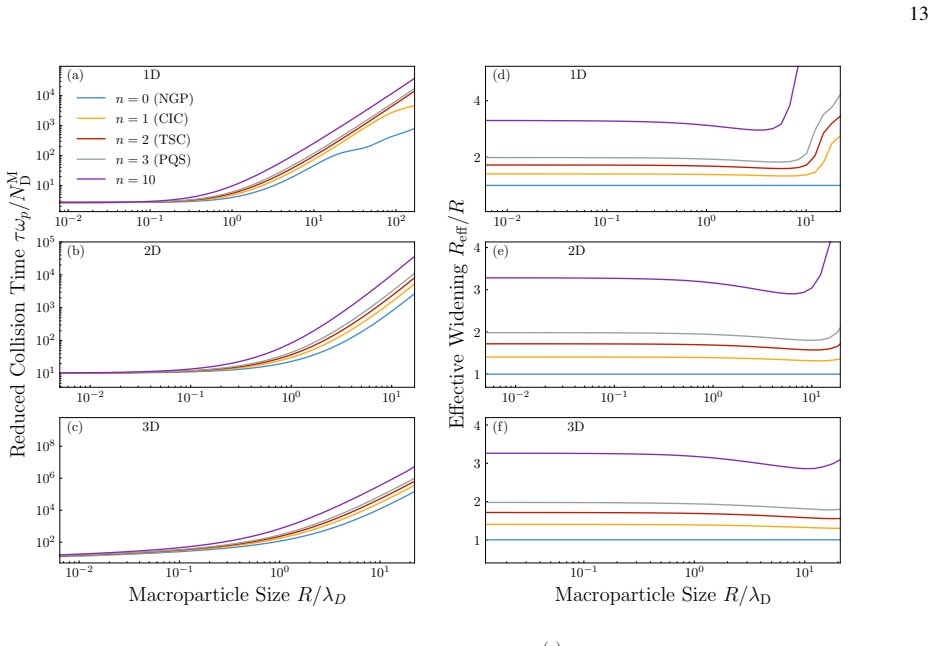
PIC simulations produce numerical collision times that match kinetic theory predictions from 1D to 3D, often making the collisionless limit unreachable in three dimensions.
A machine-rendered reading of the paper's core claim, the machinery that carries it, and where it could break.
Core claim
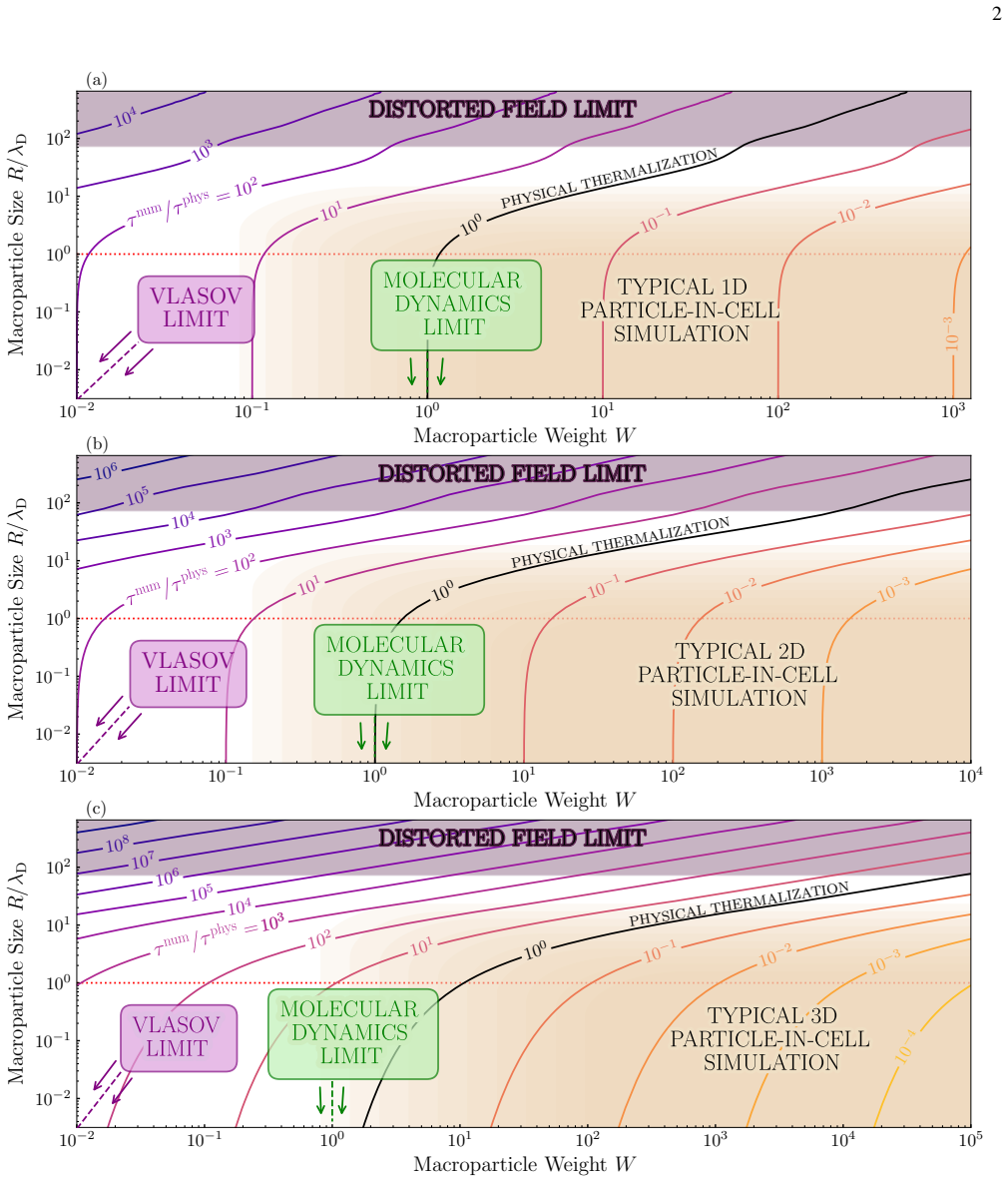
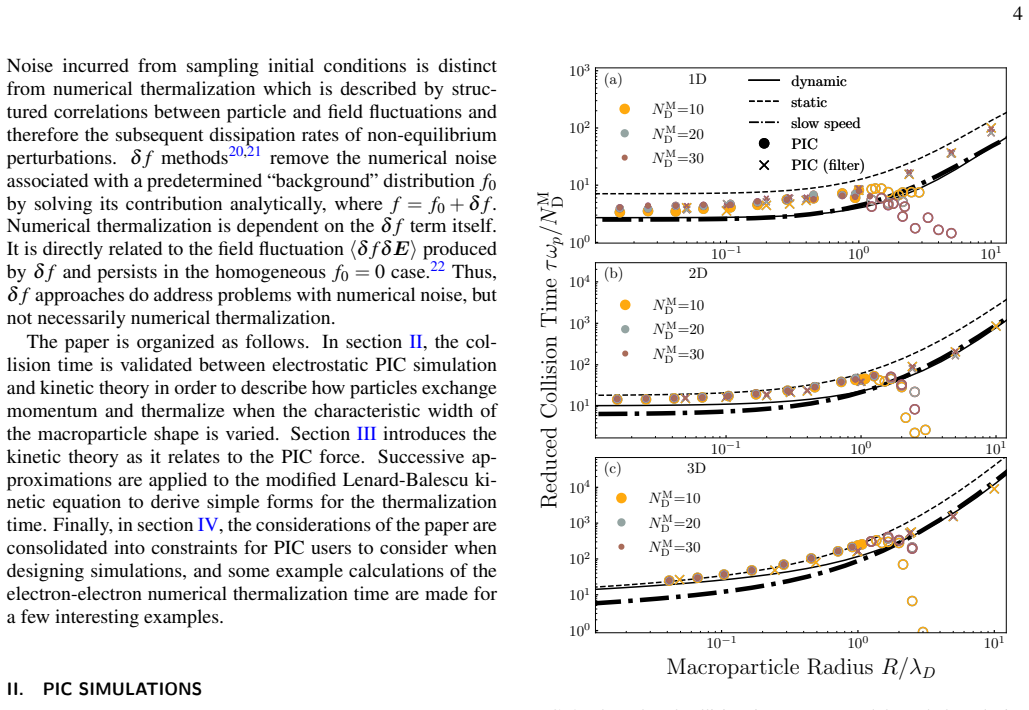
The Okuda-Birdsall-Langdon kinetic theory accurately predicts the collision time measured in PIC simulations for varied grid spacings, plasma conditions, and simulation dimensionalities from one to three dimensions. Particle shape effects partially compensate for large macroparticle weights, but the compensation is insufficient in 3D to reach physical thermalization timescales when the Debye length is resolved.
What carries the argument
Decay rate of the velocity autocorrelation function, used to isolate numerical collision time and compared directly to the Okuda-Birdsall-Langdon theory.
If this is right
- The timescale of numerical thermalization can be predicted directly from grid spacing and macroparticle weight.
- In three dimensions, macroparticle sizes that resolve the Debye length usually produce collision times far shorter than physical values.
- Approximating the collisionless Vlasov limit requires macroparticle weights low enough that the predicted collision time exceeds the physical thermalization time.
- Compensation by finite particle shape for large macroparticle weight weakens as dimensionality increases from 1D to 3D.
- Simulation parameters can be chosen to keep numerical collisions negligible only when the predicted collision time is known in advance.
Where Pith is reading between the lines
- Three-dimensional PIC studies of weakly collisional plasmas may need explicit collision operators or drastically higher particle counts to avoid dominance by numerical effects.
- The same velocity-autocorrelation diagnostic could be applied to other grid-based plasma or fluid codes to quantify their effective collisionality.
- Dimensionality-dependent compensation suggests that reduced-dimensionality test problems may systematically understate numerical thermalization present in full 3D runs.
- Parameter scans over macroparticle weight versus grid resolution become feasible once the theory is accepted as predictive.
Load-bearing premise
The decay rate of the velocity autocorrelation function isolates the collisional contribution without contamination from other numerical artifacts such as grid heating or finite-size effects.
What would settle it
A set of PIC runs in which the collision time extracted from velocity autocorrelation deviates systematically from the Okuda-Birdsall-Langdon prediction while grid spacing, macroparticle weight, and dimensionality are held fixed.
Figures
read the original abstract
The particle-in-cell (PIC) simulation method is often understood to solve the collisionless Vlasov equation due to the finite shape of its macroparticles. In reality, it can suffer from artificially high collisionality due to the underresolution of particle number; i.e., the use of a large macroparticle weight. The degree to which particle shape effects compensate for a large macroparticle weight in 1D, 2D, and 3D is presented. The collision time is calculated from PIC simulations based on the decay rate of the velocity autocorrelation function and compared directly with the kinetic theory of Okuda, Birdsall, and Langdon. The theory is found to accurately predict the simulated collision time with varied grid spacings, plasma conditions, and simulation dimensionalities. The result is a means to predict the timescale of self-consistent Coulomb interactions in the PIC simulation and thus characterize the relevance and implications of numerical thermalization as a function of grid spacing and macroparticle weight. It is determined that reaching the physical thermalization time, let alone approximating the collisionless Vlasov limit, may often be intractable in 3D for macroparticle sizes that resolve the Debye length.
Editorial analysis
A structured set of objections, weighed in public.
Referee Report
Summary. The manuscript examines numerical thermalization in particle-in-cell (PIC) simulations across 1D, 2D, and 3D. Collision times are extracted from the decay rate of the velocity autocorrelation function in simulations with varied grid spacings, plasma conditions, and dimensionalities, then compared directly to the Okuda-Birdsall-Langdon kinetic theory. The theory is reported to accurately predict the simulated collision times, yielding a practical means to estimate self-consistent Coulomb interaction timescales and characterize when numerical thermalization becomes relevant. The authors conclude that reaching physical thermalization times (or approximating the collisionless Vlasov limit) is often intractable in 3D for macroparticle sizes that resolve the Debye length.
Significance. If the extraction isolates the collisional contribution, the work supplies a concrete, testable way for PIC users to predict numerical thermalization as a function of grid spacing and macroparticle weight. The multi-dimensional survey and direct theory comparison are useful for assessing when simulations remain effectively collisionless.
major comments (1)
- [Abstract] Abstract and the measurement procedure (velocity autocorrelation decay used as collision-time proxy): the central claim requires that this decay isolates the collisional contribution predicted by Okuda et al. The manuscript does not describe control runs, analytic subtraction, or other isolation steps for non-collisional numerical diffusion (grid aliasing, macroparticle shape effects, finite-size artifacts). Without such isolation, agreement across grid spacings and dimensions could be coincidental rather than confirmatory, directly affecting the 3-D intractability conclusion.
minor comments (2)
- [Abstract] Abstract and results sections lack quantitative error bars, number of independent runs, or explicit exclusion criteria for the reported agreement with theory.
- Notation for macroparticle weight and grid spacing should be defined consistently when first introduced.
Simulated Author's Rebuttal
We thank the referee for their careful review and constructive feedback on our manuscript. We address the major comment point by point below.
read point-by-point responses
-
Referee: [Abstract] Abstract and the measurement procedure (velocity autocorrelation decay used as collision-time proxy): the central claim requires that this decay isolates the collisional contribution predicted by Okuda et al. The manuscript does not describe control runs, analytic subtraction, or other isolation steps for non-collisional numerical diffusion (grid aliasing, macroparticle shape effects, finite-size artifacts). Without such isolation, agreement across grid spacings and dimensions could be coincidental rather than confirmatory, directly affecting the 3-D intractability conclusion.
Authors: The Okuda-Birdsall-Langdon theory specifically derives the collision frequency arising from finite-size macroparticle interactions in PIC. Our reported quantitative match to this theory holds across independent variations in grid spacing, plasma parameters, and dimensionality. Such agreement is unlikely to arise from unrelated numerical diffusion mechanisms, which lack the same parametric scaling. We nevertheless recognize the value of explicit isolation. In revision we will add a concise discussion paragraph on potential non-collisional contributions (with scaling arguments and literature citations) and note that the multi-parameter theory match supplies the primary evidence for collisional dominance. Additional control runs can be included if the editor requests them. revision: partial
Circularity Check
No significant circularity; comparison to independent external theory.
full rationale
The paper extracts collision times from velocity autocorrelation decay in PIC simulations and compares them directly to the kinetic theory of Okuda, Birdsall, and Langdon (an independent prior result). No load-bearing steps reduce by construction to the paper's own inputs, fitted parameters, or self-citations. The central claim is a validation against external theory across varied parameters, with no renaming, ansatz smuggling, or self-definitional loops exhibited in the provided text or abstract. This is the most common honest finding for a simulation-vs-theory validation paper.
Axiom & Free-Parameter Ledger
axioms (2)
- domain assumption Velocity autocorrelation decay rate equals the effective collision frequency
- domain assumption Okuda-Birdsall-Langdon kinetic theory applies to finite-shape macroparticles in n dimensions
Reference graph
Works this paper leans on
-
[1]
Journal of Computational Physics , volume=
Grid effects on the plasma simulation by the finite-sized particle , author=. Journal of Computational Physics , volume=. 1975 , publisher=
1975
-
[2]
Particle interactions in a fully ionized plasma , author=. Rev. Plasma Phys. , volume=. 1965 , pages=
1965
-
[3]
2018 , publisher=
Plasma physics via computer simulation , author=. 2018 , publisher=
2018
-
[4]
Journal of Computational Physics , author =
Clouds-in-clouds, clouds-in-cells physics for many-body plasma simulation , volume =. Journal of Computational Physics , author =. 1969 , pages =. doi:10.1016/0021-9991(69)90058-8 , number =
-
[5]
and Sarwar, Salman and Kaganovich, Igor D
Jubin, Sierra and Powis, Andrew Tasman and Villafana, Willca and Sydorenko, Dmytro and Rauf, Shahid and Khrabrov, Alexander V. and Sarwar, Salman and Kaganovich, Igor D. , title =. Physics of Plasmas , volume =. 2024 , month =. doi:10.1063/5.0180421 , url =
-
[6]
Journal of Computational Physics , volume=
Energy-conserving numerical approximations for Vlasov plasmas , author=. Journal of Computational Physics , volume=. 1970 , publisher=
1970
-
[7]
2025 , school=
Modeling Low Temperature Plasma Sources: Particle-in-Cell Simulations and Computational Chemistry Investigations of Surface Interactions , author=. 2025 , school=
2025
-
[8]
The Physics of Fluids , volume=
Numerical experiments with a plasma model , author=. The Physics of Fluids , volume=. 1963 , publisher=
1963
-
[9]
Reviews of modern physics , volume=
Particle simulation of plasmas , author=. Reviews of modern physics , volume=. 1983 , publisher=
1983
-
[10]
The Physics of Fluids , volume=
Collisions in a plasma of finite-size particles , author=. The Physics of Fluids , volume=. 1970 , publisher=
1970
-
[11]
The Physics of Fluids , volume=
Verification of Theory for Plasma of Finite-Size Particles , author=. The Physics of Fluids , volume=. 1972 , publisher=
1972
-
[12]
Journal of Computational Physics , volume=
Nonphysical noises and instabilities in plasma simulation due to a spatial grid , author=. Journal of Computational Physics , volume=. 1972 , publisher=
1972
-
[13]
The Physics of Fluids , volume=
Theory of Plasma Simulation Using Finite-Size Particles , author=. The Physics of Fluids , volume=. 1970 , publisher=
1970
-
[14]
Journal of Computational Physics , volume=
Effects of the spatial grid in simulation plasmas , author=. Journal of Computational Physics , volume=. 1970 , publisher=
1970
-
[15]
Energy-conserving
“Energy-conserving” plasma simulation algorithms , author=. Journal of Computational Physics , volume=. 1973 , publisher=
1973
-
[16]
Physical Review E , volume=
Numerical heating in particle-in-cell simulations with Monte Carlo binary collisions , author=. Physical Review E , volume=. 2021 , publisher=
2021
-
[17]
2021 , publisher=
Computer simulation using particles , author=. 2021 , publisher=
2021
-
[18]
Measurements of collision and heating times in a two-dimensional thermal computer plasma , journal =. 1971 , issn =. doi:https://doi.org/10.1016/0021-9991(71)90032-5 , url =
-
[19]
The Physics of Fluids , volume=
Irreversible processes in ionized gases , author=. The Physics of Fluids , volume=. 1960 , publisher=
1960
-
[20]
Hockney, R. W. , title =. The Physics of Fluids , volume =. 1966 , month =. doi:10.1063/1.1761939 , url =
-
[21]
Plasma Physics and Controlled Fusion , volume=
Kinetic theory of particle-in-cell simulation plasma and the ensemble averaging technique , author=. Plasma Physics and Controlled Fusion , volume=. 2022 , publisher=
2022
-
[22]
and Aszalos, Madeline and Feister, Scott and Smith, Joseph R
Daneshmand, Lillian A. and Aszalos, Madeline and Feister, Scott and Smith, Joseph R. , title =. Physics of Plasmas , volume =. 2025 , month =. doi:10.1063/5.0234889 , url =
-
[23]
Physical Review , volume=
Dissipation of currents in ionized media , author=. Physical Review , volume=. 1959 , publisher=
1959
-
[24]
Methods Comput
The particle-in-cell computing method for fluid dynamics , author=. Methods Comput. Phys. , volume=
-
[25]
Plasma Physics and Controlled Fusion , volume=
Contemporary particle-in-cell approach to laser-plasma modelling , author=. Plasma Physics and Controlled Fusion , volume=. 2015 , publisher=
2015
-
[26]
Acciarri, M. D. and Moore, C. and Baalrud, S. D. , title =. Physics of Plasmas , volume =. 2024 , month =. doi:10.1063/5.0210881 , url =
-
[27]
Particle-in-cell simulations of burning inertial confinement fusion capsule implosions , volume =. Physical Review E , author =. 2025 , pages =. doi:10.1103/zwjx-jbxl , number =
-
[28]
Physical Review Letters , author =
Fast. Physical Review Letters , author =. 2011 , note =. doi:10.1103/PhysRevLett.106.215003 , number =
-
[29]
Physical Review Letters , author =
Magnetic. Physical Review Letters , author =. 2006 , pages =. doi:10.1103/PhysRevLett.97.255001 , number =
-
[30]
Plasma Sources Science and Technology , author =. 2017 , note =. doi:10.1088/1361-6595/aa550f , number =
-
[31]
Impact of the radial electric field on plasma instabilities in a penning discharge:. Physics of Plasmas , author =. 2025 , keywords =. doi:10.1063/5.0271375 , number =
-
[32]
Plasma Sources Science and Technology , author =. 2016 , keywords =. doi:10.1088/0963-0252/25/4/044005 , number =
-
[33]
Review of Scientific Instruments , author =
Review of particle-in-cell modeling for the extraction region of large negative hydrogen ion sources for fusion , volume =. Review of Scientific Instruments , author =. 2018 , keywords =. doi:10.1063/1.5011799 , number =
-
[34]
Nuclear Fusion , author =. 2010 , pages =. doi:10.1088/0029-5515/50/10/105011 , number =
-
[35]
A unified. Physics of Plasmas , author =. 1994 , keywords =. doi:10.1063/1.870740 , number =
-
[36]
Generalized weighting scheme for f particle‐simulation method , volume =. Physics of Plasmas , author =. 1994 , keywords =. doi:10.1063/1.870745 , number =
-
[37]
The Physics of Fluids , author =
Kinetic theory for fluctuations and noise in computer simulation of plasma , volume =. The Physics of Fluids , author =. 1979 , keywords =. doi:10.1063/1.862452 , number =
-
[38]
Contributions to Plasma Physics , author =
Particle‐in‐. Contributions to Plasma Physics , author =. 2007 , pages =. doi:10.1002/ctpp.200710074 , number =
-
[39]
Numerical simulation , author=. Bull. Am. Phys. Soc , volume=
-
[40]
Theory of cumulative small-angle collisions in plasmas , volume =. Physical Review E , author =. 1997 , keywords =. doi:10.1103/PhysRevE.55.4642 , number =
-
[41]
Numerical analysis of blood flow in the heart,
A binary collision model for plasma simulation with a particle code , volume =. Journal of Computational Physics , author =. 1977 , keywords =. doi:10.1016/0021-9991(77)90099-7 , number =
-
[42]
2013 , publisher=
Theory of simple liquids: with applications to soft matter , author=. 2013 , publisher=
2013
-
[43]
1972 , publisher=
Mathematical theory of transport processes in gases , author=. 1972 , publisher=
1972
-
[44]
Computer Physics Communications , volume=
P3M3DP-The three-dimensional periodic particle-particle/particle-mesh program , author=. Computer Physics Communications , volume=. 1980 , publisher=
1980
-
[45]
Plasma Sources Science and Technology , author =
Modelling the ion source for. Plasma Sources Science and Technology , author =. 2014 , keywords =. doi:10.1088/0963-0252/23/1/015008 , number =
-
[46]
Journal of Physics D: Applied Physics , author =. 2019 , keywords =. doi:10.1088/1361-6463/ab0f44 , number =
-
[47]
Journal of Physics D: Applied Physics , volume=
Kinetics of a plasma streamer ionization front , author=. Journal of Physics D: Applied Physics , volume=. 2018 , publisher=
2018
-
[48]
Journal of Computational Physics , volume=
Multi-scale particle-in-cell plasma simulation , author=. Journal of Computational Physics , volume=. 1991 , publisher=
1991
-
[49]
Plasma Physics and Controlled Fusion , volume=
Particle simulation of plasmas: review and advances , author=. Plasma Physics and Controlled Fusion , volume=. 2005 , publisher=
2005
-
[50]
1936 , publisher=
Collected papers of LD Landau , author=. 1936 , publisher=
1936
-
[51]
Bernstein, David J. and Baalrud, Scott D. and Daligault, Jérôme , title =. Physics of Plasmas , volume =. 2019 , month =. doi:10.1063/1.5095419 , url =
-
[52]
SMR , volume=
Numerical recipes in C , author=. SMR , volume=
-
[53]
Journal of Computational Physics , volume=
Robust verification of stochastic simulation codes , author=. Journal of Computational Physics , volume=. 2022 , publisher=
2022
-
[54]
experiments
Computer" experiments" on classical fluids. I. Thermodynamical properties of Lennard-Jones molecules , author=. Physical review , volume=. 1967 , publisher=
1967
-
[55]
Scheiner, Brett and Adrian, Patrick J. , title =. Physics of Plasmas , volume =. 2019 , month =. doi:10.1063/1.5089507 , url =
-
[56]
Communications on pure and applied mathematics , volume=
On the kinetic theory of rarefied gases , author=. Communications on pure and applied mathematics , volume=. 1949 , publisher=
1949
-
[57]
Thermodynamik der Gase/Thermodynamics of Gases , pages=
Principles of the kinetic theory of gases , author=. Thermodynamik der Gase/Thermodynamics of Gases , pages=. 1958 , publisher=
1958
-
[58]
Journal of Computational Physics , volume=
An energy-and charge-conserving, implicit, electrostatic particle-in-cell algorithm , author=. Journal of Computational Physics , volume=. 2011 , publisher=
2011
-
[59]
Journal of computational physics , volume=
A curvilinear, fully implicit, conservative electromagnetic PIC algorithm in multiple dimensions , author=. Journal of computational physics , volume=. 2016 , publisher=
2016
-
[60]
IEEE Transactions on plasma science , volume=
Particle-in-cell charged-particle simulations, plus Monte Carlo collisions with neutral atoms, PIC-MCC , author=. IEEE Transactions on plasma science , volume=. 2002 , publisher=
2002
-
[61]
Turner, M. M. , title =. Physics of Plasmas , volume =. 2006 , month =. doi:10.1063/1.2169752 , url =
-
[62]
Role of electron physics in the development of turbulent magnetic reconnection in collisionless plasmas , volume =. Nature Physics , author =. 2011 , note =. doi:10.1038/nphys1965 , abstract =
discussion (0)
Sign in with ORCID, Apple, or X to comment. Anyone can read and Pith papers without signing in.