A Wideband Millimeter-wave Receiver at 120-350 GHz for LMT-FINER
Pith reviewed 2026-06-25 20:13 UTC · model grok-4.3
The pith
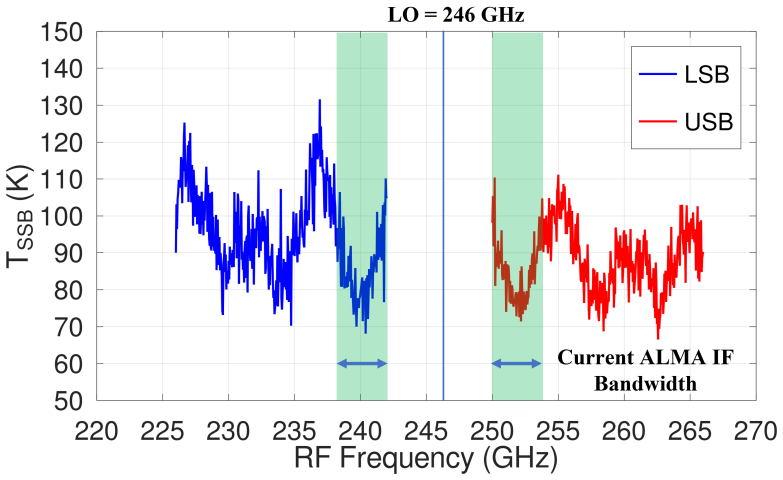
The 210-350 GHz receiver for FINER achieves approximately 100 K single-sideband noise temperature over most of the band in laboratory tests.
A machine-rendered reading of the paper's core claim, the machinery that carries it, and where it could break.
Core claim
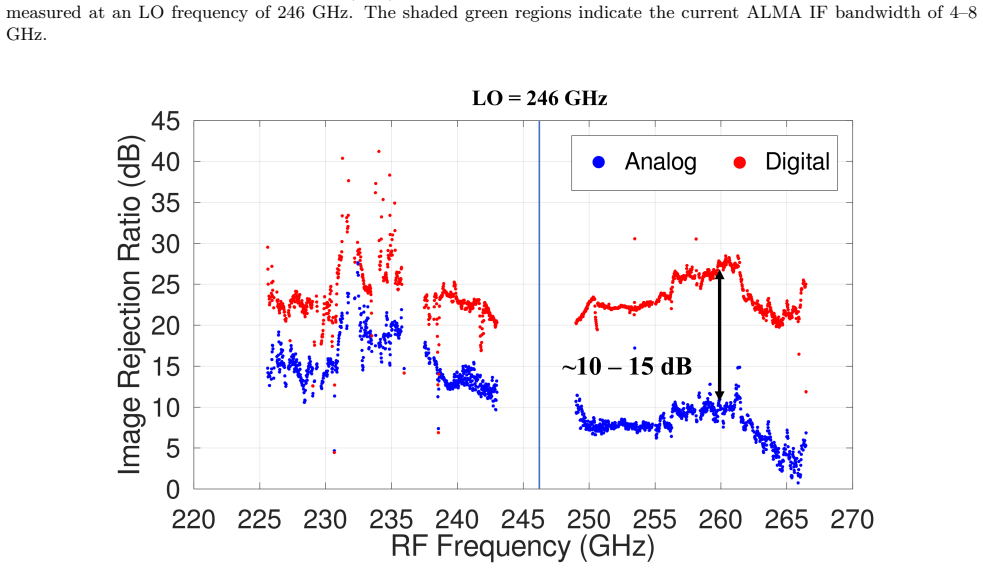
The 210-350 GHz receiver achieves a single sideband noise temperature of approximately 100 K over most of the radio-frequency band, and digital sideband separation with an image rejection ratio of around 20 dB has been demonstrated using a wideband spectrometer array.
What carries the argument
High-critical-current-density superconductor-insulator-superconductor mixer technology that enables the wide 3-21 GHz intermediate-frequency bandwidth per sideband and per polarization.
If this is right
- Provides approximately five times wider intermediate-frequency bandwidth than current ALMA specifications.
- Supports highly efficient spectral-scanning capability on the Large Millimeter Telescope among northern-hemisphere facilities.
- Facilitates identification of high-redshift galaxy candidates in the early universe.
Where Pith is reading between the lines
- Successful lab performance suggests the receiver could be scaled for dual-polarization operation across both 120-210 GHz and 210-350 GHz bands.
- The digital sideband separation method may reduce hardware complexity compared to analog approaches in future wideband systems.
- Installation on the telescope could enable new surveys that were previously limited by narrower bandwidths.
Load-bearing premise
The laboratory test conditions and calibration accurately represent the noise and sideband performance that will be obtained once the receiver is installed and operated on the Large Millimeter Telescope under actual observing conditions.
What would settle it
Direct measurements of the receiver noise temperature and image rejection ratio after installation on the Large Millimeter Telescope that deviate substantially from the laboratory values of 100 K and 20 dB would falsify the extrapolation to on-sky performance.
Figures

read the original abstract
The Far-Infrared Nebular Emission Receiver (FINER) project is developing two wideband dual-polarization sideband-separating receivers covering 120-210 GHz and 210-350 GHz to efficiently identify high-redshift galaxy candidates in the early universe. Based on high-critical-current-density superconductor-insulator-superconductor mixer technology originally developed for the ALMA wideband sensitivity upgrade, the FINER receivers are designed to provide an intermediate-frequency bandwidth of 3-21 GHz per sideband and per polarization, approximately five times wider than the current ALMA specifications. After installation on the Large Millimeter Telescope, these receivers are expected to offer highly efficient spectral-scanning capability among (sub)millimeterwave facilities in the northern-hemisphere. This paper reports the initial laboratory characterization of the 210-350 GHz receiver. The measured single sideband receiver noise temperature is approximately 100 K over most of the radio-frequency band. Digital sideband separation was also demonstrated using a wideband spectrometer array (DRS4), achieving an image rejection ratio of around 20 dB in the initial tests. These results represent an important step toward the realization of a wideband spectral-scanning receiver system for FINER.
Editorial analysis
A structured set of objections, weighed in public.
Referee Report
Summary. The manuscript reports the initial laboratory characterization of a 210-350 GHz wideband dual-polarization sideband-separating receiver developed for the FINER project on the Large Millimeter Telescope. Key results include a measured single-sideband receiver noise temperature of approximately 100 K over most of the RF band and demonstration of digital sideband separation using the DRS4 spectrometer array, achieving an image rejection ratio of around 20 dB. The design uses high-critical-current-density SIS mixers to achieve a 3-21 GHz IF bandwidth per sideband and polarization.
Significance. If the laboratory results are substantiated, the work represents a meaningful step toward wideband spectral-scanning receivers in the northern hemisphere, with an IF bandwidth approximately five times wider than current ALMA specifications. This could improve efficiency for identifying high-redshift galaxy candidates. The paper provides no machine-checked proofs or parameter-free derivations, but the direct laboratory measurements constitute a concrete, falsifiable data point for the community.
major comments (1)
- [Abstract and results section] Abstract and results section: The stated SSB noise temperature of ~100 K and IRR of ~20 dB are presented without accompanying details on the laboratory setup, Y-factor calibration procedure, hot/cold load temperatures, error analysis, or supporting raw data. This omission prevents verification that the measurements support the central performance claims.
minor comments (2)
- The manuscript would benefit from a brief comparison table of the achieved IF bandwidth and noise temperature against existing ALMA Band 6/7 receivers to quantify the claimed improvement.
- Clarify whether the digital sideband separation tests used the full 3-21 GHz IF bandwidth or a subset, and specify the spectrometer channelization.
Simulated Author's Rebuttal
We thank the referee for their review and for identifying the need for greater transparency in the measurement details. We address the single major comment below and will revise the manuscript accordingly.
read point-by-point responses
-
Referee: [Abstract and results section] Abstract and results section: The stated SSB noise temperature of ~100 K and IRR of ~20 dB are presented without accompanying details on the laboratory setup, Y-factor calibration procedure, hot/cold load temperatures, error analysis, or supporting raw data. This omission prevents verification that the measurements support the central performance claims.
Authors: We agree that the current manuscript lacks sufficient detail on the laboratory procedures to allow independent verification of the reported ~100 K SSB noise temperature and ~20 dB image rejection. In the revised version we will expand the results section (and, if space permits, the abstract) to describe the cryogenic test setup, the Y-factor calibration method including the physical temperatures of the hot and cold loads, the error budget and uncertainty analysis, and references to the raw spectra or additional figures that support the quoted performance figures. revision: yes
Circularity Check
No significant circularity; claims are direct lab measurements
full rationale
The paper reports empirical laboratory measurements of SSB noise temperature (~100 K) and digital sideband separation performance (~20 dB IRR) using the DRS4 spectrometer. These are presented as initial characterization results with no derivations, parameter fits, self-citation chains, or reductions of predictions to inputs. The abstract and results sections frame the outcomes explicitly as measured data, with no load-bearing theoretical steps or ansatzes that could introduce circularity. This is a standard instrumentation report whose central claims stand on direct observation.
Axiom & Free-Parameter Ledger
Reference graph
Works this paper leans on
-
[1]
Development status of wideband millimeter-wave receivers for lmt-finer,
Kang, H., Kojima, T., Sakai, T., Tamura, Y., Tetsuka, A., Masui, S., and Takekoshi, T., “Development status of wideband millimeter-wave receivers for lmt-finer,” in [Millimeter, Submillimeter, and Far-Infrared Detectors and Instrumentation for Astronomy XII],13102, 220–233, SPIE (2024)
2024
-
[2]
Some fundamental and practical limits on broadband matching to capacitive devices, and the implications for sis mixer design,
Kerr, A., “Some fundamental and practical limits on broadband matching to capacitive devices, and the implications for sis mixer design,”IEEE transactions on microwave theory and techniques43(1), 2–13 (1995)
1995
-
[3]
Performance and charac- terization of a wide if sis-mixer-preamplifier module employing high-j c sis junctions,
Kojima, T., Kroug, M., Uemizu, K., Niizeki, Y., Takahashi, H., and Uzawa, Y., “Performance and charac- terization of a wide if sis-mixer-preamplifier module employing high-j c sis junctions,”IEEE Transactions on Terahertz Science and Technology7(6), 694–703 (2017)
2017
-
[4]
275–500-ghz wideband waveguide sis mixers,
Kojima, T., Kroug, M., Gonzalez, A., Uemizu, K., Kaneko, K., Miyachi, A., Kozuki, Y., and Asayama, S., “275–500-ghz wideband waveguide sis mixers,”IEEE Transactions on Terahertz Science and Technol- ogy8(6), 638–646 (2018)
2018
-
[5]
Wideband technology development to increase the rf and instantaneous band- width of alma receivers,
Kojima, T., Uemizu, K., Kiuchi, H., Tamura, T., Kaneko, K., Sakai, R., Miyachi, A., Shan, W., Uzawa, Y., Gonzalez, A., et al., “Wideband technology development to increase the rf and instantaneous band- width of alma receivers,” in [Millimeter, Submillimeter, and Far-Infrared Detectors and Instrumentation for Astronomy X],11453, 139–147, SPIE (2020)
2020
-
[6]
Development of the ALMA band-3 and band-6 sideband-separating SIS mixers,
Kerr, A. R., Pan, S.-K., Claude, S. M. X., Dindo, P., Lichtenberger, A. W., Effland, J. E., and Lauria, E. F., “Development of the ALMA band-3 and band-6 sideband-separating SIS mixers,”IEEE Transactions on Terahertz Science and Technology4(2), 201–212 (2014)
2014
-
[7]
A 10.24-GHz-wide digital spectrometer array system for LMT- FINER: System design and laboratory performance verification,
Hagimoto, M., Taniguchi, A., Tamura, Y., Okauchi, N., Kawamoto, H., Nakajima, T., Hikosaka, T., Harada, K., Taniguchi, T., Kamazaki, T., et al., “A 10.24-GHz-wide digital spectrometer array system for LMT- FINER: System design and laboratory performance verification,” in [Millimeter, Submillimeter, and Far- Infrared Detectors and Instrumentation for Astro...
2024
-
[8]
A 345-GHz sideband-separating receiver prototype with ultra-wide instantaneous bandwidth,
Garrett, J. D., Tong, C.-Y. E., Zeng, L., Chen, T.-J., and Wang, M.-J., “A 345-GHz sideband-separating receiver prototype with ultra-wide instantaneous bandwidth,”IEEE Transactions on Terahertz Science and Technology13(3), 237–245 (2023)
2023
-
[9]
FINER: Far-infrared nebular emission receiver for the large millimeter telescope,
Tamura, Y., Sakai, T., Kawabe, R., Kojima, T., Taniguchi, A., Takekoshi, T., Kang, H., Shan, W., Hag- imoto, M., Okauchi, N., et al., “FINER: Far-infrared nebular emission receiver for the large millimeter telescope,” in [Millimeter, Submillimeter, and Far-Infrared Detectors and Instrumentation for Astronomy XII],13102, 187–198, SPIE (2024)
2024
-
[10]
High-resolution digital spectrometer with correlation and image rejection capabilities,
Murk, A., Straub, C., Zardet, D., and Stuber, B., “High-resolution digital spectrometer with correlation and image rejection capabilities,” in [Twentieth International Symposium on Space Terahertz Technology], 202 (2009)
2009
-
[11]
A calibrated digital sideband- separating spectrometer for radio astronomy applications,
Finger, R., Mena, P., Reyes, N., Rodriguez, R., and Bronfman, L., “A calibrated digital sideband- separating spectrometer for radio astronomy applications,”Publications of the Astronomical Society of the Pacific125(925), 263–269 (2013)
2013
-
[12]
Digital compensation of the sideband-rejection ratio in a fully analog 2SB sub-millimeter receiver,
Rodriguez, R., Finger, R., Mena, F. P., Alvear, A., Fuentes, R., Khudchenko, A., Hesper, R., Baryshev, A. M., Reyes, N., and Bronfman, L., “Digital compensation of the sideband-rejection ratio in a fully analog 2SB sub-millimeter receiver,”Astronomy & Astrophysics619, A153 (2018)
2018
discussion (0)
Sign in with ORCID, Apple, or X to comment. Anyone can read and Pith papers without signing in.