Barocaloric phase transformation from data efficient fine-tuning of machine learned interatomic potentials
Pith reviewed 2026-06-25 21:03 UTC · model grok-4.3
The pith
Fine-tuned machine-learned potentials reproduce the barocaloric phase transformation in ammonium sulfate with 5-10 DFT configurations
A machine-rendered reading of the paper's core claim, the machinery that carries it, and where it could break.
Core claim
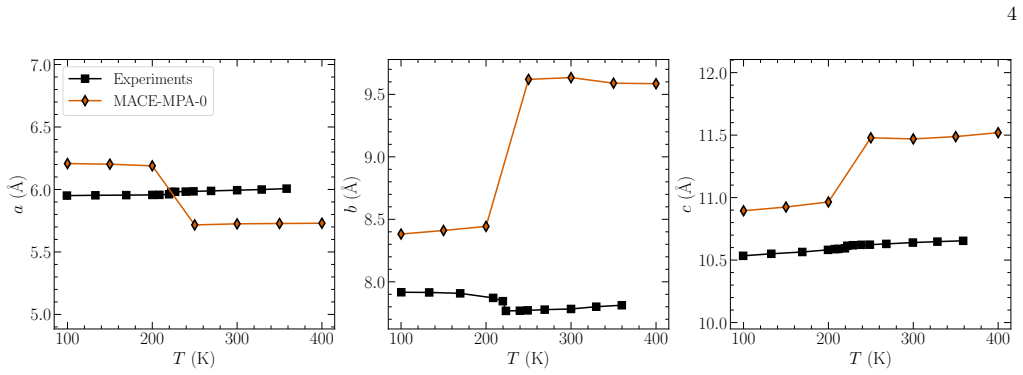
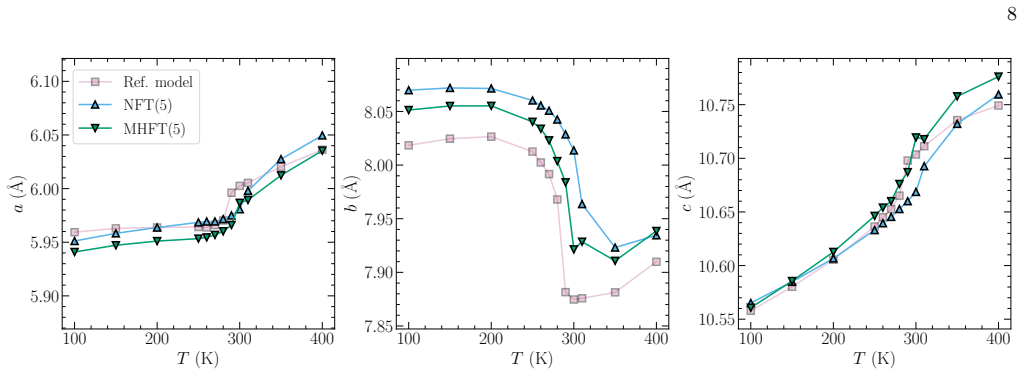
Fine-tuned MACE models reproduce the temperature-driven structural phase transformation of ammonium sulfate in molecular dynamics simulations using as few as 5 to 10 60-atom DFT configurations, whereas the MACE-MPA-0 foundation model itself fails to reproduce the transformation and models trained from scratch break down for small datasets.
What carries the argument
Fine-tuning the MACE-MPA-0 foundation model with naive and multihead replay protocols on small sets of 60-atom DFT configurations to enable accurate molecular dynamics of the phase transformation.
Load-bearing premise
The small number of 60-atom configurations chosen for fine-tuning are representative of those that control the phase transformation over the full temperature range of interest.
What would settle it
Molecular dynamics trajectories generated by the fine-tuned potential on supercells much larger than 60 atoms or at temperatures outside the narrow training window fail to show the expected phase transformation at the correct temperature.
Figures





read the original abstract
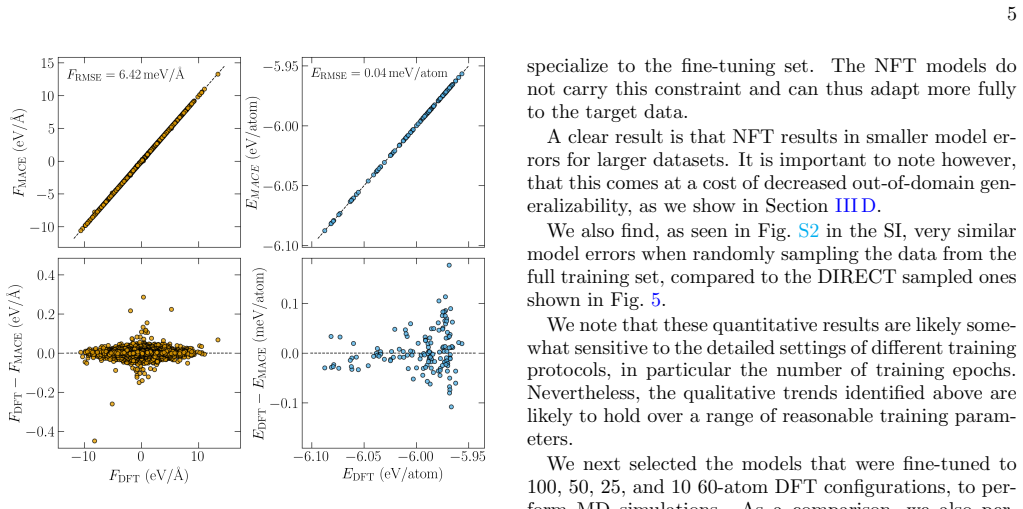
Solid-state cooling based on the barocaloric (BC) effect has emerged as promising environmentally friendly prospective alternative to conventional vapor-compression refrigeration. The search for suitable BC materials relies on efficient atomistic simulations of their phase behavior. Machine-learned interatomic potentials (MLIPs) enable such simulations at near density functional theory (DFT) accuracy, but generating the required DFT training data remains computationally demanding, which motivates development of strategies that reduce the amount of data needed to train accurate models. In this work, we use a prototypical BC material, ammonium sulfate, as a model system and investigate how small a training set can be while still reproducing the temperature-driven structural phase transformation that underlies its BC response. We train a series of MLIPs based on the MACE architecture using three strategies: training from scratch, and naive- and multihead replay fine-tuning of the MACE-MPA-0 foundation model. These strategies are evaluated on their ability to reproduce the phase transformation of ammonium sulfate in molecular dynamics simulations across a range of training-set sizes. We find that, while the MACE-MPA-0 foundation model itself fails to reproduce the transformation, and models trained from scratch break down for small datasets, fine-tuned models reproduce the transformation using as few as 5 to 10 60-atom DFT configurations. Both fine-tuning protocols yield similarly accurate results for ammonium sulfate, but we also find some indications that multihead replay fine-tuning is more robust on configurations outside the fine-tuning domain. Exploiting this data efficiency, we further show that models can be trained on small datasets and the hybrid-DFT level, and that some form of inclusion of dispersion correction is necessary to describe the phase behavior correctly.
Editorial analysis
A structured set of objections, weighed in public.
Referee Report
Summary. The manuscript claims that fine-tuning the MACE-MPA-0 foundation model (via naive or multihead replay) on as few as 5–10 60-atom DFT configurations of ammonium sulfate enables MD simulations to reproduce the temperature-driven structural phase transformation underlying its barocaloric response, while the base foundation model fails and models trained from scratch break down at small dataset sizes. The work also reports that both fine-tuning protocols perform similarly, with some indications of better out-of-domain robustness for multihead replay, and extends the approach to hybrid-DFT training provided dispersion corrections are included.
Significance. If the central result is robust, the demonstration of data-efficient fine-tuning for capturing a finite-temperature phase transformation would be a notable advance for MLIP applications in barocaloric materials discovery, where generating large DFT datasets is a bottleneck. The explicit comparison of training-from-scratch versus foundation-model fine-tuning, together with the hybrid-DFT extension, supplies useful empirical benchmarks on the minimal data threshold for this class of problem.
major comments (2)
- [Abstract and MD results section] Abstract and Results (MD evaluation): the claim that fine-tuned models 'reproduce the transformation' lacks quantitative support—no order-parameter time series, transition temperatures with uncertainties, hysteresis widths, or direct comparison to experimental or larger-scale reference data are reported, making it impossible to assess whether the observed structural change is a genuine capture of the barocaloric mechanism or an artifact of the simulation protocol.
- [Methods and Results on training-set size] Methods (training-set construction) and Results (fine-tuning experiments): the selection criteria and provenance of the 5–10 60-atom configurations used for fine-tuning are not specified (e.g., whether drawn from 0 K relaxations, a single low-T trajectory, or an ensemble spanning the transition temperature). This directly bears on the central claim, because the foundation model and scratch-trained models fail while fine-tuned ones succeed; without evidence that the chosen configurations encode the anharmonic and entropic physics sampled at finite T, the data-efficiency result cannot be distinguished from memorization of a narrow slice of configuration space.
minor comments (2)
- [Methods] Notation for the two fine-tuning protocols (naive vs. multihead replay) should be defined once in the Methods section and used consistently in all figures and tables.
- [Figure captions] Figure captions for the MD trajectories should explicitly state the system size, thermostat/barostat settings, and simulation length to allow reproducibility assessment.
Simulated Author's Rebuttal
We thank the referee for their constructive feedback, which highlights important areas for strengthening the quantitative evidence and methodological transparency in our work. We address each major comment below and have revised the manuscript to incorporate the suggested improvements.
read point-by-point responses
-
Referee: [Abstract and MD results section] Abstract and Results (MD evaluation): the claim that fine-tuned models 'reproduce the transformation' lacks quantitative support—no order-parameter time series, transition temperatures with uncertainties, hysteresis widths, or direct comparison to experimental or larger-scale reference data are reported, making it impossible to assess whether the observed structural change is a genuine capture of the barocaloric mechanism or an artifact of the simulation protocol.
Authors: We agree that additional quantitative metrics are needed to robustly support the central claim. In the revised manuscript, we have expanded the MD evaluation section to include order-parameter time series from the simulations, transition temperatures reported with uncertainties derived from multiple independent runs, measured hysteresis widths, and direct comparisons against both experimental values and reference data from larger-scale simulations. These additions confirm that the observed structural changes align with the known barocaloric phase transformation mechanism rather than arising from simulation artifacts. revision: yes
-
Referee: [Methods and Results on training-set size] Methods (training-set construction) and Results (fine-tuning experiments): the selection criteria and provenance of the 5–10 60-atom configurations used for fine-tuning are not specified (e.g., whether drawn from 0 K relaxations, a single low-T trajectory, or an ensemble spanning the transition temperature). This directly bears on the central claim, because the foundation model and scratch-trained models fail while fine-tuned ones succeed; without evidence that the chosen configurations encode the anharmonic and entropic physics sampled at finite T, the data-efficiency result cannot be distinguished from memorization of a narrow slice of configuration space.
Authors: We acknowledge that the original manuscript did not provide sufficient detail on how the small set of configurations was assembled. The revised Methods section now explicitly describes the selection criteria and provenance of the 5–10 configurations, including their generation from both 0 K structural relaxations and finite-temperature trajectories that sample the relevant temperature range around the phase transition. This clarification demonstrates that the configurations incorporate the necessary anharmonic and entropic features, supporting the data-efficiency claim beyond simple memorization. revision: yes
Circularity Check
No circularity: empirical validation of fine-tuned MLIP performance on MD phase transformation
full rationale
The paper reports an empirical study: MACE models are trained (from scratch or fine-tuned) on small sets of 60-atom DFT configurations for ammonium sulfate, then evaluated by whether MD trajectories reproduce the known temperature-driven structural phase change. No equations, parameters, or claims reduce by construction to the training inputs; the central result is a direct, falsifiable comparison of simulated vs. observed phase behavior. No self-citation chains, ansatzes smuggled via prior work, or fitted quantities renamed as predictions appear in the provided text. The representativeness concern raised by the skeptic is a question of experimental design validity, not a circular reduction in the derivation.
Axiom & Free-Parameter Ledger
free parameters (1)
- Training-set size threshold
axioms (2)
- domain assumption The MACE architecture and foundation model weights provide a sufficiently general starting point that fine-tuning on local environments transfers to the global phase behavior.
- domain assumption Dispersion corrections are required for correct phase behavior.
Reference graph
Works this paper leans on
-
[1]
Anderson, E
S. Anderson, E. Bandarra, C. Bhushan, N. Borgford- Parnell, Z. Chen, J. Christensen, S. Devotta, M. Lal Dhasan, G. Dreyfus, J. Dulac,et al., Cool- ing emissions and policy synthesis report: benefits of cooling efficiency and the kigali amendment, United Nations Environment Programme-International Energy Agency (2020)
2020
-
[2]
M. Baha, S. Hammami, and J.-L. Dupont,The Role of Refrigeration in Global Economy, Tech. Rep. (Interna- tional Institute of Refrigeration (IIR), Paris, 2025)
2025
-
[3]
C. Cazorla, Novel mechanocaloric materials for solid- state cooling applications, Applied Physics Reviews6, 10.1063/1.5113620 (2019)
-
[4]
Cirillo, A
L. Cirillo, A. Greco, and C. Masselli, Cooling through barocaloric effect: A review of the state of the art up to 2022, Thermal Science and Engineering Progress33, 101380 (2022)
2022
-
[5]
V. K. Pecharsky and K. A. Gschneidner Jr, Giant mag- netocaloric effect in Gd5(Si2Ge2), Physical review letters 78, 4494 (1997)
1997
-
[6]
P. Lloveras, A. Aznar, M. Barrio, P. Negrier, C. Popescu, A. Planes, L. Ma˜ nosa, E. Stern-Taulats, A. Avramenko, N. D. Mathur, X. Moya, and J.-L. Tamarit, Colos- sal barocaloric effects near room temperature in plastic crystals of neopentylglycol, Nature Communications10, 10.1038/s41467-019-09730-9 (2019)
-
[7]
B. Li, Y. Kawakita, S. Ohira-Kawamura, T. Suga- hara, H. Wang, J. Wang, Y. Chen, S. I. Kawaguchi, S. Kawaguchi, K. Ohara, K. Li, D. Yu, R. Mole, T. Hat- tori, T. Kikuchi, S.-i. Yano, Z. Zhang, Z. Zhang, W. Ren, S. Lin, O. Sakata, K. Nakajima, and Z. Zhang, Colos- sal barocaloric effects in plastic crystals, Nature567, 506–510 (2019)
2019
-
[8]
Y. Zuo, C. Chen, X. Li, Z. Deng, Y. Chen, J. Behler, G. Cs´ anyi, A. V. Shapeev, A. P. Thompson, M. A. Wood, and S. P. Ong, Performance and cost assessment of machine learning interatomic potentials, The Journal of Physical Chemistry A124, 731–745 (2020)
2020
-
[9]
Pan, Scaling up system size in materials simulation, Nature Computational Science1, 95–95 (2021)
J. Pan, Scaling up system size in materials simulation, Nature Computational Science1, 95–95 (2021)
2021
-
[10]
T. W. Ko and S. P. Ong, Recent advances and outstand- ing challenges for machine learning interatomic poten- tials, Nature Computational Science3, 998–1000 (2023)
2023
-
[11]
V. L. Deringer, M. A. Caro, and G. Cs´ anyi, Ma- chine learning interatomic potentials as emerging tools for materials science, Advanced Materials31, 10.1002/adma.201902765 (2019)
-
[12]
Jacobs, D
R. Jacobs, D. Morgan, S. Attarian, J. Meng, C. Shen, Z. Wu, C. Y. Xie, J. H. Yang, N. Artrith, B. Blaiszik, G. Ceder, K. Choudhary, G. Csanyi, E. D. Cubuk, B. Deng, R. Drautz, X. Fu, J. Godwin, V. Honavar, O. Isayev, A. Johansson, B. Kozinsky, S. Martiniani, 11 S. P. Ong, I. Poltavsky, K. Schmidt, S. Takamoto, A. P. Thompson, J. Westermayr, and B. M. Wood...
2025
-
[13]
Zhang, V
Y.-W. Zhang, V. Sorkin, Z. H. Aitken, A. Politano, J. Behler, A. P Thompson, T. W. Ko, S. P. Ong, O. Cha- lykh, D. Korogod, E. Podryabinkin, A. Shapeev, J. Li, Y. Mishin, Z. Pei, X. Liu, J. Kim, Y. Park, S. Hwang, S. Han, K. Sheriff, Y. Cao, and R. Freitas, Roadmap for the development of machine learning-based interatomic potentials, Modelling and Simulat...
2025
-
[14]
E. C.-Y. Yuan, Y. Liu, J. Chen,et al., Foundation mod- els for atomistic simulation of chemistry and materials, Nature Reviews Chemistry10, 212 (2026)
2026
-
[15]
The Journal of Chemical Physics , author =
I. Batatia, P. Benner, Y. Chiang, A. M. Elena, D. P. Kov´ acs, J. Riebesell, X. R. Advincula, M. Asta, M. Avaylon, W. J. Baldwin, F. Berger, N. Bernstein, A. Bhowmik, F. Bigi, S. M. Blau, V. C˘ arare, M. Ceriotti, S. Chong, J. P. Darby, S. De, F. Della Pia, V. L. Deringer, R. Elijoˇ sius, Z. El-Machachi, E. Fako, F. Falcioni, A. C. Ferrari, J. L. A. Gardn...
-
[16]
H¨ anseroth, A
J. H¨ anseroth, A. Fl¨ ototto, M. N. Qaisrani, and C. Dreßler, Fine-tuning unifies foundational machine- learned interatomic potential architectures at ab initio accuracy, The Journal of Physical Chemistry Letters17, 3152–3162 (2026)
2026
-
[17]
H. Kaur, F. Della Pia, I. Batatia, X. R. Advincula, B. X. Shi, J. Lan, G. Cs´ anyi, A. Michaelides, and V. Kapil, Data-efficient fine-tuning of foundational models for first- principles quality sublimation enthalpies, Faraday Dis- cussions256, 120–138 (2025)
2025
-
[18]
Grandel, P
J. Grandel, P. Benner, and J. George, Parameter-efficient fine-tuning of machine-learning interatomic potentials for phonon and thermal properties (2026)
2026
-
[19]
M. Radova, W. G. Stark, C. S. Allen, R. J. Maurer, and A. P. Bart´ ok, Fine-tuning foundation models of materials interatomic potentials with frozen transfer learning, npj Computational Materials11, 10.1038/s41524-025-01727- x (2025)
-
[20]
M. Lu, S. Hu, C. Zhao, C. Wang, W. Jia, G. Tan, J. Jiang, and L. Chen, Efficient fine-tuning of foundation atomistic models for reversible polymorphic phase tran- sitions in organic molecular crystals (2025), preprint
2025
-
[21]
P. Lloveras, E. Stern-Taulats, M. Barrio, J.-L. Tamarit, S. Crossley, W. Li, V. Pomjakushin, A. Planes, L. Ma˜ nosa, N. D. Mathur, and X. Moya, Gi- ant barocaloric effects at low pressure in ferrielec- tric ammonium sulphate, Nature Communications6, 10.1038/ncomms9801 (2015)
-
[22]
Batatia, D
I. Batatia, D. P. Kovacs, G. Simm, C. Ortner, and G. Csanyi, Mace: Higher order equivariant message pass- ing neural networks for fast and accurate force fields, in Advances in Neural Information Processing Systems 35, NeurIPS 2022 (Neural Information Processing Systems Foundation, Inc. (NeurIPS), 2022) p. 11423–11436
2022
-
[23]
L. M. Malec, M. Z. Brela, and K. M. Stadnicka, Dis- placive or order-disorder phase transition? the h-bond dynamics in multicaloric ammonium sulfate, Acta Mate- rialia209, 116782 (2021)
2021
-
[24]
S. Yuan, B. E. Meijer, G. Cai, R. J. C. Dixey, F. Dem- mel, M. T. Dove, J. Liu, H. Y. Playford, H. C. Walker, and A. E. Phillips, Origin of the large en- tropy change in the molecular caloric and ferroelectric ammonium sulfate, Advanced Functional Materials32, 10.1002/adfm.202207717 (2022)
-
[25]
R. Jinnouchi, J. Lahnsteiner, F. Karsai, G. Kresse, and M. Bokdam, Phase transitions of hybrid perovskites sim- ulated by machine-learning force fields trained on the fly with bayesian inference, Physical Review Letters122, 10.1103/physrevlett.122.225701 (2019)
-
[26]
R. Jinnouchi, F. Karsai, and G. Kresse, On-the-fly ma- chine learning force field generation: Application to melting points, Physical Review B100, 10.1103/phys- revb.100.014105 (2019)
-
[27]
R. Jinnouchi, F. Karsai, C. Verdi, R. Asahi, and G. Kresse, Descriptors representing two- and three-body atomic distributions and their effects on the accuracy of machine-learned inter-atomic potentials, The Journal of Chemical Physics152, 10.1063/5.0009491 (2020)
-
[28]
MACE foundation models,https://github.com/ ACEsuit/mace-foundations/releases(2024), accessed: 2025-05-21
2024
-
[29]
J. Qi, T. W. Ko, B. C. Wood, T. A. Pham, and S. P. Ong, Robust training of machine learning interatomic poten- tials with dimensionality reduction and stratified sam- pling, npj Computational Materials10, 10.1038/s41524- 024-01227-4 (2024)
-
[30]
P. E. Bl¨ ochl, Projector augmented-wave method, Physi- cal Review B50, 17953–17979 (1994)
1994
-
[31]
Kresse and J
G. Kresse and J. Furthm¨ uller, Efficiency of ab-initio total energy calculations for metals and semiconductors using a plane-wave basis set, Computational Materials Science 6, 15–50 (1996)
1996
-
[32]
Kresse and J
G. Kresse and J. Furthm¨ uller, Efficient iterative schemes for ab initio total-energy calculations using a plane-wave basis set, Physical Review B54, 11169–11186 (1996)
1996
-
[33]
Kresse and D
G. Kresse and D. Joubert, From ultrasoft pseudopoten- tials to the projector augmented-wave method, Physical Review B59, 1758–1775 (1999)
1999
-
[34]
J. W. Furness, A. D. Kaplan, J. Ning, J. P. Perdew, and J. Sun, Accurate and numerically efficient r2scan meta-generalized gradient approximation, The Journal of Physical Chemistry Letters11, 8208–8215 (2020)
2020
-
[35]
Adamo and V
C. Adamo and V. Barone, Toward reliable density func- tional methods without adjustable parameters: The pbe0 model, The Journal of Chemical Physics110, 6158–6170 (1999)
1999
-
[36]
S. Grimme, J. Antony, S. Ehrlich, and H. Krieg, A con- sistent and accurate ab initio parametrization of den- sity functional dispersion correction (dft-d) for the 94 12 elements h-pu, The Journal of Chemical Physics132, 10.1063/1.3382344 (2010)
-
[37]
Gilmer, S
J. Gilmer, S. S. Schoenholz, P. F. Riley, O. Vinyals, and G. E. Dahl, Neural message passing for quantum chem- istry (arXiv, 2017)
2017
-
[38]
Atomicclusterexpansionforaccurateandtransferableinteratomicpotentials
R. Drautz, Atomic cluster expansion for accurate and transferable interatomic potentials, Physical Review B 99, 10.1103/physrevb.99.014104 (2019)
-
[39]
Mailoa, Mordechai Kornbluth, Nicola Molinari, Tess E
S. Batzner, A. Musaelian, L. Sun, M. Geiger, J. P. Mailoa, M. Kornbluth, N. Molinari, T. E. Smidt, and B. Kozinsky, E(3)-equivariant graph neural networks for data-efficient and accurate interatomic potentials, Na- ture Communications13, 10.1038/s41467-022-29939-5 (2022)
-
[40]
B. Deng, P. Zhong, K. Jun, J. Riebesell, K. Han, C. J. Bartel, and G. Ceder, Chgnet as a pretrained universal neural network potential for charge-informed atomistic modelling, Nature Machine Intelligence5, 1031–1041 (2023)
2023
-
[41]
Schmidt, T
J. Schmidt, T. F. Cerqueira, A. H. Romero, A. Loew, F. J¨ ager, H.-C. Wang, S. Botti, and M. A. Marques, Improving machine-learning models in materials science through large datasets, Materials Today Physics48, 101560 (2024)
2024
-
[42]
L. Barros-Luque, M. Shuaibi, X. Fu, B. M. Wood, M. Dzamba, M. Gao, A. Rizvi, M. Uyttendaele, C. L. Zit- nick, and Z. W. Ulissi, The open materials 2024 (omat24) inorganic materials dataset and models, Nature Compu- tational Science 10.1038/s43588-026-00996-w (2026)
-
[43]
Ceriotti, J
M. Ceriotti, J. More, and D. E. Manolopoulos, i-pi: A python interface for ab initio path integral molecular dy- namics simulations, Computer Physics Communications 185, 1019–1026 (2014)
2014
-
[44]
G. J. Martyna, D. J. Tobias, and M. L. Klein, Constant pressure molecular dynamics algorithms, The Journal of Chemical Physics101, 4177–4189 (1994)
1994
-
[45]
Langevinet al., Sur la th´ eorie du mouvement brown- ien, CR Acad
P. Langevinet al., Sur la th´ eorie du mouvement brown- ien, CR Acad. Sci. Paris146, 530 (1908)
1908
-
[46]
Hedin and J
L. Hedin and J. Klarbring, Reproducibility package for: ”barocaloric phase transformation from data efficient fine-tuning of machine learned interatomic potentials”, https://github.com/Snurre3/mace-amsulf-data (2026)
2026
-
[47]
Kothakonda, A
M. Kothakonda, A. D. Kaplan, E. B. Isaacs, C. J. Bartel, J. W. Furness, J. Ning, C. Wolverton, J. P. Perdew, and J. Sun, Testing the r2scan density functional for the ther- modynamic stability of solids with and without a van der waals correction, ACS Materials Au3, 102–111 (2022)
2022
-
[48]
Fotopoulos, M
V. Fotopoulos, M. Siebenhofer, M. Huang, L. Xu, and B. Yildiz, First-principles study of sio2/mos2 and sio2/ws2 interfaces: A comparative analysis of surface terminations, van der waals corrections, and functionals, MRS Advances10, 1277–1283 (2025)
2025
-
[49]
MACE documentation (2025), accessed: 18 June 2026
2025
discussion (0)
Sign in with ORCID, Apple, or X to comment. Anyone can read and Pith papers without signing in.