Cosmology with Tully-Fisher HI Galaxy Surveys
Pith reviewed 2026-06-25 19:48 UTC · model grok-4.3
The pith
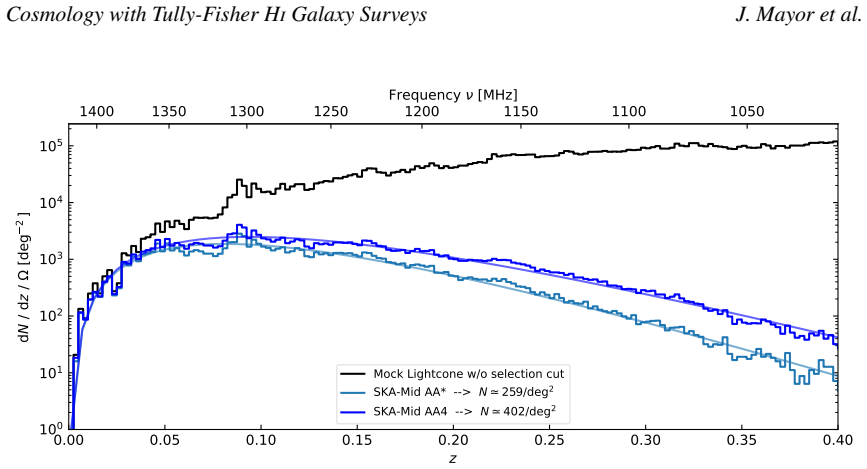
SKAO Tully-Fisher HI galaxy surveys with AA* and AA4 will extend peculiar velocity measurements and related cosmology cases.
A machine-rendered reading of the paper's core claim, the machinery that carries it, and where it could break.
Core claim
The paper claims that SKAO Tully-Fisher HI surveys using AA* and AA4 configurations of SKA-Mid will deliver statistical samples of peculiar velocities at unprecedented depths and redshifts, thereby covering an extended range of cosmology science cases beyond what present HI surveys allow.
What carries the argument
The Tully-Fisher relation applied to HI-selected galaxies, whose line widths and luminosities yield distance-independent velocity estimates when combined with SKA-Mid's spatial and spectral sensitivity.
If this is right
- Peculiar velocity catalogs will reach higher redshifts and larger volumes than existing datasets.
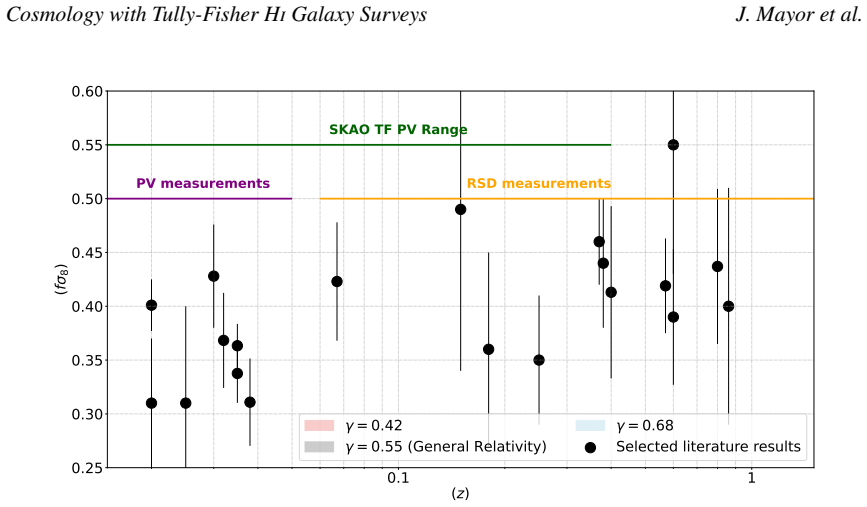
- The growth rate of structure can be measured over an extended baseline in redshift.
- Additional cosmology applications become feasible once the velocity-field samples grow by the forecasted factors.
- Direct comparison of AA* versus AA4 configurations shows how array design choices control the reachable science cases.
Where Pith is reading between the lines
- Such surveys could provide an independent cross-check on redshift-space distortion measurements from intensity mapping.
- Combining the new peculiar velocities with supernova or BAO distances would tighten tests of the distance-velocity relation.
- If the relation holds, the same data could also constrain the baryonic Tully-Fisher relation at higher redshift.
- Future array upgrades beyond AA4 would further extend the same science cases in a predictable way.
Load-bearing premise
The Tully-Fisher relation remains tight and measurable for HI-selected galaxies out to the redshifts and depths forecast for SKA-Mid.
What would settle it
An observation that the scatter in the Tully-Fisher relation for HI galaxies increases sharply beyond the redshifts reached by current surveys, erasing the predicted growth in usable peculiar-velocity sample size.
Figures


read the original abstract
The SKA Observatory will enable measurements of the Tully-Fisher relation for statistical samples of HI selected galaxies out to unprecedented depths and redshifts thanks to its unique combined spatial and spectral sensitivity. This chapter explores the transformative potential of such surveys for cosmology, in particular in the field of peculiar velocity measurements. We briefly review the present observational landscape for Tully-Fisher HI galaxy surveys and existing peculiar velocity datasets, and compare them with predictions for SKAO Tully-Fisher HI galaxy surveys with AA* and AA4 configurations of the SKA-Mid array. We discuss the extended range of cosmology science cases covered and enabled by such surveys.
Editorial analysis
A structured set of objections, weighed in public.
Referee Report
Summary. The manuscript reviews the current observational landscape for Tully-Fisher HI galaxy surveys and existing peculiar velocity datasets. It then compares these with predictions for SKAO Tully-Fisher HI galaxy surveys using the AA* and AA4 configurations of the SKA-Mid array, and discusses the extended range of cosmology science cases (particularly peculiar velocity measurements) that such surveys would enable.
Significance. If the forecasts prove robust, the work would be useful for highlighting the cosmological potential of SKA-Mid TF surveys in peculiar velocities and for survey planning. The comparison of current versus predicted yields provides a clear benchmark, but the absence of error budgets, explicit modeling assumptions, and validation against existing data reduces the immediate impact of the predictions.
major comments (2)
- [Predictions and comparison section] The section comparing current low-z surveys with predicted SKA yields: the central claim that AA* and AA4 configurations enable an extended range of peculiar-velocity cosmology cases requires that statistical TF samples can be assembled at the forecast depths and redshifts. This in turn depends on the TF relation retaining small intrinsic scatter and no systematic evolution or selection bias, yet the manuscript supplies no explicit modeling of possible redshift evolution in the TF zero-point or scatter and no quantitative propagation of TF uncertainty into the final cosmological constraints.
- [Abstract] Abstract: the abstract states comparisons and predictions but provides no error budgets, explicit modeling assumptions, or validation against existing data, making it difficult to assess whether post-hoc choices affect the central forecasts.
minor comments (1)
- The notation for survey configurations (AA* and AA4) could be defined more explicitly on first use for readers unfamiliar with SKA-Mid array details.
Simulated Author's Rebuttal
We thank the referee for their constructive comments. We address each major point below and indicate the revisions made to strengthen the manuscript while preserving its scope as a review of survey capabilities and science potential.
read point-by-point responses
-
Referee: [Predictions and comparison section] The section comparing current low-z surveys with predicted SKA yields: the central claim that AA* and AA4 configurations enable an extended range of peculiar-velocity cosmology cases requires that statistical TF samples can be assembled at the forecast depths and redshifts. This in turn depends on the TF relation retaining small intrinsic scatter and no systematic evolution or selection bias, yet the manuscript supplies no explicit modeling of possible redshift evolution in the TF zero-point or scatter and no quantitative propagation of TF uncertainty into the final cosmological constraints.
Authors: We agree that robust forecasts ultimately require attention to TF evolution and uncertainty propagation. The manuscript is a review comparing yields and outlining enabled science cases rather than a dedicated forecasting study; the central claims concern the increase in sample size and redshift reach assuming the TF relation remains usable at the level demonstrated by existing low-z surveys. To address the concern we have added a dedicated paragraph in the predictions section that (i) summarizes existing observational constraints on TF zero-point and scatter evolution out to z~0.2, (ii) states the explicit assumption of no strong evolution adopted for the AA* and AA4 extrapolations, and (iii) notes that a full end-to-end propagation of TF systematics into cosmological parameters lies beyond the present scope and is identified as future work. We have also added two relevant references on TF evolution. revision: partial
-
Referee: [Abstract] Abstract: the abstract states comparisons and predictions but provides no error budgets, explicit modeling assumptions, or validation against existing data, making it difficult to assess whether post-hoc choices affect the central forecasts.
Authors: We have revised the abstract to include a concise statement of the principal modeling assumptions (extrapolation of the TF relation with scatter comparable to current surveys and no strong redshift evolution) and to clarify that the comparisons are based on number-count forecasts rather than full error-budgeted cosmological forecasts. revision: yes
Circularity Check
No circularity: forecasts rely on external instrument models and established TF relation without reduction to self-fitted inputs
full rationale
The provided abstract and context describe a forward-looking comparison of current TF HI surveys against predicted SKAO yields for peculiar velocity cosmology, without any quoted equations, self-citations, or ansatzes that reduce the central predictions to fitted parameters by construction. The TF relation is treated as an input observational tool whose scatter and applicability at higher z is an assumption (not derived within the paper), and no load-bearing uniqueness theorem or renaming of known results appears. This is the standard structure of a survey forecast paper whose claims remain falsifiable by future data rather than tautological.
Axiom & Free-Parameter Ledger
axioms (1)
- domain assumption The Tully-Fisher relation remains valid and tight for HI-selected galaxies at the redshifts targeted by SKAO surveys
Reference graph
Works this paper leans on
-
[1]
doi: 10.1103/tr6y-kpc6. M. Baes et al.A&A, 696:A52, Apr
-
[2]
doi: 10.1051/0004-6361/202453417. C. J. Ball et al.ApJ, 950(2):87, June
-
[3]
D.G.Barnesetal.MNRAS,322(3):486–498, Apr.2001
doi: 10.3847/1538-4357/accb53. D.G.Barnesetal.MNRAS,322(3):486–498, Apr.2001. doi: 10.1046/j.1365-8711.2001.04102.x. E. F. Bell and R. S. de Jong.ApJ, 550(1):212–229, Mar
-
[4]
doi: 10.1086/319728. D. Bertacca et al. InAdvancing Astrophysics with the SKA – II (AASKAII)
-
[5]
doi: 10.1086/185348. S. Blyth et al. InMeerKAT Science: On the Pathway to the SKA, page 4, Jan
-
[6]
doi: 10.22323/1.277.0004. P. Boubel, M. Colless, K. Said, and L. Staveley-Smith.MNRAS, 531(1):84–109, June
-
[7]
doi: 10.1093/mnras/stae1122. P. Boubel, M. Colless, K. Said, and L. Staveley-Smith.JCAP, 2025(3):066, Mar
-
[8]
doi: 10.1088/1475-7516/2025/03/066. R.Braunetal. Anticipatedperformanceofthesquarekilometrearray–phase1(ska1),2019. URL https://arxiv.org/abs/1912.12699. S. Camera et al. InAdvancing Astrophysics with the SKA – II (AASKAII)
-
[9]
J.Carrick,S.J.Turnbull,G.Lavaux,andM.J.Hudson.MNRAS,450(1):317–332,June2015
doi: 10.1051/0004-6361/202346173. J.Carrick,S.J.Turnbull,G.Lavaux,andM.J.Hudson.MNRAS,450(1):317–332,June2015. doi: 10.1093/mnras/stv547. H. M. Courtois et al.A&A, 670:L15, Feb. 2023a. doi: 10.1051/0004-6361/202245331. H. M. Courtois et al.MNRAS, 519(3):4589–4607, Mar. 2023b. doi: 10.1093/mnras/stac3246. R. Davé et al.MNRAS, 486(2):2827–2849, June
-
[10]
doi: 10.1093/mnras/stz937. G. De Lucia et al.MNRAS, 445(1):970–987, Nov
-
[11]
doi: 10.1093/mnras/stu1752. G. De Lucia, F. Fontanot, L. Xie, and M. Hirschmann.A&A, 687:A68, July
-
[12]
doi: 10.3847/2041-8213/ad6f9f. S. Djorgovski and M. Davis.ApJ, 313:59, Feb
-
[13]
doi: 10.1086/164948. K. Douglass et al.arXiv e-prints, art. arXiv:2507.11765, July
-
[14]
doi: 10.48550/arXiv.2507. 11765. A. Dressler et al.ApJ, 313:42, Feb
-
[15]
A.R.Duffyetal.MNRAS,426(4):3385–3402,Nov.2012
doi: 10.1086/164947. A.R.Duffyetal.MNRAS,426(4):3385–3402,Nov.2012. doi: 10.1111/j.1365-2966.2012.21987.x. A. A. Dutton.MNRAS, 424(4):3123–3128, Aug
doi:10.1086/164947 2012
-
[16]
doi: 10.1111/j.1365-2966.2012.21469.x. G. Dvali, G. Gabadadze, and M. Porrati.Physics Letters B, 485(1-3):208–214, July
-
[17]
EuclidCollaboration: Mellieretal.A&A,697:A1,May2025.doi: 10.1051/0004-6361/202450810
doi: 10.1016/S0370-2693(00)00669-9. EuclidCollaboration: Mellieretal.A&A,697:A1,May2025.doi: 10.1051/0004-6361/202450810. X. Fernández et al.ApJL, 770(2):L29, June
-
[18]
doi: 10.1088/2041-8205/770/2/L29. X. Fernández et al.ApJL, 824(1):L1, June
-
[19]
doi: 10.3847/2041-8205/824/1/L1. F. Fontanot et al.MNRAS, 496(3):3943–3960, Aug
-
[20]
doi: 10.1093/mnras/staa1716. F. Fontanot et al.A&A, 699:A108, July
-
[21]
26 Cosmology with Tully-FisherHiGalaxy Surveys J
doi: 10.1051/0004-6361/202452029. 26 Cosmology with Tully-FisherHiGalaxy Surveys J. Mayor et al. B. S. Frank et al.AJ, 151(4):94, Apr
-
[22]
doi: 10.3847/0004-6256/151/4/94. W. L. Freedman et al.ApJ, 882(1):34, Sept
-
[23]
doi: 10.3847/1538-4357/ab2f73. W. L. Freedman et al.ApJ, 985(2):203, June
-
[24]
doi: 10.3847/1538-4357/adce78. K. C. Freeman.ApJ, 160:811, June
-
[25]
doi: 10.1086/150474. R. Giovanelli et al.AJ, 130(6):2598–2612, Dec
-
[26]
M.Glowacki,E.Elson,andR.Davé.MNRAS,498(3):3687–3702,Nov.2020
doi: 10.1086/497431. M.Glowacki,E.Elson,andR.Davé.MNRAS,498(3):3687–3702,Nov.2020. doi: 10.1093/mnras/ staa2616. L. Guzzo et al.Nature, 451(7178):541–544, Jan
doi:10.1086/497431 2020
-
[27]
doi: 10.1038/nature06555. I. Harrison et al. InAdvancing Astrophysics with the SKA – II (AASKAII). 2026a. arXiv search: Report number AASKAII/Harrison01. I. Harrison et al. InAdvancing Astrophysics with the SKA – II (AASKAII). 2026b. arXiv search: Report number AASKAII/Harrison02. M. P. Haynes et al.ApJ, 861(1):49, July
-
[28]
doi: 10.3847/1538-4357/aac956. W. A. Hellwing et al.Phys. Rev. Let., 112(22):221102, June
-
[29]
doi: 10.1103/PhysRevLett.112. 221102. K. M. Hess et al.MNRAS, 484(2):2234–2256, Apr
-
[30]
doi: 10.1093/mnras/sty3421. M. Hirschmann, G. De Lucia, and F. Fontanot.MNRAS, 461(2):1760–1785, Sept
-
[31]
doi: 10.1093/mnras/stw1318. C. Howlett.MNRAS, 487(4):5209–5234, Aug
-
[32]
doi: 10.1093/mnras/stz1403. C. Howlett et al.MNRAS, 471(3):3135–3151, Nov
-
[33]
doi: 10.1093/mnras/stx1521. C. Howlett et al.MNRAS, 515(1):953–976, Sept
-
[34]
doi: 10.1093/mnras/stac1681. Y.-H. Huang et al.Phys. Rev. D, 110(4):043509, Aug
-
[35]
doi: 10.1103/PhysRevD.110.043509. E. M. Huff et al.arXiv e-prints, art. arXiv:1311.1489, Nov
-
[36]
doi: 10.48550/arXiv.1311.1489. L. Hui and P. B. Greene.Phys. Rev. D, 73(12):123526, June
-
[37]
doi: 10.1103/PhysRevD.73. 123526. D. Huterer, D. L. Shafer, D. M. Scolnic, and F. Schmidt.JCAP, 2017(5):015, May
-
[38]
doi: 10.1088/1475-7516/2017/05/015. M. F. Ivarsen, P. Bull, C. Llinares, and D. Mota.A&A, 595:A40, Oct
-
[39]
doi: 10.3847/1538-4357/ab042c. M. Jarvis et al. InMeerKAT Science: On the Pathway to the SKA, page 6, Jan
-
[40]
doi: 10.22323/1.277.0006. M. J. Jarvis et al.MNRAS, Oct
-
[41]
doi: 10.1093/mnras/staf1702. J. Koda et al.MNRAS, 445(4):4267–4286, Dec
-
[42]
doi: 10.1093/mnras/stu1610. B. S. Koribalski et al.Astro. & Space Sci., 365(7):118, July
-
[43]
doi: 10.1093/mnras/stac303. R. Laureijs et al.arXiv e-prints, art. arXiv:1110.3193, Oct
-
[44]
doi: 10.48550/arXiv.1110.3193. F. Lelli, S. S. McGaugh, and J. M. Schombert.AJ, 152(6):157, Dec. 2016a. doi: 10.3847/ 0004-6256/152/6/157. F. Lelli, S. S. McGaugh, and J. M. Schombert.ApJL, 816(1):L14, Jan. 2016b. doi: 10.3847/ 2041-8205/816/1/L14. F. Lelli et al.MNRAS, 484(3):3267–3278, Apr
-
[45]
27 Cosmology with Tully-FisherHiGalaxy Surveys J
doi: 10.1093/mnras/stz205. 27 Cosmology with Tully-FisherHiGalaxy Surveys J. Mayor et al. D. Li et al.IEEE Microwave Magazine, 19(3):112–119, Apr
-
[46]
doi: 10.1109/MMM.2018. 2802178. R. Lilow and A. Nusser.MNRAS, 507(2):1557–1581, Oct
doi:10.1109/mmm.2018 2018
-
[47]
doi: 10.1093/mnras/stab2009. E. V. Linder.Phys. Rev. D, 72(4):043529, Aug
-
[48]
doi: 10.1103/PhysRevD.72.043529. E. V. Linder and R. N. Cahn.Astroparticle Physics, 28(4-5):481–488, Dec
-
[49]
doi: 10.1016/j. astropartphys.2007.09.003. N. Maddox et al.A&A, 646:A35, Feb
doi:10.1016/j 2007
-
[50]
doi: 10.1051/0004-6361/202039655. D. S. Mathewson, V. L. Ford, and M. Buchhorn.ApJSS, 81:413, Aug
-
[51]
doi: 10.1086/191700. J. Mayor et al. Simulations of the 21cm emission line for upcoming large-scale hi galaxy surveys,
-
[52]
URLhttps://arxiv.org/abs/2602.21058. S. S. McGaugh.ApJ, 632(2):859–871, Oct
-
[53]
doi: 10.1086/432968. S. S. McGaugh, J. M. Schombert, G. D. Bothun, and W. J. G. de Blok.ApJL, 533(2):L99–L102, Apr
-
[54]
doi: 10.1086/312628. M. Meyer. InPanoramic Radio Astronomy: Wide-field 1-2 GHz Research on Galaxy Evolution, page 15, Jan
-
[55]
M.J.Meyeretal.MNRAS,350(4):1195–1209,June2004.doi: 10.1111/j.1365-2966.2004.07710.x
doi: 10.22323/1.089.0015. M.J.Meyeretal.MNRAS,350(4):1195–1209,June2004.doi: 10.1111/j.1365-2966.2004.07710.x. H. J. Mo, S. Mao, and S. D. M. White.MNRAS, 295(2):319–336, Apr
-
[56]
doi: 10.1046/j. 1365-8711.1998.01227.x. R. Nan et al.International Journal of Modern Physics D, 20(6):989–1024, Jan
doi:10.1046/j 1998
-
[57]
doi: 10.1142/S0218271811019335. A. Nasirudin et al. InAdvancing Astrophysics with the SKA – II (AASKAII)
-
[58]
arXiv search: Report number AASKAII/Nasirudin01. D. Obreschkow et al.ApJ, 703(2):1890–1903, Oct
1903
-
[59]
doi: 10.1088/0004-637X/703/2/1890. C. Park.MNRAS, 319(2):573–582, Dec
-
[60]
Planck Collaboration et al.A&A, 641:A6, Sept
doi: 10.1046/j.1365-8711.2000.03886.x. Planck Collaboration et al.A&A, 641:A6, Sept
-
[61]
A.A.Ponomareva,M.A.W.Verheijen,R.F.Peletier,andA.Bosma.MNRAS,469(2):2387–2400, Aug
doi: 10.1051/0004-6361/201833910. A.A.Ponomareva,M.A.W.Verheijen,R.F.Peletier,andA.Bosma.MNRAS,469(2):2387–2400, Aug
-
[62]
doi: 10.1093/mnras/stx1018. A. A. Ponomareva et al.MNRAS, 474(4):4366–4384, Mar
-
[63]
doi: 10.1093/mnras/stx3066. A. A. Ponomareva et al.MNRAS, 508(1):1195–1205, Nov
-
[64]
doi: 10.1093/mnras/stab2654. F. Qin, C. Howlett, and L. Staveley-Smith.MNRAS, 487(4):5235–5247, Aug
-
[65]
doi: 10.3847/1538-4357/ad9391. A. G. Riess et al.ApJ, 826(1):56, July
-
[66]
doi: 10.3847/0004-637X/826/1/56. A. G. Riess et al.ApJL, 934(1):L7, July
-
[67]
doi: 10.3847/2041-8213/ac5c5b. T. Ronconi et al. InAdvancing Astrophysics with the SKA – II (AASKAII)
-
[68]
doi: 10.1086/162866. C. Saulder et al.MNRAS, 525(1):1106–1125, Oct
-
[69]
SKA Cosmology SWG et al.PASA, 37:e007, Mar
doi: 10.1093/mnras/stad2200. SKA Cosmology SWG et al.PASA, 37:e007, Mar
-
[70]
doi: 10.1017/pasa.2019.51. Y.-S. Song et al.Phys. Rev. D, 84(8):083523, Oct
-
[71]
doi: 10.1103/PhysRevD.84.083523. C. M. Springob et al.MNRAS, 445(3):2677–2697, Dec
-
[72]
doi: 10.1093/mnras/stu1743. E. N. Taylor et al.The Messenger, 190:46–48, Mar
-
[73]
28 Cosmology with Tully-FisherHiGalaxy Surveys J
doi: 10.18727/0722-6691/5312. 28 Cosmology with Tully-FisherHiGalaxy Surveys J. Mayor et al. A. L. Tiley et al.MNRAS, 482(2):2166–2188, Jan
-
[74]
doi: 10.1093/mnras/sty2794. S. Topal et al.MNRAS, 479(3):3319–3334, Sept
-
[75]
doi: 10.1093/mnras/sty1617. P. Tripathi et al. InAdvancing Astrophysics with the SKA – II (AASKAII)
-
[76]
doi: 10.3847/0004-6256/ 152/2/50. R. B. Tully et al.ApJ, 944(1):94, Feb
-
[77]
doi: 10.3847/1538-4357/ac94d8. M. A. W. Verheijen.ApJ, 563(2):694–715, Dec
-
[78]
doi: 10.1086/323887. N. P. Vogt et al.ApJL, 479(2):L121–L124, Apr
-
[79]
doi: 10.1086/310591. L. Wang and P. J. Steinhardt.ApJ, 508(2):483–490, Dec
-
[80]
doi: 10.1086/306436. R. Watkins et al.MNRAS, 524(2):1885–1892, Sept
discussion (0)
Sign in with ORCID, Apple, or X to comment. Anyone can read and Pith papers without signing in.