New Superconductors in the PtPb₃Bi Structure Type
Pith reviewed 2026-06-26 00:56 UTC · model grok-4.3
The pith
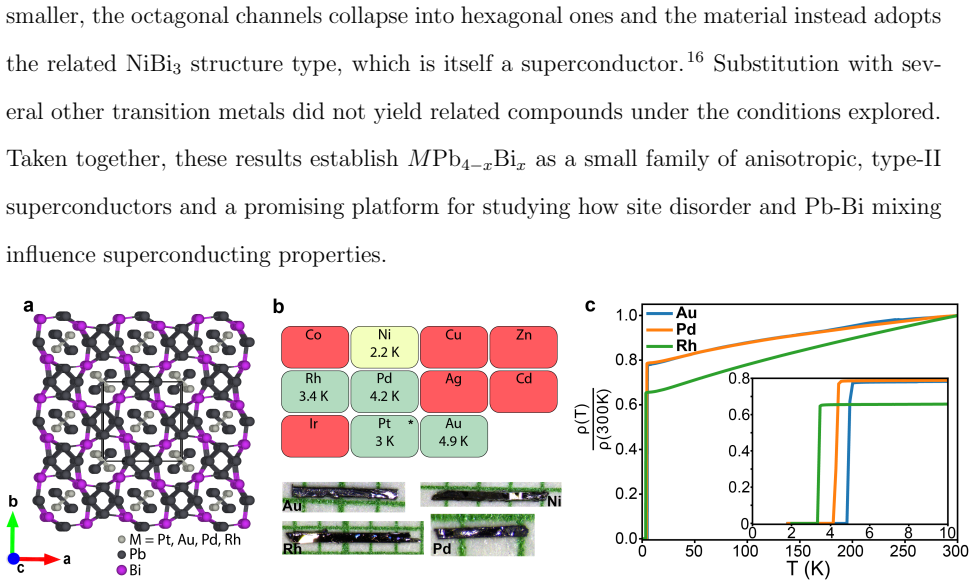
New compounds M Pb4-x Bix with M = Au, Pd, Rh adopt the PtPb3Bi structure and show bulk superconductivity at 4.9 K, 4.2 K and 3.4 K.
A machine-rendered reading of the paper's core claim, the machinery that carries it, and where it could break.
Core claim
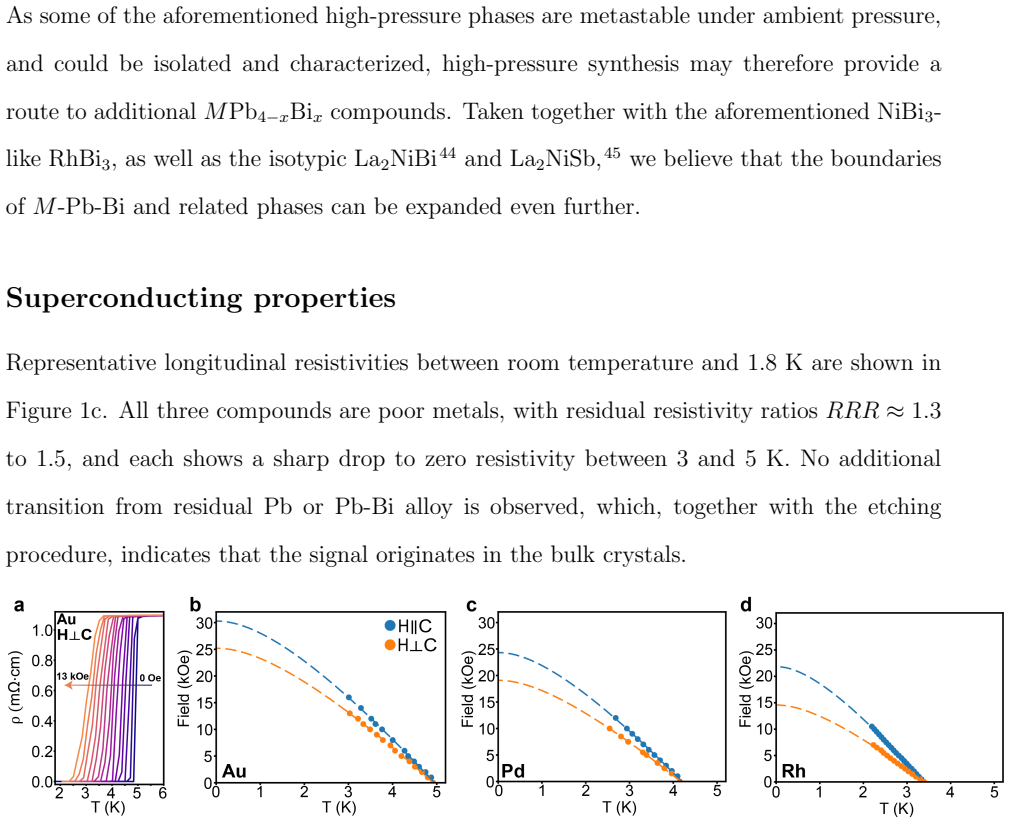
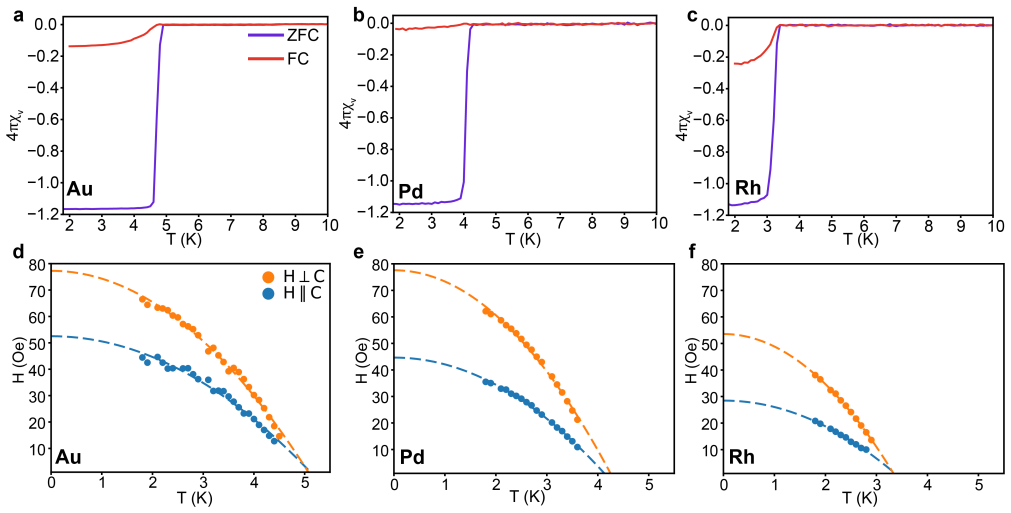
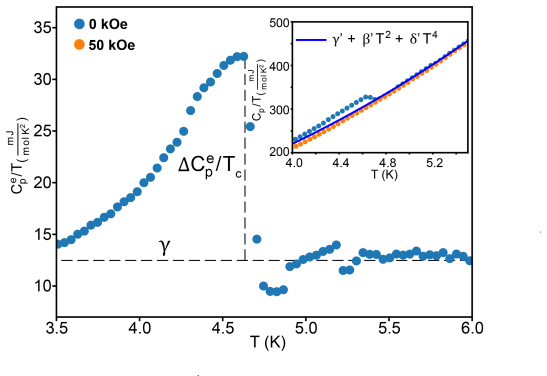
We find superconductivity in the newly synthesized M Pb4-x Bix (M = Au, Pd, and Rh), of which PtPb3Bi is a member. The superconducting transitions occur at 4.9, 4.2, and 3.4 K, for M = Au, Pd, and Rh, respectively. Using electrical resistivity, magnetization, and specific heat measurements, we establish the bulk nature of the superconducting state and determine the critical fields, characteristic length scales, and anisotropy ratios. All three compounds are moderately anisotropic type-II superconductors, with modest upper critical field anisotropies of Hc2 parallel c over Hc2 perpendicular c approximately 1.2 to 1.5.
What carries the argument
The PtPb3Bi structure type, stabilized when the M atom radius is large enough and when x is chosen to keep the total valence electron count near 20 per formula unit.
If this is right
- M Pb4-x Bix constitutes a tunable family of anisotropic type-II superconductors in which Pb-Bi mixing and M-site disorder can be varied while preserving the structure.
- Superconductivity appears only when the M atom is large enough to stabilize the PtPb3Bi structure; smaller atoms produce a different structure without superconductivity.
- The near-constant valence electron count of 20 suggests an electron-count design rule that may extend to other heavy-element intermetallics.
- The modest anisotropy and measured length scales provide a concrete starting point for vortex-dynamics studies in this class of materials.
Where Pith is reading between the lines
- The reported electron-count constraint offers a possible route to predict additional members by substituting other late transition metals while keeping the count near 20.
- Because the structure tolerates Pb-Bi mixing, controlled disorder could be used to test how scattering affects the superconducting gap or critical temperature.
- The collapse for Ni indicates a radius threshold that could be mapped systematically across the periodic table to delimit the stability window of the structure type.
Load-bearing premise
The measured superconducting transitions and critical fields originate from the majority phase that has the reported PtPb3Bi structure and composition, not from minority phases or impurities.
What would settle it
Absence of a diamagnetic response or zero-resistance state in phase-pure polycrystalline or single-crystal samples whose composition and structure match the reported M Pb4-x Bix formulas would falsify the claim of intrinsic superconductivity.
Figures
read the original abstract
The quest for new superconductors is of both fundamental and technological importance. Recently, an artificial intelligence method correctly predicted PtPb$_3$Bi to be a superconductor. In this work, we find superconductivity in the newly synthesized $M$Pb$_{4-x}$Bi$_x$ ($M$ = Au, Pd, and Rh), of which PtPb$_3$Bi is a member. When $M$ = Ni, whose radius is considerably smaller, the structure instead collapses into the different, Pb-substituted NiBi$_3$ type. Interestingly, the stoichiometric parameter $x$ shifts across the three compounds to keep the total valence electron count close to 20 per formula unit. The superconducting transitions occur at 4.9, 4.2, and 3.4 K, for $M$ = Au, Pd, and Rh, respectively. Using electrical resistivity, magnetization, and specific heat measurements, we establish the bulk nature of the superconducting state and determine the critical fields, characteristic length scales, and anisotropy ratios. All three compounds are moderately anisotropic type-II superconductors, with modest upper critical field anisotropies of $H_{c2}^{\parallel c}/H_{c2}^{\perp c} \approx 1.2$ to $1.5$. These results establish $M$Pb$_{4-x}$Bi$_x$ as a family of anisotropic superconductors and a platform for studying how site disorder and Pb-Bi mixing govern superconductivity in heavy-element intermetallics.
Editorial analysis
A structured set of objections, weighed in public.
Referee Report
Summary. The manuscript reports the synthesis of M Pb_{4-x} Bi_x compounds (M = Au, Pd, Rh) in the PtPb3Bi structure type, which exhibit superconductivity with Tc values of 4.9 K, 4.2 K, and 3.4 K. The authors use resistivity, magnetization, and specific heat measurements to establish bulk type-II superconductivity, determine critical fields and length scales, and report moderate anisotropy (H_c2^||c / H_c2^⊥c ≈ 1.2–1.5). The work notes that x adjusts to maintain ~20 valence electrons per formula unit and contrasts with the structural collapse for M = Ni.
Significance. If phase purity and composition are rigorously verified, the identification of this new family of anisotropic type-II superconductors in heavy-element intermetallics would provide a platform for studying the effects of Pb-Bi mixing and site disorder on superconductivity, extending the known examples beyond the AI-predicted PtPb3Bi case.
major comments (1)
- [Experimental methods and Results] Experimental/synthesis and characterization sections: The central claim that the observed transitions reflect intrinsic bulk superconductivity in single-phase M Pb_{4-x} Bi_x requires quantitative verification of phase purity and composition (e.g., Rietveld refinement, EDX mapping, or lattice-parameter consistency). The note that the structure collapses for smaller-radius Ni already indicates sensitivity to composition; without such data the specific-heat and magnetization features could arise from minority phases or local compositional variations rather than the claimed majority phase.
minor comments (2)
- [Abstract] Abstract: The reported anisotropy range (1.2 to 1.5) is given without per-compound values or error bars, and the specific x values for each M are not stated explicitly.
- [Discussion] The manuscript does not compare the observed Tc values or electron counts to any theoretical predictions beyond the initial AI result for PtPb3Bi.
Simulated Author's Rebuttal
We thank the referee for their careful review and constructive feedback on our manuscript. We address the major comment below.
read point-by-point responses
-
Referee: [Experimental methods and Results] Experimental/synthesis and characterization sections: The central claim that the observed transitions reflect intrinsic bulk superconductivity in single-phase M Pb_{4-x} Bi_x requires quantitative verification of phase purity and composition (e.g., Rietveld refinement, EDX mapping, or lattice-parameter consistency). The note that the structure collapses for smaller-radius Ni already indicates sensitivity to composition; without such data the specific-heat and magnetization features could arise from minority phases or local compositional variations rather than the claimed majority phase.
Authors: We agree that explicit quantitative verification of phase purity and composition is necessary to fully substantiate the claim of intrinsic bulk superconductivity in the majority phase. The manuscript currently supports this through the consistency of resistivity, magnetization, and specific-heat data together with the noted structural sensitivity for Ni, but we acknowledge that additional direct evidence would strengthen the conclusions. In the revised manuscript we will incorporate Rietveld refinements, EDX composition mapping, and lattice-parameter consistency checks. revision: yes
Circularity Check
No circularity: experimental synthesis and measurement paper with no derivations or fitted predictions
full rationale
This is a purely experimental paper reporting synthesis of M Pb_{4-x} Bi_x compounds, structural characterization, and direct measurements of superconductivity via resistivity, magnetization, and specific heat. No equations, derivations, or predictions are presented that reduce to fitted parameters or self-citations. The AI prediction mentioned is an external citation to prior work and is not load-bearing for the new experimental claims. Phase purity is addressed via standard experimental methods (XRD, etc.) without any circular reduction. Central results (Tc values, critical fields) are direct observations, not constructed from inputs.
Axiom & Free-Parameter Ledger
axioms (2)
- domain assumption Standard type-II superconductor classification via Ginzburg-Landau theory and critical field measurements
- domain assumption Valence electron count near 20 per formula unit stabilizes the PtPb3Bi structure type and influences superconductivity
Reference graph
Works this paper leans on
-
[1]
Physica C: Superconductivity and its Applications , volume=
Superconductivity in the A15 structure , author=. Physica C: Superconductivity and its Applications , volume=. 2015 , publisher=
2015
-
[2]
Polyhedron , volume=
Superconducting Chevrel phases: prospects and perspectives , author=. Polyhedron , volume=. 1986 , publisher=
1986
-
[3]
Physica C: Superconductivity and its Applications , volume=
Hole-doped cuprate high temperature superconductors , author=. Physica C: Superconductivity and its Applications , volume=. 2015 , publisher=
2015
-
[4]
Reviews of Modern Physics , volume=
Progress and perspectives on electron-doped cuprates , author=. Reviews of Modern Physics , volume=. 2010 , publisher=
2010
-
[5]
Progress in low temperature physics , volume=
Chapter v superconductivity in the periodic system , author=. Progress in low temperature physics , volume=. 1957 , publisher=
1957
-
[6]
Iscience , volume=
Superconducting materials: Challenges and opportunities for large-scale applications , author=. Iscience , volume=. 2021 , publisher=
2021
-
[7]
Chemical reviews , volume=
Chemistry in superconductors , author=. Chemical reviews , volume=. 2021 , publisher=
2021
-
[8]
Physical Review Letters , volume=
Upper limit for the critical field in hard superconductors , author=. Physical Review Letters , volume=. 1962 , publisher=
1962
-
[9]
II , author=
Temperature and purity dependence of the superconducting critical field, H c 2. II , author=. Physical Review , volume=. 1966 , publisher=
1966
-
[10]
Temperature and purity dependence of the superconducting critical field, H c 2. III. Electron spin and spin-orbit effects , author=. Physical Review , volume=. 1966 , publisher=
1966
-
[11]
Physical review applied , volume=
Effective demagnetizing factors of diamagnetic samples of various shapes , author=. Physical review applied , volume=. 2018 , publisher=
2018
-
[12]
Physical Review B---Condensed Matter and Materials Physics , volume=
Superconductivity and magnetism on flux-grown single crystals of NiBi 3 , author=. Physical Review B---Condensed Matter and Materials Physics , volume=. 2013 , publisher=
2013
-
[13]
Strong coupling superconductivity of Pb0. 7Bi0. 3 alloys , author=. Solid State Communications , volume=. 1971 , publisher=
1971
-
[14]
arXiv preprint arXiv:2510.07373 , year=
Learning to predict superconductivity , author=. arXiv preprint arXiv:2510.07373 , year=
-
[15]
Physica C: Superconductivity and its Applications , volume=
Phenomenological theory of magnetic structure in the high-temperature superconductors , author=. Physica C: Superconductivity and its Applications , volume=. 1989 , publisher=
1989
-
[16]
Superconductor Science and Technology , volume=
Anisotropy and two-dimensional behaviour in the high-temperature superconductors , author=. Superconductor Science and Technology , volume=
-
[17]
Zeitschrift f
Jana2020--a new version of the crystallographic computing system Jana , author=. Zeitschrift f. 2023 , publisher=
2023
-
[18]
Pb (Lead) Binary Alloy Phase Diagrams , booktitle =
, editor =. Pb (Lead) Binary Alloy Phase Diagrams , booktitle =. 2016 , month =. doi:10.31399/asm.hb.v03.a0006192 , url =
-
[19]
Binary Alloy Phase Diagrams, II Ed., Ed
Bi-Co (Bismuth-Cobalt) , author=. Binary Alloy Phase Diagrams, II Ed., Ed. TB Massalski , volume=
-
[20]
arXiv preprint arXiv:2604.04653 , year=
Discovery of Quasi One Dimensional Superconductivity in PtPb3Bi , author=. arXiv preprint arXiv:2604.04653 , year=
-
[21]
Journal of phase equilibria , volume=
The Bi-Pb (bismuth-lead) system , author=. Journal of phase equilibria , volume=. 1992 , publisher=
1992
-
[22]
Nature physics , volume=
High-temperature superconductivity in iron-based materials , author=. Nature physics , volume=. 2010 , publisher=
2010
-
[23]
National Science Review , volume=
Iron-based high transition temperature superconductors , author=. National Science Review , volume=. 2014 , publisher=
2014
-
[24]
Europhysics Letters , volume=
Superconductivity in HfCuGe2: A non-magnetic analog of the 1111 iron pnictides , author=. Europhysics Letters , volume=. 2013 , publisher=
2013
-
[25]
Physical Review B , volume=
Fully gapped superconductivity with preserved time-reversal symmetry in NiBi 3 single crystals , author=. Physical Review B , volume=. 2023 , publisher=
2023
-
[26]
Journal of the Physical Society of Japan , volume=
Superconducting and normal state properties of NiBi 3 , author=. Journal of the Physical Society of Japan , volume=. 2000 , publisher=
2000
-
[27]
Leo Lukas, Hans and Materials Science International Team, MSIT. Ag-Bi-Pb Ternary Phase Diagram Evaluation Phase diagrams, crystallographic and thermodynamic data: Datasheet from MSI Eureka in SpringerMaterials (https://materials.springer.com/msi/literature/docs/sm \_ msi \_ r \_ 10 \_ 012133 \_ 01)
-
[28]
Bulletin of Alloy Phase Diagrams , volume=
The Bi- Cd (Bismuth-Cadmium) system , author=. Bulletin of Alloy Phase Diagrams , volume=. 1988 , publisher=
1988
-
[29]
Journal of electronic materials , volume=
Thermodynamic Descriptions for the Cd-Te, Pb-Te, Cd-Pb and Cd-Pb-Te Systems , author=. Journal of electronic materials , volume=. 2009 , publisher=
2009
-
[30]
Thermochimica Acta , volume=
Prediction of phase equilibria and thermal analysis in the Bi--Cu--Pb ternary system , author=. Thermochimica Acta , volume=. 2010 , publisher=
2010
-
[31]
Zur Kenntnis von Mischungsl
Seith, Woligang and Johnen, Heinz and Wagner, J. Zur Kenntnis von Mischungsl. International Journal of Materials Research , volume=. 1955 , publisher=
1955
-
[32]
Inorganic Chemistry , volume=
Structure and bonding of Bi4Ir: a difficult-to-access bismuth iridide with a unique framework structure , author=. Inorganic Chemistry , volume=. 2015 , publisher=
2015
-
[33]
, author=
CoBi 3: A Binary Cobalt-Bismuth Compound and Superconductor. , author=. Angewandte Chemie International Edition , volume=
-
[34]
Journal of Physics: Condensed Matter , volume=
CoBi3--the first binary compound of cobalt with bismuth: high-pressure synthesis and superconductivity , author=. Journal of Physics: Condensed Matter , volume=. 2014 , publisher=
2014
-
[35]
Chemistry of Materials , volume=
Creating binary Cu--Bi compounds via high-pressure synthesis: a combined experimental and theoretical study , author=. Chemistry of Materials , volume=. 2017 , publisher=
2017
-
[36]
Journal of the American Chemical Society , volume=
Predicted Ferromagnetism in Discovered Co--Bi Binary Phases , author=. Journal of the American Chemical Society , volume=. 2025 , publisher=
2025
-
[37]
Chemical Society Reviews , volume=
A briefing on aurophilicity , author=. Chemical Society Reviews , volume=. 2008 , publisher=
2008
-
[38]
Journal of the American Chemical Society , volume=
Gold--Gold Bonding: The Key to Stabilizing the 19-Electron Ternary Phases Ln AuSb (Ln= La--Nd and Sm) , author=. Journal of the American Chemical Society , volume=. 2015 , publisher=
2015
-
[39]
Dalton transactions , number=
Covalent radii revisited , author=. Dalton transactions , number=. 2008 , publisher=
2008
-
[40]
1993 , journal =
Kresse, G and Hafner, J , number =. 1993 , journal =
1993
-
[41]
1994 , journal =
Kresse, G and Hafner, J , number =. 1994 , journal =
1994
-
[42]
Kresse, G. and Furthm. 1996 , journal =. doi:10.1016/0927-0256(96)00008-0 , issn =
-
[43]
1996 , journal =
Kresse, G and Furthm. 1996 , journal =
1996
-
[44]
1996 , journal =
Perdew, John P and Burke, Kieron and Ernzerhof, Matthias , number =. 1996 , journal =
1996
-
[45]
1994 , journal =
Bl. 1994 , journal =
1994
-
[46]
From ultrasoft pseudopotentials to the projector augmented-wave method.Phys
Kresse, G. and Joubert, D. , month = jan, year =. From ultrasoft pseudopotentials to the projector augmented-wave method , volume =. Physical Review B , publisher =. doi:10.1103/PhysRevB.59.1758 , number =
-
[47]
Special points for Brillouin-zone integrations
Monkhorst, Hendrik J. and Pack, James D. , month = jun, year =. Special points for. Physical Review B , publisher =. doi:10.1103/PhysRevB.13.5188 , number =
-
[48]
Alex M. Ganose and Adam J. Jackson and David O. Scanlon , title =. 2018 , publisher =. doi:10.21105/joss.00717 , url =
-
[49]
Journal of the Less Common Metals , volume=
Kristallstruktur von PtPb3Bi , author=. Journal of the Less Common Metals , volume=. 1978 , publisher=
1978
-
[50]
Journal of the Less Common Metals , volume=
Structural properties of Ni1- tRhtBi3 , author=. Journal of the Less Common Metals , volume=. 1987 , publisher=
1987
-
[51]
Zeitschrift f
Structure and bonding of La2NiBi , author=. Zeitschrift f. 2019 , publisher=
2019
-
[52]
Zeitschrift f
La2NiSb--A Ternary Ordered Version of the Bi3Ni Type with Highly Polar Bonding , author=. Zeitschrift f. 2014 , publisher=
2014
-
[53]
Journal of the Less Common Metals , volume=
Strukturuntersuchungen in den mischungen Pt--Tl--Pb und Pt--Pb--Bi , author=. Journal of the Less Common Metals , volume=. 1969 , publisher=
1969
-
[54]
Mitteilung , author=
Einige Strukturdaten metallischer Phasen: 13. Mitteilung , author=. Naturwissenschaften , volume=. 1968 , publisher=
1968
discussion (0)
Sign in with ORCID, Apple, or X to comment. Anyone can read and Pith papers without signing in.