Architectures of Planetary Systems III: Excitation of Eccentricities and Inclinations
Pith reviewed 2026-06-26 01:19 UTC · model grok-4.3
The pith
Large-gap planetary systems exhibit greater eccentricity dispersion than compact ones, rendering the solar system dynamically colder than typical.
A machine-rendered reading of the paper's core claim, the machinery that carries it, and where it could break.
Core claim
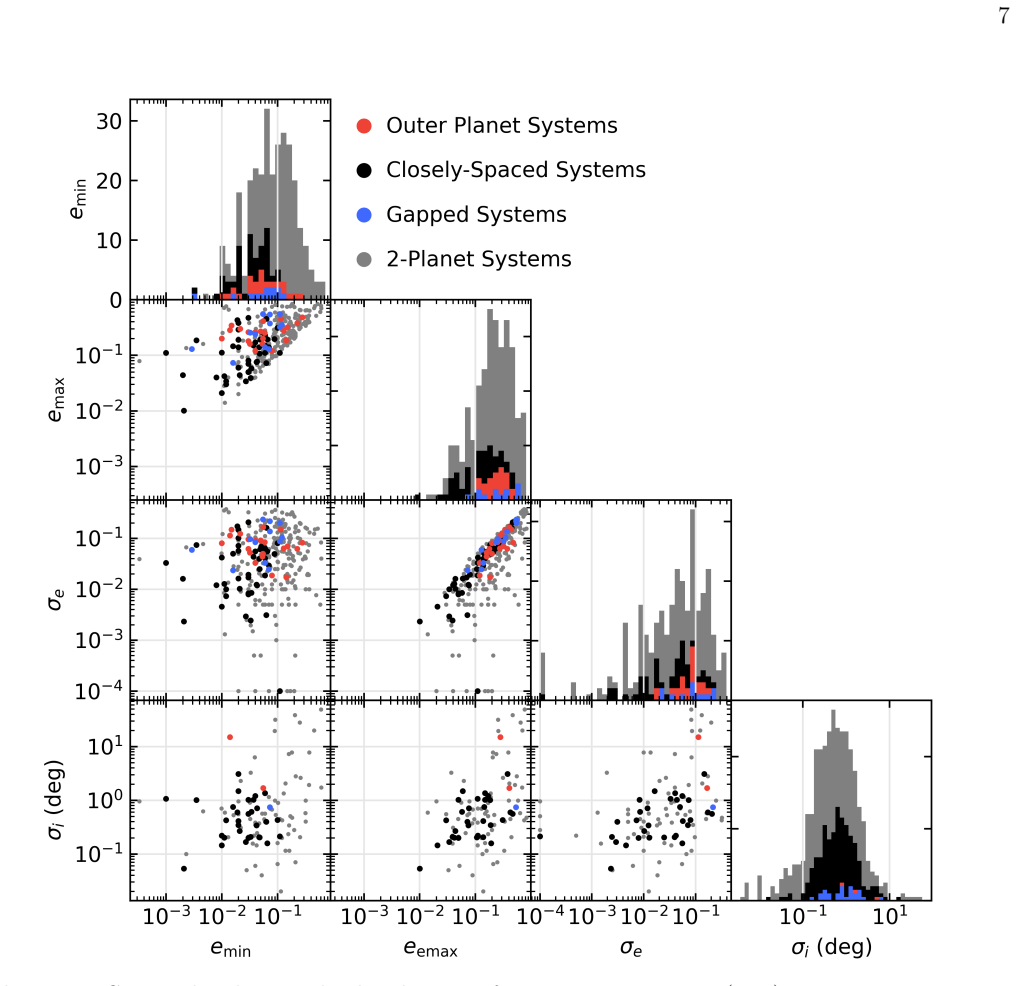
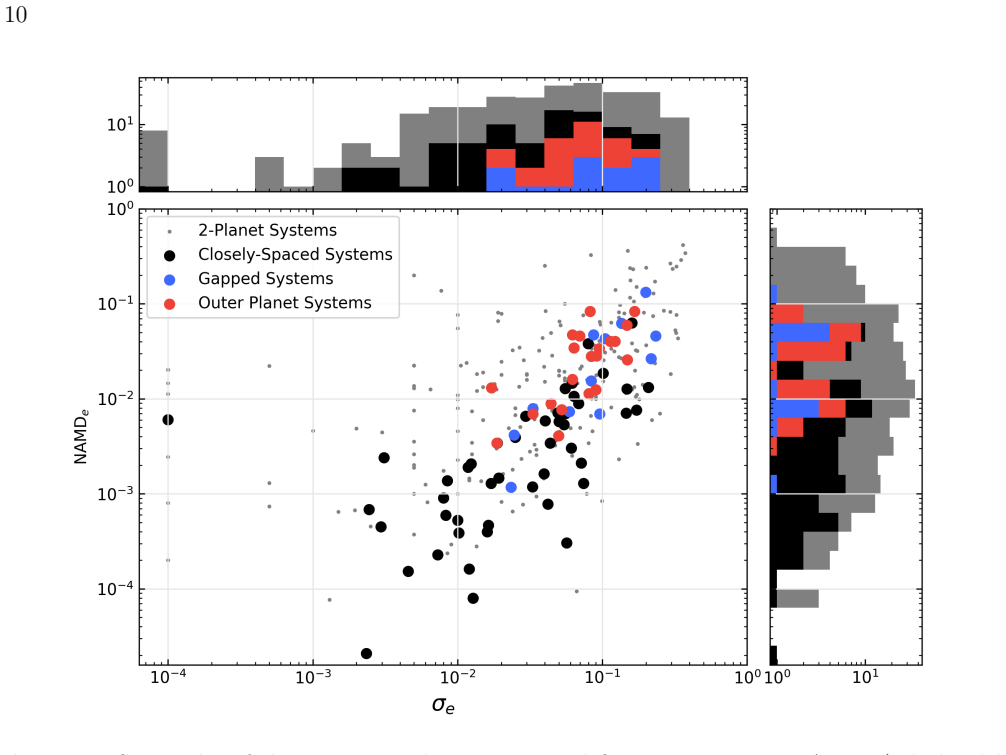
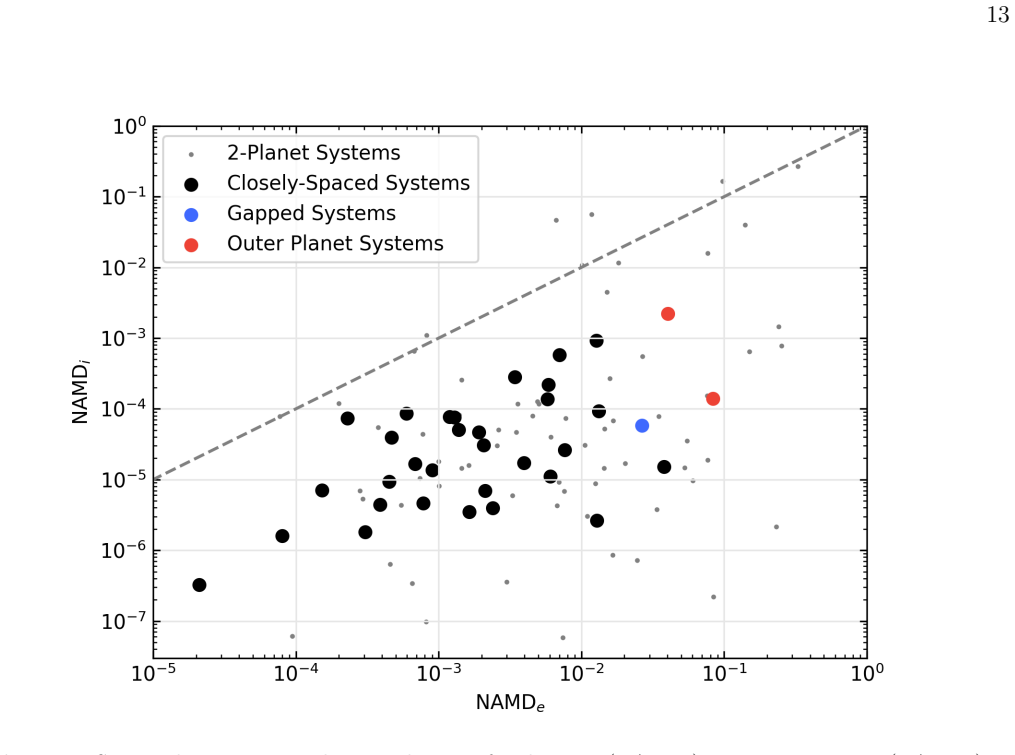
Extending an earlier classification framework, the analysis finds statistically significant correlations between architecture type and eccentricity distributions. Systems separated by large gaps display more dynamical excitation than compact systems when measured by eccentricity dispersion and an eccentricity-specific NAMD metric. Systems with detected outer planets also register higher excitation levels, so that the solar system appears dynamically colder than most observed systems of similar architecture. Inclination data remain too compromised by selection effects for reliable conclusions, yet the patterns predict a reservoir of highly inclined long-period planets accessible to future ast
What carries the argument
Architecture classification framework that groups systems by inter-planet spacing and presence of outer planets, tested against eccentricity dispersion and eccentricity-specific normalized angular momentum deficit (NAMD).
If this is right
- Large-gap architectures are expected to retain higher eccentricity dispersion as a signature of past dynamical interactions.
- Detection of an outer planet correlates with elevated system-wide excitation in the eccentricity metrics.
- The solar system constitutes an outlier whose low excitation level is atypical for systems with its spacing and outer-planet properties.
- A population of highly inclined long-period planets remains undetected but should appear in upcoming astrometric data.
Where Pith is reading between the lines
- The observed link between gap size and excitation may trace back to formation pathways that permit more violent scattering when planets are widely spaced.
- Unbiased future surveys could test whether the solar system's cold state is intrinsically rare or an artifact of current detection limits.
- The prediction of inclined long-period planets supplies a concrete target for distinguishing between migration and scattering scenarios in formation models.
Load-bearing premise
Eccentricity measurements and architectural classifications drawn from current detections are not substantially distorted by observational selection biases.
What would settle it
A larger, bias-corrected sample of planetary systems in which eccentricity dispersion shows no systematic difference between large-gap and compact architectures would falsify the central correlation.
Figures

read the original abstract
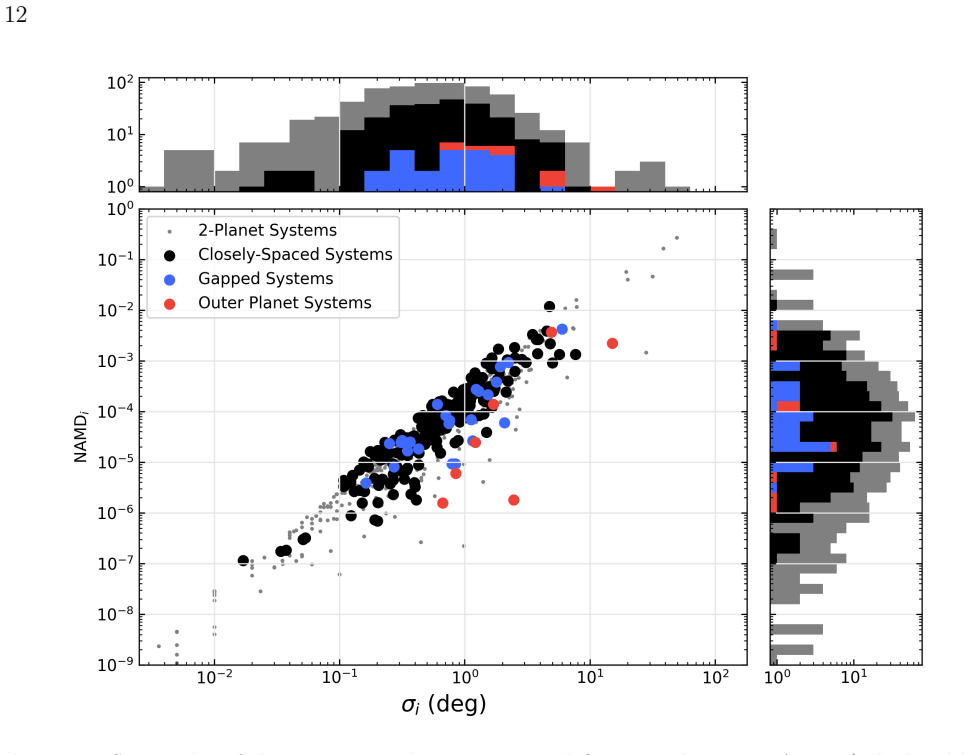
The current census of planetary systems displays a wide range of architectures. Extending earlier work, this paper investigates the correlation between our classification framework for these architectures and the distribution of eccentricities and inclinations of planetary orbits using both dispersion and normalized angular momentum deficit (NAMD) metrics. Orbital inclinations prove to be too strongly affected by observational biases to yield meaningful results, but the patterns in eccentricities reveal significant correlations. We find that systems with large gaps between planets are more dynamically excited than closely-spaced systems, based on dispersion in eccentricity and an eccentricity-specific NAMD metric. Systems with detected outer planets also appear dynamically excited, to a degree where our own solar system appears to be dynamically colder than expected. We also predict the existence of a population of highly-inclined long-period planets that is likely to be observed by upcoming astrometric surveys.
Editorial analysis
A structured set of objections, weighed in public.
Referee Report
Summary. The paper extends prior work on planetary system architectures by correlating classifications (large-gap vs. closely spaced systems; presence/absence of detected outer planets) with dynamical excitation, quantified via eccentricity dispersion and an eccentricity-specific normalized angular momentum deficit (NAMD). It reports that large-gap systems and those with outer planets are more excited, that the solar system is dynamically colder than typical, that inclinations are too biased for analysis, and that a population of highly inclined long-period planets should be detectable by future astrometry.
Significance. If the reported correlations survive bias corrections, the results would constrain formation and migration scenarios by linking architectural features to excitation levels. The adoption of an eccentricity-specific NAMD is a methodological strength for enabling mass-weighted comparisons across heterogeneous systems.
major comments (2)
- [Data and sample selection] The central comparison of eccentricity dispersion and NAMD between large-gap and closely-spaced systems (as summarized in the abstract) rests on direct use of catalogued values without forward-modeling of survey selection functions. RV semi-amplitude and transit completeness both favor higher-e and longer-period detections in a manner that correlates with gap size; no injection-recovery or Monte-Carlo test is described that would show the trend persists after these filters.
- [Results on systems with outer planets] Classification of systems as having 'detected outer planets' is performed on the same incomplete catalog used for the eccentricity metrics. The claim that such systems appear dynamically excited therefore requires explicit demonstration that the outer-planet detection threshold does not itself induce the reported excitation difference; this is load-bearing for the solar-system comparison.
minor comments (2)
- [Abstract] The abstract refers to an 'eccentricity-specific NAMD metric' without a defining equation or reference to its precise formulation; adding this would aid readers.
- [Inclination analysis] Inclination results are dismissed due to biases, but the paper could briefly quantify the bias strength (e.g., via a simple completeness estimate) to justify the decision.
Simulated Author's Rebuttal
We thank the referee for their insightful comments and the recommendation for major revision. We address each major comment below and outline the revisions we will make to strengthen the manuscript's handling of observational biases.
read point-by-point responses
-
Referee: The central comparison of eccentricity dispersion and NAMD between large-gap and closely-spaced systems (as summarized in the abstract) rests on direct use of catalogued values without forward-modeling of survey selection functions. RV semi-amplitude and transit completeness both favor higher-e and longer-period detections in a manner that correlates with gap size; no injection-recovery or Monte-Carlo test is described that would show the trend persists after these filters.
Authors: We acknowledge the validity of this concern. Our analysis is based on the directly observed catalog values, as is common in studies of exoplanet demographics. However, we agree that selection effects could potentially influence the results. In the revised manuscript, we will include a dedicated discussion of these biases and conduct a Monte-Carlo test to evaluate the persistence of the trend under assumed detection thresholds. This will be presented as a partial revision since a complete forward-modeling of all survey selection functions is a substantial undertaking that we will note as future work. revision: partial
-
Referee: Classification of systems as having 'detected outer planets' is performed on the same incomplete catalog used for the eccentricity metrics. The claim that such systems appear dynamically excited therefore requires explicit demonstration that the outer-planet detection threshold does not itself induce the reported excitation difference; this is load-bearing for the solar-system comparison.
Authors: We agree that this is a critical point for the interpretation, particularly regarding the solar system comparison. We will revise the manuscript to explicitly address this by adding an analysis that examines the excitation levels while accounting for the detection limits of outer planets, such as by restricting the comparison to systems with similar observational coverage. We will also clarify that the solar system is presented as a notable example rather than a statistical outlier based on the current sample. This revision will be incorporated in the next version. revision: yes
Circularity Check
No circularity: empirical application of metrics to external catalog
full rationale
The paper classifies observed systems using a prior framework, then computes eccentricity dispersion and an eccentricity-specific NAMD on the same catalog to report correlations. No equation defines the output metric in terms of the architecture labels, no parameter is fitted to a subset and relabeled a prediction, and no uniqueness theorem or ansatz is imported via self-citation to force the result. The reported patterns are direct statistical comparisons against observed values; the forward prediction of inclined planets is likewise a non-circular extrapolation. The derivation chain therefore remains self-contained against the external data.
Axiom & Free-Parameter Ledger
Reference graph
Works this paper leans on
-
[1]
Adams, F. C., & Laughlin, G. 2006, ApJ, 649, 1004, doi: 10.1086/506145
-
[2]
The Planetary Science Journal , keywords =
Agol, E., Dorn, C., Grimm, S. L., et al. 2021, Planetary Science Journal, 2, 1, doi: 10.3847/PSJ/abd022
-
[3]
Disruption of bound clusters by photoionization
Anderson, D. R., Collier Cameron, A., Gillon, M., et al. 2012, MNRAS, 422, 1988, doi: 10.1111/j.1365-2966.2012.20635.x
-
[4]
R., Collier Cameron, A., Delrez, L., et al
Anderson, D. R., Collier Cameron, A., Delrez, L., et al. 2014, MNRAS, 445, 1114, doi: 10.1093/mnras/stu1737
-
[5]
´A., Torres, G., P´ al, A., et al
Bakos, G. ´A., Torres, G., P´ al, A., et al. 2010, ApJ, 710, 1724, doi: 10.1088/0004-637X/710/2/1724
-
[6]
2010, A&A, 519, A98, doi: 10.1051/0004-6361/201014817
Bouchy, F., Hebb, L., Skillen, I., et al. 2010, A&A, 519, A98, doi: 10.1051/0004-6361/201014817
-
[7]
Buchhave, L. A., Dressing, C. D., Dumusque, X., et al. 2016, AJ, 152, 160, doi: 10.3847/0004-6256/152/6/160
-
[8]
Butters, O. W., West, R. G., Anderson, D. R., et al. 2010, A&A, 520, L10, doi: 10.1051/0004-6361/201015655
-
[9]
J., Sanchis-Ojeda, R., Campante, T
Chaplin, W. J., Sanchis-Ojeda, R., Campante, T. L., et al. 2013, ApJ, 766, 101, doi: 10.1088/0004-637X/766/2/101
-
[10]
Christiansen, J. L., McElroy, D. L., Harbut, M., et al. 2025, Planetary Science Journal, 6, 186, doi: 10.3847/PSJ/ade3c2
-
[11]
Coughlin, J. L., Mullally, F., Thompson, S. E., et al. 2016, ApJS, 224, 12, doi: 10.3847/0067-0049/224/1/12
-
[12]
Dalba, P. A., Kane, S. R., Li, Z., et al. 2021, AJ, 162, 154, doi: 10.3847/1538-3881/ac134b
-
[13]
D., Vanderburg, A., Schlieder, J
Dressing, C. D., Vanderburg, A., Schlieder, J. E., et al. 2017, AJ, 154, 207, doi: 10.3847/1538-3881/aa89f2
-
[14]
Gilbert, G. J., Petigura, E. A., & Entrican, P. M. 2026, arXiv e-prints, arXiv:2603.23644, doi: 10.48550/arXiv.2603.23644
-
[15]
Gillon, M., Triaud, A. H. M. J., Demory, B.-O., et al. 2017, Nature, 542, 456, doi: 10.1038/nature21360
-
[16]
, year = 2024, month = aug, volume =
Gupta, A. F., Millholland, S. C., Im, H., et al. 2024, Nature, 632, 50, doi: 10.1038/s41586-024-07688-3
-
[17]
He, M. Y., Ford, E. B., Ragozzine, D., & Carrera, D. 2020, AJ, 160, 276, doi: 10.3847/1538-3881/abba18 18
-
[18]
1979, Scandinavian journal of statistics, 65
Holm, S. 1979, Scandinavian journal of statistics, 65
1979
-
[19]
Howe, A. R., Becker, J. C., & Adams, F. C. 2026, AJ, 171, 148, doi: 10.3847/1538-3881/ae3aa6
-
[20]
Adams, F. C. 2025, AJ, 169, 149, doi: 10.3847/1538-3881/adabdb
-
[21]
Hunter, J. D. 2007, Computing in Science & Engineering, 9, 90, doi: 10.1109/MCSE.2007.55
-
[22]
Izidoro, A., Raymond, S. N., Pierens, A., et al. 2016, ApJ, 833, 40, doi: 10.3847/1538-4357/833/1/40 Juri´ c, M., & Tremaine, S. 2008, ApJ, 686, 603, doi: 10.1086/590047
-
[23]
, year = 1962, month = nov, volume =
Kozai, Y. 1962, AJ, 67, 591, doi: 10.1086/108790
-
[24]
2024, AJ, 167, 254, doi: 10.3847/1538-3881/ad3804
Lam, C., & Ballard, S. 2024, AJ, 167, 254, doi: 10.3847/1538-3881/ad3804
-
[25]
Lammers, C., & Winn, J. N. 2025, ApJL, 984, L39, doi: 10.3847/2041-8213/adce01
-
[26]
, year = 2000, month = apr, volume =
Laskar, J. 1997, A&A, 317, L75 —. 2000, PhRvL, 84, 3240, doi: 10.1103/PhysRevLett.84.3240
-
[27]
Laskar, J., & Petit, A. C. 2017, A&A, 605, A72, doi: 10.1051/0004-6361/201630022
-
[28]
Lidov, M. L. 1962, Planet. Space Sci., 9, 719, doi: 10.1016/0032-0633(62)90129-0
-
[29]
Livesey, J. R., & Becker, J. 2025, ApJ, 979, 202, doi: 10.3847/1538-4357/ada28b
-
[30]
, year = 1971, month = aug, volume =
Lucy, L. B., & Sweeney, M. A. 1971, AJ, 76, 544, doi: 10.1086/111159
-
[31]
2017, Nature Astronomy, 1, 0129, doi: 10.1038/s41550-017-0129
Luger, R., Sestovic, M., Kruse, E., et al. 2017, Nature Astronomy, 1, 0129, doi: 10.1038/s41550-017-0129
-
[32]
Mills, S. M., Howard, A. W., Weiss, L. M., et al. 2019, AJ, 157, 145, doi: 10.3847/1538-3881/ab0899 NASA Exoplanet Science Institute. 2020, Planetary Systems Composite Table, NASA IPAC DataSet, NEA13, doi: 10.26133/NEA13
-
[33]
2011, Journal of Machine Learning Research, 12, 2825
Pedregosa, F., Varoquaux, G., Gramfort, A., et al. 2011, Journal of Machine Learning Research, 12, 2825
2011
-
[34]
Petit, A. C., Laskar, J., & Bou´ e, G. 2017, A&A, 607, A35, doi: 10.1051/0004-6361/201731196
-
[35]
Rasio, F. A., & Ford, E. B. 1996, Science, 274, 954, doi: 10.1126/science.274.5289.954
-
[36]
2013, Icarus, 226, 671, doi: 10.1016/j.icarus.2013.06.019
Selsis, F. 2013, Icarus, 226, 671, doi: 10.1016/j.icarus.2013.06.019
-
[37]
Sagear, S., Ballard, S., Daniel, K. J., et al. 2025, arXiv e-prints, arXiv:2509.23973, doi: 10.48550/arXiv.2509.23973
-
[38]
2017, AJ, 153, 61, doi: 10.3847/1538-3881/153/2/61
Shvartzvald, Y., Bryden, G., Gould, A., et al. 2017, AJ, 153, 61, doi: 10.3847/1538-3881/153/2/61
-
[39]
2023, A&A, 677, L15, doi: 10.1051/0004-6361/202347329
Sozzetti, A., Pinamonti, M., Damasso, M., et al. 2023, A&A, 677, L15, doi: 10.1051/0004-6361/202347329
-
[40]
Proceedings of the National Academy of Science , keywords =
Tamayo, D., Cranmer, M., Hadden, S., et al. 2020, Proceedings of the National Academy of Science, 117, 18194, doi: 10.1073/pnas.2001258117
-
[41]
Turrini, D., Zinzi, A., & Belinchon, J. A. 2020, A&A, 636, A53, doi: 10.1051/0004-6361/201936301
-
[42]
Vanderburg, A., Becker, J. C., Buchhave, L. A., et al. 2017, AJ, 154, 237, doi: 10.3847/1538-3881/aa918b
-
[43]
Virtanen, P., Gommers, R., Oliphant, T. E., et al. 2020, Nature Methods, 17, 261, doi: 10.1038/s41592-019-0686-2
-
[44]
Protostars and Planets VII , year = 2023, editor =
Weiss, L. M., Millholland, S. C., Petigura, E. A., et al. 2023, in Astronomical Society of the Pacific Conference Series, Vol. 534, Protostars and Planets VII, ed. S. Inutsuka, Y. Aikawa, T. Muto, K. Tomida, & M. Tamura, 863, doi: 10.48550/arXiv.2203.10076
-
[45]
Weiss, L. M., Marcy, G. W., Petigura, E. A., et al. 2018, AJ, 155, 48, doi: 10.3847/1538-3881/aa9ff6
-
[46]
Weiss, L. M., Isaacson, H., Howard, A. W., et al. 2024, ApJS, 270, 8, doi: 10.3847/1538-4365/ad0cab Wes McKinney. 2010, in Proceedings of the 9th Python in Science Conference, ed. St´ efan van der Walt & Jarrod Millman, 56 – 61, doi: 10.25080/Majora-92bf1922-00a
-
[47]
Wright, J. T., & Howard, A. W. 2009, ApJS, 182, 205, doi: 10.1088/0067-0049/182/1/205
-
[48]
Yee, S. W., Petigura, E. A., Fulton, B. J., et al. 2018, AJ, 155, 255, doi: 10.3847/1538-3881/aabfec
-
[49]
Zakamska, N. L., Pan, M., & Ford, E. B. 2011, MNRAS, 410, 1895, doi: 10.1111/j.1365-2966.2010.17570.x
discussion (0)
Sign in with ORCID, Apple, or X to comment. Anyone can read and Pith papers without signing in.