Extending the SKA Across Africa: The Case for a Continental African VLBI Network
Pith reviewed 2026-06-26 00:47 UTC · model grok-4.3
The pith
A continental African VLBI network with 9000 km baselines will exceed ngVLA resolution by about 10 percent at comparable frequencies while filling missing north-south coverage in global arrays.
A machine-rendered reading of the paper's core claim, the machinery that carries it, and where it could break.
Core claim
The central claim is that an African VLBI Network formed by refurbishing existing antennas and adding a modest number of SKA-Mid-type telescopes will create an "African arm" of SKA-VLBI whose maximum baseline reaches approximately 9000 km and thereby surpasses the resolution of the ngVLA by roughly 10 percent at similar frequencies while markedly improving global VLBI coverage and imaging fidelity.
What carries the argument
The continental African VLBI Network (AVN), formed by strategic north-south and intermediate baselines across refurbished and new SKA-Mid-type telescopes that close coverage gaps in the existing global VLBI array.
If this is right
- The network will deliver higher angular resolution and better imaging fidelity than current global VLBI configurations for the same observing frequencies.
- Global VLBI coverage will improve through the addition of the missing north-south and intermediate baselines.
- The array will operate in close synergy with SKA-Mid, enabling transformational science across all cosmic scales.
- Development and operation of the network will train engineers, data scientists, and astronomers while stimulating local industry.
Where Pith is reading between the lines
- If the network reaches full operation, it could become the primary southern-hemisphere anchor for future space-VLBI or multi-messenger campaigns that require long baselines.
- The same continental distribution that improves north-south coverage might also reduce scheduling conflicts for time-critical transient events observed jointly with northern arrays.
- Sustained operation would require new data-transport and correlation infrastructure whose design could be reused by other large-scale scientific facilities on the continent.
Load-bearing premise
Partner countries will succeed in refurbishing or converting existing antennas and in deploying the additional SKA-Mid-type telescopes needed to reach the proposed 9000 km baselines.
What would settle it
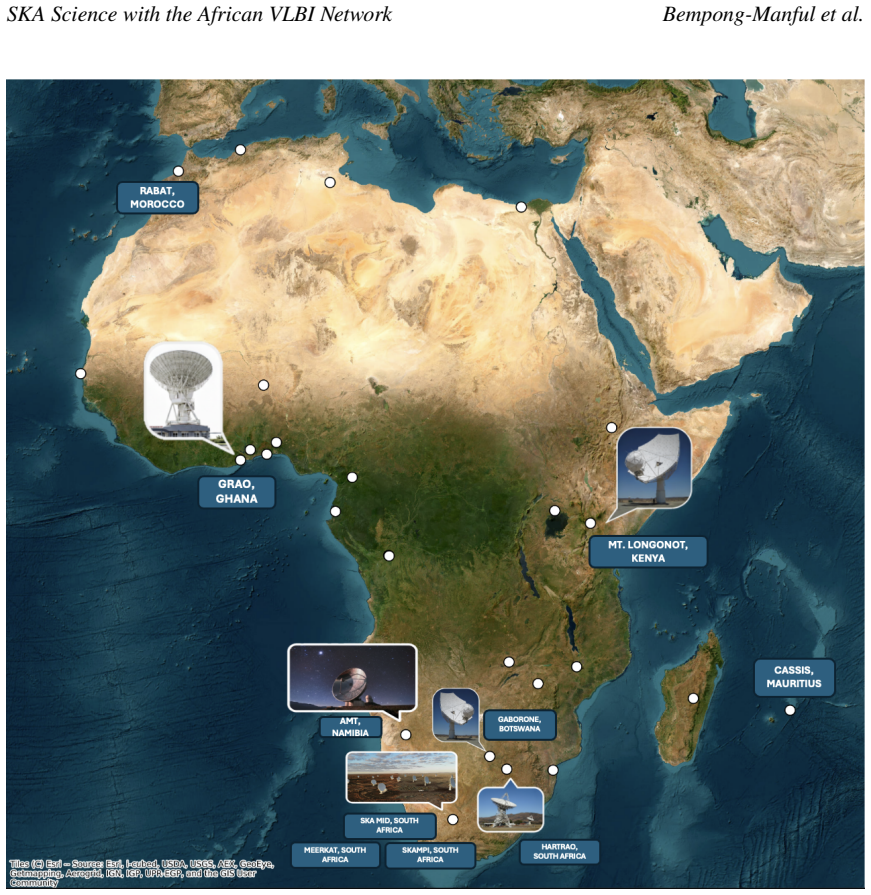
A concrete observation that would settle the claim is whether at least three to five additional operational stations (including one near Rabat and one near Cassis) are brought online within the next decade and achieve the stated 9000 km baseline length at the target frequencies.
Figures
read the original abstract
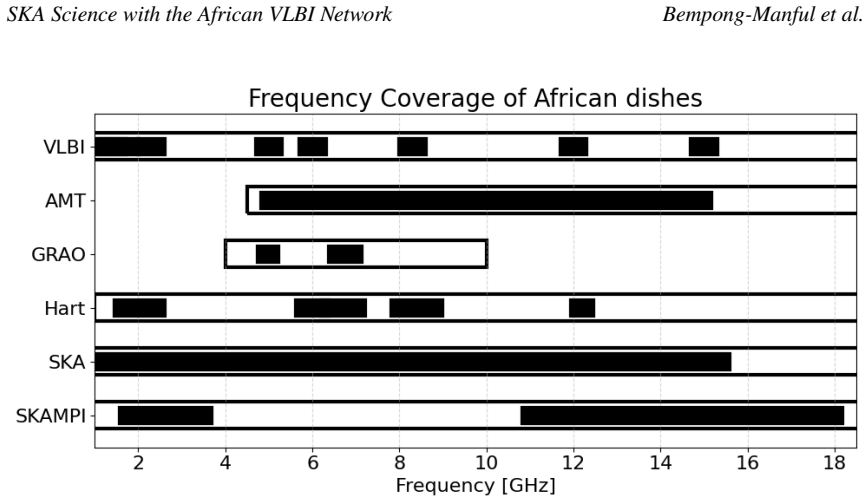
The African continent holds the key to unlocking the full potential of global Very Long Baseline Interferometry (VLBI). Strategic placement of radio telescopes across Africa provides the crucial north-south and intermediate baselines that are currently missing from the global VLBI network. This expansion will dramatically enhance imaging fidelity and resolution. In this chapter, we propose a vision for a continental African VLBI Network (AVN) that will operate in close synergy with SKA-Mid, enabling transformational science across all cosmic scales. While only the Hartebeesthoek Radio Astronomy Observatory (HartRAO) in South Africa and the Ghana Radio Astronomy Observatory (GRAO) are currently operational, several partner countries are in the process of refurbishing or converting existing antennas. Here, we advocate for the expansion of this network through the deployment of a limited number of SKA-Mid-type telescopes across the continent, creating an "African arm" of SKA-VLBI. With a maximum baseline of ~ 9000 km (from Rabat, Morocco to Cassis, Mauritius), the proposed continental facility will surpass for example, the resolution that will be achieved by the next generation Very Large Array (ngVLA) by ~ 10 % at similar observing frequencies and significantly enhance global VLBI coverage. Beyond the scientific and technical gains, the AVN represents a unique opportunity for sustainable growth in human capital, education, and innovation across Africa. Developing and operating a continental VLBI array will train the next generation of engineers, data scientists, and astronomers, stimulate local industry, and inspire public engagement in science and technology. We outline the current status, challenges, and potential roadmap towards realizing this vision, and we highlight how a continental African VLBI network will position Africa at the forefront of global radio astronomy.
Editorial analysis
A structured set of objections, weighed in public.
Referee Report
Summary. The manuscript is a vision paper advocating for a Continental African VLBI Network (AVN) operating in synergy with SKA-Mid. It argues that strategic deployment of telescopes across Africa will supply missing north-south and intermediate baselines to the global VLBI array, dramatically improving imaging fidelity and resolution. The paper notes current operational sites (HartRAO, GRAO), ongoing refurbishments in partner countries, and proposes limited new SKA-Mid-type antennas. A central quantitative claim is that a maximum baseline of ~9000 km (Rabat to Cassis) will exceed ngVLA resolution by ~10% at comparable frequencies, while also delivering human-capital and socio-economic benefits across Africa. The document outlines status, challenges, and a high-level roadmap.
Significance. If realized, the proposed AVN would address documented gaps in global VLBI uv-coverage, potentially enabling higher-resolution imaging across cosmic scales and strengthening SKA-VLBI capabilities. The capacity-building aspects are a notable strength for a developing region. As a forward-looking advocacy piece without new derivations, simulations, or empirical data, its significance is prospective rather than immediate; the technical case rests on standard interferometric principles but requires quantitative support for the specific performance claims.
major comments (1)
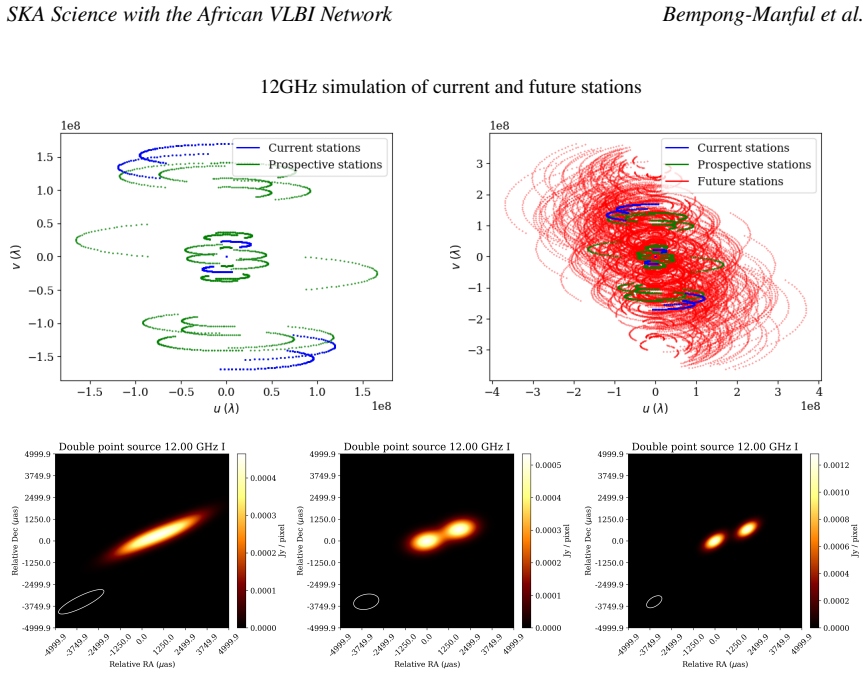
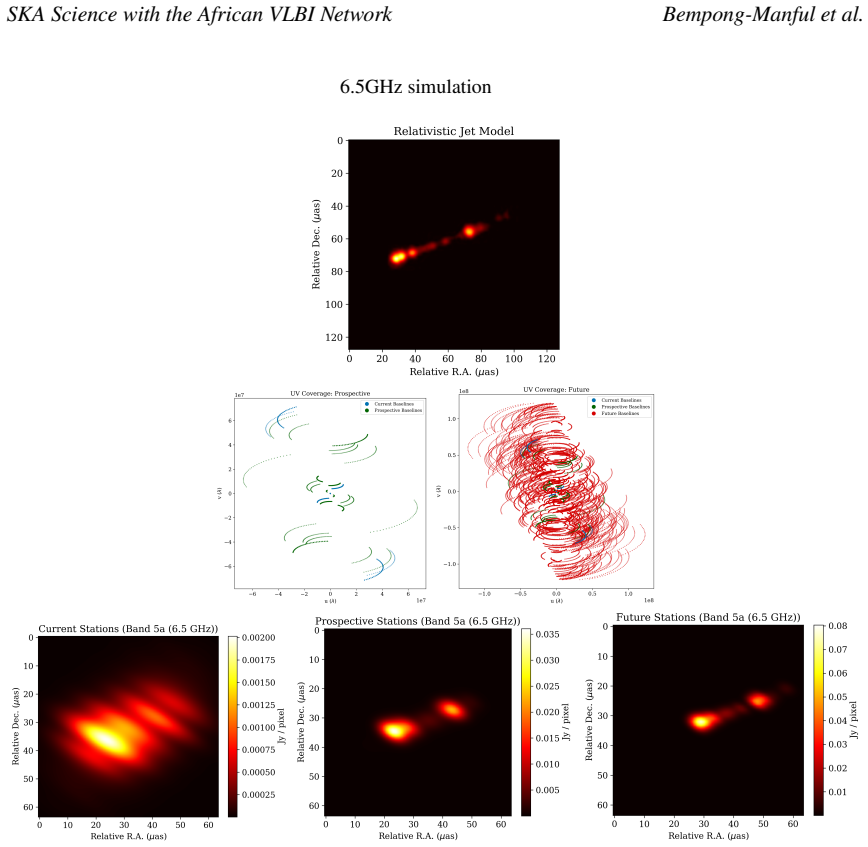
- [Abstract] Abstract: The claim that a ~9000 km baseline 'will surpass ... the resolution that will be achieved by the next generation Very Large Array (ngVLA) by ~10 % at similar observing frequencies' is presented without supporting calculations, uv-coverage simulations, or frequency-specific comparisons. This quantitative assertion is load-bearing for the paper's central technical argument and must be substantiated (or qualified) for the manuscript to be credible.
minor comments (1)
- [Abstract] Abstract: The phrasing 'surpass for example, the resolution' is grammatically awkward and should be revised for clarity.
Simulated Author's Rebuttal
We thank the referee for the constructive comment on the need to support the resolution claim. We address the point below and will revise the manuscript to ensure the technical argument is properly substantiated.
read point-by-point responses
-
Referee: [Abstract] Abstract: The claim that a ~9000 km baseline 'will surpass ... the resolution that will be achieved by the next generation Very Large Array (ngVLA) by ~ 10 % at similar observing frequencies' is presented without supporting calculations, uv-coverage simulations, or frequency-specific comparisons. This quantitative assertion is load-bearing for the paper's central technical argument and must be substantiated (or qualified) for the manuscript to be credible.
Authors: We agree that the claim as stated requires substantiation or qualification. The ~10% improvement is based on the standard interferometric resolution formula θ ≈ λ / B_max at comparable frequencies, with the proposed 9000 km baseline exceeding the ngVLA maximum baseline by that margin; however, this derivation is not shown in the current text. In the revised manuscript we will either insert a short explanatory clause in the abstract and a supporting sentence in the main text (e.g., near the discussion of baseline lengths) or qualify the statement as an estimate derived from maximum baseline lengths. Detailed uv-coverage simulations lie beyond the scope of this vision paper, but the simple resolution comparison can be made explicit without new modeling. revision: yes
Circularity Check
No significant circularity; vision paper with no derivations
full rationale
This document is a forward-looking advocacy and vision paper outlining a proposed continental African VLBI network. It advances no mathematical derivations, fitted parameters, equations, simulations, or empirical predictions that could reduce to their own inputs. The central claim of ~9000 km baselines yielding ~10% better resolution than ngVLA is asserted without calculation, uv-coverage analysis, or self-referential logic in the text. Deployment assumptions are presented as policy preconditions, not load-bearing premises of a proof. No self-citations, ansatzes, or uniqueness theorems are invoked in a manner that creates circularity. The paper is self-contained as a proposal.
Axiom & Free-Parameter Ledger
Reference graph
Works this paper leans on
-
[1]
Accessed: 2025-10-27. A. Alves-Brito et al.Nature Astronomy, 3(5):366–368,
2025
-
[2]
Atemkeng et al.arXiv e-prints, art
M. Atemkeng et al.arXiv e-prints, art. arXiv:2003.08642, Mar
arXiv 2003
-
[3]
doi: 10.48550/arXiv.2003. 08642. M. Backes et al. InThe 4th Annual Conference on High Energy Astrophysics in Southern Africa (HEASA 2016), page 29, Jan
-
[4]
doi: 10.22323/1.275.0029. A.-K. Baczko et al. InAdvancing Astrophysics with the SKA – II (AASKAII)
-
[5]
doi: 10.1109/AFRCON.2013.6757829. D. Barbosa et al.Advances in Space Research, 68(7):3064–3078,
-
[6]
doi: 10.1016/j.asr.2021. 05.023. 19 SKA Science with the African VLBI Network Bempong-Manful et al. N. W. Broten et al.Science, 156(3782):1592–1593,
-
[7]
doi: 10.1029/RS005i010p01223. X. Cheng et al.ApJSS, 277(2):56,
-
[8]
Annual report 2024–25.https://astro4dev.org/annual-report-2024-25/, 2025a
IAU – OAD. Annual report 2024–25.https://astro4dev.org/annual-report-2024-25/, 2025a. Accessed: 2025-10-27. IAU – OAD. Astronomy engagement events, 2025b. URLhttps://iauoutreach.org/ astronomy-outreach. Accessed: 2025-10-27. M. Kadler et al. InAdvancing Astrophysics with the SKA – II (AASKAII)
2024
-
[9]
arXiv search: Report number AASKAII/Kadler01. P. M. McCulloch et al.AJ, 129(4):2034–2040,
2034
-
[10]
doi: 10.1086/428374. M. Nickola et al.South African Journal of Geomatics, 12(1):98–111,
-
[11]
doi: 10.4314/sajg. v12i1.7. J. Nsor et al.Journal of Instrumentation, 19(05):T05012, may
-
[12]
URLhttps://doi.org/10.1088/1748-0221/19/05/T05012
doi: 10.1088/1748-0221/19/ 05/T05012. URLhttps://doi.org/10.1088/1748-0221/19/05/T05012. S. Nyangi. Iau-oad to fund 13 astronomy-for-development projects in 2025,
-
[13]
Accessed: 2025-10-27
URLhttps: //spaceinafrica.com/2025/. Accessed: 2025-10-27. F. Panessa et al. InAdvancing Astrophysics with the SKA – II (AASKAII)
2025
-
[14]
doi: 10.22323/1.215.0143. L. Petrov et al.MNRAS, 485(1):88–101, May
-
[15]
doi: 10.1093/mnras/stz242. A. B. Pushkarev et al.A&A, 545:A113,
- [16]
-
[17]
Accessed: 2025-10-27. J. Wongphechauxsorn et al. InAdvancing Astrophysics with the SKA – II (AASKAII)
2025
discussion (0)
Sign in with ORCID, Apple, or X to comment. Anyone can read and Pith papers without signing in.