In situ cryogenic characterization of proton damage in thick p-channel skipper CCDs
Pith reviewed 2026-06-26 00:43 UTC · model grok-4.3
The pith
P-channel skipper CCDs maintain excellent performance after proton doses equivalent to 10 years at L2 when tested cryogenically
A machine-rendered reading of the paper's core claim, the machinery that carries it, and where it could break.
Core claim
We find that these devices maintain excellent performance after displacement damage doses equivalent to ∼10 years at the Earth/Sun L2 Lagrange point, demonstrating for the first time that these sensors remain radiation-hard in realistic deep-space thermal and radiation environments.
What carries the argument
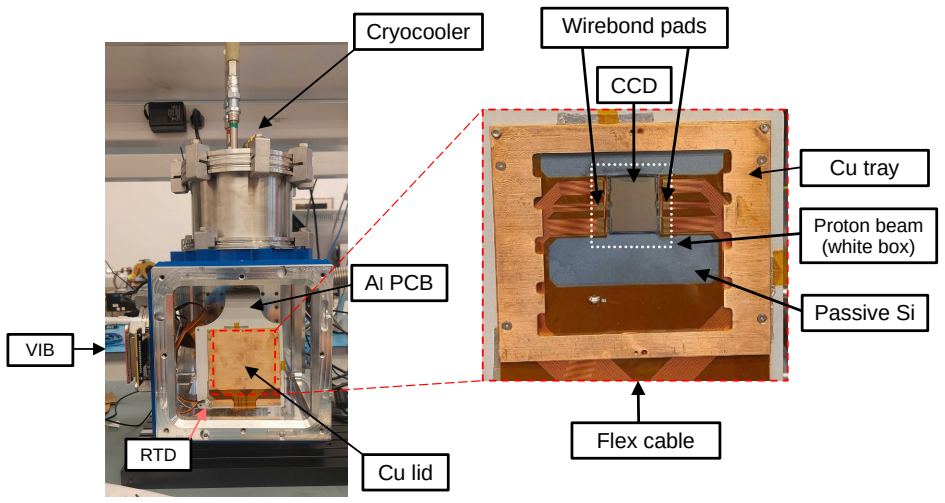
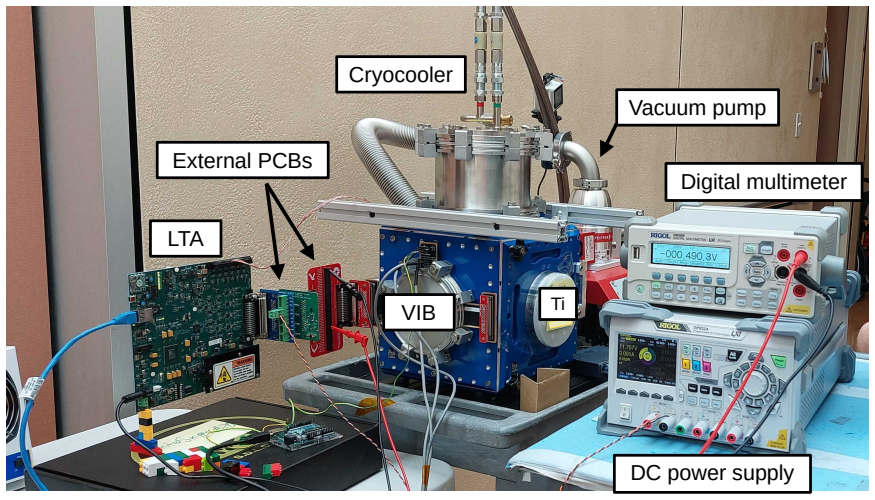
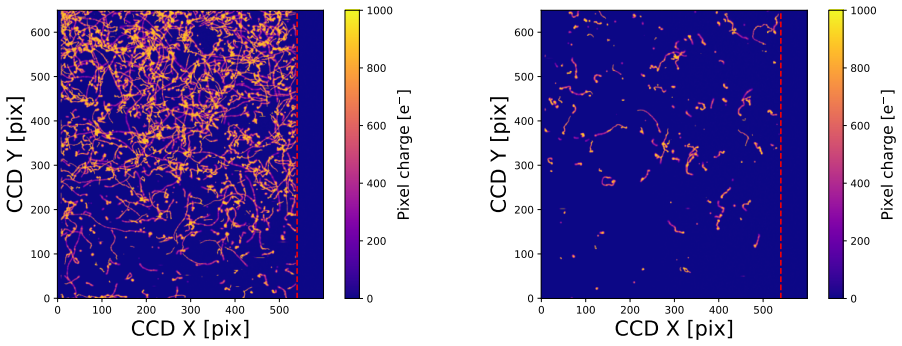
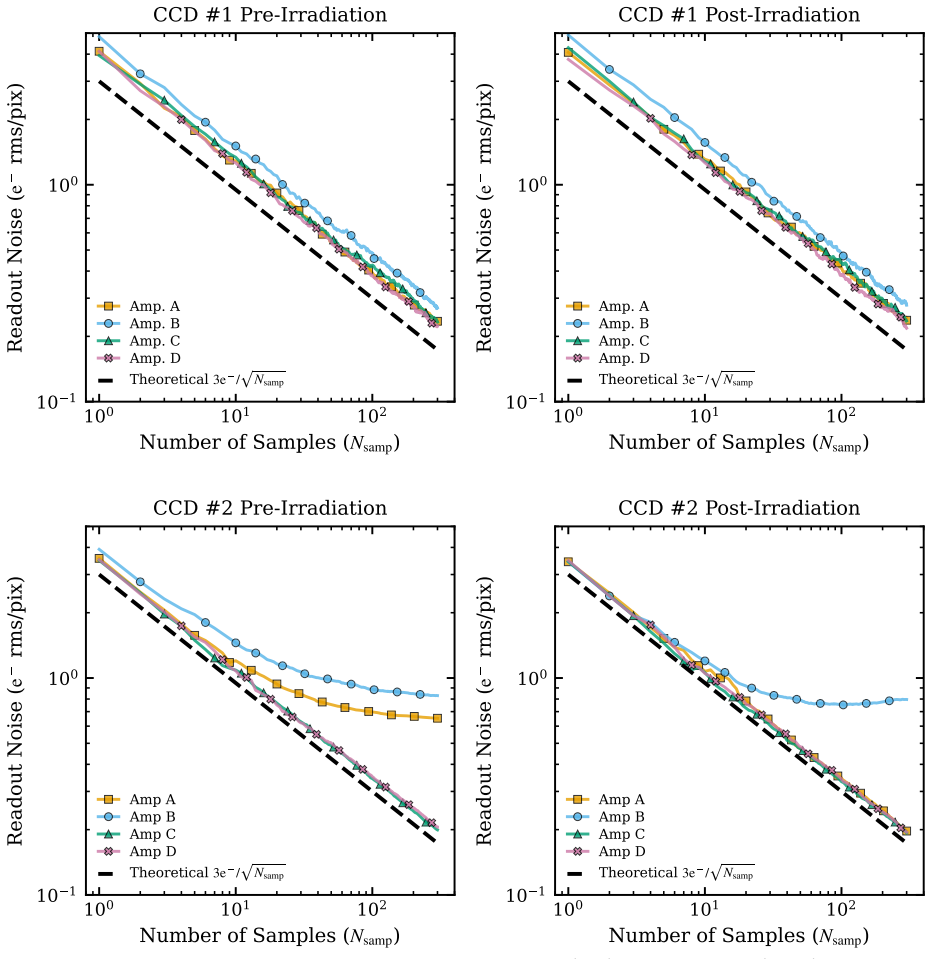
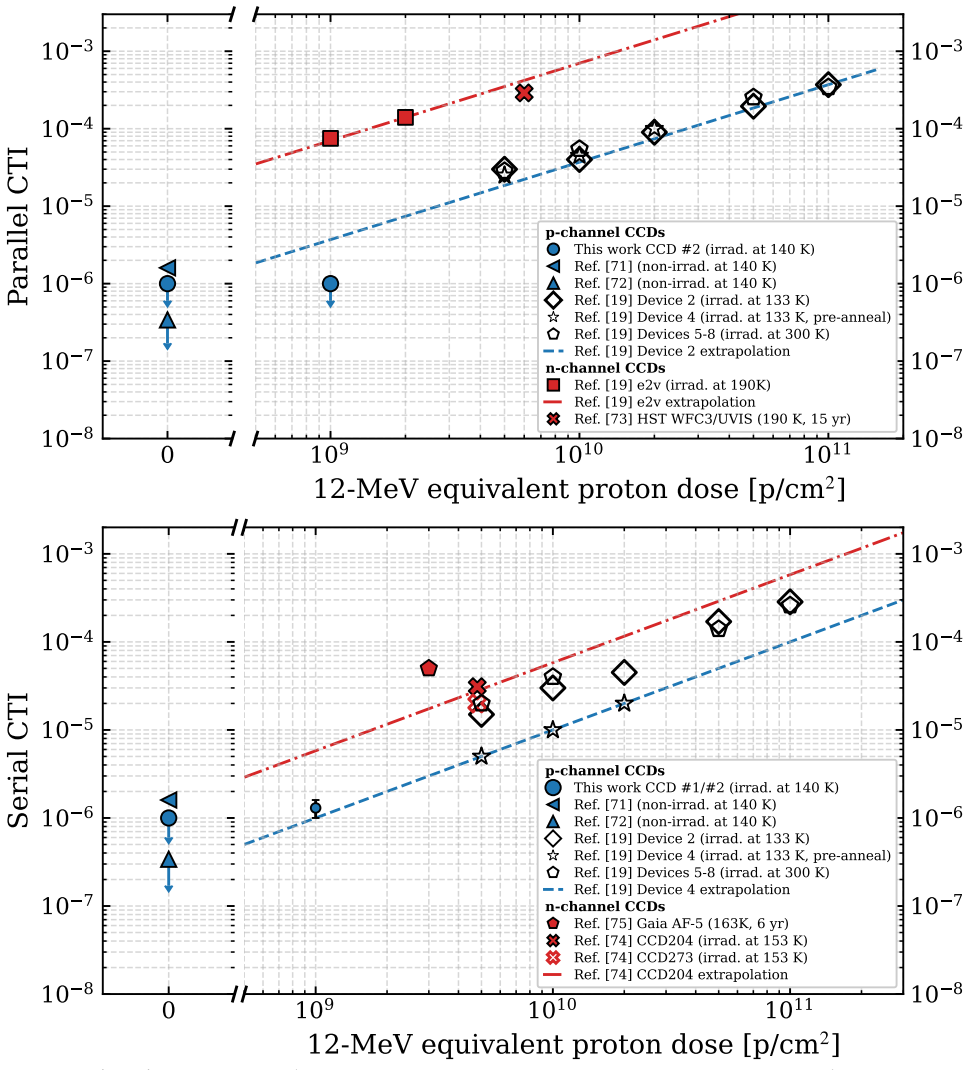
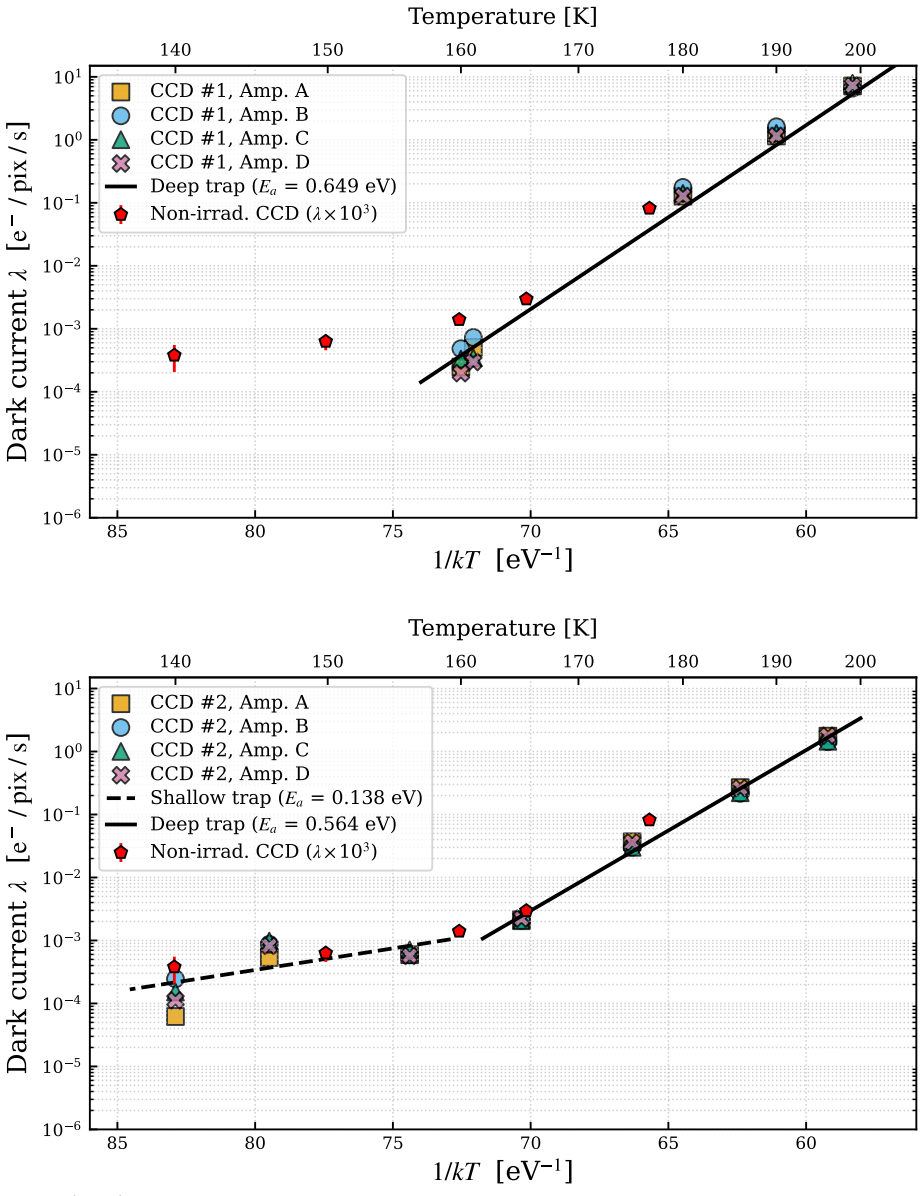
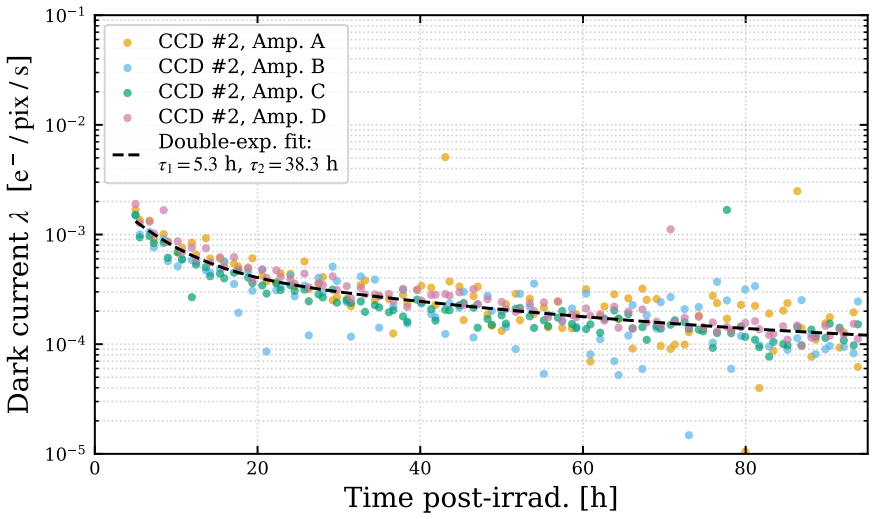
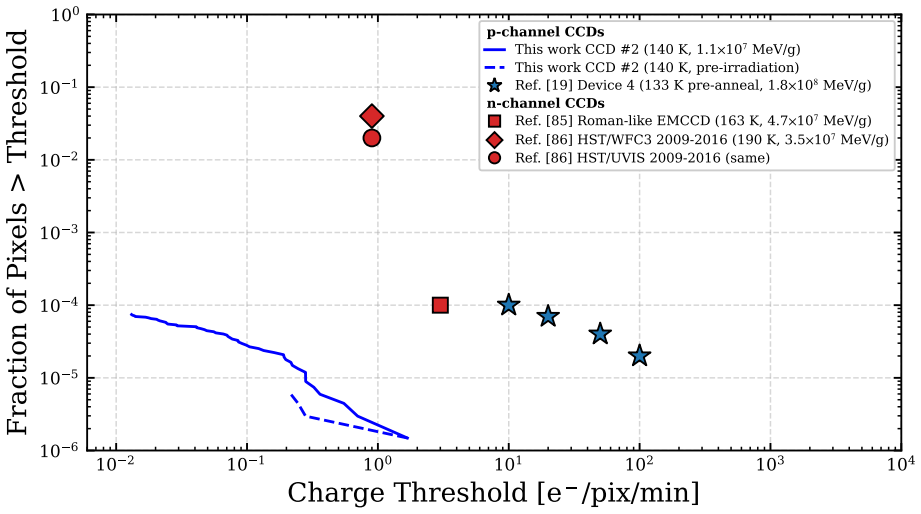
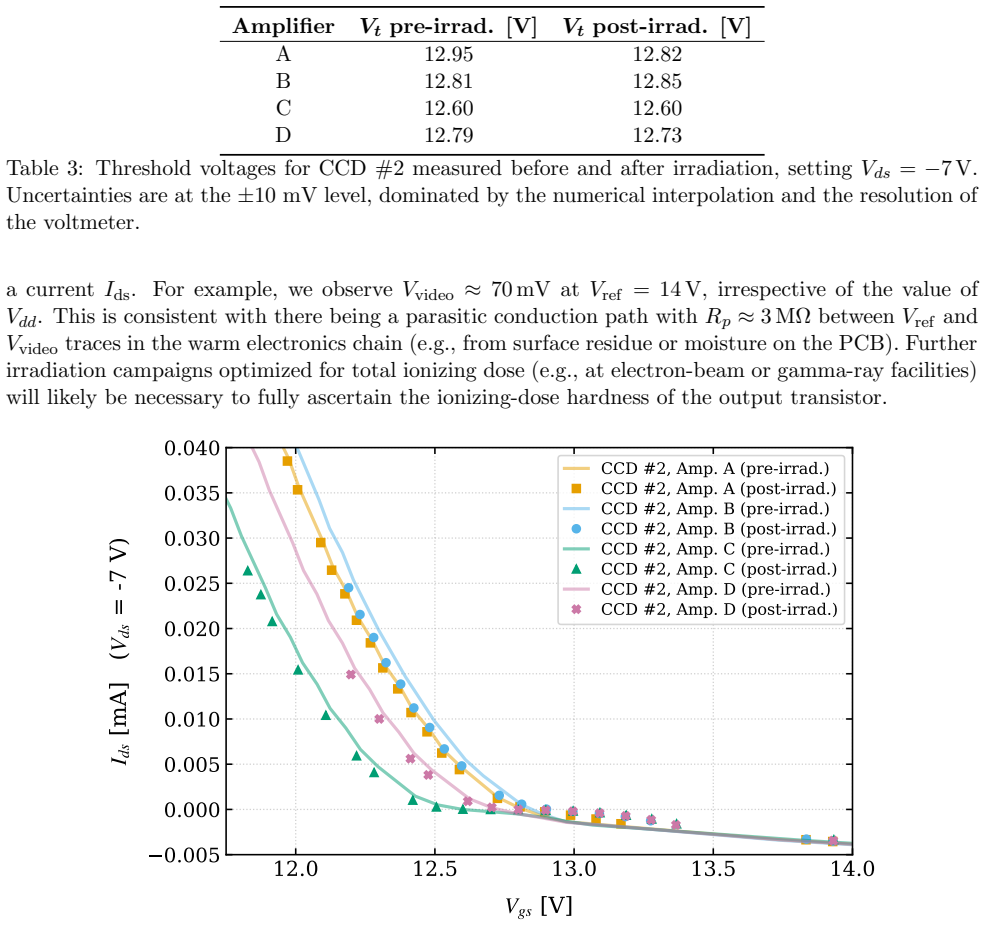
In-situ cryogenic proton irradiation of thick p-channel skipper CCDs, with assessment of the floating-gate output stage and global parameters such as charge transfer inefficiency, dark current, hot pixels, and charge traps.
If this is right
- Skipper CCDs can support single-photon counting instruments in deep space for mission durations of at least a decade without radiation-induced performance loss.
- The p-channel architecture on n-type silicon retains its radiation hardness advantage even when operated at cryogenic temperatures.
- Repeated non-destructive charge measurements remain viable after exposure to the expected L2 radiation environment.
- Dark current and hot-pixel rates stay low enough for photon-starved observations after the simulated 10-year dose.
Where Pith is reading between the lines
- Similar in-situ cryogenic irradiation protocols could be applied to qualify other sensor technologies for future space missions.
- The results reduce the need for heavy shielding on L2 instruments that use these detectors.
- Longer mission lifetimes or higher-sensitivity observations become more feasible if the hardness holds across the full range of space thermal cycles.
Load-bearing premise
The laboratory proton doses and cryogenic conditions accurately reproduce the displacement damage spectrum and thermal environment the sensors would experience over 10 years at L2.
What would settle it
Observation of substantially higher charge transfer inefficiency or dark current rates in actual flight data after several years at L2 compared with the post-irradiation lab measurements.
Figures
read the original abstract
Skipper charge-coupled devices (CCDs) are an offshoot of standard silicon pixel detectors and are capable of performing repeated non-destructive charge measurements, enabling deeply sub-electron readout noise. This capability has opened the door to single-photon counting from the near-infrared ($\sim$1.1\,$\mu$m) to the soft X-ray (several keV), making these devices strong candidates for future astronomical instruments operating in the photon-starved limit. Furthermore, the p-channel architecture used to fabricate Skipper CCDs on n-type silicon has been demonstrated to have an increased hardness to the intense radiation environment of space. Building upon previous irradiation campaigns on room-temperature sensors, here we describe the first radiation-hardness tests of p-channel skipper CCDs at their cryogenic operating temperatures. We assess the performance of the floating-gate output stage and global CCD parameters (charge transfer inefficiency, dark current, hot pixels, and charge traps). We find that these devices maintain excellent performance after displacement damage doses equivalent to ${\sim}$10 years at the Earth/Sun L2 Lagrange point, demonstrating for the first time that these sensors remain radiation-hard in realistic deep-space thermal and radiation environments.
Editorial analysis
A structured set of objections, weighed in public.
Referee Report
Summary. The manuscript reports the first in-situ cryogenic proton irradiation tests performed on thick p-channel skipper CCDs. It evaluates the floating-gate output stage and global CCD parameters including charge transfer inefficiency, dark current, hot pixels, and charge traps after exposure to displacement damage doses stated to be equivalent to ~10 years at L2, concluding that the sensors maintain excellent performance under combined cryogenic and radiation conditions relevant to deep space.
Significance. If the central claim holds, the result is significant for validating p-channel skipper CCDs as radiation-hard detectors for future space-based astronomical instruments operating in the photon-starved regime. The in-situ cryogenic protocol during irradiation is a clear experimental strength that directly addresses prior gaps in room-temperature-only campaigns.
major comments (2)
- [Methods] The headline claim that the devices 'maintain excellent performance' after doses equivalent to ~10 years at L2 is load-bearing on the assumption that the chosen lab proton fluence, energy, and single-run protocol produce equivalent displacement damage (trap density, CTI, dark current) to the integrated L2 spectrum plus annealing history. The methods section provides no quantitative NIEL-based calculation, spectrum folding, or comparison to space proton/ion/neutron contributions that would allow the reader to verify the equivalence margin (Methods, irradiation setup and dose equivalence paragraphs).
- [Results] The results section reports positive outcomes but supplies no tabulated pre/post-irradiation values, error bars, or statistical measures for CTI, dark current, or trap densities. Without these numbers it is not possible to assess whether the observed changes remain within the 'excellent performance' margin claimed for the L2-equivalent dose (Results, performance metrics and figures).
minor comments (2)
- [Abstract] The abstract states the dose equivalence but does not cite the specific proton energy or fluence used; this should be added for immediate clarity.
- [Figures] Figure captions for the performance plots should explicitly label pre- and post-irradiation data sets and include the exact proton fluence applied.
Simulated Author's Rebuttal
We thank the referee for their careful review and constructive comments, which help strengthen the clarity of our dose-equivalence justification and quantitative results presentation. We address each major comment below.
read point-by-point responses
-
Referee: [Methods] The headline claim that the devices 'maintain excellent performance' after doses equivalent to ~10 years at L2 is load-bearing on the assumption that the chosen lab proton fluence, energy, and single-run protocol produce equivalent displacement damage (trap density, CTI, dark current) to the integrated L2 spectrum plus annealing history. The methods section provides no quantitative NIEL-based calculation, spectrum folding, or comparison to space proton/ion/neutron contributions that would allow the reader to verify the equivalence margin (Methods, irradiation setup and dose equivalence paragraphs).
Authors: We agree that an explicit quantitative justification strengthens the manuscript. The original text referenced prior NIEL scaling literature for the L2 equivalence but omitted the detailed steps. In revision we have added a dedicated paragraph (and supporting equations) in the Methods section that performs the NIEL calculation for the laboratory proton energy and fluence, folds it against the L2 proton spectrum, and compares the resulting displacement damage to the integrated proton, ion, and neutron contributions expected over ten years at L2. This addition directly addresses the verification margin requested. revision: yes
-
Referee: [Results] The results section reports positive outcomes but supplies no tabulated pre/post-irradiation values, error bars, or statistical measures for CTI, dark current, or trap densities. Without these numbers it is not possible to assess whether the observed changes remain within the 'excellent performance' margin claimed for the L2-equivalent dose (Results, performance metrics and figures).
Authors: We concur that tabulated values with uncertainties improve transparency. We have inserted a new table in the Results section that reports the pre- and post-irradiation means, standard deviations, and sample sizes for CTI, dark current, hot-pixel fraction, and trap densities. Error bars have been added to the relevant performance figures, and the text now references these quantitative values when stating that changes remain within the excellent-performance regime. revision: yes
Circularity Check
No circularity: pure experimental characterization with no derivations or self-referential predictions
full rationale
The paper reports laboratory proton irradiation and in-situ cryogenic measurements of CCD performance metrics (CTI, dark current, etc.). The central claim equates lab fluence to an L2-equivalent dose via standard displacement-damage calculations external to the work; no equations, fitted parameters, or self-citations are used to derive the performance results from the inputs. No self-definitional steps, fitted-input predictions, or load-bearing self-citations appear. The equivalence assumption is an external modeling choice, not a circular reduction within the paper's own chain.
Axiom & Free-Parameter Ledger
Reference graph
Works this paper leans on
-
[1]
Charge coupled semiconductor devices,
Boyle, W. S. and Smith, G. E., “Charge coupled semiconductor devices,”Bell Syst. Tech. J.49(4), 587–593 (1970)
1970
-
[2]
R., [Scientific Charge Coupled Devices], SPIE (2001)
Janesick, J. R., [Scientific Charge Coupled Devices], SPIE (2001)
2001
-
[3]
KH-11 KENNAN: Reconnaissance Imaging Spacecraft,
Vick, C. P., “KH-11 KENNAN: Reconnaissance Imaging Spacecraft,”GlobalSecurity.org(2007)
2007
-
[4]
The Hubble CCDs: lessons learned,
Blouke, M. M., Bredthauer, R., and Janesick, J. R., “The Hubble CCDs: lessons learned,” in [Focal Plane Arrays for Space Telescopes II], Grycewicz, T. J. and Marshall, C. J., eds.,SPIE Conference Series5902, 12–18 (Aug. 2005)
2005
-
[5]
Cooling out the radiation damage on the XMM-Newton EPIC MOS CCDs,
Abbey, A., Bennie, P., Turner, M., Altieri, B., and Rives, S., “Cooling out the radiation damage on the XMM-Newton EPIC MOS CCDs,”Nucl. Instrum. Methods A513(1), 136–142 (2003). Proceedings of the 6th International Conference on Position-Sensitive Detectors
2003
-
[6]
pnCCDs on XMM-Newton—42 months in orbit,
Str¨ uder, L., Englhauser, J., Hartmann, R., Holl, P., Meidinger, N., Soltau, H., Briel, U., Dennerl, K., Freyberg, M., Haberl, F., Hartner, G., Pfeffermann, E., Stadlbauer, T., and Kendziorra, E., “pnCCDs on XMM-Newton—42 months in orbit,”Nucl. Instrum. Methods A512(1), 386– 400 (2003). Proceedings of the 9th European Symposium on Semiconductor Detectors...
2003
-
[7]
The effect of proton damage on the X-ray spectral response of MOS CCDs for the Swift X-ray telescope,
Ambrosi, R., Short, A., Abbey, A., Wells, A., and Smith, D., “The effect of proton damage on the X-ray spectral response of MOS CCDs for the Swift X-ray telescope,”Nucl. Instrum. Methods A482(3), 644–652 (2002)
2002
-
[8]
An improved model of charge transfer inefficiency and correction algorithm for the Hubble Space Telescope,
Massey, R., Schrabback, T., Cordes, O., Marggraf, O., Israel, H., Miller, L., Hall, D., Cropper, M., Prod’homme, T., and Niemi, S.-M., “An improved model of charge transfer inefficiency and correction algorithm for the Hubble Space Telescope,”Mon. Not. R. Astron. Soc.439(1), 887–907 (2014)
2014
-
[9]
Twenty-four years of radiation protection of the Chandra X-Ray Observatory,
Wolk, S. J., Aldcroft, T. L., Plucinsky, P. P., Schwartz, D. A., O’Dell, S. L., Minow, J. I., Grant, C. E., Bautz, M. W., Viens, P., and Bissell, B., “Twenty-four years of radiation protection of the Chandra X-Ray Observatory,”J. Spacecr. Rockets62(2), 542–547 (2025)
2025
-
[10]
Gaia Data Release 1. On-orbit performance of the Gaia CCDs at L2,
Crowley, C., Kohley, R., Hambly, N. C., Davidson, M., Abreu, A., van Leeuwen, F., Fabricius, C., Seabroke, G., de Bruijne, J. H. J., Short, A., Lindegren, L., Brown, A. G. A., Sarri, G., Gare, P., Prusti, T., Prod’homme, T., Mora, A., Mart´ ın-Fleitas, J., Raison, F., Lammers, U., O’Mullane, W., and Jansen, F., “Gaia Data Release 1. On-orbit performance o...
2016
-
[11]
Radiation damage to the Hubble Space Telescope during two solar cycles, and correction of charge transfer inefficiency using ArCTIc,
Massey, R., Kegerreis, J. A., Barrios, J. P. L. G., Nightingale, J. W., Hayes, R. G., Lagattuta, D., Lentz, Z. D., Leroy, G., Skottfelt, J., Vecchi, F., and von Wietersheim-Kramsta, M., “Radiation damage to the Hubble Space Telescope during two solar cycles, and correction of charge transfer inefficiency using ArCTIc,”Mon. Not. R. Astron. Soc.546, staf218...
2026
-
[12]
Tracking radiation damage of Euclid VIS detectors after 1 year in space,
Skottfelt, J., Wander, M., Cropper, M., Dryer, B., and Hall, D. J., “Tracking radiation damage of Euclid VIS detectors after 1 year in space,”Proc. SPIE Int. Soc. Opt. Eng.13092, 130920P (2024)
2024
-
[13]
Space radiation damage to HDTV camera CCDs onboard the International Space Station,
Nagamatsu, A., Murakami, K., Yokota, A., Yamazaki, J., Yamauchi, M., Kitajo, K., Kumagai, H., and Tawara, H., “Space radiation damage to HDTV camera CCDs onboard the International Space Station,”Radiat. Meas.46(2), 205–212 (2011)
2011
-
[14]
Investigation of space radiation-induced effects on the perfor- mance of CCD detectors using Radiation Monitor’s in-flight measurements,
Serief, C. and Meguenni, M., “Investigation of space radiation-induced effects on the perfor- mance of CCD detectors using Radiation Monitor’s in-flight measurements,”IEEE Trans. Nucl. Sci.72(2), 110–117 (2025)
2025
-
[15]
Hot pixel behavior in WFC3 CCD detectors irradiated under operational conditions,
Polidan, E. J., Waczynski, A., Marshall, P. W., Johnson, S. D., Marshall, C. J., Reed, R. A., Kimble, R. A., Delo, G., Schlossberg, D., Russell, A. M., Beck, T., Wen, Y., Yagelowich, J., Hill, R. J., and Wassell, E., “Hot pixel behavior in WFC3 CCD detectors irradiated under operational conditions,” in [Focal Plane Arrays for Space Telescopes], Grycewicz,...
2004
-
[16]
Proton damage effects on p-channel CCDs,
Hopkinson, G., “Proton damage effects on p-channel CCDs,”IEEE Trans. Nucl. Sci.46, 1790 (1999)
1999
-
[17]
Analysis of charge transfer efficiency noise on proton-damaged CCDs for the Hubble Space Telescope Wide Field Camera 3,
Johnson, S. D., Waczynski, A., Polidan, E. J., Marshall, P. W., and Reed, R. A., “Analysis of charge transfer efficiency noise on proton-damaged CCDs for the Hubble Space Telescope Wide Field Camera 3,” in [Photonics for Space Environments VIII],4823, 245–253, SPIE (2002)
2002
-
[18]
Proton radiation damage in p-channel CCDs fabricated on high-resistivity silicon,
Bebek, C., Groom, D., Holland, S., Karcher, A., Kolbe, W., Lee, J., Levi, M., Palaio, N., Turko, B., Uslenghi, M., Wagner, A., and Wang, G., “Proton radiation damage in p-channel CCDs fabricated on high-resistivity silicon,”IEEE Trans. Nucl. Sci.49(3), 1221–1225 (2002)
2002
-
[19]
Radiation tolerance of fully-depleted p-channel CCDs designed for the SNAP satellite,
Dawson, K. et al., “Radiation tolerance of fully-depleted p-channel CCDs designed for the SNAP satellite,”IEEE Trans. Nucl. Sci.55, 1725–1735 (2008)
2008
-
[20]
Comparison of proton irradiated p-channel and n-channel CCDs,
Gow, J. P., Murray, N. J., Holland, A. D., Burt, D., and Pool, P. J., “Comparison of proton irradiated p-channel and n-channel CCDs,”Nucl. Instrum. Methods A686, 15–19 (2012)
2012
-
[21]
Evolution and impact of defects in a p-channel CCD after cryogenic proton-irradiation,
Wood, D., Hall, D. J., Gow, J., Skottfelt, J., Murray, N. J., Stefanov, K., and Holland, A. D., “Evolution and impact of defects in a p-channel CCD after cryogenic proton-irradiation,”IEEE Trans. Nucl. Sci.64(11), 2814–2821 (2017)
2017
-
[22]
Technology advancement of the CCD201-20 EMCCD for the WFIRST coronagraph instrument: sensor characterization and radiation damage,
Harding, L. K., Demers, R. T., Hoenk, M., Peddada, P., Nemati, B., Cherng, M., Michaels, D., Neat, L. S., Loc, A., Bush, N., et al., “Technology advancement of the CCD201-20 EMCCD for the WFIRST coronagraph instrument: sensor characterization and radiation damage,”J. Astron. Telesc. Instrum. Syst.2(1), 011007–011007 (2016)
2016
-
[23]
Radiation damage test of the X-ray CCDs for MAXI onboard the International Space Station,
Miyata, E., Kouno, H., Kamazuka, T., Fukuda, M., Mihara, M., Matsuta, K., Tanaka, K., Tsunemi, H., Minamisono, T., Tomida, H., et al., “Radiation damage test of the X-ray CCDs for MAXI onboard the International Space Station,” in [X-Ray and Gamma-Ray Telescopes and Instruments for Astronomy],4851, 1080–1091, SPIE (2003)
2003
-
[24]
Proton radiation damage assessment of a CCD for use in a Ultraviolet and Visible Spectrometer,
Gow, J., Mason, J., Leese, M., Hathi, B., and Patel, M., “Proton radiation damage assessment of a CCD for use in a Ultraviolet and Visible Spectrometer,”J. Instrum.12, P01007 (jan 2017)
2017
-
[25]
Assessment of space proton radiation-induced charge transfer inefficiency in the CCD204 for the Euclid space observatory,
Gow, J. P. D., Murray, N. J., Holland, A. D., Hall, D. J., Cropper, M., Burt, D., Hopkinson, G., and Duvet, L., “Assessment of space proton radiation-induced charge transfer inefficiency in the CCD204 for the Euclid space observatory,”J. Instrum.7, C01030 (jan 2012)
2012
-
[26]
The National Academies of Sciences, Engineering, and Medicine, [Pathways to Discovery in Astronomy and Astrophysics for the 2020s.], National Academies Press (2023)
2023
-
[27]
Direct high-resolution imaging of Earth-like exoplanets,
Turyshev, S. G., “Direct high-resolution imaging of Earth-like exoplanets,”Phys. Rev. D113(2), 023034 (2026)
2026
-
[28]
Detectors and cooling technology for direct spectroscopic biosignature characterization,
Rauscher, B. J., Canavan, E. R., Moseley, S. H., Sadleir, J. E., and Stevenson, T., “Detectors and cooling technology for direct spectroscopic biosignature characterization,”J. Astron. Telesc. Instrum. Sys.2, 041212 (Oct. 2016)
2016
-
[29]
Progress for technology for exoplanet missions: an appendix to the NASA Exoplanet Exploration Program Technology Plan,
Crill, B. P., “Progress for technology for exoplanet missions: an appendix to the NASA Exoplanet Exploration Program Technology Plan,” tech. rep., NASA Jet Propulsion Laboratory (2022). https://exoplanets.nasa.gov/internal_resources/2595/
2022
-
[30]
New advancements in charge-coupled device technology: subelectron noise and 4096×4096 pixel CCDs,
Janesick, J. R., Elliott, T. S., Dingiziam, A., Bredthauer, R. A., Chandler, C. E., Westphal, J. A., and Gunn, J. E., “New advancements in charge-coupled device technology: subelectron noise and 4096×4096 pixel CCDs,” in [Charge-Coupled Devices and Solid State Optical Sensors], Blouke, M. M., ed.,1242, 223, International Society for Optics and Photonics, ...
1990
-
[31]
Design and operation of a floating gate amplifier,
Wen, D., “Design and operation of a floating gate amplifier,”IEEE J. Solid-State Circuits9(6), 410–414 (1974)
1974
-
[32]
Sub- electron noise charge coupled devices,
Chandler, C. E., Bredthauer, R. A., Janesick, J. R., Westphal, J. A., and Gunn, J. E., “Sub- electron noise charge coupled devices,” in [Charge-Coupled Devices and Solid State Optical Sen- sors], Blouke, M. M., ed.,SPIE Conference Series1242, 238–251 (Jan. 1990)
1990
-
[33]
Single-electron and single-photon sensitivity with a silicon skipper CCD,
Tiffenberg, J., Sofo-Haro, M., Drlica-Wagner, A., Essig, R., Guardincerri, Y., Holland, S., Volan- sky, T., and Yu, T.-T., “Single-electron and single-photon sensitivity with a silicon skipper CCD,” Phys. Rev. Lett.119(13), 131802 (2017)
2017
-
[34]
Skipper-CCDs: current applications and future,
Cervantes-Vergara, B. A., Perez, S., D’Olivo, J. C., Estrada, J., Grimm, D. J., Holland, S., Sofo-Haro, M., and Wong, W., “Skipper-CCDs: current applications and future,”Nucl. Instrum. Methods A1046, 167681 (2023)
2023
-
[35]
SENSEI at SNOLAB: single-electron event rate and implications for dark matter,
Bloch, I. M. et al., “SENSEI at SNOLAB: single-electron event rate and implications for dark matter,”Phys. Rev. Lett.134(16), 161002 (2025)
2025
-
[36]
Search for reactor-produced millicharged particles with skipper- CCDs at the CONNIE and Atucha-II experiments,
Aguilar-Arevalo, A. A. et al., “Search for reactor-produced millicharged particles with skipper- CCDs at the CONNIE and Atucha-II experiments,”Phys. Rev. Lett.134(7), 071801 (2025)
2025
-
[37]
DarkNESS: developing a skipper-CCD instrument to search for dark matter from low Earth orbit,
Alpine, P. et al., “DarkNESS: developing a skipper-CCD instrument to search for dark matter from low Earth orbit,” (12 2024)
2024
-
[38]
Probing benchmark models of hidden-sector dark matter with DAMIC-M,
Aggarwal, K. et al., “Probing benchmark models of hidden-sector dark matter with DAMIC-M,” Phys. Rev. Lett.135(7), 071002 (2025)
2025
-
[39]
Astronomical spectroscopy with skipper CCDs: first results from a skipper CCD focal plane prototype at SIFS,
Villalpando, E. M. et al., “Astronomical spectroscopy with skipper CCDs: first results from a skipper CCD focal plane prototype at SIFS,”Proc. SPIE Int. Soc. Opt. Eng.13103, 131030F (2024)
2024
-
[40]
A summary review of displacement damage from high energy radiation in silicon semiconductors and semiconductor devices,
Messenger, G., “A summary review of displacement damage from high energy radiation in silicon semiconductors and semiconductor devices,”IEEE Trans. Nucl. Sci.39(3), 468–473 (1992)
1992
-
[41]
Radiation damage in silicon detectors,
Lindstr¨ om, G., “Radiation damage in silicon detectors,”Nucl. Instrum. Methods A512(1), 30– 43 (2003). Proceedings of the 9th European Symposium on Semiconductor Detectors: New Developments on Radiation Detectors
2003
-
[42]
Displacement damage in silicon detectors for high energy physics,
Moll, M., “Displacement damage in silicon detectors for high energy physics,”IEEE Trans. Nucl. Sci.65, 1561–1582 (Aug. 2018)
2018
-
[43]
Radiation-induced dark current increases in CCDs,
Hopkinson, G., “Radiation-induced dark current increases in CCDs,” in [RADECS 93. Second Eu- ropean Conference on Radiation and its Effects on Components and Systems (Cat. No.93TH0616- 3)], 401–408 (1993)
1993
-
[44]
Radiation effects considerations for the application of photonics in space systems,
Barnes, C., Swift, G., Johnston, A., Rax, B., and LaBel, K., “Radiation effects considerations for the application of photonics in space systems,” in [1998 IEEE Aerospace Conference Proceedings (Cat. No.98TH8339)],2, 219–239 (1998)
1998
-
[45]
Proton effects in charge-coupled devices,
Hopkinson, G., Dale, C., and Marshall, P., “Proton effects in charge-coupled devices,”IEEE Trans. Nucl. Sci.43(2), 614 (1996)
1996
-
[46]
Charge transfer efficiency in proton damaged CCD’s,
Hardy, T., Murowinski, R., and Deen, M., “Charge transfer efficiency in proton damaged CCD’s,” IEEE Trans. Nucl. Sci.45(2), 154–163 (1998)
1998
-
[47]
In-orbit performance of the soft X-ray imaging telescope Xtend aboard XRISM,
Uchida, H. et al., “In-orbit performance of the soft X-ray imaging telescope Xtend aboard XRISM,”Publ. Astron. Soc. Jpn.77, S23–S38 (09 2025)
2025
-
[48]
Plummer, J., [Silicon VLSI Technology: Fundamentals, Practice and Modeling], Dorling Kinder- sley (2009)
2009
-
[49]
Assessment of the performance and radiation damage effects under cryogenic temperatures of a P-channel CCD204s,
Murray, N. J., Holland, A. D., Gow, J. P., Hall, D. J., Stefanov, K. D., Dryer, B. J., Barber, S., and Burt, D. J., “Assessment of the performance and radiation damage effects under cryogenic temperatures of a P-channel CCD204s,” in [High Energy, Optical, and Infrared Detectors for Astronomy VI],9154, 212–225, SPIE (2014)
2014
-
[50]
Proton radiation damage experiment on P-Channel CCD for an X-ray CCD camera onboard the ASTRO-H satellite,
Mori, K., Nishioka, Y., Ohura, S., Koura, Y., Yamauchi, M., Nakajima, H., Ueda, S., Kan, H., Anabuki, N., Nagino, R., Hayashida, K., Tsunemi, H., Kohmura, T., Ikeda, S., Murakami, H., Ozaki, M., Dotani, T., Maeda, Y., and Sagara, K., “Proton radiation damage experiment on P-Channel CCD for an X-ray CCD camera onboard the ASTRO-H satellite,”Nucl. Instrum. ...
2013
-
[51]
Effects of proton irradiation on the performance of skipper CCDs,
Roach, B., Cervantes Vergara, B. A., Perez, S., Drlica-Wagner, A., Estrada, J., and Bakshi, A., “Effects of proton irradiation on the performance of skipper CCDs,”Proc. SPIE Int. Soc. Opt. Eng.13103, 131030G (2024)
2024
-
[52]
Characterization of proton-induced damage in thick, p- channel skipper-CCDs,
Cervantes-Vergara, B. A., Perez, S. E., Chavez, C. R., Chierchie, F., Roach, B., Estrada, J., Drlica-Wagner, A., and Holland, S., “Characterization of proton-induced damage in thick, p- channel skipper-CCDs,”J. Instrum.20(07), P07005 (2025)
2025
-
[53]
X-ray characterization of fully-depleted p-channel Skipper-CCDs for the Dark- NESS mission,
Alpine, P. et al., “X-ray characterization of fully-depleted p-channel Skipper-CCDs for the Dark- NESS mission,”
-
[54]
The SENSEI Experiment,
Tiffenberg, J., “The SENSEI Experiment,”Astrophys. Space Sci. Proc.56, 137–142 (2019)
2019
-
[55]
Aguilar-Arevalo, A. et al., “The Oscura experiment,”arXiv e-prints, arXiv:2202.10518 (Feb. 2022)
arXiv 2022
-
[56]
Measurement of radioactive contamination in the high-resistivity silicon CCDs of the DAMIC experiment,
Aguilar-Arevalo, A. et al., “Measurement of radioactive contamination in the high-resistivity silicon CCDs of the DAMIC experiment,”J. Instrum.10(08), P08014 (2015)
2015
-
[57]
Low Threshold Acquisition controller for skipper CCDs,
Cancelo, G. I., Chavez, C., Chierchie, F., Estrada, J., Fernandez Moroni, G., Paolini, E. E., Sofo Haro, M., Soto, A., Stefanazzi, L., Tiffenberg, J., Treptow, K., Wilcer, N., and Zmuda, T., “Low Threshold Acquisition controller for skipper CCDs,”J. Astron. Telesc. Instrum. Syst.7(1), 015001 (2021)
2021
-
[58]
ACS WFC CCD radiation test: the radiaton environment,
Jones, M. E., “ACS WFC CCD radiation test: the radiaton environment,” Instrument Science Report ACS 00-09, Space Telescope Science Institute, Baltimore, MD (May 2000)
2000
-
[59]
Personal Communication,
S. Laub, “Personal Communication,” (2025)
2025
-
[60]
Geant4—a simulation toolkit,
Agostinelli, S., Allison, J., Amako, K., Apostolakis, J., Araujo, H., Arce, P., Asai, M., Axen, D., Banerjee, S., Barrand, G., Behner, F., Bellagamba, L., et al., “Geant4—a simulation toolkit,” Nucl. Instrum. Methods A506(3), 250–303 (2003)
2003
-
[61]
ESTAR,PSTAR, andASTAR: computer programs for calculating stopping-power and range tables for electrons, protons, and he- lium ions (version 1.2.3)
Berger, M., Coursey, J., Zucker, M., and Chang, J., “ESTAR,PSTAR, andASTAR: computer programs for calculating stopping-power and range tables for electrons, protons, and he- lium ions (version 1.2.3).” National Institute of Standards and Technology, Gaithersburg, MD [http://physics.nist.gov/Star] (2005)
2005
-
[62]
Particle interaction and displacement damage in silicon devices operated in radiation environments,
Leroy, C. and Rancoita, P.-G., “Particle interaction and displacement damage in silicon devices operated in radiation environments,”Rep. Prog. Phys.70, 493–625 (Apr. 2007)
2007
-
[63]
Displacement damage analogs to ionizing radiation effects,
Summers, G., Burke, E., and Xapsos, M., “Displacement damage analogs to ionizing radiation effects,”Radiat. Meas.24, 1 (1995)
1995
-
[64]
Space Envi- ronment Effects: Model for Emission of Solar Protons (ESP): Cumulative and Worst Case Event Fluences
Xapsos, M. A., Barth, J. L., Stassinopoulos, E. G., Burke, E. A., and Gee, G. B., “Space Envi- ronment Effects: Model for Emission of Solar Protons (ESP): Cumulative and Worst Case Event Fluences.” Technical Report, NASA/TP-1999-209763; M-952; NAS 1.60:209763 (Dec. 1999)
1999
-
[65]
Space Environment Information System (SPENVIS),
Kruglanski, M., Messios, N., de Donder, E., Gamby, E., Calders, S., Hetey, L., and Evans, H., “Space Environment Information System (SPENVIS),” in [EGU General Assembly Conference Abstracts],EGU General Assembly Conference Abstracts, 7457 (Apr. 2009)
2009
-
[66]
How long can the Hubble Space Telescope operate reliably? A total dose perspective,
Xapsos, M. A., Stauffer, C., Jordan, T., Poivey, C., Haskins, D. N., Lum, G., Pergosky, A. M., Smith, D. C., and LaBel, K. A., “How long can the Hubble Space Telescope operate reliably? A total dose perspective,”IEEE Trans. Nucl. Sci.61(6), 3356–3362 (2014)
2014
-
[67]
SR-NIEL-7 calculator: screened relativistic (SR) treatment for NIEL dose, nuclear and electronic stopping power calculator (v10.20). https://www.sr-niel.org, accessed 2025-04,
Boschini, M., Rancoita, P., and Tacconi, M., “SR-NIEL-7 calculator: screened relativistic (SR) treatment for NIEL dose, nuclear and electronic stopping power calculator (v10.20). https://www.sr-niel.org, accessed 2025-04,”
2025
-
[68]
Uncertainty in silicon displacement damage metrics due to the displacement thresh- old treatment,
Griffin, P. J., “Uncertainty in silicon displacement damage metrics due to the displacement thresh- old treatment,” in [2016 16th European Conference on Radiation and Its Effects on Components and Systems (RADECS)], 1 (2016)
2016
-
[69]
On the uncertainties of silicon hardness factors,
Huhtinen, H. and Manousos, A., “On the uncertainties of silicon hardness factors,” in [LHC Radiation Damage Workshop], (2019)
2019
-
[70]
Studying single-electron traps in newly fabricated Skipper-CCDs for the Oscura experiment using the pocket-pumping technique,
Perez, S. E., Cervantes Vergara, B. A., Estrada, J., Holland, S., Rodrigues, D., and Tiffenberg, J., “Studying single-electron traps in newly fabricated Skipper-CCDs for the Oscura experiment using the pocket-pumping technique,”J. Appl. Phys.136(20), 204502 (2024)
2024
-
[71]
Statistics of the recombinations of holes and electrons,
Shockley, W. and Read, W. T., “Statistics of the recombinations of holes and electrons,”Phys. Rev.87, 835–842 (Sep 1952)
1952
-
[72]
Intrinsic concentration, effective densities of states, and effective mass in silicon,
Green, M. A., “Intrinsic concentration, effective densities of states, and effective mass in silicon,” J. Appl. Phys.67, 2944–2954 (03 1990)
1990
-
[73]
and Simoen, E., [Metal Impurities in Silicon- and Germanium-Based Technologies], Springer (2018)
Claeys, C. and Simoen, E., [Metal Impurities in Silicon- and Germanium-Based Technologies], Springer (2018)
2018
-
[74]
Characterization of skipper CCDs for cosmological applications,
Drlica-Wagner, A. et al., “Characterization of skipper CCDs for cosmological applications,” in [X-Ray, Optical, and Infrared Detectors for Astronomy IX], Holland, A. D. and Beletic, J., eds., SPIE Conference Series11454, 114541A (Dec. 2020)
2020
-
[75]
Characterization and Optimization of Skipper CCDs for the SOAR Integral Field Spectrograph,
Marrufo Villalpando, E. et al., “Characterization and Optimization of Skipper CCDs for the SOAR Integral Field Spectrograph,”Proc. Astron. Soc. Pac.136, 045001 (Apr. 2024)
2024
-
[76]
WFC3/UVIS EPER CTE 2009-2025,
O’Connor, A. and Khandrika, H., “WFC3/UVIS EPER CTE 2009-2025,” Instrument Science Report WFC3 2025-02, Space Telescope Science Institute, Baltimore, MD (May 2025)
2009
-
[77]
Assessment of proton radiation-induced charge transfer inefficiency in the CCD273 detector for the Euclid Dark Energy Mission,
Gow, J. P. D., Murray, N. J., Hall, D. J., Clarke, A. S., Burt, D., Endicott, J., and Holland, A. D., “Assessment of proton radiation-induced charge transfer inefficiency in the CCD273 detector for the Euclid Dark Energy Mission,” in [High Energy, Optical, and Infrared Detectors for Astronomy V], Holland, A. D. and Beletic, J. W., eds.,SPIE Conference Ser...
2012
-
[78]
Understanding the evolution of radiation damage on the Gaia CCDs after 72 months at L2,
Ahmed, S., Hall, D., Crowley, C., Skottfelt, J., Dryer, B., Seabroke, G., Hernandez, J., and Holland, A., “Understanding the evolution of radiation damage on the Gaia CCDs after 72 months at L2,”J. Astron. Telesc. Instrum. Sys.8, 016003 (Jan. 2022)
2022
-
[79]
Measurement of Photons Emitted by High-Energy Charged Particles as Background in Single-Photon Resolving Image Sensors,
Moroni, G. F., Chierchie, F., Giardino, L., Tiffenberg, J., and Estrada, J., “Measurement of Photons Emitted by High-Energy Charged Particles as Background in Single-Photon Resolving Image Sensors,”IEEE Trans. Nucl. Sci.72, 2948–2955 (Jan. 2025)
2025
-
[80]
Characterization of the Cherenkov Photon Background for Low-noise Silicon Detectors in Space,
Gaido, M. E., Tiffenberg, J., Drlica-Wagner, A., Fernandez-Moroni, G., Rauscher, B. J., Chier- chie, F., Rodrigues, D., Giardino, L., Estrada, J., and Lapi, A. J., “Characterization of the Cherenkov Photon Background for Low-noise Silicon Detectors in Space,”Publ. Astron. Soc. Pac.137, 095001 (Sept. 2025)
2025
discussion (0)
Sign in with ORCID, Apple, or X to comment. Anyone can read and Pith papers without signing in.