Primordial black hole formation in bulk-viscous cosmology
Pith reviewed 2026-06-26 04:50 UTC · model grok-4.3
The pith
Bulk viscosity raises the collapse threshold for primordial black holes and increases their masses.
A machine-rendered reading of the paper's core claim, the machinery that carries it, and where it could break.
Core claim
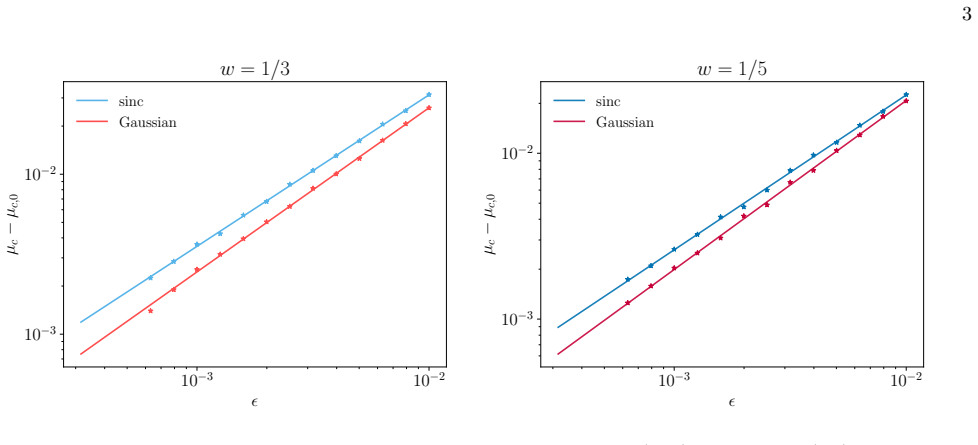
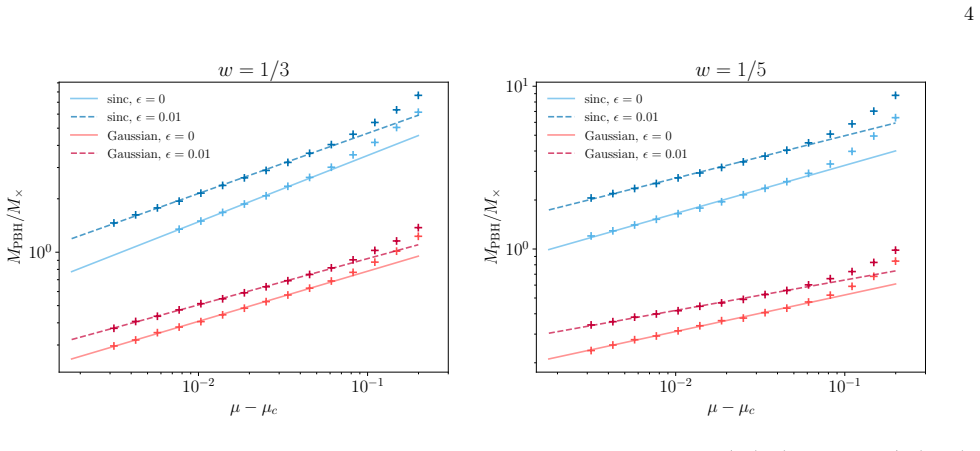
The critical threshold μ_c retains a dependence on the equation-of-state parameter w similar to that in the inviscid case, but is enhanced by an amount comparable to the bulk-viscosity strength ε. For fixed w, the increase in μ_c is approximately linear in ε. By fitting the standard critical-scaling law for near-threshold collapse, the bulk viscosity leads to an enhancement in the resulting PBH mass. These results indicate that bulk viscosity can systematically modify both the PBH threshold and PBH mass scaling law in the early universe.
What carries the argument
Numerical hydrodynamics simulations of collapse in a bulk-viscous cosmological background that extract the critical threshold μ_c and the resulting black-hole mass from the critical scaling relation.
If this is right
- The critical threshold for primordial black hole formation increases with bulk viscosity strength by an amount comparable to the viscosity parameter itself.
- For any fixed equation-of-state parameter the threshold rises approximately linearly with the viscosity parameter.
- The resulting primordial black hole masses are larger than in the inviscid case once the critical scaling law is applied.
- Both the threshold value and the mass scaling relation are modified systematically by the presence of bulk viscosity.
Where Pith is reading between the lines
- Models that use primordial black holes to explain dark matter would have to adjust the allowed mass window once bulk viscosity is included.
- Gravitational-wave signals from primordial black hole binaries could carry an imprint of the early-universe viscosity strength.
- The same simulation approach could test whether other forms of viscosity or different parametrizations produce comparable shifts.
Load-bearing premise
The numerical hydrodynamics setup and the chosen parametrization of bulk viscosity strength accurately capture the relevant physics of the early-universe fluid.
What would settle it
An observed population of primordial black holes whose masses or abundance fall outside the range predicted by the raised threshold and enhanced mass scaling for any given viscosity strength.
Figures

read the original abstract
We investigate primordial black hole (PBH) formation in a cosmological background with bulk viscosity. Using numerical simulations, we determine the collapse threshold and the resulting PBH mass. We find that the critical threshold $\mu_c$ retains a dependence on the equation-of-state parameter $w$ similar to that in the inviscid case, but is enhanced by an amount comparable to the bulk-viscosity strength $\epsilon$. For fixed $w$, the increase in $\mu_c$ is approximately linear in $\epsilon$. By fitting the standard critical-scaling law for near-threshold collapse, we find that the bulk viscosity leads to an enhancement in the resulting PBH mass. These results indicate that bulk viscosity can systematically modify both the PBH threshold and PBH mass scaling law in the early universe.
Editorial analysis
A structured set of objections, weighed in public.
Referee Report
Summary. The manuscript investigates primordial black hole (PBH) formation in a bulk-viscous cosmological background. Using numerical simulations of general relativistic hydrodynamics, it reports that the critical collapse threshold μ_c retains a dependence on the equation-of-state parameter w similar to the inviscid case but is enhanced by an amount comparable to the bulk-viscosity strength ε, with the increase approximately linear in ε for fixed w. Fitting the standard critical-scaling law shows that bulk viscosity also enhances the resulting PBH mass.
Significance. If the numerical results hold after validation, the work would show that bulk viscosity systematically modifies both the PBH formation threshold and the mass scaling in the early universe, with implications for PBH abundance and observational constraints. Credit is due for the direct numerical integration approach that extracts thresholds and scaling exponents beyond purely analytic treatments, and for the explicit comparison to the inviscid limit.
major comments (2)
- [Numerical results] Numerical results section: The central claims of linear enhancement in μ_c with ε and the mass increase rest on extraction from near-threshold collapse simulations, yet no convergence tests with respect to spatial resolution or time-stepping, no error bars on the fitted μ_c values, and no quantification of the linearity (e.g., fit coefficient or residuals) are reported. This is load-bearing because near-threshold dynamics are known to be sensitive to truncation errors, and artifacts of size comparable to the reported ε-induced shift would undermine both the linear enhancement and the mass-enhancement conclusion.
- [Methods / viscosity model] Simulation framework and viscosity parametrization: The model adopts a constant bulk-viscosity strength ε without higher-order corrections or temperature dependence; the manuscript must demonstrate that this parametrization does not introduce systematic bias into the extracted μ_c(w,ε) relation, as any mismatch with the relevant early-universe viscous physics would directly affect the claimed retention of w-dependence and the linear ε scaling.
minor comments (2)
- [Abstract] Abstract: The phrase 'approximately linear' should be accompanied in the results by a quantitative measure of linearity (e.g., slope and goodness-of-fit) rather than left qualitative.
- [Introduction] Notation: The symbol μ_c is introduced without an explicit definition equation in the early sections; a clear definition (e.g., in terms of the density contrast or curvature perturbation) would improve readability.
Simulated Author's Rebuttal
We thank the referee for the careful reading and constructive criticism. The two major comments identify important gaps in the numerical validation and model justification. We respond to each below and commit to revisions that directly address the concerns.
read point-by-point responses
-
Referee: [Numerical results] Numerical results section: The central claims of linear enhancement in μ_c with ε and the mass increase rest on extraction from near-threshold collapse simulations, yet no convergence tests with respect to spatial resolution or time-stepping, no error bars on the fitted μ_c values, and no quantification of the linearity (e.g., fit coefficient or residuals) are reported. This is load-bearing because near-threshold dynamics are known to be sensitive to truncation errors, and artifacts of size comparable to the reported ε-induced shift would undermine both the linear enhancement and the mass-enhancement conclusion.
Authors: We agree that the absence of convergence tests, error bars, and quantitative linearity measures weakens the central claims. In the revised manuscript we will add (i) resolution studies at three or more grid spacings demonstrating convergence of μ_c to within the reported ε-induced shift, (ii) error bars on each fitted μ_c obtained from the threshold-search procedure, and (iii) an explicit linear regression of μ_c(ε) together with fit coefficients and residuals. These additions will be placed in a new subsection of the numerical results. revision: yes
-
Referee: [Methods / viscosity model] Simulation framework and viscosity parametrization: The model adopts a constant bulk-viscosity strength ε without higher-order corrections or temperature dependence; the manuscript must demonstrate that this parametrization does not introduce systematic bias into the extracted μ_c(w,ε) relation, as any mismatch with the relevant early-universe viscous physics would directly affect the claimed retention of w-dependence and the linear ε scaling.
Authors: The constant-ε model is a deliberate minimal parametrization chosen to isolate the leading viscous correction. We will expand the methods section with (a) a justification based on the relevant Hubble and temperature scales at PBH formation, (b) a brief comparison to temperature-dependent bulk-viscosity prescriptions in the literature, and (c) a short robustness test in which ε is allowed a mild temperature dependence for one representative w. These additions will clarify the domain of applicability while preserving the paper’s scope as a first numerical exploration. revision: partial
Circularity Check
No circularity: claims extracted from direct numerical hydrodynamics simulations
full rationale
The paper determines μ_c and PBH mass via numerical simulations of viscous GR hydrodynamics, with the reported linear enhancement in μ_c (for fixed w) and mass increase emerging as simulation outputs rather than algebraic reductions. No self-definitional steps, fitted inputs renamed as predictions, or load-bearing self-citations appear in the derivation chain; the standard critical-scaling fit is applied post-simulation as analysis, not as a premise that forces the viscosity-induced shifts. The setup is self-contained against external benchmarks for the purpose of circularity analysis.
Axiom & Free-Parameter Ledger
free parameters (2)
- ε
- w
axioms (1)
- domain assumption The early-universe fluid can be modeled as a viscous perfect fluid in general relativity whose evolution is captured by standard numerical relativity codes
Reference graph
Works this paper leans on
-
[1]
The Hypothesis of Cores Retarded during Expansion and the Hot Cosmological Model,
Y. B. Zel’dovich and I. D. Novikov, “The Hypothesis of Cores Retarded during Expansion and the Hot Cosmological Model,” Sov. Astron.10(1967) 602
1967
-
[2]
Gravitationally collapsed objects of very low mass,
S. Hawking, “Gravitationally collapsed objects of very low mass,” Mon. Not. Roy. Astron. Soc.152(1971) 75
1971
-
[3]
Black holes in the early Universe,
B. J. Carr and S. W. Hawking, “Black holes in the early Universe,” Mon. Not. Roy. Astron. Soc.168 (1974) 399–415
1974
-
[4]
The Primordial black hole mass spectrum,
B. J. Carr, “The Primordial black hole mass spectrum,” Astrophys. J.201(1975) 1–19
1975
-
[5]
Primordial Black Holes as Dark Matter,
B. Carr, F. Kuhnel, and M. Sandstad, “Primordial Black Holes as Dark Matter,” Phys. Rev. D94no. 8, (2016) 083504,arXiv:1607.06077 [astro-ph.CO]
Pith/arXiv arXiv 2016
-
[6]
Primordial Black Holes as Dark Matter: Recent Developments,
B. Carr and F. Kuhnel, “Primordial Black Holes as Dark Matter: Recent Developments,” Ann. Rev. Nucl. Part. Sci.70(2020) 355–394,arXiv:2006.02838 [astro-ph.CO]
Pith/arXiv arXiv 2020
-
[7]
Primordial Black Holes as a dark matter candidate,
A. M. Green and B. J. Kavanagh, “Primordial Black Holes as a dark matter candidate,” J. Phys. G48 no. 4, (2021) 043001,arXiv:2007.10722 [astro-ph.CO]
Pith/arXiv arXiv 2021
-
[8]
Primordial black holes as dark matter candidates,
B. Carr and F. Kuhnel, “Primordial black holes as dark matter candidates,” SciPost Phys. Lect. Notes48 (2022) 1,arXiv:2110.02821 [astro-ph.CO]
arXiv 2022
-
[9]
Dynamics of primordial black hole formation,
J. C. Niemeyer and K. Jedamzik, “Dynamics of primordial black hole formation,” Phys. Rev. D59 (1999) 124013,arXiv:astro-ph/9901292
Pith/arXiv arXiv 1999
-
[10]
Black hole formation in the Friedmann universe: Formulation and computation in numerical relativity,
M. Shibata and M. Sasaki, “Black hole formation in the Friedmann universe: Formulation and computation in numerical relativity,” Phys. Rev. D60(1999) 084002,arXiv:gr-qc/9905064
Pith/arXiv arXiv 1999
-
[11]
Primordial black holes from CDM isocurvature perturbations,
S. Passaglia and M. Sasaki, “Primordial black holes from CDM isocurvature perturbations,” Phys. Rev. D 105no. 10, (2022) 103530,arXiv:2109.12824 [astro-ph.CO]
arXiv 2022
-
[12]
Primordial black hole formation from massless scalar isocurvature,
C.-M. Yoo, T. Harada, S. Hirano, H. Okawa, and M. Sasaki, “Primordial black hole formation from massless scalar isocurvature,” Phys. Rev. D105 no. 10, (2022) 103538,arXiv:2112.12335 [gr-qc]
arXiv 2022
-
[13]
The trichotomy of primordial black holes initial conditions,
C. Germani and L. Montell` a, “The trichotomy of primordial black holes initial conditions,” arXiv:2510.02006 [gr-qc]
-
[14]
Primordial black holes from primordial voids,
C. Joana and Z.-Y. Yuwen, “Primordial black holes from primordial voids,” Phys. Rev. D113no. 2, (2026) 023518,arXiv:2510.11611 [astro-ph.CO]
arXiv 2026
-
[15]
Primordial black hole production due to preheating,
A. M. Green and K. A. Malik, “Primordial black hole production due to preheating,” Phys. Rev. D64 (2001) 021301,arXiv:hep-ph/0008113
Pith/arXiv arXiv 2001
-
[16]
Collapse of Small-Scale Density Perturbations during Preheating in Single Field Inflation,
K. Jedamzik, M. Lemoine, and J. Martin, “Collapse of Small-Scale Density Perturbations during Preheating in Single Field Inflation,” JCAP09(2010) 034, arXiv:1002.3039 [astro-ph.CO]
Pith/arXiv arXiv 2010
-
[17]
Primordial Black Holes from Inflaton Fragmentation into Oscillons,
E. Cotner, A. Kusenko, and V. Takhistov, “Primordial Black Holes from Inflaton Fragmentation into Oscillons,” Phys. Rev. D98no. 8, (2018) 083513, arXiv:1801.03321 [astro-ph.CO]
Pith/arXiv arXiv 2018
-
[18]
Primordial black holes from the preheating instability in single-field inflation,
J. Martin, T. Papanikolaou, and V. Vennin, “Primordial black holes from the preheating instability in single-field inflation,” JCAP01(2020) 024, arXiv:1907.04236 [astro-ph.CO]
arXiv 2020
-
[19]
Oscillon Preheating in Full General Relativity,
X.-X. Kou, C. Tian, and S.-Y. Zhou, “Oscillon Preheating in Full General Relativity,” Class. Quant. Grav.38no. 4, (2021) 045005,arXiv:1912.09658 [gr-qc]
arXiv 2021
-
[20]
Bubble Collisions in the Very Early Universe,
S. W. Hawking, I. G. Moss, and J. M. Stewart, “Bubble Collisions in the Very Early Universe,” Phys. Rev. D26(1982) 2681
1982
-
[21]
Spontaneous Generation of Density Perturbations in the Early Universe,
M. Crawford and D. N. Schramm, “Spontaneous Generation of Density Perturbations in the Early Universe,” Nature298(1982) 538–540. 6
1982
-
[22]
Singularity formation from colliding bubbles,
I. G. Moss, “Singularity formation from colliding bubbles,” Phys. Rev. D50(1994) 676–681
1994
-
[23]
Formation of black holes in first order phase transitions,
M. Y. Khlopov, R. V. Konoplich, S. G. Rubin, and A. S. Sakharov, “Formation of black holes in first order phase transitions,”arXiv:hep-ph/9807343
-
[24]
First order phase transitions as a source of black holes in the early universe,
M. Y. Khlopov, R. V. Konoplich, S. G. Rubin, and A. S. Sakharov, “First order phase transitions as a source of black holes in the early universe,” Grav. Cosmol.2(1999) S1,arXiv:hep-ph/9912422
Pith/arXiv arXiv 1999
-
[25]
Primordial black holes from bubble collisions during a first-order phase transition,
T. H. Jung and T. Okui, “Primordial black holes from bubble collisions during a first-order phase transition,” Phys. Rev. D110no. 11, (2024) 115014, arXiv:2110.04271 [hep-ph]
arXiv 2024
-
[26]
Black Holes From Cosmic Strings,
S. W. Hawking, “Black Holes From Cosmic Strings,” Phys. Lett. B231(1989) 237–239
1989
-
[27]
Formation of Primordial Black Holes by Cosmic Strings,
A. Polnarev and R. Zembowicz, “Formation of Primordial Black Holes by Cosmic Strings,” Phys. Rev. D43(1991) 1106–1109
1991
-
[28]
Black holes from nucleating strings,
J. Garriga and A. Vilenkin, “Black holes from nucleating strings,” Phys. Rev. D47(1993) 3265–3274,arXiv:hep-ph/9208212
Pith/arXiv arXiv 1993
-
[29]
Dynamics of Thick Domain Walls,
L. M. Widrow, “Dynamics of Thick Domain Walls,” Phys. Rev. D40(1989) 1002
1989
-
[30]
Primordial black holes from nonequilibrium second order phase transition,
S. G. Rubin, M. Y. Khlopov, and A. S. Sakharov, “Primordial black holes from nonequilibrium second order phase transition,” Grav. Cosmol.6(2000) 51–58, arXiv:hep-ph/0005271
Pith/arXiv arXiv 2000
-
[31]
Primordial black holes and their gravitational-wave signatures,
LISA Cosmology Working Group Collaboration, E. Bagui et al., “Primordial black holes and their gravitational-wave signatures,” Living Rev. Rel.28 no. 1, (2025) 1,arXiv:2310.19857 [astro-ph.CO]
arXiv 2025
-
[32]
A. Escriv` a, F. Kuhnel, and Y. Tada, “Primordial Black Holes,”arXiv:2211.05767 [astro-ph.CO]
-
[33]
The Basics of Primordial Black Hole Formation and Abundance Estimation,
C.-M. Yoo, “The Basics of Primordial Black Hole Formation and Abundance Estimation,” Galaxies10 no. 6, (2022) 112,arXiv:2211.13512 [astro-ph.CO]
arXiv 2022
-
[34]
BLACK HOLE BUBBLES,
I. G. Moss, “BLACK HOLE BUBBLES,” Phys. Rev. D32(1985) 1333
1985
-
[35]
CAN BLACK HOLES NUCLEATE VACUUM PHASE TRANSITIONS?,
W. A. Hiscock, “CAN BLACK HOLES NUCLEATE VACUUM PHASE TRANSITIONS?,” Phys. Rev. D 35(1987) 1161–1170
1987
-
[36]
Super-slow phase transition catalyzed by BHs and the birth of baby BHs,
R. Jinno, J. Kume, and M. Yamada, “Super-slow phase transition catalyzed by BHs and the birth of baby BHs,” Phys. Lett. B849(2024) 138465, arXiv:2310.06901 [hep-ph]
arXiv 2024
-
[37]
Bubbles kick off primordial black holes to form more binaries,
Z.-Y. Yuwen, C. Joana, S.-J. Wang, and R.-G. Cai, “Bubbles kick off primordial black holes to form more binaries,” Phys. Rev. Res.7no. 2, (2025) 023180, arXiv:2406.05838 [gr-qc]
arXiv 2025
-
[38]
Nearly Monochromatic Primordial Black Holes as total Dark Matter from Bubble Collapse,
H. Wang, Y.-l. Zhang, and T. Suyama, “Nearly Monochromatic Primordial Black Holes as total Dark Matter from Bubble Collapse,”arXiv:2510.19233 [astro-ph.CO]
-
[39]
Constraints on the induced gravitational wave background from primordial black holes,
E. Bugaev and P. Klimai, “Constraints on the induced gravitational wave background from primordial black holes,” Phys. Rev. D83(2011) 083521, arXiv:1012.4697 [astro-ph.CO]
Pith/arXiv arXiv 2011
-
[40]
Gravitational wave production by Hawking radiation from rotating primordial black holes,
R. Dong, W. H. Kinney, and D. Stojkovic, “Gravitational wave production by Hawking radiation from rotating primordial black holes,” JCAP10 (2016) 034,arXiv:1511.05642 [astro-ph.CO]
Pith/arXiv arXiv 2016
-
[41]
G. Ferrante, G. Franciolini, A. Iovino, Junior., and A. Urbano, “Primordial non-Gaussianity up to all orders: Theoretical aspects and implications for primordial black hole models,” Phys. Rev. D107no. 4, (2023) 043520,arXiv:2211.01728 [astro-ph.CO]
arXiv 2023
-
[42]
Relic gravitational waves from primordial gravitational collapses,
X.-X. Zeng, Z. Ning, Z.-Y. Yuwen, S.-J. Wang, H. Deng, and R.-G. Cai, “Relic gravitational waves from primordial gravitational collapses,” arXiv:2504.11275 [gr-qc]
-
[43]
Sound waves from primordial black hole formations,
Z. Ning, X.-X. Zeng, Z.-Y. Yuwen, S.-J. Wang, H. Deng, and R.-G. Cai, “Sound waves from primordial black hole formations,” Phys. Rev. D113 no. 2, (2026) 024020,arXiv:2504.12243 [gr-qc]
arXiv 2026
-
[44]
Acoustic gravitational waves from primordial curvature perturbations,
Z. Ning, Z.-Y. Yuwen, X.-X. Zeng, R.-G. Cai, and S.-J. Wang, “Acoustic gravitational waves from primordial curvature perturbations,”arXiv:2512.21151 [gr-qc]
-
[45]
Numerical simulations of primordial black hole formation via delayed first-order phase transitions,
Z. Ning, X.-X. Zeng, R.-G. Cai, and S.-J. Wang, “Numerical simulations of primordial black hole formation via delayed first-order phase transitions,” arXiv:2601.21878 [gr-qc]
-
[46]
21 cm limits on decaying dark matter and primordial black holes,
S. Clark, B. Dutta, Y. Gao, Y.-Z. Ma, and L. E. Strigari, “21 cm limits on decaying dark matter and primordial black holes,” Phys. Rev. D98no. 4, (2018) 043006,arXiv:1803.09390 [astro-ph.HE]
Pith/arXiv arXiv 2018
-
[47]
Constraining the primordial black hole abundance with 21-cm cosmology,
O. Mena, S. Palomares-Ruiz, P. Villanueva-Domingo, and S. J. Witte, “Constraining the primordial black hole abundance with 21-cm cosmology,” Phys. Rev. D 100no. 4, (2019) 043540,arXiv:1906.07735 [astro-ph.CO]
arXiv 2019
-
[48]
M.-L. Zhao, S. Wang, and X. Zhang, “Prospects for probing dark matter particles and primordial black holes with the Hongmeng mission using the 21 cm global spectrum at cosmic dawn,” JCAP07(2025) 039,arXiv:2412.19257 [astro-ph.CO]
arXiv 2025
-
[49]
M.-L. Zhao, Y. Shao, S. Wang, and X. Zhang, “Prospects for probing dark matter particles and primordial black holes with the Square Kilometre Array using the 21 cm power spectrum at cosmic dawn*,” Chin. Phys.50no. 2, (2026) 025101, arXiv:2507.02651 [astro-ph.CO]
arXiv 2026
-
[50]
Primordial Black Hole Abundance from Reionization,
Z. Yin, H. Cheng, and L. Visinelli, “Primordial Black Hole Abundance from Reionization,” arXiv:2602.06794 [astro-ph.CO]
-
[51]
Experimental Limits on Primordial Black Hole Dark Matter from the First 2 yr of Kepler Data,
K. Griest, A. M. Cieplak, and M. J. Lehner, “Experimental Limits on Primordial Black Hole Dark Matter from the First 2 yr of Kepler Data,” Astrophys. J.786no. 2, (2014) 158,arXiv:1307.5798 [astro-ph.CO]
Pith/arXiv arXiv 2014
-
[52]
Microlensing constraints on primordial black holes with Subaru/HSC Andromeda observations,
H. Niikura et al., “Microlensing constraints on primordial black holes with Subaru/HSC Andromeda observations,” Nature Astron.3no. 6, (2019) 524–534, arXiv:1701.02151 [astro-ph.CO]
Pith/arXiv arXiv 2019
-
[53]
Constraints on Earth-mass primordial black holes from OGLE 5-year microlensing events,
H. Niikura, M. Takada, S. Yokoyama, T. Sumi, and S. Masaki, “Constraints on Earth-mass primordial black holes from OGLE 5-year microlensing events,” Phys. Rev. D99no. 8, (2019) 083503, arXiv:1901.07120 [astro-ph.CO]
Pith/arXiv arXiv 2019
-
[54]
New limits from microlensing on Galactic black holes in the mass range 10 M⊙<M< 1000 M⊙,
T. Blaineau et al., “New limits from microlensing on Galactic black holes in the mass range 10 M⊙<M< 1000 M⊙,” Astron. Astrophys.664(2022) A106, arXiv:2202.13819 [astro-ph.GA]
arXiv 2022
-
[55]
Revealing dark matter dress of primordial black holes by cosmological lensing,
M. Oguri, V. Takhistov, and K. Kohri, “Revealing dark matter dress of primordial black holes by cosmological lensing,” Phys. Lett. B847(2023) 138276,arXiv:2208.05957 [astro-ph.CO]
arXiv 2023
-
[56]
Gravitational microlensing by dressed primordial 7 black holes,
R.-G. Cai, T. Chen, S.-J. Wang, and X.-Y. Yang, “Gravitational microlensing by dressed primordial 7 black holes,” JCAP03(2023) 043,arXiv:2210.02078 [astro-ph.CO]
arXiv 2023
-
[57]
Density perturbations and black hole formation in hybrid inflation,
J. Garcia-Bellido, A. D. Linde, and D. Wands, “Density perturbations and black hole formation in hybrid inflation,” Phys. Rev. D54(1996) 6040–6058, arXiv:astro-ph/9605094
Pith/arXiv arXiv 1996
-
[58]
Generating Primordial Black Holes Via Hilltop-Type Inflation Models,
L. Alabidi and K. Kohri, “Generating Primordial Black Holes Via Hilltop-Type Inflation Models,” Phys. Rev. D80(2009) 063511,arXiv:0906.1398 [astro-ph.CO]
Pith/arXiv arXiv 2009
-
[59]
Primordial black hole formation from an axionlike curvaton model,
M. Kawasaki, N. Kitajima, and T. T. Yanagida, “Primordial black hole formation from an axionlike curvaton model,” Phys. Rev. D87no. 6, (2013) 063519,arXiv:1207.2550 [hep-ph]
Pith/arXiv arXiv 2013
-
[60]
Massive Primordial Black Holes from Hybrid Inflation as Dark Matter and the seeds of Galaxies,
S. Clesse and J. Garc´ ıa-Bellido, “Massive Primordial Black Holes from Hybrid Inflation as Dark Matter and the seeds of Galaxies,” Phys. Rev. D92no. 2, (2015) 023524,arXiv:1501.07565 [astro-ph.CO]
Pith/arXiv arXiv 2015
-
[61]
Gravitational waves at interferometer scales and primordial black holes in axion inflation,
J. Garcia-Bellido, M. Peloso, and C. Unal, “Gravitational waves at interferometer scales and primordial black holes in axion inflation,” JCAP12 (2016) 031,arXiv:1610.03763 [astro-ph.CO]
Pith/arXiv arXiv 2016
-
[62]
Primordial black holes from inflaton and spectator field perturbations in a matter-dominated era,
B. Carr, T. Tenkanen, and V. Vaskonen, “Primordial black holes from inflaton and spectator field perturbations in a matter-dominated era,” Phys. Rev. D96no. 6, (2017) 063507,arXiv:1706.03746 [astro-ph.CO]
Pith/arXiv arXiv 2017
-
[63]
Primordial Black Holes from Thermal Inflation,
K. Dimopoulos, T. Markkanen, A. Racioppi, and V. Vaskonen, “Primordial Black Holes from Thermal Inflation,” JCAP07(2019) 046,arXiv:1903.09598 [astro-ph.CO]
arXiv 2019
-
[64]
Near-critical gravitational collapse and the initial mass function of primordial black holes,
J. C. Niemeyer and K. Jedamzik, “Near-critical gravitational collapse and the initial mass function of primordial black holes,” Phys. Rev. Lett.80(1998) 5481–5484,arXiv:astro-ph/9709072
Pith/arXiv arXiv 1998
-
[65]
Dissipative cosmology,
R. Maartens, “Dissipative cosmology,” Class. Quant. Grav.12(1995) 1455–1465
1995
-
[66]
W. Zimdahl, “Bulk viscous cosmology,” Phys. Rev. D 53(1996) 5483–5493,arXiv:astro-ph/9601189
Pith/arXiv arXiv 1996
-
[67]
First-Order General-Relativistic Viscous Fluid Dynamics,
F. S. Bemfica, M. M. Disconzi, and J. Noronha, “First-Order General-Relativistic Viscous Fluid Dynamics,” Phys. Rev. X12no. 2, (2022) 021044, arXiv:2009.11388 [gr-qc]
arXiv 2022
-
[68]
Cosmological Non-Linearities as an Effective Fluid,
D. Baumann, A. Nicolis, L. Senatore, and M. Zaldarriaga, “Cosmological Non-Linearities as an Effective Fluid,” JCAP07(2012) 051, arXiv:1004.2488 [astro-ph.CO]
Pith/arXiv arXiv 2012
-
[69]
Nonlinear cosmological consistency relations and effective matter stresses,
G. Ballesteros, L. Hollenstein, R. K. Jain, and M. Kunz, “Nonlinear cosmological consistency relations and effective matter stresses,” JCAP05 (2012) 038,arXiv:1112.4837 [astro-ph.CO]
Pith/arXiv arXiv 2012
-
[70]
Non-linear curvature inhomogeneities and backreaction for relativistic viscous fluids,
M. Giovannini, “Non-linear curvature inhomogeneities and backreaction for relativistic viscous fluids,” Class. Quant. Grav.32(2015) 155004,arXiv:1503.08739 [hep-th]
Pith/arXiv arXiv 2015
-
[71]
Simulations of ellipsoidal primordial black hole formation,
A. Escriv` a and C.-M. Yoo, “Simulations of ellipsoidal primordial black hole formation,” Phys. Rev. D112 no. 8, (2025) 083518,arXiv:2410.03452 [gr-qc]
arXiv 2025
-
[72]
Nonspherical effects on the mass function of primordial black holes,
A. Escriv` a and C.-M. Yoo, “Nonspherical effects on the mass function of primordial black holes,” Phys. Rev. D112no. 8, (2025) L081304,arXiv:2410.03451 [gr-qc]
arXiv 2025
-
[73]
Viscous FRW model with particle creation in the early universe,
C. P. Singh, “Viscous FRW model with particle creation in the early universe,” Mod. Phys. Lett. A27 (2012) 1250070,arXiv:1107.2212 [gr-qc]
Pith/arXiv arXiv 2012
-
[74]
Bulk Viscosity and Particle Creation in the Inflationary Cosmology,
M. Eshaghi, N. Riazi, and A. Kiasatpour, “Bulk Viscosity and Particle Creation in the Inflationary Cosmology,”arXiv:1504.07774 [gr-qc]
-
[75]
Cosmology with bulk viscosity and the gravitino problem,
L. Buoninfante and G. Lambiase, “Cosmology with bulk viscosity and the gravitino problem,” Eur. Phys. J. C77no. 5, (2017) 287,arXiv:1610.01827 [astro-ph.CO]
Pith/arXiv arXiv 2017
-
[76]
Origin of bulk viscosity in cosmology and its thermodynamic implications,
T. Paul, “Origin of bulk viscosity in cosmology and its thermodynamic implications,” Phys. Rev. D111no. 8, (2025) 083540,arXiv:2504.00422 [gr-qc]
arXiv 2025
-
[77]
Bulk Viscous Matter-dominated Universes: Asymptotic Properties,
A. Avelino, R. Garcia-Salcedo, T. Gonzalez, U. Nucamendi, and I. Quiros, “Bulk Viscous Matter-dominated Universes: Asymptotic Properties,” JCAP08(2013) 012,arXiv:1303.5167 [gr-qc]
Pith/arXiv arXiv 2013
-
[78]
Interacting viscous dark fluids,
A. Avelino, Y. Leyva, and L. A. Urena-Lopez, “Interacting viscous dark fluids,” Phys. Rev. D88 (2013) 123004,arXiv:1306.3270 [astro-ph.CO]
Pith/arXiv arXiv 2013
-
[79]
Characteristic Properties of Two Different Viscous Cosmology Models for the Future Universe,
B. D. Normann and I. Brevik, “Characteristic Properties of Two Different Viscous Cosmology Models for the Future Universe,” Mod. Phys. Lett. A 32no. 4, (2017) 1750026,arXiv:1612.01794 [gr-qc]
Pith/arXiv arXiv 2017
-
[80]
Viscous Cosmology for Early- and Late-Time Universe,
I. Brevik, Ø. Grøn, J. de Haro, S. D. Odintsov, and E. N. Saridakis, “Viscous Cosmology for Early- and Late-Time Universe,” Int. J. Mod. Phys. D26no. 14, (2017) 1730024,arXiv:1706.02543 [gr-qc]
Pith/arXiv arXiv 2017
discussion (0)
Sign in with ORCID, Apple, or X to comment. Anyone can read and Pith papers without signing in.