Topological phase transition driven by in-plane spin rotation
Pith reviewed 2026-06-26 04:38 UTC · model grok-4.3
The pith
A 60° in-plane magnetization rotation reverses the Chern number sign in a kagome Chern insulator.
A machine-rendered reading of the paper's core claim, the machinery that carries it, and where it could break.
Core claim
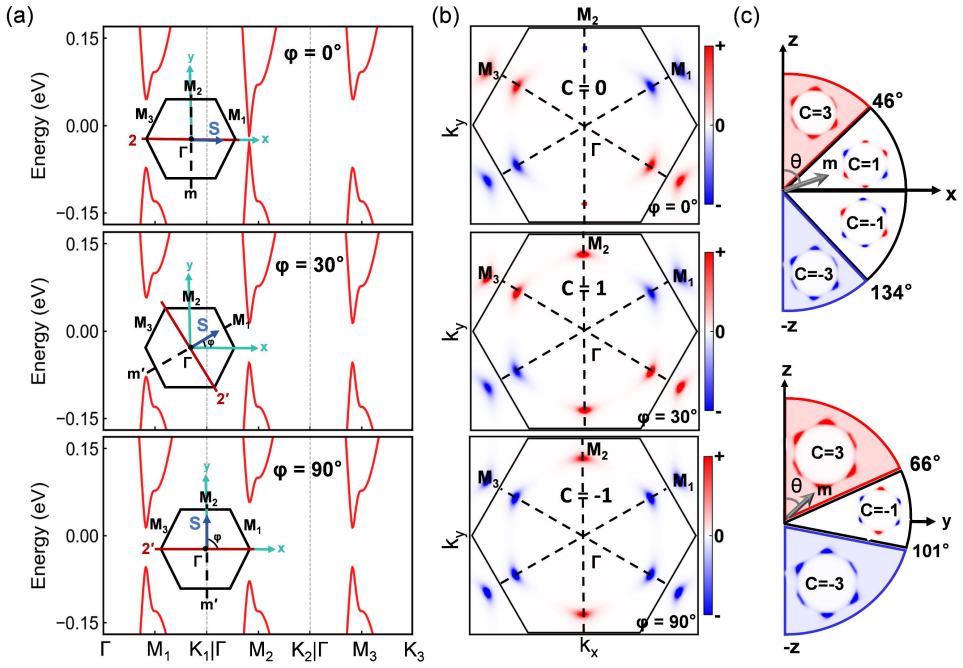
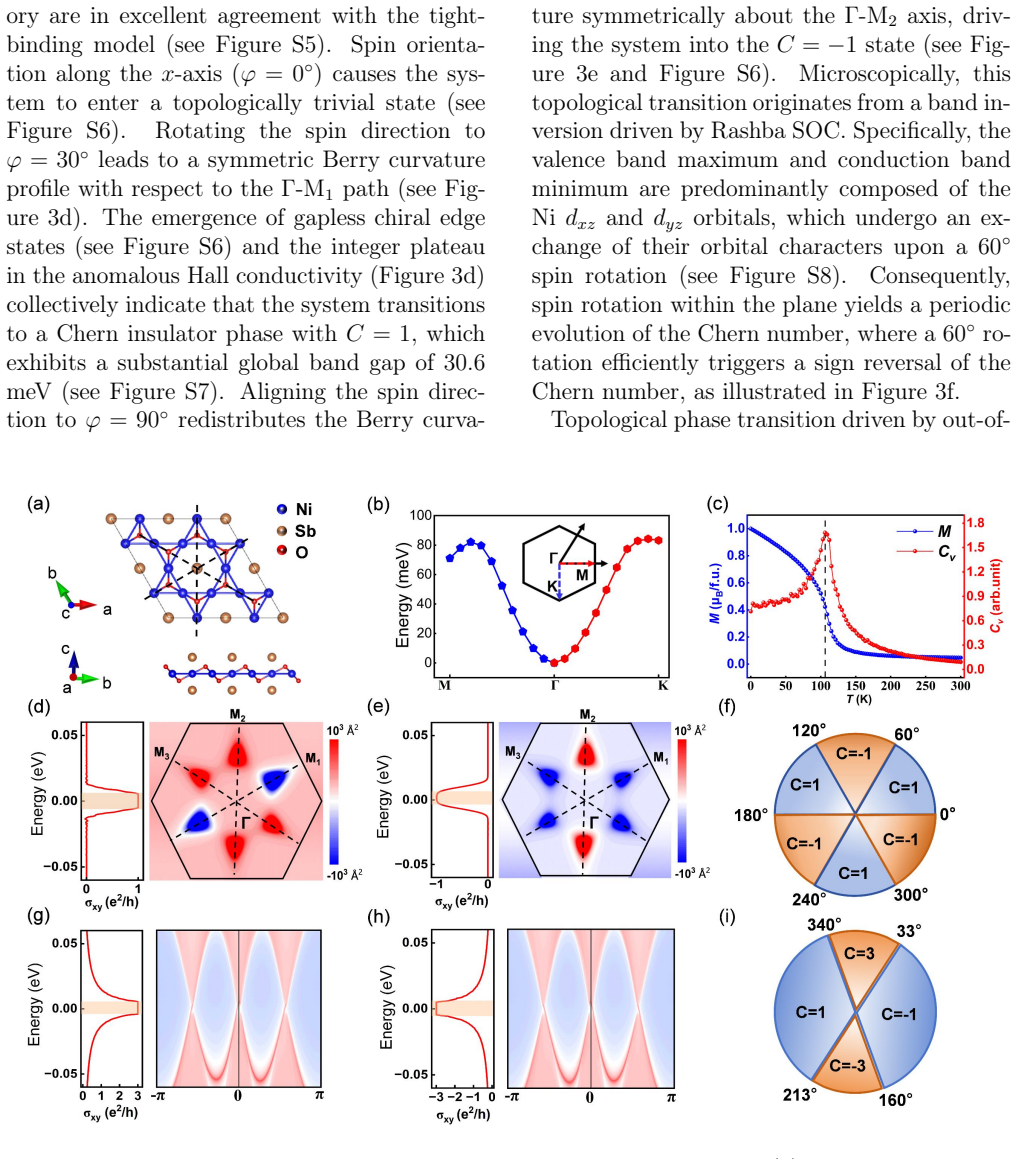
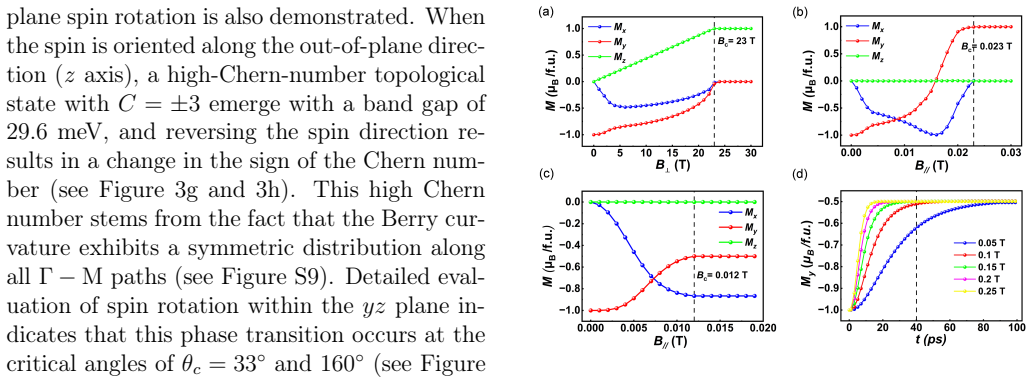
In a two-dimensional kagome ferromagnetic Chern insulator the intrinsic link between magnetism and band topology allows external fields to act through spin reorientation. Magnetic point group constraints on the Berry curvature distribution dictate that a 60° in-plane magnetization rotation reverses the sign of the Chern number while passing through a topologically trivial state. Micromagnetic simulations confirm the rotation occurs under small fields and on ultrafast timescales.
What carries the argument
Magnetic point group constraints on the Berry curvature distribution that enforce how curvature changes with continuous in-plane spin rotation.
If this is right
- Topological switching becomes possible with continuous tunability rather than abrupt phase changes.
- Only exceptionally small magnetic fields are needed to drive the transition.
- The process occurs on ultrafast timescales according to the simulations.
- The symmetry framework applies to other magnetic topological insulators with compatible point groups.
Where Pith is reading between the lines
- Device concepts could exploit in-plane field pulses already common in spintronics to control topology without large out-of-plane fields.
- The same rotation mechanism may appear in other lattices whose magnetic point groups permit similar Berry curvature redistribution.
- Real-material tests would need to separate the predicted rotation effect from possible domain-wall motion or heating.
Load-bearing premise
The assumption that micromagnetic simulations capture the real dynamics without disorder or higher-order effects changing the Berry curvature during the rotation.
What would settle it
Measuring the Hall conductivity or edge-state spectrum in a real kagome material while rotating the in-plane magnetization by 60° and checking whether the Chern number changes sign as predicted.
Figures

read the original abstract
The intrinsic coupling between magnetism and nontrivial band topology in magnetic topological insulators makes external magnetic fields a powerful tool for manipulating topological states. However, conventional magnetic control mechanisms, such as driving magnetic phase transitions or fully reversing magnetization, typically demand large magnetic fields and lack continuous tunability. Here, we establish a symmetry framework for the reversible switching of topological states via continuous in-plane spin rotation, governed by magnetic point group constraints on the Berry curvature distribution. Using a two-dimensional kagome ferromagnetic Chern insulator as a prototype, we demonstrate that a 60{\deg}in-plane magnetization rotation reverses the sign of the Chern number, transitioning through a topologically trivial state. Crucially, micromagnetic simulations confirm that this spin-reorientation-driven switching operates under exceptionally small magnetic fields and on ultrafast timescales. This work provides a highly efficient, low-energy paradigm for the manipulation of topological states.
Editorial analysis
A structured set of objections, weighed in public.
Referee Report
Summary. The manuscript claims that a symmetry framework based on magnetic point group constraints on the Berry curvature allows reversible topological switching in a 2D kagome ferromagnetic Chern insulator via continuous 60° in-plane magnetization rotation, which reverses the Chern number sign while passing through a topologically trivial (C=0) state; micromagnetic simulations are invoked to show this occurs under small fields on ultrafast timescales.
Significance. If the central symmetry argument and the mapping C → −C hold without additional terms altering the Berry curvature trajectory, the result would offer a low-energy, continuously tunable alternative to conventional magnetization reversal for controlling topological states in magnetic topological insulators.
major comments (2)
- [Abstract] Abstract: the central claim that magnetic point group symmetries constrain the Berry curvature distribution to enforce a sign-reversing transition at exactly 60° is stated without derivation details, explicit symmetry analysis, or checks that the gap-closing angle remains fixed under the model Hamiltonian.
- [Abstract] Abstract: micromagnetic simulations are cited to confirm small-field, ultrafast operation, yet no validation metrics, parameter sensitivity tests, or comparison to the instantaneous topological trajectory are reported, leaving the weakest assumption (uniform rotation without domain effects or higher-order terms) unaddressed.
Simulated Author's Rebuttal
We thank the referee for their careful reading and constructive comments. We address each major comment below and indicate the revisions we will incorporate.
read point-by-point responses
-
Referee: [Abstract] Abstract: the central claim that magnetic point group symmetries constrain the Berry curvature distribution to enforce a sign-reversing transition at exactly 60° is stated without derivation details, explicit symmetry analysis, or checks that the gap-closing angle remains fixed under the model Hamiltonian.
Authors: The full symmetry analysis from the magnetic point group, the explicit constraints on Berry curvature, and the calculation of the Chern number versus magnetization angle are derived in Sections II and III using the model Hamiltonian. The 60° transition follows directly from the point-group-allowed terms that force the Berry curvature to reverse sign while passing through zero. We agree the abstract is too terse on this point; we will revise it to reference the key symmetry elements and add a supplementary note confirming that the gap-closing angle remains fixed at 60° under moderate variations of the Hamiltonian parameters. revision: yes
-
Referee: [Abstract] Abstract: micromagnetic simulations are cited to confirm small-field, ultrafast operation, yet no validation metrics, parameter sensitivity tests, or comparison to the instantaneous topological trajectory are reported, leaving the weakest assumption (uniform rotation without domain effects or higher-order terms) unaddressed.
Authors: Section IV presents the micromagnetic results for the required field amplitudes and timescales under the uniform-rotation assumption. We acknowledge that the abstract omits validation details and that the assumption of uniform rotation merits explicit checks. In the revision we will add parameter-sensitivity tests, report quantitative validation metrics against the instantaneous topological trajectory, and include a brief discussion of domain-formation thresholds to justify the uniform-rotation regime. revision: yes
Circularity Check
No significant circularity; symmetry framework is independent of model outputs
full rationale
The paper derives the central claim from a symmetry framework based on magnetic point group constraints on Berry curvature, presented as a general principle that dictates the sign reversal of the Chern number under 60° in-plane rotation through a trivial state. This is then applied to the kagome tight-binding model as a prototype demonstration. Micromagnetic simulations address only the practical feasibility (small fields, ultrafast timescales) and do not enter the topological derivation. No equations reduce a prediction to a fitted parameter by construction, no self-citations are load-bearing for the uniqueness or ansatz, and the symmetry analysis supplies independent content not equivalent to the simulation or model inputs. The derivation chain is self-contained against external symmetry principles.
Axiom & Free-Parameter Ledger
Reference graph
Works this paper leans on
-
[1]
Nature Reviews Physics , volume =
Magnetic topological insulators , author =. Nature Reviews Physics , volume =. 2019 , doi =
2019
-
[2]
Topological
Zhang, Dongqin and Shi, Minji and Zhu, Tongshuai and Xing, Dingyu and Zhang, Haijun and Wang, Jing , journal =. Topological. 2019 , doi =
2019
-
[3]
Robust axion insulator and
Liu, Chang and Wang, Yongchao and Li, Hao and Wu, Yang and Li, Yaoxin and Li, Jiaheng and He, Ke and Xu, Yong and Zhang, Jinsong and Wang, Yayu , journal =. Robust axion insulator and. 2020 , doi =
2020
-
[4]
Grytsiuk, Sergii and Katsnelson, Mikhail I. and Loon, Erik G.C.P. van and Rösner, Malte , journal =. 2024 , issn =. doi:10.1038/s41535-024-00619-5 , publisher =
-
[5]
Quantum anomalous
Deng, Yujun and Yu, Yijun and Shi, Meng Zhu and Guo, Zhongxun and Xu, Zihan and Wang, Jing and Chen, Xian Hui and Zhang, Yuanbo , journal =. Quantum anomalous. 2020 , doi =
2020
-
[6]
Wang, Yaojia and Wu, Heng and McCandless, Gregory T. and Chan, Julia Y. and Ali, Mazhar N. , journal =. Quantum states and intertwining phases in kagome materials , year =. doi:10.1038/s42254-023-00635-7 , publisher =
-
[7]
Xiao, Di and Jiang, Jue and Shin, Jae-Ho and Wang, Wenbo and Wang, Fei and Zhao, Yi-Fan and Liu, Chaoxing and Wu, Weida and Chan, Moses H. W. and Samarth, Nitin and Chang, Cui-Zu , journal =. Realization of the. 2018 , doi =
2018
-
[8]
Nature Materials , volume =
Topological spintronics and magnetoelectronics , author =. Nature Materials , volume =. 2022 , doi =
2022
-
[9]
Li, C. H. and van 't Erve, O. M. J. and Robinson, J. T. and Liu, Y. and Li, L. and Jonker, B. T. , journal =. Electrical detection of charge-current-induced spin polarization due to spin-momentum locking in. 2014 , doi =
2014
-
[10]
Physical Review Letters , volume =
Spin-electricity conversion induced by spin injection into topological insulators , author =. Physical Review Letters , volume =. 2014 , doi =
2014
-
[11]
Reviews of Modern Physics , volume =
Colloquium: topological insulators , author =. Reviews of Modern Physics , volume =. 2010 , doi =
2010
-
[12]
Reviews of Modern Physics , volume =
Topological insulators and superconductors , author =. Reviews of Modern Physics , volume =. 2011 , doi =
2011
-
[13]
Nature Materials , volume =
Spintronics and pseudospintronics in graphene and topological insulators , author =. Nature Materials , volume =. 2012 , doi =
2012
-
[14]
Intrinsic magnetic topological insulator phases in the
Chen, Bo and Fei, Fucong and Zhang, Dongqin and Zhang, Bo and Liu, Wanling and Zhang, Shuai and Wang, Pengdong and Wei, Boyuan and Zhang, Yong and Zuo, Zewen and Guo, Jingwen and Liu, Qianqian and Wang, Zilu and Wu, Xuchuan and Zong, Junyu and Xie, Xuedong and Chen, Wang and Sun, Zhe and Wang, Shancai and Zhang, Yi and Zhang, Minhao and Wang, Xuefeng and ...
2019
-
[15]
Intrinsic magnetic topological insulators in van der
Li, Jiaheng and Li, Yang and Du, Shiqiao and Wang, Zun and Gu, Bing-Lin and Zhang, Shou-Cheng and He, Ke and Duan, Wenhui and Xu, Yong , journal =. Intrinsic magnetic topological insulators in van der. 2019 , doi =
2019
-
[16]
Nature , volume=
Prediction and observation of an antiferromagnetic topological insulator , author=. Nature , volume=. 2019 , publisher=
2019
-
[17]
Hao, Yu-Jie and Liu, Pengfei and Feng, Yue and Ma, Xiao-Ming and Schwier, Eike F. and Arita, Masashi and Kumar, Shiv and Hu, Chaowei and Lu, Rui'e and Zeng, Meng and Wang, Yuan and Hao, Zhanyang and Sun, Hongyi and Zhang, Ke and Mei, Jiawei and Ni, Ni and Wu, Liusuo and Shimada, Kenya and Chen, Chaoyu and Liu, Qihang and Liu, Chang , journal =. Gapless su...
2019
-
[18]
and Zhang, Q
Yan, J.-Q. and Zhang, Q. and Heitmann, T. and Huang, Zengle and Chen, K. Y. and Cheng, J.-G. and Wu, Weida and Vaknin, D. and Sales, B. C. and McQueeney, R. J. , journal =. Crystal growth and magnetic structure of. 2019 , doi =
2019
-
[19]
Floquet--
Bielinski, Nina and Chari, Rajas and May-Mann, Julian and Kim, Soyeun and Zwettler, Jack and Deng, Yujun and Aishwarya, Anuva and Roychowdhury, Subhajit and Shekhar, Chandra and Hashimoto, Makoto and Lu, Donghui and Yan, Jiaqiang and Felser, Claudia and Madhavan, Vidya , journal =. Floquet--. 2025 , doi =
2025
-
[20]
Annual Review of Condensed Matter Physics , volume =
Floquet engineering of quantum materials , author =. Annual Review of Condensed Matter Physics , volume =. 2019 , doi =
2019
-
[21]
Electrically switchable topological magnetic phase transition in
Yang, Junhuang and Dou, Kaiying and Dai, Ying and Huang, Baibiao and Ma, Yandong , journal =. Electrically switchable topological magnetic phase transition in. 2025 , doi =
2025
-
[22]
Physical Review Letters , volume =
Design of two-dimensional multiferroics with direct polarization-magnetization coupling , author =. Physical Review Letters , volume =. 2020 , doi =
2020
-
[23]
Physical Review Letters , volume =
Coexistence and coupling of spin-induced ferroelectricity and ferromagnetism in perovskites , author =. Physical Review Letters , volume =. 2022 , doi =
2022
-
[24]
Physical Review Applied , volume =
Magnetoelectric coupling and cross control in two-dimensional ferromagnets , author =. Physical Review Applied , volume =. 2023 , doi =
2023
-
[25]
Nano Letters , volume=
Generation and Annihilation of Local Magnetic Moments by an Electric Field , author=. Nano Letters , volume=. 2025 , doi=
2025
-
[26]
and Fox, Eli J
Chen, Guorui and Sharpe, Aaron L. and Fox, Eli J. and Zhang, Ya-Hui and Wang, Shaoxin and Jiang, Lili and Lyu, Bosai and Li, Hongyuan and Watanabe, Kenji and Taniguchi, Takashi and Shi, Zhiwen and Senthil, T. and Goldhaber-Gordon, David and Zhang, Yuanbo and Wang, Feng , journal =. Tunable correlated. 2020 , doi =
2020
-
[27]
and Su, J.-J
Zhu, J. and Su, J.-J. and MacDonald, A. H. , journal =. Voltage-Controlled Magnetic Reversal in Orbital. 2020 , doi =
2020
-
[28]
Physical Review Letters , volume =
Manipulation of Topology by Electric Field in Breathing Kagome Lattice , author =. Physical Review Letters , volume =. 2025 , doi =
2025
-
[29]
Rienks, Emile D. L. and others , journal =. Large magnetic gap at the. 2019 , doi =
2019
-
[30]
Experimental Signature of an Intrinsic Magnetic Topological Insulator
Gong, Yan and others , journal =. Experimental Signature of an Intrinsic Magnetic Topological Insulator. 2019 , doi =
2019
-
[31]
Lee, S. H. and others , journal =. Spin Scattering and Topological Phase Transitions in. 2020 , doi =
2020
-
[32]
Experimental observation of the quantum anomalous
Chang, Cui-Zu and Zhang, Jinsong and Feng, Xiao and Shen, Jie and Zhang, Zuocheng and Guo, Minghua and Li, Kang and Ou, Yunbo and Wei, Pang and Wang, Li-Li and Ji, Zhong-Qing and Feng, Yang and Ji, Shuaihua and Chen, Xi and Jia, Jinfeng and Dai, Xi and Fang, Zhong and Zhang, Shou-Cheng and He, Ke and Wang, Yayu and Lu, Li and Ma, Xu-Cun and Xue, Qi-Kun , ...
2013
-
[33]
Nature , volume =
Comprehensive search for topological materials using symmetry indicators , author =. Nature , volume =. 2019 , doi =
2019
-
[34]
Quantized anomalous
Yu, Rui and Zhang, Wei and Zhang, Hai-Jun and Zhang, Shou-Cheng and Dai, Xi and Fang, Zhong , journal =. Quantized anomalous. 2010 , doi =
2010
-
[35]
and Xiang, Hongjun and Koo, Hyun-Joo and Lee, Changhoon and Whangbo, Myung-Hwan , journal =
Gordon, Elijah E. and Xiang, Hongjun and Koo, Hyun-Joo and Lee, Changhoon and Whangbo, Myung-Hwan , journal =. Prediction of Spin Orientations in Terms of. 2015 , doi =
2015
-
[36]
Nagaosa, Naoto and Sinova, Jairo and Onoda, Shigeki and MacDonald, A. H. and Ong, N. P. , journal =. Anomalous. 2010 , doi =
2010
-
[37]
and Asamitsu, Atsushi and Mathieu, Roland and Ogasawara, Takeshi and Yamada, Hiroyuki and Kawasaki, Masashi and Tokura, Yoshinori and Terakura, Kiyoyuki , journal =
Fang, Zhong and Nagaosa, Naoto and Takahashi, Kei S. and Asamitsu, Atsushi and Mathieu, Roland and Ogasawara, Takeshi and Yamada, Hiroyuki and Kawasaki, Masashi and Tokura, Yoshinori and Terakura, Kiyoyuki , journal =. The anomalous. 2003 , doi =
2003
-
[38]
In-plane magnetization-induced quantum anomalous
Liu, Xin and Hsu, Hsiu-Chuan and Liu, Chao-Xing , journal =. In-plane magnetization-induced quantum anomalous. 2013 , doi =
2013
-
[39]
Physical Review Letters , volume =
Weyl semimetal in a topological insulator multilayer , author =. Physical Review Letters , volume =. 2011 , doi =
2011
-
[40]
Physical Review B , volume =
Topological field theory of time-reversal invariant insulators , author =. Physical Review B , volume =. 2008 , doi =
2008
-
[41]
Quantum anomalous
Liu, Chao-Xing and Qi, Xiao-Liang and Dai, Xi and Fang, Zhong and Zhang, Shou-Cheng , journal =. Quantum anomalous. 2008 , doi =
2008
-
[42]
2022 , doi =
Li, Zeyu and Han, Yulei and Qiao, Zhenhua , journal =. 2022 , doi =
2022
-
[43]
Reviews of Modern Physics , volume =
Berry phase effects on electronic properties , author =. Reviews of Modern Physics , volume =. 2010 , doi =
2010
-
[44]
Thouless, D. J. and Kohmoto, M. and Nightingale, M. P. and den Nijs, M. , journal =. Quantized. 1982 , doi =
1982
-
[45]
Nano Letters , volume =
Chern-Insulator Phase in Antiferromagnets , author =. Nano Letters , volume =. 2023 , doi =
2023
-
[46]
Nodal-line semimetal and quantum anomalous
Zhong, Ping and Ren, Yafei and Han, Yu and Zhang, Liang and Qiao, Zhenhua , journal =. Nodal-line semimetal and quantum anomalous. 2017 , doi =
2017
-
[47]
Liu, Zhao and Zhao, Gan and Liu, Bing and Wang, Z. F. and Yang, Jinlong and Liu, Feng , journal =. Intrinsic Quantum Anomalous. 2018 , doi =
2018
-
[48]
Ferroelectrically Switchable Anomalous
Liu, Xinran and Zhao, Hong Jian and Bellaiche, Laurent and Ma, Yanming , journal =. Ferroelectrically Switchable Anomalous. 2025 , doi =
2025
-
[49]
Nature Reviews Physics , volume=
Kagome magnets and topological flat bands , author=. Nature Reviews Physics , volume=. 2021 , publisher=
2021
-
[50]
Advances in Physics , volume=
Noncollinear magnetism in itinerant-electron systems: theory and applications , author=. Advances in Physics , volume=. 1998 , publisher=
1998
-
[51]
Journal of Magnetism and Magnetic Materials , volume=
Local spin density functional approach to the theory of exchange interactions in ferromagnetic metals and alloys , author=. Journal of Magnetism and Magnetic Materials , volume=. 1987 , publisher=
1987
-
[52]
Physical Review Letters , volume=
Ab initio spin dynamics in magnets , author=. Physical Review Letters , volume=. 1996 , publisher=
1996
-
[53]
Journal of Physics: Condensed Matter , volume=
Atomistic spin model simulations of magnetic nanomaterials , author=. Journal of Physics: Condensed Matter , volume=. 2014 , publisher=
2014
-
[54]
The journal of chemical physics , volume=
Equation of state calculations by fast computing machines , author=. The journal of chemical physics , volume=. 1953 , publisher=
1953
-
[55]
Computer Physics Communications , volume=
TB2J: A python package for computing magnetic interaction parameters , author=. Computer Physics Communications , volume=. 2021 , publisher=
2021
-
[56]
IEEE transactions on magnetics , volume=
A phenomenological theory of damping in ferromagnetic materials , author=. IEEE transactions on magnetics , volume=. 2004 , publisher=
2004
-
[57]
Journal of physics: condensed matter , volume=
A method for atomistic spin dynamics simulations: implementation and examples , author=. Journal of physics: condensed matter , volume=. 2008 , publisher=
2008
-
[58]
AIP advances , volume=
The design and verification of MuMax3 , author=. AIP advances , volume=. 2014 , publisher=
2014
-
[59]
Nature materials , volume=
Spintronics and pseudospintronics in graphene and topological insulators , author=. Nature materials , volume=. 2012 , publisher=
2012
-
[60]
Journal of Physics: Condensed Matter , volume =
Atomistic spin dynamics: foundations and applications , author =. Journal of Physics: Condensed Matter , volume =. 2014 , doi =
2014
discussion (0)
Sign in with ORCID, Apple, or X to comment. Anyone can read and Pith papers without signing in.