Witness expansion: A unified framework for analytical and measurable mixed-state resource detection
Pith reviewed 2026-06-26 04:45 UTC · model grok-4.3
The pith
Witness expansion constructs unified nonlinear polynomial criteria that detect quantum resources in mixed states, including the first analytical test for fermionic non-Gaussianity valid at any qubit number.
A machine-rendered reading of the paper's core claim, the machinery that carries it, and where it could break.
Core claim
Witness expansion generates a family of polynomial functions from the group of free unitaries that serve as witnesses for quantum resources, yielding analytical and measurable criteria that apply to mixed states and remain effective for arbitrary system sizes in the case of fermionic non-Gaussianity.
What carries the argument
Witness expansion, the construction of polynomial functions of the state derived from the defining group of free unitaries to detect deviations from the resource-free set.
If this is right
- Recovers the l2 norm of coherence, partial-transpose moments for entanglement, stabilizer entropy for nonstabilizerness, and fermionic antiflatness.
- Yields new criteria for detecting qubit and qudit magic states that enhance witness-based detection.
- Supplies the first analytical criterion for mixed-state fermionic non-Gaussianity relative to the convex hull of pure fermionic Gaussian states, nontrivial for any number of qubits.
- Produces criteria that can be estimated experimentally using multiple copies of the target state.
Where Pith is reading between the lines
- The polynomial structure may support efficient numerical checks for resources in systems too large for full tomography.
- The framework could be applied to resource detection during open-system dynamics or in the presence of noise.
- Alignment of free unitary groups with symmetries in many-body models might allow these polynomials to serve as order parameters for quantum phases.
Load-bearing premise
The quantum resources under study are associated with a well-defined group of free unitaries, which allows the polynomial witness construction to be both nontrivial and experimentally accessible.
What would settle it
A mixed state that other measures identify as fermionic non-Gaussian yet satisfies every witness-expansion criterion, or a demonstration that the new fermionic criterion becomes trivial for sufficiently large qubit numbers.
Figures

read the original abstract
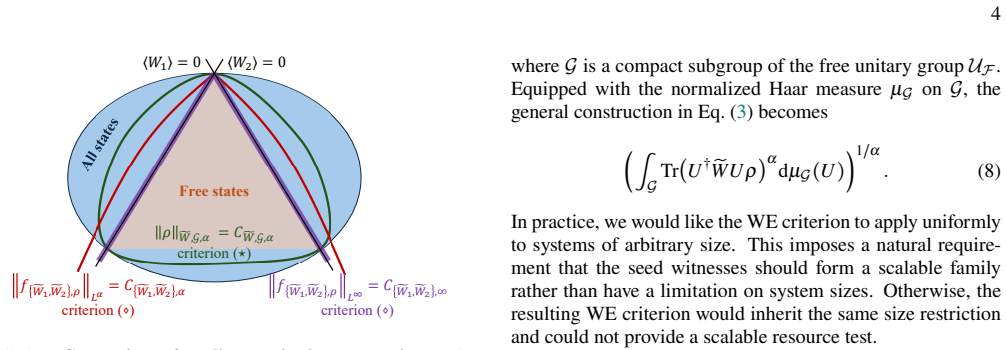
Quantum information science aims to harness different kinds of quantum resources to accomplish specific information-processing tasks. These resources also play an increasingly important role in addressing fundamental questions concerning quantum phases and dynamics. Therefore, developing powerful and practical methods for identifying and detecting quantum resources is of great significance, with applications ranging from benchmarking quantum devices to understanding the fundamental structure of quantum theory. In this work, we propose witness expansion, a unified framework for constructing nonlinear criteria for detecting quantum resources that are associated with a well-defined group of free unitaries. These criteria apply to both pure and mixed quantum states and are based on polynomial functions of the target state, which can be estimated experimentally using multiple copies of the state and evaluated analytically in certain physical models. We show how several well-known resource-detection quantities naturally emerge from our framework, including the $l_2$ norm of coherence, partial-transpose moments for entanglement, stabilizer entropy for nonstabilizerness (quantum magic), and fermionic antiflatness for fermionic non-Gaussianity. Beyond recovering these existing structures, our framework also yields new criteria for detecting qubit and qudit magic states, substantially enhancing witness-based detection capabilities. In addition, it gives, to the best of our knowledge, the first analytical criterion for detecting mixed-state fermionic non-Gaussianity with respect to the convex hull of pure fermionic Gaussian states that remains nontrivial for arbitrary numbers of qubits, demonstrating the broad applicability and conceptual unifying power of the framework.
Editorial analysis
A structured set of objections, weighed in public.
Referee Report
Summary. The manuscript proposes a 'witness expansion' framework for constructing polynomial (nonlinear) criteria to detect quantum resources associated with a well-defined group of free unitaries. The criteria apply to both pure and mixed states, are claimed to be analytically evaluable in some models and experimentally measurable via multiple copies, recover several known witnesses (l2 coherence, partial-transpose moments, stabilizer entropy, fermionic antiflatness), and introduce new witnesses for qubit/qudit magic as well as what is presented as the first nontrivial analytical mixed-state fermionic non-Gaussianity witness relative to the convex hull of pure fermionic Gaussian states.
Significance. If the derivations and explicit constructions hold, the framework would offer a conceptually unifying and experimentally practical approach to resource detection across multiple resource theories. The recovery of known polynomial witnesses provides a consistency check, while the claimed first nontrivial fermionic mixed-state witness would fill a documented gap; the explicit tie to free-unitary groups is a clear enabling assumption that supports both analyticity and measurability.
major comments (1)
- Abstract: the central claims (recovery of known witnesses without tautology and the first nontrivial mixed-state fermionic non-Gaussianity criterion) are stated without any derivations, explicit constructions, or error analysis, so it is impossible to verify independence of recovered quantities or nontriviality of the new witness from the provided text.
Simulated Author's Rebuttal
We thank the referee for their review. We address the single major comment below.
read point-by-point responses
-
Referee: Abstract: the central claims (recovery of known witnesses without tautology and the first nontrivial mixed-state fermionic non-Gaussianity criterion) are stated without any derivations, explicit constructions, or error analysis, so it is impossible to verify independence of recovered quantities or nontriviality of the new witness from the provided text.
Authors: The abstract is a concise summary by design and therefore contains no derivations or constructions; these appear in full in the body of the manuscript (Sections 3–5). The referee’s own summary already recognizes that the framework recovers the listed known witnesses and yields new criteria, confirming that the main text supplies the explicit constructions. Independence follows because each recovered quantity is obtained by specializing the same witness-expansion procedure to a different free-unitary group, without circular appeal to the target quantity itself. Nontriviality of the mixed-state fermionic witness is established by direct evaluation on states outside the convex hull of Gaussian states, with the resulting polynomial remaining nonzero for arbitrary mode number. We do not believe the abstract requires alteration to include technical derivations. revision: no
Circularity Check
No significant circularity detected
full rationale
The witness-expansion framework is constructed from the group of free unitaries and polynomial functions of the state; known witnesses (l2 coherence, PT moments, stabilizer entropy, antiflatness) are shown to emerge as special cases rather than being presupposed. The new fermionic non-Gaussianity criterion is presented as the first nontrivial analytical result for mixed states relative to the convex hull of pure fermionic Gaussians, with the enabling assumption (resources tied to a well-defined free-unitary group) stated explicitly and independent of the target results. No load-bearing step reduces by definition or self-citation chain to the inputs; the derivation remains self-contained.
Axiom & Free-Parameter Ledger
axioms (1)
- domain assumption Resources are associated with a well-defined group of free unitaries
Reference graph
Works this paper leans on
-
[1]
We reformulate Theorem 3 as the theorem below
Proof of Theorem 3 We then take theα→∞limit, the WE criterion reduces to asking whether the partial transpositionρ TB has a negative value when projected to the basis of the family of maximally entangled states. We reformulate Theorem 3 as the theorem below. Theorem 12(WE∞-criterion for entanglement).Let∣Φ d⟩∶=∑d−1 j=0 ∣j,j⟩/ √ dand define the maximally e...
-
[2]
Proof of Theorem 6 Inn-qubit magic state resource theory, the set of free states (denoted as the stabilizer polytopeSTABn) is the convex hull of all n-qubit pure stabilizer states, i.e., those that can be generated from∣0n⟩using a Clifford unitary, F=STAB n=Conv(Σ n),withΣ n={U∣0n⟩∣U∈Cln}. (E1) Here, then-qubit Clifford groupCl n is the normalizer ofn-qub...
-
[3]
Dimensions of Specht and irreducible components, which appear in the fourth-order Clifford twirling formula
1 (d+1)(d+2) 6 (d−1)(d+1)(d+2)(d+4) 24 [3,1] 3 0 d(d+2)(d 2−1) 8 [2,2] 2 d2−1 3 (d 2−4)(d2−1) 12 [2,1,1] 3 0 d(d−2)(d2−1) 8 [1,1,1,1] 1 (d−1)(d−2) 6 (d+1)(d−1)(d−2)(d−4) 24 TABLE I. Dimensions of Specht and irreducible components, which appear in the fourth-order Clifford twirling formula. as (cf. Eq. (C14)) Pλ = dλ 24 ∑ ω∈S4 χλ(ω)P (4) ω ,(E14) we have ∑...
-
[4]
Character table of the symmetric groupS4
1 1 1 1 1 [3,1] 3 1 -1 0 -1 [2,2] 2 0 2 -1 0 [2,1,1] 3 -1 -1 0 1 [1,1,1,1] 1 -1 1 1 -1 TABLE II. Character table of the symmetric groupS4. Rows correspond to irreducible representations (partitionsλ⊢4), columns to conjugacy classes (cycle types)µ. We further define the character transforms (cf. Eq. (E4), Table II, Eq. (E7) and Eq. (E11)) ̂pλ(A)= 1 dλ Tr(P...
-
[5]
For the witness induced by the triangle criterion [89] W=T= I+X−Y+Z 1+ √ 3 ⊗∣0n−1⟩⟨0n−1∣, ̃W= ̃T=I−T,(E52) its spectrum is spec(̃T)={0,3− √ 3,1,
Coefficients for standard triangle witness and proof of Corollary 2 We then calculate the explicit coefficients related tõTthat appear in the formula of∥ρ∥̃T,Cl n,4. For the witness induced by the triangle criterion [89] W=T= I+X−Y+Z 1+ √ 3 ⊗∣0n−1⟩⟨0n−1∣, ̃W= ̃T=I−T,(E52) its spectrum is spec(̃T)={0,3− √ 3,1, . . . ,1},(E53) where the eigenvalue1has mult...
-
[6]
(E55) Lemma 6(Coefficient data for ̃T).Writeν λ = ̂pλ(̃T),a λ = ̂qλ(̃T)andb λ =ν λ−aλ , their explicit values are ν[4]= t4 1+6t 2 1t2+3t 2 2+8t 1t3+6t 4 24 , ν[3,1]= t4 1+2t 2 1t2−t2 2−2t4 8 , ν[2,2]= t4 1+3t 2 2−4t1t3 12 , ν[2,1,1]= t4 1−2t2 1t2−t2 2+2t 4 8 , ν[1,1,1,1]= t4 1−6t2 1t2+3t 2 2+8t 1t3−6t4 24 , (E56) where values oft k are given in Eq.(E55). ...
-
[7]
Step 4: Evaluation of the fiveQ-sector invariants.We now substitute the above traces into Eq
(E103) Thus (τ1(P),τ 2(P),τ 3(P),τ 4(P))=(0,d+2−2 √ 3,0,d+20−12 √ 3)(E104) for allp∈{I,X,Y,Z}. Step 4: Evaluation of the fiveQ-sector invariants.We now substitute the above traces into Eq. (E10). Forq [1,1,1,1](̃T), only Classes (i) (Eq. (E70)) and (ii) (Eq. (E80)) contribute: q[1,1,1,1](̃T)= 1 d2 [t4 1+3(1− √ 3)4+4( d 2−1)(1− √ 3)4] =d 2+(4−4 √ 3)d+(24−1...
1968
-
[8]
We first prove the existence of such a state and then calculate the coefficients introduced in Theorem 6 and Theorem 13
Proof of Corollary 3 We then consider the WE4-criterion constructed by a seed operator chosen as the rank-1projector onto a puren-qubit state vector∣Φ⟩with high magic. We first prove the existence of such a state and then calculate the coefficients introduced in Theorem 6 and Theorem 13. Proof of Corollary 3.Denote the fifth root of unity asω 5 =e i2π/5 a...
-
[9]
They become products of Pauli operators under Jordan-Wigner transformation
Proof of Proposition 2 In the resource theory of fermionic non-Gaussianity, it is convenient to introduce Majorana operators. They become products of Pauli operators under Jordan-Wigner transformation. Definition 2(Majorana operators).For ann-mode fermionic state, which corresponds to ann-qubit state by Jordan-Wigner transformation, the set of2nMajorana o...
-
[10]
for operatorO 1∈L(Cd), Φ(1) Mn(O1)=E U∼µMn [U †O1U]= 1 d Tr(O1)I,(F11)
-
[11]
for operatorO 2∈L((Cd) ⊗2 ), Φ(2) Mn(O2)=E U∼µMn [U†⊗2 O2U⊗2] = 1 d2 2n ∑ k=0 ∑ A1⊆[2n] ∣A1∣=k ∑ A2⊆[2n] ∣A2∣=k ( 2n k ) −1 Tr((̂γA2⊗̂γA2) O2)̂γ⊗2 A1 = 1 d2 2n ∑ k=0 ∑ A1⊆[2n] ∣A1∣=k ∑ A2⊆[2n] ∣A2∣=k ( 2n k ) −1 Tr(( γ † A2⊗γ† A2) O2)γ⊗2 A1 . (F12) 54 So we have ∥ρ∥2 ̃̂γS,Mn,2=E U∼µMn [(1−Tr(U †̂γSUρ)) 2 ] =1−2E U∼µMn [Tr(U †̂γSUρ)]+E U∼µMn [Tr(U †⊗2 ̂γ⊗2...
-
[12]
Then the set of free states is the convex hull ofG n,F=Conv(G n)⊆DF, also known as the convex Gaussian states [20]
Proof of Theorem 7 and Corollary 4 The set ofn-qubit pure Gaussian (free-fermionic) states is those that can be generated from∣0 n⟩using a Gaussian unitary, Gn ={U∣0n⟩ ∣U∈Mn}. Then the set of free states is the convex hull ofG n,F=Conv(G n)⊆DF, also known as the convex Gaussian states [20]. It is known that forn≤3, all valid fermionic states are convex Ga...
-
[13]
If(ℓ 1, ℓ2, ℓ3)=(2,0,0), thenA 2=A 3=∅and T2,0,0(P4)= ∑ ∣A1∣=4 ε(A 1)2=14.(F66) By symmetry, the same holds for the coefficients ofy2 andz 2
-
[14]
If(ℓ 1, ℓ2, ℓ3)=(4,0,0), thenA 1=[8]andA 2=A 3=∅, so T4,0,0(P4)=ε([8]) 2=1.(F67) By symmetry, the same holds fory 4 andz 4
-
[15]
In this caseν(A 1,A 2)≡∑a∈A1 a(mod 2),ν(A 2,A 3)=ν(A 3,A 1)=0
If(ℓ 1, ℓ2, ℓ3)=(2,2,0), thenA 3=∅andA2=[8]∖A1. In this caseν(A 1,A 2)≡∑a∈A1 a(mod 2),ν(A 2,A 3)=ν(A 3,A 1)=0. The complement of every degree-4support in Eq. (F60) is again a degree-4support, and for every such ordered pair (−1)ν(A 1,A2)+ν(A 2,∅)+ν(∅,A1)ε(A 1∪A2)ε(A 2)ε(A 1)=1.(F68) Hence T2,2,0(P4)=14.(F69) By symmetry, the same holds for the coefficient...
-
[16]
Proof of Theorem 8 and Corollary 5 Proof of Theorem 8.Letd=2 n, we now calculate the WE2-norm in Eq. (95). Recall the seed operator defined in Eq. (94) for 1≤ℓ≤n, ̂γTℓ = ℓ ∏ j=1 Z j,T ℓ=[2ℓ].(F118) 68 Using Eq. (F14) and Eq. (F41), we have ∥ρ∥2 ̂γTℓ ,Mn,2=E U∼µMn [Tr(U †̂γTℓUρ) 2 ]=Tr[Φ (2) Mn (̂γ⊗2 Tℓ ) ρ⊗2] =( 2n 2ℓ) −1 ∑ S⊆[2n] ∣S∣=2ℓ Tr(̂γSρ) 2 =( 2n ...
discussion (0)
Sign in with ORCID, Apple, or X to comment. Anyone can read and Pith papers without signing in.