Magnetoresistance in chiral systems driven by inter-band spin-orbit coupling
Pith reviewed 2026-06-30 09:46 UTC · model grok-4.3
The pith
Inter-band spin-orbit coupling enables spin polarization above 25% in multi-band chiral systems with Coulomb interactions.
A machine-rendered reading of the paper's core claim, the machinery that carries it, and where it could break.
Core claim
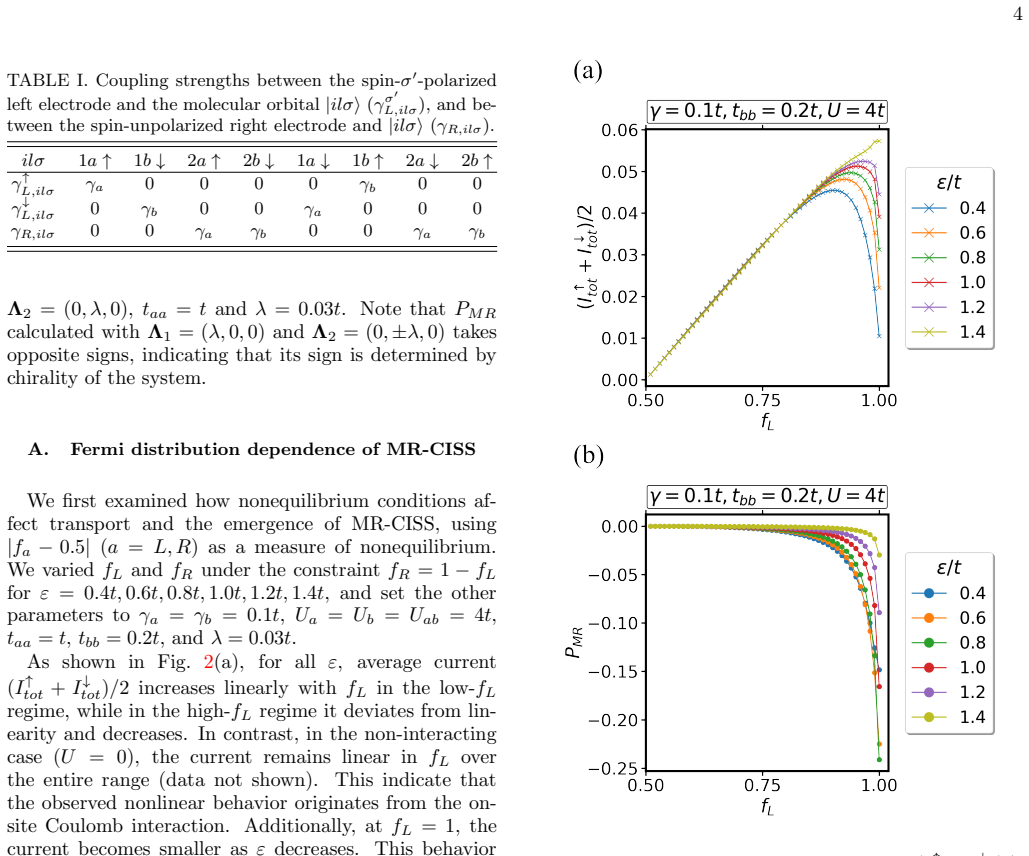
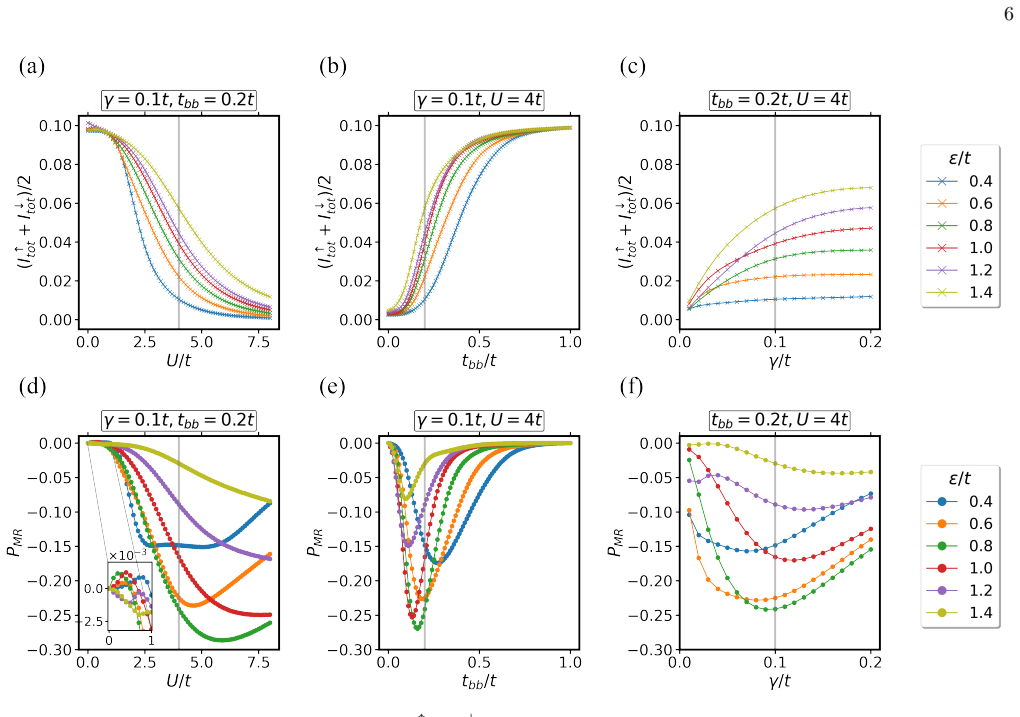
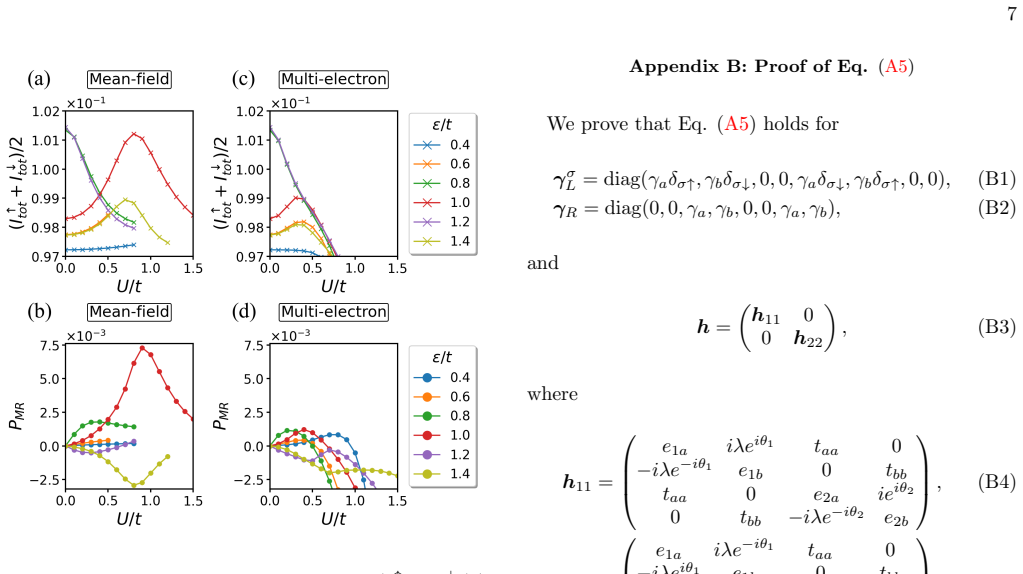
In multi-band chiral systems, inter-band spin-orbit coupling drives magnetoresistance-CISS, and simulations using the Gorini-Kossakowski-Sudarshan-Lindblad master equation show that spin polarization exceeding 25% is achievable for realistic coupling strengths when on-site Coulomb interactions are included.
What carries the argument
The Gorini-Kossakowski-Sudarshan-Lindblad master equation applied to multi-band chiral models that incorporate inter-band spin-orbit coupling, used to compute nonequilibrium steady-state currents and resulting spin polarization.
If this is right
- Magnetoresistance-CISS can produce spin polarization over 25% under conditions matching typical experimental strengths.
- Inter-band spin-orbit coupling is required for quantitative accounts of CISS in multi-band systems.
- On-site Coulomb interactions enhance the spin selectivity when inter-band coupling is present.
- Single-band models miss essential contributions to spin polarization in real chiral materials.
Where Pith is reading between the lines
- Material engineering efforts may benefit from targeting stronger inter-band coupling rather than only molecular chirality.
- The result suggests that transport theories for CISS should routinely include multiple bands to avoid underestimating polarization.
- The same simulation framework could be applied to temperature or disorder dependence to generate further testable predictions.
Load-bearing premise
The Gorini-Kossakowski-Sudarshan-Lindblad master equation accurately models the nonequilibrium steady-state current in these multi-band chiral systems.
What would settle it
An experiment on a chiral molecule or nanostructure with measured realistic inter-band spin-orbit coupling and on-site interactions that finds spin polarization well below 25% would falsify the claim.
Figures

read the original abstract
Chiral-induced spin selectivity (CISS), in which electrons transmitted through nonmagnetic chiral materials exhibit strong spin-dependent transport, has attracted growing interest for spintronic applications. However, a quantitative understanding of CISS remains elusive, partly because most previous studies rely on single-band models. In this work, we theoretically investigate multi-band effects on magnetoresistance (MR)-CISS, which is typically observed in experiments using magnetic conductive atomic force microscopy. To evaluate the spin polarization in MR-CISS, we simulate the nonequilibrium steady-state current using the Gorini-Kossakowski-Sudarshan-Lindblad master equation. We find that spin polarization exceeding 25% can be achieved for realistic inter-band spin-orbit coupling strengths in the presence of on-site Coulomb interactions. These findings highlight the crucial role of inter-band spin-orbit coupling in the mechanism of CISS.
Editorial analysis
A structured set of objections, weighed in public.
Referee Report
Summary. The manuscript investigates multi-band effects in chiral-induced spin selectivity (CISS) and magnetoresistance, extending beyond single-band models by including inter-band spin-orbit coupling and on-site Coulomb interactions. It computes nonequilibrium steady-state currents via the Gorini-Kossakowski-Sudarshan-Lindblad (GKSL) master equation and reports that spin polarization exceeding 25% is achievable for realistic inter-band SOC strengths.
Significance. If the numerical findings are robust, the work would demonstrate that inter-band SOC plays a key role in generating observable CISS effects when combined with electron-electron interactions, providing a more realistic multi-band framework than prior single-band treatments and potentially aligning better with magnetic AFM experiments.
major comments (2)
- [Method] Method section (GKSL implementation): The manuscript applies the GKSL master equation directly to the multi-band chiral Hamiltonian with inter-band SOC and on-site Coulomb terms but supplies no explicit derivation of the jump operators, no verification that the weak system-bath coupling and Markovian bath assumptions remain valid under these interactions, and no comparison to non-Markovian or alternative transport formalisms. This is load-bearing for the central quantitative claim of >25% polarization.
- [Results] Results (spin-polarization curves): The reported spin polarization >25% is obtained exclusively from GKSL numerics for chosen values of inter-band SOC and Coulomb strength; the manuscript does not demonstrate that this threshold survives changes in the bath spectral density or inclusion of coherent inter-band channels that could invalidate the Lindblad form.
minor comments (2)
- [Model] Notation for the inter-band SOC term is introduced without an explicit matrix form or comparison to the single-band limit, making it difficult to isolate its contribution.
- [Figures] Figure captions for the polarization vs. SOC strength plots should include the exact parameter values used for the 'realistic' regime and the single-band reference case.
Simulated Author's Rebuttal
We thank the referee for the careful reading and constructive comments. We address the major points below and will revise the manuscript to incorporate additional details and checks where appropriate.
read point-by-point responses
-
Referee: [Method] Method section (GKSL implementation): The manuscript applies the GKSL master equation directly to the multi-band chiral Hamiltonian with inter-band SOC and on-site Coulomb terms but supplies no explicit derivation of the jump operators, no verification that the weak system-bath coupling and Markovian bath assumptions remain valid under these interactions, and no comparison to non-Markovian or alternative transport formalisms. This is load-bearing for the central quantitative claim of >25% polarization.
Authors: We agree that the manuscript would benefit from greater methodological transparency. In the revised version we will add an appendix deriving the jump operators from the underlying system-bath interaction Hamiltonian via the standard Born-Markov procedure. We will also insert a short discussion justifying the weak-coupling and Markovian regime for the chosen parameters (bath coupling strength kept well below the inter-band SOC and Coulomb energy scales) and will briefly contrast the GKSL approach with the non-equilibrium Green’s-function method in the discussion section. revision: yes
-
Referee: [Results] Results (spin-polarization curves): The reported spin polarization >25% is obtained exclusively from GKSL numerics for chosen values of inter-band SOC and Coulomb strength; the manuscript does not demonstrate that this threshold survives changes in the bath spectral density or inclusion of coherent inter-band channels that could invalidate the Lindblad form.
Authors: The >25 % polarization is obtained within the present GKSL framework. To address robustness we will add supplementary figures showing the spin polarization for several bath spectral densities (Ohmic and sub-Ohmic forms with varied cutoff frequencies). We will also clarify that inter-band SOC is retained as a coherent term inside the system Hamiltonian while the bath generates the dissipative channels; a short paragraph will be added explaining why the Lindblad form remains applicable and confirming that the polarization threshold is stable under moderate changes in the bath parameters. revision: yes
Circularity Check
No circularity detected; result is output of numerical simulation
full rationale
The paper obtains its central quantitative claim (spin polarization exceeding 25%) exclusively from numerical solution of the nonequilibrium steady-state current via the GKSL master equation applied to a multi-band model that includes inter-band SOC and on-site Coulomb interactions. No equations, parameters, or steps are shown that reduce this output to a fitted input, self-definition, or self-citation chain by construction. The GKSL method is invoked as an external computational tool whose validity is an assumption (not a derived result), and the reported polarization is presented as an emergent model prediction rather than a renaming or tautological restatement of the inputs. The derivation chain is therefore self-contained against external benchmarks.
Axiom & Free-Parameter Ledger
free parameters (2)
- inter-band spin-orbit coupling strength
- on-site Coulomb interaction strength
axioms (1)
- domain assumption The Gorini-Kossakowski-Sudarshan-Lindblad master equation governs the nonequilibrium steady-state current in the multi-band chiral system.
Reference graph
Works this paper leans on
-
[1]
Gorini, Vittorio and Kossakowski, Andrzej and Sudarshan, E. C. G. , title =. Journal of Mathematical Physics , volume =. 1976 , month =. doi:10.1063/1.522979 , url =
-
[2]
Lindblad , title =
G. Lindblad , title =. Communications in Mathematical Physics , number =
-
[3]
Electronic Transport in Mesoscopic Systems , publisher=
Datta, Supriyo , year=. Electronic Transport in Mesoscopic Systems , publisher=
-
[4]
Jin, Tony and Filippone, Michele and Giamarchi, Thierry , journal =. 2020 , month =. doi:10.1103/PhysRevB.102.205131 , url =
-
[5]
Renormalized Lindblad driving: A numerically exact nonequilibrium quantum impurity solver , author =. Phys. Rev. Res. , volume =. 2020 , month =. doi:10.1103/PhysRevResearch.2.043052 , url =
-
[6]
Entropy , VOLUME =
Moldoveanu, Valeriu and Manolescu, Andrei and Gudmundsson, Vidar , TITLE =. Entropy , VOLUME =. 2019 , NUMBER =
2019
-
[7]
and Bittl, Robert and Santini, Paolo and Carretta, Stefano , title =
Chiesa, Alessandro and Garlatti, Elena and Mezzadri, Matteo and Celada, Leonardo and Sessoli, Roberta and Wasielewski, Michael R. and Bittl, Robert and Santini, Paolo and Carretta, Stefano , title =. Nano Letters , volume =. 2024 , doi =
2024
-
[8]
and Díaz, E
Gutierrez, R. and Díaz, E. and Gaul, C. and Brumme, T. and Domínguez-Adame, F. and Cuniberti, G. , title =. The Journal of Physical Chemistry C , volume =. 2013 , doi =
2013
-
[9]
The Journal of Physical Chemistry C , volume =
Geyer, Matthias and Gutierrez, Rafael and Mujica, Vladimiro and Cuniberti, Gianaurelio , title =. The Journal of Physical Chemistry C , volume =. 2019 , doi =
2019
-
[10]
The Journal of Physical Chemistry C , volume =
Huisman, Karssien Hero and Heinisch, Jan-Brian Mi-Yu and Thijssen, Joseph Marie , title =. The Journal of Physical Chemistry C , volume =. 2023 , doi =
2023
-
[11]
Kiran, Vankayala and Cohen, Sidney R. and Naaman, Ron , title =. The Journal of Chemical Physics , volume =. 2017 , month =. doi:10.1063/1.4966237 , url =
-
[12]
, title =
Suda, Masayuki and Thathong, Yuranan and Promarak, Vinich and Kojima, Hirotaka and Nakamura, Masakazu and Shiraogawa, Takafumi and Ehara, Masahiro and Yamamoto, Hiroshi M. , title =. Nature Communications , volume =. 2019 , doi =
2019
-
[13]
Mishra, Suryakant and Mondal, Amit Kumar and Pal, Shubhadeep and Das, Tapan Kumar and Smolinsky, Eilam Z. B. and Siligardi, Giuliano and Naaman, Ron , title =. The Journal of Physical Chemistry C , volume =. 2020 , doi =
2020
-
[14]
and Ślęczkowski, Marcin L
Mondal, Amit Kumar and Preuss, Marco D. and Ślęczkowski, Marcin L. and Das, Tapan Kumar and Vantomme, Ghislaine and Meijer, E. W. and Naaman, Ron , title =. Journal of the American Chemical Society , volume =. 2021 , doi =
2021
-
[15]
Nature Nanotechnology , volume =
Saito, Takuho and Inoue, Daisuke and Kitamoto, Yuichi and Hanayama, Hiroki and Fujita, Takatoshi and Watanabe, Yuki and Suda, Masayuki and Hirose, Takashi and Kajitani, Takashi and Yagai, Shiki , title =. Nature Nanotechnology , volume =. 2025 , doi =
2025
-
[16]
and Lingenfelder, Magalí and Naaman, Ron and Sun, Dali and Waldeck, David H
Bloom, Brian P. and Lingenfelder, Magalí and Naaman, Ron and Sun, Dali and Waldeck, David H. , title =. Nature Reviews Materials , volume =. 2026 , doi =
2026
-
[17]
Newton , volume =. 2025 , issn =. doi:https://doi.org/10.1016/j.newton.2025.100013 , url =
-
[18]
Scientific Reports , volume =. 2025 , issn =. doi:10.1038/s41598-025-04413-6 , url =
-
[19]
ACS Nano , volume =
Wolf, Yotam and Liu, Yizhou and Xiao, Jiewen and Park, Noejung and Yan, Binghai , title =. ACS Nano , volume =. 2022 , doi =
2022
-
[20]
2022 , month =
Fransson, Jonas , journal =. 2022 , month =
2022
-
[21]
Yang, See-Hun and Naaman, Ron and Paltiel, Yossi and Parkin, Stuart S. P. , journal =. 2021 , month =. doi:10.1038/s42254-021-00302-9 , url =
-
[22]
Mishra, Suryakant and Jones, Andrew C. and Fontanesi, Claudio. Recent advancements in chiral spintronics: from molecular-level insights to device applications. A prospect based on the interplay between physical and chemical properties of chiral systems. J. Mater. Chem. C. 2025. doi:10.1039/D4TC03453H
-
[23]
Yang, Xu and van der Wal, Caspar H. and van Wees, Bart J. , journal =. 2019 , month =. doi:10.1103/PhysRevB.99.024418 , url =
-
[24]
Spin selectivity through time-reversal symmetric helical junctions , author =. Phys. Rev. B , volume =. 2020 , month =. doi:10.1103/PhysRevB.102.035445 , url =
-
[25]
Israel Journal of Chemistry , volume =
Utsumi, Yasuhiro and Kato, Takemitsu and Entin-Wohlman, Ora and Aharony, Amnon , title =. Israel Journal of Chemistry , volume =. doi:https://doi.org/10.1002/ijch.202200107 , url =
-
[26]
The Journal of Chemical Physics , volume =
Kato, Takemitsu and Utsumi, Yasuhiro and Entin-Wohlman, Ora and Aharony, Amnon , title =. The Journal of Chemical Physics , volume =. 2023 , month =. doi:10.1063/5.0160051 , url =
-
[27]
The European Physical Journal Special Topics , year =
Kato, Takemitsu and Utsumi, Yasuhiro and Entin-Wohlman, Ora and Aharony, Amnon , title =. The European Physical Journal Special Topics , year =
-
[28]
Fundamental limitations in Lindblad descriptions of systems weakly coupled to baths , author =. Phys. Rev. A , volume =. 2022 , month =. doi:10.1103/PhysRevA.105.032208 , url =
-
[29]
Proceedings of the National Academy of Sciences , volume =
Ai-Min Guo and Qing-Feng Sun , title =. Proceedings of the National Academy of Sciences , volume =. 2014 , doi =
2014
-
[30]
, title =
Fransson, J. , title =. The Journal of Physical Chemistry Letters , volume =. 2019 , doi =
2019
-
[31]
Spin-Selective Transport of Electrons in DNA Double Helix , author =. Phys. Rev. Lett. , volume =. 2012 , month =. doi:10.1103/PhysRevLett.108.218102 , url =
-
[32]
B. G\". Spin selectivity in electron transmission through self-assembled monolayers of double-stranded DNA. Science. 2011. doi:10.1126/science.1199339
-
[33]
and Paltiel, Yossi and Naaman, Ron and Waldeck, David H
Bloom, Brian P. and Paltiel, Yossi and Naaman, Ron and Waldeck, David H. , title =. Chemical Reviews , volume =. 2024 , doi =
2024
-
[34]
Nano Letters , volume =
Fransson, Jonas , title =. Nano Letters , volume =. 2021 , doi =
2021
-
[35]
and Sessoli, Roberta and Carretta, Stefano , title =
Chiesa, Alessandro and Privitera, Alberto and Macaluso, Emilio and Mannini, Matteo and Bittl, Robert and Naaman, Ron and Wasielewski, Michael R. and Sessoli, Roberta and Carretta, Stefano , title =. Advanced Materials , volume =. doi:https://doi.org/10.1002/adma.202300472 , url =
-
[36]
APL Computational Physics , volume =
Fransson, Jonas , title =. APL Computational Physics , volume =. 2025 , month =. doi:10.1063/5.0289548 , url =
-
[37]
Chae, Kyunghee and Mohamad, Nur Aqlili Riana Che and Kim, Jeonghyeon and Won, Dong-Il and Lin, Zhiqun and Kim, Jeongwon and Kim, Dong Ha , title=. Chem. Soc. Rev. , year=. doi:10.1039/D3CS00316G , url=
-
[38]
Highly Efficient and Tunable Filtering of Electrons' Spin by Supramolecular Chirality of Nanofiber-Based Materials , author =. Advanced Materials , pages =. 2020 , month =. doi:10.1002/adma.201904965 , volume=
-
[39]
The Journal of Physical Chemistry C , volume =
Das, Tapan Kumar and Tassinari, Francesco and Naaman, Ron and Fransson, Jonas , title =. The Journal of Physical Chemistry C , volume =. 2022 , doi =
2022
-
[40]
Journal of the American Chemical Society , volume =
Zhang, Dan-Yang and Sang, Yutao and Das, Tapan Kumar and Guan, Zhao and Zhong, Ni and Duan, Chun-Gang and Wang, Wei and Fransson, Jonas and Naaman, Ron and Yang, Hai-Bo , title =. Journal of the American Chemical Society , volume =. 2023 , doi =
2023
-
[41]
Dynamical theory of chiral-induced spin selectivity in electron donor--chiral molecule--acceptor systems , author =. Phys. Rev. B , volume =. 2025 , month =. doi:10.1103/PhysRevB.111.205417 , url =
-
[42]
Fransson, J. , journal =. 2020 , month =. doi:10.1103/PhysRevB.102.235416 , url =
-
[43]
Journal of the American Chemical Society , volume =
Rodríguez, Rafael and Naranjo, Cristina and Kumar, Anil and Matozzo, Paola and Das, Tapan Kumar and Zhu, Qirong and Vanthuyne, Nicolas and Gómez, Rafael and Naaman, Ron and Sánchez, Luis and Crassous, Jeanne , title =. Journal of the American Chemical Society , volume =. 2022 , doi =
2022
-
[44]
and Majumder, Subrata and Ruiz-Carretero, Amparo , title =
Hong, Kyeong-Im and Kumar, Abhinandan and Garcia, Ana M. and Majumder, Subrata and Ruiz-Carretero, Amparo , title =. The Journal of Chemical Physics , volume =. 2023 , month =. doi:10.1063/5.0164825 , url =
-
[45]
Ray and S
K. Ray and S. P. Ananthavel and D. H. Waldeck and R. Naaman , title =. Science , volume =. 1999 , doi =
1999
-
[46]
Sturdy spin-momentum locking in a chiral organic superconductor , author =. Phys. Rev. Res. , volume =. 2025 , month =. doi:10.1103/PhysRevResearch.7.023056 , url =
-
[47]
and Copley, Graeme and Young, Ryan M
Eckvahl, Hannah J. and Copley, Graeme and Young, Ryan M. and Krzyaniak, Matthew D. and Wasielewski, Michael R. , title =. Journal of the American Chemical Society , volume =. 2024 , doi =
2024
-
[48]
Eckvahl and Nikolai A
Hannah J. Eckvahl and Nikolai A. Tcyrulnikov and Alessandro Chiesa and Jillian M. Bradley and Ryan M. Young and Stefano Carretta and Matthew D. Krzyaniak and Michael R. Wasielewski , title =. Science , volume =. 2023 , doi =
2023
-
[49]
Latawiec and Alessandro Chiesa and Yunfan Qiu and Nikolai A
Elisabeth I. Latawiec and Alessandro Chiesa and Yunfan Qiu and Nikolai A. Tcyrulnikov and Ryan M. Young and Stefano Carretta and Matthew D. Krzyaniak and Michael R. Wasielewski , title =. Proceedings of the National Academy of Sciences , volume =. 2025 , doi =
2025
-
[50]
, title =
Seibel, Christopher and Soh, Jia Hao and Zilberg, Shmuel and Krylov, Anna I. , title =. The Journal of Physical Chemistry Letters , volume =. 2025 , doi =
2025
-
[51]
Xu, Meng and Chen, Yan , journal =. 2024 , month =. doi:10.1103/PhysRevB.110.235145 , url =
-
[52]
Göhler and V
B. Göhler and V. Hamelbeck and T. Z. Markus and M. Kettner and G. F. Hanne and Z. Vager and R. Naaman and H. Zacharias , title =. Science , volume =. 2011 , doi =
2011
-
[53]
and Mishra, Debabrata and Naaman, Ron , title =
Rosenberg, Richard A. and Mishra, Debabrata and Naaman, Ron , title =. Angewandte Chemie International Edition , volume =. doi:https://doi.org/10.1002/anie.201501678 , year =
-
[54]
2018 , doi =
Chirality-Dependent Electron Spin Filtering by Molecular Monolayers of Helicenes , journal =. 2018 , doi =
2018
-
[55]
Ghosh, K. B. and Zhang, Wenyan and Tassinari, F. and Mastai, Y. and Lidor-Shalev, O. and Naaman, R. and M. The Journal of Physical Chemistry C , volume =. 2019 , doi =
2019
-
[56]
Spin-Polarized Photoemission from Chiral CuO Catalyst Thin Films , journal =
M. Spin-Polarized Photoemission from Chiral CuO Catalyst Thin Films , journal =. 2022 , doi =
2022
-
[57]
doi:10.20944/preprints202603.2520.v1 , url =
Alberta Carella and Francesco Rossella and Claudio Fontanesi , title =. doi:10.20944/preprints202603.2520.v1 , url =
-
[58]
Bloom and Anna R
Brian P. Bloom and Anna R. Waldeck and David H. Waldeck , title =. Proceedings of the National Academy of Sciences , volume =. 2022 , doi =
2022
-
[59]
Theories of Chiral-Induced Spin Selectivity: A Pedagogical Overview
Nuomin, Hanggai and Charyshnikova, Zinaida and Song, Feng-Feng and Sun, Rui and Nabei, Yoji and Singh, Niven and Terai, Kiriko and Zhang, Peng and Sun, Dali and Beratan, David N. Theories of Chiral-Induced Spin Selectivity: A Pedagogical Overview. Annual Review of Physical Chemistry. 2026. doi:https://doi.org/10.1146/annurev-physchem-083122-125320
-
[60]
Koyel Banerjee-Ghosh and Oren Ben Dor and Francesco Tassinari and Eyal Capua and Shira Yochelis and Amir Capua and See-Hun Yang and Stuart S. P. Parkin and Soumyajit Sarkar and Leeor Kronik and Lech Tomasz Baczewski and Ron Naaman and Yossi Paltiel , title =. Science , volume =. 2018 , doi =
2018
-
[61]
2026 , eprint=
Connection between the GKSL master equation and the Landauer formula , author=. 2026 , eprint=
2026
discussion (0)
Sign in with ORCID, Apple, or X to comment. Anyone can read and Pith papers without signing in.