Causality and the Equivalence Principle for Higher Energy Scattering
Pith reviewed 2026-06-26 02:45 UTC · model grok-4.3
The pith
Non-singlet Regge trajectories with δ below 1/2 produce growing sign-indefinite time-delays in colored scattering, violating causality.
A machine-rendered reading of the paper's core claim, the machinery that carries it, and where it could break.
Core claim
In the Regge limit of colored scattering, parameterizing a trajectory by s^{α(t)} with α(0)=2−δ, any non-singlet trajectory with δ<1/2 produces a growing sign-indefinite time-delay (with δ=1/2 a marginal, dimension-dependent case), which becomes dominant in the Regge diffusion region in the weak-gravity regime. The essential point is that, while the eikonal phase is naturally organized in t-channel irreducible representations, the physical time-delays are its eigenvalues in the s-channel. A non-singlet exchange therefore recouples into the physical channels with both signs, inevitably producing a negative time-delay in at least one channel.
What carries the argument
The mismatch between t-channel irreducible representations organizing the eikonal phase and s-channel eigenvalues giving physical time-delays, forcing non-singlet exchanges to recouple with both signs.
If this is right
- Causality rules out non-singlet trajectories with δ below 1/2.
- The bound δ equals 1/2 is the marginal case whose sign-indefiniteness depends on spacetime dimension.
- In the weak-gravity regime the non-singlet contribution dominates the Regge diffusion region.
- Any universal high-energy behavior independent of charge must respect this stricter bound for colored exchanges.
Where Pith is reading between the lines
- Singlet trajectories face weaker constraints and could remain viable at smaller δ.
- The same recoupling logic may limit other conserved quantum numbers beyond color in high-energy amplitudes.
- This bound could restrict possible string or gravitational UV completions that attempt to make high-energy scattering charge-independent.
Load-bearing premise
Physical time-delays are the eigenvalues of the eikonal phase matrix in the s-channel basis, while the phase itself is naturally organized in t-channel irreducible representations.
What would settle it
An explicit computation of the eikonal phase eigenvalues for a non-singlet trajectory with δ less than 1/2 that yields only non-negative time-delays in every s-channel physical basis would falsify the claim.
Figures

read the original abstract
Recently, it was proposed that the leading high-energy behavior of scattering amplitudes is universal, independent of charge, thereby extending the equivalence principle beyond the graviton pole. In this Letter, we derive a sharper causality constraint on such behavior by studying the Regge limit of colored scattering. Parameterizing a trajectory by $s^{\alpha(t)}$ with $\alpha(0)=2-\delta$, we analyze the Shapiro/Wigner--Smith time-delays in the irreducible scattering channels. We show that any non-singlet trajectory with $\delta< 1/2$ produces a growing sign-indefinite time-delay (with $\delta=1/2$ a marginal, dimension-dependent case), which becomes dominant in the Regge diffusion region in the weak-gravity regime. The essential point is that, while the eikonal phase is naturally organized in $t$-channel irreducible representations, the physical time-delays are its eigenvalues in the $s$-channel. A non-singlet exchange therefore recouples into the physical channels with both signs, inevitably producing a negative time-delay in at least one channel.
Editorial analysis
A structured set of objections, weighed in public.
Referee Report
Summary. The paper claims that in the Regge limit of colored scattering, a non-singlet trajectory parameterized as s^{\alpha(t)} with \alpha(0)=2-\delta produces growing sign-indefinite Shapiro/Wigner-Smith time delays in s-channel physical states whenever \delta<1/2 (with \delta=1/2 marginal and dimension-dependent). This follows from the eikonal phase being diagonal in t-channel irreps while physical time delays are its eigenvalues after recoupling to the s-channel basis; the resulting negative eigenvalue dominates in the Regge diffusion region in the weak-gravity limit and thereby supplies a causality obstruction to charge-independent universality of high-energy behavior.
Significance. If the central derivation is correct, the result supplies a concrete, representation-theoretic obstruction to extending the equivalence principle to colored high-energy scattering. It leverages standard Regge and eikonal tools to obtain a falsifiable sign-indefiniteness statement that is independent of any fitted parameters inside the paper.
major comments (1)
- The manuscript states that the eikonal phase matrix is naturally organized in t-channel irreps while time delays are its s-channel eigenvalues, leading to both signs for non-singlet exchange. An explicit diagonalization (or at least the characteristic equation) for a concrete low-dimensional representation (e.g., fundamental or adjoint of SU(2) or SU(3)) should be displayed to confirm that one eigenvalue is negative and grows for \delta<1/2; without this the sign-indefiniteness claim remains at the level of the abstract.
minor comments (2)
- The Regge diffusion region is invoked as the regime where the effect dominates; a brief definition or reference to its kinematic boundaries would aid readability.
- Notation for the trajectory intercept (\alpha(0)=2-\delta) and the time-delay operator should be introduced once in the main text with a short reminder of the Wigner-Smith definition used.
Simulated Author's Rebuttal
We thank the referee for their careful reading of the manuscript and for the constructive suggestion. We address the major comment below.
read point-by-point responses
-
Referee: The manuscript states that the eikonal phase matrix is naturally organized in t-channel irreps while time delays are its s-channel eigenvalues, leading to both signs for non-singlet exchange. An explicit diagonalization (or at least the characteristic equation) for a concrete low-dimensional representation (e.g., fundamental or adjoint of SU(2) or SU(3)) should be displayed to confirm that one eigenvalue is negative and grows for δ<1/2; without this the sign-indefiniteness claim remains at the level of the abstract.
Authors: We agree that an explicit low-dimensional example would make the sign-indefiniteness more concrete and improve the presentation. In the revised manuscript we will add a short subsection (or appendix) that performs the explicit diagonalization for the fundamental representation of SU(2). The t-channel irreps are the singlet (trivial phase) and the triplet; after recoupling to the s-channel basis via the appropriate Clebsch-Gordan coefficients we obtain a 2×2 phase matrix whose eigenvalues are +φ and −φ (up to normalization), with the negative eigenvalue growing as s^{1−δ} for δ<1/2. The characteristic equation and the resulting eigenvalues will be displayed explicitly, confirming that the negative time delay dominates in the Regge diffusion region. revision: yes
Circularity Check
No significant circularity
full rationale
The paper's central derivation proceeds from the standard decomposition of the eikonal phase into t-channel irreps, followed by diagonalization in the s-channel basis to extract time-delay eigenvalues. This change-of-basis is a linear-algebra identity independent of any fitted parameters or prior results internal to the paper. No equation reduces a claimed prediction to a quantity defined or fitted inside the manuscript itself, and the provided text contains no load-bearing self-citations that would render the sign-indefiniteness or Regge-diffusion dominance tautological. The argument therefore remains self-contained against external benchmarks of Regge theory and eikonal methods.
Axiom & Free-Parameter Ledger
axioms (2)
- domain assumption Analyticity, unitarity, and crossing symmetry of scattering amplitudes
- domain assumption Validity of the eikonal approximation in the Regge limit for colored amplitudes
Reference graph
Works this paper leans on
-
[1]
Infrared photons and gravitons,
S. Weinberg, “Infrared photons and gravitons,” Phys. Rev.140, B516–B524 (1965)
1965
-
[2]
TheEquivalencePrincipleatHighEnergies Completes the Spectrum,
F. Calisto, C. Cheung, G. N. Remmen, F. Sciotti, and M.Tarquini, “TheEquivalencePrincipleatHighEnergies Completes the Spectrum,” arXiv:2605.20319 [hep-th]
-
[3]
Fourth test of general relativity,
I. I. Shapiro, “Fourth test of general relativity,” Phys. Rev. Lett.13, 789–791 (1964)
1964
-
[4]
Causality constraints on corrections to the graviton three-point coupling,
X. O. Camanho, J. D. Edelstein, J. Maldacena, and A. Zhiboedov, “Causality constraints on corrections to the graviton three-point coupling,” JHEP02, 020 (2016), arXiv:1407.5597 [hep-th]
Pith/arXiv arXiv 2016
-
[5]
Causality in Curved Spacetimes: The Speed of Light and Gravity,
C. de Rham and A. J. Tolley, “Causality in Curved Spacetimes: The Speed of Light and Gravity,” Phys. Rev. D102, no.8, 084048 (2020), 6 doi:10.1103/PhysRevD.102.084048 [arXiv:2007.01847 [hep-th]]
-
[6]
A cautionary case of casual causality,
C. Y. R. Chen, C. de Rham, A. Margalit and A. J. Tolley, “A cautionary case of casual causality,” JHEP03, 025 (2022), doi:10.1007/JHEP03(2022)025[arXiv:2112.05031 [hep-th]]
-
[7]
P. D. B. Collins,An Introduction to Regge Theory and High Energy Physics(Cambridge University Press, Cam- bridge, 1977)
1977
-
[8]
Amati, M
D. Amati, M. Ciafaloni, and G. Veneziano, Superstring collisions at Planckian energies, Phys. Lett. B197, 81 (1987)
1987
-
[9]
K. Häring and A. Zhiboedov, Gravitational Regge bounds, SciPost Phys.16, 034 (2024), arXiv:2202.08280
arXiv 2024
-
[10]
S. Caron-Huot, D. Mazac, L. Rastelli and D. Simmons-Duffin, JHEP07, 110 (2021) doi:10.1007/JHEP07(2021)110
-
[11]
E. P. Wigner, Lower limit for the energy derivative of the scattering phase shift, Phys. Rev.98, 145 (1955)
1955
-
[12]
F. T. Smith, Lifetime matrix in collision theory, Phys. Rev.118, 349 (1960)
1960
-
[13]
On the time-delay of simple scattering systems,
P. A. Martin, “On the time-delay of simple scattering systems,” Commun. Math. Phys.47, 221–227 (1976), doi:10.1007/BF01609841
-
[14]
Cvitanovic,Group Theory: Birdtracks, Lie’s, and Ex- ceptional Groups, (Princeton University Press, 2020)
P. Cvitanovic,Group Theory: Birdtracks, Lie’s, and Ex- ceptional Groups, (Princeton University Press, 2020)
2020
-
[15]
D. J. Gross and J. A. Harvey and E. J. Martinec and R. Rohm, Heterotic string theory: (II). The interacting heterotic string, Nucl. Phys. B267, 75 (1986)
1986
-
[16]
Hillman and Y
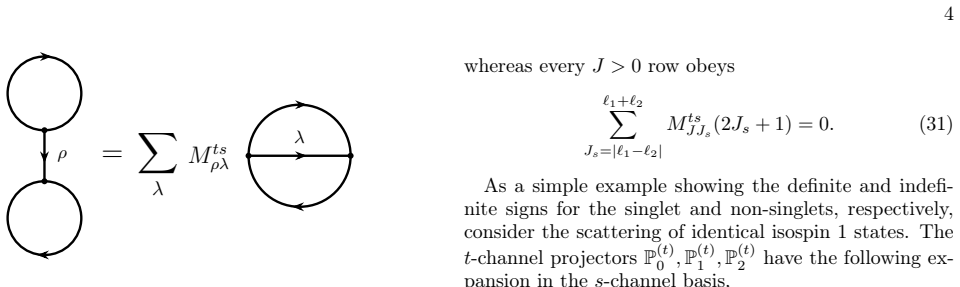
A. Hillman and Y. Huang and L. Rodina and J. Rum- butis, Spectral constraints on theories of colored particles and gravity, Phys. Rev. Lett.135, 6 (2025). Appendix A: Non-singlet rows have indefinite sign TheprojectionoperatorsP (s) λ andP (t) ρ , representeddia- grammatically in Fig. 1 are generally built from Clebsch– Gordan coefficientsC λν ρ :V λ ⊗V ν...
2025
discussion (0)
Sign in with ORCID, Apple, or X to comment. Anyone can read and Pith papers without signing in.