Prospects for probing neutral vector-like leptons via pair production at muon collider
Pith reviewed 2026-06-29 04:05 UTC · model grok-4.3
The pith
A future 6 TeV muon collider can detect neutral doublet vector-like leptons with over 5 sigma significance across a wide mass range through specific decay signals.
A machine-rendered reading of the paper's core claim, the machinery that carries it, and where it could break.
Core claim
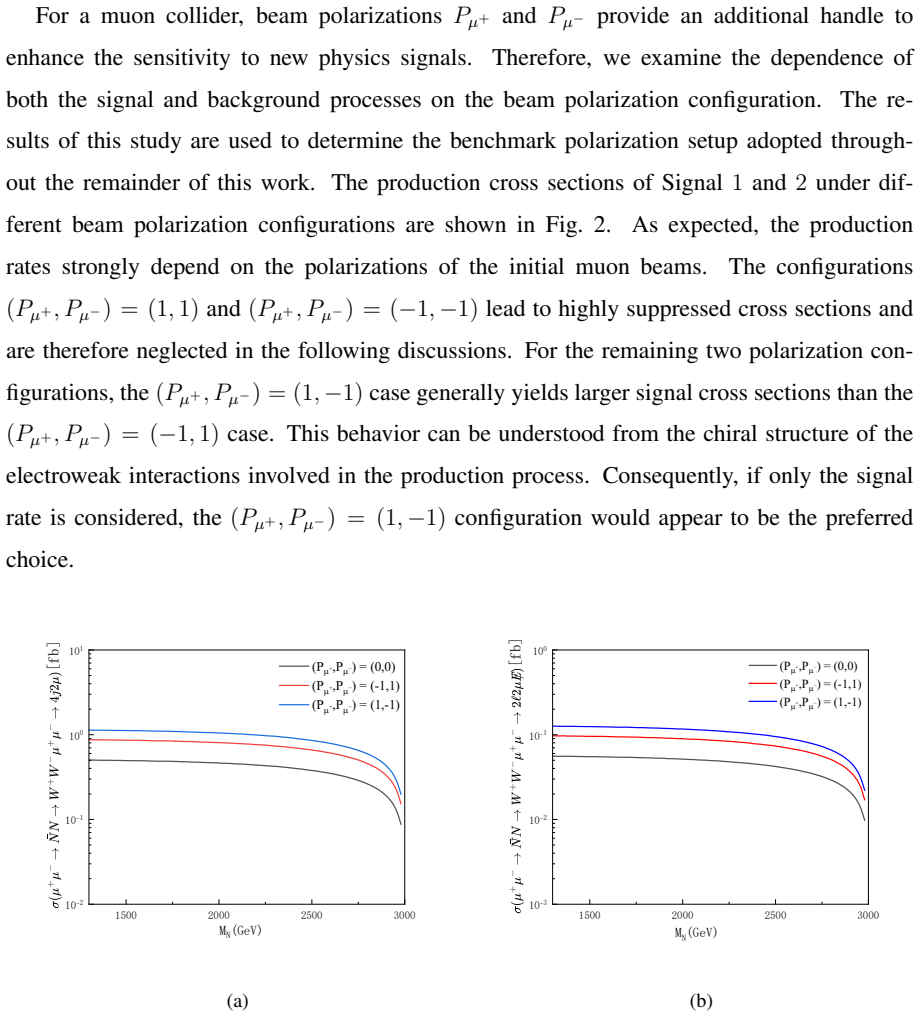
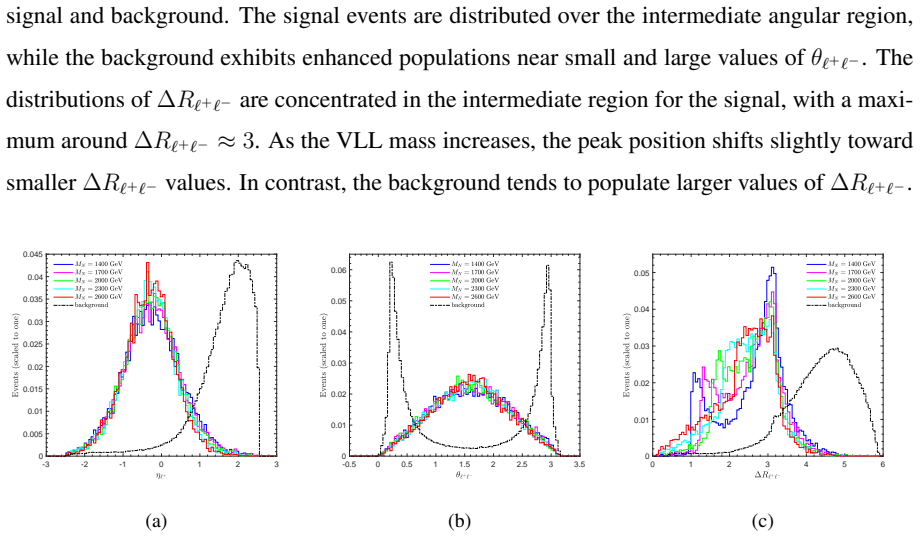
Within a general vector-like lepton framework, the neutral doublet VLL denoted N can be probed at the 6 TeV muon collider through its pair production followed by the decay N to W+ mu, yielding the 4j2mu and 2l2mu missing-ET final states. With 4 ab inverse integrated luminosity and beam polarizations of minus one and plus one, the cut-based analysis finds statistical significances exceeding 5 sigma over the mass range 1300 to 3000 GeV.
What carries the argument
Neutral doublet vector-like lepton N, produced in pairs at the muon collider and decaying via N to W+ mu, with the two representative final states 4j2mu and 2l2mu missing-ET after W decays.
If this is right
- The 6 TeV muon collider would exclude or discover neutral doublet VLLs up to 3000 GeV in the chosen channels.
- Both hadronic and leptonic W decay modes contribute to the overall search reach.
- Beam polarization at (minus 1, plus 1) enhances the signal significance relative to unpolarized running.
- The results apply within the general VLL framework with the assumed branching ratios.
Where Pith is reading between the lines
- Similar reach might be expected for other vector-like lepton representations if their production cross sections and decay patterns are comparable.
- Extending the mass range above 3000 GeV would require either higher collider energy or larger integrated luminosity to maintain 5 sigma sensitivity.
- If backgrounds are underestimated in the Monte Carlo, the actual mass reach would shrink.
Load-bearing premise
The analysis assumes that Standard Model backgrounds are accurately modeled by the chosen Monte Carlo generators and that no additional new physics alters the signal or background rates.
What would settle it
If the observed event yields in the 4j2mu or 2l2mu missing-ET channels at 6 TeV with 4 ab inverse luminosity fall below the predicted 5 sigma excess for a given VLL mass in 1300-3000 GeV, the sensitivity claim is falsified.
Figures



read the original abstract
Vector-like leptons (VLLs) are well-motivated candidates for physics beyond the Standard Model. We investigate the sensitivity of the $6$ TeV muon collider to the neutral doublet VLL (denoted as $N$) via its pair production within a general VLL framework. Taking vector-like muon as a case study, we study the subsequent decay $N\rightarrow W^+ \mu$ and analyze two representative signals, namely $4j2\mu$ and $2\ell2\mu E\mkern-10.5 mu/$, arising from the hadronic and leptonic decays of the $W$ boson, respectively. The signal and background events are simulated within a complete Monte Carlo framework, and a cut-based analysis is performed at the $6$ TeV muon collider with an integrated luminosity $\mathcal{L}=4$ ab$^{-1}$ and beam polarizations $(P_{\mu^+},P_{\mu^-})=(-1,1)$. We consider VLL masses in the range of $1300-3000$ GeV and evaluate the corresponding search sensitivity. Our results show that the future $6$ TeV muon collider can effectively probe neutral doublet VLLs through the $4j2\mu$ and $2\ell2\mu E\mkern-10.5 mu/$ signals, with statistical significances exceeding $5\sigma$ over a broad mass range. These results demonstrate that the future $6$ TeV muon collider has excellent potential to search neutral doublet VLLs.
Editorial analysis
A structured set of objections, weighed in public.
Referee Report
Summary. The manuscript presents a Monte Carlo-based cut-and-count study of pair production of neutral doublet vector-like leptons (VLLs) at a proposed 6 TeV muon collider. Focusing on the vector-like muon case, it simulates the decays N → Wμ leading to the 4j2μ and 2ℓ2μ + E_T^miss final states, applies a set of kinematic cuts, and reports statistical significances exceeding 5σ for VLL masses 1300–3000 GeV at 4 ab^{-1} with beam polarizations (P_μ+, P_μ−) = (−1, 1).
Significance. If the background modeling proves robust, the projections would establish that a future muon collider can access a broad, currently unconstrained mass window for neutral VLLs. The work supplies concrete benchmark points and channel definitions that could guide detector design studies.
major comments (2)
- [Results and cut-based analysis (likely §4–5)] The significance values quoted in the results (presumably §5 and associated tables) are computed directly from raw simulated signal and background yields after cuts, with no systematic uncertainty assigned to the background normalization, jet-energy scale, or higher-order QCD corrections. A 10–20 % background uncertainty, typical for multi-jet + lepton final states at multi-TeV energies, would rescale the background yield and reduce several of the reported significances below 5σ.
- [Signal modeling and decay assumptions (likely §3)] The analysis fixes the N → Wμ branching ratio from the general VLL framework and assumes no additional decay modes or interference effects. Any deviation in the branching fraction or the presence of other new-physics contributions would alter the signal efficiency used in the same significance calculation, directly affecting the claimed mass reach.
minor comments (2)
- [Abstract] The abstract contains a typesetting artifact in the missing-transverse-energy symbol (E\mkern-10.5 mu/).
- [Simulation framework (likely §2)] The manuscript would benefit from an explicit statement of the Monte Carlo generator versions, parton-shower settings, and any validation against known SM processes at similar energies.
Simulated Author's Rebuttal
We thank the referee for the detailed and constructive report. The comments highlight important aspects of the analysis that we address below. We have revised the manuscript to incorporate additional discussion on systematic uncertainties and to clarify the model assumptions.
read point-by-point responses
-
Referee: The significance values quoted in the results (presumably §5 and associated tables) are computed directly from raw simulated signal and background yields after cuts, with no systematic uncertainty assigned to the background normalization, jet-energy scale, or higher-order QCD corrections. A 10–20 % background uncertainty, typical for multi-jet + lepton final states at multi-TeV energies, would rescale the background yield and reduce several of the reported significances below 5σ.
Authors: We agree that systematic uncertainties were not included in the quoted significances. Our study is a cut-and-count Monte Carlo projection focused on statistical reach, which is standard for initial collider prospect papers. However, to address this point we will add a dedicated subsection in the revised manuscript estimating a conservative 15% systematic uncertainty on the background yields (covering normalization, jet scale, and QCD effects). We will recompute and tabulate the significances under this assumption, showing that the 5σ reach is reduced but remains viable up to approximately 2.5 TeV in the 4j2μ channel. This provides a more realistic projection without altering the core simulation framework. revision: yes
-
Referee: The analysis fixes the N → Wμ branching ratio from the general VLL framework and assumes no additional decay modes or interference effects. Any deviation in the branching fraction or the presence of other new-physics contributions would alter the signal efficiency used in the same significance calculation, directly affecting the claimed mass reach.
Authors: The analysis is performed strictly within the general vector-like lepton framework outlined in Section 2, where the branching ratio BR(N → Wμ) is determined by the model parameters (mixing angles and Yukawa couplings) and is fixed to the value used in the simulation. We explicitly assume this is the dominant decay mode with no additional beyond-Standard-Model contributions or interference. The results are therefore benchmark-specific to this setup. We will expand the text in Section 3 to state this assumption more explicitly and note that deviations would require a separate study. No change to the numerical results is needed, as they correspond to the stated framework. revision: partial
Circularity Check
No circularity: standard MC simulation projections with external tools
full rationale
The paper performs a cut-based analysis on Monte Carlo-simulated signal and background events for VLL pair production and decays at a 6 TeV muon collider. No equations, parameters, or central claims reduce by construction to quantities defined or fitted within the paper itself. Background modeling and branching ratios are taken from external generators and the general VLL framework; significances are computed directly from simulated yields. This is a forward projection study with no self-definitional steps, fitted-input predictions, or load-bearing self-citations.
Axiom & Free-Parameter Ledger
free parameters (2)
- VLL mass
- Integrated luminosity
axioms (2)
- domain assumption Standard Model backgrounds can be accurately modeled by Monte Carlo generators without significant missing higher-order effects or detector mis-modeling.
- domain assumption The neutral doublet VLL decays exclusively via N → W μ with branching ratios taken from the general VLL framework.
Reference graph
Works this paper leans on
-
[1]
VLCjetR05N2
(10) In the doublet VLL model, bothEandNare present. However, since this work focuses on the production of the neutralN, we only present the expressions of its decay widths in the following. Γ(N→W +µ) = MN 32π (1−r W )2(2 + 1/rW )|gW + ¯µ† ¯N |2, (11) Γ(N→Zν) = Γ(N→hν) = 0, (12) 6 wherer X =M 2 X/M2 N withX=W, Z, h. As can be seen from the decay width for...
2000
-
[2]
Salam, Conf
A. Salam, Conf. Proc. C680519, 367 (1968)
1968
-
[3]
Weinberg, Phys
S. Weinberg, Phys. Rev. Lett.19, 1264 (1967)
1967
-
[4]
S. L. Glashow, Nucl. Phys.22, 579 (1961)
1961
-
[5]
J. L. Feng, Ann. Rev. Nucl. Part. Sci.63, 351 (2013), 1302.6587
Pith/arXiv arXiv 2013
-
[6]
L. D. Duffy and K. van Bibber, New J. Phys.11, 105008 (2009), 0904.3346
Pith/arXiv arXiv 2009
-
[7]
F. Chadha-Day, J. Ellis, and D. J. E. Marsh, Sci. Adv.8, abj3618 (2022), 2105.01406
arXiv 2022
-
[8]
M. C. Gonzalez-Garcia and M. Maltoni, Phys. Rept.460, 1 (2008), 0704.1800
Pith/arXiv arXiv 2008
- [9]
- [10]
-
[11]
R. Dermisek, K. Hermanek, and N. McGinnis, Phys. Rev. D104, 055033 (2021), 2103.05645
arXiv 2021
- [12]
- [13]
- [14]
- [15]
-
[16]
B. Belfatto, R. Beradze, and Z. Berezhiani, Eur. Phys. J. C80, 149 (2020), 1906.02714
arXiv 2020
- [17]
-
[18]
A. Crivellin, F. Kirk, C. A. Manzari, and M. Montull, JHEP12, 166 (2020), 2008.01113
arXiv 2020
- [19]
-
[20]
S. P. Martin, Phys. Rev. D81, 035004 (2010), 0910.2732
Pith/arXiv arXiv 2010
- [21]
-
[22]
K. Kong, S. C. Park, and T. G. Rizzo, JHEP07, 059 (2010), 1004.4635. 17
Pith/arXiv arXiv 2010
-
[23]
M. Endo, K. Hamaguchi, S. Iwamoto, and N. Yokozaki, Phys. Rev. D84, 075017 (2011), 1108.3071
Pith/arXiv arXiv 2011
-
[24]
J. Y . Araz, S. Banerjee, M. Frank, B. Fuks, and A. Goudelis, Phys. Rev. D98, 115009 (2018), 1810.07224
Pith/arXiv arXiv 2018
-
[25]
C. Anastasiou, E. Furlan, and J. Santiago, Phys. Rev. D79, 075003 (2009), 0901.2117
Pith/arXiv arXiv 2009
-
[26]
M. Gillioz, R. Grober, C. Grojean, M. Muhlleitner, and E. Salvioni, JHEP10, 004 (2012), 1206.7120
Pith/arXiv arXiv 2012
-
[27]
K. Agashe, G. Perez, and A. Soni, Phys. Rev. D75, 015002 (2007), hep-ph/0606293
Pith/arXiv arXiv 2007
- [28]
-
[29]
W.-Y . Tsai, L. L. Deraad, and K. A. Milton, Phys. Rev. D6, 1428 (1972), [Erratum: Phys.Rev.D 11, 703–703 (1975)]
1972
-
[30]
R. N. Mohapatra and J. C. Pati, Phys. Rev. D11, 2558 (1975)
1975
-
[31]
Senjanovic and R
G. Senjanovic and R. N. Mohapatra, Phys. Rev. D12, 1502 (1975)
1975
-
[32]
R. N. Mohapatra, F. E. Paige, and D. P. Sidhu, Phys. Rev. D17, 2462 (1978)
1978
- [33]
-
[34]
I. Dorsner, S. Fajfer, and I. Mustac, Phys. Rev. D89, 115004 (2014), 1401.6870
Pith/arXiv arXiv 2014
-
[35]
A. Joglekar and J. L. Rosner, Phys. Rev. D96, 015026 (2017), 1607.06900
Pith/arXiv arXiv 2017
- [36]
-
[37]
F. del Aguila, J. de Blas, and M. Perez-Victoria, Phys. Rev. D78, 013010 (2008), 0803.4008
Pith/arXiv arXiv 2008
-
[38]
K. Ishiwata and M. B. Wise, Phys. Rev. D88, 055009 (2013), 1307.1112
Pith/arXiv arXiv 2013
-
[39]
S. D. Thomas and J. D. Wells, Phys. Rev. Lett.81, 34 (1998), hep-ph/9804359
Pith/arXiv arXiv 1998
-
[40]
P. Achard et al. (L3), Phys. Lett. B517, 75 (2001), hep-ex/0107015
Pith/arXiv arXiv 2001
- [41]
- [42]
- [43]
-
[44]
S. Bahrami, M. Frank, D. K. Ghosh, N. Ghosh, and I. Saha, Phys. Rev. D95, 095024 (2017), 1612.06334
Pith/arXiv arXiv 2017
-
[45]
Y . Mahmoud, J. Kawamura, H. Abdallah, M. T. Hussein, and S. Elgammal, JHEP03, 001 (2025), 2411.08143
arXiv 2025
-
[46]
C.-X. Yue, Y .-Q. Wang, X.-C. Sun, and X.-Y . Li, J. Phys. G52, 025003 (2025), 2412.07125. 18
arXiv 2025
-
[47]
C.-X. Yue, Y .-Q. Wang, H. Wang, Y .-H. Wang, and S. Li, Nucl. Phys. B1000, 116482 (2024), 2402.02072
arXiv 2024
-
[48]
Q.-H. Cao, J. Guo, J. Liu, Y . Luo, and X.-P. Wang, Phys. Rev. D110, 015029 (2024), 2311.12934
arXiv 2024
- [49]
-
[50]
Yue, M.-S.-Y
C.-X. Yue, M.-S.-Y . Wang, and X.-Y . Li, Nucl. Phys. B1020, 117143 (2025)
2025
-
[51]
P. W. Graham, A. Ismail, S. Rajendran, and P. Saraswat, Phys. Rev. D81, 055016 (2010), 0910.3020
Pith/arXiv arXiv 2010
- [52]
-
[53]
M. Endo, K. Hamaguchi, S. Iwamoto, and N. Yokozaki, Phys. Rev. D85, 095012 (2012), 1112.5653
Pith/arXiv arXiv 2012
-
[54]
S. A. R. Ellis, R. M. Godbole, S. Gopalakrishna, and J. D. Wells, JHEP09, 130 (2014), 1404.4398
Pith/arXiv arXiv 2014
-
[55]
N. Kumar and S. P. Martin, Phys. Rev. D92, 115018 (2015), 1510.03456
Pith/arXiv arXiv 2015
-
[56]
F.-Z. Xu, W. Zhang, J. Li, and T. Li, Phys. Rev. D98, 115033 (2018), 1809.01472
Pith/arXiv arXiv 2018
-
[57]
R. Dermisek, E. Lunghi, and S. Shin, JHEP02, 119 (2016), 1509.04292
Pith/arXiv arXiv 2016
-
[58]
R. Dermisek, J. P. Hall, E. Lunghi, and S. Shin, JHEP12, 013 (2014), 1408.3123
Pith/arXiv arXiv 2014
-
[59]
R. Dermisek and A. Raval, Phys. Rev. D88, 013017 (2013), 1305.3522
Pith/arXiv arXiv 2013
-
[60]
F. F. Freitas, J. Gonc ¸alves, A. P. Morais, and R. Pasechnik, JHEP01, 076 (2021), 2010.01307
arXiv 2021
-
[61]
P. H. Frampton, P. Q. Hung, and M. Sher, Phys. Rept.330, 263 (2000), hep-ph/9903387
Pith/arXiv arXiv 2000
-
[62]
A. Falkowski, D. M. Straub, and A. Vicente, JHEP05, 092 (2014), 1312.5329
Pith/arXiv arXiv 2014
- [63]
-
[64]
P. N. Bhattiprolu and S. P. Martin, Phys. Rev. D100, 015033 (2019), 1905.00498
Pith/arXiv arXiv 2019
- [65]
-
[66]
Q. Guo, L. Gao, Y . Mao, and Q. Li, Chin. Phys. C47, 103106 (2023), 2304.01885
arXiv 2023
-
[67]
A. P. Morais, A. Onofre, F. F. Freitas, J. Gonc ¸alves, R. Pasechnik, and R. Santos, Eur. Phys. J. C 83, 232 (2023), 2108.03926
arXiv 2023
- [68]
- [69]
-
[70]
M. Greco, T. Han, and Z. Liu, Phys. Lett. B763, 409 (2016), 1607.03210
Pith/arXiv arXiv 2016
-
[71]
J. P. Delahaye, M. Diemoz, K. Long, B. Mansouli´e, N. Pastrone, L. Rivkin, D. Schulte, A. Skrinsky, and A. Wulzer (2019), 1901.06150. 19
Pith/arXiv arXiv 2019
-
[72]
K. Long, D. Lucchesi, M. Palmer, N. Pastrone, D. Schulte, and V . Shiltsev, Nature Phys.17, 289 (2021), 2007.15684
arXiv 2021
- [73]
-
[74]
C. Accettura et al., Eur. Phys. J. C83, 864 (2023), [Erratum: Eur.Phys.J.C 84, 36 (2024)], 2303.08533
arXiv 2023
-
[75]
C. Accettura et al. (International Muon Collider), CERN Yellow Rep. Monogr.2/2024, 176 (2024), 2407.12450
arXiv 2024
-
[76]
K. M. Black et al., JINST19, T02015 (2024), 2209.01318
arXiv 2024
-
[77]
T. Han, Y . Ma, and K. Xie, Phys. Rev. D103, L031301 (2021), 2007.14300
arXiv 2021
-
[78]
A. Costantini, F. De Lillo, F. Maltoni, L. Mantani, O. Mattelaer, R. Ruiz, and X. Zhao, JHEP09, 080 (2020), 2005.10289
arXiv 2020
-
[79]
K. Y . Cingiloglu and M. Frank, Phys. Rev. D111, 016025 (2025), 2408.10898
arXiv 2025
-
[80]
A. Adhikary, M. Olechowski, J. Rosiek, and M. Ryczkowski, Phys. Rev. D110, 075029 (2024), 2406.16050
arXiv 2024
discussion (0)
Sign in with ORCID, Apple, or X to comment. Anyone can read and Pith papers without signing in.