Non-equilibrium quantum thermometry with bosonic samples
Pith reviewed 2026-06-29 04:32 UTC · model grok-4.3
The pith
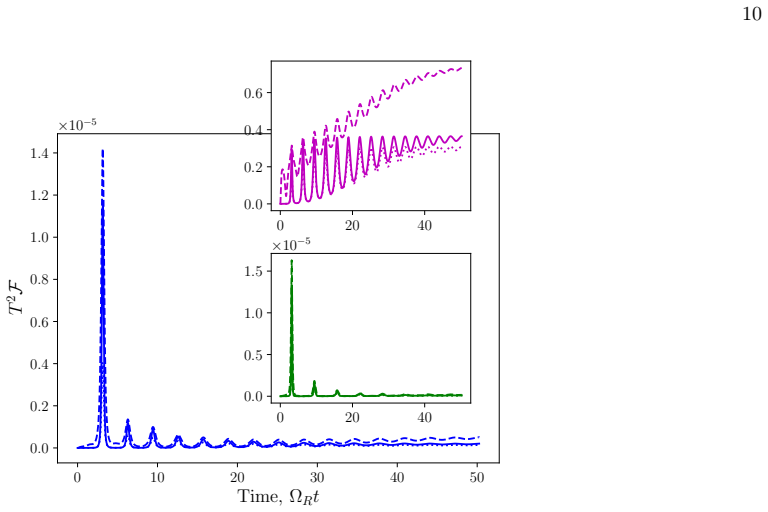
Non-Markovian coupling to a bosonic bath makes finite interrogation time optimal for quantum thermometry.
A machine-rendered reading of the paper's core claim, the machinery that carries it, and where it could break.
Core claim
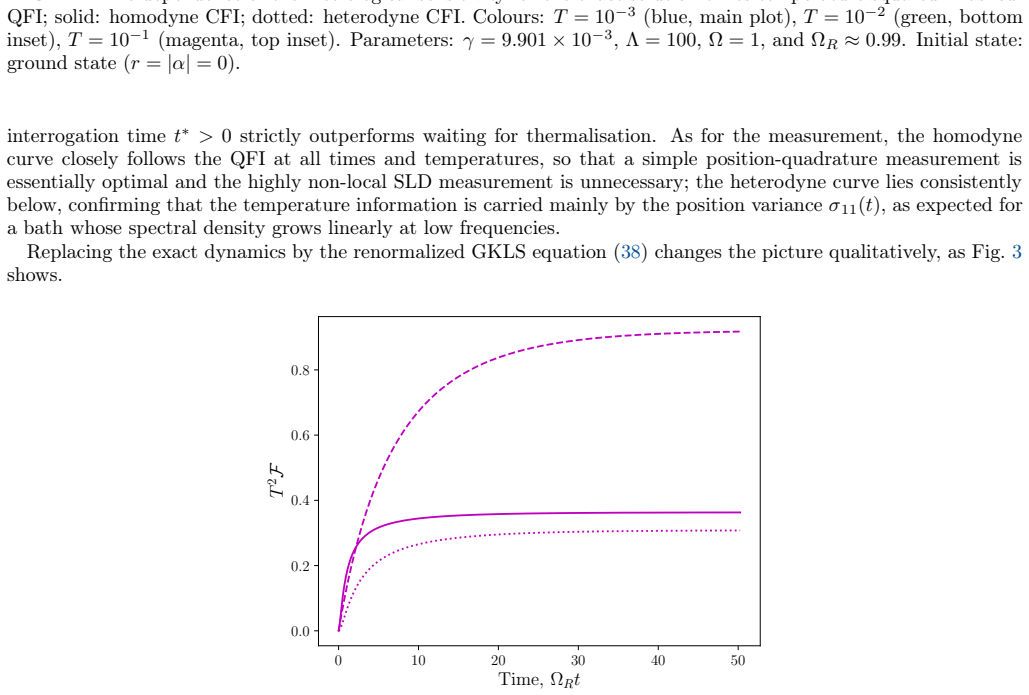
Using the exact quadratic solution for the dynamics with Drude-Ohmic spectral density, the paper establishes that the quantum Fisher information extracted from the time-dependent covariance matrix of Gaussian probe states is non-monotonic in the non-Markovian regime, with bath-memory revivals creating an optimal finite interrogation time. The Markovian quantum Fisher information rises monotonically to its stationary value with the optimum at infinite time. Squeezed initial states provide a transient advantage erased by thermalization, and strong coupling at equilibrium replaces exponential Boltzmann suppression of the relative error with polynomial divergence.
What carries the argument
The time-dependent covariance matrix of single-mode Gaussian probe states, obtained from the exact quadratic solution of the probe-bath dynamics, from which the quantum Fisher information for temperature is computed.
If this is right
- Squeezed initial states yield a large transient advantage that thermalisation eventually erases, establishing squeezing and interrogation time as complementary thermometric resources.
- At equilibrium, strong coupling replaces the exponential Boltzmann suppression of the low-temperature relative error by a far milder polynomial divergence.
- The Markovian QFI rises monotonically to its stationary value with optimum at infinite time, complementing existing bounds on precision per unit time.
- The model maps directly onto circuit quantum electrodynamics, placing the protocols within experimental reach.
Where Pith is reading between the lines
- Engineering non-Markovian environments could allow deliberate use of memory revivals to improve finite-time thermometry in quantum sensors.
- The distinction between single-shot QFI optimality and rate-based bounds may guide design choices in other open-system metrology tasks.
- Tests in circuit QED would clarify whether the non-monotonic behavior depends on the specific Drude-Ohmic form or holds more generally.
Load-bearing premise
The bath spectral density is Drude-Ohmic, allowing an exact quadratic solution for the probe dynamics.
What would settle it
An experiment that measures the quantum Fisher information at successive interrogation times in a strongly coupled oscillator-bath system and checks whether a maximum appears at finite time rather than monotonic growth.
Figures


read the original abstract
We study low-temperature non-equilibrium quantum thermometry with a bosonic probe: a quantum harmonic oscillator strongly coupled to a bosonic bath at temperature $T$ through a Drude--Ohmic spectral density. We treat the probe--bath dynamics both exactly, using the quadratic solution of Boyanovsky and Jasnow, and within a renormalized Gorini--Kossakowski--Lindblad--Sudarshan (GKLS) master equation. From the time-dependent covariance matrix we extract the quantum Fisher information (QFI) for general single-mode Gaussian probe states, including squeezed ones. In the strong-coupling, non-Markovian regime the QFI is non-monotonic in time, displaying bath-memory revivals that make a finite interrogation time $t^*>0$ strictly optimal. By contrast, we prove that the Markovian QFI rises monotonically to its stationary value and develops no interior optimum, so that its optimum is always pinned to the boundary $t^*\to\infty$; this complements existing Markovian precision-rate bounds, which concern $(\mathcal F(t)/t)$ rather than the single-shot QFI $(\mathcal F(t))$. Squeezed initial states yield a large transient advantage that thermalisation eventually erases, establishing squeezing and interrogation time as complementary thermometric resources. At equilibrium, strong coupling replaces the exponential Boltzmann suppression of the low-temperature relative error by a far milder polynomial divergence. As the model maps directly onto circuit quantum electrodynamics, these protocols appear within current experimental reach.
Editorial analysis
A structured set of objections, weighed in public.
Referee Report
Summary. The manuscript studies non-equilibrium quantum thermometry with a bosonic probe (harmonic oscillator) strongly coupled to a bosonic bath at temperature T via a Drude-Ohmic spectral density. It computes the time-dependent quantum Fisher information (QFI) for general single-mode Gaussian states using both the exact quadratic solution of Boyanovsky and Jasnow and a renormalized GKLS master equation. The central claims are that the QFI is non-monotonic in the strong-coupling non-Markovian regime (with bath-memory revivals yielding a finite optimal interrogation time t*>0), while the Markovian QFI is proven monotonic and thus optimized only at t*→∞; squeezed states provide transient advantage, and strong coupling alters the low-T equilibrium scaling from exponential to polynomial.
Significance. If the exact covariance-matrix extraction and the Markovian monotonicity proof hold, the work provides rigorous evidence that non-Markovian memory effects can make finite-time interrogation strictly optimal for single-shot QFI, complementing existing precision-rate bounds. The mapping to circuit QED and the explicit treatment of squeezed states as a complementary resource strengthen the experimental relevance. The use of an established exact solution for the Drude-Ohmic case and the parameter-free character of the monotonicity proof are clear strengths.
major comments (2)
- [Markovian analysis section] The monotonicity proof for the Markovian QFI under renormalized GKLS dynamics is load-bearing for the contrast with the non-Markovian case; the manuscript should explicitly state the initial covariance matrix and the form of the renormalized rates used in the derivative dF/dt ≥ 0 (see the paragraph containing the proof statement).
- [Non-Markovian regime] The non-monotonicity and t* optimum are tied to the specific Drude-Ohmic memory kernel; the covariance-matrix elements extracted from the Boyanovsky-Jasnow solution should be shown to produce the reported revivals without additional fitting parameters (Eqs. for the time-dependent variances and covariances).
minor comments (2)
- [Methods] Clarify the precise definition of the renormalized GKLS generator (including any frequency shift) to avoid ambiguity with the exact solution.
- [Equilibrium discussion] The low-temperature equilibrium scaling claim would benefit from an explicit asymptotic expression for the relative error as T→0.
Simulated Author's Rebuttal
We thank the referee for their positive evaluation and recommendation of minor revision. We address each major comment below and will incorporate the requested clarifications in the revised manuscript.
read point-by-point responses
-
Referee: [Markovian analysis section] The monotonicity proof for the Markovian QFI under renormalized GKLS dynamics is load-bearing for the contrast with the non-Markovian case; the manuscript should explicitly state the initial covariance matrix and the form of the renormalized rates used in the derivative dF/dt ≥ 0 (see the paragraph containing the proof statement).
Authors: We agree that making these elements explicit will improve clarity. In the revised version we will state the initial covariance matrix (a general single-mode Gaussian state with variances and covariance parameters) and the explicit renormalized rates (decay rate and frequency shift) that enter the GKLS generator. With these inserted, the steps establishing dF/dt ≥ 0 become fully traceable while the proof itself remains unchanged. revision: yes
-
Referee: [Non-Markovian regime] The non-monotonicity and t* optimum are tied to the specific Drude-Ohmic memory kernel; the covariance-matrix elements extracted from the Boyanovsky-Jasnow solution should be shown to produce the reported revivals without additional fitting parameters (Eqs. for the time-dependent variances and covariances).
Authors: We appreciate the request for explicit verification. The Boyanovsky-Jasnow solution supplies closed-form, parameter-free expressions for the time-dependent variances and covariances in terms of the Drude-Ohmic kernel. In the revision we will quote these equations and note that the oscillatory contributions arising directly from the memory kernel produce the revivals in the QFI, confirming that no auxiliary fitting is involved. revision: yes
Circularity Check
No significant circularity identified
full rationale
The derivation extracts the time-dependent covariance matrix from the external Boyanovsky-Jasnow quadratic solution for the chosen spectral density, then applies the standard Gaussian-state QFI formula; the Markovian monotonicity claim is proven directly under renormalized GKLS dynamics. No load-bearing step reduces by construction to a fitted parameter, self-definition, or self-citation chain. The non-monotonicity follows from the memory kernel of the Drude-Ohmic density, which is an input assumption rather than a derived output. The paper is therefore self-contained against external benchmarks.
Axiom & Free-Parameter Ledger
free parameters (2)
- probe-bath coupling strength
- Drude cutoff frequency
axioms (2)
- domain assumption The joint probe-bath Hamiltonian is quadratic, permitting an exact solution via the Boyanovsky-Jasnow method.
- standard math Gaussian states remain Gaussian under linear coupling to a bosonic bath.
Reference graph
Works this paper leans on
-
[1]
Thermometry in the quantum regime: Recent theoretical progress
M. Mehboudi, A. Sanpera, and L. A. Correa, J. Phys. A: Math. Theor.52, 303001 (2019), arXiv:1811.03988
work page internal anchor Pith review Pith/arXiv arXiv 2019
-
[2]
M. G. A. Paris, Int. J. Quantum Inf.7, 125 (2009), arXiv:0804.2981
work page internal anchor Pith review Pith/arXiv arXiv 2009
-
[3]
S. L. Braunstein and C. M. Caves, Phys. Rev. Lett.72, 3439 (1994)
1994
-
[4]
Cramér,Mathematical Methods of Statistics(Princeton University Press, Princeton, NJ, 1999)
H. Cramér,Mathematical Methods of Statistics(Princeton University Press, Princeton, NJ, 1999)
1999
-
[5]
C. R. Rao, inBreakthroughs in Statistics: Foundations and Basic Theory(Springer, 1992) pp. 235–247
1992
-
[6]
L. A. Correa, M. Mehboudi, G. Adesso, and A. Sanpera, Phys. Rev. Lett.114, 220405 (2015), arXiv:1411.2437
work page internal anchor Pith review Pith/arXiv arXiv 2015
-
[7]
K. V. Hovhannisyan and L. A. Correa, Phys. Rev. B98, 045101 (2018), arXiv:1712.03088
work page internal anchor Pith review Pith/arXiv arXiv 2018
-
[8]
P. P. Potts, J. B. Brask, and N. Brunner, Quantum3, 161 (2019), arXiv:1711.09827
work page internal anchor Pith review Pith/arXiv arXiv 2019
-
[9]
A. O. Caldeira and A. J. Leggett, Physica A121, 587 (1983)
1983
-
[10]
L. A. Correa, M. Perarnau-Llobet, K. V. Hovhannisyan, S. Hernández-Santana, M. Mehboudi, and A. Sanpera, Phys. Rev. A96, 062103 (2017)
2017
-
[11]
G. Planella, M. F. B. Cenni, A. Acín, and M. Mehboudi, Phys. Rev. Lett.128, 040502 (2022), arXiv:2001.11812
-
[12]
J. Glatthard, K. V. Hovhannisyan, M. Perarnau-Llobet, L. A. Correa, and H. J. D. Miller, Quantum7, 1190 (2023), arXiv:2302.03061
-
[13]
P. Sekatski and M. Perarnau-Llobet, Quantum6, 869 (2022), arXiv:2107.04425
-
[14]
R. Ravell Rodríguez, M. Mehboudi, M. Horodecki, and M. Perarnau-Llobet, New J. Phys.26, 013046 (2024), arXiv:2310.14655
- [15]
- [16]
-
[17]
C. Weedbrook, S. Pirandola, R. García-Patrón, N. J. Cerf, T. C. Ralph, J. H. Shapiro, and S. Lloyd, Rev. Mod. Phys.84, 621 (2012), arXiv:1110.3234
work page internal anchor Pith review Pith/arXiv arXiv 2012
-
[18]
Serafini,Quantum Continuous Variables: A Primer of Theoretical Methods(CRC Press, Taylor & Francis Group, Boca Raton, FL, 2017)
A. Serafini,Quantum Continuous Variables: A Primer of Theoretical Methods(CRC Press, Taylor & Francis Group, Boca Raton, FL, 2017)
2017
-
[19]
Gaussian states in continuous variable quantum information
A. Ferraro, S. Olivares, and M. G. A. Paris, Gaussian states in continuous variable quantum information (2005), arXiv:quant-ph/0503237
work page internal anchor Pith review Pith/arXiv arXiv 2005
-
[20]
Phase space formalism for quantum estimation of Gaussian states
A. Monras, Phase space formalism for quantum estimation of Gaussian states (2013), arXiv:1303.3682 [quant-ph]
work page internal anchor Pith review Pith/arXiv arXiv 2013
-
[21]
D. Šafránek, J. Phys. A: Math. Theor.52, 035304 (2018), arXiv:1801.00299
-
[22]
Quantum parameter estimation using general single-mode Gaussian states
O. Pinel, P. Jian, N. Treps, C. Fabre, and D. Braun, Phys. Rev. A88, 040102 (2013), arXiv:1307.4637
work page internal anchor Pith review Pith/arXiv arXiv 2013
- [23]
- [24]
-
[25]
Heisenberg-Langevin vs. quantum master equation
D. Boyanovsky and D. Jasnow, Phys. Rev. A96, 062108 (2017), arXiv:1707.04135
work page internal anchor Pith review Pith/arXiv arXiv 2017
-
[26]
M. Winczewski and R. Alicki, Renormalization in the theory of open quantum systems via the self-consistency condition (2021), arXiv:2112.11962 [quant-ph]
-
[27]
M. Łobejko, M. Winczewski, G. Suárez, R. Alicki, and M. Horodecki, Phys. Rev. E110, 014144 (2024), arXiv:2204.00643
-
[28]
M. A. Nielsen and I. L. Chuang,Quantum Computation and Quantum Information(Cambridge University Press, Cam- bridge, 2010)
2010
-
[29]
In this section we closely follow the notation of Ref. [25]
-
[30]
Winczewski, CUDA Numerical Integration (2024), gitHub repository
M. Winczewski, CUDA Numerical Integration (2024), gitHub repository
2024
-
[31]
Ravell Rodríguez and S
R. Ravell Rodríguez and S. Morelli, SciPost Phys.18, 167 (2025)
2025
- [32]
-
[33]
G. Mihailescu, S. Campbell, and A. K. Mitchell, Phys. Rev. A107, 042614 (2023), arXiv:2212.09618
- [34]
-
[35]
X.-M. Lu, X. Wang, and C. P. Sun, Phys. Rev. A82, 042103 (2010), arXiv:0912.0587
work page internal anchor Pith review Pith/arXiv arXiv 2010
-
[36]
A. W. Chin, S. F. Huelga, and M. B. Plenio, Phys. Rev. Lett.109, 233601 (2012), arXiv:1103.1219
work page internal anchor Pith review Pith/arXiv arXiv 2012
- [37]
-
[38]
D. Parlato, G. Di Bello, F. Pavan, G. De Filippis, and C. A. Perroni, Phys. Rev. B112, 224314 (2025), arXiv:2508.16413
-
[39]
Measure for the Degree of Non-Markovian Behavior of Quantum Processes in Open Systems
H.-P. Breuer, E.-M. Laine, and J. Piilo, Phys. Rev. Lett.103, 210401 (2009), arXiv:0908.0238
work page internal anchor Pith review Pith/arXiv arXiv 2009
-
[40]
Entanglement and non-Markovianity of quantum evolutions
A. Rivas, S. F. Huelga, and M. B. Plenio, Phys. Rev. Lett.105, 050403 (2010), arXiv:0911.4270. Appendix A: Exact solution: covariance matrix dynamics This appendix collects the full analytical solution for the time evolution of the probe’s first and second moments, following the Schrödinger-picture construction of Sec. IIIB and Ref. [25]. We reproduce the...
work page internal anchor Pith review Pith/arXiv arXiv 2010
-
[41]
Using4ν 2 0 −1 = 4¯n(¯n+ 1)and4ν0c= (4¯n+ 2)(cosh 2r−2¯n−1), the square bracket equals2 (2¯n+ 1) cosh 2r−1 , whenceA= ˙¯n2[(2¯n+ 1) cosh 2r−1]/[2¯n2(¯n+ 1)2]
= 4ν0c,D ′(0) = 32ν3 0 c, so f ′(0) = N ′(0)D(0)−N(0)D ′(0) D(0)2 =− 4ν0c (4ν2 0 −1) 2 .(C14) Assembling,A= 4 ˙¯n2 2(4ν2 0 −1) + 4ν0c /(4ν2 0 −1) 2. Using4ν 2 0 −1 = 4¯n(¯n+ 1)and4ν0c= (4¯n+ 2)(cosh 2r−2¯n−1), the square bracket equals2 (2¯n+ 1) cosh 2r−1 , whenceA= ˙¯n2[(2¯n+ 1) cosh 2r−1]/[2¯n2(¯n+ 1)2]. Finally[(2¯n+
-
[42]
cosh 2r−1]/2 = ¯ncosh 2r+ 1 2(cosh 2r−1) = ¯ncosh 2r+ sinh 2 r, which gives Eq. (C13). Both terms¯ncosh 2rand sinh2 rare non-negative (and¯ncosh 2r >0for¯n >0), soA>0strictly. Proposition 2(Global monotonicity).For every temperatureT >0and every squeezingr≥0, the MarkovianF(t) of the squeezed preparation(C11)is strictly increasing int. Consequently it has...
-
[43]
From Eq. (C11), a(w)b(w)− 1 4 =w(1−w) ν0C− 1 2 +w 2n(n+ 1),(C15) whose right-hand side is strictly positive onw∈(0,1](bothν 0C− 1 2 andn(n+ 1)are positive); henceD(w) := 16a(w) 2b(w)2 −1>0there, and the closed form (C4) is regular—the removable singularity atw= 0(pure initial state) being fixed byF(0) = 0. Differentiating Eq. (C4), written with(1−u)2 =w 2...
-
[44]
1 a(w) + 1 2 2 + 1 b(w) + 1 2 2 # .(C22) For the squeezed-vacuum preparation(C11), this becomes Fhet(t) = 2w 2 ˙¯n2
This is a convex combination of the positive variancesV θ(0)andν 0, hence strictly positive on[0,1], so its reciprocal is regular and F (θ) hom(w) = ˙¯n2 2 " w Vθ(0) +w ν0 −V θ(0) #2 . The bracketed function has derivative d dw w/[Vθ(0) +w(ν 0 −V θ(0))] =V θ(0)/[Vθ(0) +w(ν 0 −V θ(0))]2 >0, since Vθ(0)>0; being non-negative and vanishing only atw= 0, its s...
-
[45]
Thus each term in Eq
The denominator is a convex combination of positive numbers, c+wd= (1−w) a(0) + 1 2 +w ν0 + 1 2 >0 (0≤w≤1), and d dw w c+wd = c (c+wd) 2 >0. Thus each term in Eq. (C22) increases strictly withw. Sincew(t) = 1−e−γt is strictly increasing int, the heterodyne Fisher information is strictly increasing in time. Remark 3(Co-rotating and laboratory homodyne phas...
discussion (0)
Sign in with ORCID, Apple, or X to comment. Anyone can read and Pith papers without signing in.