Construction of Sensitivity Curves for Dynamic LISA and Taiji
Pith reviewed 2026-06-29 03:26 UTC · model grok-4.3
The pith
Dynamic LISA and Taiji sensitivity curves vary by 20% from static approximations at low frequencies, producing 70% shifts in directional source counts.
A machine-rendered reading of the paper's core claim, the machinery that carries it, and where it could break.
Core claim
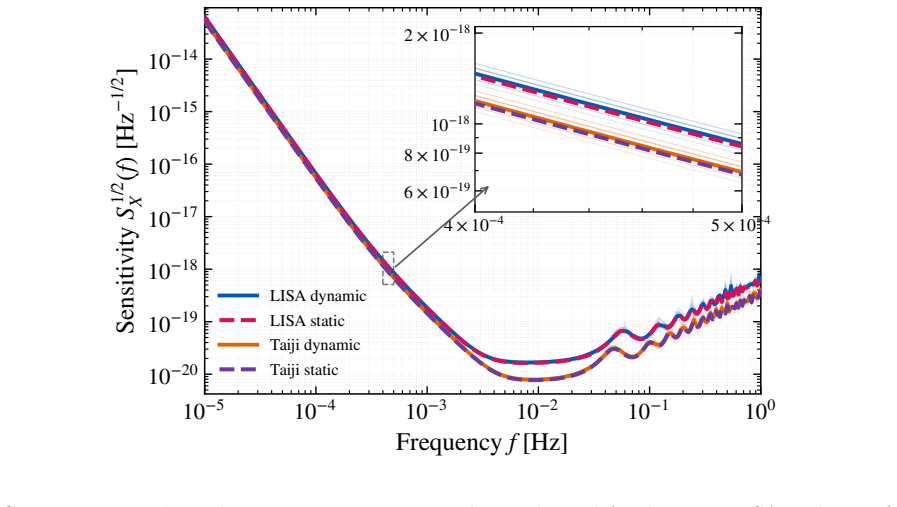
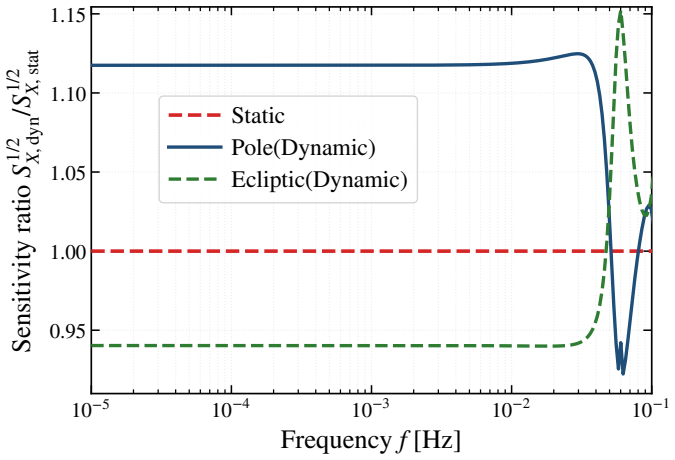
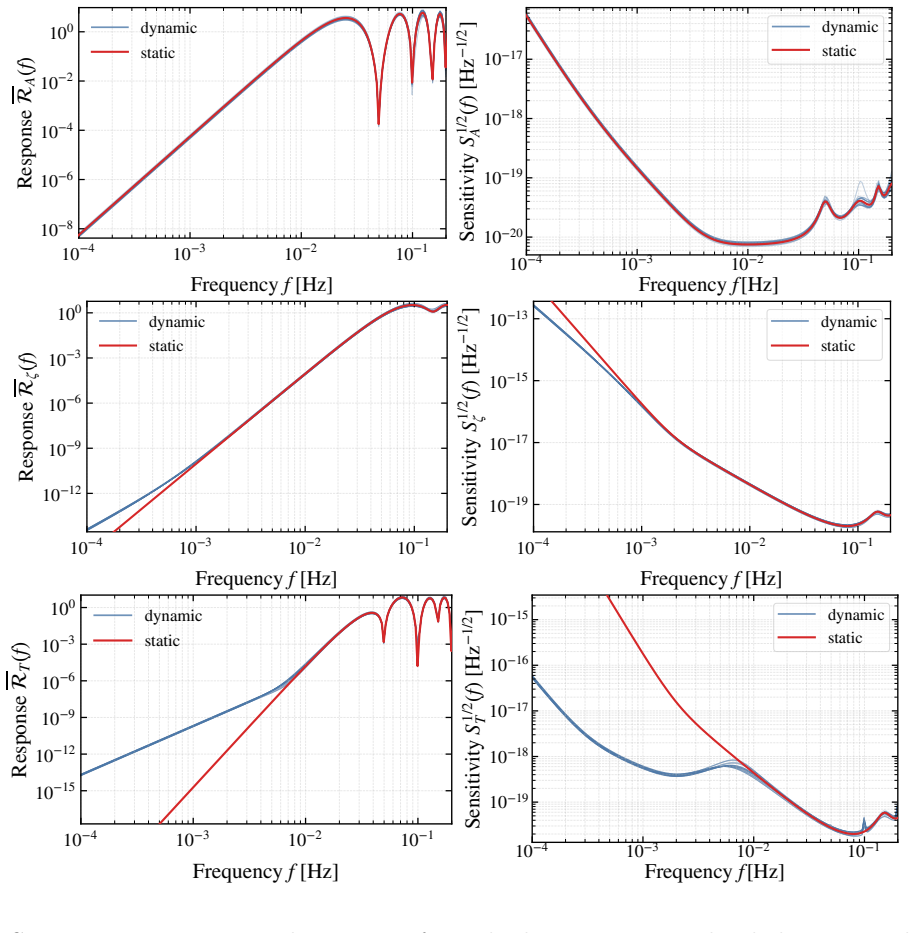
The central claim is that the direction-dependent response of dynamic LISA and Taiji, obtained from an analytic time-dependent heliocentric orbital model and adiabatic unequal-arm interferometer, produces sensitivity curves whose low-frequency values differ by roughly 20% from the static approximation; this difference induces about 70% variation in the directional distribution of detectable GW sources, with larger discrepancies at higher frequencies, so that fully dynamic curves are required for reliable source-count predictions and parameter inference.
What carries the argument
Analytic expressions for angular-dependent sensitivity in the Michelson interferometric channel, built from the time-dependent heliocentric orbital model and adiabatic unequal-arm configuration
If this is right
- Total predicted counts of detectable gravitational-wave sources must be recalculated with direction-dependent dynamic curves.
- Parameter estimation for binary systems will shift when the correct angular sensitivity is used instead of the static average.
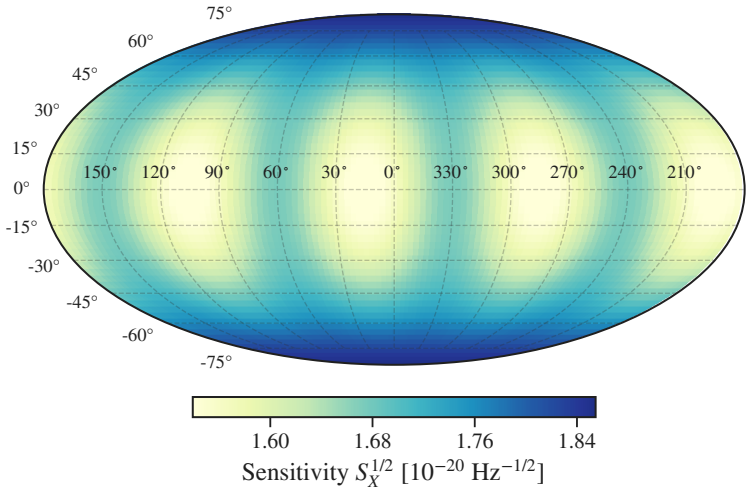
- Sky maps of sensitivity display a quadrant-like pattern at low frequencies that is absent in static models.
- Discrepancies between dynamic and static predictions grow at higher frequencies within the millihertz band.
Where Pith is reading between the lines
- Earlier population studies that relied on static sensitivity maps may have under- or over-estimated detection rates for sources clustered in particular sky regions.
- Mission design trade-offs for sky coverage could be re-evaluated once the dynamic quadrant pattern is folded into exposure calculations.
- The same orbital-modeling approach could be applied to other proposed heliocentric interferometers to test whether similar 20% corrections appear.
Load-bearing premise
The adiabatic unequal-arm interferometer configuration together with the analytic time-dependent heliocentric orbital model accurately captures the instrument response over a full year.
What would settle it
Direct numerical integration of the exact time-dependent arm-length responses over one full orbit, compared against the analytic sensitivity curves; systematic differences exceeding 5% at low frequencies would falsify the model.
Figures
read the original abstract
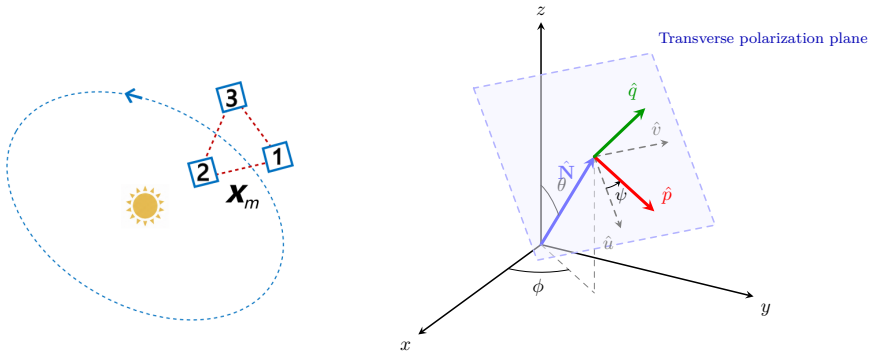
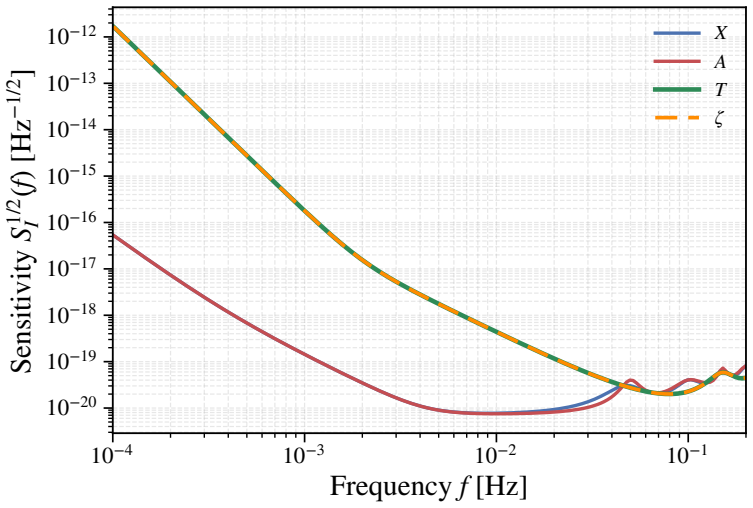
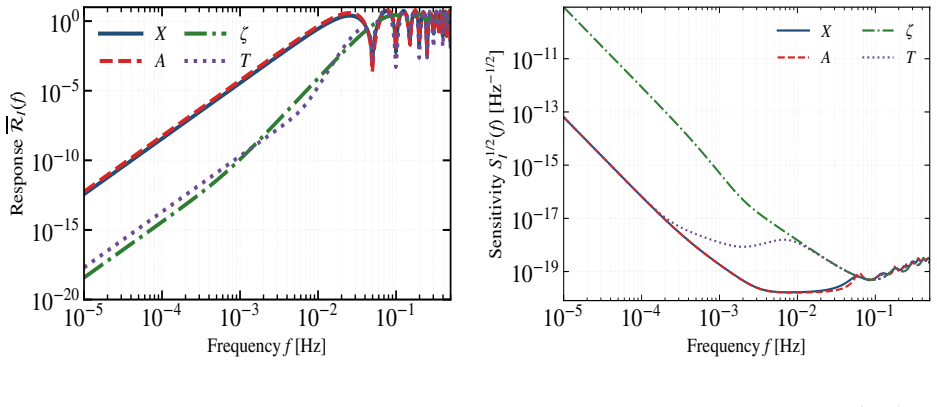
Space-based gravitational-wave (GW) laser interferometers, including LISA and Taiji, are designed to observe gravitational waves in the millihertz band and are expected to open up a frequency range that is otherwise inaccessible. The sensitivity and response of these instruments are central to their scientific goals, mission design and parameter estimation capabilities. However, they are commonly modeled as static, equilateral triangular constellations, an approximation that neglects both orbital motion and directional dependence. In this work, we systematically examine the direction-dependent response and sensitivity of dynamic LISA-like detectors over an entire year of heliocentric orbit. Based on an analytical, time-dependent heliocentric orbital model and an adiabatic unequal-arm interferometer configuration, we construct direction-dependent sensitivity curves in the Michelson interferometric channel for dynamic LISA and Taiji. We obtain analytic expressions for the angular-dependent sensitivity and demonstrate the emergence of a quadrant-like pattern in sky maps at low frequencies. We show that, relative to the static approximation, the low-frequency sensitivity varies by roughly $20\%$, which in turn produces about a $70\%$ variation in the directional dependence of the number of detectable GW sources, with even larger discrepancies at higher frequencies. Therefore, for accurate predictions of the total GW source counts and reliable parameter inference for binary systems, it is necessary to employ fully dynamic, direction-dependent sensitivity curves.
Editorial analysis
A structured set of objections, weighed in public.
Referee Report
Summary. The paper constructs analytic, direction-dependent sensitivity curves for dynamic LISA and Taiji using a time-dependent heliocentric orbital model and an adiabatic unequal-arm Michelson interferometer configuration. It reports that, relative to the static equilateral approximation, low-frequency sensitivity varies by ~20%, producing ~70% variation in the directional dependence of detectable GW sources (with larger discrepancies at higher frequencies), and concludes that fully dynamic curves are required for accurate source counts and parameter estimation.
Significance. If the analytic model is shown to be faithful, the result demonstrates that the common static approximation introduces non-negligible errors in sky-dependent sensitivity, directly affecting forecasts of resolvable binary populations and inference. The provision of closed-form angular expressions and the emergence of a quadrant pattern in low-frequency sky maps would be a concrete, usable advance for mission planning and data analysis pipelines.
major comments (1)
- [Abstract (methods paragraph)] Abstract (methods paragraph): The quoted 20% low-frequency sensitivity variation and 70% source-count variation rest entirely on the fidelity of the adiabatic unequal-arm configuration plus analytic heliocentric orbital model. No comparison to the static limit, no numerical time-domain validation, and no error budget for neglected orbital perturbations are described; without these checks the central percentages cannot be confirmed to be physical rather than artifacts of the chosen analytic setup.
Simulated Author's Rebuttal
We thank the referee for their careful reading of the manuscript and for highlighting the need to strengthen the validation of the analytic model. We address the single major comment below.
read point-by-point responses
-
Referee: [Abstract (methods paragraph)] Abstract (methods paragraph): The quoted 20% low-frequency sensitivity variation and 70% source-count variation rest entirely on the fidelity of the adiabatic unequal-arm configuration plus analytic heliocentric orbital model. No comparison to the static limit, no numerical time-domain validation, and no error budget for neglected orbital perturbations are described; without these checks the central percentages cannot be confirmed to be physical rather than artifacts of the chosen analytic setup.
Authors: The abstract explicitly states the comparison to the static equilateral approximation, and the main text (Sections 3 and 4) derives and quantifies the ~20% low-frequency variation and the resulting ~70% directional source-count variation using the same analytic expressions for both the dynamic and static cases. The heliocentric orbital model and adiabatic unequal-arm Michelson configuration follow standard treatments in the LISA literature. We nevertheless agree that the manuscript would benefit from explicit numerical time-domain validation and an error budget for neglected perturbations (e.g., small eccentricities). We will add a dedicated subsection presenting such comparisons and error estimates in the revised version. revision: yes
Circularity Check
No circularity; derivation uses external orbital and interferometer models
full rationale
The paper derives direction-dependent sensitivity curves from an analytical time-dependent heliocentric orbital model and adiabatic unequal-arm interferometer configuration, treated as standard external inputs from orbital mechanics and interferometry. No equations or results reduce to self-defined quantities, fitted parameters renamed as predictions, or load-bearing self-citations. The reported 20% sensitivity variation and 70% source-count variation are computed outputs of these models, not inputs. The central claim is self-contained against external benchmarks like standard LISA response functions.
Axiom & Free-Parameter Ledger
Reference graph
Works this paper leans on
-
[1]
1 + 0.4×10 −3 Hz f 2#
Power Spectral Density (PSD) of noises The optical metrology noise and test-mass acceleration noise are modeled as [8, 46] S1/2 oms(f) = 15×10 −12 2πf c s 1 + 2×10 −3 Hz f 4 m√ Hz ,(A1) S1/2 acc (f) = 3×10 −15 2πf c vuut " 1 + 0.4×10 −3 Hz f 2#" 1 + f 8×10 −3 Hz 4# m/s2 √ Hz .(A2) The numerical coefficient 15×10 −12 in Eq. (A1) corresponds to the LISA opt...
-
[2]
(A1) and (A2), using the same adiabatic unequal-arm TDI combinations as those used for the gravitational-wave response
Unequal-arm noise construction In the dynamic case, the noise spectra in each interferometric channel are constructed directly from the single-link optical metrology and acceleration-noise PSDs in Eqs. (A1) and (A2), using the same adiabatic unequal-arm TDI combinations as those used for the gravitational-wave response. For each orbital day, we compute th...
-
[3]
Amaro-Seoaneet al., Laser interferometer space antenna (2017), arXiv:1702.00786 [astro- ph.IM]
P. Amaro-Seoaneet al., Laser interferometer space antenna (2017), arXiv:1702.00786 [astro- ph.IM]
Pith/arXiv arXiv 2017
-
[4]
Hu and Y.-L
W.-R. Hu and Y.-L. Wu, Natl. Sci. Rev.4, 685 (2017)
2017
-
[5]
Luoet al., Classical and Quantum Gravity33, 035010 (2016)
J. Luoet al., Classical and Quantum Gravity33, 035010 (2016)
2016
- [6]
-
[7]
N. J. Cornish and L. J. Rubbo, Phys. Rev. D67, 022001 (2003), arXiv:gr-qc/0209011
Pith/arXiv arXiv 2003
-
[8]
Tinto and J
M. Tinto and J. W. Armstrong, Phys. Rev. D59, 102003 (1999)
1999
-
[9]
A. Petiteau, G. Auger, H. Halloin, O. Jeannin, E. Plagnol, S. Pireaux, T. Regimbau, and J.-Y. Vinet, Phys. Rev. D77, 023002 (2008), arXiv:0802.2023 [gr-qc]
Pith/arXiv arXiv 2008
-
[10]
S. L. Larson, W. A. Hiscock, and R. W. Hellings, Phys. Rev. D62, 062001 (2000), arXiv:gr- qc/9909080. 22
arXiv 2000
-
[11]
T. Robson, N. J. Cornish, and C. Liu, Class. Quant. Grav.36, 105011 (2019), arXiv:1803.01944 [astro-ph.HE]
Pith/arXiv arXiv 2019
-
[12]
T. L. Smith and R. Caldwell, Phys. Rev. D100, 104055 (2019), [Erratum: Phys.Rev.D 105, 029902 (2022)], arXiv:1908.00546 [astro-ph.CO]
arXiv 2019
- [13]
-
[14]
D. Liang, Y. Gong, A. J. Weinstein, C. Zhang, and C. Zhang, Phys. Rev. D99, 104027 (2019), arXiv:1901.09624 [gr-qc]
Pith/arXiv arXiv 2019
- [15]
- [16]
- [17]
-
[18]
Wang, Y.-J
P.-P. Wang, Y.-J. Tan, W.-L. Qian, and C.-G. Shao, Phys. Rev. D103, 063021 (2021)
2021
-
[19]
G. Wang, B. Li, P. Xu, and X. Fan, Phys. Rev. D106, 044054 (2022), arXiv:2201.10902 [gr-qc]
arXiv 2022
-
[20]
M. Du, P. Wang, Z. Luo, W.-B. Han, X. Zhang,et al., Sci. China Phys. Mech. Astron.69, 249501 (2026), arXiv:2505.16500 [gr-qc]
arXiv 2026
-
[21]
M. R. Adams and N. J. Cornish, Phys. Rev. D82, 022002 (2010), arXiv:1002.1291 [gr-qc]
Pith/arXiv arXiv 2010
-
[22]
G. Wang and W.-T. Ni, Phys. Scripta98, 075005 (2023), arXiv:2008.05812 [gr-qc]
arXiv 2023
-
[23]
G. Wang, W.-T. Ni, W.-B. Han, and C.-F. Qiao, Phys. Rev. D103, 122006 (2021), arXiv:2010.15544 [gr-qc]
arXiv 2021
-
[24]
M. Tinto and S. V. Dhurandhar, Living Rev. Relativity8, 4 (2005), arXiv:gr-qc/0409034
arXiv 2005
-
[25]
F. B. Estabrook and H. D. Wahlquist, General Relativity and Gravitation6, 439 (1975)
1975
-
[27]
L. J. Rubbo, N. J. Cornish, and O. Poujade, Physical Review D69, 082003 (2004), arXiv:gr- qc/0311069 [gr-qc]
arXiv 2004
-
[28]
Tinto, F
M. Tinto, F. B. Estabrook, and J. W. Armstrong, Phys. Rev. D65, 082003 (2002)
2002
-
[29]
M. Vallisneri, Phys. Rev. D72, 042003 (2005), [Erratum: Phys.Rev.D 76, 109903 (2007)], arXiv:gr-qc/0504145. 23
Pith/arXiv arXiv 2005
- [30]
-
[31]
A. Pierce, K. Riles, and Y. Zhao, Phys. Rev. Lett.121, 061102 (2018), arXiv:1801.10161 [hep-ph]
Pith/arXiv arXiv 2018
-
[32]
S. Morisaki and T. Suyama, Phys. Rev. D100, 123512 (2019), arXiv:1811.05003 [hep-ph]
arXiv 2019
-
[33]
H. Grote and Y. V. Stadnik, Phys. Rev. Res.1, 033187 (2019), arXiv:1906.06193 [astro-ph.IM]
arXiv 2019
-
[34]
A. L. Miller and L. Mendes, Phys. Rev. D107, 063015 (2023), arXiv:2301.08736 [gr-qc]
arXiv 2023
- [35]
- [36]
-
[37]
Y.-H. Yao, T. Jiang, and Y. Tang, Phys. Rev. D111, 055031 (2025), arXiv:2410.22072 [hep- ph]
arXiv 2025
-
[38]
H.-T. Xu, Y.-H. Yao, Y. Tang, and Y.-L. Wu, Phys. Rev. D112, 095021 (2025), arXiv:2506.09744 [hep-ph]
Pith/arXiv arXiv 2025
- [39]
-
[40]
Y.-H. Yao, T. Jiang, W. Ren, D. Chen, Y. Tang, and Y.-F. Zhou, (2025), arXiv:2508.14655 [hep-ph]
arXiv 2025
- [41]
-
[42]
Y.-Y. Liu, J.-R. Zhang, M.-H. Du, H.-S. Liu, P. Xu, and Y.-L. Zhang, Eur. Phys. J. C86, 347 (2026), arXiv:2511.15438 [gr-qc]
Pith/arXiv arXiv 2026
- [43]
-
[44]
Y. Chen, P.-P. Wang, B. Wang, R. Luo, and C.-G. Shao, Universe12, 48 (2026), arXiv:2603.07158 [astro-ph.CO]
arXiv 2026
-
[45]
T. A. Prince, M. Tinto, S. L. Larson, and J. W. Armstrong, Phys. Rev. D66, 122002 (2002), arXiv:gr-qc/0209039
Pith/arXiv arXiv 2002
-
[46]
M. Muratore, D. Vetrugno, S. Vitale, and O. Hartwig, Phys. Rev. D105, 023009 (2022), arXiv:2108.02738 [gr-qc]
arXiv 2022
-
[47]
O. Hartwig and M. Muratore, Phys. Rev. D105, 062006 (2022), arXiv:2111.00975 [gr-qc]
arXiv 2022
-
[48]
Bayle and O
J.-B. Bayle and O. Hartwig, Phys. Rev. D107, 083019 (2023). 24
2023
discussion (0)
Sign in with ORCID, Apple, or X to comment. Anyone can read and Pith papers without signing in.