Role of the Casimir force in the capacitive radio-frequency microelectromechanical switches
Pith reviewed 2026-06-29 02:30 UTC · model grok-4.3
The pith
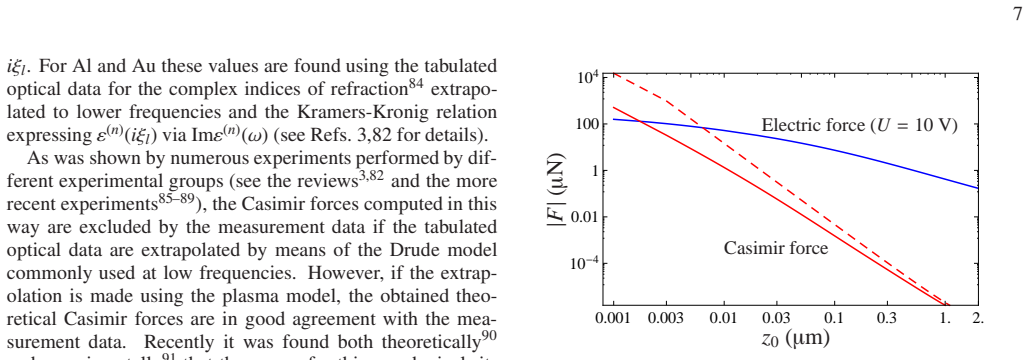
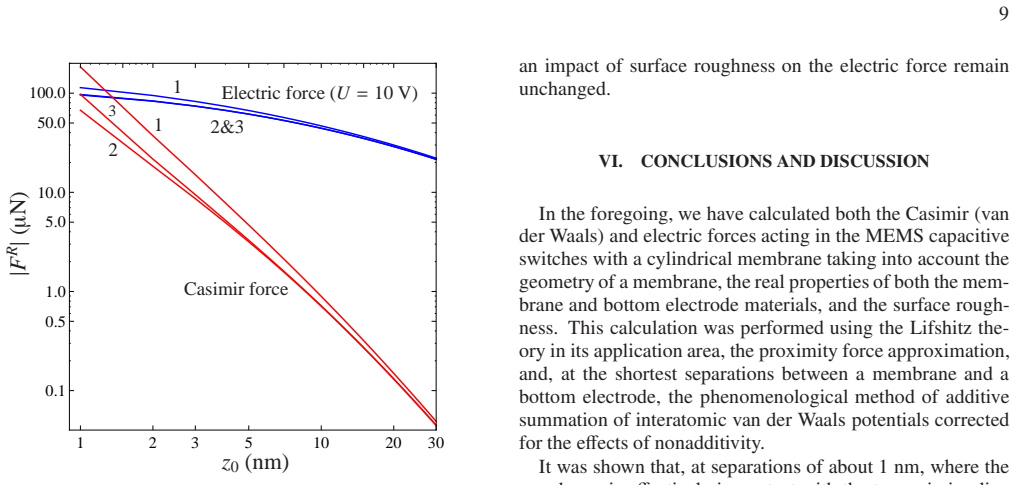
Casimir force can exceed electric force at contact in MEMS switches, determining needed membrane thickness for stable operation.
A machine-rendered reading of the paper's core claim, the machinery that carries it, and where it could break.
Core claim
The Casimir force between the switch membrane and electrode, calculated with real material properties and roughness, may exceed the electric force at contact separations; its magnitude then sets the membrane thickness that produces the required elastic restoring force for stable cyclic operation without pull-in.
What carries the argument
Computation of the Casimir force that incorporates real dielectric responses of membrane and electrode materials together with surface-roughness corrections.
If this is right
- Switch design must include the Casimir contribution when selecting membrane thickness to avoid pull-in.
- Ideal-metal approximations cannot be used for force estimates at the relevant separations.
- Membrane thickness depends on the chosen operating voltage to balance all three forces.
- Real-material and roughness corrections are required for any quantitative prediction of switch stability.
Where Pith is reading between the lines
- The same force-balance approach could be applied to other MEMS structures that reach nanometer-scale gaps.
- Voltage-dependent Casimir dominance might set a practical lower limit on reliable operating voltage for a given geometry.
- Direct force measurements at contact separations in fabricated switches would test whether the computed values guide thickness correctly.
Load-bearing premise
The calculated Casimir-force values with real materials and roughness correctly predict the actual forces present in the operating device.
What would settle it
Measure the actual force or observe pull-in behavior in switches built with the membrane thicknesses predicted from the Casimir calculation at given voltages; mismatch would show the values are not usable for design.
Figures


read the original abstract
We determine the role of the fluctuation-induced Casimir force acting between a membrane of cylindrical shape and a bottom electrode in microelectromechanical capacitive switches. For this purpose, the Casimir force is computed taking into account the real properties of both a membrane and a bottom electrode materials with account of surface roughness. The obtained results are compared with those found for the smooth surfaces using the idealization of ideal metal. It is shown that an account of both the real material properties and surface roughness is crucial for obtaining the correct values of the Casimir force. According to our results, at the shortest separations, when the switch membrane is in contact with the transmission line, the magnitudes of the Casimir force may exceed the magnitudes of the electric one depending on the value of the operating voltage. The obtained values of the Casimir force can be used for determining the thickness of the switch membrane, which ensures the necessary magnitude of the restoring elastic force required for a stable cyclic functioning of the micromechanical switch with no pull-in.
Editorial analysis
A structured set of objections, weighed in public.
Referee Report
Summary. The manuscript computes the Casimir force between a cylindrical membrane and bottom electrode in capacitive RF MEMS switches, incorporating real material dielectric properties and surface roughness via the Lifshitz formalism. Results are contrasted with the ideal-metal, smooth-surface case. The central claim is that at contact separations the Casimir force magnitude can exceed the electric force (depending on operating voltage) and that the computed Casimir values can be used to select membrane thickness so that the restoring elastic force ensures stable cyclic operation without pull-in.
Significance. If the numerical values are quantitatively reliable, the work supplies concrete guidance for MEMS switch design at the scale where fluctuation forces become comparable to electrostatic forces, directly addressing pull-in instability.
major comments (2)
- [Computational method and Results sections] The load-bearing claim that the obtained Casimir values can be used to determine membrane thickness for stable operation (final paragraph) presupposes that the computed forces are accurate to within the precision needed to set thickness. No comparison to known analytic limits (e.g., proximity-force approximation for cylinder-plane geometry), no convergence tests with respect to Matsubara frequencies or wave-vector cutoff, and no uncertainty quantification are supplied.
- [Results section (contact-separation data)] The roughness correction is stated to be included, yet the manuscript does not demonstrate that the model remains valid when the mean separation approaches the rms roughness amplitude (the regime of the strongest claim). This directly affects the quantitative comparison between Casimir and electric forces at contact.
minor comments (2)
- [Figures] Figure captions and axis labels should explicitly state the membrane radius, material pair, and roughness parameters used for each curve.
- [Computational method] The dielectric functions or tabulated optical data for the membrane and electrode materials should be referenced or reproduced so that the calculation can be reproduced.
Simulated Author's Rebuttal
We thank the referee for the careful reading and constructive comments on our manuscript. We address the major comments point by point below.
read point-by-point responses
-
Referee: [Computational method and Results sections] The load-bearing claim that the obtained Casimir values can be used to determine membrane thickness for stable operation (final paragraph) presupposes that the computed forces are accurate to within the precision needed to set thickness. No comparison to known analytic limits (e.g., proximity-force approximation for cylinder-plane geometry), no convergence tests with respect to Matsubara frequencies or wave-vector cutoff, and no uncertainty quantification are supplied.
Authors: We agree that explicit validation strengthens the quantitative claim regarding membrane thickness selection. In the revised manuscript we will add a comparison of the ideal-metal results to the proximity-force approximation for cylinder-plane geometry, convergence tests for the number of Matsubara frequencies and wave-vector cutoff, and an uncertainty estimate derived from variations in the tabulated dielectric functions. These additions will support the use of the computed forces for design guidance. revision: yes
-
Referee: [Results section (contact-separation data)] The roughness correction is stated to be included, yet the manuscript does not demonstrate that the model remains valid when the mean separation approaches the rms roughness amplitude (the regime of the strongest claim). This directly affects the quantitative comparison between Casimir and electric forces at contact.
Authors: The roughness correction follows the standard perturbative treatment within the Lifshitz formalism. We acknowledge that the regime where mean separation approaches rms roughness requires explicit discussion of model validity. In the revision we will add a paragraph on the applicability limits of the roughness model and its implications for the contact-separation comparison. revision: yes
Circularity Check
Casimir force computation uses external material data and standard formalism; no reduction to fitted inputs or self-definitions
full rationale
The paper computes Casimir forces via the Lifshitz formula (or equivalent scattering approach) incorporating tabulated dielectric functions for real materials plus a roughness correction, then contrasts the results against the ideal-metal smooth-surface limit. The abstract and reader's summary contain no equations or statements indicating that any output quantity (e.g., force magnitude at contact) is obtained by fitting a parameter to the same quantity, by redefining a variable in terms of itself, or by a load-bearing self-citation whose validity is presupposed. The claim that Casimir force may exceed the electric force at shortest separations follows directly from these independent numerical evaluations rather than from any internal re-labeling or tautological construction. Consequently the derivation chain is self-contained against external benchmarks and receives the default non-circularity score.
Axiom & Free-Parameter Ledger
Reference graph
Works this paper leans on
-
[1]
J. J. Allen, ``Micro Electro Mechanical System Design,'' (CRC Press, New York, 2005)
2005
-
[2]
\ A.\ Parsegian, ``Van der Waals Forces: A Handbook for Biologists, Chemists, Engineers, and Physicists,'' (Cambridge University Press, Cambridge, 2005)
V. \ A.\ Parsegian, ``Van der Waals Forces: A Handbook for Biologists, Chemists, Engineers, and Physicists,'' (Cambridge University Press, Cambridge, 2005)
2005
-
[3]
Bordag, G
M. Bordag, G. L. Klimchitskaya, U.\ Mohideen, and V.\ M.\ Mostepanenko, ``Advances in the Casimir Effect,'' (Oxford University Press, Oxford, 2015)
2015
-
[4]
G. L. Klimchitskaya, V. M. Mostepanenko, V. M. Petrov, and T. Tschudi, ``Optical chopper driven by the Casimir force,'' Phys. Rev. Applied 10 , 014010 (2018)
2018
-
[5]
Esquivel-Sirvent, A
R. Esquivel-Sirvent, A. Gusso, S. Castillo-L\' o pez, and F. S\' a nchez-Ochoa, ``Casimir forces: from Au to time crystals,'' Riv. Nuovo Cim. 49 , 137 (2026)
2026
-
[6]
R. H. French, V. A. Parsegian, R. Podgornik, et al., ``Long range interactions in nanoscale science,'' Rev. Mod. Phys. 82 , 1887 (2010)
2010
-
[7]
Sarabadani, A
J. Sarabadani, A. Naji, R. Asgari, and R. Podgornik, ``Many-body effects in the van der Waals–Casimir interaction between graphene layers,'' Phys. Rev. B 84 , 155407 (2011)
2011
-
[8]
L. M. Woods, D. A. R. Dalvit, A. Tkatchenko, P.\ Rodriguez-Lopez, A.\ W.\ Rodriguez, and R.\ Podgornik, ``Materials perspective on Casimir and van der Waals interactions,'' Rev. Mod. Phys. 88 , 045003 (2016)
2016
-
[9]
Drosdoff, I
D. Drosdoff, I. V. Bondarev, A. Widom, R. Podgornik, and L. M. Woods, ``Charge-induced fluctuation forces in graphitic nanostructures,'' Phys. Rev. X 6 011004 (2016)
2016
-
[10]
P. D. Grant, M. W. Denhoff, and R. R. Mansour, ``A Comparison between RF MEMS Switches and Semiconductor Switches,'' in 2004 International Conference on MEMS, NANO and Smart Systems (ICMENS'04) , (Banff, Canada, 2004), pp. 515-521
2004
-
[11]
M. A. Llamas, E. Pausas, L. Pradell, D. Girbau, S. Aouba, C. Villeneuve, V. Puyal, P. Pons, R. Plana, S. Colpo, and F. Giacomozzi, ``Capacitive and resistive RF-MEMS switches 2.5D & 3D electromagnetic and circuit modelling,'' in 7th Spanish Conference on Electron Devices CDE-2009 (Santiago de Compostela, Spain, 2009), pp. 451-454,
2009
-
[12]
B. Shao, C. Lu , Y. Xiang, F. Li, and M. Song, ``Comprehensive review of RF MEMS switches in satellite communications,'' Sensors 24 , 3135 (2024)
2024
-
[13]
Lin and Y.-P
W.-H. Lin and Y.-P. Zhao, ``Casimir effect on the pull-in parameters of nanometer switches,'' Microsyst. Technol. 11 , 80 (2005)
2005
-
[14]
Lin and Y.-P
W.-H. Lin and Y.-P. Zhao, ``Nonlinear behavior for nanoscale electrostatic actuators with Casimir force,'' Chaos, Solit. Fract. 23 , 1777 (2005)
2005
-
[15]
Palasantzas and J
G. Palasantzas and J. Th. M. De Hosson, ``Pull-in characteristics of electromechanical switches in the presence of Casimir forces: Influence of self-affine surface roughness,'' Phys. Rev. B 72 , 115426 (2005)
2005
-
[16]
Palasantzas and J
G. Palasantzas and J. Th. M. De Hosson, ``Phase maps of microelectromechanical switches in the presence of electrostatic and Casimir forces,'' Phys. Rev. B 72 , 121409(R) (2005)
2005
-
[17]
Ramezani, A
A. Ramezani, A. Alasty, and J. Akbari, ``Pull-in parameters of cantilever type nanomechanical switches in presence of Casimir force,'' Nonlin. Anal.: Hybrid Syst. 1 , 364 (2007)
2007
-
[18]
G.\ Palasantzas, ``Contact angle influence on the pull-in voltage of microswitches in the presence of capillary and quantum vacuum effects,'' J. Appl. Phys. 101 , 053512 (2007)
2007
-
[19]
G.\ Palasantzas, ``Pull-in voltage of microswitch rough plates in the presence of electromagnetic and acoustic Casimir forces,'' J. Appl. Phys. 101 , 063548 (2007)
2007
-
[20]
L. Wu, V. Rochus, L. Noels, and J. C. Golinval, ``Influence of adhesive rough surface contact on microswitches,'' J. Appl. Phys. 106 , 113502 (2009)
2009
-
[21]
X. L. Jia, J. Yang, and S. Kitipornchai, ``Characterization of FGM micro-switches under electrostatic and Casimir forces,'' IOP Conf. Series: Mater. Sci. Engineer. 10 , 012178 (2010)
2010
-
[22]
E. S. Reich, ``Casimir effect put to work as a nano-switch,'' New Sci. 207 , 19 (2010)
2010
-
[23]
X. L. Jia, J. Yang, and S. Kitipornchai, ``Pull-in instability of geometrically nonlinear micro-switches under electrostatic and Casimir forces,'' Acta Mech. 218 , 161 (2011)
2011
-
[24]
J. B. Ma, S. F. Asokanthan, and L. Jiang, ``Surface effects considerations for the design of Casimir actuated nanoswitches,'' Appl. Mech. Mater. 110-116 , 1036 (2011)
2011
-
[25]
Yang, G.-F
F. Yang, G.-F. Wang, J.-M. Long, and B.-L. Wang, ``Influence of surface energy on the pull-in instability of electrostatic nano-switches,'' J. Comput. Theor. Nanosci. 10 , 1273 (2013)
2013
-
[26]
S. A. A. Ghorbanpour Arani, A. Jalilvand, M. Ghaffari, M. Talebi Mazraehshahi, R. Kolahchi, M. A. Roudbari, and S. Amir, ``Nonlinear pull-in instability of boron nitride nano-switches considering electrostatic and Casimir forces,'' Scientia Iranica F 21 , 1183 (2014)
2014
-
[27]
Di Maida and G
P. Di Maida and G. Bianchi, ``Numerical investigation of pull-In instability in a micro-switch MEMS device through the pseudo-spectral method,'' Model. Simul. Eng. 2016 , 8543616 (2016)
2016
-
[28]
X.-f. Liu, Y. Li, and H. Jing, ``Casimir switch: steering optical transparency with vacuum forces,'' Sci. Reports 6 , 27102 (2016)
2016
-
[29]
Inui, ``Optical switching of a graphene mechanical switch using the Casimir effect,'' J
N. Inui, ``Optical switching of a graphene mechanical switch using the Casimir effect,'' J. Appl. Phys. 122 , 104501 (2017)
2017
-
[30]
R. Yang, J. Qian, and P. X.-L. Feng, ``Electrodynamic force, Casimir effect, and stiction mitigation in silicon carbide nanoelectromechanical switches,'' Small 16 , 2005594 (2020)
2020
-
[31]
\" O zmen and I
R. \" O zmen and I. Esen, ``The Casimir, Van der Waals, and electrostatic forces’ effects on the response of magneto-electro-elastic nanosensor/switch beams under thermal environment,'' Mech. Based Des. Struct. Mach. 52 , 2318615 (2024)
2024
-
[32]
G. L. Klimchitskaya, A. S. Korotkov, V. V. Loboda, and V. M. Mostepanenko, ``Pull-in features of nanoswitches in the Casimir regime with account of contact repulsion,'' EPL 148 , 16002 (2024)
2024
-
[33]
G. L. Klimchitskaya, A. S. Korotkov, V. V. Loboda, and V. M. Mostepanenko, ``Contact separation in nanoswitches with regard to the Casimir force and exchange repulsion: Role of surface roughness and transmitted signal,'' EPL 150 , 46003 (2025)
2025
-
[34]
Molaei and B
S. Molaei and B. A. Ganji, ``Design and simulation of a novel RF MEMS shunt capacitive switch with low actuation voltage and high isolation,'' Microsyst. Technol. 23 , 1907 (2017)
1907
-
[35]
Mulloni, B., Margesin, P
V. Mulloni, B., Margesin, P. Farinelli, R. Marcelli, A. Lucibello, and G. De Angelis, ``Cycling reliability of RF-MEMS switches with gold-platinum multilayers as contact material,'' Microsyst. Technol. 23 , 3843 (2017)
2017
-
[36]
H. Wei, Z. Deng, X. Guo, Y. Wang, and H. Yang, ``High on/off capacitance ratio RF MEMS capacitive switches,'' J. Micromech. Microeng. 27 , 055002 (2017)
2017
-
[37]
K. Han, H. Guo, S. Smith, Z. Deng, and W. Li, ``Novel high-capacitance-ratio mems switch: design, analysis and performance verification,'' Micromachines 9 , 390 (2018)
2018
-
[38]
B. Jmai, P. Anacleto, P. Mendes, A. Gharsallah, ``Modeling, design, and simulation of a radio frequency microelectromechanical system capacitive shunt switch,'' Numerical Modelling 31 , e2266 (2018)
2018
-
[39]
Pertin and K
O. Pertin and K. R. Kurmendra, ``Pull-in-voltage and RF analysis of MEMS based high performance capacitive shunt switch,'' Microelectron. J. 77 , 5 (2018)
2018
-
[40]
A. K. Ravirala, L. K. Bethapudi, J. Kommareddy, B. S. Thommandru, S. Jasti, P. R. Gorantla, P. Ashok, G. S. Karumuri, and S. R. Karumuri, ``Design and performance analysis of uniform meander structured RF MEMS capacitive shunt switch along with perforations.'' Microsyst. Technol. 24 , 901 (2018)
2018
-
[41]
Zhang, Z
N. Zhang, Z. Yan, R. Song, C. Wang, Q. Guo, and J. Yang, ``Design and performance of a J band MEMS switch,'' Micromachines 10 , 467 (2019)
2019
-
[42]
Deshmukh and M
D. Deshmukh and M. Angira, ``Investigation on switching structure material selection for RF-MEMS shunt capacitive switches using Ashby, TOPSIS and VIKOR,'' Trans. Electr. Electron. Mater. 20 , 181 (2019)
2019
-
[43]
K. R. Kurmendra and R. Kumar, ``Design and analysis of MEMS shunt capacitive switch with Si _3 N _4 dielectric and Au beam material to improve actuation voltage and RF performance in consideration with and without circular perforations,'' Trans. Electr. Electron. Mater. 20 , 299 (2019)
2019
-
[44]
H. Wei, S. Jia, F. Zhao, L. Dang, G. Liang, Y. Xu, and Z. Deng, ``A new RF MEMS capacitive switch for K-band application,'' Progress Electromagn. Res. 93 , 253 (2019)
2019
-
[45]
Angira, D
M. Angira, D. Bansal, P. Kumar, K. Mehta, and K. Rangra, ``A novel capacitive RF-MEMS switch for multi-frequency operation,'' Superlatt. Microstruct. 133 , 106204 (2019)
2019
-
[46]
Nawaz, M
H. Nawaz, M. U. Masooda, M. M. Saleema, J. Iqbal, and M. Zubair, ``Surface roughness effects on electromechanical performance of RF-MEMS capacitive switches,'' Microelectronics Reliability 104 , 113544 (2020)
2020
-
[47]
K. G. Sravani, K. Guha, and A. Elsinawi, ``Design and optimisation of a novel structure capacitive RF MEMS switch to integrate with an antenna to improve its performance parameters,'' IET Circuits, Devices & Systems 14 , 261 (2020)
2020
-
[48]
K. R. Kurmendra and R. Kumar, ``Novel capacitance evaluation model for microelectromechanical switch considering fringe and effect of holes in pull-up and pull-down conditions,'' Microsyst. Technol. 26 , 873 (2020)
2020
-
[49]
L. N. Thalluri, K. Guha, K. S. Rao, G. V. H. Prasad, K. G. Sravani, K. S. R. Sastry, A. R. Kanakala, and P. B. Babu, ``Perforated serpentine membrane with AlN as dielectric material shunt capacitive RF MEMS switch fabrication and characterization,'' Microsyst. Technol. 26 , 2029 (2020)
2029
-
[50]
R. Qin, B. Zhang, C. Lei, Y. Xu, J. Qin, C. Fan, B. Mi, Y. Y. Wang, and J. Duan, ``A novel switch beam design method with extending switching radiofrequency bandwidth,'' Microsyst. Technol. 27 , 315 (2021)
2021
-
[51]
K. S. Rao, P. A. Kumar, K. Guha, B. V. S. Sailaja, K. V. Vineetha, K. L. Baishnab, and K. G. Sravani, ``Design and simulation of fixed–fixed flexure type RF MEMS switch for reconfigurable antenna,'' Microsyst. Technol. 27 , 455 (2021)
2021
-
[52]
K. G. Sravani, T. L. Narayana, K. Guha, and K. S. Rao, ``Role of dielectric layer and beam membrane in improving the performance of capacitive RF MEMS switches for Ka-band applications,'' Microsyst. Technol. 27 , 493 (2021)
2021
-
[53]
K. R. Kurmendra and R. Kumar, ``A review on RF micro-electro-mechanical systems (MEMS) switch for radio frequency applications,'' Microsyst. Technol. 27 , 2525 (2021)
2021
-
[54]
K. R. Kurmendra and R. Kumar, ``Investigations on beam membrane and dielectric materials using Ashby’s methodology and their impact on the performance of a MEMS capacitive switch,'' Microsyst. Technol. 27 , 4269 (2021)
2021
-
[55]
H. Feng, J. Zhao, C. Zhou, and M. Song, ``Design and analysis of the capacitive RF MEMS switches with support pillars,'' Sensors 22 , 8864 (2022)
2022
-
[56]
Z. Deng, Y. Wang, K. Deng, C. Lai, and J. Zhou, ``Novel high isolation and high capacitance ratio RF MEMS switch: Design, analysis and performance verification,'' Micromachines 13 , 646 (2022)
2022
-
[57]
Z. Deng, C. Lai, J. Zhou, and Y. Wang, ``Design and analysis of a novel low RF MEMS switch with low pull-in voltage and high capacitance ratio,'' Microsyst. Technol. 29 , 809 (2023)
2023
-
[58]
Bajpai, K
A. Bajpai, K. Rangra, and D. Bansal, ``Fabrication process improvement of high isolation of RF MEMS switch for 5G applications,'' Sens. Actuat. A: Phys. 376 , 115582 (2024)
2024
-
[59]
Karthick and S.P.K
R. Karthick and S.P.K. Babu, ``Electromechanical modelling and analysis of RF MEMS switch for mm-wave application,'' SSRG Int. J. Electron. Commun. Eng. 11 , 89 (2024)
2024
-
[60]
Michalas, G
L. Michalas, G. Stavrinidis, K. Tsagaraki, A. Stavrinidis, and G. Konstantinidis, ``An experimental study of the pull-in voltage in RF MEMS switches fabricated by Au electroplating and standard wet release: Considering the bridge geometry,'' Sensors 25 , 1877 (2025)
2025
-
[61]
Anusha, K
Y. Anusha, K. Guha, K. Mummaneni, and J. Thati, ``Low-voltage U-shaped RF MEMS shunt switch integration for K-band phased array beam steering,'' Sci. Rep., 16 , 11585 (2026)
2026
-
[62]
Kundu, S
A. Kundu, S. Sethi, N.C. Mondal, B. Gupta, S.K. Lahiri, and H. Saha, ``Analysis and optimization of two movable plates RF MEMS switch for simultaneous improvement in actuation voltage and switching time,'' Microelectron. J. 41 , 257 (2010)
2010
-
[63]
W. M. van Spengen, ``Capacitive RF MEMS switch dielectric charging and reliability: a critical review with recommendations,'' J. Micromech. Microeng. 22 , 074001 (2012)
2012
-
[64]
K. N. Bhadri Narayanan, and M. R. Baiju, ``Electromagnetic analysis of RF MEMS switch,'' Int. J. Engin. Res. Technol. 3 , 1197 (2014)
2014
-
[65]
T. Emig, R. L. Jaffe, M. Kardar, and A. Scardicchio, ``Casimir Interaction between a Plate and a Cylinder,'' Phys. Rev. Lett. 96 , 080403 (2006)
2006
-
[66]
Bordag, ``Casimir effect for a sphere and a cylinder in front of a plane and corrections to the proximity force theorem,'' Phys
M. Bordag, ``Casimir effect for a sphere and a cylinder in front of a plane and corrections to the proximity force theorem,'' Phys. Rev. D 73 , 125018 (2006)
2006
-
[67]
F. C. Lombardo, F. D. Mazzitelli, and P. I. Villar, ``Numerical evaluation of the Casimir interaction between cylinders,'' Phys. Rev. D 78 , 085009 (2008)
2008
-
[68]
E. M. Lifshitz and L. P. Pitaevskii, ``Statistical Physics,'' Pt II, (Pergamon Press, Oxford, 1984)
1984
-
[69]
R. S. Decca, E. Fischbach, G. L. Klimchitskaya, D. E. Krause, D. L\' o pez, and V. M. Mostepanenko, ``Possibility of measuring the thermal Casimir interaction between a plate and a cylinder attached to a micromachined oscillator,'' Phys. Rev. A 82 , 052515 (2010)
2010
-
[70]
Gradshteyn and I.M
I.S. Gradshteyn and I.M. Ryzhik, ``Table of Integrals, Series, and Products,'' (Elsevier, New York, 2007)
2007
-
[71]
A. P. Prudnikov, Yu. A. Brychkov, and O. I. Marichev, ``Integrals and Series: Elementary Functions,'' (Gordon and Breach, New York, 1986)
1986
-
[72]
Revisiting the divergent multipole expansion of atom-surface interactions: Hydrogen and positronium, -quartz, and physisorption
G. L. Klimchitskaya, ``Comment on "Revisiting the divergent multipole expansion of atom-surface interactions: Hydrogen and positronium, -quartz, and physisorption",'' Phys. Rev. A 111 , 016801 (2025)
2025
-
[73]
V. M. Mostepanenko, ``A few remarks concerning application of the Lifshitz theory to calculation of the Casimir–Polder interaction,'' Int. J. Mod. Phys. A 40 , 2543001 (2025)
2025
-
[74]
Frenkel and B
D. Frenkel and B. Smit, ``Understanding Molecular Simulation From Algorithms to Applications,'' (Academic Press, San Diego, 2023)
2023
-
[75]
Yu. N. Moiseev, V. M. Mostepanenko, V. I. Panov, and I. Yu. Sokolov, ``Force dependences for the definition of the atomic force microscopy spatial resolution,'' Phys. Lett. A 132 , 354 (1988)
1988
-
[76]
S. I. Zanette, A. O. Caride, V. B. Nunes, G. L. Klimchitskaya, F. L. Freire Jr., and R. Prioli, ``Theoretical and experimental investigation of the force-distance relation for an atomic force microscope with a pyramidal tip,'' Surf. Sci. 453 , 75 (2000)
2000
-
[77]
Tabor and R
D. Tabor and R. H. S. Winterton, ``The direct measurement of normal and retarded van der Waals forces,'' Proc. Roy. Soc. Lond. A 312 , 435 (1969)
1969
-
[78]
J. N. Israelachvili and D. Tabor, ``The measurement of van der Waals dispersion forces in the range 1.5 to 130 nm,'' Proc. Roy. Soc. Lond. A 331 , 19 (1972)
1972
-
[79]
Bordag, G
M. Bordag, G. L. Klimchitskaya, and V. M. Mostepanenko, ``The Casimir force between plates with small deviations from plane parallel geometry,'' Int. J. Mod. Phys. A 10 , 2661 (1995)
1995
-
[80]
Connelly and T.-J
D. Connelly and T.-J. King Liu, ``Modeling nanoelectromechanical switches with random surface roughness,'' IEEE Trans. Electron Devices 64 , 2409 (2017)
2017
discussion (0)
Sign in with ORCID, Apple, or X to comment. Anyone can read and Pith papers without signing in.