The cosmology of long range Yukawa interactions in general backgrounds
Pith reviewed 2026-06-29 02:58 UTC · model grok-4.3
The pith
In the scaling regime the ratio between the scalar and fermion energy densities is approximately constant.
A machine-rendered reading of the paper's core claim, the machinery that carries it, and where it could break.
Core claim
In cosmological backgrounds with constant equation of state, general scalar-field-dependent Yukawa couplings produce two regimes: a scaling regime in which the scalar oscillates about vanishing fermion mass, generated by approximate scale invariance of the scalar-fermion action that becomes approximate conformal invariance later, and an asymptotic regime in which fermions recover their bare mass; inside the scaling regime the ratio of scalar to fermion energy densities remains approximately constant.
What carries the argument
The scaling regime, which arises from approximate scale invariance in the scalar-fermion action.
Load-bearing premise
The scaling regime arises from an approximate scale invariance in the scalar-fermion action, which becomes an approximate conformal invariance at late times.
What would settle it
A numerical integration of the scalar and fermion equations in an expanding background with constant equation of state that tracks whether their energy-density ratio remains constant when the approximate scale invariance is preserved.
Figures



read the original abstract
Long-range forces in the early universe may lead to early structure formation and, perhaps, to primordial black holes. We generalise previous studies of fermions coupled to a light scalar field by considering general scalar-field-dependent couplings in cosmological backgrounds with a constant equation of state. We identify two broad regimes: a scaling regime, in which the scalar field oscillates around a point of vanishing fermion mass, and an asymptotic regime, in which the field evolves toward configurations where the fermions recover their bare mass. We show that the scaling regime arises from an approximate scale invariance in the scalar-fermion action, which becomes an approximate conformal invariance at late times. In the scaling regime, the ratio between the scalar and fermion energy densities is approximately constant. Our work provides a first step toward a general study of the growth of perturbations in this system.
Editorial analysis
A structured set of objections, weighed in public.
Referee Report
Summary. The manuscript generalizes studies of fermions coupled to a light scalar via general scalar-dependent couplings in constant-equation-of-state cosmological backgrounds. It identifies a scaling regime, arising from approximate scale invariance in the scalar-fermion action that approaches conformal invariance at late times, in which the ratio of scalar to fermion energy densities remains approximately constant, and an asymptotic regime in which the scalar evolves toward bare-mass fermion configurations. The work is framed as a first step toward analyzing perturbation growth.
Significance. If the derivations hold, the result supplies a general framework for long-range Yukawa forces in the early universe with possible relevance to structure formation and primordial black holes. The explicit tie between approximate scale invariance and the constant energy-density ratio, together with the generalization to arbitrary couplings and backgrounds, is a useful advance. The absence of free parameters or ad-hoc axioms strengthens the contribution.
minor comments (2)
- [Abstract] The abstract states that the scaling regime 'arises from an approximate scale invariance' but does not quote the relevant term in the action; adding the explicit Lagrangian term or scaling transformation would improve traceability.
- The transition from scale to conformal invariance at late times is asserted without a displayed equation showing the explicit time dependence; a short derivation or reference to the relevant equation would aid verification.
Simulated Author's Rebuttal
We thank the referee for their positive summary of our work, the assessment of its significance, and the recommendation for minor revision. No specific major comments were listed in the report.
Circularity Check
No significant circularity detected
full rationale
The paper explicitly derives the scaling regime from the approximate scale invariance of the scalar-fermion action in constant-EoS backgrounds and states that the energy-density ratio is approximately constant as a consequence of that invariance (which approaches conformal invariance at late times). No step reduces a claimed prediction to a fitted input, self-citation chain, or definitional tautology by construction; the central result is presented as following from the identified symmetry without load-bearing self-citations or ansatz smuggling.
Axiom & Free-Parameter Ledger
axioms (1)
- domain assumption The scalar-fermion system possesses an approximate scale invariance that produces the scaling regime with constant energy-density ratio.
Reference graph
Works this paper leans on
-
[1]
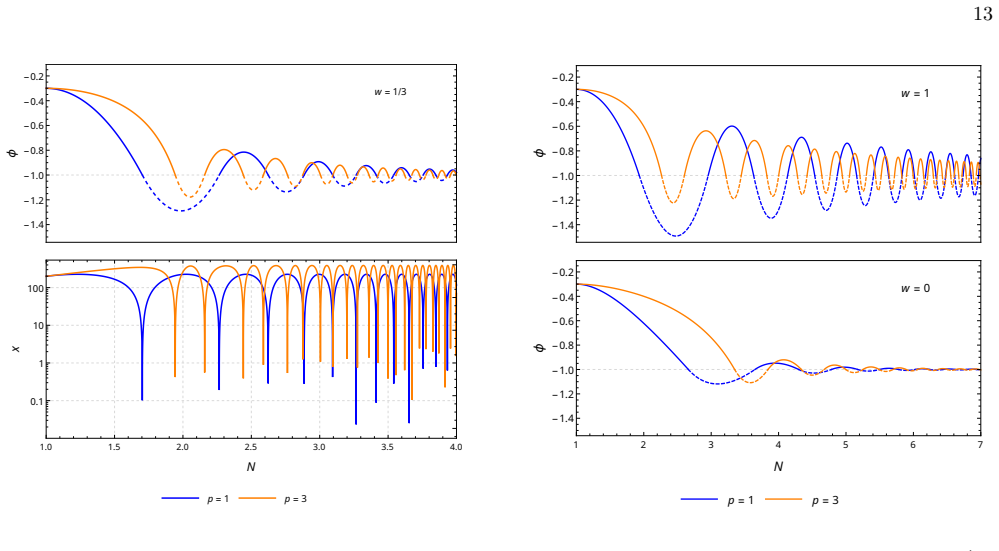
Thep= 1case Forp= 1, corresponding to the standard Yukawa cou- pling studied in Ref. [45], the equation of motion (45) becomes ϕ′′ + 5−3w 2a ϕ′ +Ka 3w−1(1 +ϕ) = 0.(57) Forw̸=−1/3, this equation has a closed-form solution in terms of Bessel functions, 3 namely ϕ=−1 +a 3(w−1) 4 (c1Jν(z(a)) +c 2Yν(z(a))),(58) where ν= 3(1−w) 2(3w+ 1) andz(a) = 2 √ K 3w+ 1 a ...
-
[2]
Linearising (57), we obtain, for w̸=−1/3, the late-time oscillatory solution aroundϕ s = −1, which reads ϕ(a)≈ −1 + Ap a cos 2p √ K 3w+ 1 a 3w+1 2 +θ p ! .(61) Note that Eq
Oddp >1case For any oddp >1, the effective potential also has a minimum atϕ s =−1. Linearising (57), we obtain, for w̸=−1/3, the late-time oscillatory solution aroundϕ s = −1, which reads ϕ(a)≈ −1 + Ap a cos 2p √ K 3w+ 1 a 3w+1 2 +θ p ! .(61) Note that Eq. (61) has the same envelope as thep= 1 solution (58), with the frequency rescaled by a factorp. This ...
-
[3]
In this case, the effective potential has a minimum atϕ= 0
The evenpcase Let us now turn to oscillatory solutions with evenp. In this case, the effective potential has a minimum atϕ= 0. Thus, the effective mass cannot reach zero, and the field eventually stabilises atϕ= 0, where the fermions recover their bare massm ψ. We start with the simplest case, p= 2, and then turn to the general case. Thep= 2 case is speci...
-
[4]
In this case, the fermion mass asymptotes to its bare value
Solutions withϕ∼0forp >2 Forp >2,both even and odd, we also have found con- figurations withϕ i >0 andϕ ′ i = 0 in which the field slows down as it approachesϕ= 0 asymptotically 4. In this case, the fermion mass asymptotes to its bare value. We find that at leading order, when the field enters the asymptotic regime, it always behaves as ϕ(a)∼a − 3w+1 p−2 ...
-
[5]
To understand the local behaviour around this point, we defineu=ϕ+ 1 with|u| ≪1
The oddpcase For oddp, the saturation point lies at the minimum of the effective potential atϕ s =−1. To understand the local behaviour around this point, we defineu=ϕ+ 1 with|u| ≪1. Expanding aroundϕ s =−1, one finds 1 +ϕ p =pu− p(p−1) 2 u2 +O(u 3),(67) and ϕp−1 = 1−(p−1)u+O(u 2).(68) Therefore, close to the saturation point, the non- relativistic equati...
-
[6]
However, this occurs only over a cosmologically very short time interval
Strictly speaking, the non-relativistic approximation breaks down in a small neighbourhood of each cross- ing. However, this occurs only over a cosmologically very short time interval. Since|ϕ+ 1| ∼a −1, the envelope ofxremains approximately constant in the saturation regime similar to the relativistic case. Thus, if this con- stant is large, the non-rela...
-
[7]
We explore the solutions aroundϕ∼0 below
The evenpcase For evenp, the minimum lies atϕ= 0, and the scalar field equation (48) becomes ϕ′′ + 5−3w 2a ϕ′ +Dp ϕ p−1a3w−2 = 0.(73) Note that, forf(φ)>0, the even case is qualitatively different from the odd case because of the absence of a saturation point atm eff = 0. We explore the solutions aroundϕ∼0 below. First, we find that the casep= 2 is again ...
-
[8]
(86) reduces to K(1 +ϕ min) + Λqa2ϕ q−1 min = 0.(88) At late times, when the minimum has already moved into the regime|ϕ min| ≪1, Eq
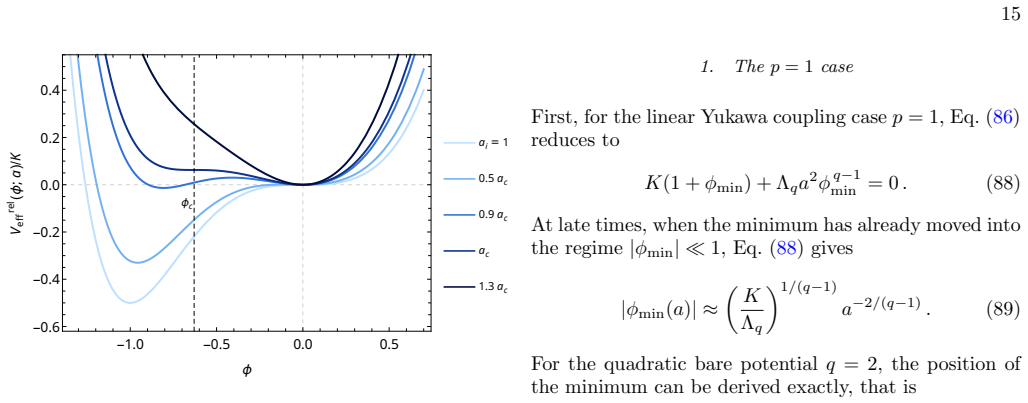
Thep= 1case First, for the linear Yukawa coupling casep= 1, Eq. (86) reduces to K(1 +ϕ min) + Λqa2ϕ q−1 min = 0.(88) At late times, when the minimum has already moved into the regime|ϕ min| ≪1, Eq. (88) gives |ϕmin(a)| ≈ K Λq 1/(q−1) a−2/(q−1) .(89) For the quadratic bare potentialq= 2, the position of the minimum can be derived exactly, that is ϕmin(a) =...
-
[9]
(86) becomes subleading relative toϕ p−1
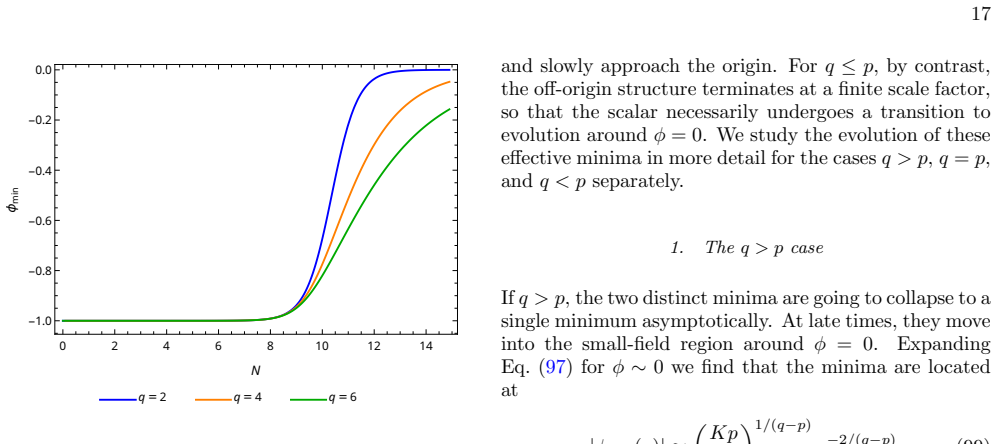
Thep >1andq > pcase Forp >1 andq > p, once the minimum enters the small-field region|ϕ min| ≪1, theϕ 2p−1 term in Eq. (86) becomes subleading relative toϕ p−1. One then finds |ϕmin(a)| ≈ Kp Λq 1/(q−p) a−2/(q−p).(91) Hence, the off-origin minimum survives for all finitea, but it drifts continuously towardϕ= 0, which is ap- proached only asymptotically
-
[10]
In this case, near the origin, the bare force, which scales asϕ q−1, is less suppressed than the fermion-induced force, which scales asϕ p−1
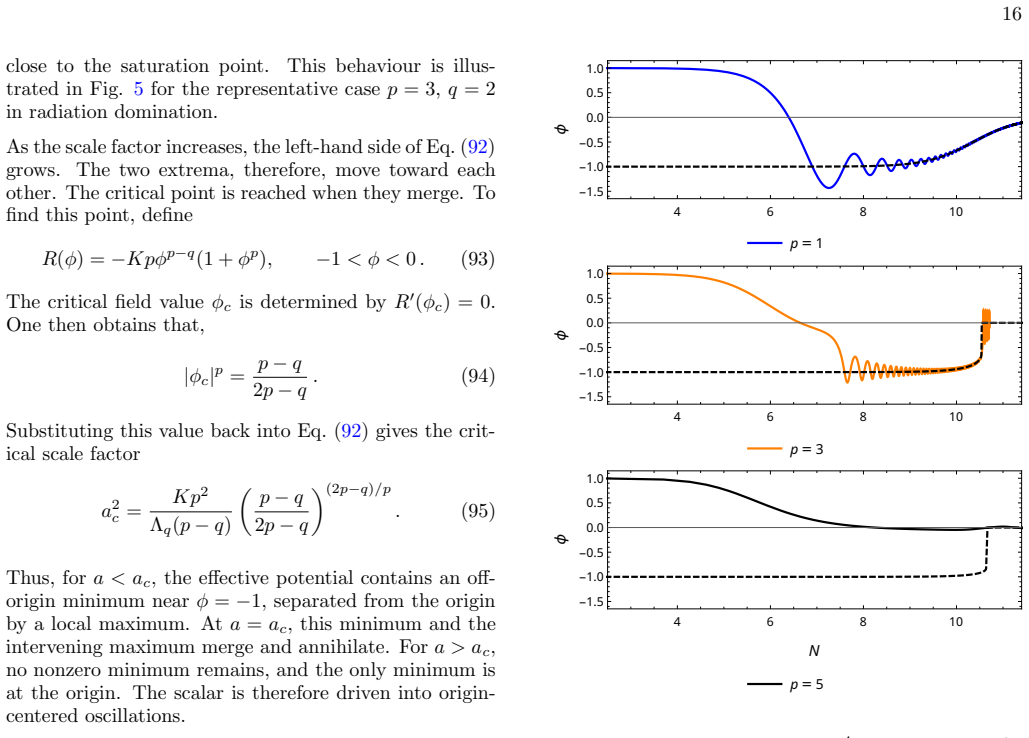
Thep >1andq < pcase The situation is different whenq < p. In this case, near the origin, the bare force, which scales asϕ q−1, is less suppressed than the fermion-induced force, which scales asϕ p−1. For the branch in the interval−1< ϕ <0, the extremum condition can be written as Λqa2 =−Kpϕ p−q(1 +ϕ p).(92) Forq < p, the right-hand side vanishes at both e...
-
[11]
Rather, it changes the asymptotic structure of the problem
Numerical exploration These results make clear that the bare potential does not simply add a small correction to the relativistic dynam- ics. Rather, it changes the asymptotic structure of the problem. In particular, the fermion-induced minimum nearϕ=−1 is only transient. At late times, the field is either forced to track a minimum that drifts toward the ...
-
[12]
At late times, they move into the small-field region aroundϕ= 0
Theq > pcase Ifq > p, the two distinct minima are going to collapse to a single minimum asymptotically. At late times, they move into the small-field region aroundϕ= 0. Expanding Eq. (97) forϕ∼0 we find that the minima are located at |ϕmin(a)| ≈ Kp Λq 1/(q−p) a−2/(q−p).(99) They therefore approach the origin asymptotically, as in the odd-pcase of Sec. V A
-
[13]
(97) enters only through the overall coefficient
Theq=pcase Whenq=p, the behaviour is qualitatively different be- cause the scale-factor dependence in Eq. (97) enters only through the overall coefficient. In this case, one finds the following exact result for the position of the effective minima, ϕ(±) min(a) =± 1− Λq Kp a2 1/p a≤a c ,(100) which shows that the two minima move inward and merge at the ori...
-
[14]
In this case, the two minima merge with the neighbouring 18 0 2 4 6 8 10 -1.0 -0.5 0.0 0.5 1.0 N ϕmin (±) p2 p4 p6 FIG
Theq < pcase Forq < p, the off-origin minima disappear even earlier. In this case, the two minima merge with the neighbouring 18 0 2 4 6 8 10 -1.0 -0.5 0.0 0.5 1.0 N ϕmin (±) p2 p4 p6 FIG. 8. The drift of the effective minima for different values ofp=q= 2 (blue lines),p=q= 4 (red lines) andp=q= 6 (green lines) in the relativistic regime. The solid line...
-
[15]
This is the main quali- tative difference from the relativistic regime of Sec
Thepodd case In the non-relativistic regime, forf(φ)∝+φ p, the in- duced contribution is no longer smooth, and the effective potential (55) becomes V non-rel eff (ϕ;a) =D a 3w−2|1 +ϕ p|+ Λq q a3w+1ϕq.(102) Note that the absolute value produces a cusp in the ef- fective potential at the saturation pointϕ=−1, so the minimum inherited from the fermion sector...
-
[16]
Thepeven case For the sign-flipped even-pbranch, that is, forf(φ)∝ −φp (which is the one allowing for a saturation point), the non-relativistic effective potential (55) reads V non-rel eff (ϕ;a) =D a 3w−2|1−ϕ p|+ Λq q a3w+1ϕq .(106) In this case, the fermion-induced term generates cusp minima atϕ=±1. The drift of the effective minima is identical to thef(...
-
[17]
In all cases considered, the lead- ing energy-density scaling isρ ϕ ∼ρ ψ ∼a −4
For both Yukawa and dilatonic couplings admitting a saturation valueϕ s at whichm eff →0, we find scaling solutions around the saturation point with |ϕ(a)−ϕ s| ∝a −1 in both the relativistic and non- relativistic limits, independently of the background cosmological fluid. In all cases considered, the lead- ing energy-density scaling isρ ϕ ∼ρ ψ ∼a −4
-
[18]
For higher-order couplings, there can also exist asymptotic solutions whose late-time decay de- pends both on the form of the coupling and on the background cosmological fluid
-
[19]
In this regime, the coarse-grained ratio satisfies ⟨ρϕ⟩/⟨ρψ⟩ ∼constant
In the saturation regime, relativistic fermions re- main relativistic, while non-relativistic fermions remain non-relativistic on average, apart from the brief intervals near the zero-mass crossings. In this regime, the coarse-grained ratio satisfies ⟨ρϕ⟩/⟨ρψ⟩ ∼constant
-
[20]
As a result, the fermions recover their bare mass and eventually become non-relativistic
A bare scalar potential eventually dominates the scalar dynamics and drives the field towards the minimum of the bare potential. As a result, the fermions recover their bare mass and eventually become non-relativistic. The scalar then oscillates around the drifting minimum of the effective poten- tial. The details of this drift depend on the coupling and ...
2021
-
[21]
(A10), one finds ρψ −3p ψ = N4/3 ψ 8π2 F(x)−P(x) .(A14) Since F(x)−P(x) = 4 x2 p 1 +x 2 −x 4 sinh−1 1 x ,(A15) this becomes ρψ −3p ψ = N4/3 ψ 2π2 x2 p 1 +x 2 −x 4 sinh−1 1 x
Exact energy density and pressure We now compute the exact thermodynamic quantities for a degenerate Fermi gas at zero temperature, where all momentum states are filled up to the Fermi momentum, pF = (3π2nψ)1/3.(A1) It is convenient to define Nψ ≡3π 2nψ,(A2) so that pF =N 1/3 ψ .(A3) The exact energy density and pressure are ρψ = 1 π2 Z pF 0 dp p2 q p2 +m...
-
[22]
Henceρ ϕ ∼a −4, ρ ψ ∼a −4. Effect of a bare scalar potential Vbare =λ qϕq/qCompetition between the fermion-induced branch and the origin The bare contribution in the scale-factor effective potential grows asV Λq eff = Λq q a3w+1ϕq.It eventually pulls the scalar towardϕ= 0. The saturation/scaling regime can be transient. At late timesm eff →m ψ, and the fe...
-
[23]
Relativistic and non-relativistic limits Forx≪1, one expands p 1 +x 2 = 1 + x2 2 +O(x 4),(A24) and sinh−1 1 x = ln 2 x +O(x 2).(A25) This gives F(x) = 2 + 2x2 +O x4 lnx , P(x) = 2−2x 2 +O x4 lnx .(A26) Hence ρψ = N4/3 ψ 4π2 1 +x 2 +O(x 4 lnx) ,(A27) pψ = N4/3 ψ 12π2 1−x 2 +O(x 4 lnx) ,(A28) and ρψ −3p ψ = N4/3 ψ 2π2 x2 +O(x 4 lnx) .(A29) Equivalently, ρψ ...
-
[24]
(D1), since in this case there exists a saturation point withm eff = 0
Dilatonic coupling withV bare = 0 From now on, let us focus on the−sign in Eq. (D1), since in this case there exists a saturation point withm eff = 0. Ignoring the bare potential, in the relativistic regime, the effective potential we obtain is V rel eff (ϕ;a) =K exp −eϕ + B 2 e2ϕ a3w−1.(D9) with its minimum atϕ s =−lnB. Hence, again the relativistic dyna...
-
[25]
f(φ) =M plecφ/Mpl ,(D13) withy >0
Asymptotic scalings for the dilatonic coupling We collect here the expected late-time behaviour for the purely dilatonic coupling with a vanishing bare scalar potential. f(φ) =M plecφ/Mpl ,(D13) withy >0. For the massless fermion case considered here, the effective fermion mass is thereforem eff(φ) = |f(φ)|. Defining the dimensionless field as earlier, ϕ=...
-
[26]
Sasaki, T
M. Sasaki, T. Suyama, T. Tanaka, and S. Yokoyama, Classical and Quantum Gravity35, 063001 (2018)
2018
-
[27]
Carr and F
B. Carr and F. K¨ uhnel, Annual Review of Nuclear and Particle Science70, 355–394 (2020)
2020
-
[28]
Primordial black holes: A review of formation and evolution,
S. Shankaranarayanan, S. Bhattacharya, and A. Vid- yarthi, “Primordial black holes: A review of formation and evolution,” (2026), arXiv:2606.23846 [gr-qc]
Pith/arXiv arXiv 2026
-
[29]
Y. B. Zel’dovich and I. D. Novikov, Sov. Astron.10, 602 (1967)
1967
-
[30]
Hawking, Mon
S. Hawking, Mon. Not. Roy. Astron. Soc.152, 75 (1971)
1971
-
[31]
B. J. Carr and S. W. Hawking, Mon. Not. Roy. Astron. Soc.168, 399 (1974)
1974
-
[32]
O. ¨Ozsoy and G. Tasinato, Universe9, 203 (2023), arXiv:2301.03600 [astro-ph.CO]
arXiv 2023
-
[33]
F. Azhar and A. Loeb, Phys. Rev. D98, 103018 (2018), arXiv:1809.06220 [astro-ph.CO]
Pith/arXiv arXiv 2018
-
[34]
M. P. Hertzberg and M. Yamada, Phys. Rev. D97, 083509 (2018), arXiv:1712.09750 [astro-ph.CO]
Pith/arXiv arXiv 2018
-
[35]
T. Nakama and Y. Wang, Phys. Rev. D99, 023504 (2019), arXiv:1811.01126 [astro-ph.CO]
Pith/arXiv arXiv 2019
-
[36]
B. Carr, S. Clesse, and J. Garc´ ıa-Bellido, Mon. Not. Roy. Astron. Soc.501, 1426 (2021), arXiv:1904.02129 [astro- ph.CO]
arXiv 2021
-
[37]
C. Animali and V. Vennin, JCAP02, 043 (2023), arXiv:2210.03812 [astro-ph.CO]
arXiv 2023
-
[38]
W. Qin, S. R. Geller, S. Balaji, E. McDonough, and D. I. Kaiser, Phys. Rev. D108, 043508 (2023), arXiv:2303.02168 [astro-ph.CO]
arXiv 2023
-
[39]
M. Braglia, A. Linde, R. Kallosh, and F. Finelli, JCAP 04, 033 (2023), arXiv:2211.14262 [astro-ph.CO]
arXiv 2023
-
[40]
P. S. Cole, A. D. Gow, C. T. Byrnes, and S. P. Patil, JCAP08, 031 (2023), arXiv:2304.01997 [astro-ph.CO]
arXiv 2023
-
[41]
Y. Gouttenoire, G. Servant, and P. Simakachorn, (2022), arXiv:2111.01150 [hep-ph]
arXiv 2022
-
[42]
Non-linear dynamics and primordial black hole forma- tion during kination,
C. Cheng, P. Giannadakis, L. Heurtier, and E. A. Lim, “Non-linear dynamics and primordial black hole forma- tion during kination,” (2026), arXiv:2507.19166 [astro- ph.CO]
arXiv 2026
-
[43]
L. Amendola, J. Rubio, and C. Wetterich, Phys. Rev. D 97, 081302 (2018), arXiv:1711.09915 [astro-ph.CO]
Pith/arXiv arXiv 2018
-
[44]
M. M. Flores and A. Kusenko, Phys. Rev. Lett.126, 041101 (2021), arXiv:2008.12456 [astro-ph.CO]
arXiv 2021
-
[45]
L. Amendola, J. Rubio, and C. Wetterich, Physical Re- view D97(2018), 10.1103/physrevd.97.081302
-
[47]
The formation of the first massive black holes,
Z. Haiman, “The formation of the first massive black holes,” in The First Galaxies (Springer Berlin Heidel- berg, 2012) p. 293–341
2012
-
[48]
Boylan-Kolchin, Nature Astron.7, 731 (2023), arXiv:2208.01611 [astro-ph.CO]
M. Boylan-Kolchin, Nature Astron.7, 731 (2023), arXiv:2208.01611 [astro-ph.CO]
arXiv 2023
-
[49]
P. E. Colazo, F. Stasyszyn, and N. Padilla, “Struc- ture formation with primordial black holes to alleviate early star formation tension revealed by jwst,” (2024), arXiv:2404.13110 [astro-ph.CO]
arXiv 2024
-
[50]
S. Hirano and N. Yoshida, “Early structure forma- tion from primordial density fluctuations with a blue, tilted power spectrum: High-redshift galaxies,” (2024), arXiv:2306.11993 [astro-ph.GA]
arXiv 2024
-
[51]
J. D. Bowman, A. E. E. Rogers, R. A. Monsalve, T. J. Mozdzen, and N. Mahesh, Nature555, 67 (2018), arXiv:1810.05912 [astro-ph.CO]
Pith/arXiv arXiv 2018
-
[52]
K. Inayoshi, E. Visbal, and Z. Haiman, Ann. Rev. As- tron. Astrophys.58, 27 (2020), arXiv:1911.05791 [astro- ph.GA]
arXiv 2020
-
[53]
C. C. Lovell, I. Harrison, Y. Harikane, S. Tacchella, and S. M. Wilkins, Monthly Notices of the Royal Astronom- ical Society518, 2511–2520 (2022)
2022
-
[54]
P. Dayal, Astron. Astrophys.690, A182 (2024), arXiv:2407.07162 [astro-ph.GA]
arXiv 2024
-
[55]
G. R. Farrar and P. J. E. Peebles, The Astrophysical Journal604, 1–11 (2004)
2004
-
[56]
S. S. Gubser and P. J. E. Peebles, Phys. Rev. D70, 123510 (2004), arXiv:hep-th/0402225
Pith/arXiv arXiv 2004
-
[57]
A. Nusser, S. S. Gubser, and P. J. E. Peebles, Phys. Rev. D71, 083505 (2005), arXiv:astro-ph/0412586
Pith/arXiv arXiv 2005
-
[58]
R. Bean, E. E. Flanagan, I. Laszlo, and M. Trodden, Phys. Rev. D78, 123514 (2008), arXiv:0808.1105 [astro- ph]
Pith/arXiv arXiv 2008
-
[59]
M. Archidiacono, E. Castorina, D. Redigolo, and E. Salvioni, JCAP10, 074 (2022), arXiv:2204.08484 [astro-ph.CO]
arXiv 2022
-
[60]
P. W. Graham, H. Ramani, O. Simon, and E. H. Tanin, (2025), arXiv:2511.09614 [hep-ph]
arXiv 2025
-
[61]
Wetterich, Nuclear Physics B302, 668–696 (1988)
C. Wetterich, Nuclear Physics B302, 668–696 (1988)
1988
-
[62]
C. Wetterich, Astron. Astrophys.301, 321 (1995), arXiv:hep-th/9408025
Pith/arXiv arXiv 1995
-
[63]
L. Amendola, Phys. Rev. D62, 043511 (2000), arXiv:astro-ph/9908023
Pith/arXiv arXiv 2000
-
[64]
G. R. Farrar and P. J. E. Peebles, Astrophys. J.604, 1 (2004), arXiv:astro-ph/0307316
Pith/arXiv arXiv 2004
-
[65]
R. Fardon, A. E. Nelson, and N. Weiner, JCAP10, 005 (2004), arXiv:astro-ph/0309800
Pith/arXiv arXiv 2004
-
[66]
N. Afshordi, M. Zaldarriaga, and K. Kohri, Phys. Rev. D72, 065024 (2005), arXiv:astro-ph/0506663
Pith/arXiv arXiv 2005
-
[67]
C. Wetterich, Phys. Lett. B655, 201 (2007), arXiv:0706.4427 [hep-ph]. 28
Pith/arXiv arXiv 2007
-
[68]
L. Amendola, M. Baldi, and C. Wetterich, Phys. Rev. D 78, 023015 (2008), arXiv:0706.3064 [astro-ph]
Pith/arXiv arXiv 2008
-
[69]
S. Casas, V. Pettorino, and C. Wetterich, Phys. Rev. D 94, 103518 (2016), arXiv:1608.02358 [astro-ph.CO]
Pith/arXiv arXiv 2016
-
[70]
Dom` enech and M
G. Dom` enech and M. Sasaki, Journal of Cosmology and Astroparticle Physics2021, 030 (2021)
2021
-
[71]
M. M. Flores, Y. Lu, and A. Kusenko, Phys. Rev. D 108, 123511 (2023), arXiv:2308.09094 [astro-ph.CO]
arXiv 2023
-
[72]
K. Kawana and K.-P. Xie, Phys. Lett. B824, 136791 (2022), arXiv:2106.00111 [astro-ph.CO]
arXiv 2022
-
[73]
Y. Lu, Z. S. C. Picker, S. Profumo, and A. Kusenko, Phys. Rev. D111, 043005 (2025), arXiv:2411.17074 [astro-ph.CO]
arXiv 2025
-
[74]
String theory and the first half of the uni- verse,
F. Apers, J. P. Conlon, E. J. Copeland, M. Mosny, and F. Revello, “String theory and the first half of the uni- verse,” (2024), arXiv:2401.04064 [hep-th]
arXiv 2024
- [75]
-
[76]
R. Allahverdi et al., Open J. Astrophys.4, as- tro.2006.16182 (2021), arXiv:2006.16182 [astro-ph.CO]
arXiv 2006
-
[77]
Jordan, Zeitschrift f¨ ur Physik157, 112 (1959)
P. Jordan, Zeitschrift f¨ ur Physik157, 112 (1959)
1959
-
[78]
C. H. Brans and R. H. Dicke, Physical Review124, 925 (1961)
1961
-
[79]
Fujii and K
Y. Fujii and K. Maeda, The scalar-tensor theory of gravitation, Cambridge Monographs on Mathematical Physics (Cambridge University Press, 2007)
2007
-
[80]
P. Brax, C. van de Bruck, A.-C. Davis, and D. J. Shaw, Phys. Rev. D82, 063519 (2010), arXiv:1005.3735 [astro- ph.CO]
Pith/arXiv arXiv 2010
-
[81]
Inflation and string the- ory,
D. Baumann and L. McAllister, “Inflation and string the- ory,” (2014), arXiv:1404.2601 [hep-th]
Pith/arXiv arXiv 2014
discussion (0)
Sign in with ORCID, Apple, or X to comment. Anyone can read and Pith papers without signing in.