Surface Water Wave Scattering and the Hydrotope
Pith reviewed 2026-06-29 02:46 UTC · model grok-4.3
The pith
Surface gravity wave scattering amplitudes equal the volume of the hydrotope polytope
A machine-rendered reading of the paper's core claim, the machinery that carries it, and where it could break.
Core claim
For scattering in one horizontal dimension and in the two-negative-wavenumber sector we obtain a closed formula for n-wave scattering. Up to a kinematic prefactor, the amplitude is the volume of a classic polytope -- a box sliced by a hyperplane, which we dub the hydrotope, whose purpose in life is simply to organize the sign patterns of the chambers characterizing all the different regions of the two-minus kinematic space. The general formula was discovered beginning with an earlier one-term expression valid in the simplest kinematic chamber. Our results resolve the puzzle raised by the 1997 computation of the five-wave amplitudes, unifying and extending it to all multiplicities.
What carries the argument
The hydrotope, a box sliced by a hyperplane whose volume (up to prefactor) equals the amplitude and organizes the sign patterns of chambers in the two-minus kinematic space.
If this is right
- The five-wave amplitudes from the 1997 computation are recovered exactly as a special case.
- Amplitudes for any number n of waves in the sector admit the same closed geometric expression.
- The two-minus kinematic space is partitioned into chambers whose sign patterns are captured uniformly by the hydrotope volume.
- Tree-level methods from high-energy physics produce exact results for these classical wave processes.
Where Pith is reading between the lines
- The chamber organization via polytope volume may suggest analogous geometric structures in other kinematic sectors or wave systems if similar sign patterns appear.
- The reduction to a single polytope volume could be tested numerically for larger n to check consistency beyond the cases already verified.
Load-bearing premise
High-energy physics tree-level methods apply directly to classical surface gravity wave scattering when restricted to one horizontal dimension and the two-negative-wavenumber sector.
What would settle it
An explicit computation of the six-wave amplitude in this sector whose value does not match the hydrotope volume times the kinematic prefactor would show the formula does not hold.
Figures

read the original abstract
We study the classical tree-level scattering amplitudes of deep-water surface gravity waves using the methods of high-energy physics. For scattering in one horizontal dimension and in the two-negative-wavenumber sector we obtain a closed formula for $n$-wave scattering. Up to a kinematic prefactor, the amplitude is the volume of a classic polytope -- a box sliced by a hyperplane, which we dub the hydrotope, whose purpose in life is simply to organize the sign patterns of the "chambers" characterizing all the different regions of the two-minus kinematic space. The general formula was discovered by Claude Opus 4.6 working under our guidance, beginning with our earlier discovery of a one-term expression valid in the "simplest" kinematic chamber. Our results resolve the puzzle raised by Y.V. Lvov's 1997 computation of the five-wave amplitudes, unifying and extending it to all multiplicities.
Editorial analysis
A structured set of objections, weighed in public.
Referee Report
Summary. The manuscript applies high-energy physics methods to classical tree-level scattering of deep-water surface gravity waves restricted to one horizontal dimension and the two-negative-wavenumber sector. It claims a closed-form n-wave amplitude that, up to a kinematic prefactor, equals the volume of a polytope (the hydrotope) whose chambers organize sign patterns in the two-minus kinematic space. The general formula is stated to have been discovered via AI-assisted pattern recognition (Claude Opus 4.6) starting from a one-term expression in the simplest chamber and is asserted to unify Lvov's 1997 five-wave result.
Significance. If the central claim holds, the result supplies a geometric, closed-form expression for arbitrary n in the stated sector, potentially resolving the 1997 puzzle and illustrating how polytope volumes can encode scattering data. The hydrotope construction offers a concrete organizing principle for kinematic chambers that could be tested against explicit low-n computations.
major comments (2)
- [Abstract] Abstract: the central claim equates the amplitude (up to prefactor) to the hydrotope volume, yet the manuscript provides neither the explicit formula, the definition of the hydrotope, nor any derivation steps or verification against known cases such as the five-wave amplitudes.
- [Abstract] Abstract: the applicability of tree-level high-energy physics techniques to classical surface gravity wave scattering is asserted without a supporting argument or reference to the relevant classical-to-quantum correspondence in the two-negative sector.
minor comments (1)
- The term 'hydrotope' is introduced as a new name for a box sliced by a hyperplane; a brief comparison to existing sliced-cube or hyperplane-section polytopes in the literature would clarify novelty.
Simulated Author's Rebuttal
We thank the referee for their report and the opportunity to clarify the manuscript. We respond to each major comment below.
read point-by-point responses
-
Referee: [Abstract] Abstract: the central claim equates the amplitude (up to prefactor) to the hydrotope volume, yet the manuscript provides neither the explicit formula, the definition of the hydrotope, nor any derivation steps or verification against known cases such as the five-wave amplitudes.
Authors: The abstract is a concise summary of the central result. The body of the manuscript states the closed-form n-wave amplitude (up to kinematic prefactor) as the hydrotope volume, defines the hydrotope as the polytope obtained by slicing a box with a hyperplane whose chambers encode the sign patterns of the two-negative kinematic space, describes the AI-assisted discovery process beginning from the one-term expression in the simplest chamber, and unifies Lvov's 1997 five-wave result. To address the concern about accessibility, we will add an explicit statement of the general formula, a precise definition of the hydrotope with its chamber decomposition, and a dedicated verification subsection for the n=5 case in the revised manuscript. revision: yes
-
Referee: [Abstract] Abstract: the applicability of tree-level high-energy physics techniques to classical surface gravity wave scattering is asserted without a supporting argument or reference to the relevant classical-to-quantum correspondence in the two-negative sector.
Authors: The manuscript applies high-energy physics methods at tree level to the classical scattering problem in the specified sector. We agree that a brief supporting argument and reference to the classical-to-quantum correspondence would strengthen the presentation. We will insert a short paragraph in the introduction of the revised version outlining the relevant correspondence for the two-negative-wavenumber sector. revision: yes
Circularity Check
No significant circularity identified
full rationale
The paper states that the general n-wave formula was discovered via AI pattern recognition beginning from a one-term expression in the simplest chamber and verified to unify the external 1997 five-wave result. No load-bearing self-citation, self-definitional reduction, fitted input renamed as prediction, or ansatz smuggled via prior work appears in the abstract or described chain. The central claim equates the amplitude (up to prefactor) to hydrotope volume in a scoped kinematic sector and is presented as an independent geometric organization of sign patterns rather than a tautological restatement of inputs.
Axiom & Free-Parameter Ledger
axioms (1)
- domain assumption Tree-level approximation suffices for the classical scattering amplitudes under study
invented entities (1)
-
hydrotope
no independent evidence
Reference graph
Works this paper leans on
-
[1]
chambers
on-shell legs and one off-shell leg: the off-shell Lagrangian vertices at cubic and higher order partition it into sub- currents,summed over all partitions{L, R},{L, M, R}, . . . of the on-shell legs. The hydrotope and the two-minus sector closed for- mula—Take the two negative momentak 1 =−ω 2 1 and k2 =−ω 2 2 in two-minusn-point scattering and letβ 2 ≡ ...
-
[2]
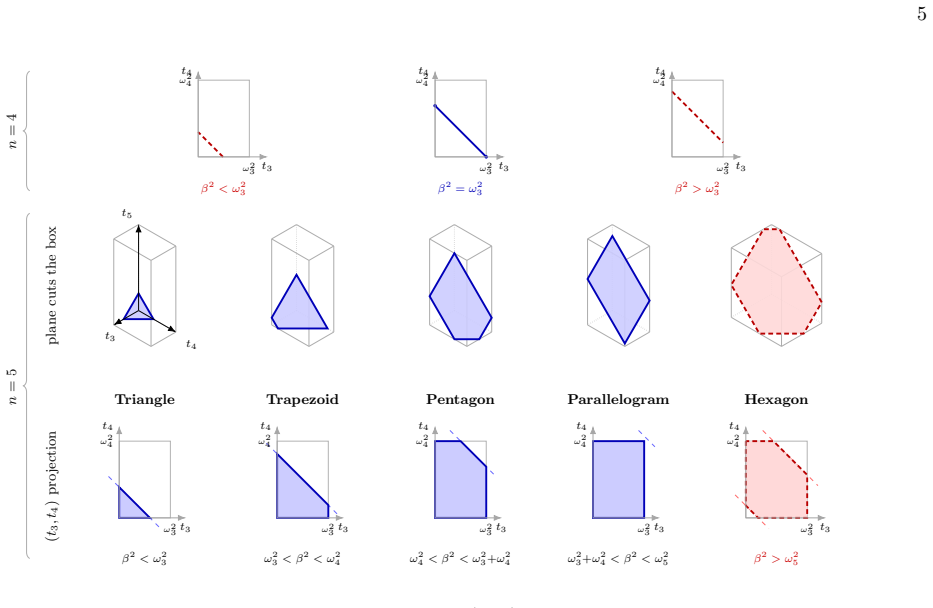
Energy and momentum conservation further constrainsW 4 toβ 2 =ω 2 3.Middle and bottom (n=5 ):the rectangular prism [0, ω 2 3]×[0, ω 2 4]×[0, ω 2 5] (ω 2 3 ≤ω 2 4 ≤ω 2
cut byt 3 +t 4 =β 2 givesW 4, a segment whose length is the amplitude. Energy and momentum conservation further constrainsW 4 toβ 2 =ω 2 3.Middle and bottom (n=5 ):the rectangular prism [0, ω 2 3]×[0, ω 2 4]×[0, ω 2 5] (ω 2 3 ≤ω 2 4 ≤ω 2
-
[3]
spline theory
cut byt 3 +t 4 +t 5 =β 2 givesW 5 (middle), and the same slice in the (t 3, t4) projection (bottom). Asβ 2 grows the section sweeps through the shapes shown; red marks the kinematically forbidden regions. these are all properties of the volume formula, and indeed if we reverse the logic, we can uniquely determine the volume function in this way. We are lo...
1980
-
[4]
C. S. Gardner, J. M. Greene, M. D. Kruskal, and R. M. Miura, Phys. Rev. Lett.19, 1095 (1967)
1967
-
[5]
V. E. Zakharov, V. S. L’vov, and G. Falkovich,Kol- mogorov Spectra of Turbulence I: Wave Turbulence (Springer, 1992)
1992
-
[6]
P. Delplace, J. B. Marston, and A. Venaille, Science358, 1075 (2017), arXiv:1702.07583 [physics.flu-dyn]
Pith/arXiv arXiv 2017
-
[7]
Tong, SciPost Phys.14, 102 (2023), arXiv:2209.10574 [hep-th]
D. Tong, SciPost Phys.14, 102 (2023), arXiv:2209.10574 [hep-th]
arXiv 2023
-
[8]
Onorato, S
M. Onorato, S. Residori, U. Bortolozzo, A. Montina, and F. T. Arecchi, Phys. Rep.528, 47 (2013)
2013
-
[9]
V. E. Zakharov, J. Appl. Mech. Tech. Phys.9, 190 (1968)
1968
-
[10]
Nazarenko,Wave Turbulence, Lect
S. Nazarenko,Wave Turbulence, Lect. Notes Phys., Vol. 825 (Springer, 2011)
2011
-
[11]
H. W. Wyld, Ann. Phys. (N.Y.)14, 143 (1961)
1961
-
[12]
Hasselmann, J
K. Hasselmann, J. Fluid Mech.12, 481 (1962)
1962
-
[13]
Hasselmann, Reviews of Geophysics4, 1 (1966)
K. Hasselmann, Reviews of Geophysics4, 1 (1966)
1966
-
[14]
A. I. Dyachenko and V. E. Zakharov, Phys. Lett. A190, 144 (1994)
1994
-
[15]
Craig and P
W. Craig and P. A. Worfolk, Physica D84, 513 (1995)
1995
-
[16]
A. I. Dyachenko, Y. V. L’vov, and V. E. Zakharov, Phys- ica D87, 233 (1995)
1995
-
[17]
Y. V. Lvov, Phys. Lett. A230, 38 (1997)
1997
-
[18]
S. J. Parke and T. R. Taylor, Phys. Rev. Lett.56, 2459 (1986)
1986
-
[19]
Britto, F
R. Britto, F. Cachazo, B. Feng, and E. Witten, Phys. Rev. Lett.94, 181602 (2005)
2005
-
[20]
N. Arkani-Hamed and J. Trnka, J. High Energy Phys. 10, 030, arXiv:1312.2007 [hep-th]
Pith/arXiv arXiv 2007
-
[21]
N. Arkani-Hamed, Y. Bai, S. He, and G. Yan, J. High Energy Phys.05, 096, arXiv:1711.09102 [hep-th]
-
[22]
N. Arkani-Hamed, P. Benincasa, and A. Postnikov, Cos- mological polytopes and the wavefunction of the universe (2017), arXiv:1709.02813 [hep-th]
Pith/arXiv arXiv 2017
-
[23]
N. Arkani-Hamed, Y. Bai, and T. Lam, J. High Energy Phys.11, 039, arXiv:1703.04541 [hep-th]
-
[24]
J. C. Luke, J. Fluid Mech.27, 395 (1967)
1967
-
[25]
T. B. Benjamin and P. J. Olver, J. Fluid Mech.125, 137 (1982)
1982
-
[26]
Here, expressions such as (∂ tξ)2ξare a shorthand for the momentum space integrals with the accompanying mo- mentum conserving delta functions: Z ddk1 (2π)d ddk2 (2π)d ddk3 (2π)d ∂tξ(k1)∂tξ(k2)ξ(k3)(2π)dδd(k1 +k 2 +k 3)
-
[27]
Arkani-Hamed, F
N. Arkani-Hamed, F. Calisto, N. Ussembayev, W. Zhao, and Z. Zhou, Hydrotope: code for tree-level surface water-wave amplitudes, GitHub repository (2026)
2026
-
[28]
Craig and C
W. Craig and C. Sulem, J. Comput. Phys.108, 73 (1993)
1993
-
[29]
N. S. Ussembayev, Non-interacting gravity waves on the surface of a deep fluid (2019), arXiv:1903.10854 [physics.flu-dyn]
Pith/arXiv arXiv 2019
-
[30]
Arkani-Hamed, F
N. Arkani-Hamed, F. Calisto, N. Ussembayev, W. Zhao, and Z. Zhou (2026), to appear
2026
-
[31]
F. A. Berends and W. T. Giele, Nucl. Phys. B306, 759 (1988)
1988
-
[32]
N. S. Ussembayev, Exact solution for progressive grav- ity waves on the surface of a deep fluid (2019), arXiv:1903.11909 [physics.flu-dyn]
Pith/arXiv arXiv 2019
-
[33]
de Boor and K
C. de Boor and K. H¨ ollig, J. Analyse Math.42, 99 (1982)
1982
-
[34]
de Boor, K
C. de Boor, K. H¨ ollig, and S. Riemenschneider, Box Splines, Applied Mathematical Sciences, Vol. 98 (Springer, New York, 1993)
1993
-
[35]
Dysthe, H
K. Dysthe, H. E. Krogstad, and P. M¨ uller, Annu. Rev. Fluid Mech.40, 287 (2008)
2008
-
[36]
Onorato, A
M. Onorato, A. R. Osborne, M. Serio, L. Cavaleri, C. Brandini, and C. T. Stansberg, Phys. Rev. E70, 067302 (2004)
2004
-
[37]
Slunyaev, E
A. Slunyaev, E. Pelinovsky, A. Sergeeva, A. Chabchoub, N. Hoffmann, M. Onorato, and N. Akhmediev, Phys. Rev. E88, 012909 (2013)
2013
-
[38]
A. Guevara, A. Lupsasca, D. Skinner, A. Strominger, and K. Weil, Single-minus gluon tree amplitudes are nonzero (2026), arXiv:2602.12176 [hep-th]. 8 Supplemental Material LAGRANGIAN KERNELS Integrating out the bulk leaves a Lagrangian for the surface elevationξalone. Withu≡ ˙ξand the Dirichlet– Neumann operatorG(ξ), defined byu=G(ξ)ψ, it reads L= 1 2 u G(...
arXiv 2026
discussion (0)
Sign in with ORCID, Apple, or X to comment. Anyone can read and Pith papers without signing in.