Near-threshold scattering of proton and Omega baryon and possible bound states
Pith reviewed 2026-06-29 02:56 UTC · model grok-4.3
The pith
Pomeron exchange improves agreement of NΩ ^5S2 observables with data and predicts a weak quasi-bound state in the ^3S1 channel.
A machine-rendered reading of the paper's core claim, the machinery that carries it, and where it could break.
Core claim
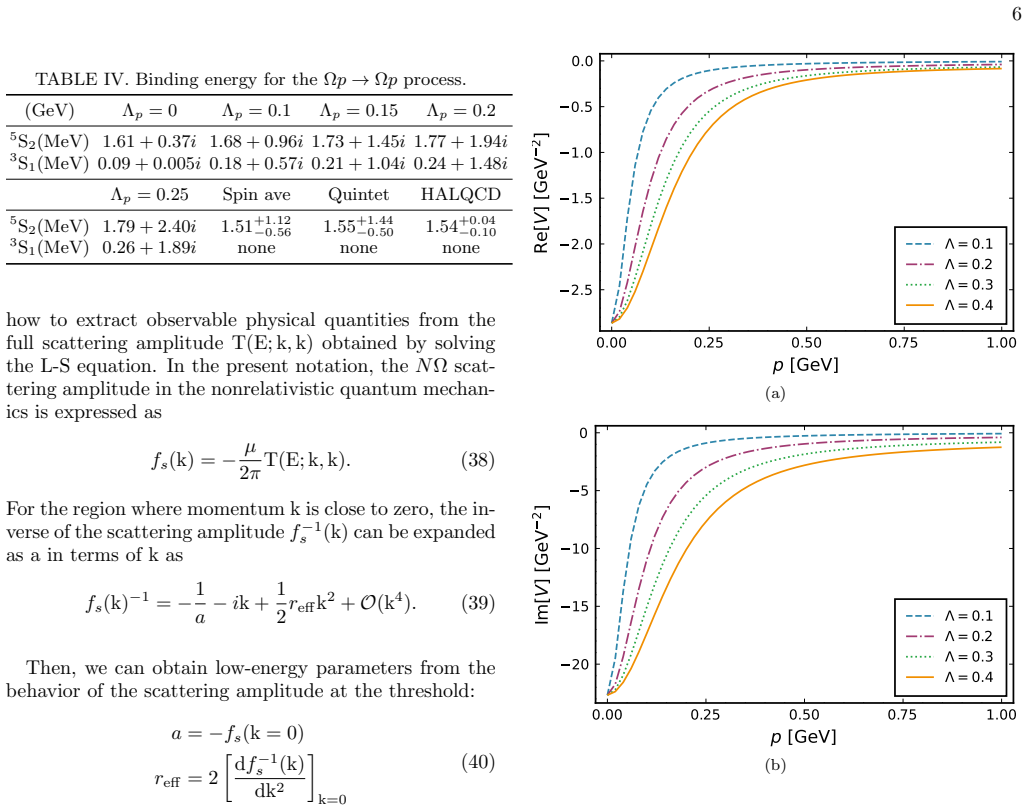
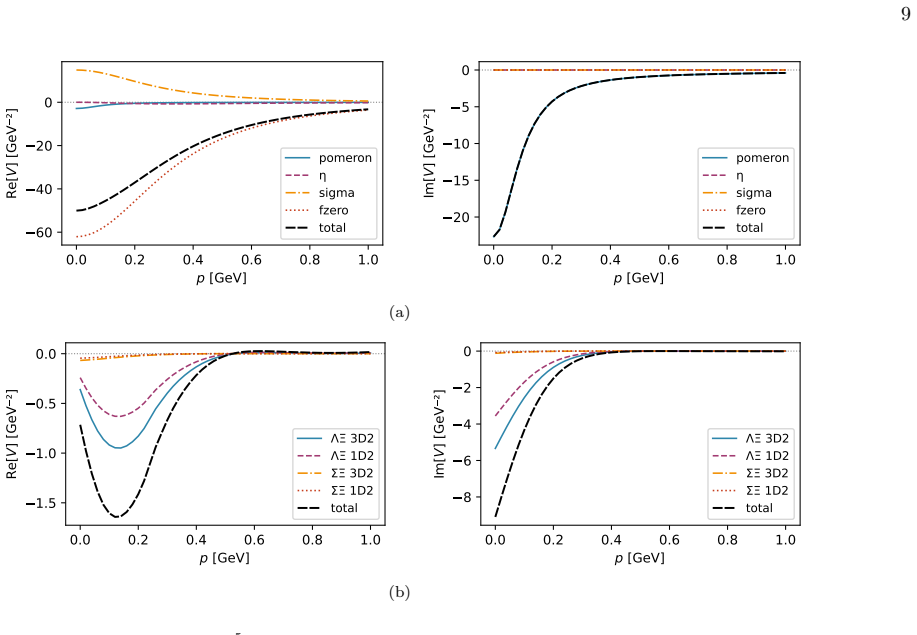
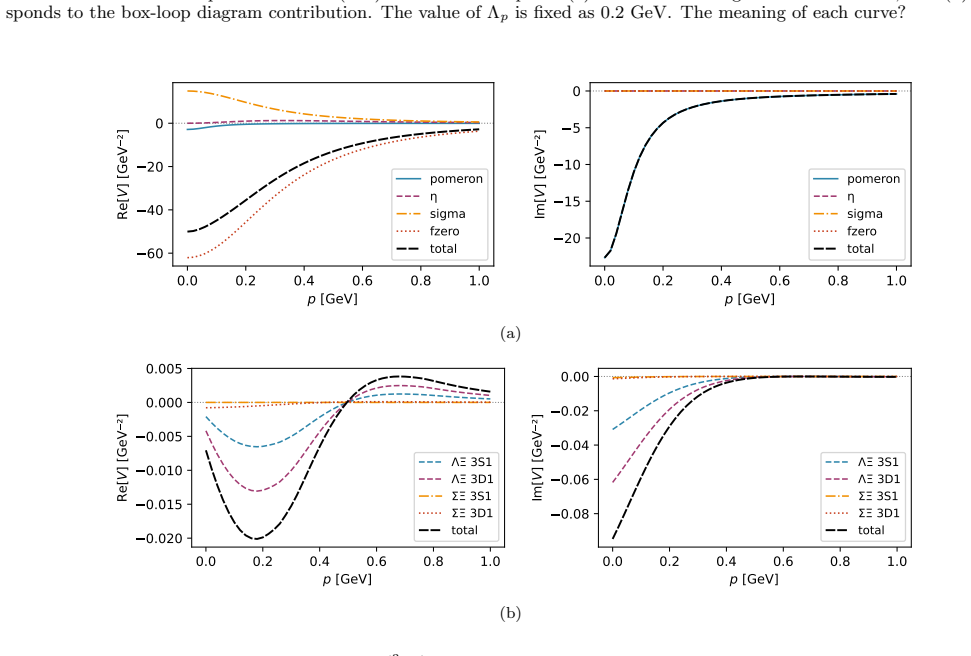
We study the near-threshold scattering and bound-state structure of the NΩ system by solving the Lippmann-Schwinger equation within the framework of the meson exchange model and the Pomeron exchange model. The numerical results indicate that after incorporating the Pomeron exchange mechanism, the observables of the ^5S2 channel, such as the binding energy, scattering length, and effective range, agree better with the experimental measurements. In addition, the Pomeron exchange can provide an extra attractive interaction to make the hadronic state more compact. We also predict the scattering behavior of the ^3S1 channel and confirm that a weak quasi-bound state exists in this channel.
What carries the argument
Lippmann-Schwinger equation solved with meson-exchange plus Pomeron-exchange potentials for the NΩ system in the ^5S2 and ^3S1 channels.
If this is right
- Binding energy, scattering length and effective range in ^5S2 move closer to experimental values.
- The hadronic state in ^5S2 becomes spatially more compact.
- A weak quasi-bound state appears in the ^3S1 channel.
- Scattering observables in ^3S1 provide a direct test of the Pomeron contribution.
Where Pith is reading between the lines
- The same potential construction could be applied to other near-threshold baryon-baryon systems to check whether Pomeron exchange systematically improves compactness.
- If the ^3S1 quasi-bound state is confirmed, it would suggest that Pomeron exchange helps stabilize compact multiquark configurations beyond the NΩ case.
- Experimental searches focused on the ^3S1 channel could distinguish between pure meson-exchange models and those that include Pomeron exchange.
Load-bearing premise
The combined meson-exchange and Pomeron-exchange potentials, when inserted into the Lippmann-Schwinger equation, capture the dominant near-threshold dynamics without extra channels or relativistic corrections.
What would settle it
A future measurement of the ^3S1 scattering length or binding energy that lies far outside the range predicted by the Pomeron-inclusive calculation.
Figures




read the original abstract
We study the near-threshold scattering and bound-state structure of the $N\Omega$ system by solving the Lippmann-Schwinger (L-S) equation within the framework of the meson exchange model and the Pomeron exchange model. The numerical results indicate that after incorporating the Pomeron exchange mechanism, the observables of the ${^5}S{_2}$ channel, such as the binding energy, scattering length, and effective range, agree better with the experimental measurements. In addition, The Pomeron exchange can provide an extra attractive interaction to make the hadronic state more compact. We also predict the scattering behavior of the ${^3}S{_1}$ channel and confirm that a weak quasi-bound state exists in this channel. Future experimental measurements on the ${^3}S{_1}$ channel will provide an important criterion for verifying the dynamic role played by the Pomeron exchange mechanism within the $N\Omega$ system.
Editorial analysis
A structured set of objections, weighed in public.
Referee Report
Summary. The paper studies near-threshold NΩ scattering and possible bound states by solving the non-relativistic Lippmann-Schwinger equation with meson-exchange potentials supplemented by a Pomeron-exchange term. It claims that adding the Pomeron improves agreement with experimental values for the ^5S2 channel observables (binding energy, scattering length, effective range), supplies extra attraction that makes the state more compact, and predicts a weak quasi-bound state in the ^3S1 channel whose future measurement would test the Pomeron mechanism.
Significance. If the modeling holds, the work would indicate that a high-energy Regge-inspired Pomeron term can meaningfully affect low-energy baryon-baryon observables and help stabilize compact states. The ^3S1 prediction supplies a concrete experimental test. The significance is reduced, however, by the absence of any reported parameter-fitting procedure, cutoff sensitivity, or independent validation of the Pomeron potential at threshold.
major comments (3)
- [Abstract and model-construction section] Abstract and model-construction section: the assertion that Pomeron exchange produces better agreement with experiment for ^5S2 observables supplies no information on how the Pomeron coupling was fixed, whether it was adjusted to the same data used for the comparison, or how results change under variation of the cutoff or channel truncation. Without this, the improvement cannot be assessed as robust.
- [Pomeron potential derivation] Pomeron potential derivation: the manuscript inserts a static Pomeron-exchange potential into the Lippmann-Schwinger equation at threshold energies, yet provides no first-principles derivation or low-energy validation for this step. Because Pomeron exchange is conventionally a high-energy Regge phenomenon, its use here as an attractive term is load-bearing for both the improved ^5S2 results and the ^3S1 quasi-bound-state claim; the lack of justification therefore undermines attribution of the effects to the Pomeron mechanism.
- [^3S1 results paragraph] ^3S1 results paragraph: the prediction of a weak quasi-bound state rests on the same unvalidated Pomeron term and the non-relativistic, single-channel LS framework. No estimate is given for the size of relativistic corrections or omitted channels, both of which are potentially important near threshold.
minor comments (2)
- [Notation] Notation: the spin-channel labels (^5S2, ^3S1) should be used consistently in all equations and tables.
- [References] References: the manuscript should cite prior meson-exchange studies of the NΩ system and any existing low-energy applications of Pomeron exchange for comparison.
Simulated Author's Rebuttal
We thank the referee for the careful reading and constructive comments. We address each major point below and indicate where revisions will be made to strengthen the manuscript.
read point-by-point responses
-
Referee: [Abstract and model-construction section] Abstract and model-construction section: the assertion that Pomeron exchange produces better agreement with experiment for ^5S2 observables supplies no information on how the Pomeron coupling was fixed, whether it was adjusted to the same data used for the comparison, or how results change under variation of the cutoff or channel truncation. Without this, the improvement cannot be assessed as robust.
Authors: We agree that the manuscript lacks explicit details on the Pomeron coupling determination and sensitivity studies. In the revised version we will add a dedicated subsection describing how the Pomeron parameters were chosen (including any relation to existing phenomenological values or data), together with explicit results for cutoff variations and channel truncation to demonstrate robustness. revision: yes
-
Referee: [Pomeron potential derivation] Pomeron potential derivation: the manuscript inserts a static Pomeron-exchange potential into the Lippmann-Schwinger equation at threshold energies, yet provides no first-principles derivation or low-energy validation for this step. Because Pomeron exchange is conventionally a high-energy Regge phenomenon, its use here as an attractive term is load-bearing for both the improved ^5S2 results and the ^3S1 quasi-bound-state claim; the lack of justification therefore undermines attribution of the effects to the Pomeron mechanism.
Authors: The Pomeron term is introduced as a phenomenological extension motivated by Regge phenomenology and prior applications to baryon-baryon systems; a complete first-principles QCD derivation lies outside the scope of the present work. We will expand the model-construction section with additional references and a concise discussion of the static approximation's rationale at low energies, while explicitly noting the phenomenological nature of the choice and its limitations. revision: partial
-
Referee: [^3S1 results paragraph] ^3S1 results paragraph: the prediction of a weak quasi-bound state rests on the same unvalidated Pomeron term and the non-relativistic, single-channel LS framework. No estimate is given for the size of relativistic corrections or omitted channels, both of which are potentially important near threshold.
Authors: We acknowledge that quantitative estimates of relativistic corrections and omitted-channel effects would improve the ^3S1 discussion. In the revision we will add a short paragraph providing order-of-magnitude estimates based on typical scales near threshold and argue why the non-relativistic single-channel treatment remains a reasonable first approximation, while noting that a full relativistic multi-channel calculation is left for future work. revision: yes
Circularity Check
No circularity: derivation remains independent of its fitted outputs
full rationale
The provided text (abstract plus context) describes solving the Lippmann-Schwinger equation with meson-exchange plus Pomeron-exchange potentials and then comparing the resulting binding energy, scattering length, and effective range to external experimental measurements. No equations, parameter-fitting statements, or self-citations are supplied that would allow any observable to be rewritten as a direct function of itself or of a parameter tuned to the same data. The comparison is therefore to an independent benchmark, satisfying the condition for a self-contained derivation.
Axiom & Free-Parameter Ledger
Reference graph
Works this paper leans on
-
[1]
D. Chatterjee and I. Vida˜ na, Do hyperons exist in the interior of neutron stars?, Eur. Phys. J. A52, 29 (2016), arXiv:1510.06306 [nucl-th]
Pith/arXiv arXiv 2016
-
[2]
H. C. Urey, F. G. Brickwedde, and G. M. Murphy, A hydrogen isotope of mass 2, Phys. Rev.39, 164 (1932)
1932
-
[3]
R. L. Jaffe, Perhaps a Stable Dihyperon, Phys. Rev. Lett.38, 195 (1977), [Erratum: Phys.Rev.Lett. 38, 617 (1977)]
1977
-
[4]
P. Adlarsonet al.(WASA-at-COSY), Measurement of thenp→npπ 0π0 Reaction in Search for the Recently Observedd ∗(2380) Resonance, Phys. Lett. B743, 325 (2015), arXiv:1409.2659 [nucl-ex]
Pith/arXiv arXiv 2015
-
[5]
Y. Dong, P. Shen, and Z. Zhang, d∗(2380) in a chiral constituent quark model, Prog. Part. Nucl. Phys.131, 104045 (2023)
2023
-
[6]
Adamet al.(STAR), The Proton-Ω correlation func- tion in Au+Au collisions at √sN N=200 GeV, Phys
J. Adamet al.(STAR), The Proton-Ω correlation func- tion in Au+Au collisions at √sN N=200 GeV, Phys. Lett. B790, 490 (2019), arXiv:1808.02511 [hep-ex]
Pith/arXiv arXiv 2019
-
[7]
X.-H. Chen, Q.-N. Wang, W. Chen, and H.-X. Chen, Mass spectra ofNΩ dibaryons in the 3S1 and 5S2 chan- nels, Phys. Rev. D103, 094011 (2021), arXiv:2103.09739 [hep-ph]
arXiv 2021
-
[8]
J. T. Goldman, K. Maltman, G. J. Stephenson, Jr., K. E. Schmidt, and F. Wang, STRANGENESS -3 DIBARYONS, Phys. Rev. Lett.59, 627 (1987)
1987
-
[9]
J. Haidenbauer, S. Petschauer, N. Kaiser, U.-G. Meißner, and W. Weise, Scattering of decuplet baryons in chiral effective field theory, Eur. Phys. J. C77, 760 (2017), arXiv:1708.08071 [nucl-th]
Pith/arXiv arXiv 2017
-
[10]
H. Huang, J. Ping, and F. Wang, Further study of theNΩ dibaryon within constituent quark models, Phys. Rev. C 92, 065202 (2015), arXiv:1507.07124 [hep-ph]
Pith/arXiv arXiv 2015
-
[11]
Iritaniet al.(HAL QCD),NΩ dibaryon from lattice QCD near the physical point, Phys
T. Iritaniet al.(HAL QCD),NΩ dibaryon from lattice QCD near the physical point, Phys. Lett. B792, 284 (2019), arXiv:1810.03416 [hep-lat]
Pith/arXiv arXiv 2019
-
[12]
Oka, Flavor Octet Dibaryons in the Quark Model, Phys
M. Oka, Flavor Octet Dibaryons in the Quark Model, Phys. Rev. D38, 298 (1988)
1988
-
[13]
T. Sekihara, Y. Kamiya, and T. Hyodo,NΩ interaction: meson exchanges, inelastic channels, and quasibound state, Phys. Rev. C98, 015205 (2018), arXiv:1805.04024 [hep-ph]
Pith/arXiv arXiv 2018
-
[14]
Y. Yan, Q. Huang, Y. Yang, H. Huang, and J. Ping, Investigating the p-Ω interactions and correlation func- tions, Sci. China Phys. Mech. Astron.68, 232012 (2025), arXiv:2408.15493 [hep-ph]
arXiv 2025
-
[15]
K. Zhang, Search for the Strange Dibaryons with Baryon Correlations in Isobar Collisions at STAR, in31st International Conference on Ultra-relativistic Nucleus- Nucleus Collisions(2025) arXiv:2512.09452 [nucl-ex]
arXiv 2025
-
[16]
Q. B. Li and P. N. Shen, N Omega and Delta Omega dibaryons in SU(3) chiral quark model, Eur. Phys. J. A 8, 417 (2000), arXiv:nucl-th/9910060
Pith/arXiv arXiv 2000
-
[17]
H.-r. Pang, J.-l. Ping, F. Wang, J. T. Goldman, and E.-g. Zhao, High strangeness dibaryons in the extended quark delocalization, color screening model, Phys. Rev. C69, 065207 (2004), arXiv:nucl-th/0306043
Pith/arXiv arXiv 2004
-
[18]
M. Chen, H. Huang, J. Ping, and F. Wang, Quark model study of strange dibaryon resonances, Phys. Rev. C83, 015202 (2011)
2011
-
[19]
T. Sekihara and T. Hashiguchi, Reexamination of the short-range baryon-baryon potentials in the con- stituent quark model, Phys. Rev. C108, 065202 (2023), arXiv:2304.13877 [nucl-th]
arXiv 2023
-
[20]
L.-R. Dai, D. Zhang, C.-R. Li, and L. Tong, Structures of N Omega and Delta Omega dibaryons, Chin. Phys. Lett. 24, 389 (2007)
2007
-
[21]
L. Zhao, N. Li, S.-L. Zhu, and B.-S. Zou, Meson-exchange model for the Λ ¯Λ interaction, Phys. Rev. D87, 054034 (2013), arXiv:1302.1770 [hep-ph]
Pith/arXiv arXiv 2013
-
[22]
Jacob and G
M. Jacob and G. C. Wick, On the General Theory of Collisions for Particles with Spin, Annals Phys.7, 404 (1959)
1959
- [23]
-
[24]
T. A. Rijken, M. M. Nagels, and Y. Yamamoto, Baryon- baryon interactions: Nijmegen extended-soft-core mod- els, Prog. Theor. Phys. Suppl.185, 14 (2010)
2010
-
[25]
X.-L. Ren, L.-S. Geng, and J. Meng, Decuplet baryon masses in covariant baryon chiral perturbation theory, Phys. Rev. D89, 054034 (2014), arXiv:1307.1896 [nucl- th]
Pith/arXiv arXiv 2014
-
[26]
L. L. Lopes, K. D. Marquez, and D. P. Menezes, Baryon coupling scheme in a unified SU(3) and SU(6) sym- metry formalism, Phys. Rev. D107, 036011 (2023), arXiv:2211.17153 [hep-ph]
arXiv 2023
-
[27]
C. Hanhart, Y. S. Kalashnikova, A. E. Kudryavtsev, and A. V. Nefediev, Two-photon decays of hadronic molecules, Phys. Rev. D75, 074015 (2007), arXiv:hep- ph/0701214
arXiv 2007
-
[28]
T. Branz, T. Gutsche, and V. E. Lyubovitskij, f0(980) meson as a K anti-K molecule in a phenomenological Lagrangian approach, Eur. Phys. J. A37, 303 (2008), arXiv:0712.0354 [hep-ph]
Pith/arXiv arXiv 2008
-
[29]
W.-H. Liang, J.-J. Xie, and E. Oset,f 0(500) ,f 0(980) , anda 0(980) production in theχ c1 →ηπ +π− reaction, Eur. Phys. J. C76, 700 (2016), arXiv:1609.03864 [hep- ph]
Pith/arXiv arXiv 2016
-
[30]
R. Molina, J.-J. Xie, W.-H. Liang, L.-S. Geng, and E. Oset, Theoretical interpretation of theD + s →π +π0η decay and the nature ofa 0(980), Phys. Lett. B803, 135279 (2020), arXiv:1908.11557 [hep-ph]
arXiv 2020
-
[31]
L. R. Dai and E. Oset, Dynamical generation of the scalar f0(500), f0(980), and K0*(700) resonances in the Ds+→K+π+π- reaction, Phys. Rev. D109, 054008 (2024), arXiv:2307.03014 [hep-ph]
arXiv 2024
-
[32]
J. J. de Swart, The Octet model and its Clebsch-Gordan coefficients, Rev. Mod. Phys.35, 916 (1963), [Erratum: Rev.Mod.Phys. 37, 326–326 (1965)]
1963
-
[33]
N. Yalikun and B.-S. Zou, Anticharmed strange pen- taquarks from the one-boson-exchange model, Phys. Rev. D105, 094026 (2022), arXiv:2112.06426 [hep-ph]
arXiv 2022
-
[34]
Donnachie and P
A. Donnachie and P. V. Landshoff, Elastic Scattering and Diffraction Dissociation, Nucl. Phys. B244, 322 (1984)
1984
-
[35]
Donnachie and P
A. Donnachie and P. V. Landshoff, Exclusive rho Pro- duction in Deep Inelastic Scattering, Phys. Lett. B185, 403 (1987)
1987
-
[36]
M. A. Pichowsky and T. S. H. Lee, Pomeron exchange and exclusive electroproduction of rho mesons in QCD, Phys. Lett. B379, 1 (1996), arXiv:nucl-th/9601032
Pith/arXiv arXiv 1996
-
[37]
M. A. Pichowsky and T. S. H. Lee, Exclusive diffractive 11 processes and the quark substructure of mesons, Phys. Rev. D56, 1644 (1997), arXiv:nucl-th/9612049
Pith/arXiv arXiv 1997
-
[38]
J. M. Laget and R. Mendez-Galain, Exclusive photopro- duction and electroproduction of vector mesons at large momentum transfer, Nucl. Phys. A581, 397 (1995)
1995
-
[39]
Q. Zhao, J. P. Didelez, M. Guidal, and B. Saghai, Nucle- onic resonance effects in the phi meson photoproduction, Nucl. Phys. A660, 323 (1999), arXiv:nucl-th/9906013
Pith/arXiv arXiv 1999
-
[40]
C. Gong, M.-C. Du, Q. Zhao, X.-H. Zhong, and B. Zhou, Nature of X(6900) and its production mech- anism at LHCb, Phys. Lett. B824, 136794 (2022), arXiv:2011.11374 [hep-ph]
arXiv 2022
-
[41]
C. Gong, M.-C. Du, and Q. Zhao, Pseudoscalar charmonium pair interactions via the Pomeron ex- change mechanism, Phys. Rev. D106, 054011 (2022), arXiv:2206.13867 [hep-ph]
arXiv 2022
-
[42]
T. S. H. Lee, S. Sakinah, and Y. Oh, Models ofJ/Ψ photo-production reactions on the nucleon, Eur. Phys. J. A58, 252 (2022), arXiv:2210.02154 [hep-ph]
arXiv 2022
-
[43]
Nozawa and D
S. Nozawa and D. B. Leinweber, Electromagnetic form- factors of spin 3/2 baryons, Phys. Rev. D42, 3567 (1990)
1990
-
[44]
C. Alexandrou, T. Korzec, G. Koutsou, C. Lorce, J. W. Negele, V. Pascalutsa, A. Tsapalis, and M. Van- derhaeghen, Quark transverse charge densities in the Delta(1232) from lattice QCD, Nucl. Phys. A825, 115 (2009), arXiv:0901.3457 [hep-ph]
Pith/arXiv arXiv 2009
-
[45]
Ramalho, Electromagnetic form factors of the Ω − baryon in the spacelike and timelike regions, Phys
G. Ramalho, Electromagnetic form factors of the Ω − baryon in the spacelike and timelike regions, Phys. Rev. D103, 074018 (2021), arXiv:2012.11710 [hep-ph]
arXiv 2021
-
[46]
P. A. Zylaet al.(Particle Data Group), Review of Par- ticle Physics, PTEP2020, 083C01 (2020)
2020
-
[47]
G. Ramalho and M. T. Pena, Extracting the Omega- elec- tric quadrupole moment from lattice QCD data, Phys. Rev. D83, 054011 (2011), arXiv:1012.2168 [hep-ph]
Pith/arXiv arXiv 2011
-
[48]
Zhang, PentaquarksP c in a dynamical coupled- channel approach ofγp→J/ψpreaction, Eur
X. Zhang, PentaquarksP c in a dynamical coupled- channel approach ofγp→J/ψpreaction, Eur. Phys. J. C85, 1120 (2025), arXiv:2410.10154 [hep-ph]
arXiv 2025
-
[49]
V. Baru, X.-K. Dong, M.-L. Du, A. Filin, F.- K. Guo, C. Hanhart, A. Nefediev, J. Nieves, and Q. Wang, Effective range expansion for narrow near- threshold resonances, Phys. Lett. B833, 137290 (2022), arXiv:2110.07484 [hep-ph]
arXiv 2022
-
[50]
C.-J. Xiao, Y.-B. Dong, T. Gutsche, V. E. Lyubovit- skij, and D.-Y. Chen, Towards the decay properties of deuteron-like state dNΩ, Phys. Rev. D101, 114032 (2020), arXiv:2004.12415 [hep-ph]
arXiv 2020
discussion (0)
Sign in with ORCID, Apple, or X to comment. Anyone can read and Pith papers without signing in.