Density Functions and Random Number Generators of α-Stable Distributions
Pith reviewed 2026-06-30 01:00 UTC · model grok-4.3
The pith
AUB-HTP package improves accuracy and stability of alpha-stable density computation while enabling multivariate simulation.
A machine-rendered reading of the paper's core claim, the machinery that carries it, and where it could break.
Core claim
AUB-HTP implements scalar density evaluation via Zolotarev-type integrals, series formulas, and characteristic function inversion, together with LePage series representations for random variate generation in scalar and multivariate settings, and experiments show gains in accuracy, stability, and parameter coverage over existing tools along with new multivariate capabilities.
What carries the argument
The AUB-HTP Python package, using complementary numerical methods including Zolotarev-type integral representations, series formulas, numerical inversion of characteristic functions for densities, and LePage series for simulation.
If this is right
- Scalar density computations become feasible and accurate for parameter values where prior tools were unstable or inaccurate.
- Multivariate alpha-stable random variates can now be generated for applications requiring joint heavy-tailed modeling.
- Reproducible simulations involving sums of heavy-tailed sources are facilitated across engineering, finance, and network science.
- Users gain flexibility in choosing spectral measures for the stable distributions.
Where Pith is reading between the lines
- Integration with existing statistical libraries could allow seamless use in larger data analysis pipelines.
- Extension to other related distributions like tempered stable laws might follow similar implementation strategies.
- Validation against real-world datasets from physics or finance would further demonstrate practical utility.
Load-bearing premise
The numerical implementations are free of coding errors and the chosen test cases fairly represent the parameter regimes where existing tools fail, without post-hoc selection that favors the new package.
What would settle it
Finding a parameter combination where an existing density tool produces a result closer to a high-precision reference than AUB-HTP does, or where multivariate samples from AUB-HTP fail basic consistency checks like marginal stability.
Figures

read the original abstract
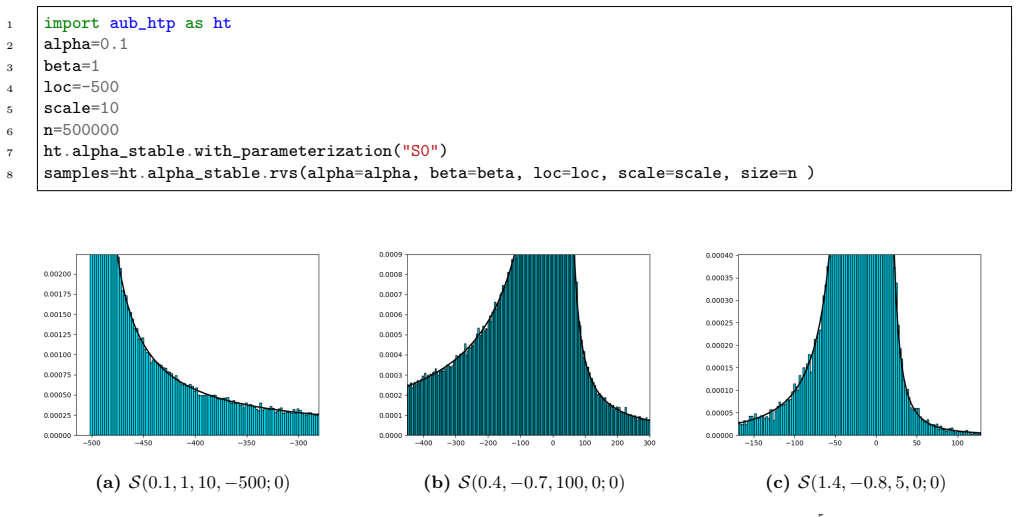
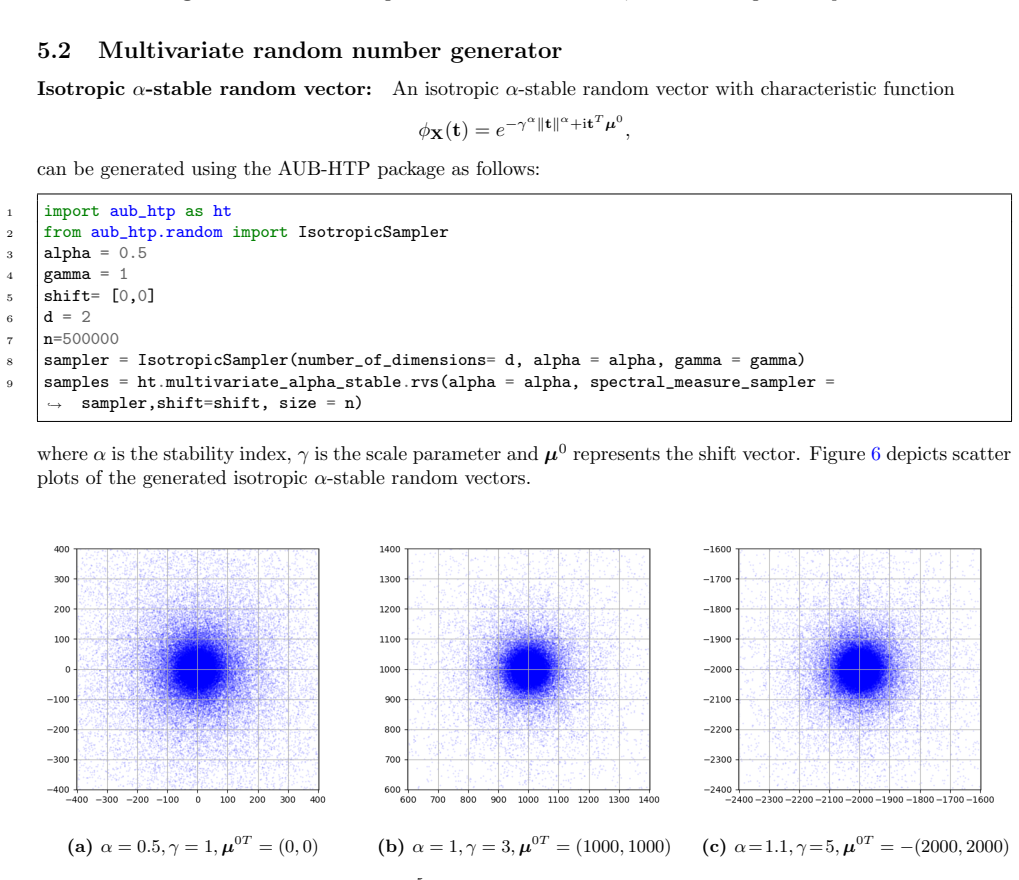
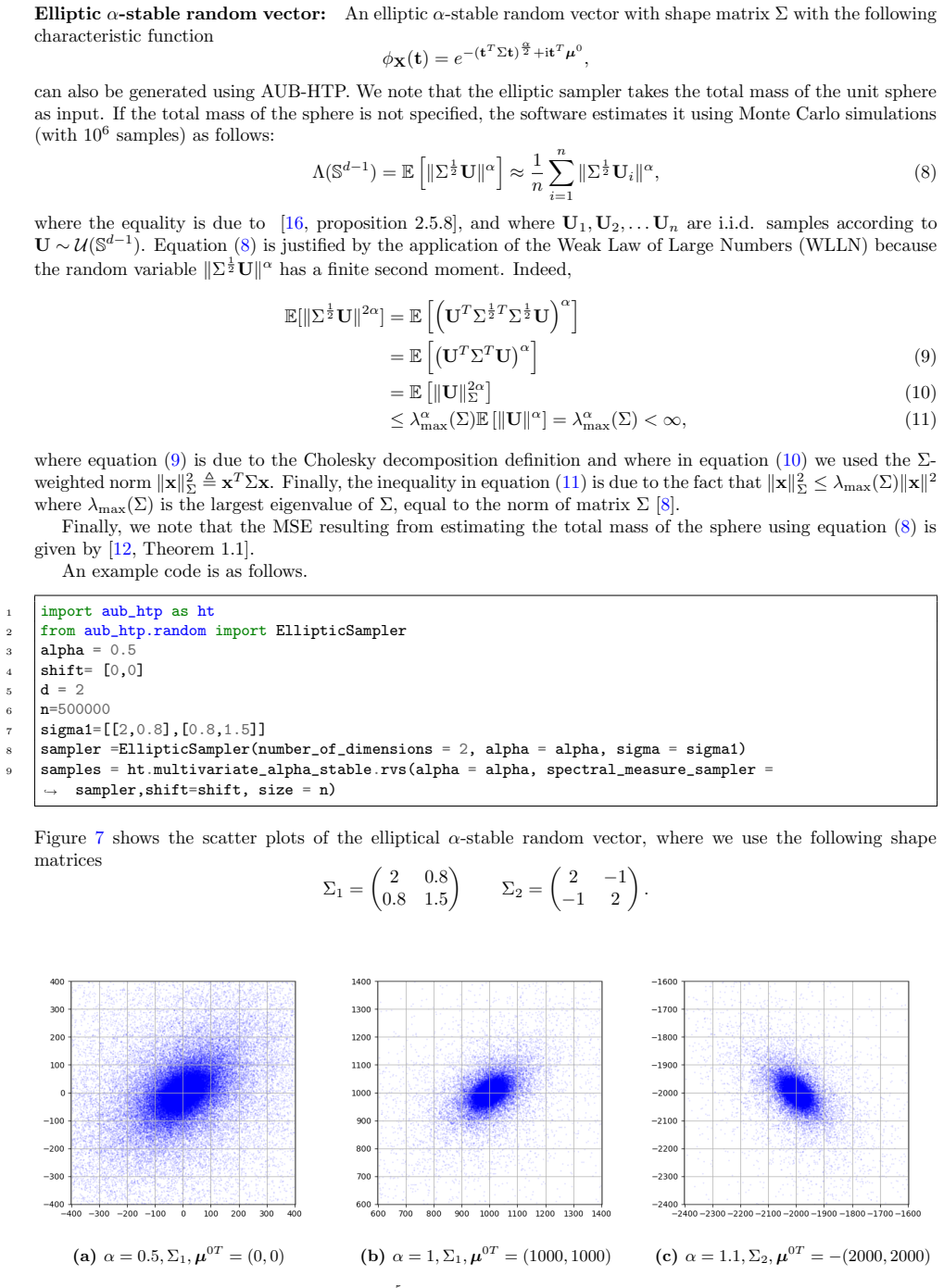
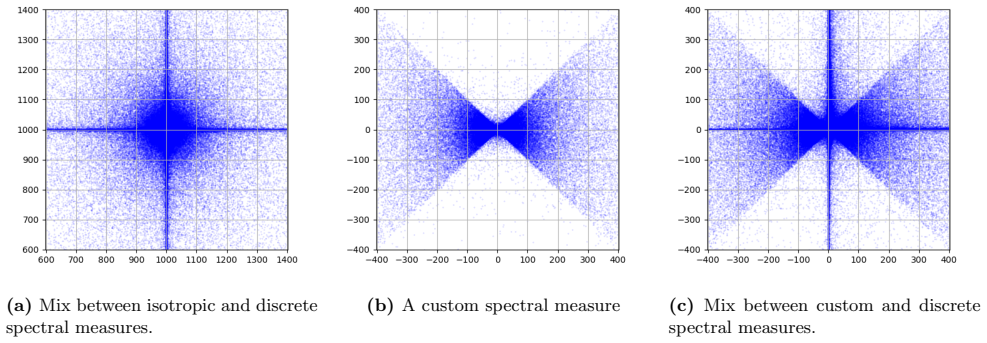
Heavy-tailed distributions are increasingly found to better fit empirical data in engineering, finance, physics, network science, and related fields. Among them, $\alpha$-stable distributions play a central role being limiting laws in the generalized central limit theorem: they are expected to be exceptionally good models whenever sums of multiple independent heavy-tailed sources are at play. Despite their theoretical importance, their practical use remains challenging: $\alpha$-stable probability densities generally do not have closed-form expressions, and numerical evaluation and random variate generation can be difficult, especially in the multivariate setting. This paper presents AUB-HTP, a Python package for numerical computation and simulation of $\alpha$-stable distributions. The package provides scalar density evaluation using several complementary methods, including Zolotarev-type integral representations, series formulas, and numerical inversion of characteristic functions. It also provides random variate generation for scalar and multivariate $\alpha$-stable distributions, with support for flexible spectral measures through LePage series representations. Numerical experiments demonstrate that AUB-HTP improves the accuracy, stability, and parameter coverage of existing tools for scalar density computation, while adding new capabilities for multivariate simulation. The package is designed to support reproducible computational work involving heavy-tailed models across a broad range of scientific applications.
Editorial analysis
A structured set of objections, weighed in public.
Referee Report
Summary. The manuscript presents AUB-HTP, a Python package implementing multiple methods (Zolotarev-type integrals, series expansions, characteristic-function inversion) for scalar α-stable density evaluation and LePage-series representations for scalar and multivariate random-variate generation. It asserts that numerical experiments demonstrate superior accuracy, stability, and parameter coverage relative to existing tools, together with new multivariate simulation capabilities.
Significance. If the implementations prove correct and the performance claims are reproducible, the package would supply a missing, open-source resource for reliable α-stable modeling in heavy-tailed applications across finance, physics, and network science, especially for the multivariate case where few alternatives exist.
major comments (2)
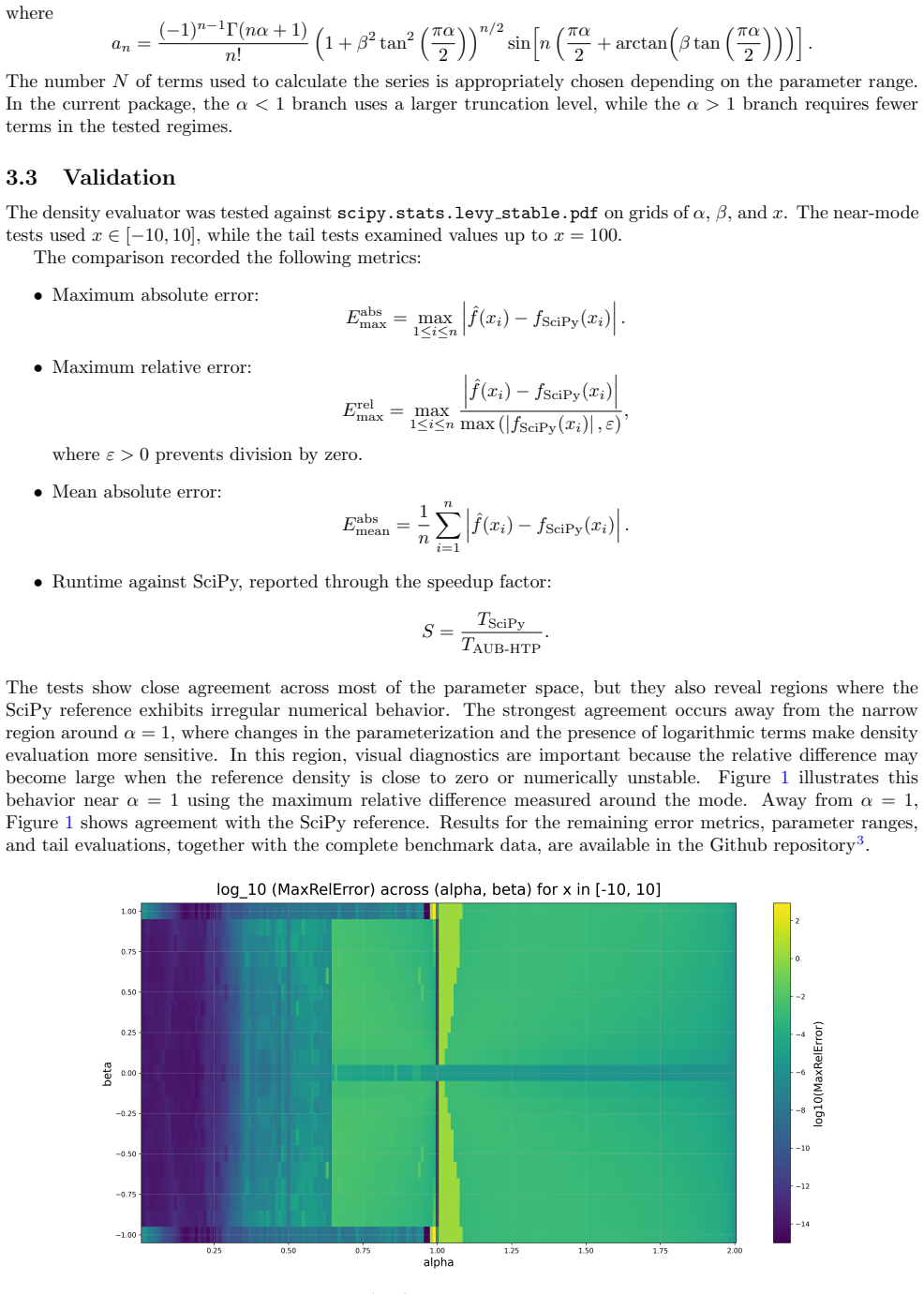
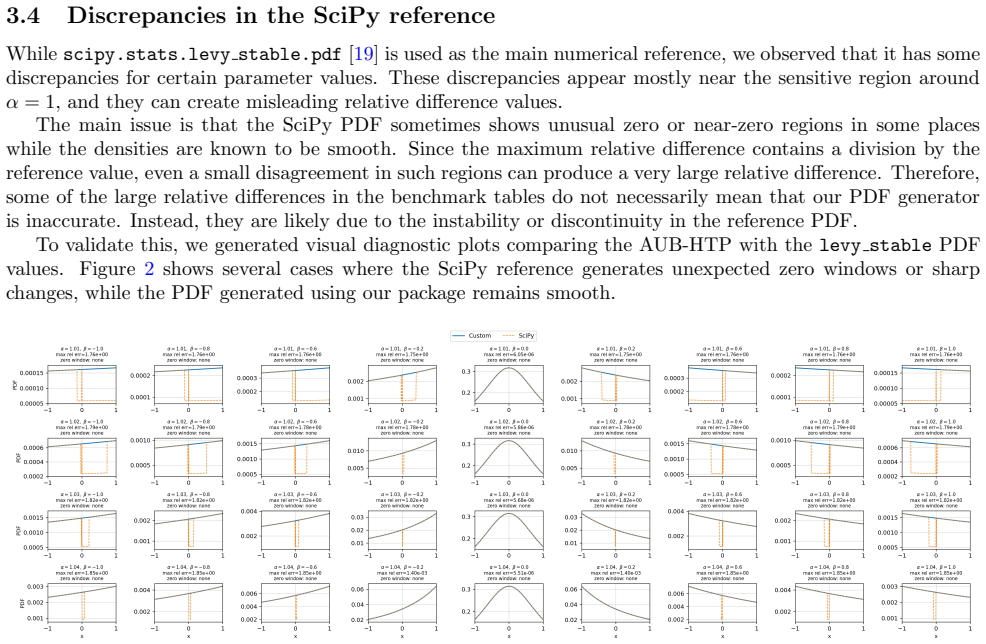
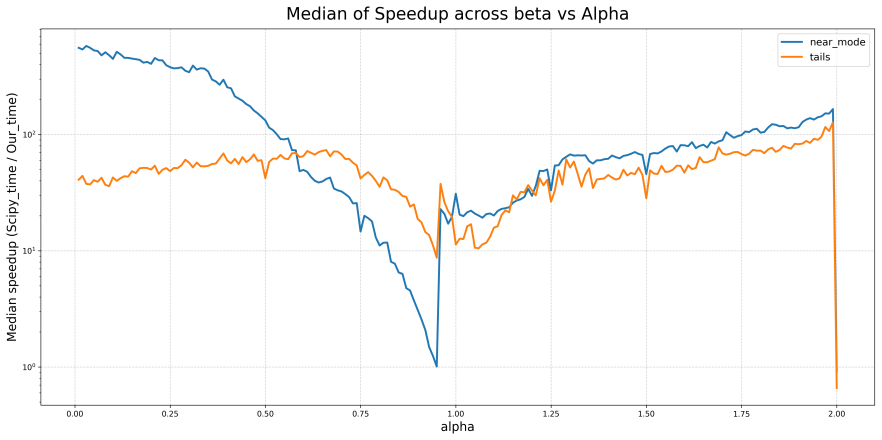
- [Numerical Experiments] Numerical Experiments section (and abstract): the central claim of improved accuracy, stability, and coverage rests on unspecified test cases, error metrics, baselines, and parameter regimes; no quantitative tables, figures, or code are referenced, rendering the claim unverifiable.
- [Methods and Numerical Experiments] Implementation and validation: no cross-checks are reported against analytically known special cases (Gaussian limit α=2, Cauchy α=1, Lévy α=1/2) or against independent libraries, leaving open the possibility that reported gains arise from implementation artifacts rather than methodological improvement.
Simulated Author's Rebuttal
We thank the referee for the constructive comments, which identify key areas where additional detail will strengthen the verifiability of our claims. We address each major comment below and commit to the indicated revisions.
read point-by-point responses
-
Referee: [Numerical Experiments] Numerical Experiments section (and abstract): the central claim of improved accuracy, stability, and coverage rests on unspecified test cases, error metrics, baselines, and parameter regimes; no quantitative tables, figures, or code are referenced, rendering the claim unverifiable.
Authors: We agree that the current manuscript does not provide sufficient detail on the test cases, error metrics, baselines, and parameter regimes underlying the accuracy and stability claims. We will revise the Numerical Experiments section (and update the abstract accordingly) to include explicit quantitative tables of errors, figures showing performance across parameter ranges, named baselines (e.g., comparisons to scipy.stats and other libraries), and references to the accompanying code and data for full reproducibility. revision: yes
-
Referee: [Methods and Numerical Experiments] Implementation and validation: no cross-checks are reported against analytically known special cases (Gaussian limit α=2, Cauchy α=1, Lévy α=1/2) or against independent libraries, leaving open the possibility that reported gains arise from implementation artifacts rather than methodological improvement.
Authors: We concur that validation against analytically tractable special cases and independent implementations is necessary to substantiate the reported gains. We will add a new subsection reporting direct comparisons for α=2 (Gaussian), α=1 (Cauchy), and α=1/2 (Lévy) against closed-form expressions, as well as numerical cross-checks against at least one established external library for both density evaluation and variate generation. revision: yes
Circularity Check
No circularity: implementation of established methods
full rationale
The paper presents AUB-HTP, a Python package implementing known numerical methods (Zolotarev integrals, series expansions, characteristic function inversion, LePage representations) for α-stable distributions. No derivation, parameter fitting, or prediction is claimed that reduces by construction to its own inputs. Claims rest on numerical experiments comparing to existing tools, but no self-referential reduction or load-bearing self-citation chain is present. This matches the default expectation of no significant circularity for implementation-focused work.
Axiom & Free-Parameter Ledger
Reference graph
Works this paper leans on
-
[1]
A. V. Skorohod. Asymptotic formulas for stable distribution laws.Selected translations in mathematical statistics and probability, 1:157–161, 1961
1961
-
[2]
B. V. Gnedenko and A. N. Kolmogorov.Limit Distributions for Sums of Independent Random Variables. Addison-Wesley Publishing Company, Reading Massachusetts, 1968
1968
-
[3]
Bentkus, A
V. Bentkus, A. Juozulynas, and V. Paulauskas. L´ evy–lepage series representation of stable vectors: Conver- gence in variation.Journal of theoretical probability, 14(4):949–978, 2001
2001
-
[4]
On some expansions of stable distribution functions.Arkiv f¨ or Matematik, 2(4):375–378, 1952
Harald Bergstr¨ om. On some expansions of stable distribution functions.Arkiv f¨ or Matematik, 2(4):375–378, 1952
1952
-
[5]
J. M. Chambers, C. L. Mallows, and B. W. Stuck. A method for simulating stable random variables.Journal of the American Statistical Association, 71(354):340–344, 1976
1976
-
[6]
Heavy-tailed probability distributions in the world wide web.A practical guide to heavy tails, 1:3–26, 1998
Mark E Crovella, Murad S Taqqu, and Azer Bestavros. Heavy-tailed probability distributions in the world wide web.A practical guide to heavy tails, 1:3–26, 1998. [7]NIST Digital Library of Mathematical Functions.https://dlmf.nist.gov/, Release 1.2.4 of 2025-03-15. F. W. J. Olver, A. B. Olde Daalhuis, D. W. Lozier, B. I. Schneider, R. F. Boisvert, C. W. Cla...
1998
-
[7]
Horn and Charles R
Roger A. Horn and Charles R. Johnson.Matrix analysis. Cambridge University Press, Cambridge, 1985
1985
-
[8]
Convergence to a stable distribution via order statistics
Raoul LePage, Michael Woodroofe, and Joel Zinn. Convergence to a stable distribution via order statistics. The Annals of probability, 9(4):624–632, 1981
1981
-
[9]
Mervin E. Muller. A note on a method for generating points uniformly on n -dimensional spheres, 1959
1959
-
[10]
Nassar, K
M. Nassar, K. Gulati, A.K. Sujeeth, N. Aghasadeghi, B.L. Evans, and K.R. Tinsley. Mitigating near-field interference in laptop embedded wireless transceivers. InIEEE International Conference on Acoustics, Speech and Signal Processing, pages 1405 –1408, Las Vegas, NV, 30 March - 4 April 2008
2008
-
[11]
CBMS-NSF Regional Conference Series in Applied Mathematics
Harald Niederreiter.Random number generation and quasi-Monte Carlo methods. CBMS-NSF Regional Conference Series in Applied Mathematics. Society for Industrial and Applied Mathematics, Philadelphia, Pa, 1992
1992
-
[12]
John P. Nolan. Multivariate elliptically contoured stable distributions: theory and estimation.Computational Statistics, 28(5):2067–2089, 2013
2067
-
[13]
Springer Series in Operations Research and Financial Engineering
John P Nolan.Univariate Stable Distributions: Models for Heavy Tailed Data. Springer Series in Operations Research and Financial Engineering. Springer Nature, Cham, 1st edition 2020 edition, 2020
2020
-
[14]
The representation ofe −xλ as a Laplace integral.Bulletin of the American Mathematical Society, 52(10):908–910, 1946
Harry Pollard. The representation ofe −xλ as a Laplace integral.Bulletin of the American Mathematical Society, 52(10):908–910, 1946
1946
-
[15]
Chapman & Hall/CRC, Boca Raton, 1 edition, 2000
Gennady Samorodnitsky and Murad S Taqqu.Stable non-Gaussian random processes : stochastic models with infinite variance. Chapman & Hall/CRC, Boca Raton, 1 edition, 2000
2000
-
[16]
A simple algorithm for uniform sampling on the surface of a hyper- sphere.arXiv.org, 2022
Stefan Schnabel and Wolfhard Janke. A simple algorithm for uniform sampling on the surface of a hyper- sphere.arXiv.org, 2022
2022
-
[17]
Statistical consequences of fat tails: Real world preasymptotics, epistemology, and applications, 2022
Nassim Nicholas Taleb. Statistical consequences of fat tails: Real world preasymptotics, epistemology, and applications, 2022. 17
2022
-
[18]
SciPy, 2026
The SciPy Community.scipy.stats.levy stable. SciPy, 2026. SciPy v1.17.0 Manual
2026
-
[19]
Tsihrintzis, P
G.A. Tsihrintzis, P. Tsakalides, and C.L. Nikias. Signal detection in severely heavy-tailed radar clutter. In Conference Record of The Twenty-Ninth Asilomar Conference on Signals, Systems and Computers, volume 2, pages 865–869 vol.2, 1995
1995
-
[20]
The singularities of Cauchy’s distributions.Duke Mathematical Journal, 8:678–681, 1941
Aurel Wintner. The singularities of Cauchy’s distributions.Duke Mathematical Journal, 8:678–681, 1941
1941
-
[21]
V. M. Zolotarev.One-Dimensional Stable Distributions, volume 65 ofTranslations of Mathematical Mono- graphs. American Mathematical Society, Providence, RI, 1986. Translation from the original 1983 Russian edition. 18
1986
discussion (0)
Sign in with ORCID, Apple, or X to comment. Anyone can read and Pith papers without signing in.