Dynamical decoupling of a quantum dot spin in a micropillar cavity for spin-multiphoton entanglement
Pith reviewed 2026-06-30 00:58 UTC · model grok-4.3
The pith
Dynamical decoupling extends an electron spin coherence time in a quantum dot by more than two orders of magnitude while preserving compatibility with cavity-enhanced spin-photon entanglement generation.
A machine-rendered reading of the paper's core claim, the machinery that carries it, and where it could break.
Core claim
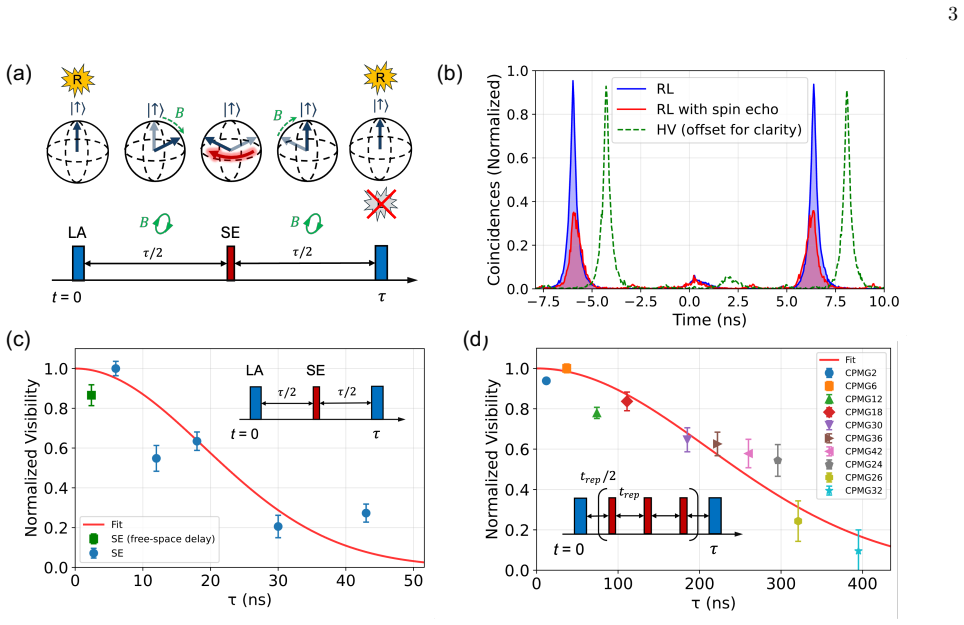
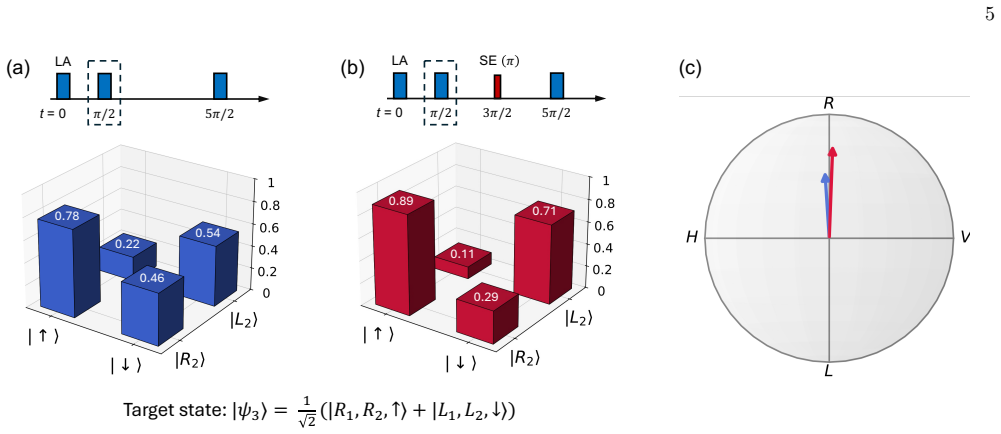
Application of dynamical decoupling sequences extends the coherence time of the resident electron spin by more than two orders of magnitude to a T2^CPMG of 298 plus or minus 53 nanoseconds, and the same sequences remain compatible with the generation of a spin-photon-photon entangled state whose simulated fidelity rises by 20 percent when the pulses are used.
What carries the argument
Dynamical decoupling pulse sequences (spin echo and CPMG) applied to the electron spin, used together with cavity-enhanced photon emission from the micropillar.
If this is right
- The longer coherence window permits emission of additional photons before the spin loses its phase information.
- The 20 percent fidelity improvement scales to larger spin-multiphoton graph states.
- High-rate entangled-state generation remains possible because the cavity enhancement is left intact.
- The same pulse sequences can be used in the weak-field regime without requiring strong magnetic fields.
Where Pith is reading between the lines
- If the pulse overhead stays low, the method could be combined with existing quantum-dot sources to reach four- or five-photon entangled states at usable rates.
- The technique may transfer to other solid-state emitters whose coherence is limited by the same low-frequency noise.
- Measuring how fidelity changes when the number of decoupling pulses is varied would give a practical test of the trade-off between coherence gain and pulse-induced errors.
Load-bearing premise
The decoupling pulses can be inserted without creating new decoherence channels or changing the cavity emission process enough to erase the fidelity gain.
What would settle it
A direct comparison, in the same micropillar device, of the measured spin-photon-photon state fidelity with and without the CPMG pulses applied during the emission window.
Figures

read the original abstract
Graph states of mutually entangled photons are key resources for quantum computation and communication and can be generated by leveraging the entanglement between a single resident spin and emitted photons from a charged semiconductor quantum dot (QD). This approach is intrinsically limited by the decoherence of the spin. We study how to mitigate this decoherence with dynamical decoupling of an electron spin in the weak transverse magnetic field regime using spin echo and Carr-Purcell-Meiboom-Gill (CPMG) techniques. Application of these techniques allows us to extend the coherence time of a spin by more than two orders of magnitude, extracting a $T_2^{CPMG}$ of $298\pm53$ ns. We further demonstrate that this technique is compatible with the generation of a spin-photon-photon entangled state at a high rate enabled by a micropillar cavity, with a 20% improvement in simulated state fidelity when using dynamical decoupling. These results pave the way for generating larger and more complex entangled states with QDs.
Editorial analysis
A structured set of objections, weighed in public.
Referee Report
Summary. The manuscript reports an experimental study of dynamical decoupling (spin echo and CPMG sequences) applied to an electron spin in a charged quantum dot inside a micropillar cavity in the weak transverse magnetic field regime. It extracts an extended coherence time T2^CPMG = 298 ± 53 ns (more than two orders of magnitude improvement) from spin-echo/CPMG measurements on the bare spin. Through numerical simulation it further claims compatibility with cavity-enhanced spin-photon-photon entanglement generation, reporting a 20% fidelity improvement when DD is inserted between photon emissions.
Significance. If the central claims hold, the work is significant for quantum information processing with quantum dots. Extending spin coherence via DD directly mitigates a key limitation for multi-photon graph-state generation. The experimental T2 extraction from measured data is a concrete, falsifiable result, and the simulation provides a quantitative estimate of the potential fidelity gain under cavity-enhanced emission. These elements together outline a practical route toward larger entangled states, though the integration step remains simulation-only.
major comments (1)
- [Abstract and entanglement simulation section] Abstract and the section describing the spin-photon-photon simulation: the claim that DD is compatible with entanglement generation (and yields a 20% fidelity gain) is supported only by numerical simulation of the combined protocol. No experimental data are shown for the full sequence in which CPMG pulses are applied during the ns-scale photon emission windows. This is load-bearing for the strongest claim, because untested effects such as pulse-induced charge noise, timing jitter relative to the Purcell-enhanced decay, or microwave crosstalk with the cavity mode could remove the simulated improvement.
minor comments (1)
- The reported T2^CPMG value includes an error bar, but the manuscript would benefit from explicit details on the number of averaged traces, the fitting model used to extract T2, and any data-exclusion criteria applied to the CPMG measurements.
Simulated Author's Rebuttal
We thank the referee for their careful reading and constructive comments. We provide a point-by-point response to the major comment below.
read point-by-point responses
-
Referee: [Abstract and entanglement simulation section] Abstract and the section describing the spin-photon-photon simulation: the claim that DD is compatible with entanglement generation (and yields a 20% fidelity gain) is supported only by numerical simulation of the combined protocol. No experimental data are shown for the full sequence in which CPMG pulses are applied during the ns-scale photon emission windows. This is load-bearing for the strongest claim, because untested effects such as pulse-induced charge noise, timing jitter relative to the Purcell-enhanced decay, or microwave crosstalk with the cavity mode could remove the simulated improvement.
Authors: We acknowledge that the demonstration of compatibility between dynamical decoupling and spin-photon-photon entanglement generation rests on numerical simulation rather than a complete experimental realization of the combined protocol. The experimental results establish an extended coherence time T2^CPMG = 298 ± 53 ns using spin-echo and CPMG sequences on the resident electron spin. These measured values, together with the cavity-enhanced emission rates, are then used as inputs to simulate the spin-photon-photon protocol, yielding the reported 20% fidelity improvement. The simulation places the DD pulses between the two photon emission events and incorporates the Purcell-enhanced decay dynamics. We agree that untested effects such as pulse-induced charge noise, timing jitter, or microwave crosstalk could in principle affect performance in an experiment. Nevertheless, the weak transverse-field regime and CPMG sequence parameters are selected to suppress dominant noise sources, and the microwave drive is detuned from the cavity resonance. To address the referee's concern, we will revise the abstract and the simulation section to state more explicitly that the fidelity gain is obtained from simulation and to include a brief discussion of the modeling assumptions regarding these potential effects. This revision will ensure the claims accurately reflect the scope of the presented results. revision: yes
Circularity Check
No significant circularity; experimental T2 extraction and independent simulation are self-contained.
full rationale
The paper reports direct experimental measurement of extended spin coherence time via spin-echo and CPMG sequences applied to the QD spin, yielding T2^CPMG = 298±53 ns extracted from data. Compatibility with spin-photon-photon entanglement generation is assessed via separate numerical simulation of state fidelity under DD insertion. No step reduces a claimed result to its own inputs by construction, no fitted parameter is relabeled as a prediction, and no load-bearing self-citation chain or ansatz smuggling is present in the provided text. The derivation chain consists of experimental data plus external simulation and remains independent of the target claims.
Axiom & Free-Parameter Ledger
axioms (1)
- standard math Standard quantum mechanics of electron spins in semiconductor quantum dots and their interaction with photons in a micropillar cavity
Reference graph
Works this paper leans on
-
[1]
Raussendorf and H
R. Raussendorf and H. J. Briegel, A one-way quantum computer, Physical Review Letters86, 5188 (2001)
2001
-
[2]
R. Raussendorf, J. Harrington, and K. Goyal, Topologi- cal fault-tolerance in cluster state quantum computation, New Journal of Physics9, 10.1088/1367-2630/9/6/199 (2007)
-
[3]
H. J. Briegel, D. E. Browne, W. D¨ ur, R. Raussendorf, and M. Van Den Nest, Measurement-based quantum compu- tation, Nature Physics5, 19 (2009), 0910.1116
work page internal anchor Pith review Pith/arXiv arXiv 2009
-
[4]
Azuma, S
K. Azuma, S. E. Economou, D. Elkouss, P. Hilaire, L. Jiang, H. K. Lo, and I. Tzitrin, Quantum repeaters: From quantum networks to the quantum internet, Re- views of Modern Physics95, 45006 (2023)
2023
-
[5]
H. J. Kimble, The quantum internet, Nature453, 1023 (2008)
2008
-
[6]
N. Coste, D. A. Fioretto, N. Belabas, S. C. Wein, P. Hi- laire, R. Frantzeskakis, M. Gundin, B. Goes, N. So- maschi, M. Morassi, A. Lemaˆ ıtre, I. Sagnes, A. Harouri, S. E. Economou, A. Auffeves, O. Krebs, L. Lanco, and P. Senellart, High-rate entanglement between a semicon- ductor spin and indistinguishable photons, Nature Pho- tonics17, 582 (2023), 2207.09881
-
[7]
Cogan, Z
D. Cogan, Z. E. Su, O. Kenneth, and D. Gershoni, De- terministic generation of indistinguishable photons in a cluster state, Nature Photonics17, 324 (2023)
2023
- [8]
-
[9]
H. Huet, P. R. Ramesh, S. C. Wein, N. Coste, P. Hilaire, N. Somaschi, M. Morassi, A. Lemaˆ ıtre, I. Sagnes, M. F. Doty, O. Krebs, L. Lanco, D. A. Fioretto, and P. Senel- lart, Deterministic and reconfigurable graph state gener- ation with a single solid-state quantum emitter, Nature Communications16, 4337 (2025)
2025
-
[10]
Nuclear spin physics in quantum dots: an optical investigation
B. Urbaszek, X. Marie, T. Amand, O. Krebs, P. Voisin, P. Maletinsky, A. H¨ ogele, and A. Imamoglu, Nuclear spin physics in quantum dots: An optical investigation, Re- views of Modern Physics85, 79 (2013), 1202.4637
work page internal anchor Pith review Pith/arXiv arXiv 2013
-
[11]
Bechtold, D
A. Bechtold, D. Rauch, F. Li, T. Simmet, P. L. Ardelt, A. Regler, K. M¨ uller, N. A. Sinitsyn, and J. J. Finley, Three-stage decoherence dynamics of an electron spin qubit in an optically active quantum dot, Nature Physics 11, 1005 (2015)
2015
-
[12]
Stockill, C
R. Stockill, C. Le Gall, C. Matthiesen, L. Huthmacher, E. Clarke, M. Hugues, and M. Atat¨ ure, Quantum dot spin coherence governed by a strained nuclear environ- ment, Nature Communications7, 1 (2016)
2016
-
[13]
Spin decoherence of a heavy hole coupled to nuclear spins in a quantum dot
J. Fischer, W. A. Coish, D. V. Bulaev, and D. Loss, Spin decoherence of a heavy hole coupled to nuclear spins in a quantum dot, Physical Review B - Condensed Matter and Materials Physics78, 1 (2008), 0807.0386
work page internal anchor Pith review Pith/arXiv arXiv 2008
-
[14]
B. Eble, C. Testelin, P. Desfonds, F. Bernardot, A. Baloc- chi, T. Amand, A. Miard, A. Lemaˆ ıtre, X. Marie, and M. Chamarro, Hole-nuclear spin interaction in quan- tum dots, Physical Review Letters102, 10.1103/Phys- RevLett.102.146601 (2009)
-
[15]
Depolarization of Electronic Spin Qubits Confined in Semiconductor Quantum Dots
D. Cogan, O. Kenneth, N. H. Lindner, G. Peniakov, C. Hopfmann, D. Dalacu, P. J. Poole, P. Hawrylak, and D. Gershoni, Depolarization of Electronic Spin Qubits Confined in Semiconductor Quantum Dots, Physical Re- view X8, 41050 (2018), 1808.00284
work page internal anchor Pith review Pith/arXiv arXiv 2018
-
[16]
N. Coste, M. Gundin, D. A. Fioretto, S. E. Thomas, C. Millet, E. Mehdi, N. Somaschi, M. Morassi, M. Pont, A. Lemaˆ ıtre, N. Belabas, O. Krebs, L. Lanco, and P. Senellart, Probing the dynamics and coherence of a semiconductor hole spin via acoustic phonon- assisted excitation, Quantum Science and Technology8, 10.1088/2058-9565/acbd6a (2023)
-
[17]
Huthmacher, R
L. Huthmacher, R. Stockill, E. Clarke, M. Hugues, C. Le Gall, and M. Atat¨ ure, Coherence of a dynami- cally decoupled quantum-dot hole spin, Phys. Rev. B97, 241413 (2018)
2018
-
[18]
E. L. Hahn, Spin echoes, Physical Review80, 580 (1950)
1950
-
[19]
Press, K
D. Press, K. De Greve, P. L. McMahon, T. D. Ladd, B. Friess, C. Schneider, M. Kamp, S. H¨ ofling, A. Forchel, and Y. Yamamoto, Ultrafast optical spin echo in a single quantum dot, Nature Photonics4, 367 (2010)
2010
-
[20]
De Greve, P
K. De Greve, P. L. McMahon, D. Press, T. D. Ladd, D. Bisping, C. Schneider, M. Kamp, L. Worschech, S. H¨ ofling, A. Forchel, and Y. Yamamoto, Ultrafast co- herent control and suppressed nuclear feedback of a single quantum dot hole qubit, Nature Phys7, 872 (2011)
2011
-
[21]
Zaporski, N
L. Zaporski, N. Shofer, J. H. Bodey, S. Manna, G. Gillard, M. H. Appel, C. Schimpf, S. F. Covre da Silva, J. Jarman, G. Delamare, G. Park, U. Haeusler, E. A. Chekhovich, A. Rastelli, D. A. Gangloff, M. Atat¨ ure, 7 and C. Le Gall, Ideal refocusing of an optically active spin qubit under strong hyperfine interactions, Nature Nanotechnology18, 257 (2023)
2023
-
[22]
B. Sun, C. M. E. Chow, D. G. Steel, A. S. Bracker, D. Gammon, and L. J. Sham, Persistent narrowing of nuclear-spin fluctuations in inas quantum dots using laser excitation, Phys. Rev. Lett.108, 187401 (2012)
2012
-
[23]
´Ethier-Majcher, D
G. ´Ethier-Majcher, D. Gangloff, R. Stockill, E. Clarke, M. Hugues, C. Le Gall, and M. Atat¨ ure, Improving a Solid-State Qubit through an Engineered Mesoscopic En- vironment, Physical Review Letters119, 1 (2017)
2017
-
[24]
D. A. Gangloff, G. ´Ethier-Majcher, C. Lang, E. V. Den- ning, J. H. Bodey, D. M. Jackson, E. Clarke, M. Hugues, C. Le Gall, and M. Atat¨ ure, Quantum interface of an electron and a nuclear ensemble, Science364, 62 (2019), 1812.07540
work page internal anchor Pith review Pith/arXiv arXiv 2019
-
[25]
J. H. Prechtel, A. V. Kuhlmann, J. Houel, A. Ludwig, S. R. Valentin, A. D. Wieck, and R. J. Warburton, De- coupling a hole spin qubit from the nuclear spins, Nature Materials15, 981 (2016)
2016
-
[26]
M. Hogg, N. Antoniadis, M. Marczak, G. Nguyen, T. Baltisberger, A. Javadi, R. Schott, S. Valentin, A. Wieck, A. Ludwig, and R. Warburton, Fast optical control of a coherent hole spin in a microcavity, Nature Physics21, 1475–1481 (2025)
2025
- [27]
-
[28]
J. P. Lee, B. Villa, A. J. Bennett, R. M. Steven- son, D. J. Ellis, I. Farrer, D. A. Ritchie, and A. J. Shields, A quantum dot as a source of time-bin entangled multi-photon states, Quantum Science and Technology4, 10.1088/2058-9565/ab0a9b (2019)
-
[29]
N. H. Lindner and T. Rudolph, Proposal for pulsed On- demand sources of photonic cluster state strings, Physical Review Letters103, 1 (2009)
2009
-
[30]
Near optimal single photon sources in the solid state
N. Somaschi, V. Giesz, L. De Santis, J. C. Loredo, M. P. Almeida, G. Hornecker, S. L. Portalupi, T. Grange, C. Ant´ on, J. Demory, C. G´ omez, I. Sagnes, N. D. Lanzillotti-Kimura, A. Lema´ ıtre, A. Auffeves, A. G. White, L. Lanco, and P. Senellart, Near-optimal single- photon sources in the solid state, Nature Photonics10, 340 (2016), 1510.06499
work page internal anchor Pith review Pith/arXiv arXiv 2016
-
[31]
Dousse, L
A. Dousse, L. Lanco, J. Suffczy´ nski, E. Semenova, A. Mi- ard, A. Lemaˆ ıtre, I. Sagnes, C. Roblin, J. Bloch, and P. Senellart, Controlled light-matter coupling for a single quantum dot embedded in a pillar microcavity using far- field optical lithography, Physical Review Letters101, 30 (2008)
2008
-
[32]
A. K. Nowak, S. L. Portalupi, V. Giesz, O. Gazzano, C. Dal Savio, P. F. Braun, K. Karrai, C. Arnold, L. Lanco, I. Sagnes, A. Lemaˆ ıtre, and P. Senellart, De- terministic and electrically tunable bright single-photon source, Nature Communications5, 1 (2014)
2014
-
[33]
S. E. Thomas, M. Billard, N. Coste, S. C. Wein, Priya, H. Ollivier, O. Krebs, L. Taza¨ ırt, A. Harouri, A. Lemaitre, I. Sagnes, C. Anton, L. Lanco, N. Somaschi, J. C. Loredo, and P. Senellart, Bright Polarized Single- Photon Source Based on a Linear Dipole, Physical Re- view Letters126, 1 (2021), 2007.04330
-
[34]
Serov, A
Y. Serov, A. Galimov, D. S. Smirnov, M. Rakhlin, N. Leppenen, G. Klimko, S. Sorokin, I. Sedova, D. Berez- ina, Y. Salii, M. Kulagina, Y. Zadiranov, S. Troshkov, T. V. Shubina, and A. Toropov, Hidden anisotropy con- trols spin-photon entanglement in a charged quantum dot, Physical Review Applied (2024)
2024
-
[35]
Press, T
D. Press, T. D. Ladd, B. Zhang, and Y. Yamamoto, Com- plete quantum control of a single quantum dot spin using ultrafast optical pulses, Nature456, 218 (2008)
2008
-
[36]
Greilich, S
A. Greilich, S. E. Economou, S. Spatzek, D. R. Yakovlev, D. Reuter, A. D. Wieck, T. L. Reinecke, and M. Bayer, Ultrafast optical rotations of electron spins in quantum dots, Nature Physics5, 262 (2009)
2009
-
[37]
T. M. Godden, J. H. Quilter, A. J. Ramsay, Y. Wu, P. Br- ereton, S. J. Boyle, I. J. Luxmoore, J. Puebla-Nunez, A. M. Fox, and M. S. Skolnick, Coherent optical control of the spin of a single hole in an InAs/GaAs quantum dot, Physical Review Letters108, 1 (2012)
2012
-
[38]
Supplemental Information,
-
[39]
H. Y. Carr and E. M. Purcell, Effects of diffusion on free precession in nuclear magnetic resonance experiments, Physical Review94, 630 (1954)
1954
-
[40]
Meiboom and D
S. Meiboom and D. Gill, Modified spin-echo method for measuring nuclear relaxation times, Review of Scientific Instruments29, 688 (1958)
1958
-
[41]
How to Enhance Dephasing Time in Superconducting Qubits
L. Cywi´ nski, R. M. Lutchyn, C. P. Nave, and S. Das Sarma, How to enhance dephasing time in superconduct- ing qubits, Physical Review B - Condensed Matter and Materials Physics77, 1 (2008), 0712.2225
work page internal anchor Pith review Pith/arXiv arXiv 2008
-
[42]
N. A. Sinitsyn, Y. Li, S. A. Crooker, A. Saxena, and D. L. Smith, Role of nuclear quadrupole coupling on decoher- ence and relaxation of central spins in quantum dots, Physical Review Letters109, 1 (2012)
2012
-
[43]
Hackmann, P
J. Hackmann, P. Glasenapp, A. Greilich, M. Bayer, and F. B. Anders, Influence of the Nuclear Electric Quadrupolar Interaction on the Coherence Time of Hole and Electron Spins Confined in Semiconductor Quantum Dots, Physical Review Letters115, 30 (2015)
2015
-
[44]
Bulutay, Quadrupolar spectra of nuclear spins in strained in xga1−xas quantum dots, Phys
C. Bulutay, Quadrupolar spectra of nuclear spins in strained in xga1−xas quantum dots, Phys. Rev. B85, 115313 (2012)
2012
-
[45]
Chekhovich, K
E. Chekhovich, K. Kavokin, A. Krysa, M. Hopkinson, A. Andreev, M. Skolnick, and A. Tartakovskii, Structural analysis of strained quantum dots using nuclear magnetic resonance, Nature nanotechnology7, 646 (2012)
2012
-
[46]
D. M. Greenberger, M. Horne, and A. Zeilinger,Bell’s theorem, quantum theory and conceptions of the universe (Springer, 1989)
1989
-
[47]
Ramesh, E
P. Ramesh, E. Annoni, N. Margaria, D. Fioretto, A. Pishchagin, M. Morassi, A. Lemaˆ ıtre, M. Doty, P. Senellart, L. Lanco, N. Belabas, S. Wein, and O. Krebs, Impact of hole-g-factor anisotropy on spin- photon entanglement generation with (In,Ga)As quan- tum dots, Phys. Rev. Appl.24, 024047 (2025)
2025
-
[48]
P. Steindl, T. Van Der Ent, H. Van Der Meer, J. A. Frey, J. Norman, J. E. Bowers, D. Bouwmeester, and W. L¨ offler, Resonant Two-Laser Spin-State Spectroscopy of a Negatively Charged Quantum-Dot-Microcavity Sys- tem with a Cold Permanent Magnet, Physical Review Applied20, 1 (2023), 2303.02763
-
[49]
S. C. Wein, T. Goubault de Brugi` ere, L. Music, P. Senel- lart, B. Bourdoncle, and S. Mansfield, Minimizing re- source overhead in fusion-based quantum computation using hybrid spin-photon devices, PRX Quantum6, 8 040362 (2025)
2025
-
[50]
Hilaire, L
P. Hilaire, L. Vidro, H. S. Eisenberg, and S. E. Economou, Near-deterministic hybrid generation of arbi- trary photonic graph states using a single quantum emit- ter and linear optics, Quantum7, 992 (2023)
2023
-
[51]
L. A. Pettersson, A. S. Sørensen, and S. Paesani, Deter- ministic Generation of Concatenated Graph Codes from Quantum Emitters, PRX Quantum6, 010305 (2025)
2025
-
[52]
de Gliniasty, P
G. de Gliniasty, P. Hilaire, P.-E. Emeriau, S. C. Wein, A. Salavrakos, and S. Mansfield, A Spin-Optical Quan- tum Computing Architecture, Quantum8, 1423 (2024). 9 SUPPLEMENT AR Y INFORMA TION
2024
-
[53]
2 uses the peak areas from correlation histograms in only theR/LandH/Vbases for various time delaysτ, accessed using an EOM to pick certain pulses from repetition rate of the laser
Extended data and visibility calculation The data in Fig. 2 uses the peak areas from correlation histograms in only theR/LandH/Vbases for various time delaysτ, accessed using an EOM to pick certain pulses from repetition rate of the laser. For the spin echo (SE) data, the ratio of the time delayτ= 2−45 ns to the temporal window of single photon detectiont...
-
[54]
Simulation methods The simulation of spin-photon entanglement is based on a four-level trion system that evolves following a Markovian master equation to describe the impact of spontaneous emission. The hyperfine interaction between the electron spin and the nuclei is captured by an additional Zeeman Hamiltonian to model the fluctuating Overhauser (OH) fi...
-
[55]
Experimental setup A schematic of the experimental setup used in this work is shown in Fig. S2. Optical pulses originate from a single femtosecond laser with a 12.35 ns repetition rate. They are shaped using a 4f-line and a spatial light modulator. The pulse repetition rate is doubled using a retro-reflector, then separated spectrally into the longitudina...
discussion (0)
Sign in with ORCID, Apple, or X to comment. Anyone can read and Pith papers without signing in.