Inter-band coherence effects in disordered crystals: beyond the non-crossing approximation
Pith reviewed 2026-06-30 08:56 UTC · model grok-4.3
The pith
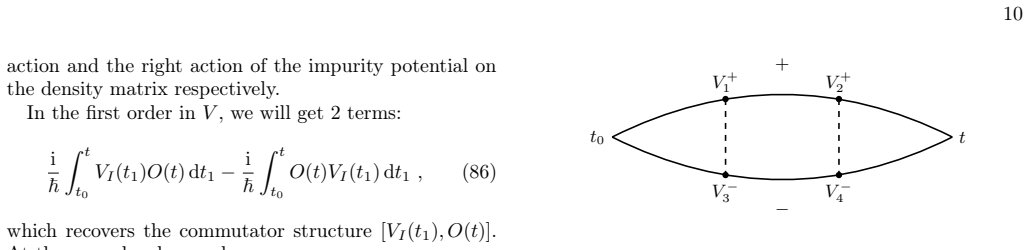
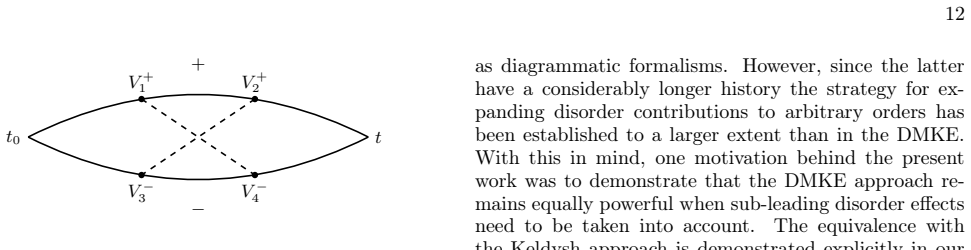
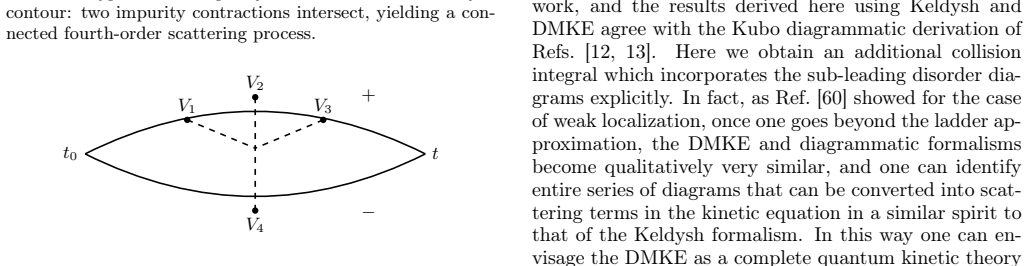
Crossed impurity processes produce an extrinsic anomalous Hall conductivity of order τ^0 that coexists with the intrinsic Berry-curvature term.
A machine-rendered reading of the paper's core claim, the machinery that carries it, and where it could break.
Core claim
In the two-dimensional massive Dirac fermion model with Gaussian white-noise disorder, fourth-order crossed impurity processes generate an extrinsic contribution of order τ^0 to the anomalous Hall conductivity that coexists with the intrinsic Berry-curvature term. For this model the Ψ-type crossed contribution cancels while the X-type term remains finite. The response is obtained from a connected V^4 collision integral derived by iterative solution of impurity-induced density-matrix fluctuations after subtracting disconnected impurity pairings, and the formalism separates self-energy corrections, ladder vertex renormalization, and crossed quantum-interference contributions while clarifying t
What carries the argument
Connected V^4 collision integral from iterative solution of impurity-induced density-matrix fluctuations after subtracting disconnected impurity pairings.
If this is right
- The approach decomposes transport responses into Fermi-surface and Fermi-sea components while including both intrinsic geometry and extrinsic crossed-disorder effects.
- It yields explicit expressions for the single-particle lifetime, transport relaxation time, and longitudinal conductivity at the Born level.
- The density-matrix kinetic equation maintains a consistent correspondence with the Keldysh formalism.
- The same machinery applies to spin, pseudospin, orbital, and valley transport phenomena in multiband systems.
Where Pith is reading between the lines
- The method could be used to compute disorder corrections to valley or spin Hall conductivities in other Dirac or Weyl systems where interband coherence is strong.
- If the surviving X-type term is generic, it implies that certain impurity configurations can produce disorder-independent extrinsic contributions that add to rather than subtract from geometric responses.
- Higher-order extensions might reveal whether crossed processes modify the scaling of conductivity with disorder strength in topological materials beyond the Born approximation.
Load-bearing premise
An iterative solution for the impurity-induced density-matrix fluctuations produces a connected V^4 collision integral after subtracting disconnected impurity pairings without introducing double counting.
What would settle it
A direct numerical evaluation of the anomalous Hall conductivity in the massive Dirac model at fourth order in white-noise disorder strength that checks whether the X-type crossed term survives as a finite τ^0 contribution while the Ψ-type term vanishes.
Figures
read the original abstract
We develop a quantum kinetic theory for Bloch electrons driven by a uniform dc electric field, extending the nonequilibrium density-matrix formalism beyond the non-crossing approximation. This extension is required to capture steady-state terms that are nominally zeroth order in disorder strength and compete with intrinsic band-geometric responses, as in anomalous Hall and related spin, orbital, and valley transport. Working in the length gauge with Gaussian white-noise disorder, we include impurity scattering to fourth order in the disorder potential. An iterative solution for the impurity-induced density-matrix fluctuations yields a connected $V^4$ collision integral after subtracting disconnected impurity pairings, thereby avoiding double counting. The resulting terms separate into self-energy corrections, ladder-type vertex renormalization, and crossed quantum-interference contributions. We clarify the correspondence between this density-matrix kinetic equation and the Keldysh formalism, and decompose the response into Fermi-surface and Fermi-sea components. As an application, we study the two-dimensional massive Dirac fermion model. We obtain analytical expressions for the single-particle lifetime, transport relaxation time, and longitudinal conductivity at the Born level, and then evaluate the anomalous Hall conductivity including crossed impurity processes. These processes generate an extrinsic contribution of order $\tau^0$ that coexists with the intrinsic Berry-curvature term; for Gaussian white-noise disorder in this model, the $\Psi$-type contribution cancels while the $X$-type term remains finite. The formalism provides a consistent route for incorporating band geometry and crossed-disorder corrections into multiband transport, with applications to spin, pseudospin, orbital, and valley phenomena.
Editorial analysis
A structured set of objections, weighed in public.
Referee Report
Summary. The paper develops a quantum kinetic theory extending the nonequilibrium density-matrix formalism for Bloch electrons in a uniform dc electric field beyond the non-crossing approximation. Working to fourth order in Gaussian white-noise disorder, an iterative solution yields a connected V^4 collision integral after subtracting disconnected impurity pairings. The resulting self-energy, ladder, and crossed (Ψ/X) contributions are applied to the 2D massive Dirac model, producing analytical expressions for lifetimes and longitudinal conductivity at Born level, plus an extrinsic τ^0 anomalous Hall conductivity that coexists with the intrinsic Berry-curvature term, with Ψ canceling and X remaining finite.
Significance. If the connected-integral construction holds, the work supplies a systematic route to include crossed-disorder corrections alongside band geometry in multiband transport, directly relevant to anomalous Hall, spin, orbital, and valley responses. The analytical cancellation result for the Dirac model is a concrete, falsifiable prediction that strengthens the formalism's utility.
major comments (1)
- [section deriving the collision integral] The iterative solution for impurity-induced density-matrix fluctuations and the subsequent subtraction of disconnected pairings to obtain the connected V^4 collision integral (abstract and the section deriving the kinetic equation): this step is load-bearing for the claimed Ψ cancellation and finite X term, yet the manuscript supplies no explicit diagrammatic enumeration or independent cross-check confirming that all connected crossed diagrams are retained and that the subtraction does not inadvertently remove part of the X channel. Because the τ^0 extrinsic contribution is precisely the difference between these channels, incompleteness here directly affects the central coexistence statement.
minor comments (2)
- [abstract] Clarify the precise correspondence between the density-matrix kinetic equation and the Keldysh formalism (mentioned in the abstract) by adding a short table or diagram mapping the terms.
- [application to Dirac model] The decomposition into Fermi-surface and Fermi-sea components is stated but not shown explicitly for the crossed terms; a brief appendix equation would help.
Simulated Author's Rebuttal
We thank the referee for the careful reading and for highlighting the importance of the connected V^4 construction. We address the single major comment below.
read point-by-point responses
-
Referee: [section deriving the collision integral] The iterative solution for impurity-induced density-matrix fluctuations and the subsequent subtraction of disconnected pairings to obtain the connected V^4 collision integral (abstract and the section deriving the kinetic equation): this step is load-bearing for the claimed Ψ cancellation and finite X term, yet the manuscript supplies no explicit diagrammatic enumeration or independent cross-check confirming that all connected crossed diagrams are retained and that the subtraction does not inadvertently remove part of the X channel. Because the τ^0 extrinsic contribution is precisely the difference between these channels, incompleteness here directly affects the central coexistence statement.
Authors: The iterative solution for the impurity-induced density-matrix fluctuations is constructed to generate every fourth-order scattering sequence exactly once. Subtracting the disconnected pairings (products of two independent second-order processes) isolates the connected V^4 collision integral by definition; this subtraction removes only the factorizable terms and leaves all topologically connected crossed diagrams intact. The resulting X channel is therefore the genuine crossed contribution. The explicit analytic evaluation for the 2D massive Dirac model then serves as an internal consistency check: the Ψ term cancels while the X term survives, yielding a finite τ^0 extrinsic AHC that coexists with the intrinsic term. The manuscript already maps the kinetic equation onto the Keldysh diagrammatic expansion, providing the independent cross-check requested. revision: no
Circularity Check
No significant circularity; derivation relies on standard diagrammatic subtraction without reduction to inputs or self-citations
full rationale
The paper's central construction—an iterative solution for density-matrix fluctuations that produces a connected V^4 collision integral after subtracting disconnected pairings—is presented as a direct application of standard perturbation theory to avoid double counting at O(V^4). No equations or claims in the abstract or described derivation reduce a target quantity (such as the τ^0 extrinsic AHC or the Ψ/X cancellation) to a fitted parameter, a renamed input, or a load-bearing self-citation. The separation into self-energy, ladder, and crossed terms follows from the subtracted integral by explicit decomposition rather than by definition. The model-specific result for Gaussian white-noise disorder in the 2D Dirac case is obtained analytically from the resulting kinetic equation, with no indication that the outcome is forced by prior author work or by construction. This is the normal case of a self-contained perturbative expansion.
Axiom & Free-Parameter Ledger
axioms (2)
- domain assumption Gaussian white-noise disorder model for impurities
- domain assumption Length gauge for the uniform dc electric field
Reference graph
Works this paper leans on
-
[1]
Raimondi, C
R. Raimondi, C. Gorini, P. Schwab, and M. Dzierzawa, Quasiclassical approach to the spin hall effect in the two-dimensional electron gas, Phys. Rev. B74, 035340 (2006)
2006
-
[2]
Culcer, E
D. Culcer, E. M. Hankiewicz, G. Vignale, and R. Win- kler, Side jumps in the spin hall effect: Construction of the boltzmann collision integral, Phys. Rev. B81, 125332 (2010)
2010
-
[3]
Y. Gao, S. A. Yang, and Q. Niu, Field induced positional shift of bloch electrons and its dynamical implications, Phys. Rev. Lett.112, 166601 (2014)
2014
-
[4]
Z. Z. Du, C. M. Wang, H.-P. Sun, H.-Z. Lu, and X. C. Xie, Quantum theory of the nonlinear hall effect, Nature Communications12, 5038 (2021)
2021
-
[6]
Valet and R
T. Valet and R. Raimondi, Semiclassical kinetic theory for systems with non-trivial quantum geometry and the expectationvalueofphysicalquantities,EurophysicsLet- ters143, 26004 (2023)
2023
-
[7]
R. Raimondi and T. Valet, Quantum kinetic the- ory of the spin hall effect for disordered graphene with rashba spin–orbit coupling, Condensed Matter10, 10.3390/condmat10010004 (2025)
-
[8]
T.ValetandR.Raimondi,Quantumkinetictheory ofthe linear response for weakly disordered multiband systems, Phys. Rev. B111, L041118 (2025)
2025
-
[9]
Culcer, A
D. Culcer, A. Sekine, and A. H. MacDonald, Interband coherence response to electric fields in crystals: Berry- phase contributions and disorder effects, Phys. Rev. B 96, 035106 (2017)
2017
-
[10]
R. B. Atencia, Q. Niu, and D. Culcer, Semiclassical re- sponse of disordered conductors: Extrinsic carrier veloc- ity and spin and field-corrected collision integral, Phys. Rev. Res.4, 013001 (2022)
2022
-
[12]
I. A. Ado, I. A. Dmitriev, P. M. Ostrovsky, and M. Titov, Anomalous hall effect with massive dirac fermions, Eu- rophysics Letters111, 37004 (2015)
2015
-
[13]
I. A. Ado, I. A. Dmitriev, P. M. Ostrovsky, and M. Titov, Anomalous hall effect in a 2d rashba ferromagnet, Phys. Rev. Lett.117, 046601 (2016)
2016
-
[14]
I. A. Ado, I. A. Dmitriev, P. M. Ostrovsky, and M. Titov, Sensitivity of the anomalous hall effect to disorder corre- lations, Phys. Rev. B96, 235148 (2017)
2017
-
[15]
Zhang and W
J.-X. Zhang and W. Chen, Anomalous hall effect in type- i weyl metals beyond the noncrossing approximation, Phys. Rev. B107, 214204 (2023)
2023
-
[16]
Gorini, P
C. Gorini, P. Schwab, R. Raimondi, and A. L. Shelankov, Non-abelian gauge fields in the gradient expansion: Gen- eralized boltzmann and eilenberger equations, Phys. Rev. B82, 195316 (2010)
2010
-
[17]
Milletarì and A
M. Milletarì and A. Ferreira, Quantum diagrammatic theory of the extrinsic spin hall effect in graphene, Phys. Rev. B94, 134202 (2016)
2016
-
[18]
Raimondi, C
R. Raimondi, C. Gorini, and S. Tölle, Spin-charge cou- pling effects in a two-dimensional electron gas, inSpin Orbitronics and Topological Properties of Nanostruc- tures, pp. 80–109
-
[19]
S. Lee, A. Trionfi, and D. Natelson, Quantum coherence in a ferromagnetic metal: Time-dependent conductance fluctuations, Phys. Rev. B70, 212407 (2004)
2004
-
[20]
Miyasato, N
T. Miyasato, N. Abe, T. Fujii, A. Asamitsu, S. Onoda, Y. Onose, N. Nagaosa, and Y. Tokura, Crossover behav- ior of the anomalous hall effect and anomalous nernst effect in itinerant ferromagnets, Phys. Rev. Lett.99, 086602 (2007)
2007
-
[21]
Y. Tian, L. Ye, and X. Jin, Proper scaling of the anoma- lous hall effect, Phys. Rev. Lett.103, 087206 (2009)
2009
-
[22]
Nagaosa, J
N. Nagaosa, J. Sinova, S. Onoda, A. H. MacDonald, and N. P. Ong, Anomalous hall effect, Rev. Mod. Phys.82, 1539 (2010)
2010
-
[23]
Morota, Y
M. Morota, Y. Niimi, K. Ohnishi, D. H. Wei, T. Tanaka, H. Kontani, T. Kimura, and Y. Otani, Indication of in- trinsic spin hall effect in4dand5dtransition metals, Phys. Rev. B83, 174405 (2011)
2011
-
[24]
Niimi, M
Y. Niimi, M. Morota, D. H. Wei, C. Deranlot, M. Basletic, A. Hamzic, A. Fert, and Y. Otani, Extrinsic spin hall effect induced by iridium impurities in copper, Phys. Rev. Lett.106, 126601 (2011)
2011
-
[25]
Sinova, S
J. Sinova, S. O. Valenzuela, J. Wunderlich, C. H. Back, and T. Jungwirth, Spin hall effects, Rev. Mod. Phys.87, 1213 (2015)
2015
-
[26]
Musha, Y
A. Musha, Y. Kanno, and K. Ando, Extrinsic-intrinsic crossover of the spin hall effect induced by alloying, Phys. Rev. Mater.3, 054411 (2019)
2019
-
[27]
J. Chen, H. J. Qin, F. Yang, J. Liu, T. Guan, F. M. Qu, G. H. Zhang, J. R. Shi, X. C. Xie, C. L. Yang, K. H. Wu, Y. Q. Li, and L. Lu, Gate-voltage control of chemical potential and weak antilocalization inbi2se3, Phys. Rev. Lett.105, 176602 (2010)
2010
-
[28]
Culcer, E
D. Culcer, E. H. Hwang, T. D. Stanescu, and S. Das Sarma, Two-dimensional surface charge transport in topological insulators, Phys. Rev. B82, 155457 (2010)
2010
-
[29]
Y. S. Kim, M. Brahlek, N. Bansal, E. Edrey, G. A. Kapilevich, K. Iida, M. Tanimura, Y. Horibe, S.-W. Cheong, and S. Oh, Thickness-dependent bulk properties and weak antilocalization effect in topological insulator bi2se3, Phys. Rev. B84, 073109 (2011)
2011
-
[30]
Steinberg, J.-B
H. Steinberg, J.-B. Laloë, V. Fatemi, J. S. Moodera, and P. Jarillo-Herrero, Electrically tunable surface-to- bulk coherent coupling in topological insulator thin films, Phys. Rev. B84, 233101 (2011)
2011
-
[31]
Ma, S.-Y
Q. Ma, S.-Y. Xu, H. Shen, D. MacNeill, V. Fatemi, T.-R. Chang, A. M. Mier Valdivia, S. Wu, Z. Du, C.-H. Hsu, S. Fang, Q. D. Gibson, K. Watanabe, T. Taniguchi, R. J. Cava, E. Kaxiras, H.-Z. Lu, H. Lin, L. Fu, N. Gedik, and P. Jarillo-Herrero, Observation of the nonlinear hall effect under time-reversal-symmetric conditions, Nature 565, 337 (2019)
2019
- [32]
-
[33]
L. Ye, M. Kang, J. Liu, F. von Cube, C. R. Wicker, T. Suzuki, C. Jozwiak, A. Bostwick, E. Rotenberg, D. C. Bell, L. Fu, R. Comin, and J. G. Checkelsky, Massive 18 dirac fermions in a ferromagnetic kagome metal, Nature 555, 638 (2018)
2018
-
[34]
D. Chen, C. Le, C. Fu, H. Lin, W. Schnelle, Y. Sun, and C. Felser, Large anomalous hall effect in the kagome ferromagnetlimn 6sn6, Phys. Rev. B103, 144410 (2021)
2021
-
[35]
E. Liu, Y. Sun, N. Kumar, L. Muechler, A. Sun, L. Jiao, S.-Y. Yang, D. Liu, A. Liang, Q. Xu, J. Kroder, V. Süß, H. Borrmann, C. Shekhar, Z. Wang, C. Xi, W. Wang, W. Schnelle, S. Wirth, Y. Chen, S. T. B. Goennenwein, and C. Felser, Giant anomalous hall effect in a ferromag- netic kagome-lattice semimetal, Nature Physics14, 1125 (2018)
2018
-
[36]
Jungwirth, Q
T. Jungwirth, Q. Niu, and A. H. MacDonald, Anomalous hall effect in ferromagnetic semiconductors, Phys. Rev. Lett.88, 207208 (2002)
2002
-
[37]
Culcer, A
D. Culcer, A. MacDonald, and Q. Niu, Anomalous hall effect in paramagnetic two-dimensional systems, Phys. Rev. B68, 045327 (2003)
2003
-
[38]
J. H. Cullen, P. Bhalla, E. Marcellina, A. R. Hamilton, and D. Culcer, Generating a topological anomalous hall effect in a nonmagnetic conductor: An in-plane magnetic field as a direct probe of the berry curvature, Phys. Rev. Lett.126, 256601 (2021)
2021
-
[39]
R. B. Atencia, D. Xiao, and D. Culcer, Disorder in the nonlinear anomalous hall effect ofPT-symmetric dirac fermions, Phys. Rev. B108, L201115 (2023)
2023
-
[40]
Sinova, D
J. Sinova, D. Culcer, Q. Niu, N. A. Sinitsyn, T. Jung- wirth, and A. H. MacDonald, Universal intrinsic spin hall effect, Phys. Rev. Lett.92, 126603 (2004)
2004
-
[41]
Culcer, J
D. Culcer, J. Sinova, N. A. Sinitsyn, T. Jungwirth, A. H. MacDonald, and Q. Niu, Semiclassical spin transport in spin-orbit-coupled bands, Phys. Rev. Lett.93, 046602 (2004)
2004
-
[42]
Bhalla, M.-X
P. Bhalla, M.-X. Deng, R.-Q. Wang, L. Wang, and D. Culcer, Nonlinear ballistic response of quantum spin hall edge states, Phys. Rev. Lett.127, 206801 (2021)
2021
-
[43]
H. Ma, J. H. Cullen, S. Monir, R. Rahman, and D. Cul- cer, Spin-hall effect in topological materials: evaluating the proper spin current in systems with arbitrary degen- eracies, npj Spintronics2, 55 (2024)
2024
-
[44]
T. Sato, S. Haddad, I. C. Fulga, F. F. Assaad, and J. van den Brink, Altermagnetic anomalous hall effect emerging from electronic correlations, Phys. Rev. Lett. 133, 086503 (2024)
2024
-
[45]
D. Go, D. Jo, C. Kim, and H.-W. Lee, Intrinsic spin and orbital hall effects from orbital texture, Phys. Rev. Lett. 121, 086602 (2018)
2018
-
[46]
Y.-G. Choi, D. Jo, K.-H. Ko, D. Go, K.-H. Kim, H. G. Park, C. Kim, B.-C. Min, G.-M. Choi, and H.-W. Lee, Observation of the orbital hall effect in a light metal ti, Nature619, 52 (2023)
2023
-
[47]
Lyalin, S
I. Lyalin, S. Alikhah, M. Berritta, P. M. Oppeneer, and R.K.Kawakami,Magneto-opticaldetectionoftheorbital hall effect in chromium, Phys. Rev. Lett.131, 156702 (2023)
2023
-
[48]
Tang and G
P. Tang and G. E. W. Bauer, Role of disorder in the intrinsic orbital hall effect, Phys. Rev. Lett.133, 186302 (2024)
2024
-
[49]
R. B. Atencia, D. P. Arovas, and D. Culcer, Intrinsic torque on the orbital angular momentum in an electric field, Phys. Rev. B110, 035427 (2024)
2024
-
[50]
Liu and D
H. Liu and D. Culcer, Dominance of extrinsic scattering mechanisms in the orbital hall effect: Graphene, transi- tion metal dichalcogenides, and topological antiferromag- nets, Phys. Rev. Lett.132, 186302 (2024)
2024
- [51]
-
[52]
Wunderlich, B
J. Wunderlich, B. Kaestner, J. Sinova, and T. Jung- wirth, Experimental observation of the spin-hall effect in a two-dimensional spin-orbit coupled semiconductor system, Phys. Rev. Lett.94, 047204 (2005)
2005
-
[53]
Onoda, N
S. Onoda, N. Sugimoto, and N. Nagaosa, Intrinsic ver- sus extrinsic anomalous hall effect in ferromagnets, Phys. Rev. Lett.97, 126602 (2006)
2006
-
[54]
S.Onoda, N.Sugimoto,andN.Nagaosa,Quantumtrans- port theory of anomalous electric, thermoelectric, and thermal hall effects in ferromagnets, Phys. Rev. B77, 165103 (2008)
2008
-
[55]
Xiao, M.-C
D. Xiao, M.-C. Chang, and Q. Niu, Berry phase effects on electronic properties, Rev. Mod. Phys.82, 1959 (2010)
1959
-
[56]
Niimi and Y
Y. Niimi and Y. Otani, Reciprocal spin hall effects in conductors with strong spin–orbit coupling: a review, Reports on Progress in Physics78, 124501 (2015)
2015
-
[57]
Sekine, D
A. Sekine, D. Culcer, and A. H. MacDonald, Quantum kinetic theory of the chiral anomaly, Phys. Rev. B96, 235134 (2017)
2017
-
[58]
G. Zala, B. N. Narozhny, and I. L. Aleiner, Interac- tion corrections at intermediate temperatures: Longitu- dinal conductivity and kinetic equation, Phys. Rev. B64, 214204 (2001)
2001
-
[59]
Adroguer, W
P. Adroguer, W. E. Liu, D. Culcer, and E. M. Han- kiewicz, Conductivity corrections for topological insula- tors with spin-orbit impurities: Hikami-larkin-nagaoka formula revisited, Phys. Rev. B92, 241402 (2015)
2015
-
[60]
W. E. Liu, E. M. Hankiewicz, and D. Culcer, Weak localization and antilocalization in topological materi- als with impurity spin-orbit interactions, Materials10, 10.3390/ma10070807 (2017)
-
[61]
H. Liu, J. H. Cullen, D. P. Arovas, and D. Culcer, Quan- tum correction to the orbital hall effect, Phys. Rev. Lett. 134, 036304 (2025)
2025
-
[62]
Bhalla, K
P. Bhalla, K. Das, A. Agarwal, and D. Culcer, Quantum kinetic theory of nonlinear optical currents: Finite fermi surface and fermi sea contributions, Phys. Rev. B107, 165131 (2023)
2023
-
[63]
V.Pandey, D.Joy, D.Culcer,andP.Bhalla,Longitudinal dc conductivity in dirac nodal line semimetals: Intrinsic and extrinsic contributions, Phys. Rev. B110, 155108 (2024)
2024
- [64]
-
[65]
Bhalla, A
P. Bhalla, A. H. MacDonald, and D. Culcer, Resonant photovoltaic effect in doped magnetic semiconductors, Phys. Rev. Lett.124, 087402 (2020)
2020
-
[66]
Bhalla, K
P. Bhalla, K. Das, D. Culcer, and A. Agarwal, Resonant second-harmonic generation as a probe of quantum ge- ometry, Phys. Rev. Lett.129, 227401 (2022)
2022
-
[67]
J. H. Cullen and D. Culcer, Spin-hall effect due to the bulk states of topological insulators: Extrinsic contribu- tion to the proper spin current, Phys. Rev. B108, 245418 (2023)
2023
-
[68]
K. Das, S. Lahiri, R. B. Atencia, D. Culcer, and A. Agar- wal, Intrinsic nonlinear conductivities induced by the quantum metric, Phys. Rev. B108, L201405 (2023). 19
2023
-
[69]
K. Das, K. Ghorai, D. Culcer, and A. Agarwal, Nonlinear valley hall effect, Phys. Rev. Lett.132, 096302 (2024)
2024
-
[70]
D. Culcer, The anomalous hall effect (2022), book chapter for Elsevier Encyclopedia of Condensed Matter Physics, arXiv:2204.02434 [cond-mat.mes-hall]
-
[71]
P. A. Lee and T. V. Ramakrishnan, Disordered electronic systems, Rev. Mod. Phys.57, 287 (1985)
1985
-
[72]
Rammer and H
J. Rammer and H. Smith, Quantum field-theoretical methods in transport theory of metals, Rev. Mod. Phys. 58, 323 (1986)
1986
-
[73]
A. A. Kovalev, K. Výborný, and J. Sinova, Hybrid skew scattering regime of the anomalous hall effect in rashba systems: Unifying keldysh, boltzmann, and kubo for- malisms, Phys. Rev. B78, 041305 (2008)
2008
-
[74]
A. Kamenev and A. Levchenko, Keldysh technique and non-linearσ-model: basic principles and ap- plications, Advances in Physics58, 197 (2009), https://doi.org/10.1080/00018730902850504
-
[75]
A. A. Kovalev, Y. Tserkovnyak, K. Výborný, and J. Sinova, Transport theory for disordered multiple-band systems: Anomalous hall effect and anisotropic magne- toresistance, Phys. Rev. B79, 195129 (2009)
2009
-
[76]
Gorini, R
C. Gorini, R. Raimondi, and P. Schwab, Onsager rela- tions in a two-dimensional electron gas with spin-orbit coupling, Phys. Rev. Lett.109, 246604 (2012)
2012
-
[77]
C.Xiao, Z.Z.Du,andQ.Niu,Theoryofnonlinearhallef- fects: Modifiedsemiclassicsfromquantumkinetics,Phys. Rev. B100, 165422 (2019)
2019
-
[78]
Nandy and I
S. Nandy and I. Sodemann, Symmetry and quantum ki- netics of the nonlinear hall effect, Phys. Rev. B100, 195117 (2019)
2019
-
[79]
R. B. Atencia, A. Agarwal, and D. Culcer, Orbital an- gular momentum of bloch electrons: equilibrium for- mulation, magneto-electric phenomena, and the orbital hall effect, Advances in Physics: X9, 2371972 (2024), https://doi.org/10.1080/23746149.2024.2371972
-
[80]
K. Das, S. Lahiri, R. B. Atencia, D. Culcer, and A. Agar- wal, Intrinsic nonlinear conductivities induced by the quantum metric, Phys. Rev. B108, L201405 (2023)
2023
-
[81]
Aversa and J
C. Aversa and J. E. Sipe, Nonlinear optical susceptibili- ties of semiconductors: Results with a length-gauge anal- ysis, Phys. Rev. B52, 14636 (1995)
1995
-
[82]
T. Morimoto and N. Nagaosa, Topologi- cal nature of nonlinear optical effects in solids, Science Advances2, e1501524 (2016), https://www.science.org/doi/pdf/10.1126/sciadv.1501524
discussion (0)
Sign in with ORCID, Apple, or X to comment. Anyone can read and Pith papers without signing in.